

Toward vs towards is a common spelling variation in English. Both words have the same meaning. However, their usage depends on regional English preferences.
Many learners feel unsure because they see both forms in books, articles, and online content. In reality, both are correct. The difference depends mainly on American English and British English usage.
In this guide, you will learn the meaning, grammar rules, usage differences, pronunciation, and when to use toward or towards correctly.
In This Page
Toward vs Towards: Quick Definition
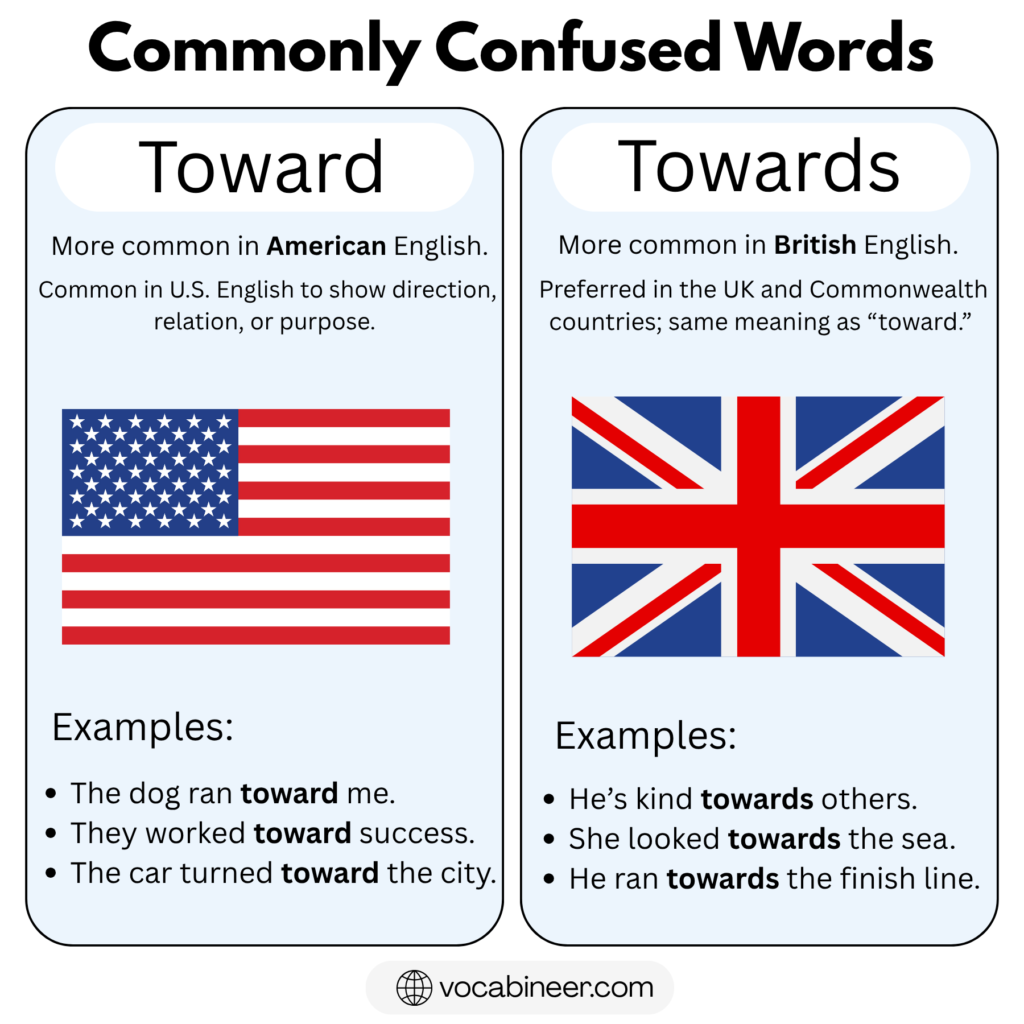
Toward is commonly used in American English.
Towards is more common in British English.
Toward vs Towards Difference in One Sentence
Toward is preferred in American English writing.
Towards is preferred in British English writing.
Why Toward and Towards Are Often Confused
Toward and towards are often confused because both are correct. Therefore, learners cannot rely on meaning to choose between them.
First, both words function as prepositions. So, they appear in the same sentence positions. Second, they have exactly the same meaning. As a result, context does not help you decide which one to use.
Moreover, books and websites mix American English and British English regularly. Consequently, students see both spellings and assume one must be wrong.
In addition, English has other word pairs that differ only by a final “-s,” such as:
- forward / forwards
- backward / backwards
- afterward / afterwards
Because of these patterns, learners often think the “-s” form changes meaning. However, in this case, the difference is mainly regional preference.
Word Origin and Etymology
The word “toward” comes from Old English tōweard, meaning “in the direction of.” Over time, the spelling evolved into “toward.”
Later, the form “towards” appeared with an added “-s,” which became common in British English.
During spelling standardization, American English began preferring shorter forms without the final “-s.” Therefore, “toward” became more common in the United States.
Meanwhile, British English continued using “towards” more frequently.
Today, both forms are historically valid. The choice depends largely on regional English usage rather than meaning.
Meaning of Toward
The meaning of toward is movement in the direction of something or showing an attitude, feeling, or action related to someone or something. It expresses direction, purpose, or relationship in a sentence.
For example, in “She walked toward the door,” it shows direction. In “He showed kindness toward his friend,” it shows attitude.
Definition of Toward
Toward is a preposition meaning “in the direction of,” “closer to,” or “with regard to.” It connects a noun or pronoun to show movement, purpose, or attitude.
Toward as Part of Speech
Toward functions as a preposition. It connects a noun or pronoun to the rest of the sentence.
As a direction:
- She walked toward the door.
- He moved toward the stage.
- The car turned toward the bridge.
- They ran toward the bus stop.
- The dog jumped toward its owner.
- He looked toward the sky.
- She stepped toward the window.
- The ship sailed toward the island.
- The child reached toward the toy.
- The crowd moved toward the exit.
As a reference or attitude:
- She showed kindness toward her friend.
- He has a positive attitude toward change.
- They worked hard toward their goal.
- The company moved toward improvement.
- He feels grateful toward his teacher.
- She contributed money toward the project.
- The team made progress toward success.
- He expressed respect toward his parents.
- They took steps toward solving the problem.
- She is friendly toward everyone.
Common Uses and Collocations of Toward
Toward appears in many common American English phrases.
- move toward
- walk toward
- look toward
- step toward
- progress toward
- work toward
- attitude toward
- contribution toward
- shift toward
- turn toward
These collocations show how frequently toward is used in American English writing and speech.
Meaning of Towards
The meaning of towards is movement in the direction of something or showing an attitude, feeling, or action related to someone or something. It expresses direction, purpose, or relationship in a sentence.
For example, in “She walked towards the door,” it shows direction. In “He showed kindness towards his friend,” it shows attitude.
Although towards ends with “-s,” it has the same meaning as “toward.” The difference is mainly regional spelling preference.
Definition of Towards
Towards is a preposition meaning “in the direction of,” “closer to,” or “with regard to.” It connects a noun or pronoun to show movement, purpose, or attitude.
Towards as Part of Speech
Towards functions as a preposition. It connects a noun or pronoun to the rest of the sentence.
As a direction:
- She walked towards the door.
- He moved towards the stage.
- The car turned towards the bridge.
- They ran towards the bus stop.
- The dog jumped towards its owner.
- He looked towards the sky.
- She stepped towards the window.
- The ship sailed towards the island.
- The child reached towards the toy.
- The crowd moved towards the exit.
As a reference or attitude:
- She showed kindness towards her friend.
- He has a positive attitude towards change.
- They worked hard towards their goal.
- The company moved towards improvement.
- He feels grateful towards his teacher.
- She contributed money towards the project.
- The team made progress towards success.
- He expressed respect towards his parents.
- They took steps towards solving the problem.
- She is friendly towards everyone.
Common Uses and Collocations of Towards
Towards appears in many common British English phrases.
- move towards
- walk towards
- look towards
- step towards
- progress towards
- work towards
- attitude towards
- contribution towards
- shift towards
- turn towards
These collocations show how widely towards is used in British English writing and everyday communication.
Toward vs Towards: Key Difference Explained
Toward and towards have the same meaning and grammar function. However, the difference depends mainly on regional English usage.
In American English, writers usually prefer toward. It follows the shorter form without the final “-s.” Therefore, it is more common in the United States.
In contrast, British English often prefers towards. This form includes the final “-s” and appears frequently in the United Kingdom and other regions that follow British spelling patterns.
Importantly, both forms are grammatically correct. The choice does not change the meaning of the sentence. Instead, it reflects American English spelling or British English spelling preference.
For professional writing, choose one version based on your audience and use it consistently.
Toward vs Towards: Difference in One Look
| Feature | Toward | Towards |
|---|---|---|
| English Variant | American English | British English |
| Spelling Pattern | No final “-s” | Includes final “-s” |
| Part of Speech | Preposition | Preposition |
| Meaning | Same | Same |
| Pronunciation | Same | Same |
| Example | She walked toward the door. | She walked towards the door. |
This table shows that the only real difference is spelling preference based on region, not meaning or grammar.
Toward vs Towards: Side by Side Sentence Contrast
Both spellings fit into the same sentence patterns. However, the spelling changes depending on regional English usage.
American English:
- She walked toward the door.
- He moved toward the stage.
- They ran toward the bus stop.
- The team worked toward success.
- He looked toward the sky.
- She stepped toward the window.
- The company shifted toward improvement.
- The child reached toward the toy.
British English:
- She walked towards the door.
- He moved towards the stage.
- They ran towards the bus stop.
- The team worked towards success.
- He looked towards the sky.
- She stepped towards the window.
- The company shifted towards improvement.
- The child reached towards the toy.
As you can see, the meaning remains the same. Only the spelling changes.
Toward vs Towards: Sentence Structure Comparison
Both words function as prepositions. Therefore, the sentence structure remains identical.
Basic structure:
Verb + toward/towards + noun
- She walked toward the park.
- She walked towards the park.
Expression of attitude:
Noun + toward/towards + noun
- His attitude toward change is positive.
- His attitude towards change is positive.
Expression of progress:
Verb + toward/towards + goal
- They worked toward their goal.
- They worked towards their goal.
So grammatically, both forms behave the same way. The difference appears only in American English spelling versus British English spelling.
When to Use Toward and Towards
Choosing between toward and towards depends on the type of English you are using.
If you are writing in American English, use toward. This shorter form is standard in the United States and appears in most American publications.
If you are writing in British English, use towards. This form with the final “-s” is more common in the United Kingdom and other regions that follow British spelling patterns.
Both forms are correct in standard English. However, you should not mix toward and towards in the same document unless you are explaining the difference.
Therefore, match the spelling to your target audience and remain consistent throughout your writing.
Context Based Usage Guide
Use this practical guide to choose the correct form.
For American audiences:
- Use toward
- Prefer shorter preposition forms
- Keep American spelling consistent
For British audiences:
- Use towards
- Use similar forms like forwards and backwards
- Stay consistent with British spelling
In academic writing:
- Follow the required style guide
- Avoid mixing regional variants
If targeting global readers:
- Choose one version at the beginning
- Keep the same form in headings and examples
During exams:
- Match the English variant mentioned in instructions
- Do not switch between American English and British English
So, the correct choice depends on regional usage, not meaning.
Grammar Difference Between Toward and Towards
Toward and towards follow the same grammar rules. The only difference is regional spelling.
Both words function as prepositions. They show direction, movement, purpose, or attitude. Their position in a sentence does not change between American English and British English.
Here is a clear comparison table:
| Grammar Feature | Toward (American English) | Towards (British English) |
|---|---|---|
| Part of Speech | Preposition | Preposition |
| Direction | She walked toward the door. | She walked towards the door. |
| Attitude | His attitude toward change is positive. | His attitude towards change is positive. |
| Progress | They worked toward success. | They worked towards success. |
| Meaning | Same | Same |
As shown above, grammar remains identical. Only the spelling reflects the regional English variant.
Pronunciation Difference Between Toward and Towards
There is no significant pronunciation difference between toward and towards.
Toward is pronounced:
/təˈwɔːrd/ or /tɔːrd/
Towards is pronounced:
/təˈwɔːrdz/ or /tɔːrdz/
In natural speech, the difference is very small. Therefore, the main distinction appears in writing rather than in spoken English.
Common Mistakes With Toward and Towards
Many learners make small mistakes when using toward and towards. However, most errors happen because of regional mixing.
One common mistake is switching between toward and towards in the same paragraph. This creates inconsistency in writing.
Another mistake is thinking that one form is grammatically wrong. In fact, both are correct. The difference depends only on American English spelling and British English spelling.
Some writers also confuse these words with similar forms like:
- forward / forwards
- backward / backwards
- afterward / afterwards
Additionally, students sometimes use American spelling in British exams or British spelling in American tests. Therefore, always follow the required English variant and remain consistent throughout your writing.
Final Summary
Toward vs towards shows a small but important spelling difference between American English and British English. Both words have the same meaning and function as prepositions that show direction, movement, purpose, or attitude.
However, toward is more common in American English, while towards is preferred in British English. The grammar and usage remain exactly the same.
FAQs
Both are correct. Toward is more common in American English, while towards is preferred in British English and other regions that follow UK spelling rules.
In the United States, the standard spelling is toward without the final “-s.” It appears in most American publications and academic writing.
In the United Kingdom, the preferred spelling is towards with the final “-s.” It follows British English spelling conventions.
No, both words have exactly the same meaning. They function as prepositions and show direction, movement, or attitude. The difference is only spelling.
The pronunciation difference is very small. Towards may include a slight “z” sound at the end, but both forms sound nearly identical in normal speech.
Read More
- Confusing Words in English
- American vs British Words
- Quiet vs Quite in English
- Theater vs Theatre in English
