

Many writers get confused between Traveled vs Travelled. Both words look almost identical. However, the spelling difference depends on regional spelling rules. In American English spelling, the single l rule is used, so it becomes traveled. In British English spelling, the double l rule applies, so it becomes travelled. Importantly, the meaning and pronunciation stay the same. So, this is not a grammar difference. Instead, it is a regional spelling variation. Therefore, choosing the correct form depends on your audience and writing style.
In This Page
Traveled vs Travelled: Quick Definition
Traveled is the American English past tense and past participle of “travel.”
Travelled is the British English past tense and past participle of “travel.”
Traveled vs Travelled Difference in One Sentence
In American English, the correct spelling is traveled with one “l.”
In British English, the correct spelling is travelled with two “l” letters.
Why Traveled and Travelled Are Often Confused
Many learners feel confused because both words sound exactly the same. There is no pronunciation difference at all. Instead, the confusion comes from spelling rules.
American English usually keeps a single “l” when adding -ed to verbs like travel, cancel, or model. However, British English often doubles the final “l” before adding -ed. As a result, writers see both forms online, in books, and in media.
Because both spellings are correct, people sometimes mix them in the same document. That creates inconsistency. Therefore, the key is not choosing which one is “right,” but choosing which one fits your audience.
Word Origin and Etymology
The word “travel” comes from the Old French word travail. Originally, it meant hard work or effort. Over time, its meaning changed to describe a journey from one place to another.
Later, as English developed differently in the United States and the United Kingdom, spelling rules began to vary. American English simplified many double letters. Meanwhile, British English kept traditional patterns. That is why we now have traveled in American English and travelled in British English.
Meaning of Traveled
In American English, traveled means someone went from one place to another in the past. It can also describe movement across a distance, such as news, sound, light, or goods moving from one location to another.
Definition of Traveled
Traveled is the American English past tense and past participle of the verb “travel.” It shows that a journey or movement happened earlier.
Traveled as Part of Speech
Traveled functions as:
• A past tense verb
• A past participle used with has, have, or had
• An adjective in phrases like well-traveled road
Common Uses and Collocations of Traveled
Common combinations include:
• traveled abroad
• traveled alone
• widely traveled
• well traveled
• traveled by car
• recently traveled
Example Sentences With Traveled
• She traveled to New York last summer.
• We traveled by car across the state.
• He traveled alone during the break.
• They traveled abroad for business.
• I traveled with my family in June.
• She has traveled to many cities.
• We have traveled together before.
• He traveled overnight by bus.
• The team traveled early in the morning.
• The news traveled quickly through town.
• I have traveled twice this year.
• It is a well-traveled highway.
Meaning of Travelled
In British English, travelled means someone went from one place to another in the past. It can also describe something that moved across a distance, such as a parcel, message, sound, or light.
Definition of Travelled
Travelled is the British English past tense and past participle of the verb “travel.” It shows that a journey or movement took place earlier.
Travelled as Part of Speech
Travelled functions as:
• A past tense verb
• A past participle used with has, have, or had
• An adjective in phrases like well-travelled route
Common Uses and Collocations of Travelled
Common combinations include:
• travelled abroad
• travelled alone
• widely travelled
• well travelled
• travelled by train
• recently travelled
Example Sentences With Travelled
• She travelled to London last winter.
• We travelled by train across England.
• He travelled alone during the holidays.
• They travelled abroad for work.
• I travelled with friends in July.
• She has travelled to many countries.
• We have travelled together before.
• He travelled overnight by coach.
• The parcel travelled by post.
• The news travelled quickly through the village.
• I have travelled twice this year.
• It is a well-travelled path.
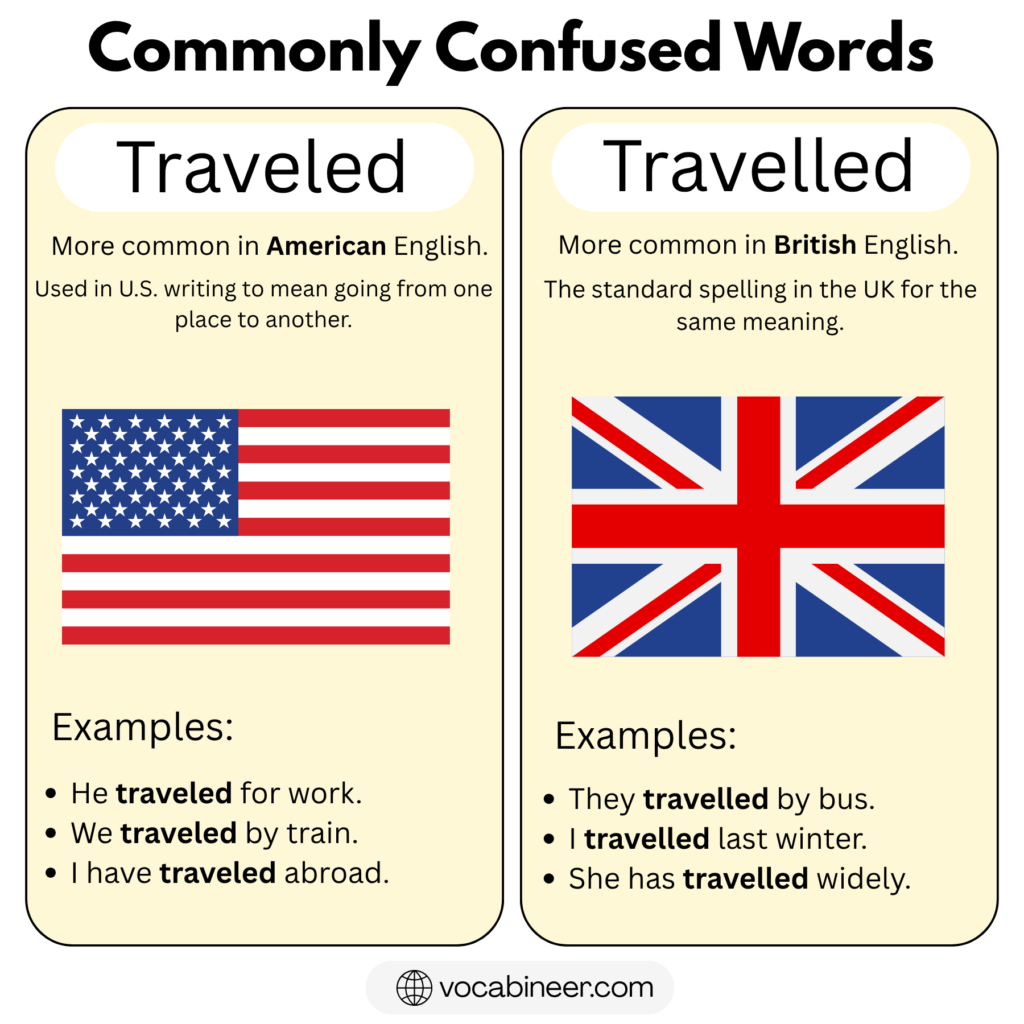
Traveled vs Travelled: Key Difference Explained
The difference between traveled and travelled is based on regional spelling rules. The meaning is exactly the same in both forms. However, the spelling changes depending on whether you follow American English or British English.
In American English, the single l rule is common. So, when adding -ed, the word becomes traveled. This style is used in the United States.
In British English, the double l rule is often applied when a verb ends in a vowel plus “l.” Therefore, the word becomes travelled. This spelling is used in the United Kingdom and many other countries that follow British English spelling.
Importantly, this is not a grammar difference. It is only a spelling difference. The pronunciation stays the same. The sentence structure also stays the same. So, the key rule is simple: match the spelling to your audience and remain consistent.
Traveled vs Travelled: Difference in One Look
| Feature | Traveled | Travelled |
|---|---|---|
| English Variety | American English spelling | British English spelling |
| L Rule | Single l rule | Double l rule |
| Meaning | Past form of travel | Past form of travel |
| Pronunciation | Same pronunciation | Same pronunciation |
| Grammar Role | Past tense / past participle | Past tense / past participle |
| Common Regions | United States | UK, Australia, Canada |
Traveled vs Travelled: Side by Side Sentence Contrast
Both spellings create the same meaning. However, the spelling changes based on region. The grammar and pronunciation stay exactly the same.
- I traveled to California last year.
- I travelled to California last year.
- She has traveled widely for work.
- She has travelled widely for work.
- We traveled by plane across the country.
- We travelled by plane across the country.
- He traveled alone during winter break.
- He travelled alone during winter break.
- The news traveled quickly through town.
- The news travelled quickly through town.
- They have traveled abroad before.
- They have travelled abroad before.
As shown above, the sentence meaning does not change. Only the spelling reflects American English spelling or British English spelling.
Traveled vs Travelled: Sentence Structure Comparison
Both words follow identical grammar patterns. Therefore, there is no structural difference.
Basic past tense pattern:
- Subject + traveled + place
- Subject + travelled + place
Examples:
- She traveled to Boston.
- She travelled to Boston.
Present perfect pattern:
- Subject + has/have + traveled
- Subject + has/have + travelled
Examples:
- They have traveled overseas.
- They have travelled overseas.
Adjective usage pattern:
- well-traveled road
- well-travelled road
As you can see, the grammar stays the same. Only the single l rule and double l rule create the spelling difference.
When to Use Traveled and Travelled
Choosing between traveled and travelled depends on your audience. The meaning does not change. However, the spelling must match the regional style you are following.
Use traveled if you are writing in American English. This includes content for the United States, American schools, companies, and publications.
Use travelled if you are writing in British English. This spelling is standard in the United Kingdom, Australia, and many other countries that follow British spelling rules.
Most importantly, stay consistent. Do not switch between single l and double l in the same article.
Here is a simple rule:
- American English spelling → traveled
- British English spelling → travelled
Context Based Usage Guide
If your audience is American:
- She traveled across the United States.
- The package traveled by air.
- We traveled during the summer break.
- He has traveled to many states.
If your audience is British:
- She travelled across England.
- The parcel travelled by post.
- We travelled during the summer holidays.
- He has travelled to many counties.
In formal academic writing, always check the required style guide. For example, American universities prefer the single l rule, while British institutions require the double l rule.
Grammar Difference Between Traveled and Travelled
Grammatically, there is no difference between traveled and travelled. Both forms act as the past tense and past participle of the verb “travel.” However, the spelling changes depending on regional rules.
In American English, the single l rule is applied when adding -ed. In British English, the double l rule is used more often after a vowel + l ending.
So, the grammar function stays the same. Only the spelling follows different conventions.
| Grammar Feature | Traveled | Travelled |
|---|---|---|
| Base Verb | Travel | Travel |
| Past Tense | Traveled | Travelled |
| Past Participle | Traveled | Travelled |
| Used With Has/Have/Had | Yes | Yes |
| Used as Adjective | Yes | Yes |
| Grammar Role | Same | Same |
As shown above, both words perform the same grammatical role in a sentence.
Pronunciation Difference Between Traveled and Travelled
There is no pronunciation difference between traveled and travelled.
Both are pronounced:
/ˈtræv.əld/
Even though the spelling changes, the sound remains exactly the same. Therefore, the difference is only visual, not spoken.
Common Mistakes With Traveled and Travelled
Many writers understand the spelling difference. However, they still make small mistakes. Most of these errors happen because people mix American English spelling and British English spelling in the same document.
Here are the most common mistakes:
- Mixing traveled and travelled in one article
- Using travelled in American academic writing
- Using traveled in British formal writing
- Forgetting the double l rule in British English
- Assuming the meaning is different
Another common mistake is switching spelling midway. For example:
- She traveled to London last year.
- Later, she travelled to Paris.
This creates inconsistency. Therefore, always choose one regional style and follow it throughout the text.
FAQs
Both are correct. “Traveled” follows American English spelling, while “travelled” follows British English spelling.
The United States uses traveled with one “l” because American English applies the single l rule.
The United Kingdom uses travelled with two “l” letters under the British double l rule.
No. They mean exactly the same thing. The difference is only regional spelling, not grammar or definition.
No. Both spellings are pronounced the same way. The difference is visible in writing, not in speech.
Final Summary
Traveled and travelled have the same meaning, pronunciation, and grammar function. The only difference is regional spelling. American English uses the single l rule, so it becomes traveled. British English follows the double l rule, so it becomes travelled. Therefore, always match the spelling to your audience. Most importantly, stay consistent throughout your writing to avoid confusion.
Read More
- Confusing Words in English
- American vs British Words
- Quiet vs Quite in English
- Toward vs Towards in English
