

Rocks are natural solid materials that make up the Earth’s surface and interior. They form through different natural processes over long periods of time. Rocks appear in many shapes, sizes, colors, and textures, and they can be found in mountains, riverbeds, deserts, oceans, and underground. Learning the types of rocks helps readers understand how the Earth changes and how natural materials develop.
Rocks are grouped based on how they form, what minerals they contain, and how their structure changes. These groupings make it easier to study their features, identify their origins, and understand geological processes. Knowing rock types also supports learning about landforms, soil formation, and natural resources.
In This Page
Main Types of Rocks
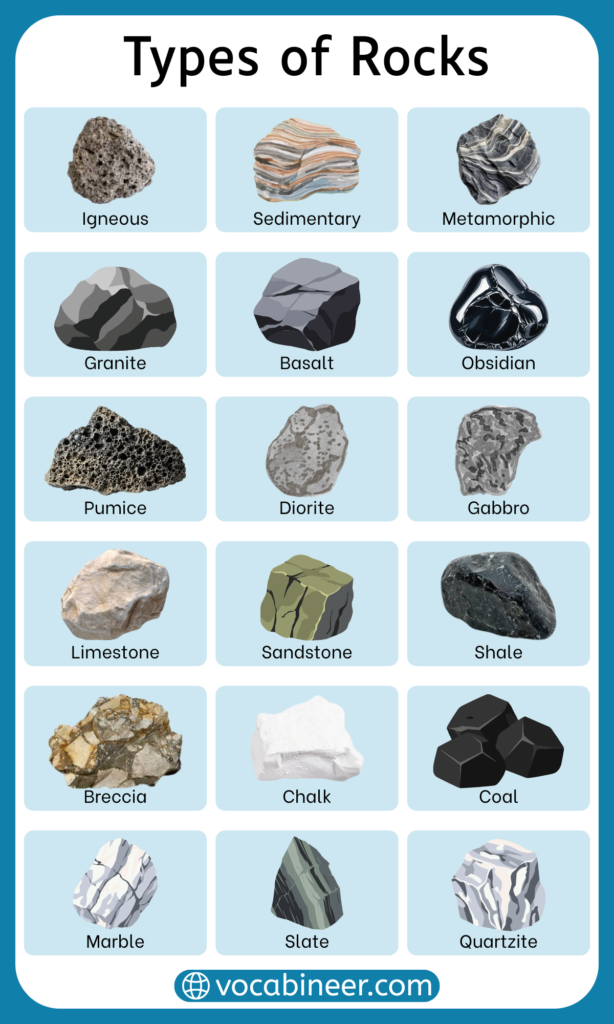
Rocks are mainly classified into three groups based on their formation process. Each group forms in a different way and shows unique physical characteristics. These three main types explain how heat, pressure, cooling, and surface activity shape the Earth’s crust over time.
The three main types of rocks are:
- Igneous rocks – Formed from cooled magma or lava
- Sedimentary rocks – Formed from layered sediments
- Metamorphic rocks – Formed when existing rocks change under heat and pressure
Igneous Rocks
Igneous rocks form when molten magma or lava cools and hardens. Rocks that cool slowly beneath the Earth develop large crystals, while rocks that cool quickly on the surface form small crystals. Igneous rocks are usually hard, strong, and resistant to weathering.
Common igneous rock names include:
- Granite: A coarse-grained rock formed deep underground, commonly used in buildings and kitchen countertops
- Basalt: A dark, fine-grained rock formed from lava, often found in volcanic regions and ocean floors
- Obsidian: A smooth, glassy rock formed from rapidly cooled lava, known for its sharp edges
- Pumice: A light, porous rock formed from gas-rich lava, often used in cleaning and polishing
- Diorite: A medium-grained rock with mixed light and dark minerals, commonly used in construction
- Gabbro: A dark, coarse-grained rock formed deep underground, similar in composition to basalt
- Rhyolite: A light-colored volcanic rock with fine crystals, often found near volcanoes
- Andesite: A medium-colored volcanic rock commonly found in mountain ranges
- Peridotite: A dense rock from deep inside the Earth, rich in green minerals
- Scoria: A rough, bubbly volcanic rock formed from gas-filled lava
Sedimentary Rocks
Sedimentary rocks form when small pieces of rock, sand, soil, shells, and organic material settle in layers over time. These layers become compacted and cemented together, slowly turning into solid rock. Sedimentary rocks often show visible layers and may contain fossils, making them important for studying Earth’s history.
Common sedimentary rock names include:
- Sandstone: A grainy rock formed from compacted sand, commonly used in building and paving
- Limestone: A light-colored rock made from shells and marine remains, often used in cement and construction
- Shale: A fine-grained rock formed from mud and clay, easily split into thin layers
- Conglomerate: A coarse rock made of rounded pebbles and stones cemented together
- Breccia: A rock similar to conglomerate but made of sharp-edged fragments
- Chalk: A soft, white limestone formed from tiny marine organisms
- Coal: A black rock formed from compressed plant remains, used as a fuel source
- Gypsum: A soft mineral rock used in making plaster and wallboard
- Rock salt: A crystalline rock formed from evaporated seawater, used for seasoning and preservation
- Siltstone: A fine-grained rock formed from compacted silt, smoother than sandstone
Metamorphic Rocks
Metamorphic rocks form when existing rocks change because of intense heat, pressure, or chemical reactions deep inside the Earth. These conditions alter the rock’s texture, mineral structure, and appearance without melting it completely. Metamorphic rocks often show banded patterns and increased hardness.
Common metamorphic rock names include:
- Marble: A hard rock formed from limestone, widely used in sculpture and building
- Slate: A fine-grained rock formed from shale, often used in roofing and flooring
- Gneiss: A banded rock formed from granite or sedimentary rocks, known for its layered appearance
- Schist: A shiny, flaky rock rich in mica, formed under strong pressure
- Quartzite: A very hard rock formed from sandstone, often used in construction
- Phyllite: A smooth rock formed between slate and schist stages
- Hornfels: A dense rock formed near magma chambers due to intense heat
- Amphibolite: A dark rock rich in amphibole minerals, formed from basalt
- Serpentinite: A greenish rock formed from mantle rocks, often smooth and waxy
- Mylonite: A fine-grained rock formed by extreme pressure along fault zones
How Different Types of Rocks Form
Rocks form through long natural processes involving heat, cooling, pressure, erosion, and deposition. These processes explain why rocks have different textures, colors, and structures. The continuous transformation of rocks is known as the rock cycle, which links all three main rock types.
Formation of Igneous Rocks
Igneous rocks form when molten magma or lava cools and solidifies.
- Slow cooling below the Earth: Produces large crystals such as in granite and gabbro
- Fast cooling on the surface: Produces small crystals such as in basalt and obsidian
Formation of Sedimentary Rocks
Sedimentary rocks form from compacted and cemented layers of sediment.
- Sand deposits: Form sandstone
- Mud and clay layers: Form shale
- Shell remains: Form limestone
- Plant material: Forms coal
Formation of Metamorphic Rocks
Metamorphic rocks form when heat and pressure change existing rocks.
- Limestone → Marble
- Shale → Slate
- Granite → Gneiss
- Sandstone → Quartzite
Properties of Different Types of Rocks
Rock properties describe how rocks look, feel, and behave under pressure. These characteristics help scientists and students identify rocks and understand how they formed. Important rock properties include hardness, texture, color, density, and layering.
Physical Properties of Rocks
- Hardness: Shows how resistant a rock is to scratching or breaking
- Texture: Describes the size, shape, and arrangement of mineral grains
- Color: Indicates mineral content and formation conditions
- Density: Measures how heavy a rock feels for its size
- Layering: Shows whether a rock forms in visible layers
- Crystal size: Reveals how quickly molten material cooled
- Surface pattern: Displays smooth, rough, shiny, or dull appearance
Property Differences by Rock Type
- Igneous rocks: Hard, crystalline, and usually not layered
- Sedimentary rocks: Layered, softer, and often fossil-bearing
- Metamorphic rocks: Banded, dense, and highly compacted
Uses of Different Types of Rocks
Rocks play an important role in everyday life. They are used in construction, decoration, industry, energy production, and tools. Different rock types serve different purposes based on their strength, appearance, and durability.
Uses of Igneous Rocks
- Granite: Used in buildings, bridges, monuments, and kitchen countertops
- Basalt: Used in road construction, railway tracks, and concrete
- Pumice: Used in cleaning products, polishing materials, and cosmetics
- Obsidian: Used in sharp tools, cutting instruments, and ornaments
Uses of Sedimentary Rocks
- Limestone: Used to make cement, concrete, and building stones
- Sandstone: Used in paving, walls, and decorative construction
- Coal: Used as a fuel source for electricity generation
- Rock salt: Used in cooking, food preservation, and road de-icing
- Gypsum: Used in plaster, wallboard, and cement production
Uses of Metamorphic Rocks
- Marble: Used in statues, flooring, tiles, and building decoration
- Slate: Used in roofing, writing boards, and floor tiles
- Quartzite: Used in construction and railway ballast
- Gneiss: Used in road stone and building projects
Rock Cycle and Rock Formation
The rock cycle explains how rocks continuously change from one type to another through natural processes. Heat, pressure, cooling, erosion, and deposition work together over long periods of time, reshaping rocks again and again. This cycle shows that rocks are not fixed but constantly transforming.
Main Stages of the Rock Cycle
- Magma formation: Molten rock forms deep inside the Earth due to intense heat
- Cooling and solidification: Magma or lava cools and becomes igneous rock
- Weathering: Rocks break down into smaller particles due to wind, water, and temperature changes
- Erosion and transportation: Rock particles move by rivers, wind, ice, and gravity
- Deposition: Sediments settle in layers on land or underwater
- Compaction and cementation: Sediments harden into sedimentary rock
- Heat and pressure: Existing rocks change into metamorphic rock
- Melting: Rocks melt again to form magma, restarting the cycle
Types of Rocks for Kids
Learning about rocks becomes easier and more interesting when explained in simple words and clear examples. Kids can understand rock types better through names, pictures, and short descriptions that connect with their everyday observations.
Easy Rock Types for Kids to Learn
- Granite: A hard rock used in buildings and kitchen slabs
- Basalt: A dark volcanic rock found near volcanoes
- Sandstone: A sandy-feeling rock made from tiny grains
- Limestone: A soft rock formed from sea shells
- Shale: A smooth rock that breaks into thin layers
- Marble: A shiny stone used in floors and statues
- Slate: A flat rock used in roofing and writing boards
- Pumice: A light rock that can float on water
- Chalk: A soft white rock used for writing and drawing
- Coal: A black rock used as fuel
Difference Between Rocks and Minerals
Rocks and minerals are closely related, but they are not the same. Minerals are natural substances with a fixed chemical composition, while rocks are mixtures of one or more minerals. Understanding this difference helps learners identify natural materials correctly.
Key Differences Between Rocks and Minerals
| Feature | Rocks | Minerals |
|---|---|---|
| Composition | Made of one or more minerals | Made of a single chemical substance |
| Structure | Mixed and varied | Uniform and ordered |
| Formation | Formed through geological processes | Formed naturally with crystal structure |
| Examples | Granite, limestone, marble | Quartz, gold, salt |
| Purpose | Used for construction and tools | Used for jewelry, industry, and science |
How to Identify Different Types of Rocks
Identifying rocks becomes easier when learners observe physical features such as texture, color, hardness, grain size, and layering. Simple observation and comparison help in recognizing the formation process and rock category.
Simple Steps to Identify Rocks
- Observe color: Light, dark, or mixed colors help indicate mineral composition
- Check texture: Smooth, rough, glassy, or grainy surfaces show formation differences
- Look for layers: Visible layers often indicate sedimentary rocks
- Test hardness: Hard rocks resist scratching, while softer rocks scratch easily
- Notice crystal size: Large crystals indicate slow cooling, small crystals indicate fast cooling
- Check weight and density: Heavy rocks feel denser than lighter ones of the same size
- Look for fossils or shells: These features usually appear in sedimentary rocks
Easy Rock Identification Tips
- Igneous rocks: Hard, crystalline, and non-layered
- Sedimentary rocks: Layered, softer, and sometimes fossil-containing
- Metamorphic rocks: Banded, shiny, and highly compacted
FAQs About Types of Rocks
The three main types of rocks are igneous, sedimentary, and metamorphic. Each type forms through different natural processes involving heat, pressure, cooling, and surface activity.
Igneous rocks form when molten magma or lava cools and solidifies. Slow cooling creates large crystals, while fast cooling forms fine-grained textures.
Sedimentary rocks form from compacted layers of sediments, while metamorphic rocks form when heat and pressure change existing rocks without melting them.
The rock cycle explains how rocks continuously change from one type to another, showing that Earth’s surface is always evolving through natural processes.
Students can identify rocks by observing color, texture, layering, hardness, and crystal size, along with simple comparison methods.
Conclusion
Rocks form the foundation of the Earth and play a vital role in shaping landscapes, natural resources, and daily life. Learning about the different types of rocks, their formation, properties, and uses helps readers understand natural processes and Earth’s structure more clearly. With clear explanations, examples, and visual learning, students and beginners can recognize rock types confidently and apply this knowledge in science learning and everyday observation.
Read More