

Ships are large watercraft built for transporting cargo, carrying passengers, supporting naval operations, fishing, research, and many other specialized tasks. Their size, hull shape, deck layout, and equipment often reveal what each vessel is designed to do.
Learning the types of ships in English helps students, travelers, and maritime learners build practical vocabulary and recognize different vessels more easily. This guide covers 50 ship and vessel types with pictures, including cargo ships, tankers, passenger vessels, naval ships, fishing vessels, working ships, historical sailing ships, and selected smaller watercraft.
In This Page
Common Ship Types and Their Uses
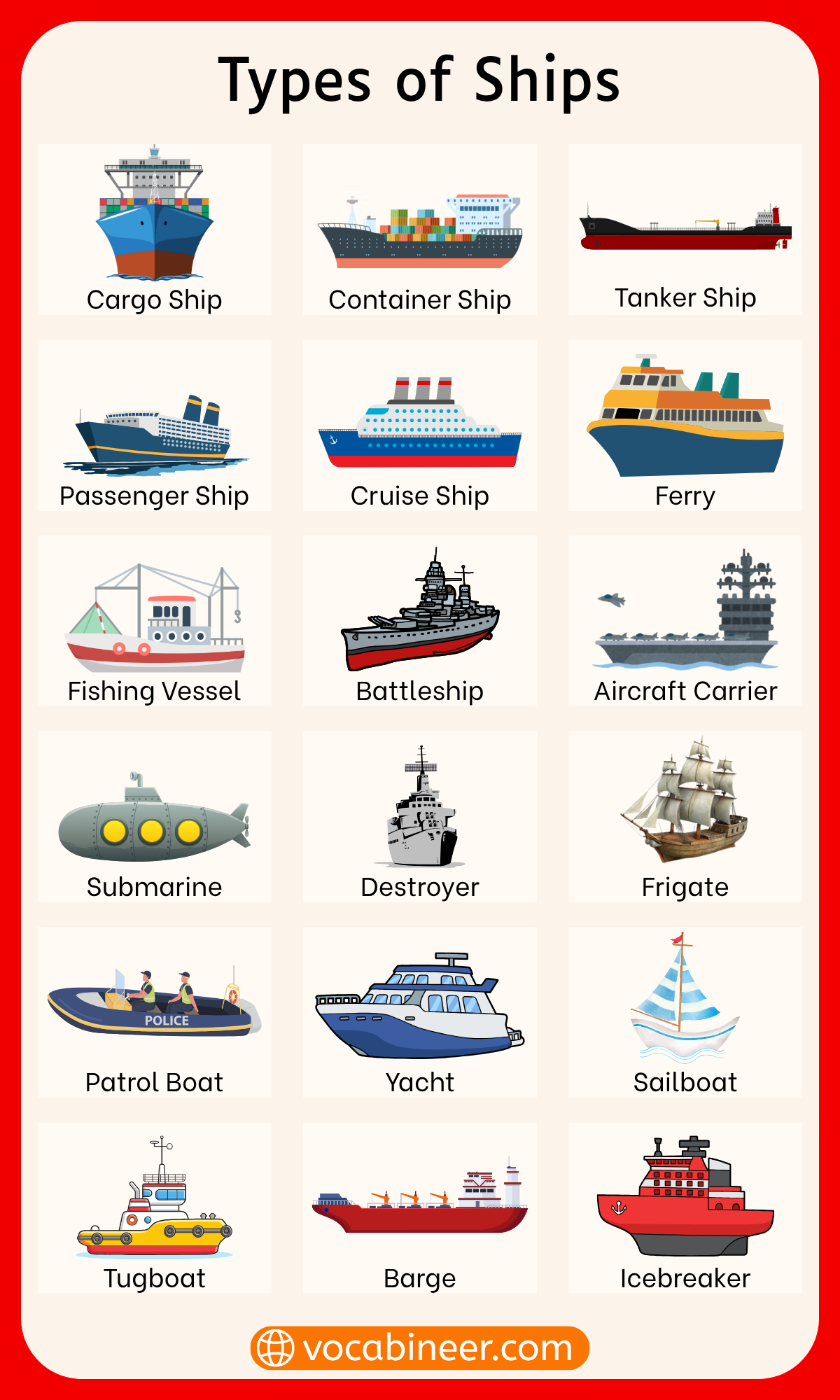
Some vessels are especially easy to recognize because their design closely matches their purpose. The following 20 types include many of the ships commonly seen in ports, shipping routes, naval fleets, and maritime photographs.
1. Container Ship
A container ship has large open decks stacked with standardized freight containers. It carries manufactured goods and other cargo between major ports.
2. Bulk Carrier
A bulk carrier has large cargo holds for unpackaged dry materials such as grain, coal, and ore. Its broad deck often includes several large hatch covers.
3. General Cargo Ship
A general cargo ship carries packaged, palletized, bagged, or mixed goods that do not require specialized container or tanker systems.
4. Oil Tanker
An oil tanker transports crude oil or refined petroleum products in large internal tanks. Its deck often has pipelines and relatively little tall cargo structure.
5. LNG Carrier
An LNG carrier transports liquefied natural gas at very low temperatures. Many are easy to recognize by their large insulated tanks or specialized containment systems.
6. Cruise Ship
A cruise ship carries passengers mainly for leisure travel. Its tall multi-deck structure often includes cabins, restaurants, entertainment areas, and open recreation decks.
7. Ferry
A ferry transports passengers, and sometimes vehicles, across regular routes between ports or shorelines.
8. Ocean Liner
An ocean liner is designed for scheduled long-distance passenger travel between major ports. Unlike most modern cruise ships, liners traditionally emphasize regular ocean crossings.
9. Ro-Ro Ship
A roll-on/roll-off ship carries wheeled cargo that can move on and off through ramps. Trucks, trailers, and vehicles are common cargo.
10. Vehicle Carrier
A vehicle carrier has several enclosed decks designed specifically for transporting cars and other vehicles. Many have tall, box-like hulls.
11. Aircraft Carrier
An aircraft carrier is a large naval vessel with a broad flight deck for operating military aircraft. Its flat upper deck makes it one of the easiest naval ship types to identify.
12. Destroyer
A destroyer is a modern naval surface ship used for fleet protection and other defense roles. These vessels usually have a long, streamlined hull and substantial radar and communications equipment.
13. Frigate
A frigate is a naval surface vessel commonly used for patrol, escort, and fleet-support roles. Classification varies between navies, but frigates are often smaller than destroyers.
14. Submarine
A submarine is a vessel designed to operate underwater as well as at the surface. Naval submarines commonly serve patrol, surveillance, deterrence, and other defense roles.
15. Trawler
A trawler is a fishing vessel associated with trawl nets. It usually has working deck space and equipment for handling fishing gear.
16. Tugboat
A tugboat is a compact but powerful vessel that helps move, turn, or position larger ships. Tugboats are especially common around ports and harbors.
17. Icebreaker
An icebreaker has a strengthened hull and specially shaped bow for operating through ice-covered waters and helping open routes for other vessels.
18. Research Vessel
A research vessel carries scientists, laboratories, and specialized equipment for studying oceans, marine life, weather, geology, or other subjects.
19. Dredger
A dredger removes sediment, sand, or other material from the bottoms of harbors, rivers, and waterways. Its specialized excavation equipment often makes it visually distinctive.
20. Cable-Laying Ship
A cable-laying ship carries and installs long underwater cables used for communications or electrical connections across the seabed.
Cargo Ships Used to Transport Goods
Cargo ships vary according to the material they carry. Some transport refrigerated goods, while others handle unusually heavy cargo, livestock, or more than one cargo type.
21. Reefer Ship
A reefer ship, or refrigerated cargo ship, carries temperature-sensitive goods such as fruit, meat, and other perishable products in refrigerated spaces.
22. Heavy-Lift Ship
A heavy-lift ship transports unusually large or heavy cargo that ordinary cargo vessels cannot handle easily. Its design may include powerful cranes or specialized loading arrangements.
23. Livestock Carrier
A livestock carrier transports live animals across sea routes. These ships include ventilation and compartment systems designed for animal transport.
24. Combination Carrier
A combination carrier is designed to carry more than one broad type of cargo, depending on its configuration and voyage requirements.
Tankers and Gas Carrier Types
Tankers and gas carriers transport liquid or liquefied cargo in specialized containment systems. Their tank design and cargo-handling equipment distinguish them from dry cargo ships.
25. Chemical Tanker
A chemical tanker carries liquid chemicals in separate tanks designed for different cargo requirements. Its internal tank arrangements can be more complex than those of a basic oil tanker.
26. LPG Carrier
An LPG carrier transports liquefied petroleum gases such as propane or butane in specialized tanks. Depending on the design, the tanks may appear as distinctive rounded or cylindrical structures.
Passenger Ships and Ferries
Passenger vessels range from large leisure ships to practical ferries that carry people and vehicles over shorter routes.
27. Ro-Pax Ferry
A Ro-Pax ferry combines roll-on/roll-off vehicle decks with passenger accommodation. Cars and trucks can board through ramps while travelers use separate passenger areas.
28. River Cruise Ship
A river cruise ship is built for passenger travel along rivers and inland waterways. Its lower profile helps it operate beneath bridges and within shallower waterways.
Cruise ships, ocean liners, and conventional ferries from the opening section complete the main passenger-vessel group.
Naval and Military Ship Types
Naval vessels are built for defense, patrol, transport, support, and other government maritime duties. Their names often describe broad roles rather than one universal size standard.
29. Corvette
A corvette is a relatively small naval surface combatant commonly associated with coastal patrol, escort, and general defense duties.
30. Patrol Vessel
A patrol vessel is used for maritime security, border protection, surveillance, and other coastal or offshore patrol duties.
31. Amphibious Assault Ship
An amphibious assault ship supports the transport of personnel, vehicles, aircraft, and landing craft for operations between sea and shore.
32. Minesweeper
A minesweeper is a specialized naval vessel designed for mine-countermeasure duties and keeping important sea routes safer for other ships.
33. Hospital Ship
A hospital ship is equipped to provide medical care at sea. Its internal spaces include treatment facilities rather than ordinary cargo or passenger accommodation.
Aircraft carriers, destroyers, frigates, and submarines from the first section are also major naval vessel types.
Common Fishing Vessel Types
Fishing vessels differ according to the method used to catch or process marine resources. Their decks often carry specialized nets, lines, storage systems, or handling equipment.
34. Longliner
A longliner uses long fishing lines fitted with multiple hooks. Its deck equipment supports the handling and storage of these lines.
35. Purse Seiner
A purse seiner uses a large surrounding net that can close around schools of fish. It often has prominent net-handling equipment on deck.
36. Crab Boat
A crab boat is designed for catching crabs using pots or traps. Its open working deck provides space for handling and storing fishing gear.
37. Factory Fishing Vessel
A factory fishing vessel combines fishing operations with onboard processing and storage facilities. As a result, it can prepare the catch before returning to port.
The trawler listed earlier is another important commercial fishing vessel.
Service and Working Ships
Working ships perform practical jobs rather than primarily carrying ordinary passengers or commercial cargo. Many are easy to identify because of their specialized deck equipment.
38. Fireboat
A fireboat carries powerful pumps and water monitors for fighting fires near ships, ports, and waterfront facilities.
39. Salvage Vessel
A salvage vessel supports recovery, towing, repair, or other assistance involving damaged or disabled vessels and marine property.
40. Pilot Boat
A pilot boat carries marine pilots between shore and ships. Pilots then assist with navigation through ports, channels, or other locally challenging waters.
Tugboats, icebreakers, research vessels, dredgers, and cable-laying ships from the opening section also belong to this broad working-vessel group.
Offshore and Support Vessels
Offshore vessels support activities away from ordinary ports and coastlines. They may carry supplies, equipment, technicians, or other personnel to offshore facilities.
41. Offshore Supply Vessel
An offshore supply vessel carries equipment, materials, and provisions between shore bases and offshore installations.
42. Crew Transfer Vessel
A crew transfer vessel carries workers between shore and offshore facilities. These vessels are generally designed for relatively fast personnel transport.
Historical Sailing Ships
Before powered ships became dominant, sailing vessels used different mast and sail arrangements for trade, exploration, naval service, and passenger transport.
43. Schooner
A schooner is a sailing vessel with two or more masts, traditionally associated with fore-and-aft sails on most masts.
44. Galleon
A galleon was a large sailing ship used particularly from the 16th to 18th centuries for trade and naval purposes.
45. Brigantine
A brigantine is a two-masted sailing vessel with a characteristic mixed sail arrangement. Its rig distinguishes it from other two-masted sailing craft.
46. Clipper
A clipper was a fast sailing ship built especially for speed during long-distance trade in the 19th century.
47. Barque
A barque is a multi-masted sailing vessel with a particular combination of square and fore-and-aft sails.
These historical names mainly describe sailing designs and rigging traditions rather than modern ship functions.
Smaller Boats and Recreational Watercraft
Not every maritime vessel is technically considered a ship. However, smaller boats and recreational craft are often learned alongside ship vocabulary because they appear in the same ports, marinas, and waterways.
48. Yacht
A yacht is a recreational vessel used for cruising, sailing, or leisure. Yachts vary greatly in size and may use sails, engines, or both.
49. Catamaran
A catamaran has two parallel hulls instead of one. This twin-hull design is used on recreational, passenger, sailing, and commercial craft.
50. Dinghy
A dinghy is a small boat used for rowing, sailing, recreation, training, or traveling between a larger vessel and the shore.
The main list stops here at exactly 50 distinct vessel types. Terms such as “ship,” “boat,” and “vessel” can overlap in everyday maritime language, so classification sometimes depends on size, purpose, design, and tradition.
How to Tell Similar Ship Types Apart
Some ship types look similar from a distance, but their cargo, hull form, deck arrangement, or main function usually provides a useful identification clue.
| Vessel Types | Main Difference |
|---|---|
| Ship vs Boat | A ship is generally larger and designed for broader commercial, passenger, naval, or specialized operations; a boat is usually smaller |
| Container Ship vs Bulk Carrier | Containers are stacked on deck and in holds; bulk carriers transport loose dry cargo in large holds |
| Oil Tanker vs LNG Carrier | Oil tankers carry petroleum liquids; LNG carriers transport liquefied natural gas in specialized containment systems |
| Cruise Ship vs Ocean Liner | Cruise ships focus mainly on leisure voyages; ocean liners traditionally focus on scheduled long-distance transport |
| Ferry vs Cruise Ship | Ferries mainly provide practical transport; cruise ships mainly provide leisure travel |
| Ro-Ro Ship vs Ro-Pax Ferry | Ro-Ro ships mainly transport wheeled cargo; Ro-Pax vessels combine vehicle decks with passenger accommodation |
| Destroyer vs Frigate | Both are naval surface ships; destroyers are often larger, although classifications differ between navies |
| Trawler vs Purse Seiner | A trawler uses a trawl net; a purse seiner surrounds fish with a closing net |
| Tugboat vs Cargo Ship | A tugboat assists other vessels; a cargo ship primarily transports goods |
| Yacht vs Catamaran | Yacht describes a recreational vessel by use, while catamaran describes a vessel with two hulls |
Other Names Used for Ships and Vessels
Maritime terminology often includes alternate names, abbreviations, and regional variations. Some describe exactly the same vessel type, while others overlap only in everyday speech.
A refrigerated cargo ship is commonly called a reefer ship. Likewise, roll-on/roll-off ship is usually shortened to Ro-Ro ship.
A vehicle carrier may also be called a car carrier, although some vehicle carriers transport more than passenger cars. Similarly, tug is a common shorter name for a tugboat.
The terms research ship and research vessel are often used for the same general category. Meanwhile, fishing boat and fishing vessel can overlap in everyday language, although “vessel” is broader and more formal.
People sometimes use cruise liner as another name for a cruise ship, but an ocean liner traditionally has a more specific role connected with scheduled long-distance transport.
Questions People Ask About Ship Types
Major groups include cargo ships, tankers, passenger ships, naval vessels, fishing vessels, service ships, offshore support vessels, and historical sailing ships. Smaller boats and recreational craft are also commonly studied alongside ship vocabulary.
A ship is generally larger and designed for more extensive transport, commercial, naval, or specialized operations, while a boat is usually smaller. However, maritime usage varies, so there is no single everyday rule that separates every boat from every ship.
A container ship carries standardized freight containers. These containers can be transferred between ships, trucks, and trains as part of global transportation networks.
A cruise ship is primarily designed for leisure voyages and onboard tourism. In contrast, an ocean liner traditionally carries passengers on scheduled long-distance routes between major ports.
Tugboats, dredgers, icebreakers, research vessels, cable-laying ships, fireboats, salvage vessels, and pilot boats all perform specialized maritime jobs rather than simply transporting ordinary cargo or passengers.
Read More
