

Trees grow in forests, gardens, farms, parks, mountains, deserts, and tropical regions around the world. They vary in leaf shape, bark, flowers, fruit, height, crown form, and the way they respond to different seasons.
Learning tree names in English with pictures makes plant and nature vocabulary easier to recognize and remember. This guide introduces familiar forest trees, fruit trees, evergreens, flowering trees, tropical species, timber trees, nut trees, and trees adapted to dry climates.
In This Page
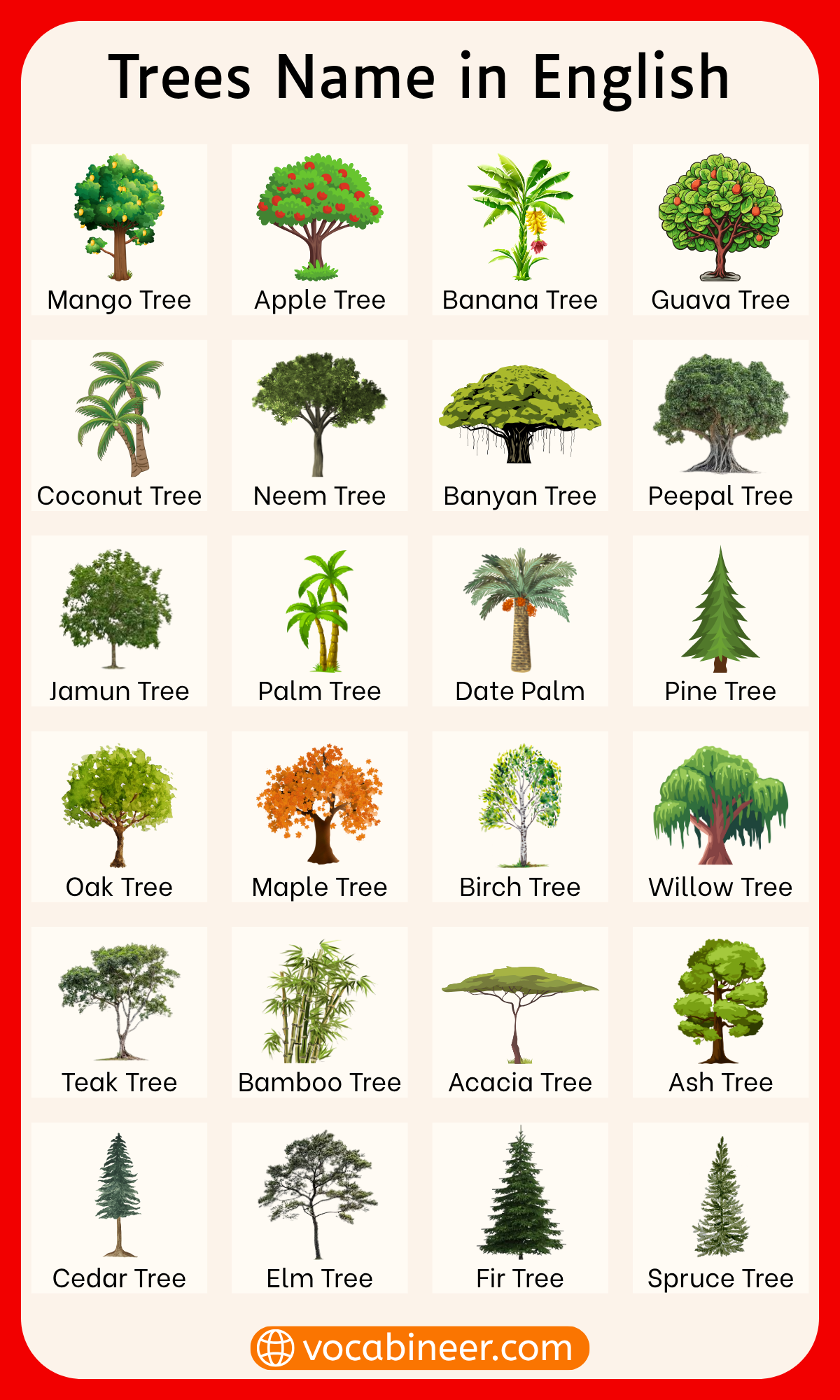
Common Trees and Their Names
Many familiar trees can be recognized by their leaves, bark, fruit, cones, or overall form. These common names provide a useful starting point for learning tree vocabulary.
Oak Tree
Oak trees are strong hardwood trees commonly recognized by their acorns and, in many species, lobed leaves.
Maple Tree
Maples are known for distinctive leaves and paired winged seeds. Many species develop bright autumn colors.
Pine Tree
Pines are evergreen conifers with needle-like leaves and woody cones.
Cedar Tree
Cedars are evergreen conifers known for aromatic wood and dense foliage.
Birch Tree
Birches often have pale bark that peels away in thin, papery layers.
Willow Tree
Willows commonly have narrow leaves and flexible branches. Some species form strongly drooping crowns.
Elm Tree
Elms are tall deciduous trees with toothed leaves and broad spreading crowns.
Ash Tree
Ash trees often have compound leaves made up of several leaflets and produce winged seeds.
Beech Tree
Beeches have smooth gray bark and broad leaves with clearly visible veins.
Spruce Tree
Spruces are evergreen conifers with short pointed needles and hanging cones.
Fir Tree
Fir trees have relatively flat needles and cones that usually stand upright on their branches.
Cypress Tree
Cypresses often have small scale-like leaves and narrow or column-shaped crowns.
Redwood Tree
Redwoods are exceptionally tall evergreen conifers with thick bark and narrow foliage.
Giant Sequoia
Giant sequoias are famous for their enormous trunks and massive overall size.
Poplar Tree
Poplars are fast-growing deciduous trees with straight trunks and light foliage.
Aspen Tree
Aspens have leaves that flutter easily in the wind because of their flattened leaf stalks.
Sycamore Tree
Sycamores are large deciduous trees known for broad leaves and mottled, peeling bark.
Chestnut Tree
Chestnut trees produce edible nuts enclosed in prickly outer husks.
Hickory Tree
Hickories have compound leaves and produce hard-shelled nuts.
Dogwood Tree
Dogwoods are small to medium trees known for attractive spring flowers or flower-like bracts.
Ginkgo Tree
Ginkgo is easily recognized by its unusual fan-shaped leaves.
Larch Tree
Larch is a conifer that sheds its soft needles seasonally instead of remaining evergreen.
Yew Tree
Yews have dark evergreen foliage and distinctive red fleshy seed coverings.
Alder Tree
Alders often grow in moist areas and produce small woody cone-like structures.
Hornbeam Tree
Hornbeams are deciduous hardwood trees with toothed leaves and characteristically ridged trunks.
Evergreen and Conifer Trees
Evergreen and conifer trees often have needles, scales, cones, or dense year-round foliage.
- Hemlock Tree has soft, flat needles and small hanging cones.
- Douglas Fir has soft needles and hanging cones with distinctive projecting bracts.
- Juniper Tree has needle-like or scale-like foliage and berry-like cones.
- Monkey Puzzle Tree has stiff, sharply pointed leaves arranged along thick branches.
- Norfolk Island Pine develops evenly spaced horizontal branches with a symmetrical shape.
- Kauri Tree is a large evergreen conifer with a massive straight trunk.
- Podocarpus Tree has narrow evergreen leaves and unusual fleshy seed structures.
- Rimu Tree is an evergreen conifer with drooping foliage.
- Totara Tree is a long-lived conifer with small stiff leaves and durable wood.
- Bunya Tree is a large evergreen conifer known for its broad crown and large cones.
Deciduous Trees
Deciduous trees shed most of their foliage during a particular season and often show noticeable seasonal changes.
- Sweetgum Tree has star-shaped leaves and round spiky seed balls.
- Plane Tree has broad leaves and mottled bark that peels in patches.
- Tulip Tree has unusual lobed leaves and green-yellow flowers.
- Catalpa Tree has very large heart-shaped leaves and long narrow seed pods.
- Paulownia Tree has very large heart-shaped leaves and pale purple flowers.
- Horse Chestnut Tree has large palmate leaves and shiny brown seeds.
- Linden Tree has heart-shaped leaves and fragrant pale flowers.
- Rowan Tree develops compound leaves and clusters of red or orange fruits.
- Hackberry Tree is a hardy tree with toothed leaves and small berry-like fruits.
- Sassafras Tree is notable for having several different leaf shapes on the same tree.
Fruit-Bearing Trees
Fruit trees are especially easy to recognize because their fruits provide strong visual clues.
- Mango Tree produces large sweet tropical fruits.
- Apple Tree produces familiar round fruits after spring blossoms.
- Pear Tree produces white flowers followed by pear-shaped fruits.
- Cherry Tree produces small round fruits and attractive blossoms.
- Peach Tree has pink flowers and soft-skinned stone fruits.
- Plum Tree produces rounded stone fruits.
- Apricot Tree bears orange-colored stone fruits.
- Orange Tree produces fragrant flowers and round orange citrus fruits.
- Lemon Tree produces yellow acidic citrus fruits.
- Guava Tree bears rounded tropical fruits and often has peeling bark.
- Jackfruit Tree produces very large fruits directly from trunks and major branches.
- Fig Tree has broad lobed leaves and soft distinctive fruits.
- Pomegranate Tree produces round fruits filled with juicy seeds.
- Mulberry Tree produces clusters of berry-like fruits.
- Persimmon Tree bears orange fruits that may remain after leaf fall.
- Avocado Tree produces large green fruits with one central seed.
- Lychee Tree produces clusters of rough-skinned red fruits.
- Tamarind Tree produces brown pods with tangy pulp.
- Jamun Tree produces dark purple fruits.
- Olive Tree has narrow gray-green leaves and small oval fruits.
Nut Trees
Nut trees are best known for the edible nuts or seeds they produce.
- Walnut Tree produces hard-shelled edible nuts.
- Almond Tree produces pale blossoms followed by fruits containing almond seeds.
- Pecan Tree produces elongated nuts and belongs to the hickory family.
- Pistachio Tree produces clusters of fruits containing edible seeds.
- Macadamia Tree produces round, very hard-shelled nuts.
- Hazelnut Tree produces round edible nuts inside leafy husks.
- Brazil Nut Tree is a huge rainforest tree that produces large woody fruits containing edible seeds.
Flowering and Ornamental Trees
Flowering trees are valued for colorful blossoms, attractive foliage, and decorative forms.
- Magnolia Tree produces large showy flowers.
- Jacaranda Tree develops purple or blue-violet flower clusters.
- Gulmohar Tree produces vivid red-orange flowers across a broad spreading crown.
- Bottlebrush Tree has cylindrical flower clusters resembling brushes.
- Kadamba Tree produces unusual round orange-yellow flower heads.
- Golden Shower Tree bears long hanging clusters of yellow flowers.
- Frangipani Tree produces fragrant flowers in several colors.
- Silk Floss Tree has a swollen trunk and large pink flowers.
- Crape Myrtle Tree produces abundant flower clusters and peeling bark.
- Tabebuia Tree produces trumpet-shaped pink, yellow, or white flowers.
Tropical and Warm-Climate Trees
These trees grow best in tropical or subtropical climates and often have unusual roots, fruits, bark, or timber.
- Neem Tree is a hardy evergreen or semi-evergreen with compound leaves.
- Banyan Tree is famous for aerial roots that may become supporting trunks.
- Peepal Tree has heart-shaped leaves with long pointed tips.
- Coconut Palm has a tall slender trunk and large feather-like fronds.
- Date Palm produces dense clusters of dates.
- Eucalyptus Tree often has aromatic leaves and peeling bark.
- Teak Tree has broad leaves and valuable durable timber.
- Mahogany Tree produces reddish-brown hardwood.
- Sandalwood Tree is valued for fragrant heartwood.
- Rosewood Tree includes tropical species with dense richly colored wood.
- Acacia Tree often has small leaflets and yellow or cream flowers.
- Baobab Tree is recognized by its enormous swollen trunk.
- Sal Tree is an important South Asian forest tree.
- Moringa Tree grows quickly and produces long seed pods.
- Rubber Tree produces latex used as a natural source of rubber.
Forest and Timber Trees
Many trees are valued for wood used in furniture, construction, flooring, tools, and other products.
- Teak produces durable tropical hardwood.
- Mahogany is known for attractive reddish-brown wood.
- Rosewood includes dense hardwood species with richly colored timber.
- Sal is an important South Asian forest tree.
- Oak produces strong hardwood used in many traditional applications.
- Cedar is known for durable aromatic wood.
- Pine provides widely used softwood.
- Eucalyptus includes fast-growing species cultivated for timber and pulp.
- Douglas Fir is an important coniferous timber tree.
- Rubber Tree can also provide plantation timber after latex production declines.
- Kapok Tree is a tall tropical tree known for its buttress roots and silky seed fibers.
Trees Adapted to Dry Climates
Dry-climate trees survive heat and limited rainfall through deep roots, small leaves, water storage, or other adaptations.
- Mesquite Tree is drought-tolerant and produces long seed pods.
- Desert Ironwood grows slowly and has extremely dense wood.
- Palo Verde Tree has green bark that can carry out photosynthesis.
- Khejri Tree is an important drought-tolerant tree of arid South Asia.
- Baobab Tree stores water in its swollen trunk.
- Acacia Tree includes many species adapted to dry landscapes.
Trees People Often Confuse
Some trees look similar because of their leaves, bark, cones, fruits, or growth forms.
| Trees | Main Difference |
|---|---|
| Pine vs Fir | Pine needles commonly grow in bundles, while fir needles attach individually |
| Fir vs Spruce | Fir needles are generally flatter and softer, while spruce needles are sharper |
| Oak vs Maple | Oaks produce acorns, while maples produce paired winged seeds |
| Cedar vs Cypress | Their foliage, cones, and branch forms differ |
| Redwood vs Giant Sequoia | Redwoods tend to grow taller, while giant sequoias develop more massive trunks |
| Banyan vs Peepal | Banyan develops aerial roots, while peepal has heart-shaped leaves with long tips |
| Coconut Palm vs Date Palm | Coconut palms produce coconuts, while date palms produce clusters of dates |
| Poplar vs Aspen | Aspen belongs to the poplar group and is known for trembling leaves |
| Pine vs Yew | Pines form woody cones, while yews produce red fleshy seed coverings |
| Spruce vs Hemlock | Spruce needles are sharper, while hemlock needles are flatter and softer |
Evergreen and Deciduous Trees Explained
Evergreen Trees
These trees retain functioning foliage throughout the year. Common examples include pine, fir, spruce, cedar, cypress, yew, neem, and many tropical species.
Deciduous Trees
Deciduous trees shed most of their leaves during a particular season. Maple, birch, elm, beech, ash, sweetgum, and many oak species belong to this group.
Larch is an important exception because it is a conifer that sheds its needles seasonally.
How to Recognize a Tree by Its Leaves, Bark, Fruit, and Shape
Different visible features help with tree identification:
- Leaves may be broad, needle-like, lobed, toothed, simple, compound, or heart-shaped.
- Bark may be smooth, ridged, papery, peeling, mottled, corky, or fibrous.
- Fruit and Nuts can provide strong clues, such as acorns, citrus fruits, pods, berries, or nuts.
- Flowers help identify ornamental and fruit trees.
- Cones and Seeds are useful for distinguishing conifers.
- Crown Shape may be spreading, narrow, pyramidal, drooping, or rounded.
- Trunk Form can be distinctive, as seen in baobab.
- Roots can also help, especially the aerial roots of banyan trees.
Common Tree Names and Their Scientific Names
| Common Tree Name | Scientific Name |
|---|---|
| Mango | Mangifera indica |
| Neem | Azadirachta indica |
| Banyan | Ficus benghalensis |
| Peepal | Ficus religiosa |
| Coconut Palm | Cocos nucifera |
| Date Palm | Phoenix dactylifera |
| Teak | Tectona grandis |
| Jamun | Syzygium cumini |
| Tamarind | Tamarindus indica |
| Jackfruit | Artocarpus heterophyllus |
| Olive | Olea europaea |
| Pomegranate | Punica granatum |
| Ginkgo | Ginkgo biloba |
| Baobab | Adansonia digitata |
| Rubber Tree | Hevea brasiliensis |
Broad names such as oak, pine, maple, eucalyptus, acacia, and rosewood include many species, so a single scientific name cannot accurately represent every tree with that common name.
Plants Commonly Called Trees but Botanically Are Not
Bamboo
Bamboo can become taller than many trees, but botanically it belongs to the grass family.
Banana Plant
People often say “banana tree,” but banana is a giant herbaceous plant with a pseudostem.
Papaya Plant
Papaya has a tree-like form but is a large herbaceous plant rather than a conventional woody tree.
These plants are not counted among the main tree names.
Questions People Ask About Trees
Common tree names include oak, maple, pine, cedar, birch, willow, mango, neem, banyan, apple, eucalyptus, and coconut palm.
Evergreen trees keep functioning foliage throughout the year, while deciduous trees shed most of their leaves during a particular season.
No. Larch is a well-known conifer that sheds its needles seasonally.
No. Bamboo belongs to the grass family even though it can grow very tall.
Look at several features together, including leaves, bark, flowers, fruit, cones, seeds, crown form, trunk, and roots.
Read More
