

Fragrant flowers are valued for the natural scents released by their blooms, ranging from soft and sweet to rich, creamy, fresh, or intensely floral. Learning common fragrant flower names helps students, gardeners, and vocabulary learners identify flowers known not only for their appearance but also for their noticeable fragrance.
This article presents common fragrant flower names with pictures, simple scent descriptions, and useful groups such as white fragrant flowers, strongly scented flowers, sweet-smelling flowers, night-fragrant flowers, and popular garden choices. It also explains a few common naming differences to keep the list clear and accurate.
In This Page
What Are Fragrant Flowers?
Fragrant flowers are flowers that release noticeable natural scents from their blooms. Their fragrance may be sweet, floral, creamy, fresh, spicy, citrus-like, or richly perfumed.
Fragrance can vary by species, cultivar, weather, growing conditions, and time of day, so flowers within the same group may differ in scent strength.
Fragrant Flower Names at a Glance
| Fragrant Flower | Simple Scent Description |
|---|---|
| Jasmine | Sweet, rich floral fragrance. |
| Gardenia | Strong creamy floral scent. |
| Rose | Classic floral fragrance that varies by variety. |
| Tuberose | Intense, sweet, rich fragrance. |
| Daphne | Strong, sweet floral perfume. |
| Lilac | Fresh, sweet floral scent. |
| Peony | Sweet fragrance that varies by cultivar. |
| Honeysuckle | Sweet, nectar-like scent. |
| Star Jasmine | Strong, sweet floral fragrance. |
| Magnolia | Rich floral scent, often creamy or citrus-like. |
| Sweet Pea | Delicate sweet floral perfume. |
| Hyacinth | Strong, fresh, sweet fragrance. |
| Lavender | Floral-herbal aromatic scent. |
| Freesia | Fresh, sweet, lightly citrus-like fragrance. |
| Plumeria | Sweet tropical floral scent. |
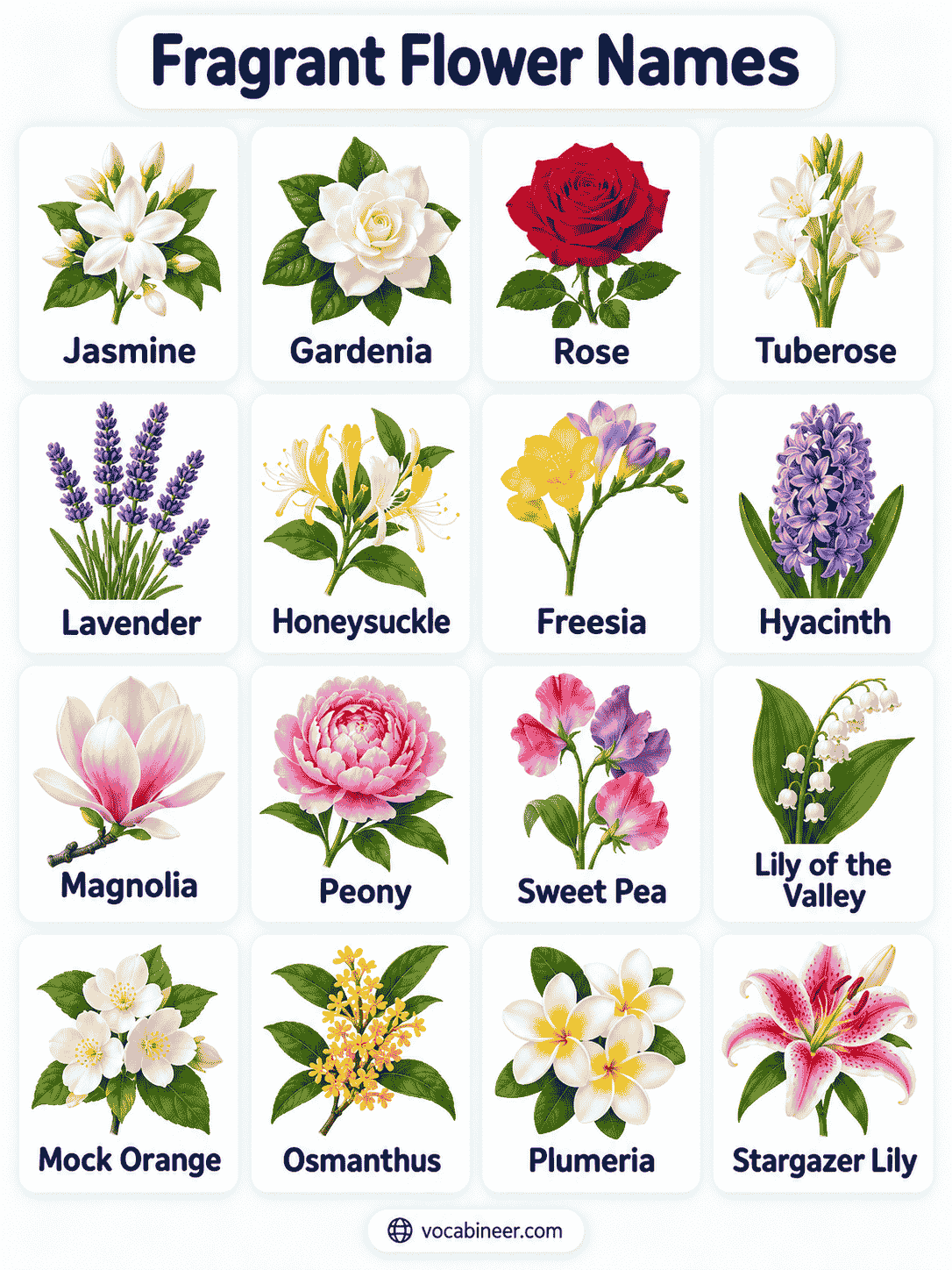
Common Fragrant Flower Names with Pictures
Fragrant flowers produce pleasant natural scents that can range from soft and sweet to rich and spicy. Learning common fragrant flower names helps children, gardeners, and English learners recognize familiar blooms and build useful flower vocabulary.
Rose
Roses produce a wide range of fragrances, from light and fresh to rich and sweet. Many garden varieties combine strong scent with colorful layered petals.
Jasmine
Jasmine produces small white or yellow flowers with a strong, sweet fragrance. Its scent often becomes especially noticeable in the evening.
Gardenia
Gardenias develop creamy white flowers with thick petals and a rich, sweet aroma. Their glossy green leaves make the fragrant blooms stand out clearly.
Lavender
Lavender grows narrow purple flower spikes with a clean, herbal fragrance. People often use its flowers in gardens, dried arrangements, and scented products.
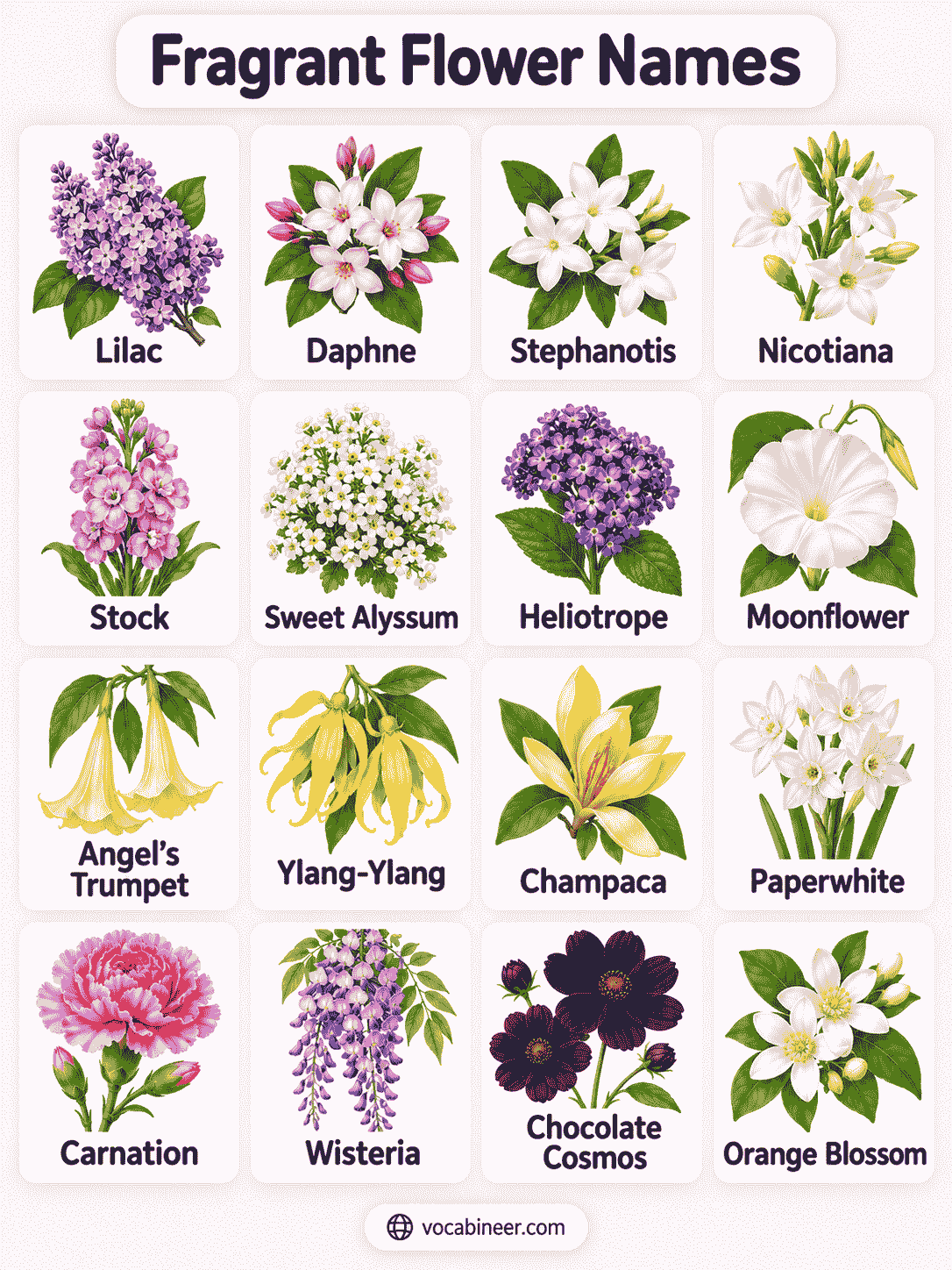
Lilac
Lilac shrubs produce clusters of small flowers with a soft, sweet fragrance. Purple, lavender, pink, and white varieties commonly bloom during spring.
Honeysuckle
Honeysuckle produces tubular flowers with a sweet scent that attracts bees, butterflies, and other pollinators. Many varieties grow as climbing vines or shrubs.
Freesia
Freesias produce slender stems covered with colorful funnel-shaped flowers. Their fragrance often combines sweet, citrus-like, and slightly spicy notes.
Hyacinth
Hyacinths develop dense spikes of small star-shaped flowers with a powerful sweet fragrance. They commonly bloom in shades of purple, blue, pink, white, and yellow.
Sweet Pea
Sweet peas produce delicate butterfly-like flowers with a soft, sweet scent. Their climbing stems and pastel colors make them popular in cottage gardens and bouquets.
Tuberose
Tuberose produces tall spikes of waxy white flowers with a deep, rich fragrance. Its strong scent makes it popular in perfumes and floral arrangements.
Magnolia
Magnolia trees and shrubs produce large flowers with a sweet, citrus-like, or creamy fragrance. Their broad petals appear in white, pink, purple, and yellow shades.
Plumeria
Plumeria produces fragrant five-petaled flowers with a sweet tropical scent. The blooms commonly appear in white, yellow, pink, and red combinations.
Orange Blossom
Orange blossoms are small white flowers produced by citrus trees. Their fresh, sweet fragrance carries noticeable citrus notes.
Lily of the Valley
Lily of the valley produces tiny white bell-shaped flowers with a strong, sweet fragrance. The plant grows close to the ground and commonly flowers in spring.
Daphne
Daphne shrubs produce small clusters of strongly scented flowers in pink, white, or purple shades. Their fragrance can become especially noticeable around garden paths and entrances.
Stock
Stock produces upright spikes of soft, colorful flowers with a sweet and slightly spicy fragrance. Gardeners often grow it in beds, borders, and cut-flower gardens.
Nicotiana
Flowering tobacco produces tubular flowers with a sweet fragrance that often becomes stronger in the evening. White, pink, red, and green varieties are common.
Heliotrope
Heliotrope produces clusters of small purple, blue, or white flowers with a sweet vanilla-like fragrance. Its compact growth suits garden beds and containers.
Sweet Alyssum
Sweet alyssum forms low-growing clusters of tiny white, pink, or purple flowers. The blooms release a mild honey-like fragrance.
Mock Orange
Mock orange shrubs produce clusters of white flowers with a sweet citrus-like scent. Their fragrance resembles orange blossoms, which explains the plant’s common name.
White Fragrant Flower Names
Many well-known fragrant flowers produce white or cream-colored blooms with noticeable natural scent.
Common examples include:
- Jasmine
- Gardenia
- Tuberose
- Star Jasmine
- Lily of the Valley
- Mock Orange
- Magnolia
- Sweet Alyssum
- White Rose
Pink and Purple Fragrant Flower Names
Pink and purple flowers include many popular scented varieties.
Common examples include:
- Rose
- Lilac
- Peony
- Sweet Pea
- Lavender
- Wisteria
- Daphne
- Heliotrope
Yellow Fragrant Flower Names
Several yellow flowers are also known for their fragrance.
Common examples include:
- Ylang-Ylang
- Yellow Rose
- Osmanthus
- some Magnolia varieties
- some Daphne varieties
Fragrance strength can vary among individual varieties.
Strongly Fragrant Flower Names
Some flowers are especially well known for noticeable or powerful fragrance.
Common examples include:
- Jasmine
- Gardenia
- Tuberose
- Daphne
- Star Jasmine
- Hyacinth
- Lilac
- Honeysuckle
These flowers are widely associated with strong scent, although fragrance intensity can vary by species or cultivar.
Sweet-Smelling Flower Names
Sweet-smelling flowers often produce soft, rich, or nectar-like fragrances.
Common examples include:
- Jasmine
- Gardenia
- Honeysuckle
- Sweet Pea
- Peony
- Plumeria
- Freesia
- Tuberose
- Lilac
These flowers are commonly recognized for pleasant floral scents rather than for one identical fragrance.
Night-Fragrant Flower Names
Some flowers release stronger fragrance during the evening or at night.
Common examples include:
- Night-Blooming Jasmine
- Tuberose
- Nicotiana
- Moonflower
- Evening Stock
- Honeysuckle
Night fragrance often becomes more noticeable after sunset.
Fragrant Flowers for Gardens
Fragrant garden flowers can add both color and noticeable scent to outdoor spaces.
Popular choices include:
- Rose
- Jasmine
- Daphne
- Lilac
- Peony
- Honeysuckle
- Lavender
- Sweet Pea
- Mock Orange
These flowers are often planted near paths, patios, entrances, and seating areas where their scent can be enjoyed.
Fragrant Flowers for Indoor Growing
Some fragrant flowering plants can also be grown indoors under suitable conditions.
Common examples include:
- Gardenia
- Jasmine
- Hyacinth
- Tuberose
- fragrant Orchids
- Hoya
The strength of indoor fragrance varies by species and growing conditions.
Fragrant Flower Names for Kids and Beginners
Children and beginner vocabulary learners can start with familiar and easy-to-recognize fragrant flowers.
- Rose
- Jasmine
- Gardenia
- Lavender
- Lilac
- Peony
- Honeysuckle
- Tuberose
- Magnolia
- Sweet Pea
These names are easy to connect with pictures and common flower vocabulary.
Most Popular Fragrant Flowers
Some fragrant flowers are especially well known because of their appearance, scent, and widespread use in gardens and floral displays.
Popular examples include:
- Rose
- Jasmine
- Gardenia
- Lavender
- Lilac
- Peony
- Honeysuckle
- Tuberose
Fragrance Can Vary Within the Same Flower Group
Not every flower within a broad group has the same fragrance strength.
For example:
- some roses have strong fragrance, while others have little scent
- some jasmine species are strongly fragrant, while others are mild or unscented
- some peonies have rich fragrance, while others are faintly scented
- some orchids are fragrant, while many have little noticeable scent
A common flower name therefore does not guarantee equal fragrance across every species or variety.
Jasmine Naming Confusion
Several plants use jasmine in their common names even though they do not all belong to the true jasmine group.
Examples include:
- Star Jasmine
- Cape Jasmine
- Madagascar Jasmine
- Chilean Jasmine
These names remain useful for vocabulary learning, but they should not automatically be treated as the same botanical group.
Gardenia and Cape Jasmine
Gardenia is also commonly called Cape Jasmine, but it is not a true jasmine.
The two names should not normally be counted as separate flowers in a general fragrant flower list.
Star Jasmine vs Jasmine
Jasmine and Star Jasmine are both fragrant, but they belong to different plant groups.
| Jasmine | Star Jasmine |
|---|---|
| belongs to the Jasminum group | belongs to a different botanical group |
| many species produce strong fragrance | also known for sweet fragrance |
| true jasmine | common name includes jasmine |
Their similar common names do not make them the same plant.
Fragrant Flowers vs Scented Foliage Plants
A fragrant flower list should focus mainly on flowers whose blooms provide the noticeable scent.
Plants known mainly for fragrant leaves or stems belong more naturally under aromatic or scented foliage plants.
This distinction keeps a Fragrant Flower Names article focused on flower vocabulary.
Common Fragrant Flower Naming Mistakes
Treating every Rose as strongly fragrant
Rose fragrance varies widely among varieties.
Treating every Jasmine as fragrant
Some jasmine species have strong fragrance, while others are mild or unscented.
Counting Gardenia and Cape Jasmine separately
Cape Jasmine is another common name for Gardenia.
Treating Star Jasmine as true Jasmine
Star Jasmine belongs to a different botanical group.
Adding flowers known mainly for appearance
A fragrant flower list should prioritize flowers genuinely known for scent.
Mixing fragrant foliage with fragrant flowers
Plants valued mainly for scented leaves should not replace flowers whose blooms provide the fragrance.
Counting color variants as separate flower names
White Rose, Pink Rose, and Yellow Rose are color forms rather than completely different flower names.
Overstating fragrance notes
Scent descriptions should remain broad unless a specific variety is known for a particular fragrance.
FAQs
Common fragrant flower names include Jasmine, Gardenia, Rose, Tuberose, Daphne, Lilac, Peony, Honeysuckle, Magnolia, Sweet Pea, Lavender, and Plumeria.
Gardenia, Jasmine, Tuberose, Daphne, Star Jasmine, Hyacinth, Lilac, and Honeysuckle are widely known for noticeable fragrance, although scent strength varies by variety.
Popular white fragrant flowers include Jasmine, Gardenia, Tuberose, Star Jasmine, Lily of the Valley, Mock Orange, Magnolia, and Sweet Alyssum.
Night-Blooming Jasmine, Tuberose, Nicotiana, Moonflower, Evening Stock, and some Honeysuckle species can become especially fragrant in the evening or at night.
Cape Jasmine is a common name for Gardenia, but Gardenia is not a true member of the jasmine genus.
Read More