

Learning flower names in English helps students, kids, and ESL learners speak about plants, gardens, gifts, seasons, and nature with more confidence. In everyday life, people see flowers in homes, parks, weddings, festivals, bouquets, and school lessons. As a result, knowing their names builds vocabulary, improves speaking skills, and makes it easier to describe the natural world clearly.
In this guide, you will learn 101 flower names in English in a simple and organized way. In addition, you will find common flowers, seasonal flowers, color-based groups, symbolic meanings, botanical names, and easy comparison tips. Because of this structure, you can learn the names more quickly and remember them more easily.
In This Page
101 Flower Names in English Master List
Below is a complete master list of 101 flower names in English. Overall, this list includes classic flowers, seasonal blooms, garden flowers, tropical flowers, and wildflowers.
- Rose
- Lily
- Tulip
- Sunflower
- Daisy
- Orchid
- Marigold
- Jasmine
- Lotus
- Hibiscus
- Lavender
- Carnation
- Daffodil
- Peony
- Chrysanthemum
- Magnolia
- Poppy
- Camellia
- Violet
- Gardenia
- Iris
- Petunia
- Geranium
- Begonia
- Zinnia
- Anemone
- Aster
- Bluebell
- Buttercup
- Cherry Blossom
- Cosmos
- Cyclamen
- Dandelion
- Goldenrod
- Hellebore
- Hyacinth
- Impatiens
- Plumeria
- Snapdragon
- Yarrow
- Bougainvillea
- Bird of Paradise
- Frangipani
- Heliconia
- Black-Eyed Susan
- Snowdrop
- Sedum
- Pansy
- Winter Jasmine
- Morning Glory
- Foxglove
- Gladiolus
- Dahlia
- Azalea
- Rhododendron
- Freesia
- Sweet Pea
- Water Lily
- Ranunculus
- Primrose
- Verbena
- Nasturtium
- Bleeding Heart
- Coneflower
- Delphinium
- Hollyhock
- Lupine
- Tuberose
- Amaryllis
- Crocus
- Narcissus
- Oleander
- Periwinkle
- Calendula
- Clematis
- Coreopsis
- Fuchsia
- Heather
- Larkspur
- Mimosa
- Phlox
- Protea
- Quince Blossom
- Salvia
- Scabiosa
- Statice
- Stock
- Sweet William
- Verbascum
- Wisteria
- Yucca Flower
- Zephyr Lily
- Milkweed
- Evening Primrose
- Bachelor’s Button
- Queen Anne’s Lace
- Indian Paintbrush
- Moonflower
- Nicotiana
- Bellflower
- Forget-Me-Not
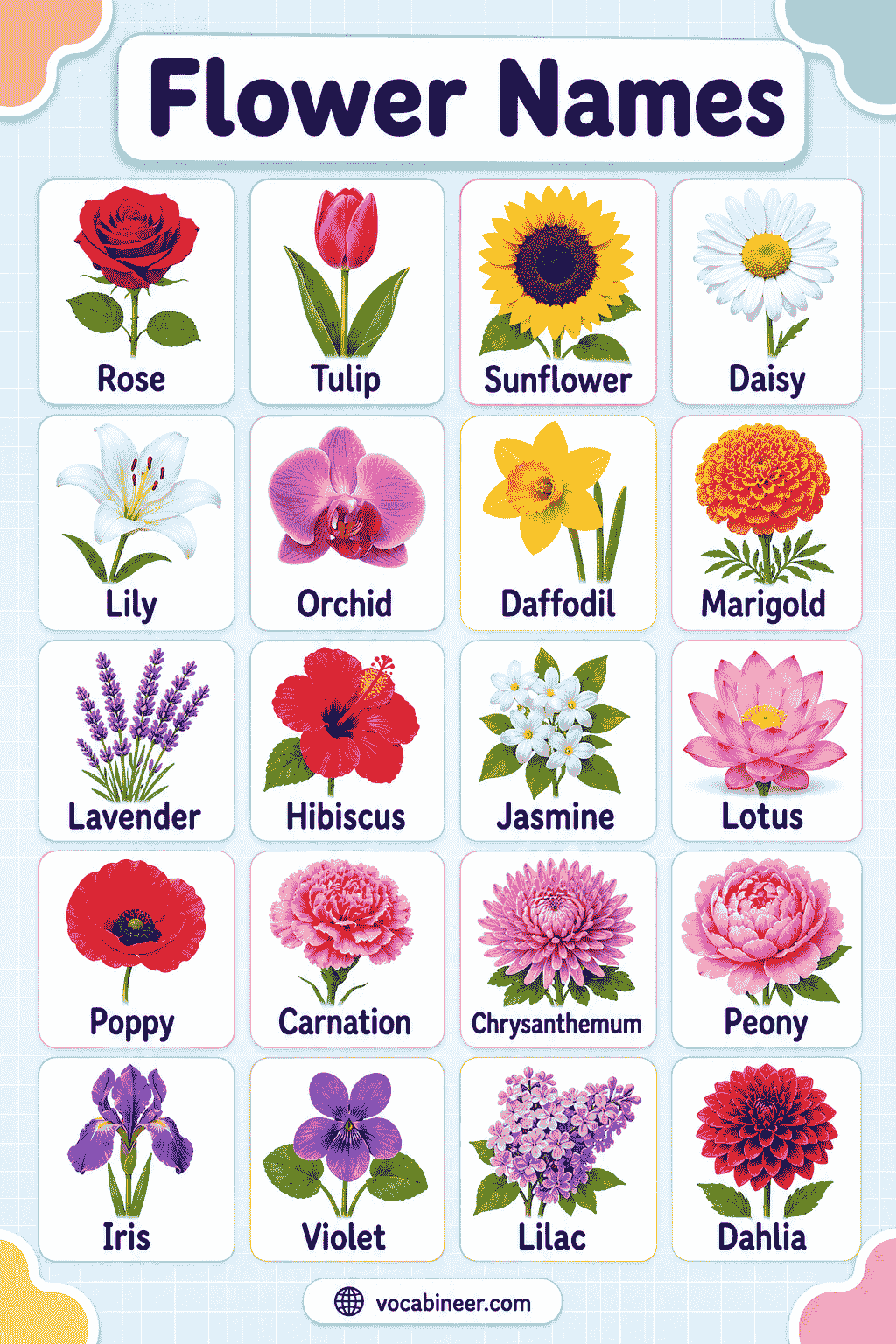
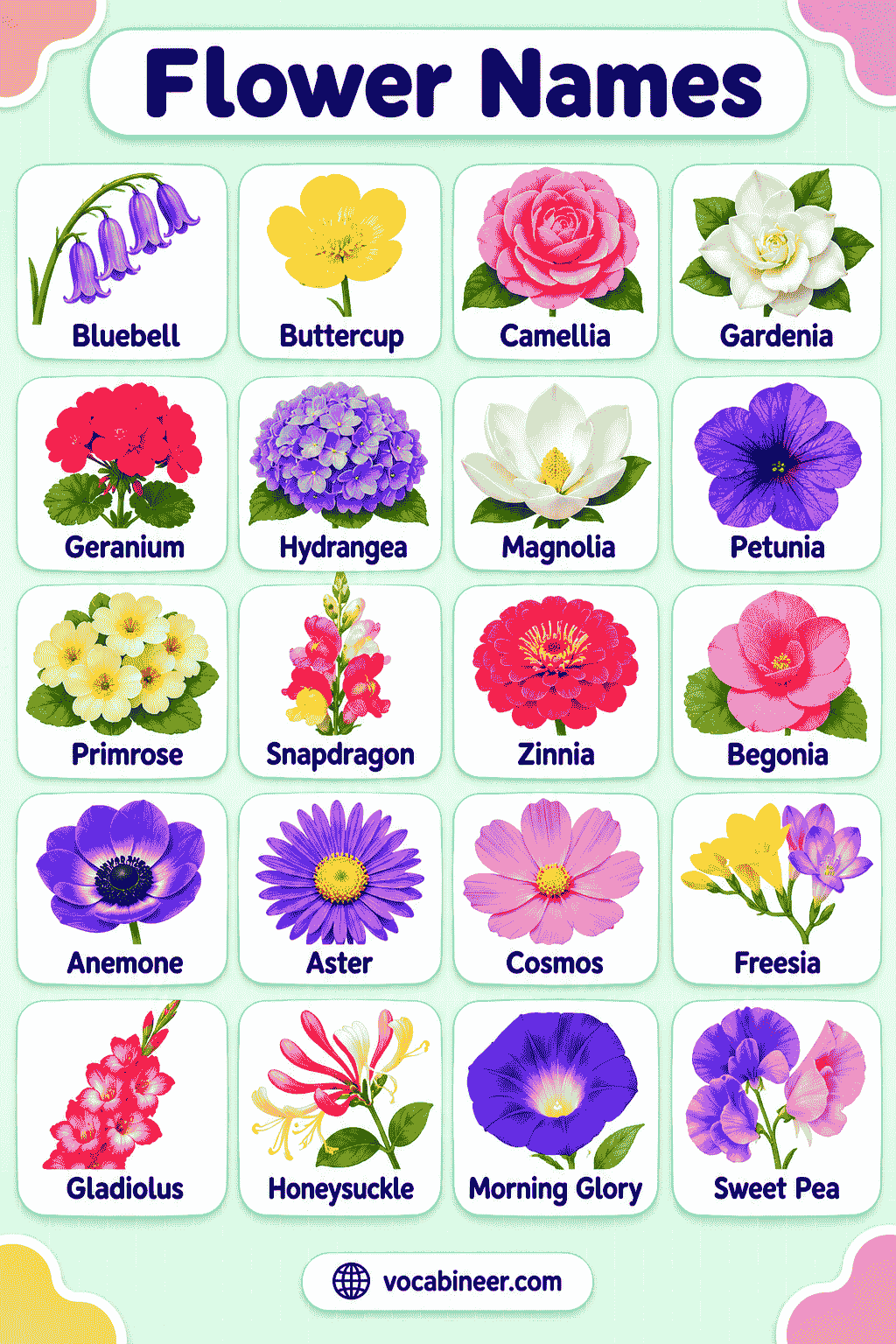
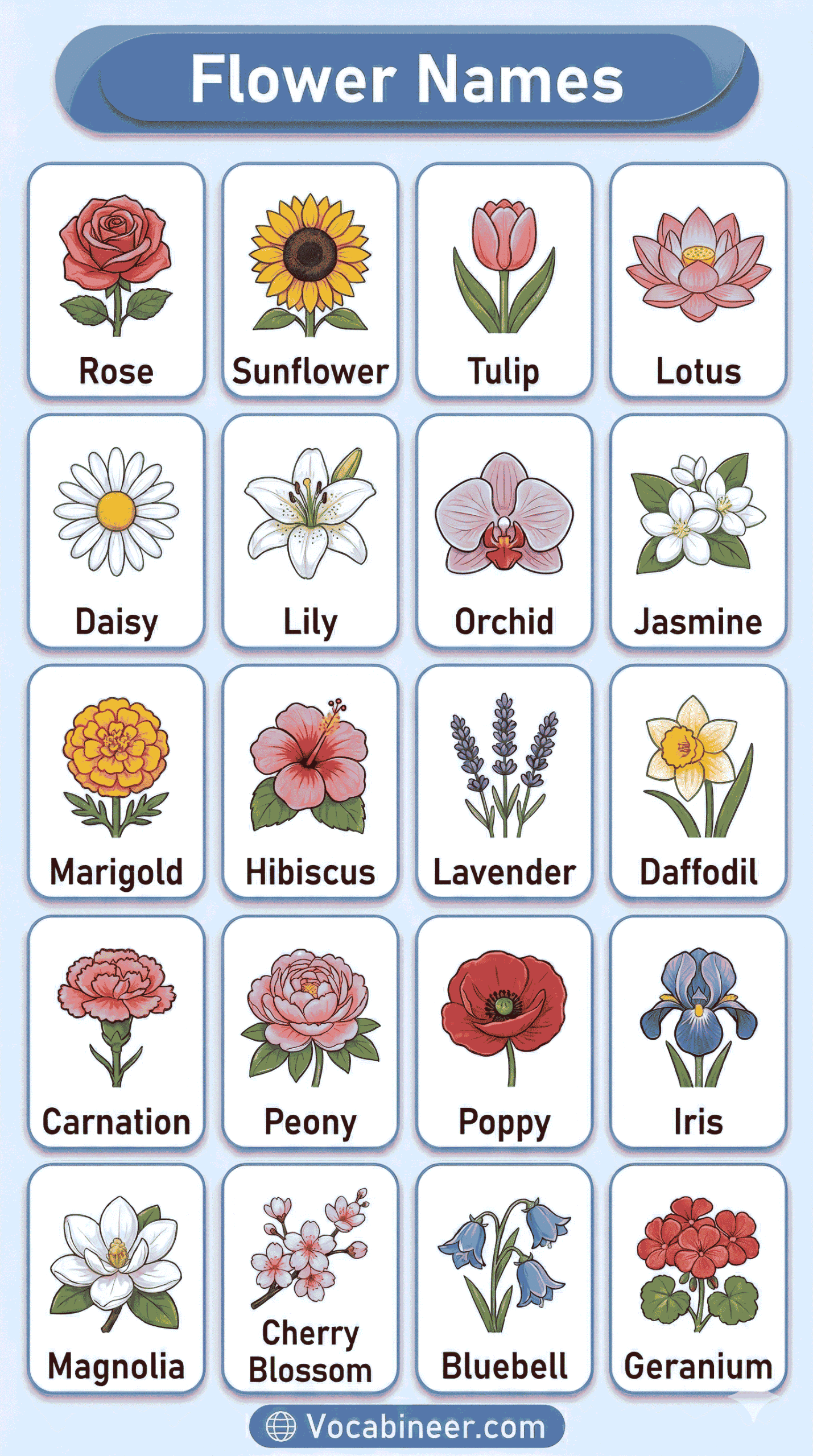
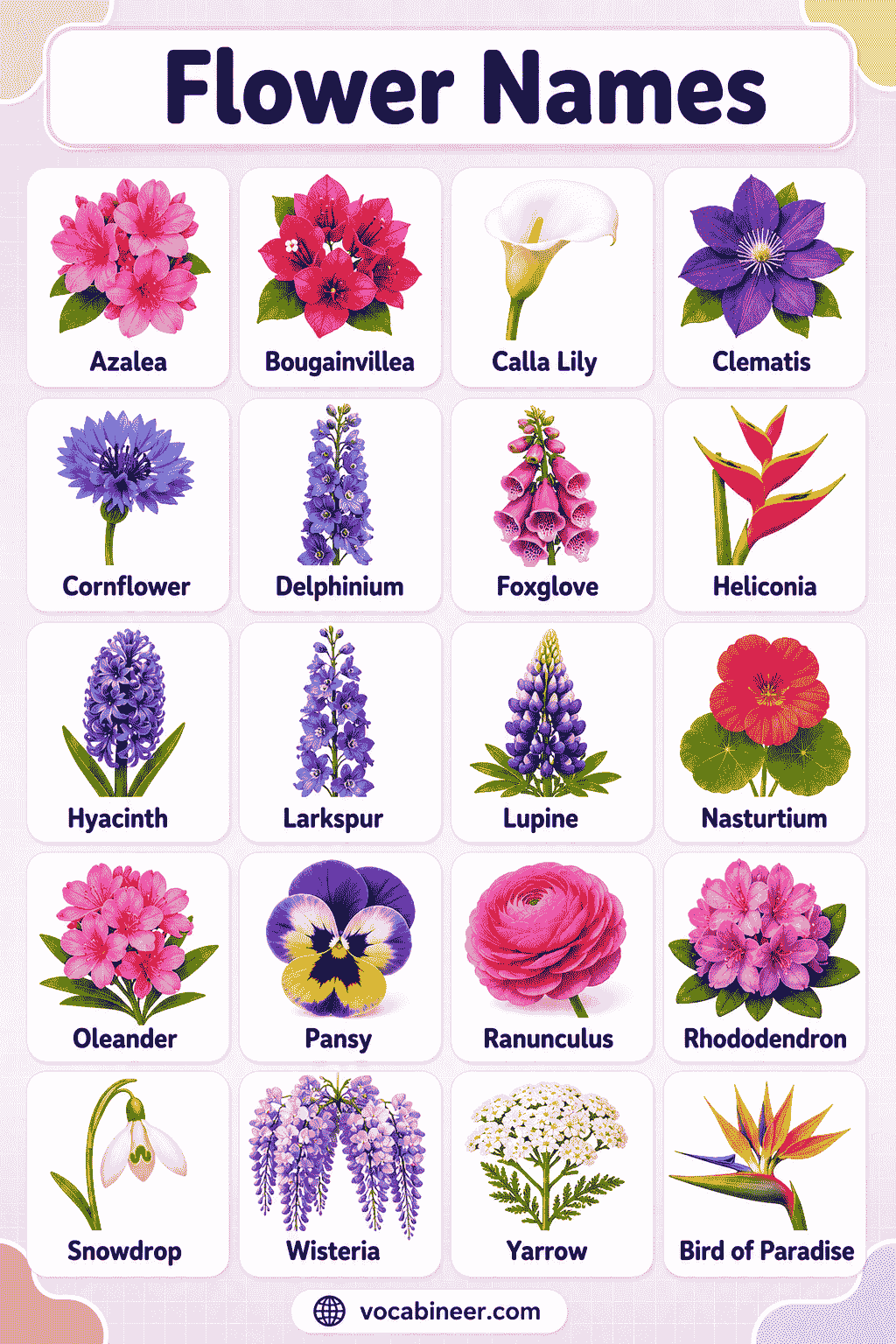
Most Common Flower Names with Pictures
These are some of the most common flower names learners should know first. Because they appear so often in gardens, bouquets, decorations, and daily conversation, they give readers a strong vocabulary foundation.
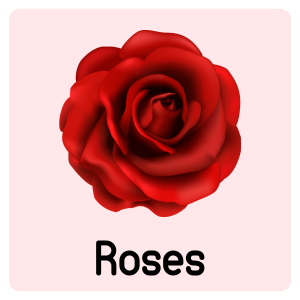
- Rose — A classic flower known for its beauty and fragrance. It usually symbolizes love and is often used in bouquets and gifts.
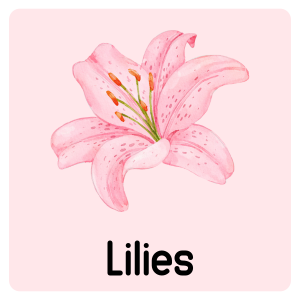
- Lily — A graceful flower with large petals. It is commonly associated with purity, peace, and elegance.
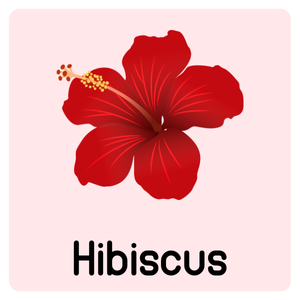
- Hibiscus — A tropical flower with large colorful petals. It is known for its bold appearance and warm-climate beauty.
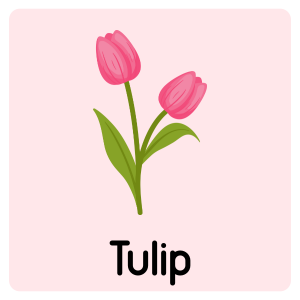
- Tulip — A bright spring flower with a cup-shaped bloom. It often represents happiness, warmth, and freshness.
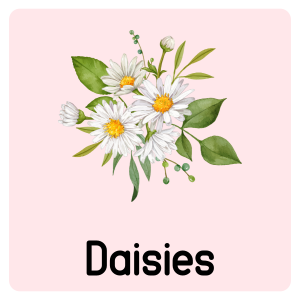
- Daisy — A simple flower with white petals and a yellow center. It often symbolizes innocence and new beginnings.
- Sunflower — A tall flower with yellow petals and a dark center. It is linked with joy, positivity, and sunlight.

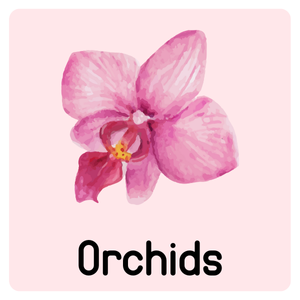
- Orchid — An exotic flower admired for its elegant shape and beauty. It is commonly used as a decorative flower.
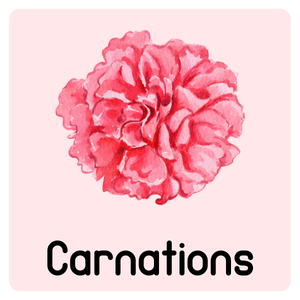
- Carnation — A flower with soft, ruffled petals that is often used in bouquets. It commonly symbolizes admiration and affection.
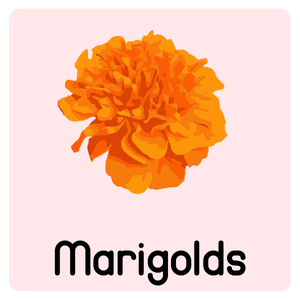
- Marigold — A bright yellow or orange flower often used in festivals and gardens. It is associated with energy and celebration.
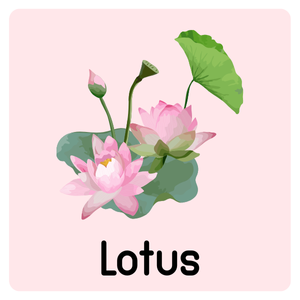
- Lotus — A flower that grows in water and is often seen in cultural and spiritual settings. It symbolizes purity and rebirth.
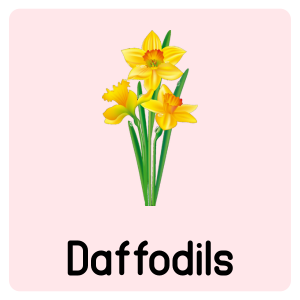
- Daffodil — A spring flower that blooms early in the year. It is linked with hope, renewal, and fresh beginnings.
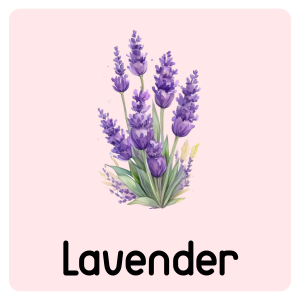
- Lavender — A purple flower valued for its fragrance. It is associated with peace, calmness, and relaxation.
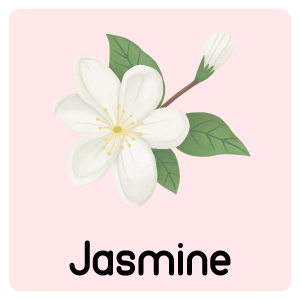
- Jasmine — A small white flower known for its sweet fragrance. It is often connected with purity and calmness.
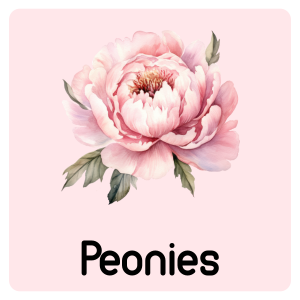
- Peony — A large, full flower with many layers of petals. It often symbolizes romance, prosperity, and beauty.
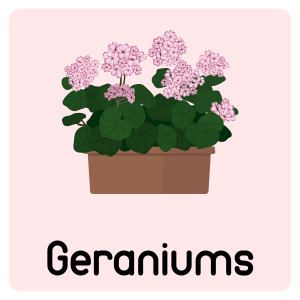
- Geranium — A cheerful garden flower with clustered blooms. It is common in homes and outdoor planters.
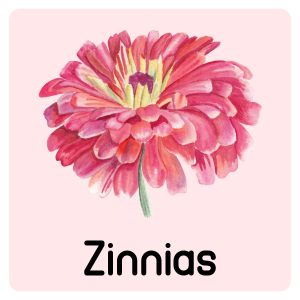
- Zinnia — A bright flower with layered petals and bold colors. It is often linked with endurance and friendship.
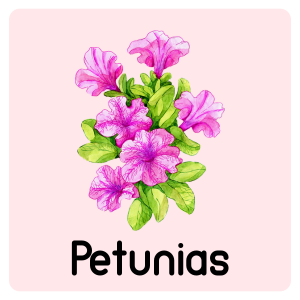
- Petunia — A trumpet-shaped garden flower found in many colors. It is popular in flower beds and hanging baskets.
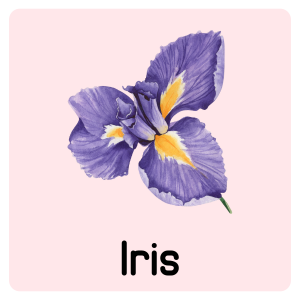
- Iris — A colorful flower with a distinct petal shape. It often symbolizes wisdom, hope, and courage.
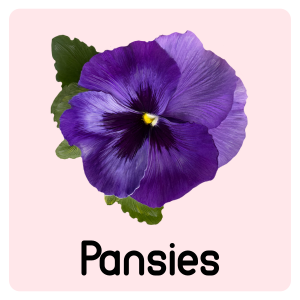
- Pansy — A small, colorful flower with soft petals and dark face-like markings. It grows well in cool weather and is popular in gardens and flower beds.
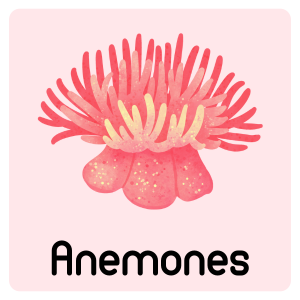
- Anemone — A bright, delicate flower with soft petals and a dark center. It blooms in many colors and is often seen in gardens and spring arrangements.
Flower Names by Category
Grouping flowers by category helps learners connect names with places, seasons, and natural settings. As a result, vocabulary becomes easier to organize and remember.
Garden Flower Names
Garden flowers are commonly grown in homes, parks, and school gardens. They are easy to recognize and often used to decorate outdoor spaces.
- Petunia
- Geranium
- Begonia
- Zinnia
- Snapdragon
- Pansy
- Impatiens
- Marigold
- Salvia
- Dahlia
Wildflower Names
Wildflowers grow naturally in fields, forests, and roadsides without being planted. They are an important part of natural landscapes.
- Bluebell
- Buttercup
- Poppy
- Dandelion
- Aster
- Yarrow
- Black-Eyed Susan
- Queen Anne’s Lace
- Indian Paintbrush
- Coneflower
Tropical Flower Names
Tropical flowers grow in warm climates and are known for bold colors, striking shapes, and lush beauty.
- Hibiscus
- Orchid
- Plumeria
- Bird of Paradise
- Bougainvillea
- Heliconia
- Frangipani
- Tuberose
- Yucca Flower
- Protea
Spring Flower Names
Spring flowers bloom after winter and are often linked with freshness, color, and new beginnings.
- Tulip
- Daffodil
- Hyacinth
- Cherry Blossom
- Iris
- Crocus
- Primrose
- Narcissus
- Anemone
- Ranunculus
Summer Flower Names
Summer flowers thrive in strong sunlight and warm weather. They are often bright, bold, and long-lasting.
- Sunflower
- Zinnia
- Cosmos
- Marigold
- Geranium
- Lavender
- Dahlia
- Coreopsis
- Verbena
- Hollyhock
Autumn Flower Names
Autumn flowers bloom later in the year and often appear in rich, warm colors.
- Chrysanthemum
- Goldenrod
- Sedum
- Aster
- Pansy
- Calendula
- Scabiosa
- Stock
- Sweet William
- Dahlia
Winter Flower Names
Winter flowers bring color to colder months and show that some plants can bloom even in cool weather.
- Camellia
- Hellebore
- Winter Jasmine
- Snowdrop
- Cyclamen
- Primrose
- Violet
- Heather
- Magnolia
- Narcissus

Flower Names by Color
Learning flower names by color helps visual learners remember vocabulary more naturally. In other words, color creates a strong mental link.
Red Flower Names
- Rose
- Poppy
- Camellia
- Dahlia
- Tulip
Pink Flower Names
- Peony
- Carnation
- Begonia
- Azalea
- Camellia
Yellow Flower Names
- Sunflower
- Marigold
- Daffodil
- Buttercup
- Coreopsis
White Flower Names
- Lily
- Jasmine
- Snowdrop
- Gardenia
- Magnolia
Purple Flower Names
- Lavender
- Violet
- Iris
- Petunia
- Lupine
Blue Flower Names
- Bluebell
- Delphinium
- Periwinkle
- Bachelor’s Button
- Iris
Orange Flower Names
- Marigold
- Calendula
- Bird of Paradise
- Nasturtium
- Zinnia
Flower Meanings and Symbolism
Flowers often carry symbolic meanings. Because symbolism adds emotion and context, it also helps learners remember names more easily.
Love and Romance
- Rose
- Peony
- Tulip
- Carnation
Friendship and Warmth
- Zinnia
- Geranium
- Yellow Rose
- Sweet Pea
Peace and Calm
- Lily
- Lavender
- Jasmine
- White Poppy
Hope and New Beginnings
- Daffodil
- Snowdrop
- Sunflower
- Primrose
Purity and Innocence
- Lotus
- Lily
- Jasmine
- Gardenia
Flowers for Remembrance
- Poppy
- Chrysanthemum
- Forget-Me-Not
Common Flowers with Their Botanical Names
Botanical names help identify flowers clearly across languages and regions. Therefore, they are especially useful in gardening, science, and education.
- Rose — Rosa
- Lily — Lilium
- Tulip — Tulipa
- Sunflower — Helianthus annuus
- Daisy — Bellis perennis
- Marigold — Tagetes
- Jasmine — Jasminum
- Lotus — Nelumbo nucifera
- Hibiscus — Hibiscus rosa-sinensis
- Lavender — Lavandula
- Carnation — Dianthus caryophyllus
- Daffodil — Narcissus
- Peony — Paeonia
- Magnolia — Magnolia
- Poppy — Papaver
- Camellia — Camellia
- Violet — Viola
- Gardenia — Gardenia jasminoides
- Iris — Iris
- Petunia — Petunia
How to Identify Common Flowers
Some flowers look similar at first glance. However, when you compare petals, size, fragrance, and growing habits, identification becomes easier.
| Flower Pair | Key Differences | Simple Tip |
|---|---|---|
| Rose vs Peony | Rose: More defined bloom shape with tighter layers. Peony: Fuller, softer, and more rounded with many layered petals. | Roses look structured, while peonies look fluffier and more abundant. |
| Lily vs Lotus | Lily: Often has pointed petals and grows on stems or in water, depending on the type. Lotus: Grows in water and is known for round leaves and an upright bloom. | If the flower rises from a pond with broad round leaves nearby, it is more likely a lotus. |
| Daisy vs Aster | Daisy: Usually has fewer, broader petals and a classic yellow center. Aster: Often has more slender petals and comes in purple, pink, or white shades. | Daisies look simpler and more open, while asters look denser and finer. |
| Jasmine vs Gardenia | Jasmine: Smaller and more delicate with a soft fragrance. Gardenia: Larger, waxier, and has a richer scent. | If the bloom looks thick and creamy, it is more likely a gardenia. |
Flower Names from A to Z
Learning flower names in alphabetical order is a simple and effective way to review vocabulary. As a result, students, kids, and ESL learners can find and remember names more confidently.
A to E Flower Names
- A — Anemone, Aster, Azalea, Amaryllis
- B — Begonia, Bluebell, Bellflower, Buttercup, Bachelor’s Button, Bougainvillea, Bird of Paradise, Bleeding Heart, Black-Eyed Susan
- C — Camellia, Carnation, Chrysanthemum, Clematis, Calendula, Cherry Blossom, Coneflower, Coreopsis, Cosmos, Crocus, Cyclamen
- D — Daisy, Daffodil, Dahlia, Dandelion, Delphinium
- E — Evening Primrose
F to J Flower Names
- F — Foxglove, Freesia, Frangipani, Fuchsia, Forget-Me-Not
- G — Gardenia, Geranium, Gladiolus, Goldenrod
- H — Hibiscus, Heather, Heliconia, Hellebore, Hollyhock, Hyacinth
- I — Impatiens, Indian Paintbrush, Iris
- J — Jasmine
K to O Flower Names
- K — No common flower from this list
- L — Lily, Lavender, Lotus, Lupine, Larkspur
- M — Magnolia, Marigold, Mimosa, Milkweed, Moonflower, Morning Glory
- N — Narcissus, Nasturtium, Nicotiana
- O — Orchid, Oleander
P to T Flower Names
- P — Pansy, Peony, Petunia, Phlox, Plumeria, Poppy, Primrose, Periwinkle, Protea
- Q — Quince Blossom
- R — Rose, Ranunculus, Rhododendron
- S — Sunflower, Snapdragon, Snowdrop, Salvia, Scabiosa, Sedum, Statice, Stock, Sweet Pea, Sweet William
- T — Tulip, Tuberose
U to Z Flower Names
- U — No common flower from this list
- V — Violet, Verbena, Verbascum
- W — Water Lily, Winter Jasmine, Wisteria
- X — No common flower from this list
- Y — Yarrow, Yucca Flower
- Z — Zinnia, Zephyr Lily
Conclusion
Flower names in English are beautiful, useful, and easy to learn when they are presented in a clear and organized way. From familiar flowers like rose, lily, and sunflower to tropical, seasonal, and wild varieties, each one adds meaningful vocabulary to everyday English.
When students and ESL learners study flower names through categories, colors, meanings, and botanical names, they can improve memory, build confidence, and talk about nature more naturally. As a result, flower vocabulary becomes valuable not only for language learning, but also for school projects, gardening, and daily life.
FAQs
Some of the most common flower names in English are rose, lily, tulip, sunflower, daisy, orchid, marigold, and jasmine.
The easiest way is to learn flower names in groups, such as by color, season, or type. Pictures, short descriptions, and regular practice also help.
The rose is often called the queen of flowers because of its beauty, fragrance, and strong connection with love.
Common spring flowers include tulip, daffodil, hyacinth, crocus, cherry blossom, and primrose.
Botanical names help identify flowers clearly across languages and regions. They are especially useful in science, gardening, and education.
Read More
