Face shape means the natural outline and structure of a person’s face. It is usually identified by looking at the forehead, cheekbones, jawline, chin, face length, and overall width. Some faces look round and soft, while others may appear long, square, heart-shaped, angular, or balanced.
This guide explains 20 different face shape names with pictures and simple descriptions. You will learn common face shapes, long and rectangular shapes, lower-face and jawline shapes, sharp and tapered shapes, and easy ways to identify your own face shape.
In This Page
Face Shape Chart
| Face Shape Name | Simple Description |
|---|---|
| Oval Face Shape | Longer than wide, with balanced features and a softly rounded jaw. |
| Round Face Shape | Almost equal in length and width, with soft curves and fuller cheeks. |
| Square Face Shape | Broad forehead and strong jawline with similar face width and length. |
| Heart Face Shape | Wider forehead with a narrower chin. |
| Diamond Face Shape | Wide cheekbones with a narrow forehead and narrow chin. |
| Oblong Face Shape | Long face shape with more length than width. |
| Rectangle Face Shape | Long face with a straighter jawline and forehead. |
| Triangle Face Shape | Narrow forehead with a wider jawline. |
| Pear Face Shape | Wider lower face with a narrower upper face. |
| Long Face Shape | A face that looks noticeably longer than it is wide. |
| Short Face Shape | A face that looks shorter in length with compact proportions. |
| Wide Face Shape | A face that appears broader across the cheeks or jaw. |
| Narrow Face Shape | A slim face shape with less width across the cheeks and jaw. |
| Rounded Square Face Shape | A square-like face with softer, rounded edges. |
| Soft Oval Face Shape | An oval face with gentle curves and less sharpness. |
| Angular Face Shape | A face with sharper lines around the jaw, cheekbones, or chin. |
| V-Shaped Face | Wider upper face with a narrow, pointed chin. |
| U-Shaped Face | A face with a soft, rounded lower jaw and chin. |
| Tapered Face Shape | A face that becomes narrower toward the chin. |
| Balanced Face Shape | A face with even proportions between forehead, cheeks, and jaw. |
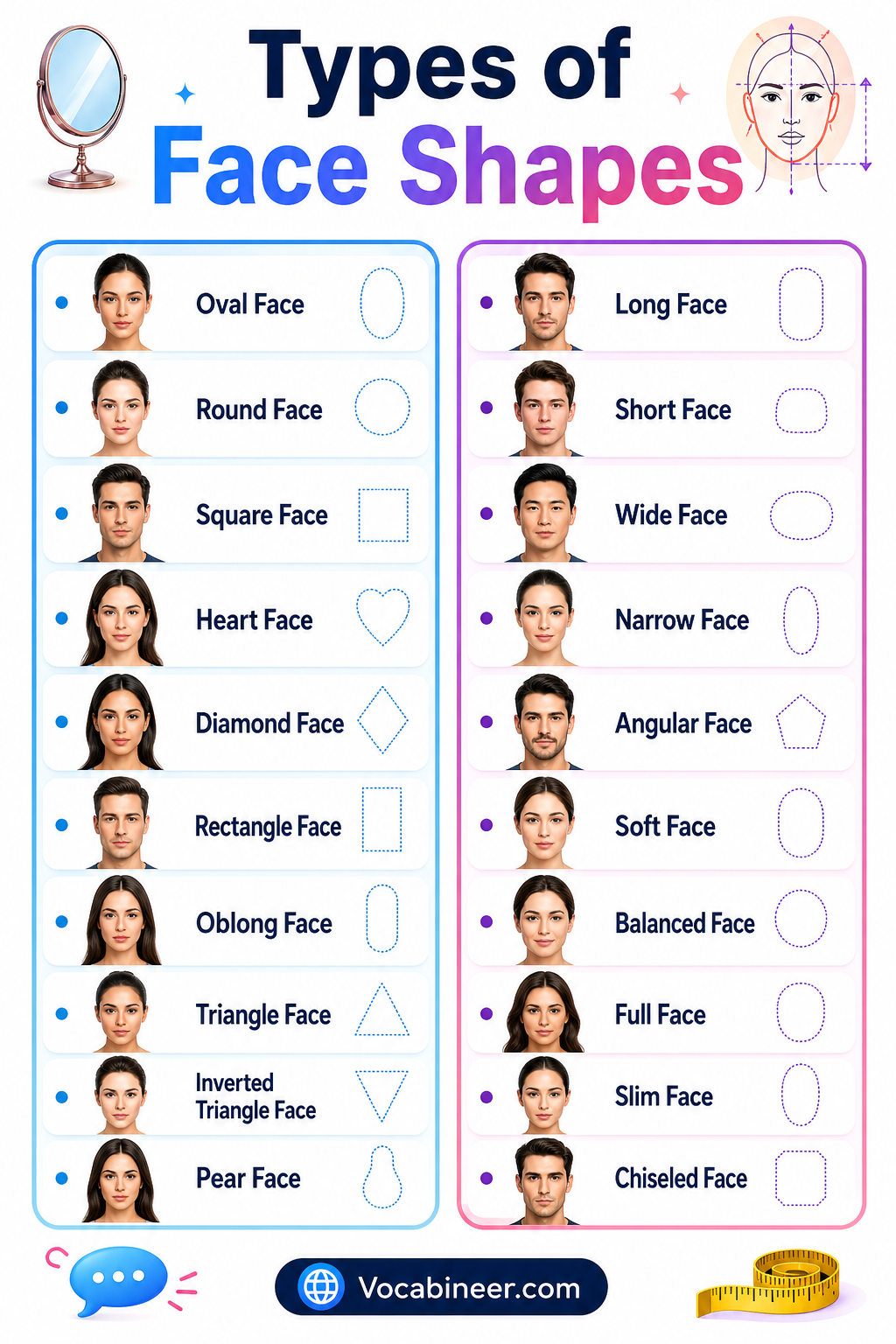
Common Face Shapes
Common face shapes are the main types most people recognize first. These names are often used in face shape charts, hairstyle guides, glasses guides, and visual learning.
Oval Face Shape
An oval face shape is longer than it is wide. The forehead and jawline are usually balanced, and the chin looks softly rounded. This face shape often has smooth, even proportions.
Round Face Shape
A round face shape has soft curves and fuller cheeks. The face length and width may look almost equal, and the jawline usually appears rounded instead of sharp.
Square Face Shape
A square face shape has a broad forehead, strong jawline, and balanced width across the face. The jaw often looks more angular, giving the face a firm and structured appearance.
Heart Face Shape
A heart face shape has a wider forehead and a narrower chin. The chin may look pointed, and the upper part of the face often appears more noticeable than the lower part.
Diamond Face Shape
A diamond face shape has wider cheekbones with a narrower forehead and chin. The cheekbones are usually the widest part of the face.
Oblong Face Shape
An oblong face shape is longer than it is wide. The face may look stretched vertically, with the forehead, cheeks, and jawline appearing fairly similar in width.
Triangle Face Shape
A triangle face shape has a narrower forehead and a wider jawline. The lower part of the face appears broader than the upper part.
Long and Rectangular Face Shapes
Long and rectangular face shapes are based mainly on face length. These shapes look taller or more vertical than round, square, or short face shapes.
Rectangle Face Shape
A rectangle face shape is long with a straighter forehead and jawline. It may look similar to an oblong face, but the jawline often appears more angular.
Long Face Shape
A long face shape looks noticeably longer than it is wide. The forehead, cheeks, and jaw may appear stretched vertically.
Narrow Face Shape
A narrow face shape has less width across the cheekbones, forehead, and jawline. It often looks slim and vertical.
Short Face Shape
A short face shape has compact proportions. The face may look shorter from forehead to chin, with less vertical length than other shapes.
Lower-Face and Jawline Shapes
Some face shapes are identified by the lower part of the face. The jawline, chin, and lower cheeks can strongly affect the overall face outline.
Pear Face Shape
A pear face shape has a narrower forehead and a wider lower face. It is close to a triangle face shape, but usually has a softer, fuller lower jaw.
Wide Face Shape
A wide face shape appears broader across the cheeks, jaw, or both. It may look more horizontal than vertical.
Rounded Square Face Shape
A rounded square face shape has the structure of a square face but with softer edges. The jaw may still look broad, but not sharply angular.
U-Shaped Face
A U-shaped face has a rounded lower jaw and chin. The bottom of the face looks soft and curved, similar to the letter U.
Sharp and Tapered Face Shapes
Sharp and tapered face shapes have more noticeable angles, narrow points, or defined lines. These shapes are often identified by cheekbones, jawline, and chin.
Angular Face Shape
An angular face shape has sharper lines around the jaw, cheekbones, or chin. The face may look more defined and structured.
V-Shaped Face
A V-shaped face has a wider upper face and a narrow, pointed chin. The lower face tapers clearly downward.
Tapered Face Shape
A tapered face shape becomes narrower toward the chin. It may look similar to a heart or V-shaped face, depending on the forehead and cheekbone width.
Soft Oval Face Shape
A soft oval face shape has the balanced length of an oval face but with gentler curves. It does not look very sharp or angular.
Balanced Face Shape
A balanced face shape has even proportions between the forehead, cheekbones, jawline, and chin. No single part of the face looks much wider or narrower than the others.
How to Identify Your Face Shape
To identify your face shape, look at your face in a mirror with your hair pulled away from your forehead and cheeks. Notice the widest part of your face and compare the forehead, cheekbones, jawline, chin, and face length.
If your face is longer than wide with soft curves, it may be oval. If the length and width look similar with rounded cheeks, it may be round. If the jawline looks strong and broad, it may be square. If the forehead is wider and the chin is narrow, it may be heart-shaped.
Face Shape Features to Check
These features help you recognize your face shape more clearly.
Forehead Width
Forehead width means how wide the upper part of your face looks. A wide forehead is common in heart-shaped faces, while a narrower forehead may appear in triangle or pear-shaped faces.
Cheekbone Width
Cheekbone width means how broad the middle part of the face looks. In diamond face shapes, the cheekbones are usually the widest part.
Jawline Shape
Jawline shape can be soft, round, square, sharp, wide, or narrow. A strong jawline often appears in square or rectangle face shapes.
Chin Shape
Chin shape may be rounded, pointed, narrow, broad, or soft. A pointed chin is common in heart, diamond, V-shaped, or tapered face shapes.
Face Length
Face length means the distance from the forehead area to the chin. Long, oblong, and rectangle face shapes have more vertical length.
Similar Face Shapes Compared
Some face shapes look alike, so comparison can make them easier to understand.
| Face Shape Pair | Simple Difference |
|---|---|
| Oval vs Round | Oval is longer; round has more equal length and width. |
| Square vs Rectangle | Square is shorter and broad; rectangle is longer with a strong jaw. |
| Heart vs Diamond | Heart has a wider forehead; diamond has wider cheekbones. |
| Triangle vs Pear | Triangle is more angular; pear often looks softer and fuller at the jaw. |
| Oblong vs Rectangle | Oblong is long and softer; rectangle is long with straighter edges. |
| V-Shaped vs Heart | V-shaped focuses on a narrow chin; heart usually has a wider forehead. |
Face Shape vs Face Size
Face shape and face size are not the same. Face shape describes the outline and proportions of the face, while face size describes how large or small the face appears.
| Term | Meaning | Example |
|---|---|---|
| Face Shape | Natural outline of the face | Oval, round, square, heart |
| Face Size | Overall size of the face | Small, medium, large |
| Face Width | How broad the face looks | Wide face, narrow face |
| Face Length | How long the face looks | Short face, long face |
FAQs
The main types of face shapes are oval, round, square, heart, diamond, oblong, rectangle, triangle, and pear. Some people may also have mixed or softer variations, such as rounded square, V-shaped, or tapered face shapes.
Look at your forehead, cheekbones, jawline, chin, and face length. Notice which part is widest and whether your face looks round, long, square, narrow, or tapered toward the chin.
There is no single face shape that is most common for everyone. Many people have a mix of features, such as an oval face with a slightly square jaw or a round face with a narrower chin.
An oval face is usually longer than it is wide, with balanced curves. A round face has a softer outline and often looks closer in length and width.
Yes, face shape can appear to change with age, weight changes, hairstyle, facial hair, posture, or natural facial development. However, the basic bone structure usually stays similar.
Summary
Different types of face shapes include oval, round, square, heart, diamond, oblong, rectangle, triangle, pear, long, short, wide, narrow, rounded square, soft oval, angular, V-shaped, U-shaped, tapered, and balanced face shapes. Learning these names helps you describe face outlines, compare pictures, and understand facial proportions more clearly.
Read More