Body movements are the ways our joints and muscles help us move. We bend, straighten, turn, lift, lower, and rotate different body parts during daily activities.
This guide explains 20 types of body movements with names, simple examples, and picture-friendly descriptions. You will learn common movement terms such as flexion, extension, abduction, adduction, rotation, pronation, supination, dorsiflexion, and more.
In This Page
What are Body Movements?
Body movements are actions made by the muscles, bones, and joints of the body. They help us bend, straighten, turn, lift, lower, rotate, walk, run, write, chew, and do daily activities.
In anatomy, body movements often describe how one body part moves at a joint. For example, bending the elbow is called flexion, straightening the knee is called extension, and turning the head left or right is called rotation.
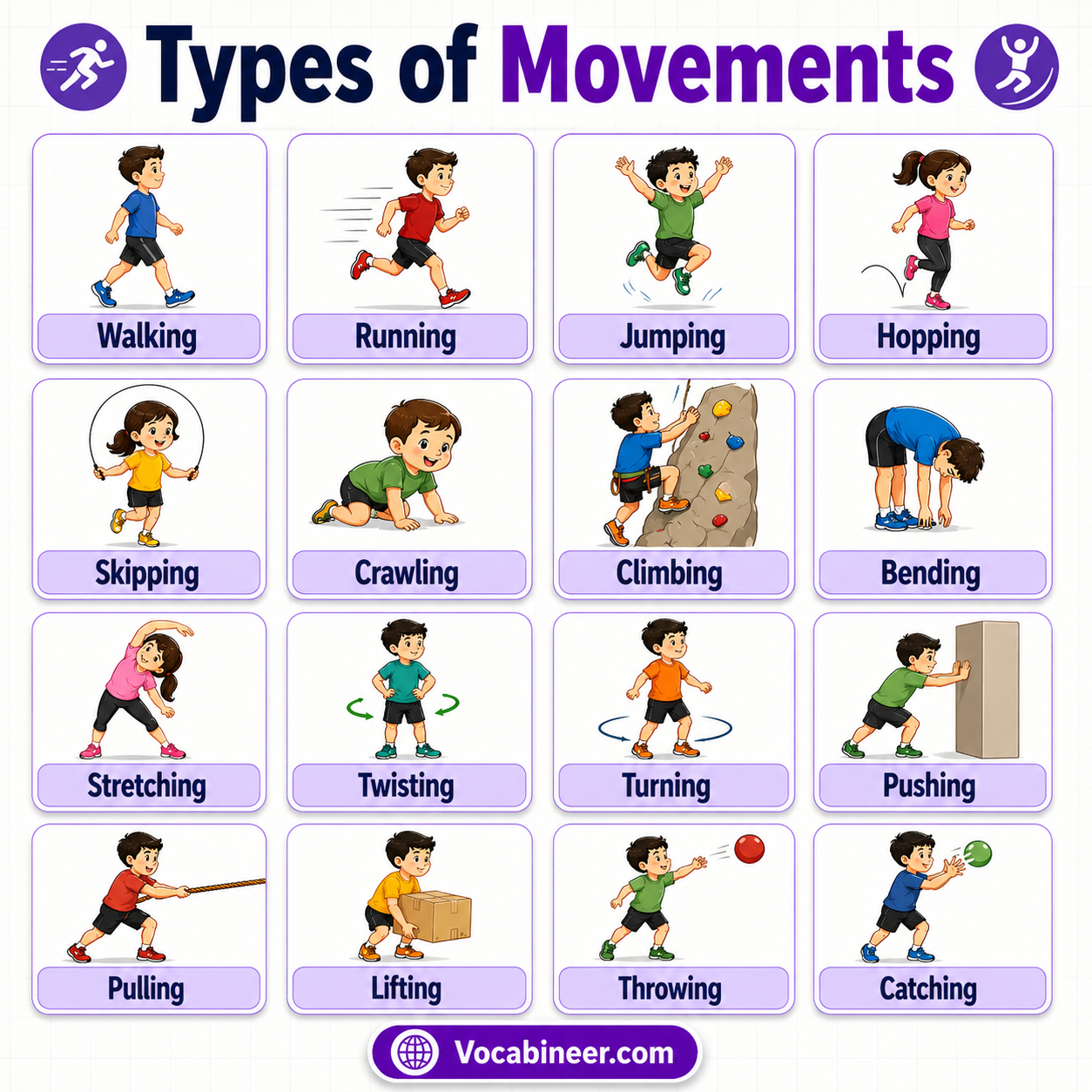
Body Movements Chart
| Movement Name | Movement Group | Simple Example |
|---|---|---|
| Flexion | Bending and Straightening | Bending the elbow |
| Extension | Bending and Straightening | Straightening the knee |
| Hyperextension | Bending and Straightening | Bending the neck backward |
| Abduction | Side and Circular | Raising the arm sideways |
| Adduction | Side and Circular | Bringing the arm back to the body |
| Circumduction | Side and Circular | Moving the arm in a circle |
| Rotation | Turning Movements | Turning the head left or right |
| Medial Rotation | Turning Movements | Turning the thigh inward |
| Lateral Rotation | Turning Movements | Turning the thigh outward |
| Pronation | Forearm and Hand | Turning the palm downward |
| Supination | Forearm and Hand | Turning the palm upward |
| Opposition | Forearm and Hand | Touching the thumb to a finger |
| Reposition | Forearm and Hand | Moving the thumb back to normal |
| Dorsiflexion | Foot and Ankle | Lifting the toes upward |
| Plantar Flexion | Foot and Ankle | Pointing the toes downward |
| Inversion | Foot and Ankle | Turning the sole inward |
| Eversion | Foot and Ankle | Turning the sole outward |
| Elevation | Shoulder and Jaw | Shrugging the shoulders |
| Depression | Shoulder and Jaw | Lowering the shoulders |
| Protraction | Shoulder and Jaw | Moving the jaw forward |
Bending and Straightening Movements
Bending and straightening movements happen when a joint changes its angle. These movements are common in the elbows, knees, neck, fingers, and spine.
Flexion
Flexion means bending a joint so the angle between two body parts becomes smaller. For example, bending your elbow to bring your hand closer to your shoulder is flexion.
Extension
Extension means straightening a joint so the angle between two body parts becomes larger. For example, straightening your knee after bending it is extension.
Hyperextension
Hyperextension means moving a joint beyond its normal straight position. For example, bending the neck backward or extending the arm too far behind the body can show hyperextension.
Side and Circular Movements
Side and circular movements move body parts away from the center, back toward the center, or around in a circular path. These movements are common in the shoulders and hips.
Abduction
Abduction means moving a body part away from the midline of the body. For example, raising your arm sideways away from your body is abduction.
Adduction
Adduction means moving a body part back toward the midline of the body. For example, lowering your raised arm back to your side is adduction.
Circumduction
Circumduction means moving a body part in a circular path. For example, swinging your arm in a circle at the shoulder is circumduction.
Turning Movements
Turning movements happen when a body part rotates around an axis. These movements are common in the neck, spine, shoulders, hips, arms, and legs.
Rotation
Rotation means turning a body part around its own axis. For example, turning your head left or right is rotation.
Medial Rotation
Medial rotation means turning a limb inward toward the center of the body. For example, turning your thigh inward at the hip is medial rotation.
Lateral Rotation
Lateral rotation means turning a limb outward away from the center of the body. For example, turning your thigh outward at the hip is lateral rotation.
Forearm and Hand Movements
Forearm and hand movements help us turn the palm, use the thumb, hold objects, and perform small daily tasks like writing, eating, and gripping.
Pronation
Pronation means turning the forearm so the palm faces downward or backward. For example, placing your palm flat on a table uses pronation.
Supination
Supination means turning the forearm so the palm faces upward or forward. For example, holding a bowl of soup in your palm shows supination.
Opposition
Opposition means moving the thumb across the palm to touch another finger. This movement helps us hold, pinch, write, and pick up small objects.
Reposition
Reposition means moving the thumb back to its normal position after opposition. For example, moving the thumb away after touching the little finger is reposition.
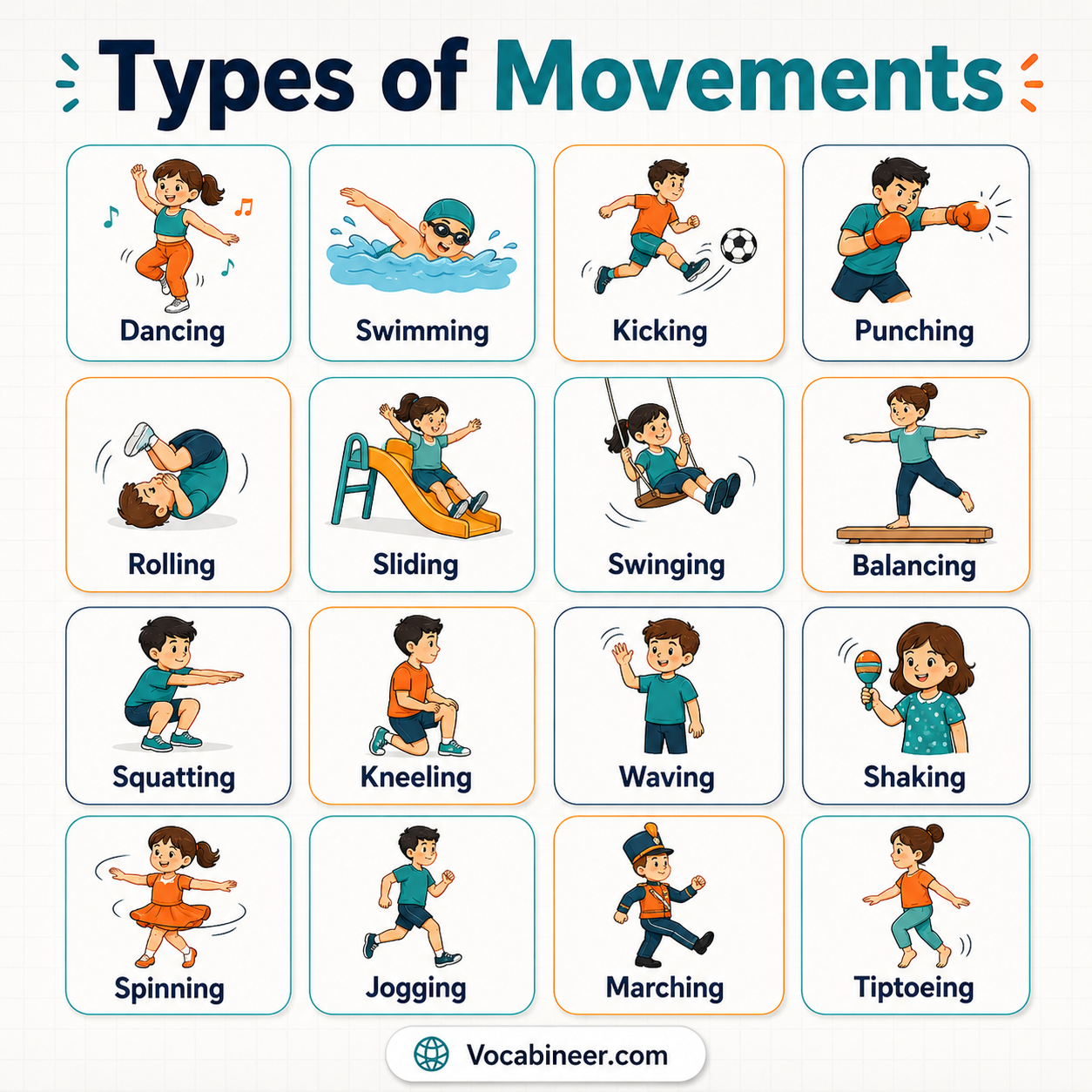
Foot and Ankle Movements
Foot and ankle movements help with walking, running, jumping, standing, balancing, and changing direction. These movements are important in the toes, feet, and ankles.
Dorsiflexion
Dorsiflexion means lifting the front of the foot or toes upward toward the shin. For example, walking on your heels uses dorsiflexion.
Plantar Flexion
Plantar flexion means pointing the toes downward away from the shin. For example, standing on your toes uses plantar flexion.
Inversion
Inversion means turning the sole of the foot inward toward the middle of the body. For example, tilting the foot inward shows inversion.
Eversion
Eversion means turning the sole of the foot outward away from the middle of the body. For example, tilting the foot outward shows eversion.
Shoulder and Jaw Movements
Shoulder and jaw movements include lifting, lowering, and moving a body part forward or backward. These movements are common in the shoulders, jaw, and shoulder blades.
Elevation
Elevation means moving a body part upward. For example, shrugging your shoulders toward your ears is elevation.
Depression
Depression means moving a body part downward. For example, lowering your shoulders after a shrug is depression.
Protraction
Protraction means moving a body part forward. For example, moving the jaw forward or pushing the shoulders forward is protraction.
Retraction
Retraction means moving a body part backward. For example, pulling the shoulders back or moving the jaw backward is retraction.
Common Movement Pairs
Many body movements work in opposite pairs. Learning these pairs makes it easier to remember the meaning of each movement.
| Movement Pair | Simple Difference |
|---|---|
| Flexion vs Extension | Flexion bends a joint; extension straightens it. |
| Abduction vs Adduction | Abduction moves away from the body; adduction moves back toward the body. |
| Medial vs Lateral Rotation | Medial turns inward; lateral turns outward. |
| Pronation vs Supination | Pronation turns the palm down; supination turns the palm up. |
| Dorsiflexion vs Plantar Flexion | Dorsiflexion lifts the toes; plantar flexion points them down. |
| Inversion vs Eversion | Inversion turns the sole inward; eversion turns it outward. |
| Elevation vs Depression | Elevation moves up; depression moves down. |
| Protraction vs Retraction | Protraction moves forward; retraction moves backward. |
Body Movements in Daily Life
Body movements happen in almost every daily activity. Simple actions like walking, sitting, writing, reaching, chewing, and turning the head all use different movement patterns.
- Bending the elbow while eating is flexion.
- Straightening the leg while standing is extension.
- Raising the arm sideways is abduction.
- Bringing the arm back down is adduction.
- Turning the head to look sideways is rotation.
- Turning the palm upward is supination.
- Pointing the toes downward is plantar flexion.
- Shrugging the shoulders is elevation.
FAQs
Body movements are actions made by muscles and joints. They help us bend, straighten, turn, lift, lower, rotate, walk, write, chew, and perform daily activities.
The main types of body movements include flexion, extension, abduction, adduction, rotation, circumduction, pronation, supination, dorsiflexion, plantar flexion, inversion, eversion, elevation, depression, protraction, and retraction.
Flexion means bending a joint and making the angle smaller. Extension means straightening a joint and making the angle larger. Bending and straightening the elbow are simple examples.
Abduction means moving a body part away from the midline of the body. Adduction means moving it back toward the midline. Raising and lowering the arm sideways shows this pair.
Rotation means turning a body part around its own axis. Turning your head left or right, rotating your shoulder, or turning your hip are examples of rotation.
Summary
Types of body movements include bending, straightening, turning, lifting, lowering, rotating, and moving body parts inward, outward, forward, or backward. Common movement names include flexion, extension, abduction, adduction, rotation, pronation, supination, dorsiflexion, plantar flexion, inversion, eversion, elevation, depression, protraction, and retraction. Learning these terms helps you understand how the human body moves in daily life.
Read More
- Types of Eyebrows
- Types of Feelings & Emotions
- Facial Expressions Names
- Human Parts of Body
- Body Language Gestures