Scars are marks that form when the skin heals after an injury, cut, burn, acne, surgery, piercing, or infection. Some scars look raised or thick, while others may appear sunken, flat, wide, tight, dark, red, pink, or lighter than nearby skin.
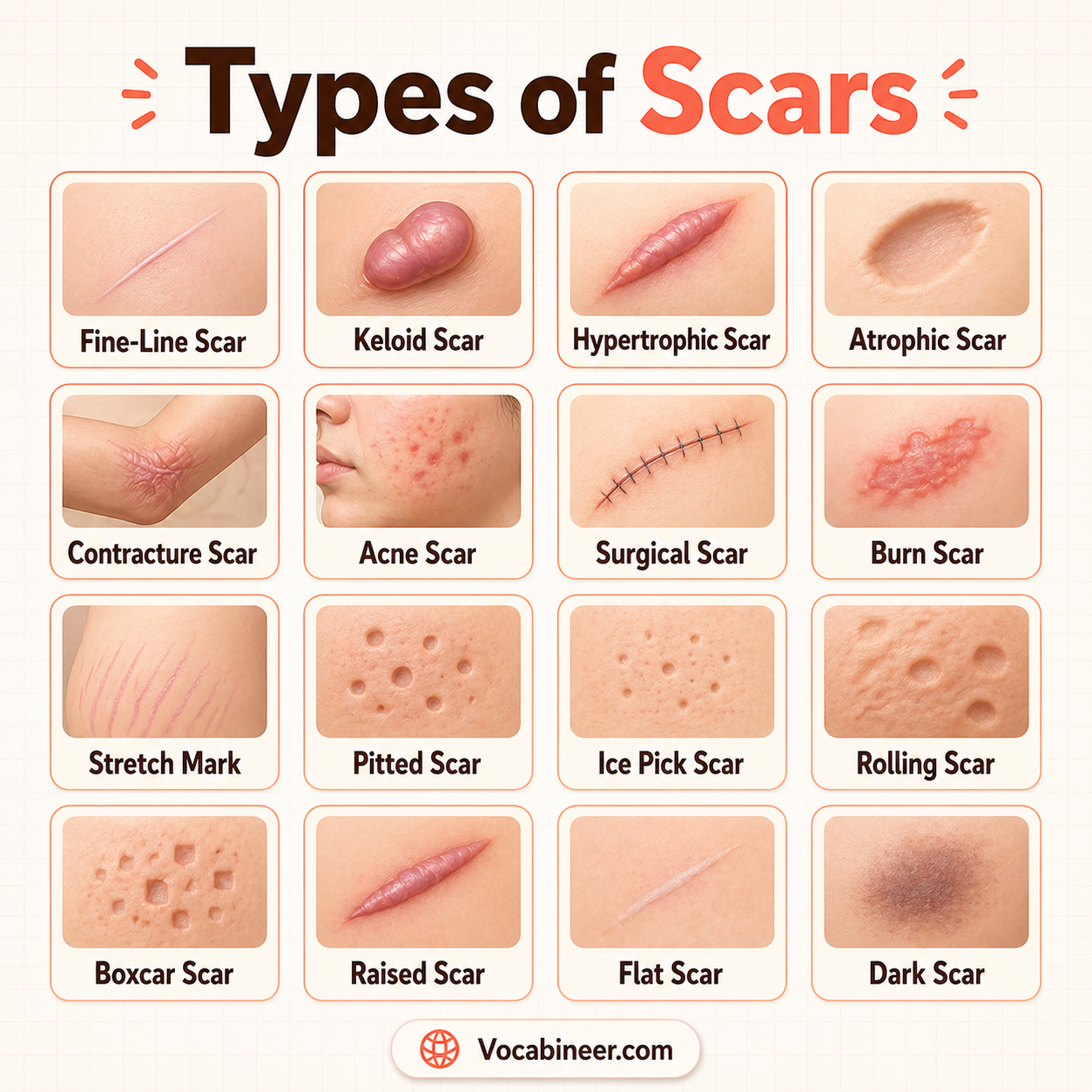
This guide explains 40 scar names with picture-friendly descriptions. Some names describe true scar types, while others describe scar appearance, color changes, or marks left after healing. You will learn raised scars, sunken scars, acne scars, line scars, cause-based scars, and surface marks in simple words.
In This Page
Main Scar Groups
| Scar Group | Common Examples |
|---|---|
| Raised Scars | Keloid Scar, Hypertrophic Scar, Raised Acne Scar |
| Sunken Scars | Atrophic Scar, Ice Pick Scar, Boxcar Scar, Rolling Scar |
| Tight and Wide Scars | Contracture Scar, Stretch Marks, Widespread Scar |
| Cause-Based Scars | Acne Scar, Surgical Scar, Burn Scar, Cut Scar |
| Scar Colors and Marks | Dark Scar, White Scar, Red Scar, Post-Acne Mark |
Scar Names Chart
Common Scar Types
| Scar Name | Group | Simple Description |
|---|---|---|
| Keloid Scar | Raised Scars | A raised scar that grows beyond the original wound. |
| Hypertrophic Scar | Raised Scars | A raised scar that stays within the wound area. |
| Atrophic Scar | Sunken Scars | A sunken scar caused by tissue loss. |
| Ice Pick Scar | Acne Scars | A narrow, deep, pitted scar often caused by acne. |
| Boxcar Scar | Acne Scars | A wide indented scar with clear edges. |
| Rolling Scar | Acne Scars | A broad scar that makes the skin look uneven or wavy. |
| Pitted Scar | Sunken Scars | A small hollow or dent-like scar in the skin. |
| Contracture Scar | Tight Scars | A tight scar that may pull the skin, often after burns. |
| Stretch Marks | Line Scars | Line-like scars caused by quick skin stretching. |
| Acne Scar | Cause-Based Scars | A scar left after severe or inflamed acne. |
| Surgical Scar | Cause-Based Scars | A scar left after surgery or stitches. |
| Burn Scar | Cause-Based Scars | A scar caused by a burn injury. |
| Cut Scar | Cause-Based Scars | A scar left after a cut or wound heals. |
| C-Section Scar | Surgical Scars | A surgical scar from cesarean delivery. |
| Flat Scar | Surface Scars | A scar that stays level with the skin. |
| Dark Scar | Color Marks | A scar or mark darker than the nearby skin. |
| White Scar | Color Marks | A scar that looks pale or lighter than the surrounding skin. |
| Red Scar | Color Marks | A newer scar that appears red during healing. |
| Hyperpigmented Scar | Color Marks | A scar or mark with extra pigment. |
| Post-Acne Mark | Surface Marks | A flat mark left after acne, often not a true scar. |
Raised Scars
Raised scars sit above the normal surface of the skin. They usually form when the body makes extra scar tissue during healing.
Keloid Scar
A keloid scar is a raised scar that grows beyond the original wound area. It may look thick, shiny, firm, or larger than the injury that caused it.
Hypertrophic Scar
A hypertrophic scar is a raised scar that stays within the original wound area. It may look red, thick, firm, or bumpy while the skin heals.
Raised Acne Scar
A raised acne scar forms after inflamed acne heals with extra scar tissue. It may look like a small raised bump or thickened area.
Thick Scar
A thick scar feels firmer or heavier than the surrounding skin. It may happen when extra tissue forms during the healing process.
Bumpy Scar
A bumpy scar has an uneven or lumpy surface. It may feel rough, raised, or irregular when touched.
Nodular Scar
A nodular scar feels like a small raised lump under or on the skin. It may appear after deep inflammation, acne, injury, or healing problems.
Sunken and Indented Scars
Sunken scars sit below the normal skin surface. They often form when the skin loses tissue or does not rebuild enough collagen during healing.
Atrophic Scar
An atrophic scar is a depressed or sunken scar. It may happen after acne, chickenpox, injury, or skin inflammation.
Ice Pick Scar
An ice pick scar is a narrow and deep scar that looks like a small hole in the skin. It is common after severe acne.
Boxcar Scar
A boxcar scar is a wider indented scar with clearer edges. It may look like a round or oval dent in the skin.
Rolling Scar
A rolling scar is a broad, shallow scar that makes the skin look uneven or wavy. It usually has softer edges than boxcar scars.
Pitted Scar
A pitted scar is a small hollow or dent-like mark in the skin. It is often seen after acne, chickenpox, or inflamed skin.
Depressed Scar
A depressed scar sits lower than the surrounding skin. It is a general name for scars that look sunken or indented.
Chickenpox Scar
A chickenpox scar is usually a small pit-like scar left after chickenpox blisters heal. It may appear as a tiny dent in the skin.
Tight and Wide Scars
Tight and wide scars may affect how skin stretches, moves, or heals. Some are narrow lines, while others become wider or tighter over time.
Contracture Scar
A contracture scar forms when scar tissue tightens and pulls the skin. It often happens after burns and may affect movement if it forms near a joint.
Stretch Marks
Stretch marks are line-like scars caused by quick stretching or shrinking of the skin. They may appear on the stomach, thighs, hips, breasts, arms, or back.
Widespread Scar
A widespread scar is a scar that becomes wider during healing. It may happen when wound edges pull apart or skin heals under tension.
Stretched Scar
A stretched scar becomes wider because of skin movement or tension. It may look like a widened line on the skin.
Fine Line Scar
A fine line scar is a thin, narrow scar. It may appear after a small cut, surgery, or minor injury.
Linear Scar
A linear scar is a straight or line-shaped scar. Surgical cuts, scratches, or clean wounds often leave linear scars.
Adhesion Scar
An adhesion scar forms deeper under the skin when scar tissue sticks tissues together. It may happen after surgery or deeper injury.
Cause-Based Scars
Cause-based scars are named by what caused them. These names help explain where the scar came from and why it may look a certain way.
Acne Scar
An acne scar forms after inflamed or severe acne damages the skin. It may be pitted, sunken, raised, or uneven.
Surgical Scar
A surgical scar forms after a cut made during surgery. Its appearance depends on the incision, stitches, healing, skin type, and body area.
Burn Scar
A burn scar forms after skin is damaged by heat, chemicals, electricity, or another burn source. It may be flat, raised, tight, shiny, or discolored.
Cut Scar
A cut scar forms after a cut or wound heals. It may appear as a thin line, wide mark, or raised area depending on healing.
Injury Scar
An injury scar forms after physical damage to the skin. Falls, accidents, scratches, or deep wounds can leave injury scars.
Stitches Scar
A stitches scar forms where stitches were used to close a wound. It may look like a line with small marks along the sides.
C-Section Scar
A C-section scar is a surgical scar from cesarean delivery. It is usually a horizontal or vertical scar on the lower abdomen.
Trauma Scar
A trauma scar forms after a deeper accident or serious injury. It may be irregular, wide, raised, sunken, or discolored.
Piercing Scar
A piercing scar forms after a piercing wound heals. It may appear as a small bump, hole mark, or thickened area.
Vaccination Scar
A vaccination scar is a small scar left after certain vaccine injections. It may look like a round, flat, or slightly indented mark.
Scar Colors and Surface Marks
Some scars or marks are noticed mainly because of color or surface changes. These may look dark, red, pink, white, brown, purple, flat, or uneven.
Flat Scar
A flat scar stays level with the skin surface. It may start red or pink and later fade closer to the natural skin tone.
Dark Scar
A dark scar looks darker than the surrounding skin. Sometimes this is a true scar, and sometimes it is a flat dark mark after inflammation.
White Scar
A white scar looks lighter or paler than the surrounding skin. It may happen when healed skin loses some pigment.
Red Scar
A red scar is often a newer scar. Many fresh scars look red at first before fading over time.
Pink Scar
A pink scar is a healing scar with a light red or pink color. It may become paler as the skin matures.
Brown Scar
A brown scar has brown discoloration. It may be more noticeable on some skin tones after injury, acne, or irritation.
Purple Scar
A purple scar or mark may appear during early healing or after inflammation. It may fade slowly depending on the skin and injury.
Hypopigmented Scar
A hypopigmented scar has less pigment than nearby skin. It often looks white, pale, or lighter than the surrounding area.
Hyperpigmented Scar
A hyperpigmented scar or mark has extra pigment. It may look brown, gray, or darker than nearby skin.
Post-Acne Mark
A post-acne mark is a flat dark, red, or brown mark left after acne. It may not be a true scar if the skin texture is not changed.
Keloid vs Hypertrophic Scar
Keloid and hypertrophic scars are both raised scars, but they are different in how they grow.
| Feature | Keloid Scar | Hypertrophic Scar |
|---|---|---|
| Growth | Grows beyond the original wound | Stays within the wound area |
| Texture | Thick, firm, shiny, or raised | Raised, firm, red, or thick |
| Size | Can become larger than the injury | Usually follows the wound shape |
| Healing | May keep growing over time | May improve or flatten over time |
| Simple clue | Spreads outside the injury border | Stays inside the injury border |
Acne Scar Types
Acne scars can look different depending on how the skin heals after inflammation. Some are sunken, some are raised, and some are mainly color marks.
| Acne Scar Type | What It Looks Like |
|---|---|
| Ice Pick Scar | Narrow, deep pit |
| Boxcar Scar | Wider dent with defined edges |
| Rolling Scar | Wavy, uneven skin texture |
| Pitted Scar | Small hollow mark |
| Raised Acne Scar | Small raised bump or thickened area |
| Post-Acne Mark | Flat dark, red, or brown mark |
Scar vs Mark
A scar and a mark are not always the same. A scar usually changes the skin texture, while a mark mainly changes the skin color.
| Feature | Scar | Mark |
|---|---|---|
| Main change | Texture, thickness, or skin level | Color only |
| Examples | Raised scar, pitted scar, sunken scar | Dark mark, red mark, brown mark |
| Surface | May be raised, flat, tight, or indented | Usually flat |
| Cause | Tissue repair after skin damage | Pigment or redness after irritation |
How Scars Change Over Time
Scars often change as the skin heals. A new scar may look red, pink, purple, brown, raised, itchy, or firm at first. Over time, many scars become flatter, softer, and lighter.
However, not every scar fades the same way. Keloids may grow larger, contracture scars may tighten, and deep acne scars may stay indented. Skin tone, wound depth, body area, and healing habits can also affect how a scar looks.
When to See a Doctor
Many scars are harmless, but some scars need medical advice. See a doctor or dermatologist if a scar is painful, itchy, growing, spreading, very tight, limiting movement, or changing quickly.
You should also get help if a scar forms after a serious burn, deep wound, infection, or surgery. A healthcare professional can check the scar type and suggest safe options if treatment is needed.
FAQs
The main types of scars include keloid scars, hypertrophic scars, atrophic scars, contracture scars, acne scars, surgical scars, burn scars, stretch marks, and color-related scars. Scars may also be grouped as raised, sunken, tight, wide, flat, or cause-based.
A keloid scar is a raised scar that grows beyond the original wound. It may become thick, shiny, firm, or larger than the original injury.
A keloid scar grows outside the original wound area, while a hypertrophic scar stays within the wound border. Both are raised, but keloids are more likely to spread beyond the injury.
Common acne scar types include ice pick scars, boxcar scars, rolling scars, pitted scars, and raised acne scars. Acne can also leave flat dark or red marks, but these are not always true scars.
Yes, many scars fade over time and may become flatter, softer, or lighter. Some scars, such as keloids, contracture scars, or deep acne scars, may need professional care if they are painful, tight, growing, or very noticeable.
Summary
Types of scars include raised scars, sunken scars, tight scars, wide scars, cause-based scars, and color-related scars or marks. Common scar names include keloid scar, hypertrophic scar, atrophic scar, ice pick scar, boxcar scar, rolling scar, contracture scar, stretch marks, surgical scar, burn scar, dark scar, white scar, and post-acne mark. Learning these scar names helps you describe scars clearly and understand when a scar may need medical attention.
Read More
- Types of Eyebrows
- Types of Feelings & Emotions
- Body Language Gestures
- Facial Expressions Names
- Human Parts of Body