

Cooking verbs are action words used to describe what people do while preparing, cooking, serving, and handling food. Words like chop, slice, mix, boil, fry, bake, stir, and serve are common cooking verbs in English. These verbs are useful in recipes, cooking videos, classroom lessons, daily conversation, and kitchen instructions.
Learning cooking verbs in English helps students, kids, beginners, and ESL learners understand food preparation more clearly. This guide includes common cooking verbs with meanings, examples, categories, recipe use, cooking stages, kitchen tools, past tense forms, picture ideas, and related kitchen vocabulary.
In This Page
What Are Cooking Verbs?
Cooking verbs are words that describe kitchen actions. They show what someone does with ingredients, tools, heat, food, or dishes.
For example:
- Chop the onions.
- Boil the water.
- Stir the soup.
- Bake the cake.
- Serve the meal.
Why Cooking Verbs Are Useful in English
Cooking verbs are useful because food and cooking are part of everyday life. You may hear these verbs at home, in restaurants, in cooking shows, in recipe books, or in English classes.
These verbs can help you:
- Read recipes more easily
- Follow cooking instructions
- Talk about food preparation
- Understand kitchen vocabulary
- Describe how food is made
- Learn useful action words in English
- Improve speaking and writing skills
Common Cooking Verbs
These are general kitchen actions used in almost every recipe. They describe basic movements and food handling steps.
- Cook: Prepare food by applying heat until it is ready to eat.
- Prepare: Get ingredients ready before the main cooking begins.
- Make: Combine ingredients to create a dish.
- Add: Put an ingredient into a mixture or pan.
- Mix: Combine ingredients evenly using a spoon or mixer.
- Stir: Move ingredients around gently in a circular motion.
- Heat: Raise the temperature of food or liquid.
- Pour: Transfer liquid carefully into another container.
- Serve: Place food on a plate for eating.
- Taste: Check flavor during the cooking process.
- Season: Add salt, spices, or herbs for flavor.
- Garnish: Decorate the dish before serving.
- Drain: Remove extra liquid from cooked food.
- Cool: Allow food to reduce in temperature.
- Store: Keep food safely for later use.
- Reheat: Warm cooked food again.
- Marinate: Soak food in seasoned liquid before cooking.
- Soak: Leave food in liquid for a period of time.
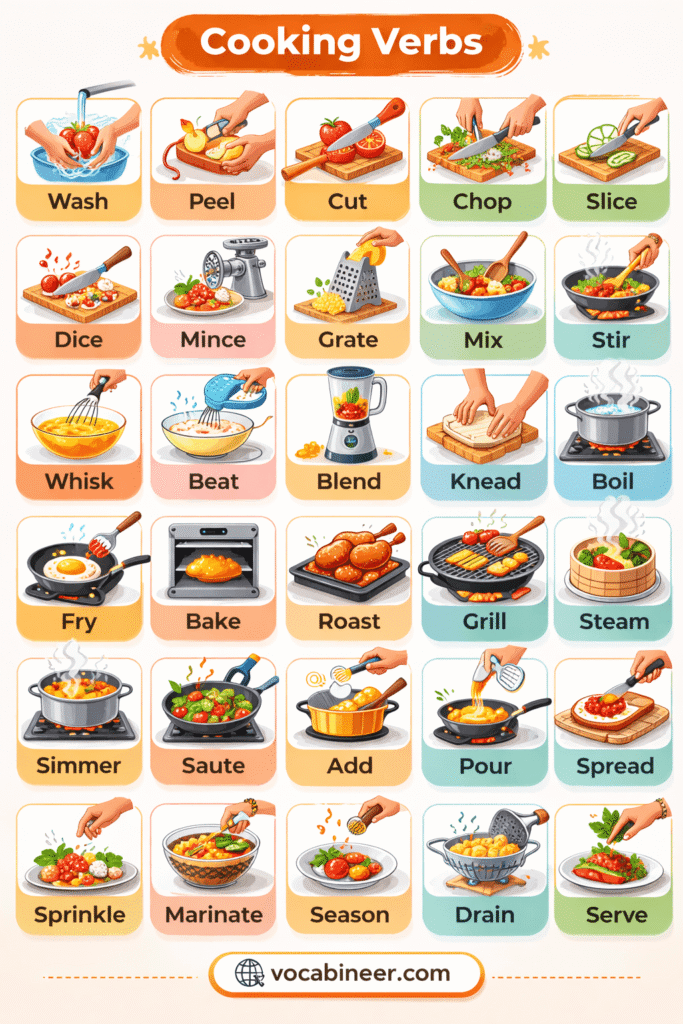
Cooking Verbs by Category
Cooking verbs are easier to learn when they are grouped by action. Some verbs are used for cutting food, some for mixing ingredients, and others for cooking with heat.
| Category | Common Verbs |
|---|---|
| Basic cooking verbs | cook, make, prepare, add, heat, serve |
| Cutting and preparing verbs | cut, chop, slice, dice, peel, grate, mince, trim |
| Mixing and combining verbs | mix, stir, whisk, beat, blend, combine, fold, knead |
| Cooking method verbs | boil, simmer, steam, fry, bake, roast, grill, sauté |
| Texture and consistency verbs | thicken, reduce, melt, soften, crisp, tenderize, whip |
| Flavor and seasoning verbs | season, salt, spice, marinate, sprinkle, garnish, drizzle |
| Serving and plating verbs | serve, plate, pour, scoop, spread, dip, portion |
| Kitchen support verbs | wash, rinse, dry, wipe, clean, store, cover, reheat |
100 Cooking Verbs With Meanings and Examples
This list includes 100 cooking verbs in English with simple meanings and examples. Some verbs are direct cooking actions, while others are food preparation, serving, measuring, or useful kitchen action verbs.
Basic Kitchen Verbs
These basic kitchen verbs are common in simple cooking instructions. They help learners understand general actions used before, during, and after cooking.
| No. | Cooking Verb | Meaning | Example Sentence |
|---|---|---|---|
| 1 | Cook | Prepare food using heat | I cook dinner every evening. |
| 2 | Make | Create or prepare food | She made a sandwich. |
| 3 | Prepare | Get food ready | Prepare the vegetables first. |
| 4 | Serve | Give food to eat | Serve the soup hot. |
| 5 | Taste | Try food for flavor | Taste the sauce before serving. |
| 6 | Add | Put something into food | Add salt to the soup. |
| 7 | Heat | Make something hot | Heat the oil in a pan. |
| 8 | Cool | Let food become less hot | Cool the cake before cutting it. |
| 9 | Cover | Put something over food | Cover the pot with a lid. |
| 10 | Store | Keep food for later | Store leftovers in the fridge. |
| 11 | Measure | Find the amount of an ingredient | Measure two cups of flour. |
| 12 | Grease | Coat a pan with oil or butter | Grease the baking tray. |
| 13 | Remove | Take something away | Remove the pan from the heat. |
| 14 | Test | Check if food is ready | Test the cake with a toothpick. |
| 15 | Set | Choose a temperature or setting | Set the oven to 180°C. |
| 16 | Rest | Let food sit before serving | Rest the meat before slicing it. |
| 17 | Transfer | Move food from one place to another | Transfer the soup to a bowl. |
| 18 | Portion | Divide food into servings | Portion the rice into bowls. |
| 19 | Refrigerate | Keep food cold in a fridge | Refrigerate the leftovers. |
| 20 | Arrange | Put food neatly | Arrange the fruit on a plate. |
Cutting and Preparation Verbs
These verbs describe actions used to clean, cut, shape, or prepare ingredients. They are common in the first steps of many recipes.
| No. | Cooking Verb | Meaning | Example Sentence |
|---|---|---|---|
| 21 | Cut | Divide food with a knife | Cut the apple in half. |
| 22 | Chop | Cut into small pieces | Chop the onions finely. |
| 23 | Slice | Cut into thin pieces | Slice the tomatoes. |
| 24 | Dice | Cut into small cubes | Dice the potatoes. |
| 25 | Peel | Remove the outer skin | Peel the carrots. |
| 26 | Grate | Rub food into small pieces | Grate the cheese. |
| 27 | Mince | Cut into very tiny pieces | Mince the garlic. |
| 28 | Trim | Remove unwanted parts | Trim the fat from the meat. |
| 29 | Wash | Clean with water | Wash the lettuce. |
| 30 | Rinse | Wash quickly with water | Rinse the rice. |
| 31 | Soak | Leave in liquid | Soak the beans overnight. |
| 32 | Drain | Remove liquid | Drain the pasta. |
| 33 | Shell | Remove the shell | Shell the peas. |
| 34 | Pit | Remove the stone or seed | Pit the cherries. |
| 35 | Core | Remove the center | Core the apples. |
| 36 | Shred | Cut into long thin pieces | Shred the cabbage. |
| 37 | Crush | Press into small pieces | Crush the garlic. |
| 38 | Mash | Press until soft | Mash the potatoes. |
| 39 | Press | Push down firmly | Press the dough gently. |
| 40 | Shape | Form food into a shape | Shape the dough into balls. |
Mixing and Measuring Verbs
These verbs are used when ingredients need to be combined, measured, poured, or shaped. They are especially common in baking and recipe instructions.
| No. | Cooking Verb | Meaning | Example Sentence |
|---|---|---|---|
| 41 | Mix | Put ingredients together | Mix the flour and milk. |
| 42 | Stir | Move with a spoon | Stir the soup slowly. |
| 43 | Whisk | Beat quickly with a whisk | Whisk the eggs. |
| 44 | Beat | Mix strongly | Beat the butter and sugar. |
| 45 | Blend | Mix until smooth | Blend the fruit and yogurt. |
| 46 | Combine | Bring ingredients together | Combine the dry ingredients. |
| 47 | Fold | Mix gently | Fold the cream into the batter. |
| 48 | Knead | Press and fold dough | Knead the dough for ten minutes. |
| 49 | Toss | Mix lightly | Toss the salad. |
| 50 | Shake | Move quickly to mix | Shake the dressing bottle. |
| 51 | Pour | Move liquid into something | Pour the milk into a bowl. |
| 52 | Fill | Put something into a container | Fill the pot with water. |
| 53 | Empty | Remove everything from a container | Empty the bowl. |
| 54 | Sift | Pass through a sieve | Sift the flour. |
| 55 | Sprinkle | Scatter lightly | Sprinkle sugar on top. |
| 56 | Spread | Put over a surface | Spread butter on bread. |
| 57 | Layer | Put in layers | Layer the pasta and sauce. |
| 58 | Roll | Make flat or round | Roll the dough. |
| 59 | Flatten | Make something flat | Flatten the dough with your hands. |
| 60 | Divide | Separate into parts | Divide the dough into pieces. |
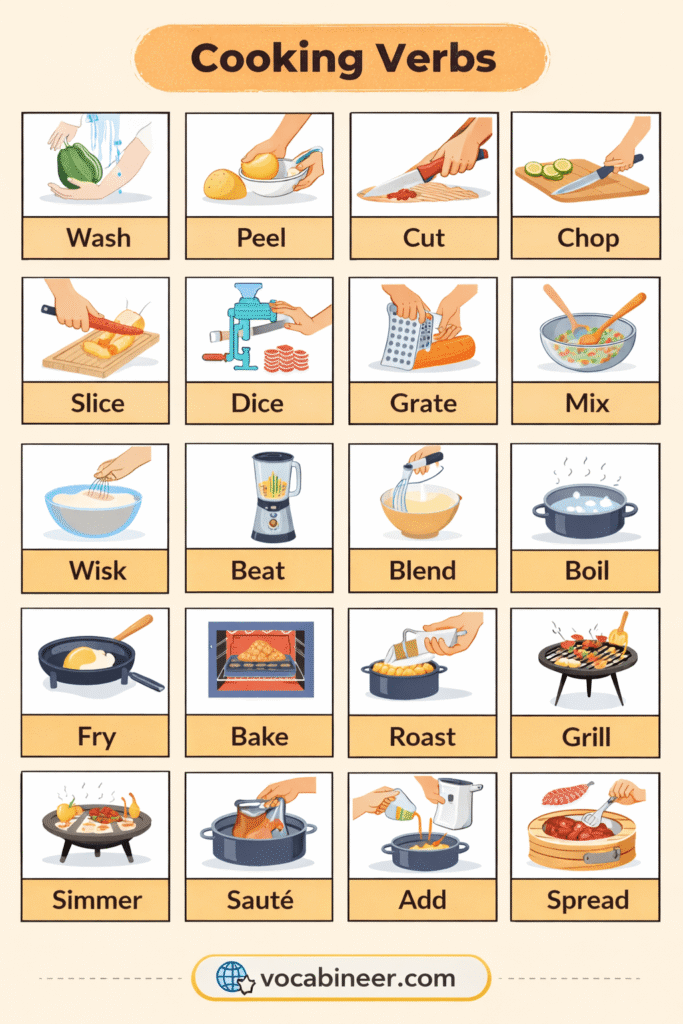
Cooking Method Verbs
Cooking method verbs explain how food is cooked with heat, oil, water, steam, or dry heat. These are some of the most important verbs in recipes.
| No. | Cooking Verb | Meaning | Example Sentence |
|---|---|---|---|
| 61 | Boil | Cook liquid until it bubbles | Boil the water. |
| 62 | Simmer | Cook gently on low heat | Simmer the sauce. |
| 63 | Steam | Cook with hot steam | Steam the vegetables. |
| 64 | Poach | Cook gently in liquid | Poach the eggs. |
| 65 | Blanch | Boil briefly, then cool | Blanch the beans. |
| 66 | Fry | Cook in hot oil | Fry the potatoes. |
| 67 | Deep-fry | Cook fully covered in oil | Deep-fry the chicken. |
| 68 | Pan-fry | Fry in a small amount of oil | Pan-fry the fish. |
| 69 | Stir-fry | Fry quickly while stirring | Stir-fry the vegetables. |
| 70 | Sauté | Cook quickly in little oil | Sauté the onions. |
| 71 | Bake | Cook in an oven | Bake the bread. |
| 72 | Roast | Cook with dry heat until brown | Roast the chicken. |
| 73 | Grill | Cook over direct heat | Grill the burgers. |
| 74 | Broil | Cook with heat from above | Broil the fish. |
| 75 | Toast | Brown with dry heat | Toast the bread. |
| 76 | Brown | Cook until brown | Brown the meat. |
| 77 | Sear | Cook the outside quickly | Sear the steak. |
| 78 | Preheat | Heat before cooking | Preheat the oven. |
| 79 | Melt | Turn solid into liquid | Melt the butter. |
| 80 | Warm | Make slightly hot | Warm the milk. |
Seasoning and Serving Verbs
These verbs are used to add flavor, decorate food, serve meals, or handle food after cooking. They are common in both home cooking and restaurant English.
| No. | Cooking Verb | Meaning | Example Sentence |
|---|---|---|---|
| 81 | Season | Add flavor | Season the chicken. |
| 82 | Salt | Add salt | Salt the soup lightly. |
| 83 | Spice | Add spices | Spice the curry. |
| 84 | Marinate | Soak in flavored liquid | Marinate the meat overnight. |
| 85 | Garnish | Decorate food | Garnish the soup with herbs. |
| 86 | Drizzle | Pour a thin stream | Drizzle honey over the pancakes. |
| 87 | Coat | Cover with another ingredient | Coat the fish with flour. |
| 88 | Glaze | Cover with a shiny layer | Glaze the cake. |
| 89 | Decorate | Make food look attractive | Decorate the cookies. |
| 90 | Plate | Arrange food on a plate | Plate the pasta neatly. |
| 91 | Scoop | Lift with a spoon or scoop | Scoop the ice cream. |
| 92 | Dip | Put food into sauce | Dip the bread in soup. |
| 93 | Carve | Cut cooked meat into slices | Carve the roast chicken. |
| 94 | Clean | Remove dirt or mess | Clean the kitchen. |
| 95 | Scrub | Clean by rubbing hard | Scrub the pan. |
| 96 | Wipe | Clean with a cloth | Wipe the counter. |
| 97 | Dry | Remove water | Dry the dishes. |
| 98 | Wrap | Cover with paper or plastic | Wrap the sandwich. |
| 99 | Seal | Close tightly | Seal the container. |
| 100 | Reheat | Heat again | Reheat the leftovers. |
Basic Cooking Verbs
Basic cooking verbs are simple kitchen action words. These verbs are useful for beginners because they appear in everyday English and easy recipes.
Cook
To cook means to prepare food using heat. You can cook rice, vegetables, meat, soup, or pasta.
Make
To make means to create or prepare something. You can make tea, salad, sandwiches, soup, or dinner.
Prepare
To prepare means to get food or ingredients ready before cooking. You may prepare vegetables, dough, sauce, or a meal.
Add
To add means to put one ingredient into another. You can add salt, sugar, flour, milk, spices, or water.
Heat
To heat means to make food, liquid, or a pan hot. You can heat oil, soup, milk, sauce, or leftovers.
Serve
To serve means to give food to someone to eat. You can serve breakfast, lunch, dinner, soup, or dessert.
Cutting and Preparing Verbs
Cutting and preparing verbs are used before food is cooked. These verbs describe how ingredients are cleaned, cut, shaped, or made ready.
Cut
To cut means to divide food into pieces with a knife. You can cut fruit, bread, meat, or vegetables.
Chop
To chop means to cut food into small pieces. People often chop onions, carrots, herbs, or garlic.
Slice
To slice means to cut food into thin, flat pieces. You can slice tomatoes, bread, cheese, or cucumbers.
Dice
To dice means to cut food into small cube-shaped pieces. Recipes often ask you to dice potatoes, onions, or peppers.
Peel
To peel means to remove the outer skin of food. You can peel apples, potatoes, carrots, oranges, or bananas.
Grate
To grate means to rub food against a grater to make small pieces. You can grate cheese, carrots, ginger, or coconut.
Mince
To mince means to cut food into very tiny pieces. Garlic, herbs, onions, and meat can be minced.
Trim
To trim means to remove unwanted parts from food. You may trim fat from meat or ends from vegetables.
Wash
To wash means to clean food with water. Vegetables, fruits, and herbs should usually be washed before cooking.
Rinse
To rinse means to wash quickly with clean water. Rice, beans, vegetables, and dishes can be rinsed.
Mixing and Combining Verbs
Mixing and combining verbs describe how ingredients are joined together. These verbs are common in baking, cooking, salads, sauces, and drinks.
Mix
To mix means to put ingredients together so they become one mixture. You can mix flour, sugar, eggs, and milk.
Stir
To stir means to move food around with a spoon or spatula. You may stir soup, tea, sauce, or batter.
Whisk
To whisk means to beat ingredients quickly with a whisk. Eggs, cream, sauce, and batter are often whisked.
Beat
To beat means to mix strongly and quickly. You can beat eggs, butter, cream, or cake batter.
Blend
To blend means to mix ingredients until smooth. Smoothies, soups, sauces, and shakes can be blended.
Combine
To combine means to bring ingredients together. A recipe may say, “Combine the dry ingredients.”
Fold
To fold means to mix gently, usually by turning one mixture into another. Bakers often fold whipped cream or egg whites into batter.
Knead
To knead means to press and fold dough with your hands. Bread, pizza dough, and flatbread dough are often kneaded.
Toss
To toss means to mix lightly by lifting and turning. You can toss salad, pasta, or vegetables.
Shake
To shake means to move something quickly up and down or side to side. You can shake a dressing bottle or spice jar.
Cooking Method Verbs
Cooking method verbs describe how food is cooked using heat, water, oil, steam, or an oven. These verbs are very common in recipes.
Boil
To boil means to cook liquid until it bubbles strongly. You can boil water, eggs, rice, pasta, or potatoes.
Simmer
To simmer means to cook gently over low heat. Soups, sauces, curries, and stews are often simmered.
Steam
To steam means to cook food using hot steam. Vegetables, dumplings, fish, and rice can be steamed.
Poach
To poach means to cook food gently in hot liquid. Eggs, fish, and fruit can be poached.
Blanch
To blanch means to boil food briefly, then cool it quickly. Vegetables are often blanched before freezing or cooking further.
Fry
To fry means to cook food in hot oil. You can fry eggs, potatoes, chicken, fish, or vegetables.
Deep-fry
To deep-fry means to cook food fully covered in hot oil. French fries, doughnuts, and fried chicken are often deep-fried.
Pan-fry
To pan-fry means to cook food in a small amount of oil in a pan. Fish, eggs, cutlets, and pancakes can be pan-fried.
Stir-fry
To stir-fry means to cook small pieces of food quickly in a hot pan while stirring. Vegetables, noodles, and meat are often stir-fried.
Sauté
To sauté means to cook food quickly in a little oil or butter. Onions, mushrooms, garlic, and vegetables are often sautéed.
Bake
To bake means to cook food in an oven using dry heat. Cakes, cookies, bread, and pies are baked.
Roast
To roast means to cook food in an oven or over heat, often until brown. Chicken, potatoes, vegetables, and meat can be roasted.
Grill
To grill means to cook food over direct heat. Meat, fish, burgers, vegetables, and sandwiches can be grilled.
Toast
To toast means to brown food using dry heat. Bread, nuts, seeds, and spices can be toasted.
Brown
To brown means to cook food until its surface becomes brown. Meat, onions, butter, and baked foods can be browned.
Sear
To sear means to cook the outside of food quickly over high heat. Meat, fish, and tofu can be seared.
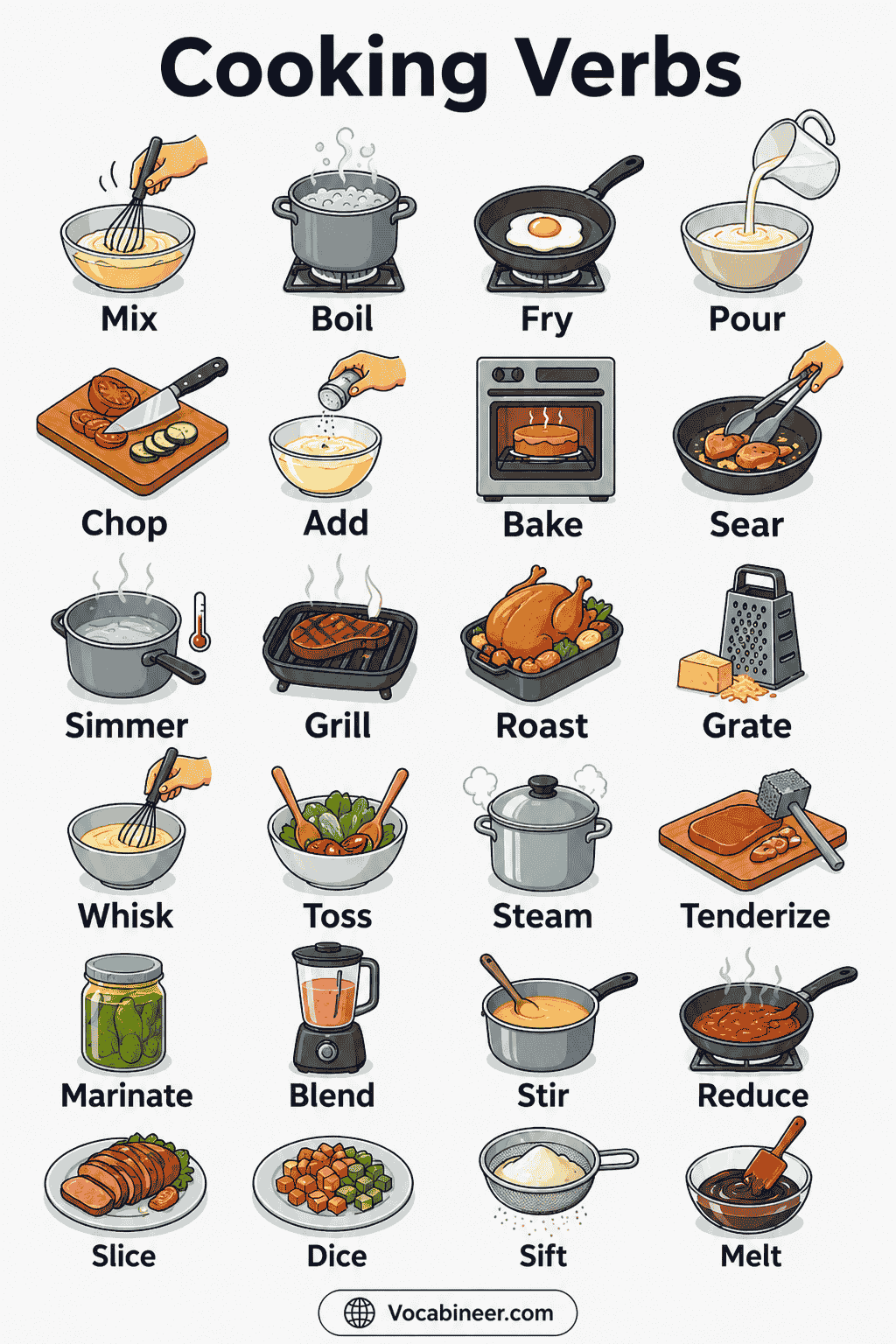
Texture and Consistency Cooking Verbs
Texture and consistency cooking verbs describe how food changes in thickness, softness, smoothness, firmness, or surface feel. These verbs are common in sauces, baking, desserts, meat recipes, and food preparation.
| Verb | Meaning | Example |
|---|---|---|
| Thicken | Make a liquid denser | Thicken the sauce. |
| Reduce | Cook liquid to make it less and stronger | Reduce the soup. |
| Melt | Turn solid food into liquid | Melt the butter. |
| Soften | Make food less hard | Soften the butter. |
| Crisp | Make food firm and crunchy | Crisp the potatoes. |
| Tenderize | Make meat softer | Tenderize the steak. |
| Whip | Beat food quickly to add air | Whip the cream. |
| Glaze | Cover food with a shiny layer | Glaze the cake. |
| Dust | Lightly sprinkle a dry ingredient | Dust the cake with sugar. |
| Brush | Apply liquid with a brush | Brush oil on the bread. |
| Stuff | Fill food with another mixture | Stuff the peppers. |
| Chill | Cool food in the refrigerator | Chill the dessert. |
| Freeze | Make food very cold or solid | Freeze the fruit. |
Flavor and Seasoning Verbs
Flavor and seasoning verbs describe how we add taste, smell, color, or decoration to food. These verbs are common in recipes and cooking instructions.
Season
To season means to add salt, spices, herbs, or other flavorings to food.
Salt
To salt means to add salt to food. You can salt pasta water, meat, soup, or vegetables.
Spice
To spice means to add spices to food. A dish can be spiced with chili, cumin, pepper, or cinnamon.
Marinate
To marinate means to soak food in a flavored liquid before cooking. Meat, fish, tofu, and vegetables can be marinated.
Sprinkle
To sprinkle means to scatter a small amount of something over food. You can sprinkle salt, sugar, cheese, or herbs.
Garnish
To garnish means to decorate food before serving. Herbs, lemon slices, nuts, and sauces can be used as garnishes.
Drizzle
To drizzle means to pour a small amount of liquid in a thin stream. You can drizzle oil, honey, sauce, or chocolate.
Coat
To coat means to cover food with another ingredient. Chicken can be coated with flour, and vegetables can be coated with oil.
Serving and Plating Verbs
Serving and plating verbs describe what happens when food is ready to eat. They are useful in recipes, restaurants, cooking videos, and daily conversation.
Serve
To serve means to give food to people. You can serve soup, rice, salad, tea, or dessert.
Plate
To plate means to arrange food on a plate before serving. Chefs often plate food neatly.
Pour
To pour means to move liquid from one container to another. You can pour tea, milk, sauce, or juice.
Scoop
To scoop means to lift food with a spoon or scoop. You can scoop ice cream, rice, soup, or batter.
Spread
To spread means to put a soft food over a surface. You can spread butter, jam, sauce, or cream cheese.
Dip
To dip means to put food briefly into sauce or liquid. Chips, bread, fruit, and vegetables can be dipped.
Portion
To portion means to divide food into serving amounts. You can portion rice, pasta, meat, or dessert.
Garnish
To garnish means to add a final decoration or flavor before serving. You can garnish food with herbs, nuts, sauce, or lemon.
Cooking Verbs by Cooking Stage
Cooking usually happens in stages. Grouping cooking verbs by stage helps learners understand which actions happen before, during, and after cooking.
| Cooking Stage | Common Verbs | Example Use |
|---|---|---|
| Before cooking | wash, peel, chop, slice, dice, measure, marinate, season | Wash the vegetables and chop the onions. |
| During cooking | boil, simmer, fry, bake, roast, grill, stir, reduce | Simmer the sauce and stir it often. |
| After cooking | cool, garnish, plate, serve, store, reheat | Plate the food and serve it warm. |
Cooking Verbs by Kitchen Tool
Some cooking verbs are closely connected to kitchen tools. Learning verbs with tools makes recipe instructions easier to understand.
| Kitchen Tool | Common Cooking Verbs | Example Use |
|---|---|---|
| Oven | bake, roast, broil, toast, preheat | Preheat the oven and bake the bread. |
| Pan | fry, sauté, sear, brown, stir-fry | Sauté the onions in a pan. |
| Grill | grill, char, smoke | Grill the chicken until cooked. |
| Blender or mixer | blend, puree, whisk, beat | Blend the fruit until smooth. |
| Knife | cut, chop, slice, dice, mince | Slice the tomatoes with a knife. |
| Pot | boil, simmer, steam, poach | Boil the pasta in a pot. |
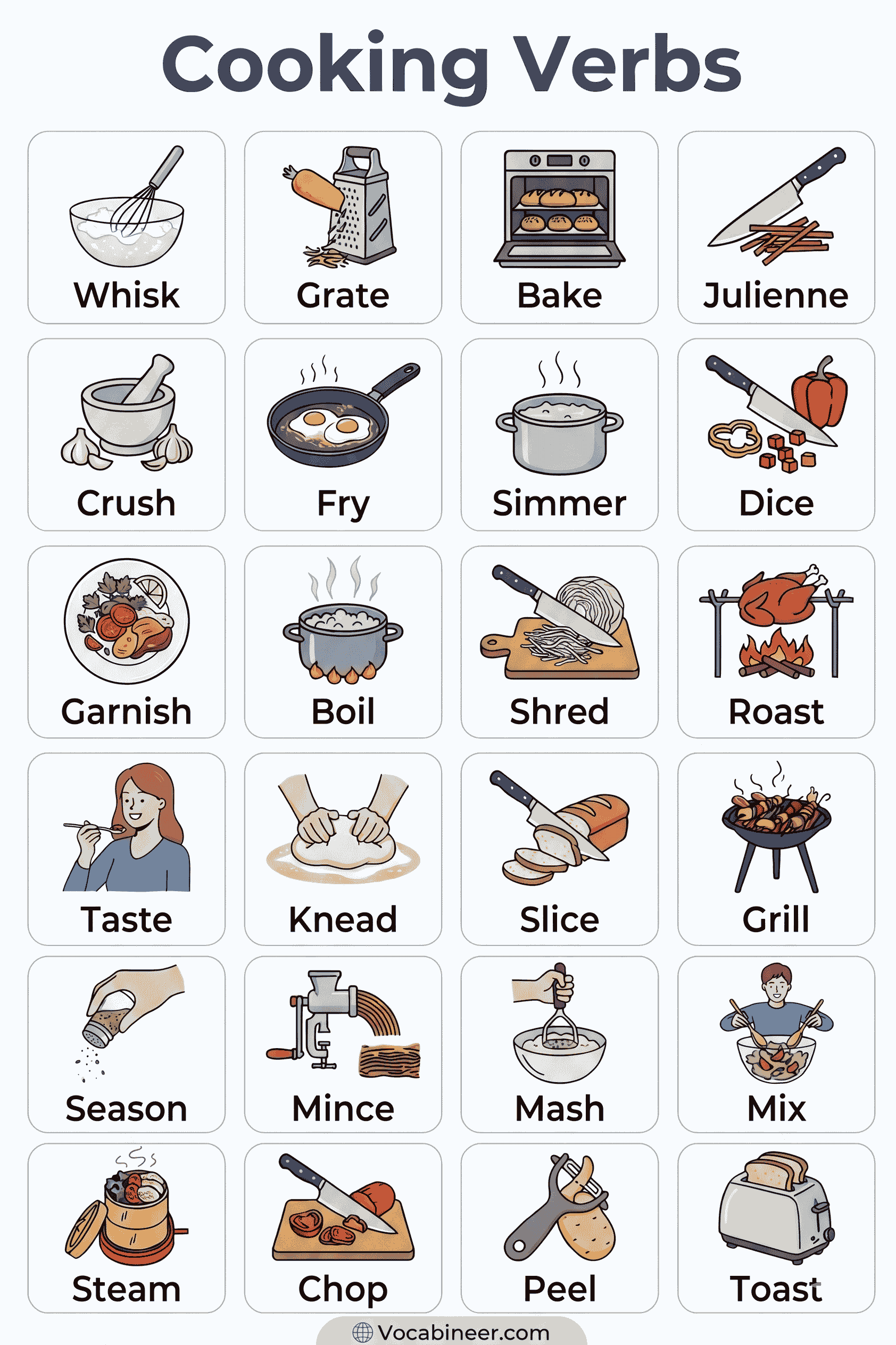
How to Use Cooking Verbs in Sentences
Cooking verbs are often used with ingredients, kitchen tools, and cooking methods. In recipes, they usually appear as commands.
Examples:
- Chop the onions.
- Boil the pasta for ten minutes.
- Stir the sauce slowly.
- Bake the cake until golden.
- Season the chicken with salt and pepper.
- Serve the soup with bread.
You can also use cooking verbs in everyday sentences:
- I made breakfast this morning.
- She fried eggs for lunch.
- We grilled vegetables yesterday.
- He washed the dishes after dinner.
- They prepared dinner together.
Cooking Verbs Used in Recipes
Recipe verbs tell the reader what action to do next. These verbs are usually short, direct, and easy to follow.
Common recipe verbs include:
- Preheat the oven.
- Chop the vegetables.
- Add the flour.
- Mix the ingredients.
- Stir the sauce.
- Simmer for 15 minutes.
- Bake until golden.
- Drain the pasta.
- Garnish with herbs.
- Serve immediately.
Cooking Verbs for Kids
Cooking verbs for kids should be simple, visual, and easy to act out. Children can learn these verbs by matching actions with pictures, toys, classroom activities, or safe kitchen practice.
Easy cooking verbs for kids include:
- Cook
- Mix
- Stir
- Pour
- Wash
- Taste
- Serve
- Bake
- Peel
- Roll
- Spread
- Dip
- Clean
Cooking Verbs Chart With Pictures
A cooking verbs chart with pictures helps learners remember vocabulary faster. Each verb should be shown with a clear picture, a short meaning, and a simple example.
| Verb | Picture Idea | Example |
|---|---|---|
| Chop | Cutting onions | Chop the onions. |
| Slice | Sliced bread | Slice the bread. |
| Mix | Bowl and spoon | Mix the batter. |
| Stir | Soup in a pot | Stir the soup. |
| Boil | Bubbling water | Boil the water. |
| Fry | Eggs in a pan | Fry the eggs. |
| Bake | Cake in an oven | Bake the cake. |
| Grill | Food on a grill | Grill the chicken. |
| Season | Salt and spices | Season the food. |
| Serve | Plate of food | Serve the meal. |
Cooking Verbs in Past Tense
Past tense helps learners talk about cooking that already happened. Many cooking verbs are regular and take -ed, but some common verbs are irregular.
| Base Verb | Past Tense | Example |
|---|---|---|
| Cook | Cooked | I cooked dinner. |
| Chop | Chopped | She chopped onions. |
| Slice | Sliced | He sliced the bread. |
| Mix | Mixed | We mixed the batter. |
| Boil | Boiled | They boiled potatoes. |
| Fry | Fried | I fried eggs. |
| Bake | Baked | She baked cookies. |
| Grill | Grilled | We grilled fish. |
| Make | Made | He made soup. |
| Eat | Ate | They ate dinner. |
Difference Between Similar Cooking Verbs
Some cooking verbs look similar, but they have different meanings. This table explains common cooking verb differences in a simple way.
| Comparison | Main Difference | Example |
|---|---|---|
| Chop vs dice | Chop means to cut food into pieces, usually not perfectly equal. Dice means to cut food into small cube-shaped pieces. | Chop onions for soup; dice potatoes for salad. |
| Boil vs simmer | Boil means to cook liquid with strong bubbles. Simmer means to cook gently with small bubbles over low heat. | Boil pasta water; simmer soup. |
| Bake vs roast | Bake is usually used for bread, cakes, cookies, and pies. Roast is often used for meat, potatoes, and vegetables. | Bake a cake; roast chicken. |
| Fry vs sauté | Fry means to cook food in oil. Sauté means to cook quickly in a small amount of oil or butter. | Fry potatoes; sauté onions. |
| Mix vs stir | Mix means to combine ingredients. Stir means to move food around with a spoon or tool. | Mix flour and milk; stir soup. |
Common Mistakes When Using Cooking Verbs
Many learners confuse cooking verbs because some actions look similar. A few simple differences can make the verbs easier to use.
One common mistake is using cut, chop, slice, and dice as if they mean the same thing. Cut is general, chop means cut into pieces, slice means cut into thin pieces, and dice means cut into small cubes.
Another common mistake is confusing boil and simmer. Boiling uses strong heat and big bubbles, while simmering uses low heat and small bubbles.
Learners may also mix up bake and roast. Cakes and bread are usually baked, while meat and vegetables are often roasted.
Some people use stir and mix incorrectly. Stirring means moving food around with a spoon, while mixing means combining ingredients together.
How to Learn Cooking Verbs Easily
Cooking verbs are easier to learn when you connect each word with a real action. Instead of memorizing a long list, practice the verbs while watching, reading, or doing kitchen activities.
Helpful learning tips:
- Match each verb with a picture.
- Act out the verb when possible.
- Read simple recipes in English.
- Watch cooking videos and listen for verbs.
- Make flashcards with meanings and examples.
- Group verbs by action, such as cutting, mixing, or heating.
- Practice sentences like “I chopped the onion” or “She baked a cake.”
- Use past tense forms to describe meals you already cooked.
Related Cooking and Kitchen Vocabulary
Related cooking and kitchen vocabulary helps learners understand cooking verbs better. These topics are useful for students, kids, ESL learners, and anyone learning food-related English.
Useful related topics include:
- Kitchen tools
- Kitchen utensils
- Crockery items
- Food names
- Vegetable names
- Fruit names
- Spices names
- Cooking methods
- Restaurant vocabulary
- Recipe vocabulary
- Bakery items
FAQs
Cooking verbs are action words used in the kitchen, such as chop, slice, mix, stir, boil, fry, bake, season, and serve. They describe how food is prepared, cooked, or served.
Common cooking verbs include cook, cut, chop, slice, peel, mix, stir, boil, fry, bake, roast, grill, season, pour, and serve. These verbs are often used in recipes and daily cooking.
Chop means to cut food into pieces, usually not perfectly equal. Dice means to cut food into small, even cube-shaped pieces.
Boil means to cook liquid with strong bubbles over high heat. Simmer means to cook gently with small bubbles over low heat.
Common recipe verbs include preheat, chop, slice, add, mix, stir, simmer, bake, fry, drain, garnish, and serve. These verbs tell readers what action to do next.
Summary
Cooking verbs are important English action words used in food preparation, recipes, kitchen instructions, and daily conversation. Common cooking verbs include chop, slice, mix, stir, boil, fry, bake, grill, season, and serve. These verbs become easier to learn when they are grouped by category, practiced in sentences, and connected with pictures or real kitchen actions. By learning cooking verbs with meanings and examples, students, kids, beginners, and English learners can build stronger cooking vocabulary and understand recipes more easily.
Read More