

Lines are basic visual elements used in geometry, art, drawing, design, maps, graphs, and everyday objects. Different types of lines help show direction, shape, position, movement, distance, and relationships between points or objects.
Common examples include horizontal, vertical, diagonal, parallel, perpendicular, curved, dotted, dashed, zigzag, and wavy lines. Learning their names and features helps students understand diagrams, draw more accurately, read visual information, and recognize line patterns in both mathematics and daily life.
In This Page
What Are Types of Lines?
Types of lines are different forms, directions, patterns, or relationships that lines can have. A line may be straight, curved, horizontal, vertical, diagonal, dotted, dashed, parallel, perpendicular, or intersecting.
In math, a line is usually described as a straight path that extends endlessly in both directions. In art and design, the idea is broader because lines can bend, break, curve, repeat, or suggest movement.
These different line types help people:
- Draw shapes and outlines
- Understand geometry diagrams
- Explain angles and positions
- Create patterns and textures
- Organize visual designs
- Identify examples in real life
Why Types of Lines Matter
Types of lines matter because they show how objects are placed, shaped, connected, and seen. A horizontal line can create a calm and balanced feeling, while a diagonal line often suggests movement or action.
Students use lines to understand geometry, angles, shapes, and diagrams. Artists rely on them to sketch, outline, shade, and build compositions. Designers use lines to divide sections, guide attention, and make visual information easier to read.
Lines can show:
- Direction
- Movement
- Distance
- Shape
- Structure
- Texture
- Pattern
- Connection
Main Types of Lines With Names
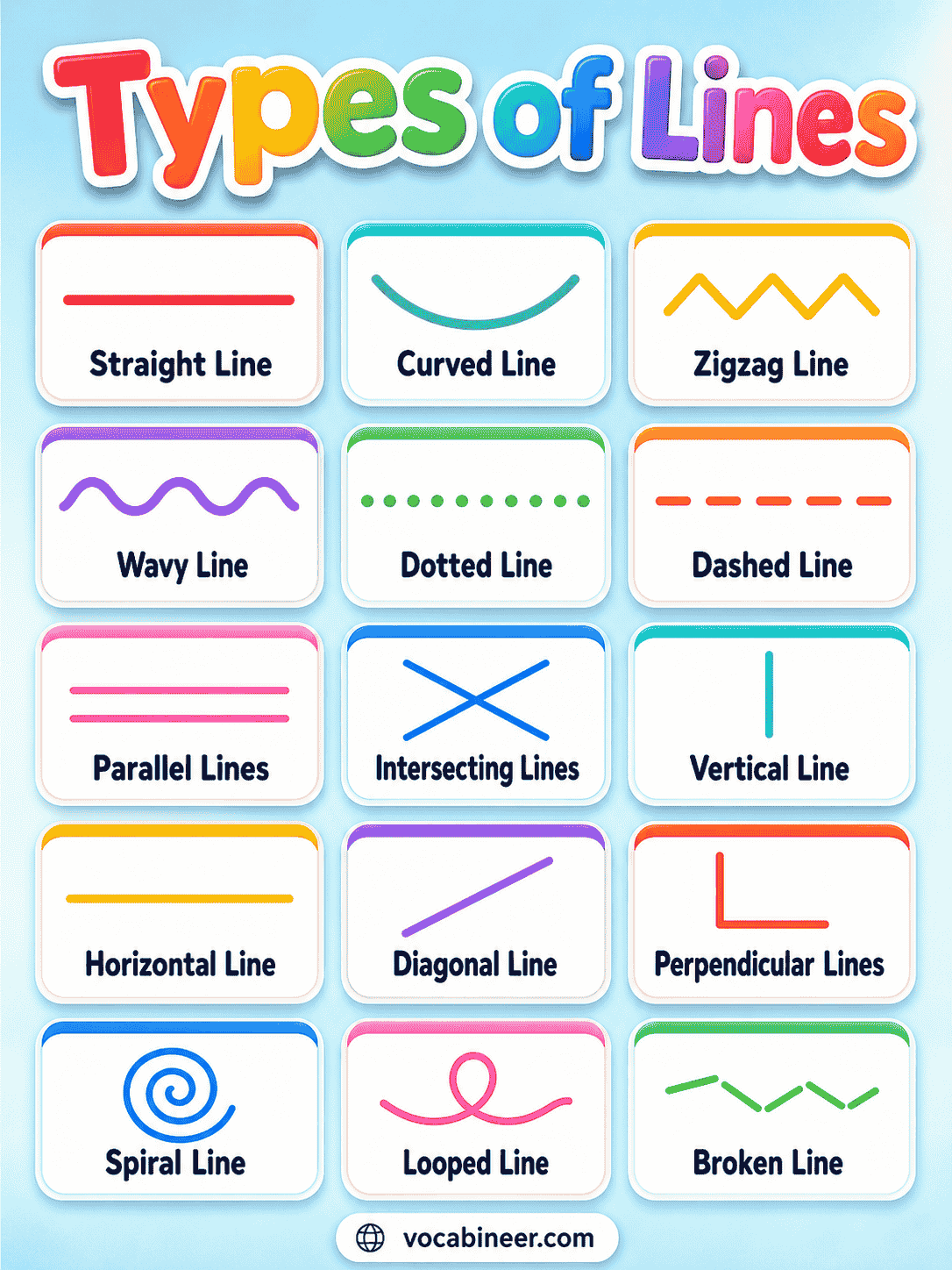
Lines can differ in direction, shape, position, and movement. Learning the main types of lines helps children and English learners recognize common line forms used in geometry, drawing, design, handwriting, and everyday objects.
Horizontal Line
A horizontal line runs from left to right and stays level across the page or surface. It does not rise or fall as it moves.
Vertical Line
A vertical line runs straight up and down. It forms a 90-degree angle with a horizontal line.
Diagonal Line
A diagonal line slants upward or downward instead of running horizontally or vertically. It often creates a sense of direction or movement.
Straight Line
A straight line follows one direction without bending or curving. In geometry, it extends endlessly in both directions.
Curved Line
A curved line bends smoothly instead of following a straight path. It can form arcs, waves, circles, and many other shapes.
Zigzag Line
A zigzag line changes direction sharply several times. It forms a repeated pattern of pointed angles.
Wavy Line
A wavy line moves smoothly up and down in a repeating pattern. It resembles small waves or flowing water.
Spiral Line
A spiral line curves around a central point while gradually moving inward or outward.
Parallel Lines
Parallel lines run in the same direction and remain the same distance apart. They never meet.
Perpendicular Lines
Perpendicular lines cross each other at a right angle. Their intersection forms four 90-degree angles.
Intersecting Lines
Intersecting lines cross at one point. The angles they form can vary depending on their direction.
Oblique Lines
Oblique lines cross or slant at angles other than 90 degrees. They are neither parallel nor perpendicular.
Broken Line
A broken line consists of separate straight segments connected at different angles. It can create an open or closed path.
Dotted Line
A dotted line uses a sequence of small dots instead of one continuous stroke. People often use it to show guides, paths, or boundaries.
Dashed Line
A dashed line consists of short line segments separated by spaces. It commonly marks hidden edges, lanes, guides, or temporary boundaries.
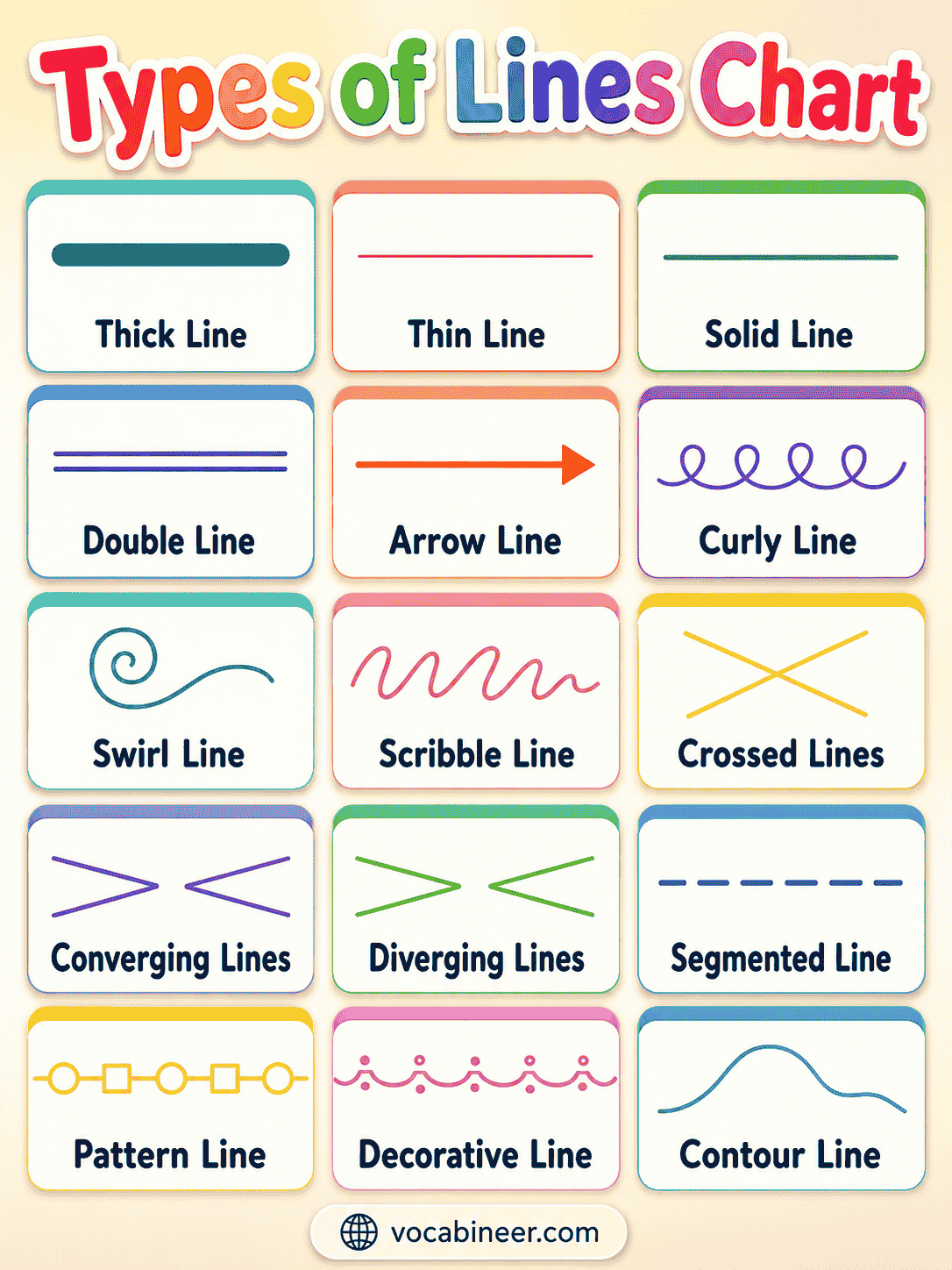
Thick Line
A thick line has greater visual width than a standard line. Artists and designers often use it for emphasis, borders, or strong outlines.
Thin Line
A thin line has a narrow width and creates a light, delicate appearance. It works well for details, guides, and fine drawings.
Slanting Line
A slanting line moves at an angle rather than straight across or straight up and down. It can lean to the left or right.
Converging Lines
Converging lines move closer together and eventually meet at a point. Artists often use them to create depth and perspective.
Diverging Lines
Diverging lines begin near each other and move farther apart. They create the opposite visual effect of converging lines.
Types of Lines by Category
Line categories make the topic easier to understand. Some lines are named by direction, some by shape, and others by how they relate to other lines.
| Category | Common Line Types | What They Show |
|---|---|---|
| Direction-based lines | Horizontal, vertical, diagonal | Direction or position |
| Shape-based lines | Straight, curved, wavy, zigzag, spiral | Visual form |
| Relationship-based lines | Parallel, perpendicular, intersecting, transversal | How lines connect or cross |
| Math-related lines | Line, line segment, ray | Geometry structure |
| Art and drawing lines | Outline, contour, gesture, implied | Form, movement, and expression |
| Pattern-based lines | Dotted, dashed, broken, thick, thin | Style or visual effect |
This table works as a category guide. The detailed sections below explain the most important line types with examples.
Types of Lines in Geometry
Geometry uses lines to explain direction, position, angles, distance, and relationships between shapes. These line types often appear in math lessons, diagrams, worksheets, maps, construction, and technical drawings.
Horizontal lines
Horizontal lines move from left to right. They often show flat surfaces, balance, and direction, such as the horizon, a shelf, or the edge of a table.
Vertical lines
Vertical lines move up and down. Tall objects like flagpoles, door frames, building edges, walls, and tree trunks are common examples.
Diagonal lines
Diagonal lines slant at an angle instead of moving straight across or straight up. Ramps, ladders, roof edges, and stair rails often show diagonal lines.
Parallel lines
Parallel lines stay the same distance apart and never meet. Railway tracks, notebook lines, road lanes, and fence rails are easy examples.
Perpendicular lines
Perpendicular lines meet at a 90-degree angle. Room corners, window frames, square corners, and the meeting point of a wall and floor often show perpendicular lines.
Intersecting lines
Intersecting lines cross each other at one point. They can form different angles depending on how the lines meet.
Transversal lines
A transversal line crosses two or more lines. In geometry, transversal lines are often used to study angle pairs, especially when they cross parallel lines.
Math Terms Related to Lines
Some math terms are connected to lines but are not always the same as everyday line types. These terms are important in geometry because they explain endpoints, direction, and measurement.
Line
A line extends endlessly in both directions. It has no fixed beginning or ending point.
Line segment
A line segment is part of a line with two endpoints. The edge of a book, a side of a square, or a measured part of a ruler can represent a line segment.
Ray
A ray starts at one endpoint and continues forever in one direction. Sun rays are a common real-life example used to explain this idea.
Transversal line
A transversal line crosses two or more lines. It is especially useful when studying angles created by parallel lines.
How Lines Form Angles
Lines form angles when they meet or cross. This is why understanding line types is important before learning angle types.
The most common angle connections include:
- Right angles: These form when perpendicular lines meet.
- Intersecting angles: These appear when two lines cross.
- Transversal angle pairs: These form when a transversal crosses two lines.
Perpendicular lines always create right angles. Intersecting lines can create different angle sizes. Transversal lines are often used to study corresponding angles, alternate interior angles, and same-side interior angles.
Shape-Based Line Types
Shape-based lines are named by how they look. These types of lines are common in drawing, handwriting, decoration, patterns, nature, and visual design.
Straight lines
Straight lines follow one direct path without bending. They are used in geometry, rulers, borders, road markings, building edges, and clean design layouts.
Curved lines
Curved lines bend smoothly instead of moving in a straight path. Rainbows, arches, smiles, rivers, and flower petals are simple examples.
Wavy lines
Wavy lines move in repeated soft curves. They are often used to show water, sound, hair, fabric, or decorative movement.
Zigzag lines
Zigzag lines have sharp repeated turns. Lightning, mountain patterns, warning signs, and energetic designs often use zigzag lines.
Spiral lines
Spiral lines curve around a center point. Shells, springs, coils, whirlpools, and decorative patterns often show spiral forms.
Broken lines
Broken lines have gaps, breaks, or disconnected parts. They may appear in sketches, diagrams, borders, maps, or paths.
Irregular lines
Irregular lines are uneven and unpredictable. Tree branches, cracks, rocks, rivers, and natural outlines often contain irregular lines.
Art and Drawing Line Types
Artists use lines to create shapes, outlines, movement, texture, depth, and emotion. In art, a line does not need to be perfectly straight or mathematical. It can be expressive, bold, soft, loose, dark, light, thick, or thin.
Outline lines
Outline lines show the outer edge of a shape or object. They help viewers recognize forms quickly in drawings, cartoons, icons, and illustrations.
Contour lines
Contour lines follow the edge or surface of an object. Artists use them to show shape, form, structure, and depth.
Gesture lines
Gesture lines are quick, loose lines that capture movement, posture, or action. They are commonly used in figure drawing and sketching.
Implied lines
Implied lines are suggested rather than fully drawn. A row of objects, a pointing hand, or a person’s gaze can guide the viewer’s eye like a line.
Thick lines
Thick lines create boldness, emphasis, and strength. Posters, logos, cartoons, and graphic illustrations often use thick lines to draw attention.
Thin lines
Thin lines add detail, softness, and delicacy. Fine sketches, technical drawings, elegant designs, and light outlines often use thin lines.
Dotted lines
Dotted lines are made of dots. They can show guides, paths, borders, cut marks, or areas that need attention.
Dashed lines
Dashed lines are made of short strokes. They often show hidden edges, temporary paths, map routes, road markings, or separated sections.
Meaning of Lines in Art and Design
Lines can change how an artwork, logo, layout, or design feels. Their direction, shape, and thickness affect the mood of the visual.
Common meanings include:
- Horizontal lines feel calm because they suggest rest, balance, and stability.
- Vertical lines show strength because they suggest height, structure, and power.
- Diagonal lines suggest movement because they slant forward or backward.
- Curved lines feel soft because they flow smoothly.
- Zigzag lines create energy because they have sharp turns and sudden changes.
Designers often choose line types based on the feeling they want to create. Calm designs may use horizontal or curved lines, while bold designs may use diagonal, thick, or zigzag lines.
Types of Lines Chart
This chart gives a quick reference for common line types, categories, and real examples.
| Line Type | Category | Common Example |
|---|---|---|
| Horizontal line | Direction | Horizon |
| Vertical line | Direction | Flagpole |
| Diagonal line | Direction | Ramp |
| Straight line | Shape | Ruler edge |
| Curved line | Shape | Rainbow |
| Wavy line | Shape | Ocean wave |
| Zigzag line | Shape | Lightning |
| Parallel lines | Relationship | Railway tracks |
| Perpendicular lines | Relationship | Room corner |
| Intersecting lines | Relationship | Crossroads |
| Dotted line | Pattern | Worksheet guide |
| Dashed line | Pattern | Road marking |
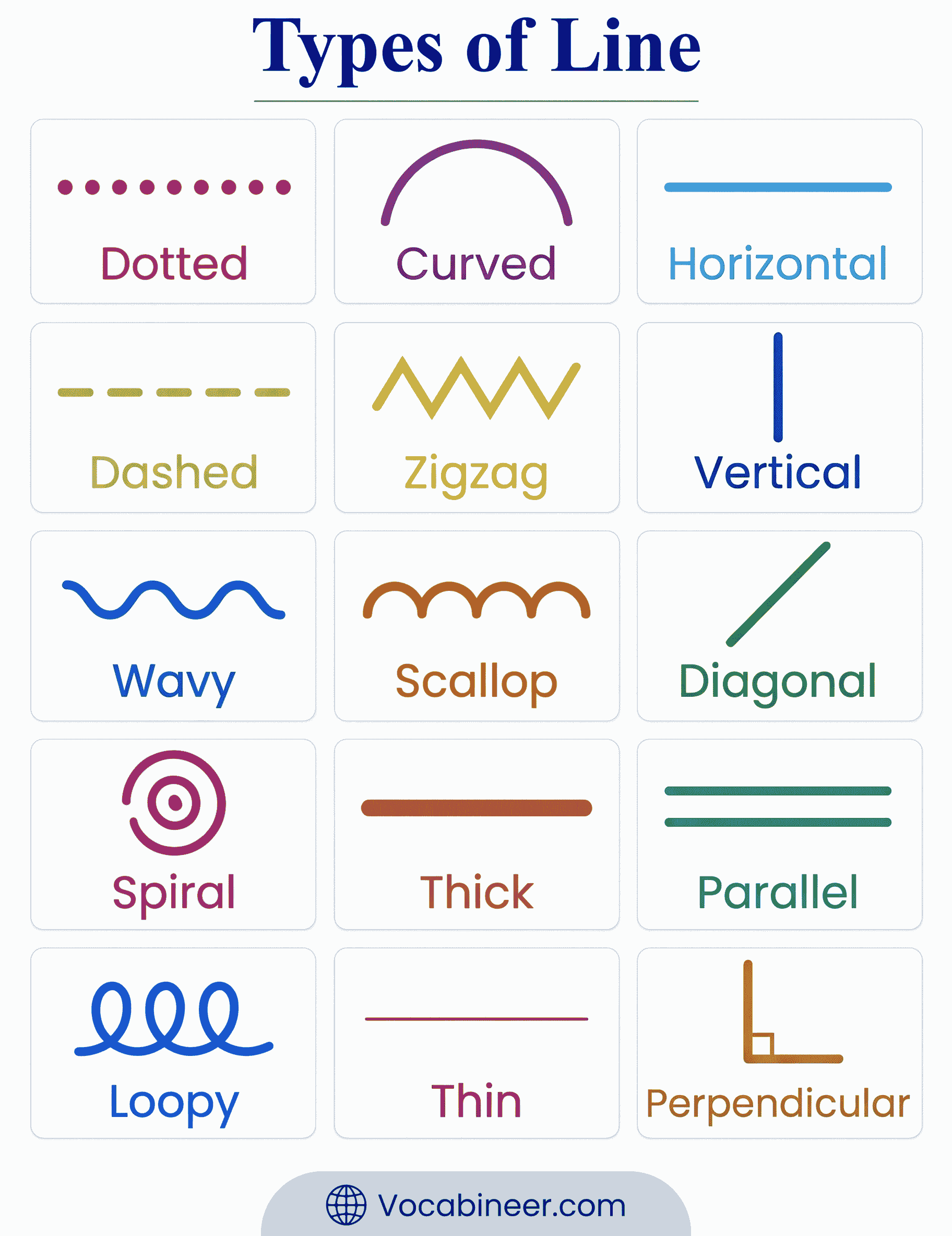
Visual Examples of Types of Lines
Visual examples make types of lines easier to remember. A geometry diagram may show horizontal, vertical, diagonal, parallel, perpendicular, intersecting, and transversal lines. An art worksheet may show outline, contour, gesture, thick, thin, dotted, and dashed lines.
Real objects also help. A door frame shows vertical and perpendicular lines. A table edge shows a horizontal line. Railway tracks show parallel lines. A rainbow shows a curved line, while ocean waves show wavy lines.
Nature gives many examples too, including spiral shells, irregular tree branches, winding rivers, and zigzag lightning.
Types of Lines With Simple Examples
Simple examples help students connect line names with real objects.
- Horizontal line: horizon, shelf, table edge, floor line
- Vertical line: flagpole, tree trunk, door side, building edge
- Diagonal line: ladder, ramp, staircase rail, slanted roof
- Straight line: ruler edge, pencil line, road marking
- Curved line: rainbow, smile, arch, river bend
- Parallel lines: railway tracks, notebook lines, road lanes
- Perpendicular lines: room corner, window frame, square corner
- Intersecting lines: crossroads, scissors, letter X
- Dotted line: coupon cut guide, worksheet path, map guide
- Dashed line: road lane marking, route line, hidden edge
- Zigzag line: lightning, mountain pattern, warning symbol
- Wavy line: ocean wave, curly hair, sound wave
- Spiral line: shell, coil, whirlpool, spring
How to Identify Types of Lines
You can identify a line type by looking at its direction, shape, endpoints, and relationship with other lines.
Use these simple checks:
- Look at the direction: Does the line move side to side, up and down, or at a slant?
- Check if the lines meet: Do they cross, stay apart, or meet at a right angle?
- Notice the shape: Is the line straight, curved, wavy, zigzag, or spiral?
- Look for endpoints: Does the line stop, continue forever, or start at one point?
- Compare with real-life objects: Does it look like a road, ladder, rainbow, or table edge?
A horizontal line moves side to side. A vertical line moves up and down. Parallel lines never meet, while perpendicular lines meet at a 90-degree angle.
Types of Lines for Kids
Kids can learn types of lines best through simple drawings and familiar objects. A table edge can show a horizontal line, and a door frame can show a vertical line. Railway tracks are helpful for parallel lines, while a rainbow is easy to use for curved lines.
Drawing activities also make learning fun. Children can draw a zigzag line like lightning, a wavy line like water, a spiral line like a snail shell, and dotted lines like a path on a treasure map.
Easy examples for kids include:
- A table edge for a horizontal line
- A door frame for a vertical line
- A ladder for a diagonal line
- Railway tracks for parallel lines
- A room corner for perpendicular lines
- A rainbow for a curved line
- Lightning for a zigzag line
- Ocean waves for wavy lines
A simple activity is to ask children to draw a house using a horizontal line, vertical line, diagonal line, curved line, and zigzag line.
Types of Lines Worksheet and Activity Ideas
Worksheets can help students practice line recognition, drawing, and comparison. A good worksheet may ask students to match each line with its name, draw examples, label lines in pictures, or find line types in classroom objects.
Useful activity ideas include:
- Match each line with its correct name.
- Draw horizontal, vertical, diagonal, curved, and zigzag lines.
- Find five line types in the classroom.
- Label lines in a picture or geometry diagram.
- Compare parallel and perpendicular lines.
- Create a small drawing using at least five types of lines.
Teachers can also ask students to look for lines at home, outdoors, or in school objects. This makes the topic more practical and easier to remember.
Examples of Types of Lines in Everyday Life
Lines appear everywhere in daily life. Buildings use vertical, horizontal, diagonal, and perpendicular lines in doors, windows, roofs, walls, and staircases. Roads use solid, dashed, parallel, and intersecting lines to guide traffic and separate lanes.
Nature is full of line examples. Waves create wavy lines, shells create spiral lines, tree branches form irregular lines, and lightning often looks like a zigzag line. Maps and graphs also depend on lines to show routes, borders, axes, trends, and directions.
You can find lines in:
- Architecture
- Road signs and lane markings
- Bridges and staircases
- Maps and graphs
- Waves and rivers
- Tree branches and leaves
- Technology screens
- Blueprints and diagrams
How Lines Are Used in Art, Design, and Branding
Art, design, and branding use lines to guide attention, create identity, and organize visual space. Graphic designers use lines to separate sections, build layouts, and add emphasis. Website designers use thin lines for dividers, icons, buttons, menus, and charts.
Fashion and pattern design also rely on lines. Stripes can make clothing feel structured, while wavy or zigzag patterns can create movement. Logos often use simple line shapes to communicate strength, speed, elegance, friendliness, or creativity.
Lines can be used in design to:
- Separate sections
- Create borders
- Guide the viewer’s eye
- Add movement
- Build patterns
- Show style or personality
- Make layouts easier to scan
A thin line can make a design feel clean and modern. A thick line may feel bold and powerful. Curved lines can make a brand feel soft or friendly, while diagonal lines often create an active and energetic look.
When to Use Different Types of Lines
Each line type works best in a different situation. Use horizontal lines when you want to show calmness, balance, or separation. Choose vertical lines when you want to suggest height, strength, or structure.
Diagonal lines are useful for showing movement or direction. Curved lines work well for soft, natural, and flowing designs. Parallel lines are helpful when showing order, distance, or repeated paths.
Use line types based on purpose:
- Horizontal lines: balance, calmness, separation
- Vertical lines: height, strength, structure
- Diagonal lines: action, direction, movement
- Curved lines: softness, flow, natural shapes
- Parallel lines: order, distance, repeated paths
- Perpendicular lines: grids, corners, right angles
- Dotted lines: guides, cut marks, paths
- Dashed lines: hidden paths, routes, temporary marks
- Zigzag lines: warning, energy, sharp movement
- Wavy lines: water, sound, decoration, motion
Types of Lines Comparison Guide
Some line types are easy to confuse, so comparisons are useful.
| Comparison | Main Difference |
|---|---|
| Straight vs curved lines | Straight lines do not bend, while curved lines bend smoothly |
| Parallel vs perpendicular lines | Parallel lines never meet, while perpendicular lines meet at 90 degrees |
| Intersecting vs perpendicular lines | Intersecting lines cross, but perpendicular lines cross at a right angle |
| Dotted vs dashed lines | Dotted lines use dots, while dashed lines use short strokes |
| Line vs line segment vs ray | A line has no endpoints, a segment has two, and a ray has one |
These differences are especially important in geometry. Clear comparisons also help students answer worksheet questions more accurately.
Common Mistakes When Learning Types of Lines
Many students mix up line types because some of them look similar at first. One common mistake is confusing horizontal and vertical lines. Horizontal lines move side to side, while vertical lines move up and down.
Another mistake is thinking parallel and perpendicular lines are the same. Parallel lines never meet, but perpendicular lines cross at a 90-degree angle.
Some learners also confuse a line, line segment, and ray. A line continues forever in both directions, a line segment stops at two endpoints, and a ray starts at one endpoint but continues in one direction.
Dotted and dashed lines can also cause confusion. Dotted lines are made of dots, while dashed lines are made of short strokes.
Summary
Types of lines are used in geometry, art, drawing, design, diagrams, and many everyday visual patterns. Common examples include horizontal, vertical, diagonal, straight, curved, parallel, perpendicular, intersecting, dotted, dashed, zigzag, wavy, spiral, broken, and irregular lines.
Each type of line serves a different purpose. Some show direction or position, while others create movement, structure, texture, or shape. In mathematics, lines also relate to line segments, rays, angles, and geometric figures, making this topic useful for students, kids, teachers, art lessons, worksheets, and beginner geometry practice.
FAQs
The main types of lines include horizontal, vertical, diagonal, straight, curved, parallel, perpendicular, intersecting, dotted, dashed, zigzag, and wavy lines. These lines are used in geometry, art, drawing, design, and everyday examples.
Types of lines in geometry include horizontal lines, vertical lines, diagonal lines, parallel lines, perpendicular lines, intersecting lines, and transversal lines. These lines help explain direction, position, angles, and relationships.
Parallel lines never meet because they stay the same distance apart. Perpendicular lines cross each other at a 90-degree angle, such as the corner of a square or the meeting point of a wall and floor.
A line extends endlessly in both directions. A line segment has two endpoints, so it stops at both ends. A ray starts at one endpoint and continues forever in one direction.
Teach types of lines to kids with simple drawings, classroom objects, and real-life examples. Use a table edge for a horizontal line, a door frame for a vertical line, railway tracks for parallel lines, and a rainbow for a curved line.
Read More