

Crystals are natural or polished stones known for their colors, shapes, patterns, and symbolic meanings. People collect crystals for decoration, jewelry, learning, meditation, gifts, and visual identification.
Many crystal names are also used as gemstone names, mineral names, or symbolic crystal names. This guide explains common crystal names with pictures, types of crystals, crystal colors, quartz crystals, gemstone crystals, crystal shapes, beginner crystals, symbolic meanings, care tips, and image metadata.
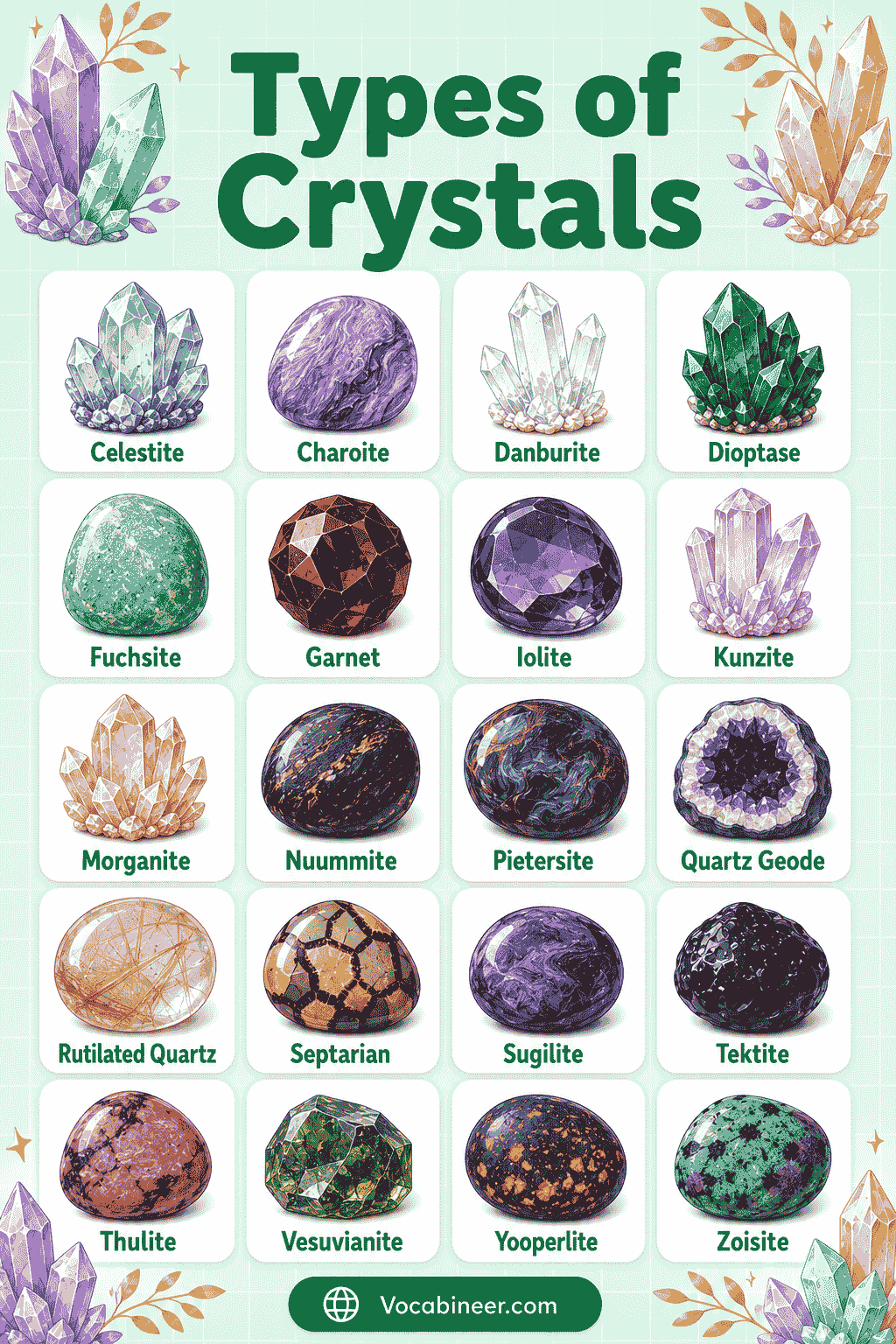
In This Page
Common Crystal Names
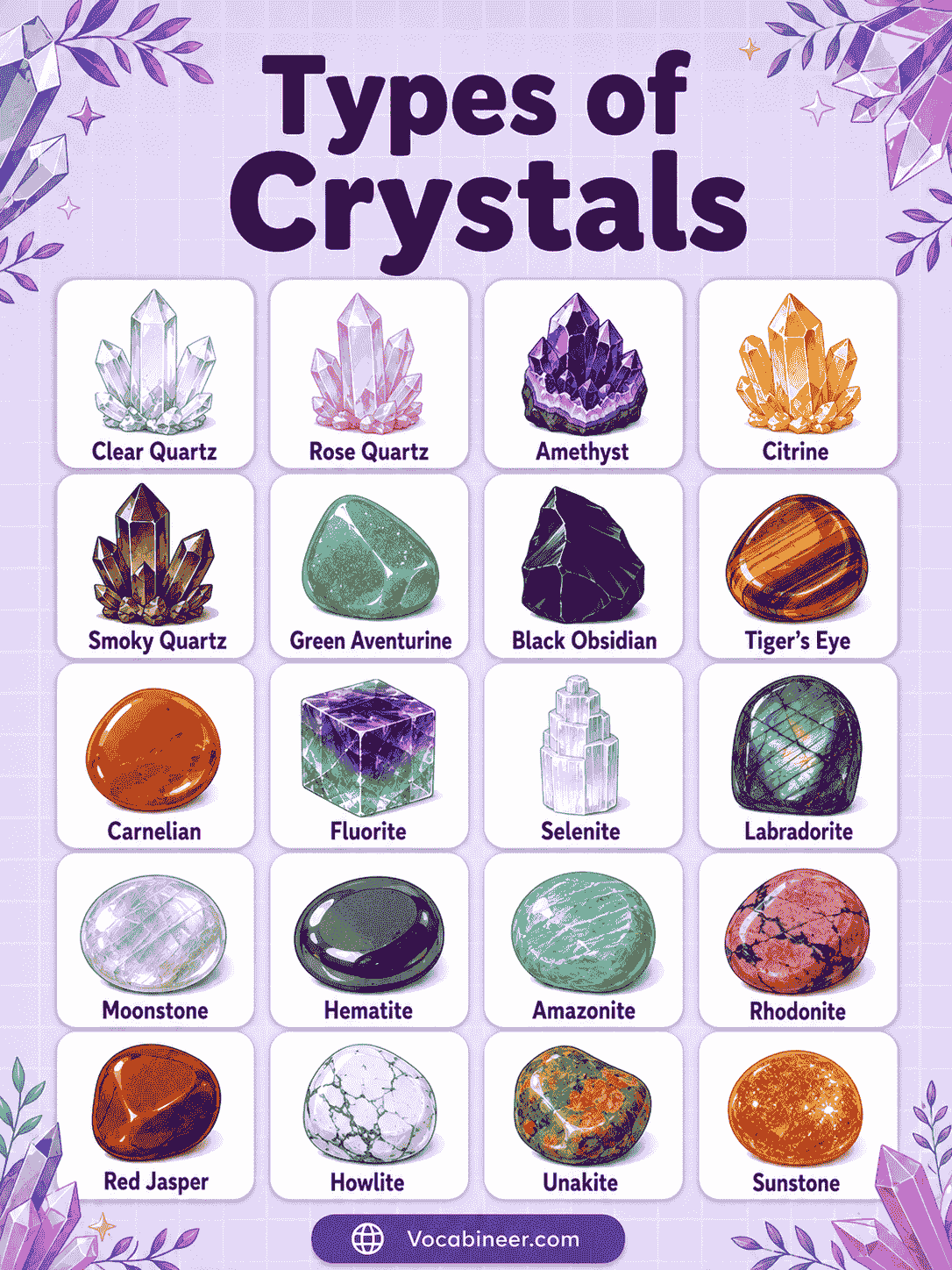
Common crystals are the stones most people see in crystal shops, jewelry, collections, and beginner guides. These names are useful for learning crystal vocabulary and identifying crystals by color, shape, or appearance.
- Clear Quartz — a clear or milky crystal often used as a basic beginner crystal.
- Rose Quartz — a soft pink crystal known for its gentle color and symbolic love meaning.
- Amethyst — a purple crystal often used in jewelry, clusters, and decorative pieces.
- Citrine — a yellow to golden quartz name often used for natural or treated stones.
- Black Tourmaline — a black crystal often used symbolically for protection and grounding.
- Selenite — a white or clear crystal with a soft, silky shine.
- Obsidian — a dark volcanic glass often grouped with black crystals.
- Tiger’s Eye — a brown and golden stone with a striped glowing effect.
- Lapis Lazuli — a deep blue stone with golden-looking flecks.
- Carnelian — an orange to red crystal often used in beads and jewelry.
- Green Aventurine — a green crystal with a smooth and natural look.
- Jasper — a stone group found in many earthy colors and patterns.
- Agate — a banded stone that appears in many colors and designs.
- Fluorite — a crystal that can appear purple, green, blue, yellow, or clear.
- Malachite — a green stone with bold bands and swirling patterns.
Popular Crystal Names and Symbolic Meanings
Crystal meanings are usually traditional, symbolic, spiritual, or personal. They are not medical facts and should not replace professional advice, treatment, or diagnosis.
- Clear Quartz — often called a symbolic clarity and focus crystal.
- Rose Quartz — traditionally linked with love, kindness, and emotional softness.
- Amethyst — often associated with calm, peace, and reflection.
- Citrine — commonly connected with joy, confidence, and bright energy.
- Black Tourmaline — often used symbolically for protection and grounding.
- Selenite — linked with cleansing, clarity, and peaceful spaces.
- Tiger’s Eye — traditionally connected with courage, focus, and confidence.
- Carnelian — often associated with creativity, motivation, and warmth.
- Green Aventurine — commonly linked with luck, growth, and opportunity.
- Hematite — often used symbolically for grounding and balance.
- Labradorite — linked with intuition, mystery, and transformation.
- Moonstone — traditionally connected with calm, cycles, and gentle energy.
Crystal Names by Color
Color is one of the easiest ways to identify crystals. Some crystals appear in one main color, while others have many shades, bands, or mixed patterns.
- Purple Crystals — amethyst, lepidolite, charoite, purple fluorite.
- Pink Crystals — rose quartz, rhodonite, pink opal, kunzite.
- Green Crystals — green aventurine, malachite, jade, amazonite.
- Blue Crystals — lapis lazuli, sodalite, aquamarine, blue lace agate.
- Black Crystals — black tourmaline, obsidian, onyx, hematite.
- Yellow Crystals — citrine, pyrite, tiger’s eye, yellow jasper.
- White Crystals — selenite, moonstone, howlite, white quartz.
- Clear Crystals — clear quartz, optical calcite, clear topaz.
- Red Crystals — garnet, red jasper, ruby.
- Orange Crystals — carnelian, sunstone, orange calcite.
- Brown Crystals — smoky quartz, brown jasper, tiger’s eye.
Crystal Names by Purpose
Crystal names by purpose are based on traditional or symbolic meanings. These groups help readers learn common crystal associations without treating them as medical claims.
- Protection Crystals — black tourmaline, obsidian, onyx.
- Love Crystals — rose quartz, rhodonite, pink opal.
- Calm Crystals — amethyst, lepidolite, blue lace agate.
- Focus Crystals — fluorite, clear quartz, tiger’s eye.
- Confidence Crystals — citrine, carnelian, tiger’s eye.
- Grounding Crystals — hematite, smoky quartz, black tourmaline.
- Creativity Crystals — carnelian, orange calcite, sunstone.
- Decorative Crystals — selenite, pyrite, amethyst cluster.
Quartz Crystal Names
Quartz is one of the most common crystal families. Many popular crystals are quartz varieties or closely connected to quartz-based names.
- Clear Quartz — a transparent or milky quartz crystal.
- Rose Quartz — a pink quartz crystal often used in jewelry and decor.
- Smoky Quartz — a brown or gray quartz crystal with a smoky look.
- Amethyst — a purple quartz variety.
- Citrine — a yellow to golden quartz name used for natural or treated stones.
- Milky Quartz — a white cloudy quartz crystal.
- Rutilated Quartz — quartz with needle-like mineral inclusions.
- Tourmalinated Quartz — quartz with black tourmaline inclusions.
- Lemon Quartz — a yellow quartz name used for bright lemon-colored stones.
- Spirit Quartz — a quartz cluster covered with tiny crystal points.
- Ametrine — a crystal that combines amethyst and citrine colors.
- Prasiolite — a green quartz variety sometimes called green amethyst.
Gemstone Crystal Names
Some crystals are also popular gemstones. These names are common in jewelry, beads, rings, pendants, and polished stone collections.
- Amethyst — a purple gemstone and quartz variety.
- Aquamarine — a blue to blue-green gemstone from the beryl family.
- Garnet — a gemstone often seen in deep red shades.
- Turquoise — a blue-green stone used in jewelry and decoration.
- Lapis Lazuli — a deep blue stone with golden-looking flecks.
- Moonstone — a soft glowing gemstone from the feldspar family.
- Labradorite — a stone known for colorful flashes called labradorescence.
- Jade — a green gemstone used in carvings and jewelry.
- Malachite — a green patterned stone with strong bands.
- Onyx — a dark stone often used in beads and jewelry.
- Ruby — a red precious gemstone.
- Sapphire — a gemstone best known for blue color.
Crystal Names for Jewelry
Many crystals are used in jewelry because of their colors, polish, shine, and symbolic meanings. Some are used as beads, while others are cut into cabochons, faceted stones, or pendants.
- Amethyst — popular for rings, necklaces, and earrings.
- Rose Quartz — used in beads, pendants, and heart-shaped jewelry.
- Moonstone — valued for its soft glow in rings and necklaces.
- Labradorite — used for jewelry because of its colorful flash.
- Garnet — a deep red gemstone often used in classic jewelry.
- Turquoise — common in rings, bracelets, and traditional jewelry.
- Onyx — used for black beads, rings, and pendants.
- Lapis Lazuli — popular for blue beads and statement pieces.
- Aquamarine — used in elegant blue gemstone jewelry.
- Citrine — used in yellow gemstone rings and pendants.
- Carnelian — common in orange-red beads and bracelets.
- Jade — used in bangles, pendants, beads, and carvings.
Raw and Tumbled Crystal Names
Raw crystals look closer to their natural form, while tumbled stones are polished until smooth. Both forms are popular for collections, decoration, and learning crystal names.
- Raw Amethyst — a natural-looking purple crystal often seen in clusters.
- Tumbled Amethyst — a smooth polished purple stone.
- Raw Rose Quartz — a rough pink crystal with a cloudy look.
- Tumbled Rose Quartz — a smooth pink stone used in collections and gifts.
- Raw Citrine — a yellow crystal in rough or natural-looking form.
- Tumbled Citrine — a polished yellow stone with a smooth surface.
- Raw Black Tourmaline — a rough black crystal with long striations.
- Tumbled Black Tourmaline — a polished black stone used in crystal sets.
- Raw Clear Quartz — a natural quartz point or rough quartz piece.
- Tumbled Clear Quartz — a clear or milky polished quartz stone.
- Raw Malachite — a natural green stone with bold banded patterns.
- Tumbled Tiger’s Eye — a smooth golden-brown stone with a glowing stripe effect.
Crystal Shapes and Forms
Crystal shapes and forms describe how a crystal looks or how it has been cut, polished, or displayed. These terms are useful for identifying crystals in shops, pictures, and collections.
- Tumbled Stones — smooth polished stones often used in beginner crystal sets.
- Raw Crystals — rough stones that keep a natural-looking surface.
- Crystal Clusters — groups of crystals growing together.
- Crystal Points — crystals with pointed ends.
- Crystal Towers — tall polished crystals shaped with a pointed top.
- Crystal Wands — long polished crystal shapes used for decoration or symbolic use.
- Geodes — hollow rocks lined with crystals inside.
- Crystal Spheres — round polished crystal balls.
- Crystal Pyramids — crystals shaped like small pyramids.
- Crystal Hearts — heart-shaped polished stones often used as gifts.
- Crystal Beads — small rounded stones used in bracelets and necklaces.
- Faceted Stones — cut stones with flat polished faces for sparkle.
Beginner Crystal Names
Beginner crystals are common, easy to recognize, and widely available. They are often used for learning crystal names, building a small collection, or starting a simple crystal display.
- Clear Quartz — a basic crystal name every beginner should know.
- Rose Quartz — an easy pink crystal to recognize.
- Amethyst — a popular purple crystal for beginners.
- Citrine — a yellow quartz name often used in beginner crystal lists.
- Black Tourmaline — a common black crystal with a rough look.
- Selenite — a soft white crystal with a silky shine.
- Tiger’s Eye — a brown and gold stone with a striped glow.
- Carnelian — a warm orange crystal used in beginner collections.
- Green Aventurine — a smooth green stone often sold in tumbled form.
- Hematite — a dark metallic-looking stone.
- Fluorite — a colorful crystal that can show purple, green, or blue shades.
- Smoky Quartz — a brown or gray quartz crystal with a smoky color.
Crystal Names by Mineral Family
Crystal names can also be grouped by mineral family. This section keeps the science simple and helps readers understand how some crystals are related.
- Quartz Family — clear quartz, rose quartz, amethyst, citrine.
- Feldspar Family — moonstone, labradorite, sunstone, amazonite.
- Calcite Family — orange calcite, blue calcite, optical calcite, honey calcite.
- Tourmaline Family — black tourmaline, pink tourmaline, green tourmaline, watermelon tourmaline.
- Beryl Family — aquamarine, emerald, morganite, heliodor.
- Jasper and Agate Group — red jasper, ocean jasper, moss agate, blue lace agate.
Crystal Meanings and Uses
Crystal meanings are often symbolic, spiritual, cultural, or personal. Many people use crystals for decoration, jewelry, meditation, collecting, display, gifts, and intention setting.
- Jewelry — amethyst, rose quartz, moonstone, garnet, turquoise, and onyx are common jewelry stones.
- Decoration — amethyst clusters, selenite towers, pyrite pieces, and geodes are used for display.
- Meditation — clear quartz, amethyst, rose quartz, and selenite are often used symbolically during quiet practice.
- Collection — beginners often collect tumbled stones, raw crystals, quartz points, and crystal clusters.
- Gifts — rose quartz hearts, amethyst points, crystal bracelets, and tumbled stone sets are common gifts.
- Intention Setting — some people choose crystals by symbolic meaning, color, or personal connection.
- Learning — crystal charts help students and beginners match names with pictures.
- Display — crystal shelves, bowls, trays, and stands are used to organize crystal collections.
Natural and Man Made Crystal Terms
Some crystal terms describe how a stone formed or how it was changed. This table helps explain natural crystals, synthetic stones, dyed stones, and imitation materials.
| Term | Simple Meaning |
|---|---|
| Natural Crystal | A crystal formed naturally in the earth. |
| Synthetic Crystal | A lab-created material made to match or imitate a natural crystal or gemstone. |
| Dyed Stone | A stone colored with dye to change or improve appearance. |
| Heat-Treated Stone | A stone changed by heat to improve color or clarity. |
| Glass Imitation | Glass made to look like a crystal or gemstone. |
| Aura-Coated Crystal | A crystal coated with metal vapor to create rainbow colors. |
Confusing Crystal Terms Explained
Some crystal terms sound similar but mean different things. These simple comparisons help beginners understand crystal vocabulary more clearly.
| Crystal Terms | Difference |
|---|---|
| Crystal vs Gemstone | A crystal has an ordered structure, while a gemstone is a stone valued for beauty, rarity, or jewelry use. |
| Crystal vs Mineral | A mineral is a natural solid substance, while a crystal describes a structured form that many minerals can have. |
| Raw Crystal vs Tumbled Stone | A raw crystal looks rough and natural, while a tumbled stone is polished smooth. |
| Geode vs Crystal Cluster | A geode is a hollow rock lined with crystals, while a cluster is a group of crystals growing together. |
| Quartz vs Clear Quartz | Quartz is a mineral family, while clear quartz is one transparent or milky type of quartz. |
| Amethyst vs Purple Fluorite | Amethyst is purple quartz, while purple fluorite is a different mineral that can also appear purple. |
| Citrine vs Yellow Quartz | Citrine is a yellow quartz name often used for natural or treated yellow quartz stones. |
| Selenite vs Satin Spar | Many crystal shops use “selenite” for satin spar, but satin spar is the common fibrous white form sold as wands and towers. |
| Obsidian vs Black Tourmaline | Obsidian is volcanic glass, while black tourmaline is a mineral crystal. |
| Jade vs Aventurine | Jade is a gemstone name for jadeite or nephrite, while aventurine is a quartz variety. |
Crystal Chart with Pictures
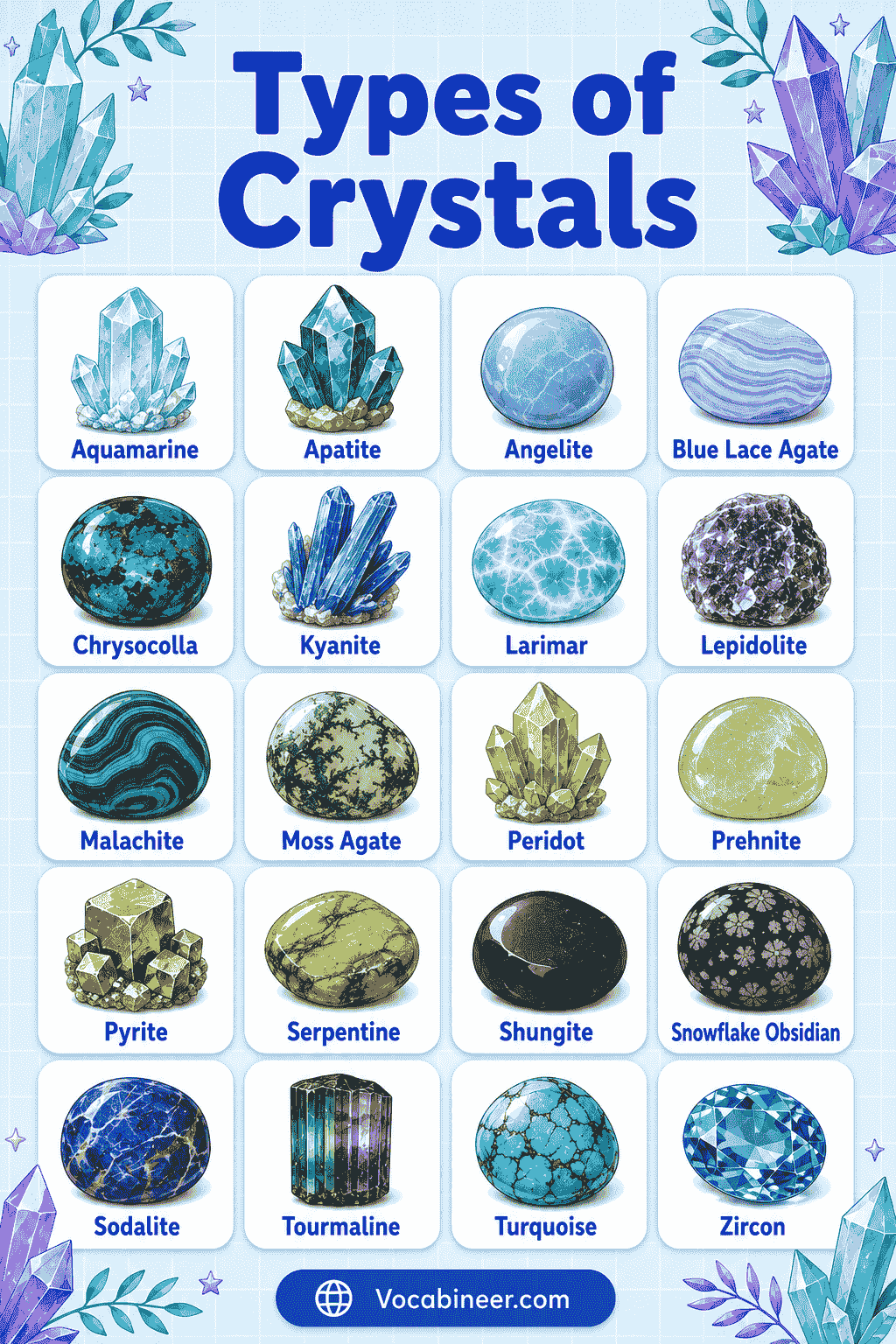
A crystal chart helps learners compare crystal groups quickly.
| Crystal Group | Details |
|---|---|
| Common Crystals | Best for: beginner crystal vocabularyExamples: clear quartz, rose quartz, amethyst |
| Colorful Crystals | Best for: visual identification by colorExamples: fluorite, malachite, lapis lazuli |
| Quartz Crystals | Best for: learning quartz family namesExamples: clear quartz, smoky quartz, citrine |
| Jewelry Crystals | Best for: rings, beads, bracelets, and pendantsExamples: garnet, moonstone, turquoise |
| Raw Crystals | Best for: natural-looking collectionsExamples: raw amethyst, raw quartz, raw black tourmaline |
| Tumbled Stones | Best for: smooth polished collectionsExamples: tumbled rose quartz, carnelian, tiger’s eye |
| Decorative Crystals | Best for: home display and crystal shelvesExamples: selenite tower, pyrite, geode |
Basic Crystal Care Tips
Crystals can fade, scratch, chip, or react badly to water depending on the stone. Simple care helps keep crystals clean, safe, and easy to display.
- Keep Soft Crystals Dry — selenite and some soft stones can be damaged by water.
- Avoid Strong Sunlight — amethyst, rose quartz, and some other stones may fade in direct sunlight.
- Store Carefully — keep fragile crystals in a pouch, box, tray, or soft cloth.
- Clean Gently — use a soft dry cloth for delicate crystals.
- Separate Hard and Soft Stones — harder crystals can scratch softer ones.
- Handle Raw Crystals Carefully — rough edges and points can chip or break.
- Check Before Washing — not every crystal is safe to rinse with water.
- Use Display Stands — points, spheres, and clusters can be safer on stands or stable surfaces.
FAQs
Common crystal names include clear quartz, rose quartz, amethyst, citrine, black tourmaline, selenite, obsidian, tiger’s eye, lapis lazuli, carnelian, green aventurine, jasper, agate, fluorite, and malachite.
Good beginner crystals include clear quartz, rose quartz, amethyst, citrine, black tourmaline, selenite, tiger’s eye, carnelian, green aventurine, hematite, fluorite, and smoky quartz.
You can start by matching the crystal’s color with common color groups. Purple crystals may include amethyst or lepidolite, pink crystals may include rose quartz or rhodonite, and green crystals may include aventurine, jade, or malachite.
A crystal has an ordered internal structure, while a gemstone is a stone valued for beauty, rarity, cutting, or jewelry use. Some stones can be both crystals and gemstones.
Common crystal shapes include raw crystals, tumbled stones, crystal clusters, points, towers, wands, geodes, spheres, pyramids, hearts, beads, cabochons, and faceted stones.
Read More
- Different Types of Minerals
- Nature Vocabulary Words
- Types of Rocks Names
- Different Types of Soil
- Types of Drinking Glasses