Exercises are physical activities that help the body move, stretch, strengthen, balance, and build stamina. Different types of exercises train different parts of fitness, such as heart health, muscle strength, flexibility, balance, core control, and endurance.
People learn exercise types for school lessons, fitness vocabulary, workout planning, and beginner training. This guide explains common exercise names, simple meanings, examples, body-area groups, confusing terms, beginner safety tips, and image metadata for a clear exercise vocabulary article.
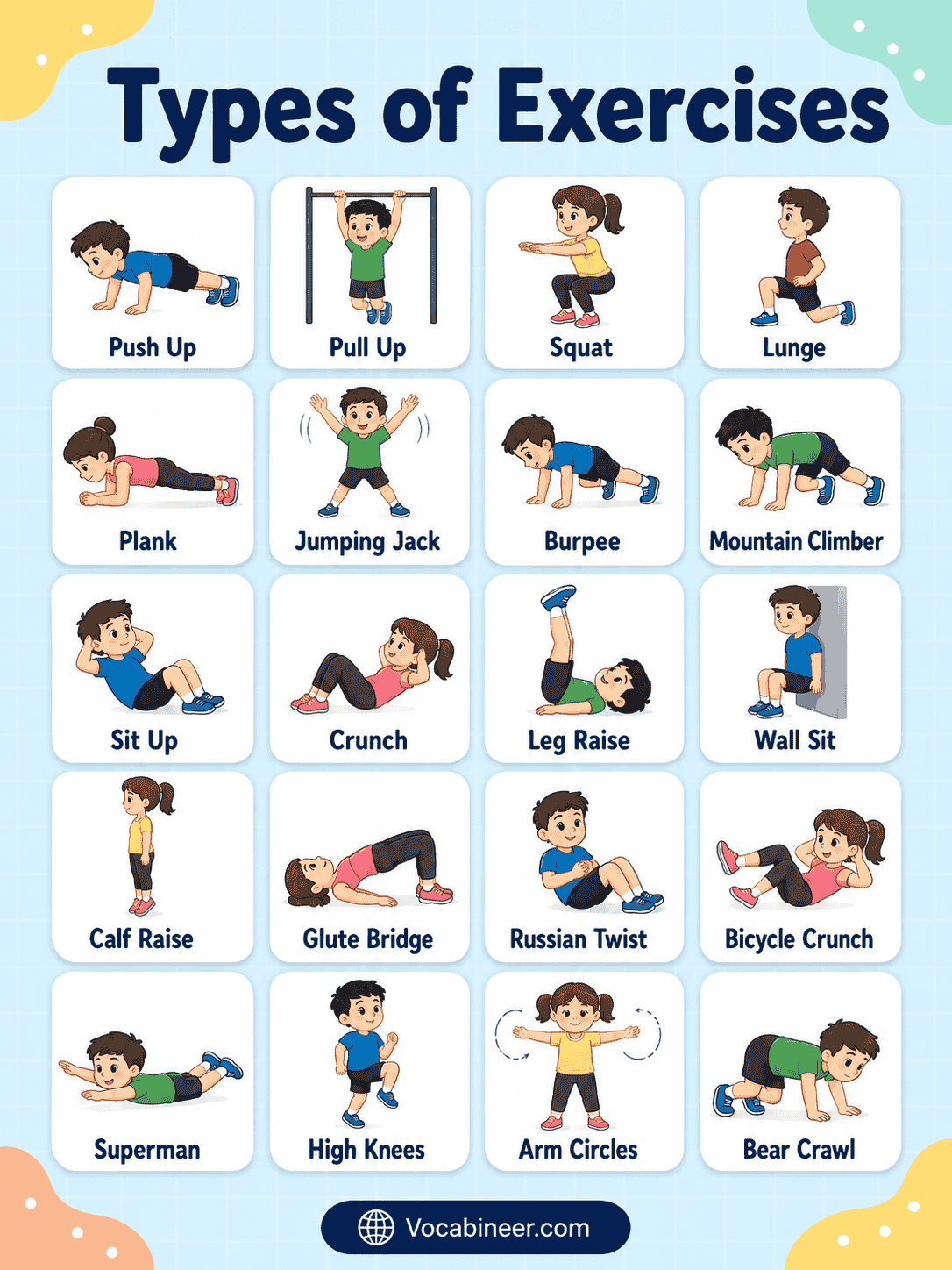
In This Page
Common Types of Exercises
Exercise types are usually grouped by how they train the body. Some exercises improve breathing and stamina, while others build strength, stretch muscles, improve balance, or support body control.
- Cardio Exercise — exercise that raises the heart rate and improves stamina.
- Aerobic Exercise — steady movement that uses oxygen and supports endurance.
- Anaerobic Exercise — short, intense exercise that uses quick bursts of energy.
- Strength Training — exercise that builds muscle strength.
- Resistance Training — exercise that uses body weight, bands, or weights for resistance.
- Flexibility Exercise — movement that helps muscles and joints stretch.
- Stretching Exercise — exercise used to lengthen muscles and improve range of motion.
- Balance Exercise — exercise that improves body control and stability.
- Core Exercise — exercise that strengthens the stomach, back, and trunk muscles.
- Endurance Exercise — exercise that helps the body stay active for longer.
- Mobility Exercise — movement that improves joint control and smooth motion.
- Bodyweight Exercise — exercise done using body weight instead of equipment.
- Weight Training — exercise done using dumbbells, barbells, or machines.
- HIIT — high-intensity interval training with short hard efforts and rest periods.
- Low Impact Exercise — exercise that puts less stress on the joints.
- Home Exercise — exercise that can be done at home with little or no equipment.
Cardio and Aerobic Exercises
Cardio and aerobic exercises use repeated movement to raise the heart rate and improve stamina. These exercises are often used for warm-ups, general fitness, and full-body activity.
- Walking — a simple exercise that can be done almost anywhere.
- Brisk Walking — faster walking that raises the heart rate more than normal walking.
- Running — a higher-impact cardio exercise done at a faster pace.
- Jogging — a steady slower run used for stamina and fitness.
- Cycling — riding a bicycle indoors or outdoors for cardio movement.
- Swimming — a full-body exercise done in water.
- Jumping Rope — a cardio exercise using a rope and repeated jumps.
- Dancing — rhythmic movement that improves stamina and coordination.
- Hiking — walking on trails, hills, or natural paths.
- Rowing — a cardio exercise that uses the arms, legs, and back.
- Stair Climbing — moving up stairs to train legs and stamina.
- Elliptical Training — a low-impact machine exercise for cardio fitness.
- Aerobic Dance — dance-based exercise done with continuous movement.
- Kickboxing — a cardio workout using punches, kicks, and footwork.
Strength and Resistance Exercises
Strength and resistance exercises train muscles by working against force. The force may come from body weight, dumbbells, resistance bands, gym machines, or weighted equipment.
- Squats — lower-body exercise that works the legs and glutes.
- Push-Ups — bodyweight exercise for the chest, shoulders, arms, and core.
- Pull-Ups — upper-body exercise that uses a bar to pull the body upward.
- Lunges — leg exercise that trains balance, thighs, and glutes.
- Deadlifts — strength exercise that works the legs, back, and hips.
- Bench Press — weight exercise for the chest, shoulders, and arms.
- Shoulder Press — exercise that pushes weight overhead to train shoulders.
- Bicep Curls — arm exercise that strengthens the front of the upper arm.
- Tricep Dips — exercise that trains the back of the upper arms.
- Glute Bridges — floor exercise that strengthens the glutes and hips.
- Wall Sits — leg exercise done by holding a seated position against a wall.
- Resistance Band Rows — back exercise using a resistance band.
- Dumbbell Exercises — strength movements done with dumbbells.
- Barbell Exercises — strength exercises done with a long weighted bar.
- Bodyweight Exercises — exercises like squats, push-ups, and planks done without weights.
Flexibility and Stretching Exercises
Flexibility and stretching exercises help muscles feel looser and support smoother movement. Some stretches are held still, while others use gentle motion.
- Static Stretching — a stretch held in one position for a short time.
- Dynamic Stretching — controlled movement used to warm up the body.
- Hamstring Stretch — stretch for the back of the thigh.
- Quad Stretch — stretch for the front of the thigh.
- Calf Stretch — stretch for the lower back part of the leg.
- Shoulder Stretch — stretch that loosens the shoulder area.
- Chest Stretch — stretch that opens the chest and front shoulders.
- Neck Stretch — gentle stretch for the neck muscles.
- Hip Flexor Stretch — stretch for the front of the hips.
- Child’s Pose — yoga-style stretch for the back and hips.
- Cat Cow Stretch — gentle spine movement done on hands and knees.
- Cobra Stretch — floor stretch that opens the chest and front body.
- Forward Fold — stretch that bends the body forward toward the legs.
- Yoga Stretches — stretches used in yoga poses and routines.
Balance Exercises
Balance exercises help the body stay steady while standing, moving, or changing position. They are useful for coordination, posture, and body control.
- Single Leg Stand — standing on one leg to improve balance.
- Heel to Toe Walk — walking in a straight line with one foot in front of the other.
- Tree Pose — a yoga balance pose done while standing on one leg.
- Tai Chi — slow controlled movement that improves balance and coordination.
- Standing Knee Raise — lifting one knee while standing tall.
- Side Leg Raise — lifting one leg to the side while standing.
- Balance Board Exercise — standing or moving on a board that challenges balance.
- Stability Ball Exercise — using a large exercise ball for balance and control.
- Bird Dog — balance exercise done on hands and knees.
- Single Leg Deadlift — strength and balance exercise done on one leg.
- Step Ups — stepping onto a raised surface to train balance and legs.
Core Exercises
Core exercises train the muscles around the stomach, lower back, hips, and trunk. A strong core supports posture, balance, and many full-body movements.
- Plank — holding the body straight while resting on hands or forearms.
- Side Plank — plank variation that trains the side core muscles.
- Crunches — abdominal exercise using a small upper-body lift.
- Sit-Ups — core exercise that lifts the upper body from the floor.
- Mountain Climbers — fast core exercise using alternating knee drives.
- Russian Twists — twisting movement that works the side core muscles.
- Bicycle Crunches — crunch variation using opposite elbow and knee movement.
- Leg Raises — lifting the legs to train the lower core.
- Dead Bug — floor exercise that trains core control.
- Bird Dog — core and balance movement done on hands and knees.
- Hollow Hold — holding a curved body position to train core strength.
- Flutter Kicks — small repeated leg kicks used for core training.
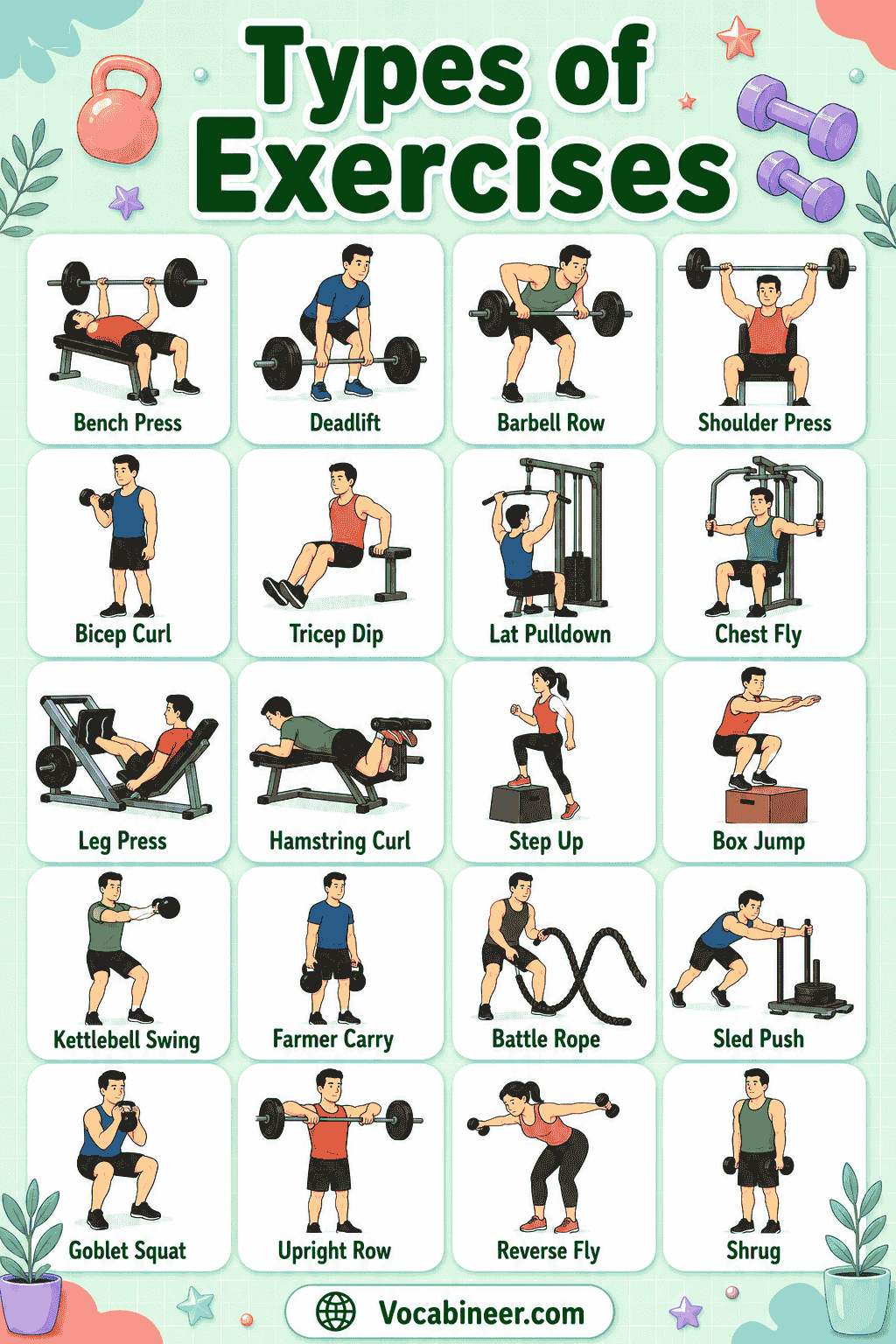
Endurance Exercises
Endurance exercises help the body continue activity for longer periods. They may train cardiovascular endurance, muscular endurance, or both.
- Long Distance Running — running for a longer time or distance.
- Cycling — repeated pedaling that builds stamina.
- Swimming Laps — swimming repeated lengths of a pool.
- Rowing — repeated pulling movement for stamina and strength.
- Hiking — longer walking activity on trails or hills.
- Circuit Training — moving through several exercises with short rest.
- Bodyweight Circuits — circuits using exercises like squats, push-ups, and planks.
- High Rep Exercises — exercises done for many repetitions.
- Jump Rope Intervals — short repeated jump rope rounds with rest.
- Stair Climbing — repeated stair movement for leg and cardio endurance.
Low Impact Exercises
Low impact exercises are easier on the joints because they usually avoid hard jumping or heavy landing. They can still improve strength, flexibility, balance, and stamina.
- Walking — simple low impact movement for daily activity.
- Swimming — water-based exercise that reduces pressure on joints.
- Cycling — low impact cardio done indoors or outdoors.
- Water Aerobics — exercise done in water with gentle resistance.
- Elliptical Exercise — machine exercise with smooth low impact motion.
- Yoga — movement and stretching with controlled poses.
- Pilates — exercise focused on control, posture, and core strength.
- Tai Chi — slow flowing movement for balance and coordination.
- Step Ups — controlled stepping movement for legs and balance.
- Seated Exercises — exercises done while sitting.
- Chair Exercises — beginner-friendly exercises using a chair for support.
- Resistance Band Exercises — strength exercises using stretch bands.
Easy Exercises for Beginners
Beginner exercises should be simple, controlled, and easy to learn. These movements can help new learners build confidence before trying harder workouts.
- Marching in Place — lifting the knees while standing in one spot.
- Wall Push-Ups — beginner push-ups done against a wall.
- Chair Squats — squats using a chair for support and guidance.
- Heel Raises — lifting the heels to train the calves and balance.
- Step Touches — side-to-side movement used in simple cardio routines.
- Arm Circles — shoulder movement done with small or large circles.
- Knee Raises — standing movement that lifts one knee at a time.
- Glute Bridges — floor exercise for the hips and glutes.
- Short Plank Holds — beginner core exercise done for a few seconds at a time.
- Standing Side Bends — gentle movement for the sides of the body.
- Seated Leg Lifts — chair exercise for beginners or low impact routines.
- Gentle Yoga Poses — easy poses used for stretching and body control.
Exercise Types by Body Area
Exercises can also be grouped by the body area they train. This helps readers understand which movements work the arms, legs, chest, back, core, or full body.
| Body Area | Exercise Examples |
|---|---|
| Upper Body Exercises | push-ups, rows, shoulder press |
| Lower Body Exercises | squats, lunges, step ups |
| Full Body Exercises | burpees, jumping jacks, mountain climbers |
| Arm Exercises | bicep curls, tricep dips, push-ups |
| Shoulder Exercises | shoulder press, arm circles, plank shoulder taps |
| Chest Exercises | push-ups, bench press, chest press |
| Back Exercises | rows, pull-ups, bird dog |
| Leg Exercises | squats, lunges, wall sits |
| Glute Exercises | glute bridges, squats, step ups |
| Core Exercises | planks, dead bugs, bicycle crunches |
Confusing Exercise Terms Explained
| Exercise Terms | Difference |
|---|---|
| Cardio vs Aerobic Exercise | Cardio focuses on raising the heart rate, while aerobic exercise is steady movement that uses oxygen. |
| Aerobic vs Anaerobic Exercise | Aerobic exercise is usually steady and longer, while anaerobic exercise is short and intense. |
| Strength Training vs Resistance Training | Strength training builds muscle strength, while resistance training uses force such as weights, bands, or body weight. |
| Flexibility vs Mobility | Flexibility is the ability to stretch, while mobility is the ability to move joints with control. |
| Stretching vs Yoga | Stretching focuses on lengthening muscles, while yoga may include poses, breathing, balance, and movement. |
| Balance vs Stability | Balance means staying steady, while stability means controlling the body during movement. |
| Core Exercises vs Ab Exercises | Core exercises train the trunk area, while ab exercises focus more directly on abdominal muscles. |
| Low Impact vs High Impact Exercises | Low impact exercises are gentler on joints, while high impact exercises often include jumping or harder landing. |
| HIIT vs Circuit Training | HIIT uses short intense intervals, while circuit training moves through several exercises in a sequence. |
| Bodyweight Exercise vs Weight Training | Bodyweight exercise uses your own body, while weight training uses equipment such as dumbbells or barbells. |
Types of Exercises Chart with Pictures
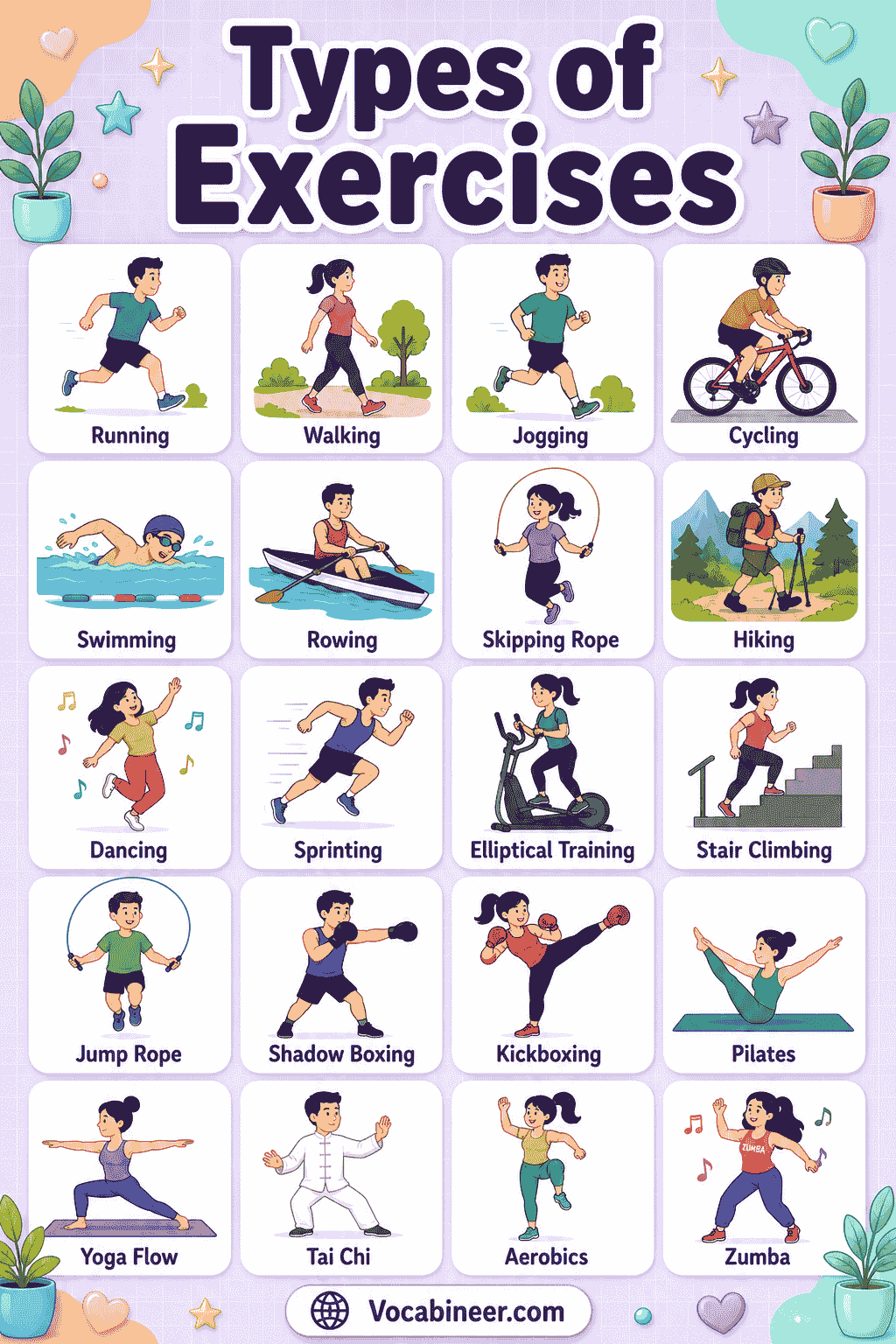
An exercise chart helps learners compare exercise groups quickly.
| Exercise Group | Details |
|---|---|
| Cardio Exercises | Best for: stamina and heart-rate movementExamples: walking, running, cycling |
| Strength Exercises | Best for: muscle strength and resistanceExamples: squats, push-ups, deadlifts |
| Flexibility Exercises | Best for: stretching and range of motionExamples: hamstring stretch, child’s pose, forward fold |
| Balance Exercises | Best for: stability and body controlExamples: single leg stand, tree pose, tai chi |
| Core Exercises | Best for: trunk strength and posture supportExamples: plank, dead bug, side plank |
| Low Impact Exercises | Best for: joint-friendly movementExamples: swimming, cycling, yoga |
| Beginner Exercises | Best for: simple starting movementsExamples: wall push-ups, chair squats, heel raises |
Basic Exercise Safety Tips
Exercise should feel controlled and suitable for your current fitness level. Beginners should start slowly, focus on form, and choose movements that feel safe and manageable.
People who are new to exercise or have health concerns should ask a qualified professional for guidance before starting a new routine. This section gives general safety tips only and does not replace personal medical or fitness advice.
- Warm Up First — begin with light movement before harder exercise.
- Cool Down After — slow down gradually after exercise.
- Start Slowly — increase time, speed, or intensity step by step.
- Use Proper Form — move with control instead of rushing.
- Stay Hydrated — drink water before and after activity.
- Take Rest Days — allow the body time to recover.
- Avoid Sharp Pain — stop if an exercise causes strong or sharp pain.
- Wear Comfortable Shoes — choose shoes that support the activity.
- Use a Safe Space — exercise in an area with enough room.
- Stop If Dizzy — pause exercise if you feel dizzy, faint, or unwell.
Exercise Duration and Frequency for Beginners
Beginners can start with short, manageable sessions instead of long or intense workouts. A simple approach is to begin with a few minutes of movement, then slowly increase time as the body feels more comfortable.
Exercise frequency depends on fitness level, goals, schedule, and recovery. Light movement can be done more often, while harder strength or intense workouts usually need rest between sessions.
FAQs
The main types of exercises include cardio, aerobic exercise, strength training, resistance training, flexibility exercises, stretching, balance exercises, core exercises, endurance exercises, and low impact exercises.
Examples of cardio exercises include walking, running, jogging, cycling, swimming, jumping rope, dancing, hiking, rowing, stair climbing, elliptical training, and kickboxing.
Examples of strength exercises include squats, push-ups, pull-ups, lunges, deadlifts, bench press, shoulder press, bicep curls, tricep dips, glute bridges, wall sits, and resistance band rows.
Good beginner exercises include marching in place, wall push-ups, chair squats, heel raises, step touches, arm circles, knee raises, glute bridges, short plank holds, seated leg lifts, and gentle yoga poses.
Cardio exercise focuses on heart-rate movement and stamina, while strength exercise focuses on building muscle strength through body weight, resistance bands, weights, or machines.
Read More