Cookware includes the pots, pans, and cooking vessels used to prepare food on a stove, in an oven, or over heat. A frying pan can cook eggs, a stockpot can boil pasta, a Dutch oven can make stew, and a wok can stir-fry vegetables.
Learning cookware names helps beginners, home cooks, students, and English learners understand kitchen vocabulary more clearly. This guide explains common cookware types, uses, materials, parts, cooking methods, stove compatibility, food matching, safety tips, and simple comparison terms.
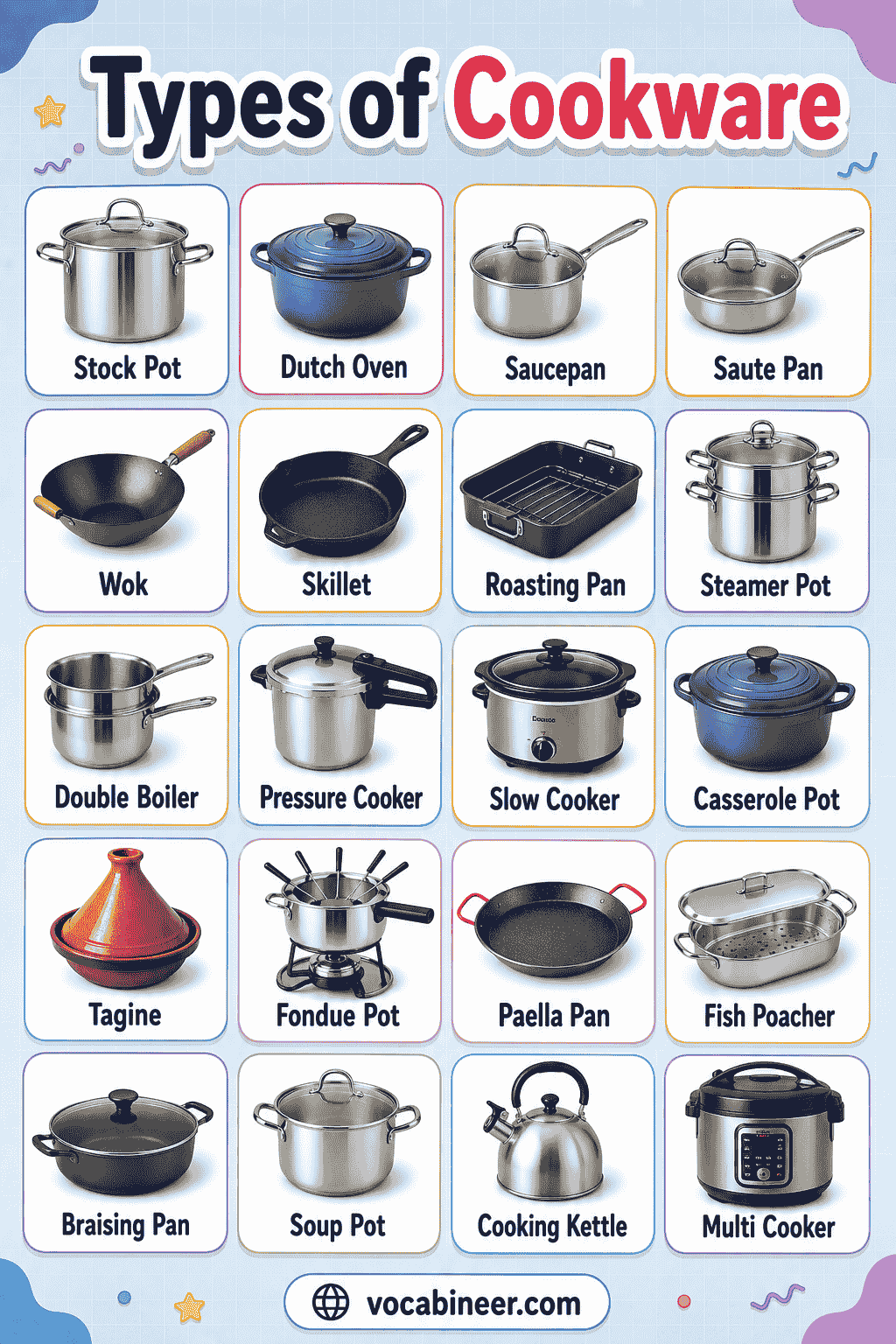
In This Page
What Is Cookware?
Cookware means the cooking vessels used to prepare food with heat. Most cookware holds food while it cooks. Some cookware works on the stovetop, some works in the oven, and some can move from the stovetop to the oven.
Common cookware includes frying pans, skillets, saucepans, stockpots, soup pots, Dutch ovens, woks, griddles, roasting pans, steamer pots, and pressure cookers.
Cookware vs Bakeware vs Kitchen Utensils: What Is the Difference?
Cookware, bakeware, and kitchen utensils are connected, but they do not mean the same thing.
| Term | Simple Meaning | Examples |
|---|---|---|
| Cookware | Vessels used to cook food with heat | Pots, pans, skillets, woks |
| Bakeware | Oven items used mainly for baking | Cake pan, loaf pan, muffin pan |
| Kitchen utensils | Hand tools used to prepare, stir, flip, cut, or serve food | Spatula, ladle, whisk, tongs |
Common Cookware Names and Uses
Here are the most common cookware names with simple uses.
- Frying pan — A shallow pan used for frying, browning, and quick cooking.
- Skillet — A sturdy pan used for frying, searing, baking, and everyday meals.
- Sauté pan — A straight-sided pan used for sautéing, simmering, and cooking foods with sauce.
- Saucepan — A small deep pan with a handle, used for sauces, milk, tea, soup, and oatmeal.
- Saucepot — A deeper pot used for sauces, grains, vegetables, and small soups.
- Stockpot — A large deep pot used for stock, broth, pasta, soup, and boiling.
- Soup pot — A deep pot used for soup, stew, beans, lentils, and warm liquid dishes.
- Dutch oven — A heavy covered pot used for stew, braising, baking bread, and slow cooking.
- Wok — A deep rounded pan used for stir-fry, noodles, rice, and quick high-heat cooking.
- Griddle — A flat cooking surface used for pancakes, eggs, burgers, toast, and flatbreads.
- Grill pan — A pan with raised ridges used for grill marks on meat, fish, or vegetables.
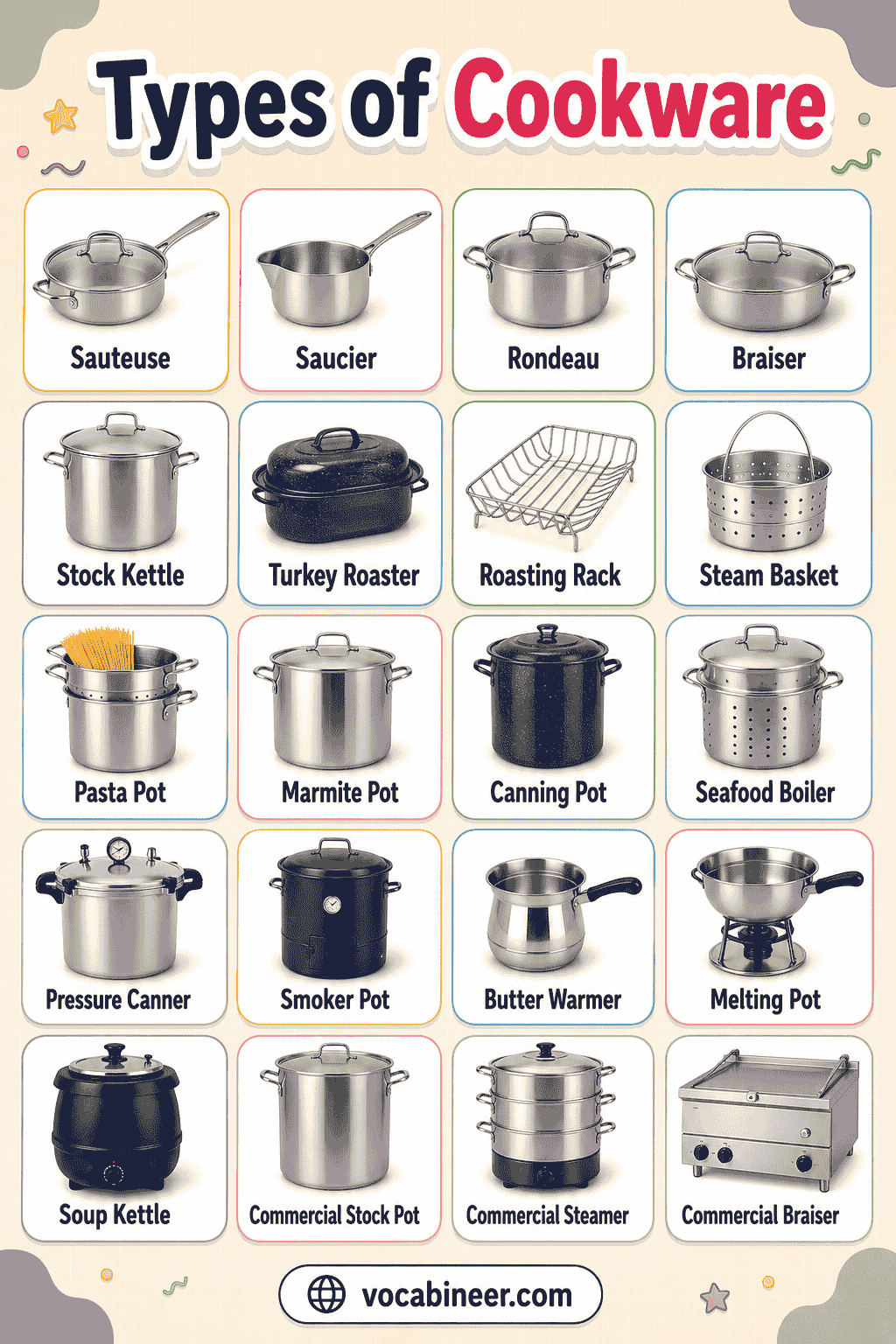
- Braiser — A wide lidded pot used for slow cooking with a small amount of liquid.
- Roasting pan — A large oven pan used for roasting meat, poultry, and vegetables.
- Sheet pan — A flat rectangular pan used for roasting, baking, and heating food.
- Saucier — A rounded pan used for whisking sauces, custards, and gravies.
- Pasta pot — A deep pot used for boiling pasta, noodles, corn, or potatoes.
- Steamer pot — A pot with an insert used for steaming vegetables, fish, buns, or dumplings.
- Double boiler — A pot setup used for gentle heating over hot water.
- Pressure cooker — A sealed pot that cooks food quickly with pressure and steam.
- Rice cooker pot — The inner cooking pot used inside a rice cooker.
Essential Cookware Every Kitchen Needs
Most kitchens do not need every cookware item. These basic pieces can handle many daily meals.
- Frying pan or skillet — Good for eggs, vegetables, chicken, fish, pancakes, and quick meals.
- Saucepan — Good for sauces, milk, tea, oatmeal, soup, and small portions.
- Stockpot — Good for soup, pasta, broth, boiling, and large batches.
- Sauté pan — Good for vegetables, chicken, sauces, pasta dishes, and one-pan meals.
- Dutch oven — Good for stew, braising, slow cooking, bread, and oven-to-table meals.
- Sheet pan — Good for roasted vegetables, cookies, fries, and oven snacks.
- Nonstick pan — Good for eggs, pancakes, fish, and delicate foods.
- Cast iron skillet — Good for searing, frying, baking, and high-heat cooking.
- Steamer pot — Good for vegetables, dumplings, fish, and gentle cooking.
- Roasting pan — Good for roasted meat, poultry, potatoes, and large oven dishes.
Cookware Parts and Features
Cookware parts affect heat, handling, cooking results, cleaning, and safety.
- Lid — Traps heat, steam, and moisture.
- Handle — Helps you hold or lift cookware.
- Helper handle — Helps lift heavy cookware with two hands.
- Base — The bottom part that touches the heat source.
- Thick bottom — Helps reduce burning and improves heat control.
- Rim — The top edge of a pot or pan.
- Sides — The walls of cookware; they may be shallow, deep, sloped, or straight.
- Cooking surface — The inside area where food touches the cookware.
- Coating — A surface layer, such as nonstick or enamel.
- Nonstick coating — Helps food release more easily.
- Enamel coating — Adds a smooth protective layer, often on cast iron.
- Cladding — Layers of metal bonded together for better heat performance.
- Pour spout — Helps pour liquids neatly.
- Steam vent — Lets steam escape.
- Insert basket — Helps with pasta, steaming, or draining.
- Oven-safe design — Allows cookware to go into the oven.
- Induction-safe base — Allows cookware to work on induction cooktops.
- Dishwasher-safe label — Shows whether cookware can go in a dishwasher.
- Heat-resistant handle — Handles heat better during cooking.
Main Types of Cookware
Cookware can be grouped by shape, use, cooking method, material, and heat source.
- Pots — Deep cookware used for boiling, simmering, soup, pasta, and liquids.
- Pans — Wider or shallower cookware used for frying, searing, sautéing, roasting, and baking.
- Skillets — Versatile pans used for frying, browning, baking, and everyday meals.
- Dutch ovens — Heavy lidded cookware used for stews, braising, bread, and slow cooking.
- Woks — Deep rounded pans used for stir-fry, noodles, fried rice, and high-heat cooking.
- Griddles — Flat cooking surfaces used for pancakes, eggs, burgers, toast, and flatbreads.
- Roasting cookware — Oven cookware used for meat, poultry, potatoes, and vegetables.
- Steaming cookware — Pots or inserts used to cook food with steam.
- Pressure cookware — Sealed cookware used for faster cooking with pressure and steam.
- Specialty cookware — Cookware made for specific dishes, traditions, or cooking methods.
Main Pot Types
Pots are usually deeper than pans and work well for liquids, boiling, simmering, steaming, and larger portions.
- Stockpot — Best for stock, broth, pasta, soup, and large batches.
- Soup pot — Best for soup, stew, beans, lentils, and warm meals.
- Saucepot — Best for sauces, grains, vegetables, and smaller soups.
- Saucepan — Best for milk, tea, sauces, oatmeal, and small portions.
- Pasta pot — Best for pasta, noodles, corn, potatoes, and boiling.
- Steamer pot — Best for vegetables, fish, buns, and dumplings.
- Pressure cooker — Best for beans, meat, rice, lentils, and fast cooking.
- Dutch oven — Best for stews, braising, slow cooking, and baking bread.
Main Pan Types
Pans are often wider or shallower than pots. They work well for frying, searing, sautéing, browning, roasting, and baking.
- Frying pan — Best for eggs, vegetables, fish, chicken, and quick meals.
- Skillet — Best for searing, browning, frying, and everyday cooking.
- Sauté pan — Best for vegetables, chicken, sauces, and shallow simmering.
- Grill pan — Best for grill marks on meat, fish, vegetables, and sandwiches.
- Griddle — Best for pancakes, eggs, burgers, toast, and flatbreads.
- Crepe pan — Best for crepes and thin pancakes.
- Omelet pan — Best for omelets and small egg dishes.
- Sheet pan — Best for roasted vegetables, cookies, and oven snacks.
- Roasting pan — Best for roasted meat, poultry, potatoes, and large oven meals.
Specialty Cookware Types
Specialty cookware is made for specific cooking tasks, foods, or traditions.
- Dutch oven — Used for stews, braising, roasting, baking bread, and slow cooking.
- Wok — Used for stir-fry, fried rice, noodles, and quick high-heat meals.
- Braiser — Used for slow cooking meat and vegetables with a small amount of liquid.
- Double boiler — Used for chocolate, custards, delicate sauces, and gentle heating.
- Steamer pot — Used for steam cooking vegetables, fish, buns, and dumplings.
- Pressure cooker — Used for faster cooking with pressure and steam.
- Tagine — Used for slow-cooked North African-style dishes.
- Cocotte — Used for stews, braising, roasting, and oven-to-table cooking.
- Paella pan — Used for paella and wide rice dishes.
- Rondeau — Used for searing, braising, shallow frying, and reducing sauces.
- Rice cooker pot — Used for cooking rice inside a rice cooker.
- Fondue pot — Used for melted cheese, chocolate, and shared dipping foods.
Cookware by Cooking Method
Different cooking methods need different cookware shapes, depths, and materials.
- Frying — Frying pan, skillet, nonstick pan, cast iron pan.
- Searing — Cast iron skillet, stainless steel pan, carbon steel pan.
- Sautéing — Sauté pan, skillet.
- Boiling — Stockpot, pasta pot, large deep pot.
- Simmering — Saucepan, soup pot, saucepot, Dutch oven.
- Steaming — Steamer pot, pot with insert basket.
- Roasting — Roasting pan, sheet pan.
- Oven cooking and baking — Sheet pan, Dutch oven, roasting pan, casserole dish, loaf pan, cake pan.
- Braising — Dutch oven, braiser, heavy lidded pot.
- Stir-frying — Wok, carbon steel pan.
- Pressure cooking — Pressure cooker.
Common Cookware Materials
Cookware material affects heat control, weight, cleaning, durability, price, and cooking results.
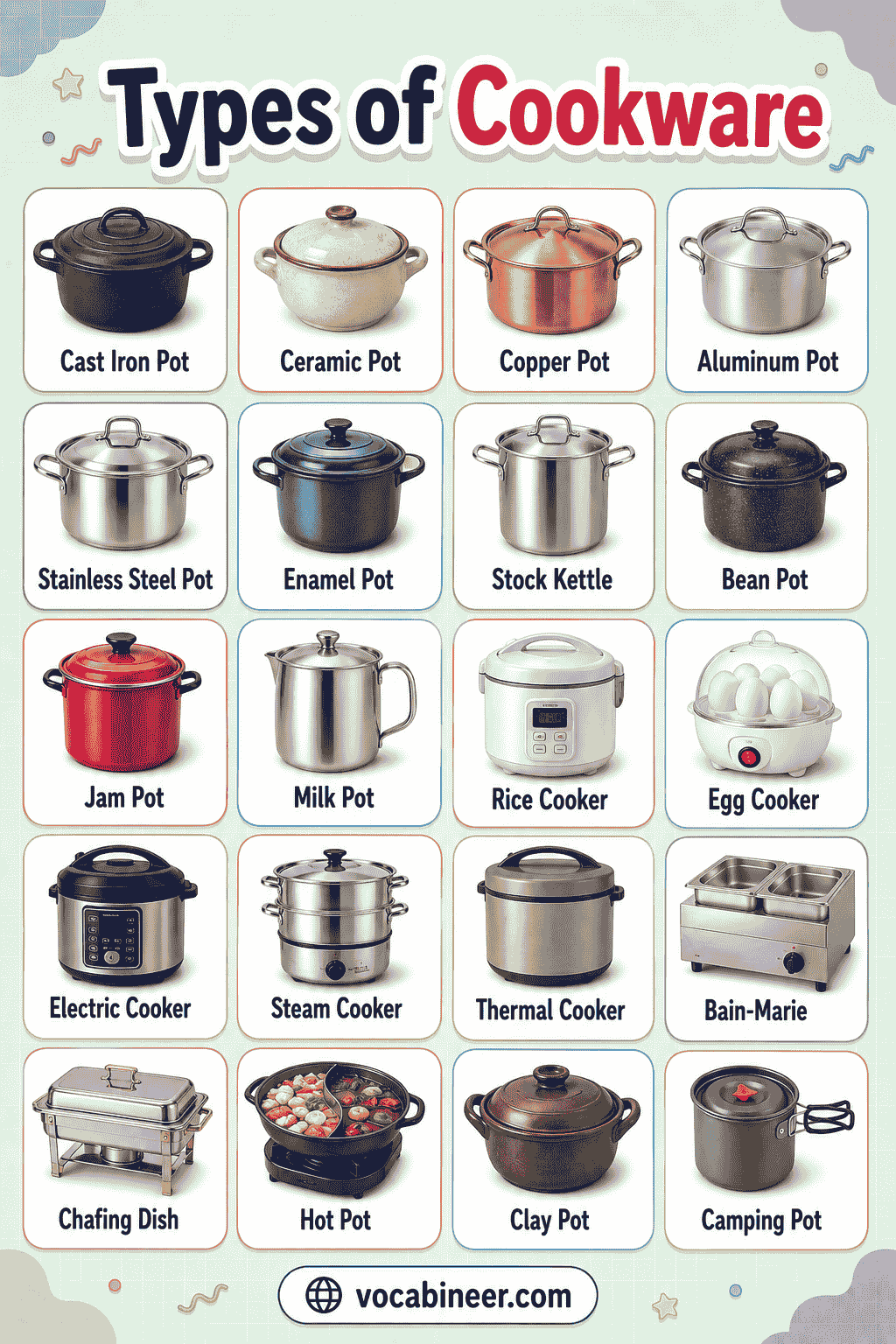
- Stainless steel — Durable, long-lasting, and useful for boiling, searing, simmering, and everyday cooking.
- Nonstick — Easy for eggs, pancakes, fish, and delicate foods.
- Ceramic-coated — Smooth coated cookware used for low-to-medium heat cooking.
- Cast iron — Heavy cookware that holds heat well and works for searing, frying, and baking.
- Enameled cast iron — Cast iron with a smooth enamel coating, often used for Dutch ovens and braisers.
- Carbon steel — Lighter than cast iron and useful for woks, skillets, and high-heat cooking.
- Copper — Heats quickly and responds fast to temperature changes.
- Aluminum — Lightweight and quick to heat.
- Hard-anodized aluminum — Stronger aluminum cookware with a durable surface.
- Glass — Often used for oven-safe dishes and visible cooking.
- Clay cookware — Used for slow cooking and traditional dishes.
- Stoneware — Often used for oven dishes, casseroles, and baking.
Stainless Steel Cookware
Stainless steel cookware is durable, common, and useful for many everyday cooking tasks.
- Best for: Boiling, simmering, browning, searing, sautéing, and pan sauces.
- Common pieces: Frying pans, saucepans, stockpots, sauté pans, saucepots, and cookware sets.
- Main benefit: Strong and long-lasting.
- Possible issue: Food can stick if the heat is too high or the pan is not used correctly.
- Good choice for: Home cooks who want reliable cookware for daily meals.
Cast Iron and Carbon Steel Cookware
Cast iron and carbon steel are strong cookware materials for high-heat cooking.
- Cast iron skillet — Best for searing, frying, baking, and high-heat cooking.
- Cast iron Dutch oven — Best for slow cooking, braising, and oven cooking.
- Cast iron grill pan — Best for grill marks and high heat.
- Carbon steel skillet — Best for searing, frying, and quick heating.
- Carbon steel wok — Best for stir-fry and fast high-heat cooking.
Care tips:
- Dry cast iron and carbon steel after washing.
- Season bare cast iron or carbon steel when needed.
- Avoid leaving them wet.
- Use them for foods that need strong heat and browning.
Nonstick and Ceramic Cookware
Nonstick and ceramic-coated cookware are useful for foods that stick easily.
- Nonstick frying pan — Best for eggs, pancakes, and quick low-to-medium heat cooking.
- Nonstick saucepan — Best for sauces, oatmeal, and foods that may stick.
- Ceramic-coated pan — Best for low-to-medium heat cooking with easier food release.
- Nonstick griddle — Best for pancakes, eggs, and flat breakfast foods.
- Nonstick sauté pan — Best for vegetables, light sauces, and everyday meals.
Care tips:
- Use wooden, silicone, or nylon utensils.
- Avoid overheating coated cookware.
- Avoid cutting food inside coated cookware.
- Replace badly scratched, peeling, or damaged coated pieces.
Copper, Aluminum, and Enameled Cookware
These cookware materials offer different benefits for heat response, weight, appearance, and cooking style.
- Copper cookware — Heats and responds quickly, often used by experienced cooks.
- Aluminum cookware — Lightweight and quick to heat.
- Hard-anodized aluminum cookware — Stronger aluminum cookware with a durable surface.
- Enameled cast iron cookware — Heavy cookware with a smooth enamel coating.
- Enameled Dutch oven — Best for stews, braising, soups, and oven-to-table meals.
- Enameled braiser — Best for slow cooking and saucy dishes.
Quick notes:
- Copper often costs more and may need more care.
- Aluminum heats quickly but quality can vary.
- Enameled cast iron holds heat well and cleans more easily than bare cast iron.
Oven-Safe and Induction-Safe Cookware
Some cookware works only on the stovetop, while other cookware can go into the oven or work on induction.
- Oven-safe cookware — Cookware that can handle oven heat.
- Stovetop-to-oven cookware — Cookware that can start on the stove and finish in the oven.
- Induction-safe cookware — Cookware with a magnetic base for induction cooktops.
- Metal handles — Often safer for oven use than plastic handles.
- Heat-safe lids — Lids that can handle oven temperatures.
- Temperature limit — The highest heat level the cookware can safely handle.
Always check the cookware label, base symbol, handle material, lid safety, and temperature limit before using cookware in the oven or on an induction cooktop.
Cookware for Different Stove Types
Different stoves work better with different cookware materials and bases.
- Gas stove — Works with many cookware types, including stainless steel, cast iron, carbon steel, copper, and aluminum.
- Electric coil stove — Works best with flat-bottom cookware that sits evenly on the coil.
- Glass-top stove — Works best with smooth, flat-bottom cookware that does not scratch the surface.
- Ceramic cooktop — Needs flat, smooth cookware for better contact and safer use.
- Induction cooktop — Needs magnetic cookware, such as many stainless steel and cast iron pieces.
Stove-use tips:
- Lift heavy cookware instead of dragging it on glass or ceramic cooktops.
- Use flat-bottom cookware for better heat contact.
- Check induction symbols before buying cookware for induction.
- Match cookware size to burner size.
Best Cookware for Different Foods
Choosing cookware becomes easier when you match it to the food.
- Eggs — Nonstick pan, omelet pan, or small frying pan.
- Steak — Cast iron skillet, stainless steel pan, or carbon steel skillet.
- Soup — Soup pot, stockpot, or Dutch oven.
- Pasta — Stockpot or pasta pot.
- Rice — Saucepan, rice cooker pot, or medium saucepot.
- Curry — Dutch oven, saucepot, or heavy-bottom pot.
- Stir-fry — Wok or carbon steel pan.
- Pancakes — Griddle or nonstick pan.
- Fish — Nonstick pan or stainless steel pan.
- Roasted vegetables — Sheet pan or roasting pan.
- Stew — Dutch oven or braiser.
- Sauces — Saucepan, saucier, or saucepot.
- Steamed vegetables — Steamer pot.
- Bread — Dutch oven or loaf pan.
- Casseroles — Casserole dish or oven-safe baking dish.
Cookware Sets vs Individual Pieces
Both cookware sets and individual pieces can be useful. The better choice depends on your kitchen needs, budget, storage space, and cooking style.
| Option | Best For | Main Benefit |
|---|---|---|
| Cookware set | New kitchens, beginners, matching pieces | Gives several basic pieces at once |
| Individual pieces | Focused buying, small kitchens, specific needs | Helps avoid unused cookware |
| Small starter set | Simple daily cooking | Covers basic meals without clutter |
| Specialty pieces | Specific cooking styles | Adds tools like a wok, Dutch oven, or steamer |
A beginner may start with one frying pan, one saucepan, one stockpot, and one sheet pan. Later, they can add a Dutch oven, wok, steamer pot, or cast iron skillet if needed.
Healthy and Safe Cookware Options
Healthy and safe cookware depends on material, heat use, cleaning, condition, and care.
- Stainless steel cookware — Durable and useful for many foods.
- Cast iron cookware — Strong and good for high-heat cooking when cared for properly.
- Carbon steel cookware — Useful for woks, skillets, and searing.
- Enameled cast iron cookware — Smooth, heavy, and useful for stews and braising.
- Quality oven-safe cookware — Safe for oven use when used within its temperature limit.
- Nonstick cookware — Useful for delicate foods, but it needs gentle tools and careful heat.
- Ceramic-coated cookware — Easy-release cookware that also needs careful use and cleaning.
Safety tips:
- Avoid overheating coated cookware.
- Replace badly scratched, peeling, or damaged coated pieces.
- Use gentle utensils on nonstick and ceramic-coated cookware.
- Follow the maker’s care instructions.
- Check oven-safe limits, induction use, and dishwasher cleaning rules.
Cookware Safety and Care Tips
Good cookware care helps cookware last longer and keeps cooking safer.
- Use oven-safe cookware only in the oven.
- Check induction compatibility before using cookware on induction.
- Avoid overheating nonstick cookware.
- Use wooden, silicone, or nylon utensils on coated cookware.
- Dry cast iron and carbon steel after washing.
- Season cast iron or carbon steel when needed.
- Avoid sudden temperature changes that can damage some materials.
- Match burner size to cookware size.
- Use oven mitts for hot handles and lids.
- Clean cookware according to its material.
- Store cookware carefully to avoid scratches.
- Avoid stacking coated cookware without protection.
Types of Cookware Chart
This chart gives a quick look at common cookware types and their best uses.
| Cookware Type | Best Used For |
|---|---|
| Frying pan | Eggs, vegetables, fish, chicken, and quick meals |
| Skillet | Searing, browning, frying, and everyday cooking |
| Saucepan | Sauces, milk, tea, oatmeal, and small portions |
| Stockpot | Soup, stock, pasta, boiling, and large batches |
| Dutch oven | Stews, braising, slow cooking, and bread |
| Wok | Stir-fry, noodles, rice, and high-heat cooking |
| Griddle | Pancakes, eggs, burgers, toast, and flatbreads |
| Roasting pan | Meat, poultry, potatoes, and large oven dishes |
| Sheet pan | Roasted vegetables, cookies, fries, and oven snacks |
| Steamer pot | Vegetables, fish, dumplings, and steam cooking |
| Pressure cooker | Beans, meat, lentils, rice, and fast cooking |
| Double boiler | Chocolate, custards, and delicate sauces |
Confusing Cookware Terms Explained
Some cookware terms sound similar. This table explains the differences simply.
| Terms | Simple Difference |
|---|---|
| Cookware vs Bakeware | Cookware is used for cooking with heat. Bakeware is used mainly for baking. |
| Cookware vs Kitchen Utensils | Cookware holds food while cooking. Utensils help stir, flip, cut, or serve food. |
| Pot vs Pan | Pots are usually deeper. Pans are usually wider or shallower. |
| Skillet vs Frying Pan | They are often similar, but skillet often suggests a heavier or more versatile pan. |
| Saucepan vs Saucepot | A saucepan usually has one long handle. A saucepot often has two side handles. |
| Dutch Oven vs Stockpot | A Dutch oven is heavy and good for slow cooking. A stockpot is taller and better for liquids. |
| Wok vs Skillet | A wok is deep and rounded. A skillet is flatter. |
| Nonstick vs Stainless Steel | Nonstick releases food easily. Stainless steel browns and sears better. |
| Cast Iron vs Carbon Steel | Cast iron holds heat longer. Carbon steel is usually lighter and heats faster. |
| Ceramic vs Nonstick Cookware | Ceramic cookware is usually ceramic-coated. Nonstick cookware may use different coating types. |
How to Choose the Right Cookware
Choose the right cookware by matching it to your cooking style, food type, stove, and cleaning routine. A frying pan or skillet works well for quick meals, a saucepan handles sauces and small portions, a stockpot works for pasta and soup, and a Dutch oven helps with stews and slow cooking. If you cook eggs often, nonstick can help; if you sear meat often, stainless steel, cast iron, or carbon steel may work better.
Material, weight, and compatibility also matter. Stainless steel is durable, cast iron holds heat well, nonstick is easy for delicate foods, and aluminum is lightweight. Check whether the cookware works on your stove, whether it is oven-safe, how easy it is to clean, and whether you have space to store it. For daily use, choose a few reliable pieces instead of buying too many items you will not use.
FAQs
The main types of cookware include frying pans, skillets, saucepans, stockpots, soup pots, Dutch ovens, woks, griddles, roasting pans, sheet pans, steamer pots, pressure cookers, and double boilers.
Cookware is used to cook food with heat on a stove or in an oven. Bakeware is used mainly for baking, such as cake pans, loaf pans, muffin pans, and baking dishes.
Most kitchens need a frying pan or skillet, saucepan, stockpot, sheet pan, and one larger pan or pot for everyday meals. A Dutch oven, steamer pot, or nonstick pan can also be useful depending on cooking habits.
Stainless steel is a good beginner-friendly material because it is durable and useful for many foods. Nonstick cookware is also helpful for eggs, pancakes, and delicate foods, but it needs gentler care.
A medium frying pan or skillet, a saucepan, and a stockpot are some of the best cookware pieces for everyday cooking. These pieces can handle eggs, vegetables, sauces, soup, pasta, rice, and quick meals.
Read More
- Types of Serving Dishes
- Types of Drinking Glasses
- Types of Cups with Names
- Different Types of Bowls
- Different Types of Baskets
- Types of Keys with Names