

Dressers are bedroom storage pieces used for folded clothes, small accessories, blankets, baby items, media items, and everyday essentials. Some dressers are wide and low, while others are tall and narrow for saving floor space.
This guide explains different types of dressers with names, simple meanings, uses, sizes, drawer layouts, materials, styles, parts, confusing terms, and a helpful dresser chart with pictures.
In This Page
Common Types of Dressers
These are some of the most common dresser types used in bedrooms, nurseries, kids’ rooms, guest rooms, apartments, and storage areas.
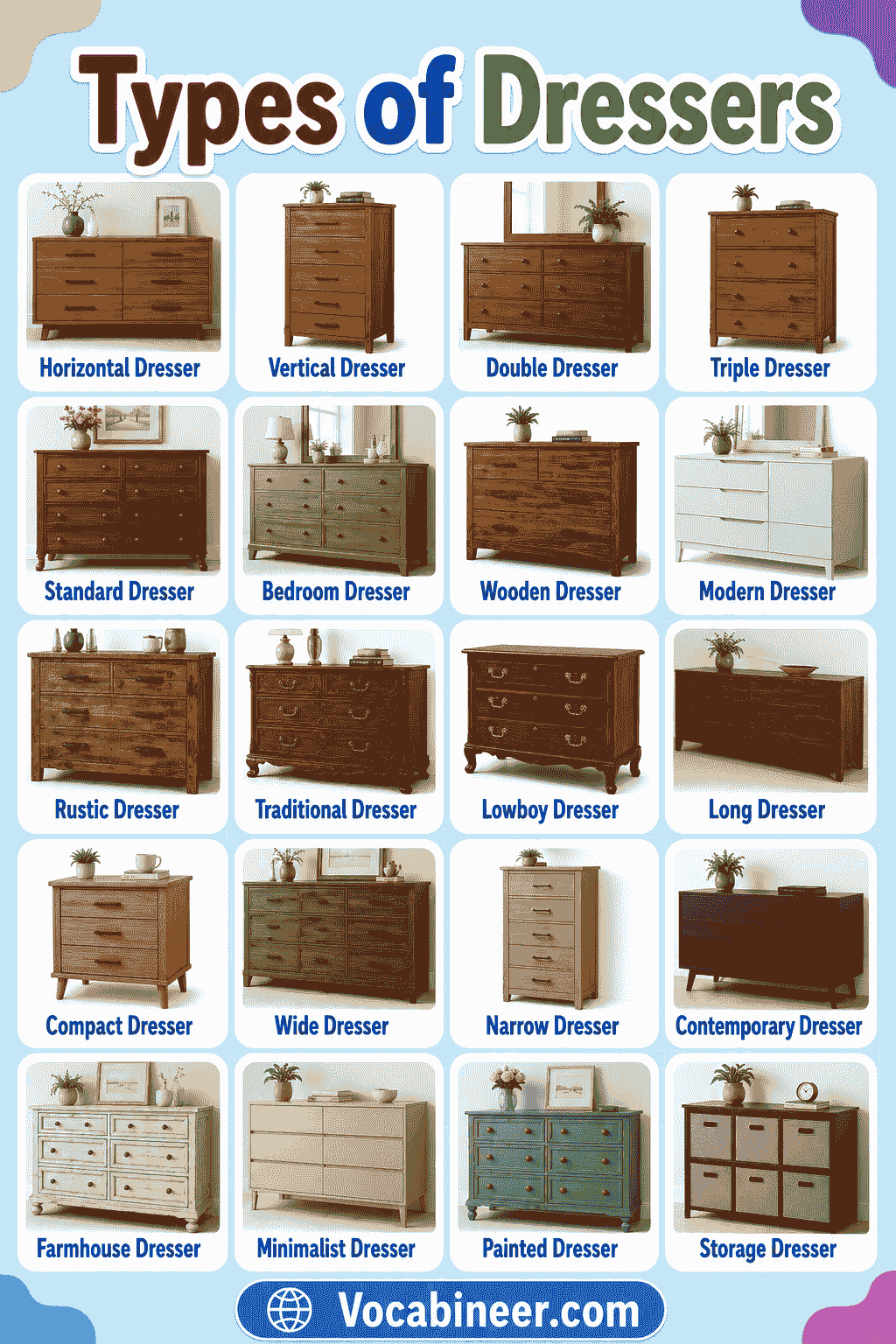
- Standard dresser — a basic bedroom dresser used for folded clothes and personal items.
- Horizontal dresser — a wide dresser with drawers arranged side by side.
- Vertical dresser — a taller dresser with drawers stacked upward.
- Double dresser — a wide dresser with two columns of drawers.
- Triple dresser — a very wide dresser with three columns or sections of drawers.
- Wide dresser — a dresser with extra width for more storage and surface space.
- Tall dresser — a dresser that uses vertical space instead of floor width.
- Low dresser — a shorter dresser that may also hold a mirror, decor, or TV.
- Highboy dresser — a tall dresser, often with a traditional furniture style.
- Lowboy dresser — a low dresser, often wider and shorter.
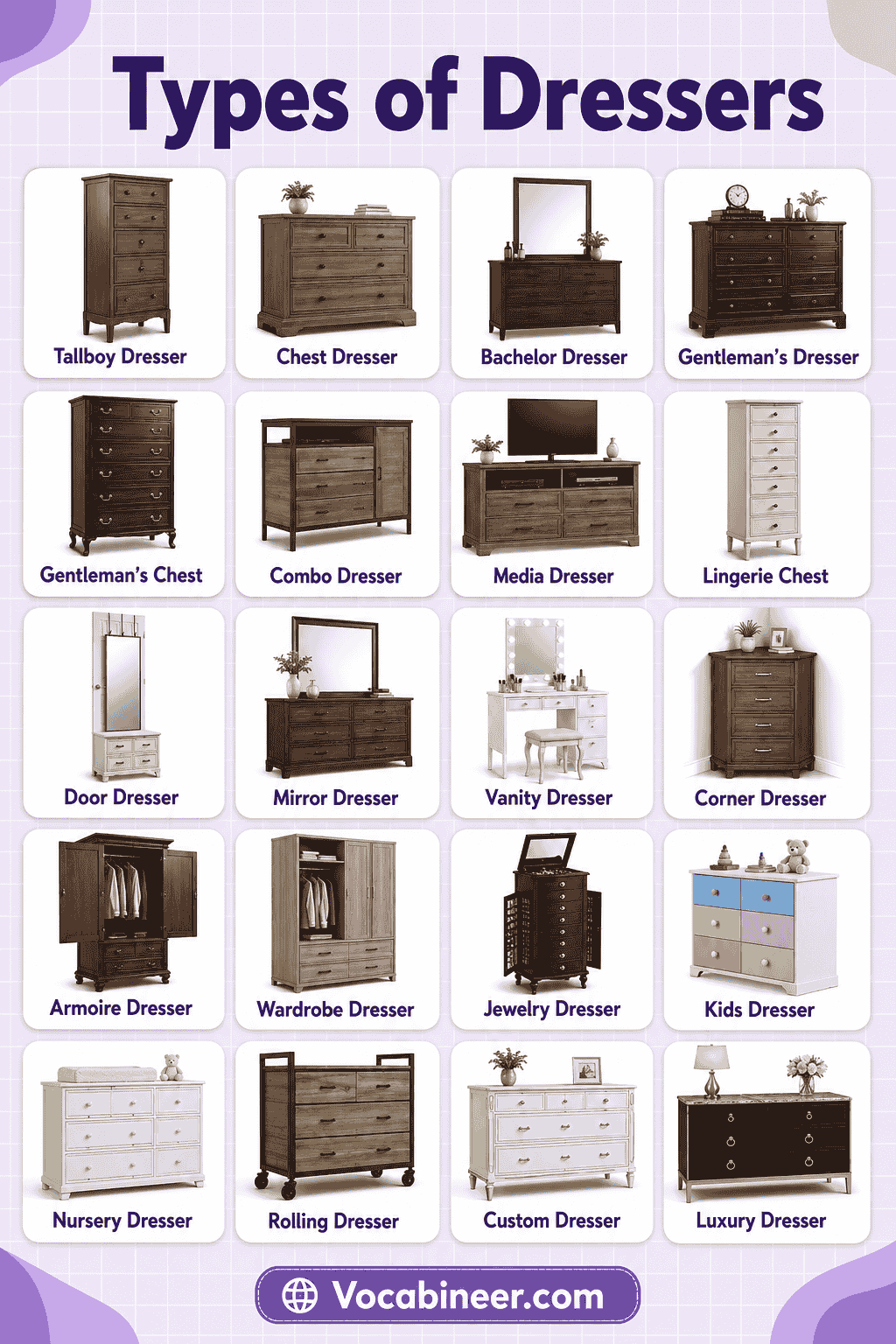
- Tallboy dresser — a tall, narrow dresser used for vertical storage.
- Chest of drawers — a tall storage piece with stacked drawers.
- Bachelor’s chest — a smaller chest of drawers, often used in compact rooms.
- Gentleman’s chest — a dresser or chest that may include drawers, cabinet space, and hanging storage.
- Lingerie chest — a tall, narrow chest with small drawers for delicate clothing.
- Mirrored dresser — a dresser that includes or supports a mirror.
- Combo dresser — a dresser with a mix of drawers, shelves, or cabinet doors.
- Media dresser — a dresser used for clothes and TV or media storage.
- Nursery dresser — a dresser used for baby clothes, diapers, blankets, and nursery items.
- Kids dresser — a dresser designed for children’s clothing and easy access.
- Changing table dresser — a nursery dresser with a top surface for changing a baby.
Dresser Types and Their Uses
Dressers are often chosen by room size, clothing amount, drawer layout, and storage purpose.
- For folded clothes — standard dressers, horizontal dressers, double dressers, and chest of drawers.
- For small bedrooms — tall dressers, vertical dressers, bachelor’s chests, and narrow chests.
- For shared bedrooms — double dressers, triple dressers, wide dressers, and combo dressers.
- For nursery storage — nursery dressers, changing table dressers, and low dressers.
- For kids’ clothes — kids dressers, low dressers, fabric dressers, and anti-tip dressers.
- For media storage — media dressers, TV dressers, and low wide dressers.
- For jewelry storage — jewelry dressers, dressers with small top drawers, and felt-lined drawers.
- For mirror and grooming use — mirrored dressers, lowboy dressers, and dresser sets with mirrors.
- For large clothing collections — triple dressers, double dressers, wide dressers, and tall chests.
- For seasonal clothes — deep-drawer dressers, chest of drawers, and storage dressers.
Horizontal, Vertical, Double, and Triple Dressers
These dresser types are named by their shape, width, height, or drawer arrangement.
- Horizontal dresser — a wide dresser that stretches across a wall. It often has a large top surface for a mirror, lamp, decor, or TV.
- Vertical dresser — a taller dresser with drawers stacked from bottom to top. It works well when floor space is limited.
- Double dresser — a wide dresser with two side-by-side drawer columns. It is useful for couples, shared rooms, or larger wardrobes.
- Triple dresser — an extra-wide dresser with three drawer sections or a large number of drawers.
- Wide dresser — a broad dresser that provides more drawer space and display space on top.
- Tall dresser — a dresser that saves floor space by using height.
- Low dresser — a shorter dresser that may fit below a mirror, window, TV, or wall decor.
- Standard dresser — a regular dresser used for everyday bedroom storage.
Highboy, Lowboy, and Tallboy Dressers
Highboy, lowboy, and tallboy dressers are traditional furniture terms. They often describe height, shape, and style.
- Highboy dresser — a tall dresser, often with a classic or traditional look.
- Lowboy dresser — a low, wide dresser that may be paired with a mirror.
- Tallboy dresser — a tall, narrow dresser used for vertical drawer storage.
- Tall chest — a chest-style dresser with stacked drawers.
- Low chest — a shorter chest or dresser used for lower storage.
- Traditional dresser — a classic dresser style that may include carved details, shaped legs, or rich wood finishes.
Chest of Drawers and Specialty Chests
Chests are often taller and narrower than dressers. They are useful when a room needs drawer storage but has limited wall width.
- Chest of drawers — a tall furniture piece with several stacked drawers.
- Bachelor’s chest — a small chest of drawers, often used beside a bed or in a compact room.
- Gentleman’s chest — a larger chest that may combine drawers, shelves, cabinet doors, or hanging space.
- Lingerie chest — a tall, narrow chest with smaller drawers for delicate clothes, socks, scarves, or accessories.
- Tall chest — a high chest with multiple drawers.
- Narrow chest — a slim chest used in tight spaces.
- Drawer chest — a general chest made mainly with drawers.
Mirrored, Combo, and Media Dressers
Some dressers include extra features such as mirrors, cabinets, shelves, or TV storage. These designs can make one piece of furniture serve several purposes.
- Mirrored dresser — a dresser that comes with a mirror or has a mirror attached above it.
- Dresser with mirror — a dresser set designed for grooming, dressing, or room decor.
- Combo dresser — a dresser that combines drawers with shelves or cabinet doors.
- Dresser with shelves — a dresser with open shelves for books, decor, baskets, or folded items.
- Dresser with cabinet — a dresser with drawers and cabinet-style storage.
- Media dresser — a dresser designed to hold a TV, media devices, clothes, or bedroom items.
- TV dresser — a low or wide dresser used as a TV stand.
- Jewelry dresser — a dresser with small drawers, trays, or lined compartments for jewelry and accessories.
Nursery, Kids, and Changing Table Dressers
Nursery and kids dressers should be easy to use, safe, and practical. They often need space for clothes, diapers, toys, blankets, and daily care items.
- Nursery dresser — a dresser used for baby clothes, blankets, diapers, wipes, and nursery supplies.
- Kids dresser — a dresser made for children’s clothes and everyday storage.
- Changing table dresser — a dresser with a top surface used as a baby changing area.
- Baby dresser — a smaller dresser for infant clothes and care items.
- Child-size dresser — a low dresser that children can reach more easily.
- Toy storage dresser — a dresser used for toys, games, clothes, and bins.
- Low dresser — a safer, easier-access dresser option for kids’ rooms.
- Anti-tip dresser — a dresser secured with anti-tip hardware to help reduce tipping risk.
Dresser Sizes and Drawer Layouts
Dresser size and drawer layout affect how much storage the dresser provides and how easily items can be organized.
- 3-drawer dresser — a small dresser with three drawers, often used in small rooms or guest rooms.
- 4-drawer dresser — a compact dresser with four drawers.
- 5-drawer dresser — a taller dresser with five stacked drawers.
- 6-drawer dresser — a common dresser size for bedrooms.
- 7-drawer dresser — a dresser with extra storage for clothes and accessories.
- 8-drawer dresser — a larger dresser with more divided storage.
- 9-drawer dresser — a wide dresser often used in larger bedrooms.
- Small-drawer dresser — a dresser with smaller drawers for socks, jewelry, or accessories.
- Deep-drawer dresser — a dresser with deep drawers for bulky clothes, blankets, or seasonal items.
- Wide-drawer dresser — a dresser with wide drawers for folded clothes.
- Mixed-drawer dresser — a dresser with both small and large drawers.
- Dresser with top small drawers — a dresser with smaller upper drawers for jewelry, watches, ties, or personal items.
Dresser Materials
Dresser material affects durability, weight, price, appearance, and long-term use.
- Wood dresser — a dresser made from wood or wood-style material.
- Solid wood dresser — a dresser made from real wood such as oak, maple, pine, walnut, or mahogany.
- Engineered wood dresser — a dresser made from manufactured wood products.
- MDF dresser — a dresser made from medium-density fiberboard.
- Metal dresser — a dresser with metal construction or metal drawers.
- Rattan dresser — a dresser with woven rattan panels or rattan details.
- Fabric dresser — a lightweight dresser with fabric drawers.
- Laminate dresser — a dresser with a laminate surface over engineered material.
- Glass-front dresser — a dresser with glass panels or glass-front drawers.
- Painted dresser — a dresser finished with paint for color and style.
Dresser Styles and Designs
Dresser style affects how the furniture looks in a bedroom. Some styles are simple and modern, while others look classic, rustic, or decorative.
- Modern dresser — a clean dresser with simple lines and a sleek look.
- Traditional dresser — a classic dresser with familiar shapes and wood finishes.
- Rustic dresser — a dresser with a natural, aged, or farmhouse-inspired look.
- Industrial dresser — a dresser that often combines wood and metal.
- Mid-century dresser — a dresser with clean lines, tapered legs, and a retro look.
- Farmhouse dresser — a dresser with a warm, simple, country-inspired style.
- Minimalist dresser — a simple dresser with plain surfaces and little decoration.
- Vintage dresser — an older-style dresser or one designed to look old.
- Antique dresser — an older dresser with historical or collectible value.
- Floating dresser — a wall-mounted dresser that does not sit directly on the floor.
- Built-in dresser — a dresser built into a wall, closet, or room design.
Dresser Storage Features
Dresser features can make storage easier, safer, and more organized.
- Deep drawers — drawers for bulky clothes, sweaters, jeans, blankets, or seasonal items.
- Shallow drawers — drawers for socks, jewelry, scarves, ties, or smaller items.
- Soft-close drawers — drawers that close gently and quietly.
- Felt-lined drawers — drawers with soft lining for jewelry or delicate accessories.
- Drawer dividers — dividers that separate socks, undergarments, jewelry, or accessories.
- Cabinet doors — doors that hide shelves or larger storage sections.
- Open shelves — visible shelves for baskets, decor, books, or folded items.
- Mirror — a mirror attached to or placed above the dresser.
- Jewelry tray — a tray or drawer insert for jewelry and small accessories.
- Drawer slides — hardware that helps drawers open and close smoothly.
- Knobs — small round handles used to pull drawers open.
- Handles — longer drawer pulls used for opening drawers.
- Anti-tip hardware — safety hardware that helps secure the dresser to the wall.
Dresser Parts You Should Know
Dresser parts are useful when describing, comparing, repairing, or shopping for dressers.
- Top — the flat upper surface of the dresser.
- Drawers — pull-out storage compartments.
- Drawer front — the visible front panel of a drawer.
- Drawer slide — the track that helps a drawer move in and out.
- Knob — a small round drawer pull.
- Handle — a longer drawer pull.
- Pull — a general term for a knob or handle used to open a drawer.
- Legs — the supports that raise some dressers from the floor.
- Base — the lower support part of the dresser.
- Frame — the main structure that holds the dresser together.
- Mirror — a reflective part attached to or placed above some dressers.
- Cabinet door — a door used on combo dressers or gentleman’s chests.
- Shelf — a flat storage surface inside or outside the dresser.
- Anti-tip strap — a strap or bracket used to secure the dresser to a wall.
Confusing Dresser Terms Explained
Some dresser terms sound similar, but they are not always the same.
| Term | Simple Difference |
|---|---|
| Dresser vs Chest of Drawers | A dresser is usually wider and lower. A chest of drawers is usually taller and narrower. |
| Dresser vs Bureau | Bureau is another word for a dresser in some regions. It can also mean a writing desk in other contexts. |
| Dresser vs Vanity | A dresser is mainly for clothing storage. A vanity is mainly used for grooming, makeup, and sitting at a mirror. |
| Highboy vs Tallboy Dresser | Both are tall storage pieces, but highboy is often used for a tall dresser with a raised or more traditional style. |
| Lowboy vs Standard Dresser | A lowboy is shorter and lower. A standard dresser is usually used for everyday bedroom storage. |
| Dresser vs Armoire | A dresser stores folded clothes in drawers. An armoire is a taller cabinet-style piece that may include hanging space. |
| Bachelor’s Chest vs Dresser | A bachelor’s chest is smaller and more compact. A dresser is usually wider and used for more clothing storage. |
Types of Dressers Chart with Pictures
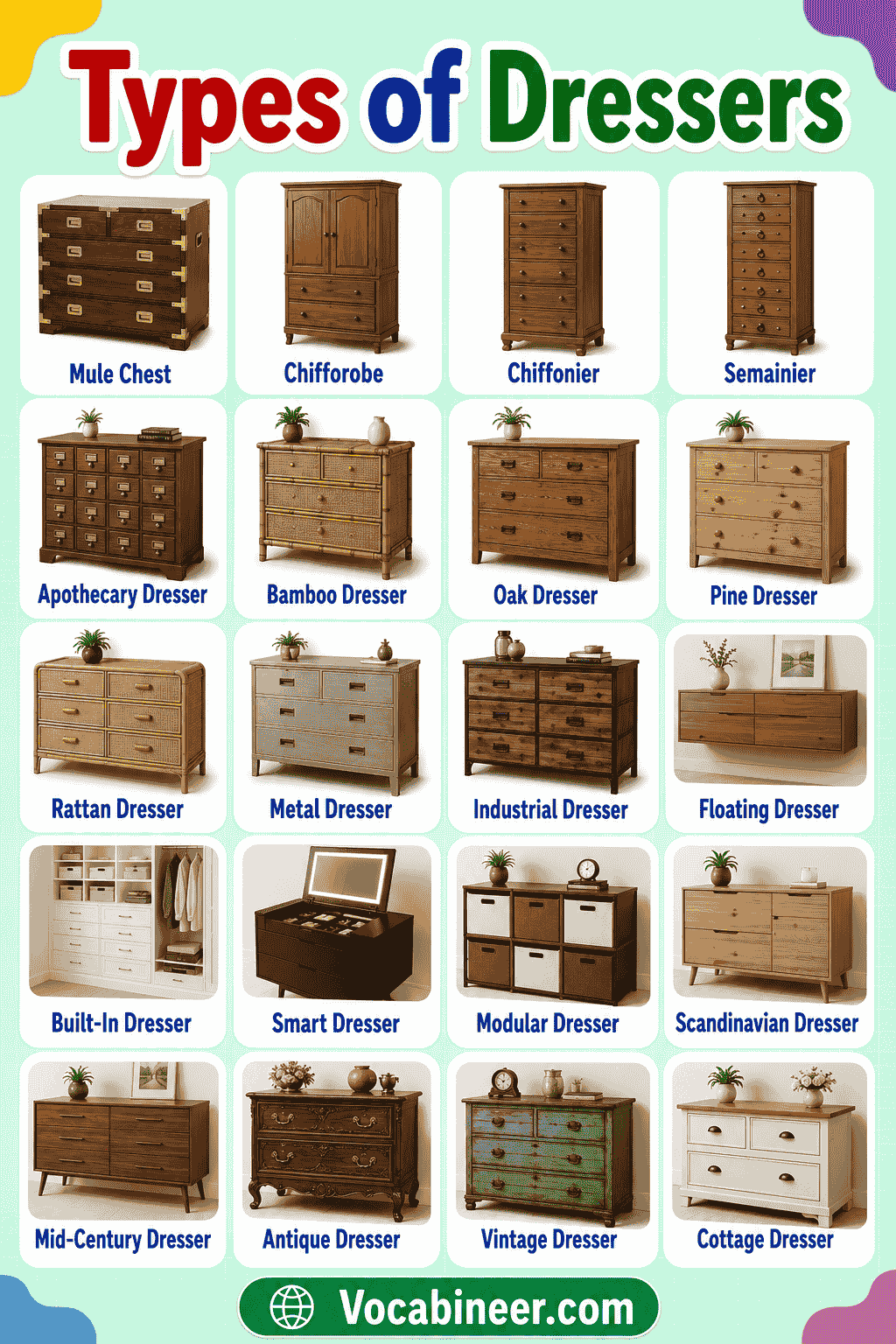
A dresser chart helps compare dresser groups, best uses, and common examples.
| Dresser Group | Details |
|---|---|
| Common Dressers | Best for: everyday bedroom clothes storage Examples: standard dresser, horizontal dresser, vertical dresser |
| Wide Dressers | Best for: large bedrooms, shared rooms, and more drawer space Examples: double dresser, triple dresser, wide dresser |
| Tall Dressers and Chests | Best for: small rooms and vertical storage Examples: highboy, tallboy, chest of drawers, lingerie chest |
| Specialty Chests | Best for: compact storage, delicate clothing, or mixed storage needs Examples: bachelor’s chest, gentleman’s chest, lingerie chest |
| Feature Dressers | Best for: mirrors, media, shelves, and cabinet storage Examples: mirrored dresser, combo dresser, media dresser |
| Nursery and Kids Dressers | Best for: baby clothes, children’s clothes, diapers, toys, and safe storage Examples: nursery dresser, kids dresser, changing table dresser |
| Material-Based Dressers | Best for: choosing by durability, style, weight, and budget Examples: wood, solid wood, MDF, metal, rattan, fabric |
| Style-Based Dressers | Best for: matching bedroom decor Examples: modern, traditional, rustic, industrial, farmhouse, vintage |
How to Choose the Right Dresser
Choosing the right dresser depends on room size, clothing amount, drawer needs, safety, material, and style.
- For small bedrooms — choose a tall dresser, vertical dresser, chest of drawers, bachelor’s chest, or narrow chest.
- For large bedrooms — choose a horizontal dresser, wide dresser, double dresser, or triple dresser.
- For shared bedrooms — choose a double dresser, triple dresser, or dresser with mixed drawer sizes.
- For kids’ rooms — choose a low dresser, kids dresser, fabric dresser, or anti-tip dresser.
- For nurseries — choose a nursery dresser or changing table dresser with safe storage.
- For delicate clothing — choose a lingerie chest or dresser with felt-lined drawers.
- For jewelry and accessories — choose a jewelry dresser or dresser with small top drawers.
- For TV and media storage — choose a media dresser, TV dresser, or low wide dresser.
- For classic bedroom decor — choose a traditional dresser, highboy, lowboy, or solid wood dresser.
- For modern rooms — choose a modern dresser, minimalist dresser, floating dresser, or built-in dresser.
FAQs
The most common types of dressers include standard dressers, horizontal dressers, vertical dressers, double dressers, triple dressers, highboy dressers, lowboy dressers, tallboy dressers, mirrored dressers, combo dressers, nursery dressers, and chest of drawers.
A dresser is usually wider and lower, with more surface space on top. A chest of drawers is usually taller and narrower, with drawers stacked vertically.
Both are tall storage pieces. A highboy is often linked with a more traditional or raised design, while tallboy is a general term for a tall, narrow dresser or chest.
A vertical dresser, tall dresser, chest of drawers, bachelor’s chest, narrow chest, or tallboy dresser works well in a small bedroom because it uses height instead of width.
A double dresser, triple dresser, horizontal dresser, chest of drawers, or deep-drawer dresser is best for clothes storage, depending on room size and clothing amount.
Read More
- Types of Baskets
- Bedroom Decor Items
- Popular Types of Tiles
- Parts of a House Names
- Different Types of Tables
- Different Types of Drawers