

Showers come in many styles, layouts, systems, and features. Some showers fit into small bathroom corners, some create a wide open walk-in space, and some include rain heads, handheld sprays, body jets, steam, glass panels, or easy-access safety features.
Learning shower names helps homeowners, students, designers, builders, and English learners understand bathroom vocabulary more clearly. This guide explains common types of showers, their uses, parts, systems, heads, enclosures, materials, safety tips, mistakes, and beginner-friendly shower terms.
In This Page
What Is a Shower?
A shower is a bathroom fixture used for washing the body while water sprays from a shower head. A shower may have a tray, drain, tiles, glass panels, curtain, bench, niche, grab bars, or different types of shower heads.
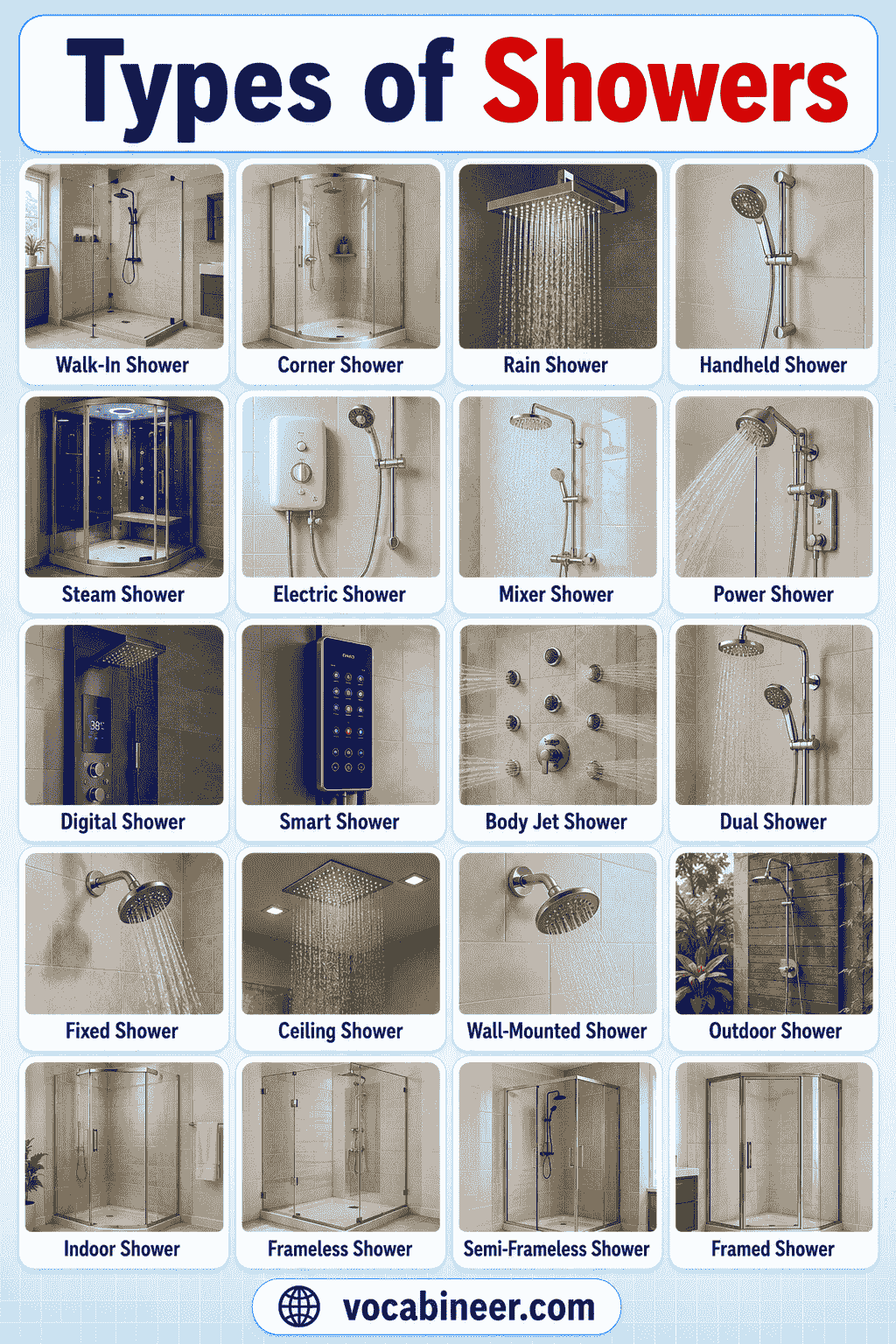
Common shower types include walk-in showers, wet room showers, alcove showers, corner showers, shower-tub combinations, mixer showers, electric showers, thermostatic showers, rain showers, handheld showers, steam showers, and shower panel systems.
Common Shower Names and Uses
These are common shower names used in bathroom design and bathroom vocabulary.
- Walk-in shower — A shower with easy entry and little or no barrier.
- Wet room shower — A shower area inside a fully waterproofed bathroom space.
- Alcove shower — A shower placed between three walls.
- Corner shower — A shower built into a bathroom corner.
- Shower-tub combination — A bathtub and shower built into the same area.
- Recessed shower — A shower built into a recessed wall space.
- Doorless shower — A shower with open entry and no door.
- Curbless shower — A shower with little or no raised edge at the floor.
- Enclosed shower — A shower surrounded by doors, walls, or panels.
- Neo-angle shower — A corner shower with angled glass panels or doors.
- Shower stall — A compact shower unit or enclosed shower space.
- Prefab shower — A ready-made shower unit installed as one system or sections.
- Custom tile shower — A shower built with custom tile walls and floor.
- Mixer shower — A shower that mixes hot and cold water from the home supply.
- Electric shower — A shower that heats cold water using an electric heating element.
- Thermostatic shower — A shower that helps keep water temperature steady.
- Rain shower — A shower with a wide, soft rainfall-like spray.
- Handheld shower — A movable shower head attached to a hose.
- Steam shower — A shower space that can produce steam for a spa-like effect.
- Shower panel system — A vertical shower panel with built-in sprays or controls.
Shower Parts and Features
Shower parts and features affect comfort, safety, water flow, cleaning, and installation.
- Shower head — The part where water sprays out.
- Shower arm — The pipe that connects the shower head to the wall or ceiling.
- Shower valve — The part that controls water flow.
- Mixer valve — A valve that mixes hot and cold water.
- Thermostatic valve — A valve that helps control water temperature.
- Diverter — A control that sends water to a different outlet, such as a handheld head.
- Controls — Handles, knobs, buttons, or digital panels used to operate the shower.
- Shower tray — The base that collects water and directs it to the drain.
- Shower pan — Another name for the shower base or tray.
- Drain — The opening where water leaves the shower.
- Linear drain — A long narrow drain often used in modern showers.
- Curb — A raised edge at the shower entry.
- Threshold — The entry edge of the shower.
- Glass panel — A fixed or movable glass section used to contain water.
- Shower screen — A glass or plastic panel used to block splashes.
- Shower door — A door used to open and close the shower area.
- Wall panels — Shower wall surfaces made from tile, acrylic, fiberglass, stone, or other materials.
- Tiles — Small or large pieces used on shower walls or floors.
- Grout — The material between tiles.
- Niche — A built-in wall shelf for soap, shampoo, or bottles.
- Bench — A seat inside the shower.
- Grab bars — Safety bars used for balance and support.
- Slip-resistant floor — A floor surface designed to reduce slipping.
- Waterproofing — Protection behind or under surfaces that helps stop water damage.
- Extractor fan — A ventilation fan that helps remove moisture.
Shower Types by Layout
Shower layout explains where the shower sits and how it uses bathroom space. Layout is one of the most important choices when planning a bathroom.
- Walk-in shower — Best for open entry, modern bathrooms, and easy access.
- Wet room shower — Best for fully waterproofed open bathroom spaces.
- Alcove shower — Best for standard bathrooms and three-wall spaces.
- Corner shower — Best for small bathrooms and unused corners.
- Recessed shower — Best for bathrooms with a built-in wall niche.
- Doorless shower — Best for open layouts with good splash control.
- Curbless shower — Best for easy entry and accessible bathroom design.
- Neo-angle shower — Best for corner spaces with angled glass.
- Shower stall — Best for compact bathrooms, guest bathrooms, and simple layouts.
- Shower-tub combination — Best for bathrooms that need both bathing and showering.
Walk-In and Wet Room Showers
Walk-in and wet room showers both create a more open bathroom feel, but they are not exactly the same. A walk-in shower is usually a defined shower area with a tray, screen, or glass panel. A wet room shower is part of a fully waterproofed bathroom where the floor drains water directly.
- Walk-in shower — Best for easy entry, modern style, and open bathroom design.
- Glass-panel walk-in shower — Best for a clean look while controlling splashes.
- Curbless walk-in shower — Best for low-threshold access and smooth floor entry.
- Recessed walk-in shower — Best for a shower built into a wall space.
- Corner walk-in shower — Best for saving space while keeping an open feel.
- Wet room shower — Best for fully waterproofed bathrooms with floor drainage.
- Small wet room shower — Best for compact bathrooms when waterproofing is planned well.
- Luxury wet room shower — Best for spa-style bathrooms with open tile and glass design.
Alcove and Corner Showers
Alcove and corner showers are common choices for small and standard bathrooms. They use wall space efficiently and can work with many enclosure styles.
- Alcove shower — Best for a shower placed between three walls.
- Corner shower — Best for fitting a shower into an unused corner.
- Quadrant shower — Best for compact corners with a curved front.
- Neo-angle shower — Best for corner layouts with angled glass panels.
- Recessed shower — Best for bathrooms with a built-in shower niche.
- Shower stall — Best for small, simple, or guest bathrooms.
- Sliding-door shower — Best when there is not enough room for a swinging door.
- Bi-fold door shower — Best for tight spaces where the door folds inward.
Shower-Tub Combinations
A shower-tub combination includes a shower and bathtub in the same area. This type is common in family bathrooms, apartments, guest bathrooms, and homes that need both bathing and showering.
- Alcove shower-tub combination — Best for standard bathrooms and everyday use.
- Shower-tub combo with curtain — Best for simple and budget-friendly bathrooms.
- Shower-tub combo with glass door — Best for a cleaner and more modern look.
- Deep shower-tub combo — Best for people who want both showering and deeper bathing.
- Kids’ bathroom shower-tub combo — Best for families with children.
- Apartment shower-tub combo — Best for compact homes that need one fixture for two uses.
Shower Types by System
A shower system explains how the shower controls water flow, temperature, and pressure. Some systems depend on the home’s hot water supply, while others heat or control water differently.
- Mixer shower — Mixes hot and cold water from the home supply.
- Electric shower — Heats cold water as it flows through the unit.
- Thermostatic shower — Helps keep the water temperature steady.
- Manual shower — Uses basic controls for water flow and temperature.
- Digital shower — Uses digital controls for temperature or flow.
- Power shower — Uses a pump to improve water flow.
- Concealed shower — Hides pipework and valves behind the wall.
- Exposed shower — Shows pipework and controls on the wall surface.
- Pressure-balanced shower — Helps reduce sudden temperature changes.
- Smart shower — May use presets, displays, or app-style controls.
Mixer, Electric, and Thermostatic Showers
Mixer, electric, and thermostatic showers are common shower system names. They are often compared because each one handles hot water and temperature control differently.
- Mixer shower — Best for homes with a reliable hot and cold water supply.
- Electric shower — Best for heating cold water on demand.
- Thermostatic shower — Best for steadier temperature control.
- Manual mixer shower — Best for simple control and basic use.
- Exposed thermostatic shower — Best for easier access to visible controls.
- Concealed thermostatic shower — Best for a cleaner built-in wall look.
Digital and Power Showers
Digital and power showers add more control or stronger water flow, depending on the system. They often need more planning than a basic shower.
- Digital shower — Best for preset temperature or digital control.
- Smart shower — Best for advanced controls or saved settings.
- Power shower — Best for improving water flow where the system supports a pump.
- Pressure-assisted shower — Best for bathrooms that need stronger water delivery.
- Concealed digital shower — Best for a clean design with hidden controls.
- Exposed digital shower — Best when easier access to controls matters.
Shower Types by Head Style
Shower head style changes how the water feels and how flexible the shower is. Some heads stay fixed, while others move on a hose or create a rain-like flow.
- Fixed shower head — Mounted in one position on the wall or ceiling.
- Handheld shower head — Attached to a hose and easy to move.
- Rain shower head — Gives a wide rainfall-like spray.
- Ceiling-mounted shower head — Mounted above the user for overhead flow.
- Wall-mounted shower head — Mounted on the wall.
- Dual shower head — Combines two shower heads, often fixed and handheld.
- High-pressure shower head — Designed to create a stronger spray feel.
- Water-saving shower head — Designed to reduce water use.
- Filtered shower head — Includes a filter to reduce some impurities.
- Rail shower — A shower head mounted on an adjustable rail.
- Multi-function shower head — Offers different spray patterns.
Fixed, Handheld, and Rain Showers
Fixed, handheld, and rain showers are among the most common shower head choices. Each one works better for different needs.
- Fixed shower — Best for simple daily showers and low-maintenance setups.
- Handheld shower — Best for families, pets, cleaning the shower area, and flexible washing.
- Rain shower — Best for a wide, soft, spa-like water flow.
- Ceiling rain shower — Best for overhead rainfall-style water.
- Wall-mounted rain shower — Best when the plumbing comes from the wall.
- Rail shower — Best for adjusting shower head height.
- Dual fixed and handheld shower — Best for users who want both comfort and flexibility.
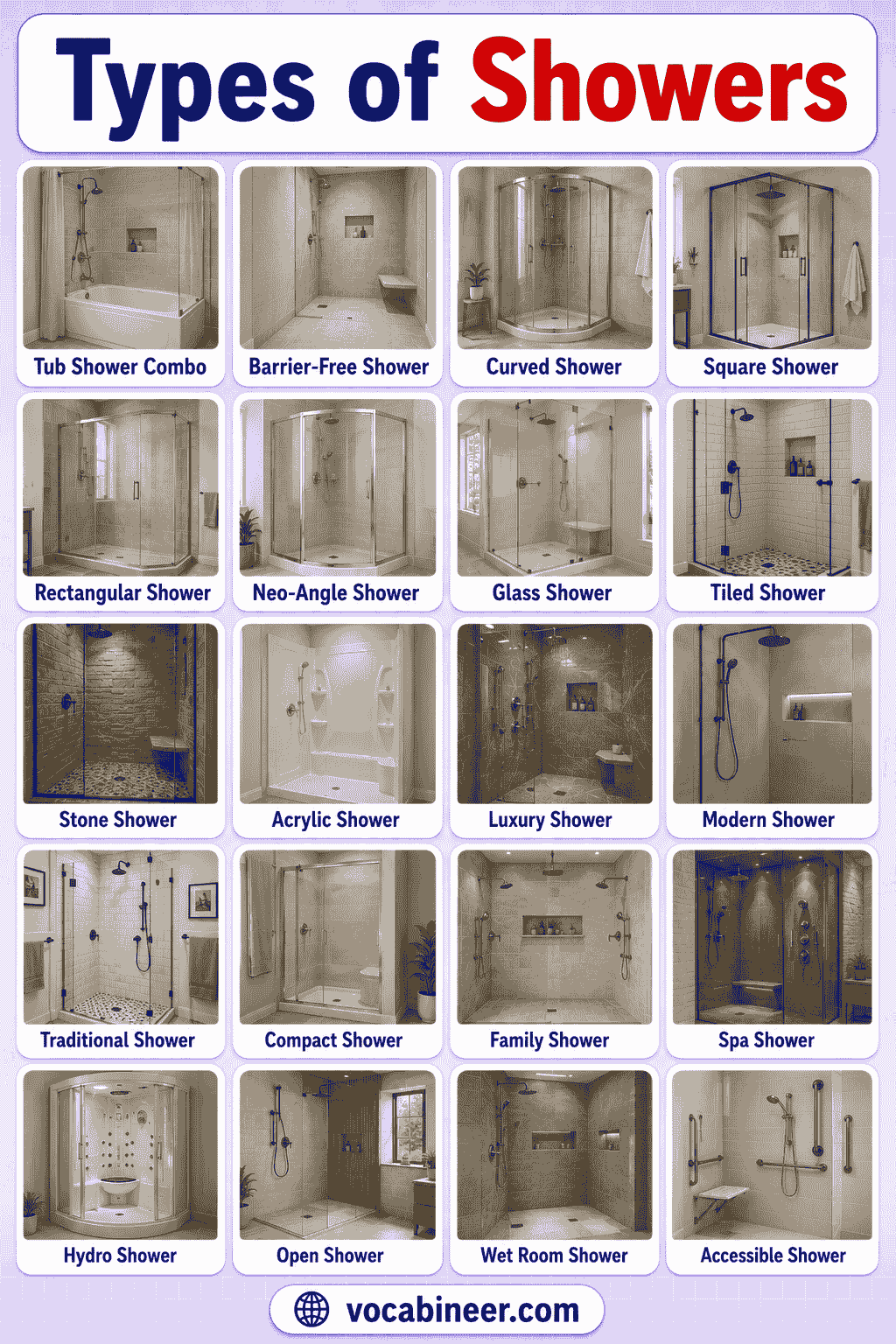
Dual, Body Spray, and Shower Panel Systems
Some showers include multiple water outlets or panel systems for a spa-style feel. These options work best when the bathroom has suitable plumbing, water pressure, and space.
- Dual shower head — Combines two shower heads in one setup.
- Body spray shower — Uses wall-mounted spray outlets for the body.
- Shower panel system — Includes a vertical panel with controls and spray outlets.
- Multi-jet shower — Uses several spray points.
- Rainfall panel shower — Combines overhead rain flow with a panel system.
- Massage shower system — Uses spray settings or jets for a massage-like feel.
Shower Types by Feature
Some shower types are named by special features rather than layout or system. These features can improve comfort, safety, cleaning, water use, or bathroom style.
- Doorless shower — Has open entry without a door.
- Curbless shower — Has little or no raised edge at the entrance.
- Steam shower — Creates steam for a spa-style experience.
- High-pressure shower — Gives a stronger spray feel.
- Water-saving shower — Helps reduce water use.
- Filtered shower — Uses a filter in the shower head or system.
- Accessible shower — Includes features that support safer use.
- Smart shower — Uses digital or preset controls.
- Low-maintenance shower — Uses simpler surfaces, fewer grout lines, or easy-clean glass.
- Ventilated shower — Uses good airflow to reduce moisture buildup.
Doorless, Curbless, and Steam Showers
Doorless, curbless, and steam showers serve different needs. Doorless and curbless showers focus on open access, while steam showers focus on spa-style comfort.
- Doorless shower — Best for open bathrooms with good splash control.
- Curbless shower — Best for smooth entry and accessible bathroom design.
- Low-threshold shower — Best for easier step-in access.
- Open shower — Best for modern bathrooms with enough space.
- Steam shower — Best for spa-style relaxation in an enclosed shower space.
- Enclosed steam shower — Best for keeping steam inside the shower area.
Accessible Showers and Safety Features
Accessible showers support safer entry, easier movement, and more comfortable washing. They are useful for seniors, people with mobility needs, children, and anyone who wants a safer shower.
- Curbless shower — Helps users enter without stepping over a high edge.
- Low-threshold shower — Reduces the step-in height.
- Handheld shower — Makes washing easier while seated or standing.
- Shower bench — Provides a place to sit.
- Grab bars — Add support for balance.
- Slip-resistant floor — Helps reduce slipping.
- Wide-entry shower — Gives more room to enter and move.
- Accessible controls — Place water controls where users can reach them more easily.
Shower Enclosure and Door Types
Shower enclosures and doors help contain water and shape the shower area. They also affect cleaning, space use, and bathroom style.
- Shower enclosure — A framed or glass area that surrounds the shower.
- Shower screen — A glass or plastic panel that helps block splashes.
- Glass panel — A fixed glass section used in many modern showers.
- Framed shower door — A shower door with a visible metal frame.
- Frameless shower door — A glass door with little visible framing.
- Semi-frameless shower door — A door with some framing and some open glass edges.
- Sliding shower door — A door that slides instead of swinging open.
- Hinged shower door — A door that swings open from hinges.
- Pivot shower door — A door that turns on a pivot point.
- Bi-fold shower door — A door that folds to save space.
- Quadrant enclosure — A curved corner enclosure.
- Neo-angle enclosure — An angled corner enclosure.
- Bath shower screen — A screen used over a bathtub shower.
- Shower curtain — A fabric or plastic curtain used to block water.
Small Showers for Compact Bathrooms
Small showers are useful for apartments, guest bathrooms, narrow bathrooms, and homes with limited space. The best small shower usually saves floor space, controls splashes, and keeps the entry easy to use.
- Corner shower — Best for using an empty corner.
- Alcove shower — Best for a three-wall shower space.
- Quadrant shower — Best for compact bathrooms with curved corner space.
- Neo-angle shower — Best for tight corners with angled entry.
- Shower stall — Best for simple compact layouts.
- Shower-tub combination — Best when one space needs both functions.
- Recessed shower — Best when the wall layout creates a built-in shower space.
- Sliding-door shower — Best when there is no room for a swinging door.
- Bi-fold door shower — Best for narrow openings.
- Compact curbless shower — Best for small spaces that need easier entry.
Luxury Shower Types
Luxury showers focus on comfort, openness, materials, and extra features. They often work best in larger bathrooms with good waterproofing, ventilation, and drainage.
- Walk-in shower — Creates an open modern look.
- Wet room shower — Creates a fully waterproofed spa-style bathroom.
- Rain shower — Gives a soft rainfall-like experience.
- Dual shower system — Adds more flexibility and comfort.
- Body spray shower — Adds wall-mounted spray points.
- Shower panel system — Combines sprays, controls, and modern style.
- Steam shower — Adds spa-like steam.
- Digital shower — Adds more control over temperature or flow.
- Smart shower — Uses presets or advanced controls.
- Frameless glass shower — Creates a clean open look.
- Curbless shower — Gives a smooth floor transition.
- Marble shower — Adds a luxury stone look.
- Custom tile shower — Allows a custom design with tile, niches, and benches.
Shower Materials, Glass, and Finishes
Shower materials affect cleaning, durability, price, and style. Finishes also change the look of shower heads, valves, handles, and frames.
- Ceramic tile — A common shower wall and floor material.
- Porcelain tile — Durable tile used for shower walls and floors.
- Stone tile — A natural-looking material used in higher-end showers.
- Marble — A luxury surface that needs careful maintenance.
- Acrylic shower panels — Smooth panels that can reduce grout lines.
- Fiberglass shower unit — A lightweight shower option often used in prefab showers.
- Glass shower panels — Clear panels used for screens, doors, and enclosures.
- Frameless glass — A clean glass style with minimal framing.
- Frosted glass — Glass that adds privacy.
- Chrome finish — A shiny silver finish for fixtures.
- Brushed nickel finish — A softer silver finish that hides marks better than shiny chrome.
- Matte black finish — A modern dark fixture finish.
- Brass finish — A warm metal finish used in classic or luxury bathrooms.
- Stainless steel finish — A durable finish used for some fixtures and fittings.
Best Showers for Different Bathrooms
Choosing a shower becomes easier when you match the shower type to the bathroom layout and the people using it.
- Small bathroom — Corner shower, alcove shower, quadrant shower, or sliding-door shower.
- Family bathroom — Shower-tub combination, handheld shower, or durable shower enclosure.
- Guest bathroom — Simple alcove shower, shower stall, or low-maintenance shower.
- Master bathroom — Walk-in shower, rain shower, wet room shower, or dual shower system.
- Accessible bathroom — Curbless shower, grab bars, handheld shower, bench, and slip-resistant floor.
- Apartment bathroom — Compact shower, shower-tub combination, or sliding-door shower.
- Luxury bathroom — Wet room shower, steam shower, body spray shower, or frameless glass shower.
- Low-maintenance bathroom — Acrylic panels, simple glass screen, fewer grout lines, and easy-clean surfaces.
- Modern bathroom — Walk-in shower, frameless glass, rain shower, or curbless shower.
- Traditional bathroom — Framed enclosure, classic tile shower, or shower-tub combination.
Shower Safety and Cleaning Tips
Good shower care helps prevent slips, water damage, mold, soap scum, and blocked drains.
- Use a slip-resistant floor or mat.
- Add grab bars when extra support is needed.
- Keep shampoo and soap off the shower floor.
- Check water temperature before showering.
- Clean soap scum from glass and tiles.
- Keep the drain clear of hair and debris.
- Use ventilation to reduce moisture.
- Clean grout regularly.
- Use cleaners that match the shower material.
- Check seals around doors, trays, and panels.
- Keep glass panels dry when possible.
- Fix leaks early.
- Make sure water drains properly.
- Use good lighting inside or near the shower.
Types of Showers Chart
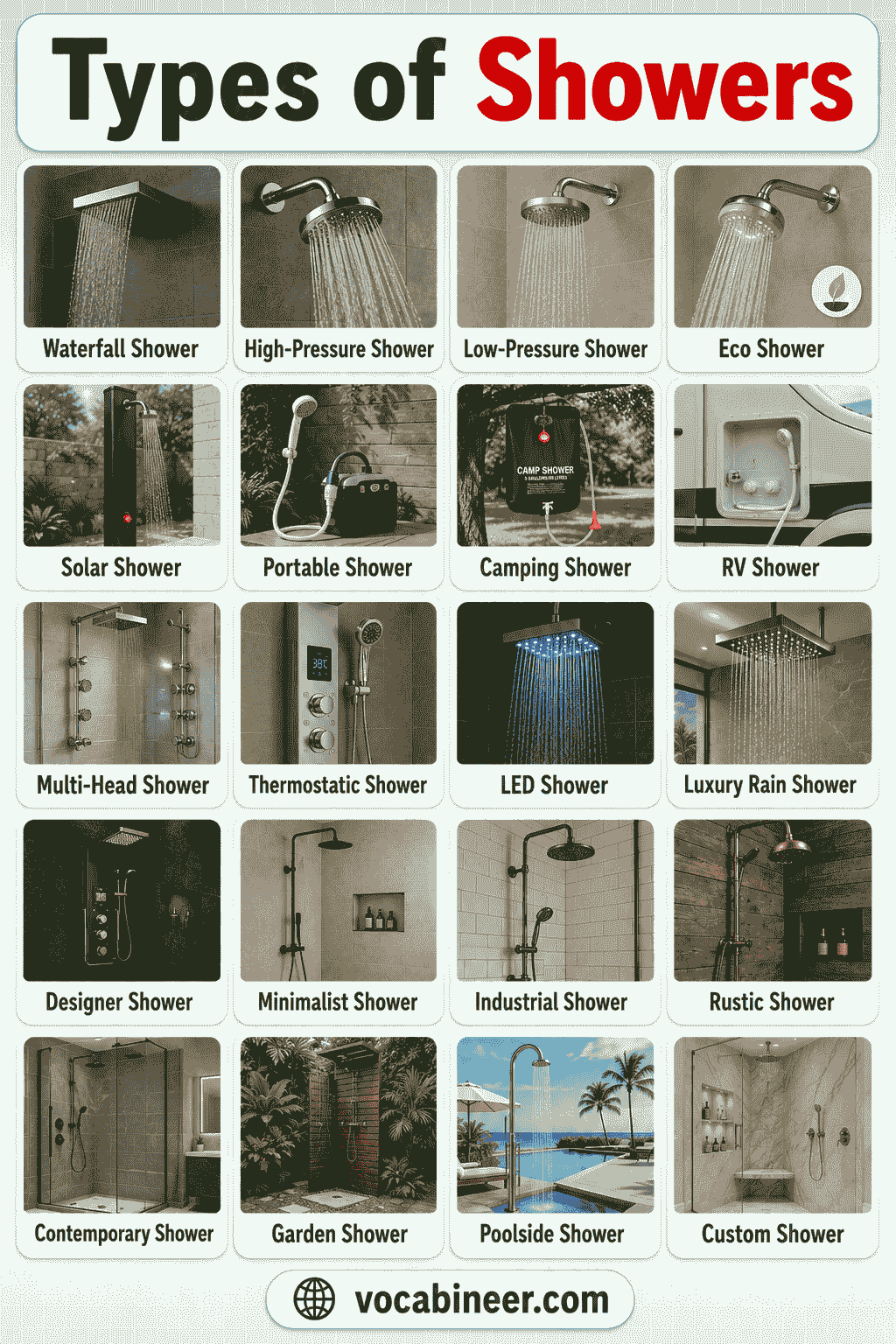
| Shower Type | Best Used For |
|---|---|
| Walk-in shower | Modern bathrooms and easy entry |
| Wet room shower | Fully waterproofed open bathrooms |
| Alcove shower | Standard bathrooms and three-wall spaces |
| Corner shower | Small bathrooms and corner layouts |
| Shower-tub combination | Family bathrooms and dual-use spaces |
| Mixer shower | Homes with hot and cold water supply |
| Electric shower | Heating cold water on demand |
| Thermostatic shower | Steadier temperature control |
| Rain shower | Soft spa-style water flow |
| Handheld shower | Flexible washing, cleaning, and accessibility |
| Steam shower | Spa-style comfort |
| Frameless glass shower | Modern open bathroom style |
Confusing Shower Terms Explained
Some shower terms sound similar. This table focuses only on relevant shower comparisons.
| Terms | Simple Difference |
|---|---|
| Walk-In Shower vs Wet Room | A walk-in shower is a defined shower area. A wet room is a fully waterproofed bathroom space. |
| Alcove Shower vs Corner Shower | An alcove shower fits between walls. A corner shower fits into a corner. |
| Shower-Tub Combo vs Walk-In Shower | A shower-tub combo includes a bathtub. A walk-in shower is mainly for showering. |
| Mixer Shower vs Electric Shower | A mixer shower uses hot and cold supply. An electric shower heats cold water. |
| Thermostatic Shower vs Manual Shower | A thermostatic shower controls temperature more steadily. A manual shower uses basic controls. |
| Digital Shower vs Power Shower | A digital shower uses digital controls. A power shower uses a pump to improve flow. |
| Fixed vs Handheld Shower Head | A fixed head stays mounted. A handheld head moves on a hose. |
| Rain Shower vs High-Pressure Shower | A rain shower gives a wide soft flow. A high-pressure head gives a stronger spray feel. |
| Shower Panel vs Body Spray | A shower panel is a vertical unit with controls or sprays. Body sprays are separate spray outlets. |
| Framed vs Frameless Shower Door | A framed door has visible metal borders. A frameless door uses less visible framing. |
| Sliding vs Hinged Shower Door | A sliding door moves sideways. A hinged door swings open. |
How to Choose the Right Shower
Choose the right shower by matching it to your bathroom size, layout, water pressure, plumbing, and daily use. A corner or alcove shower works well in small bathrooms, while a walk-in shower, wet room, or frameless glass shower fits larger modern bathrooms. Choose a handheld shower for flexibility, a rain shower for comfort, a thermostatic shower for steadier temperature, and a curbless shower if easy entry matters.
Cleaning, safety, and maintenance also matter. Large glass panels look modern but need regular cleaning, while acrylic panels and fewer grout lines can make upkeep easier. Check drainage, waterproofing, ventilation, door swing, storage, lighting, and slip resistance before choosing. For daily use, pick a shower that fits the room, feels comfortable, drains well, and matches the people who will use it most.
FAQs
The main types of showers include walk-in showers, wet room showers, alcove showers, corner showers, shower-tub combinations, mixer showers, electric showers, thermostatic showers, rain showers, handheld showers, steam showers, and shower panel systems.
A corner shower, alcove shower, quadrant shower, sliding-door shower, or compact shower stall often works best for a small bathroom. A shower-tub combination can also work if the bathroom needs both a shower and bathtub.
A walk-in shower is a defined shower area with open entry, a screen, tray, or glass panel. A wet room is a fully waterproofed bathroom space where water drains through the floor.
A mixer shower mixes hot and cold water from the home’s water supply. An electric shower heats cold water as it flows through the shower unit.
A simple shower with smooth wall panels, fewer grout lines, good ventilation, and a clear glass screen is often easier to clean. Frameless glass looks clean and modern, but it still needs regular wiping to reduce water spots.
Read More
- Types of Bathtubs
- Popular Types of Tiles
- Parts of a House Names
- Different Types of Tables
- Different Types of Drawers
- Different Types of Baskets