Tanks are armored tracked vehicles designed to combine protection, mobility, and direct firepower. Since their appearance during World War I, armies have developed different tank types for infantry support, reconnaissance, rapid movement, fortified defenses, water crossings, and modern front-line operations.
Learning the types of tanks becomes easier when historical weight classes, battlefield roles, and specialist vehicles are separated clearly. This guide explains the main tank categories, recognizable examples, visual features, and related armored vehicles that people often mistake for tanks.
In This Page
What Is a Tank?
A tank is an armored land vehicle that normally moves on continuous tracks and carries powerful direct-fire weapons. Most familiar tanks have a protected hull, a rotating turret, a main gun, an engine, tracks, and enclosed crew positions.
Tank design traditionally balances three major qualities:
- firepower;
- protection;
- mobility.
Improving one quality can affect the others. For example, thicker armor may provide greater protection, but it also adds weight, increases fuel use, and makes transportation more difficult.
Modern tanks also include advanced observation equipment, digital communications, computerized controls, and additional protective systems.
Not every armored or tracked vehicle is a tank. Infantry fighting vehicles, armored personnel carriers, self-propelled guns, bridge layers, and recovery vehicles serve different primary purposes.
How Tanks Are Classified
Tank classification has changed considerably over time. Earlier armies commonly grouped tanks by weight, speed, weapon size, or battlefield function. As technology improved, many separate medium and heavy categories gradually gave way to the more versatile main battle tank.
The most useful classification methods are:
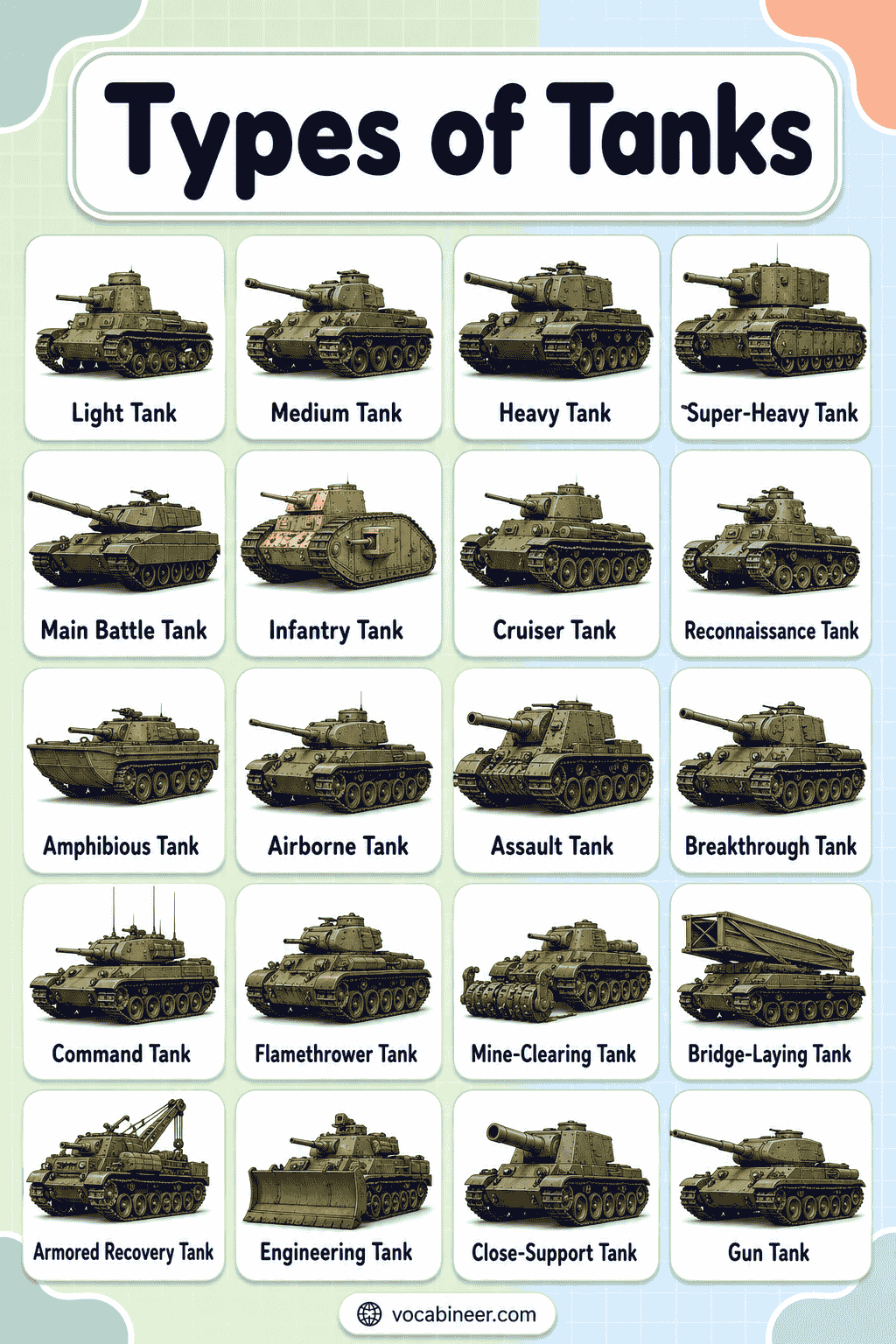
By weight: Tankettes, light tanks, medium tanks, heavy tanks, and super-heavy tanks.
By battlefield role: Infantry tanks, cruiser tanks, reconnaissance tanks, assault tanks, and main battle tanks.
By special capability: Amphibious, flame, command, engineer, and mine-clearing vehicles.
By historical period: World War I, interwar, World War II, Cold War, and modern tanks.
These classifications sometimes overlap. For instance, one vehicle may be both a light tank and an amphibious tank.
Tank Types by Weight
Weight-based classes are especially useful for understanding tanks developed during the first half of the twentieth century. However, countries did not always use identical weight limits.
Tankettes
A tankette is a very small, lightly armored tracked vehicle, usually designed for one or two crew members. Most tankettes carried machine guns or similarly light weapons instead of a full-sized tank gun.
Their compact size made them relatively inexpensive and easy to transport. Nevertheless, thin armor, limited visibility, and weak armament reduced their usefulness against stronger vehicles.
Well-known examples include:
- Carden-Loyd tankette;
- Italian L3/35;
- Polish TKS;
- Japanese Type 94.
Tankettes are mainly associated with the interwar period and early World War II. Modern militaries generally use armored reconnaissance vehicles or other light platforms for similar duties.
Light Tanks
Light tanks prioritize lower weight, mobility, and easier deployment. Historically, armies used them for reconnaissance, screening, infantry support, and operations where heavier vehicles were difficult to transport.
Common characteristics include:
- relatively light armor;
- smaller dimensions;
- easier air or sea transport;
- high mobility;
- lower ground pressure than many heavier tanks.
Recognizable light tanks include:
- M24 Chaffee;
- M41 Walker Bulldog;
- AMX-13;
- PT-76;
- M551 Sheridan;
- Type 15.
Some modern forces still use light tanks or light armored gun systems for rapid deployment, mountainous terrain, reconnaissance support, and areas where heavy main battle tanks are unsuitable.
Medium Tanks
Medium tanks were designed to balance protection, mobility, firepower, and production cost. They became especially important during World War II because they could perform a wider range of tasks than many specialized light or heavy designs.
Famous examples include:
- M4 Sherman;
- T-34;
- Panzer IV;
- Cromwell;
- Panther;
- M48 Patton.
The boundaries between medium and heavy tanks were never universal. A vehicle considered medium by one country could appear heavy when compared with another nation’s designs.
Over time, improvements in engines, armor, weapons, and suspension allowed medium-tank ideas to develop into the modern main battle tank.
Heavy Tanks
Heavy tanks carried thicker armor and more powerful weapons than most contemporary medium tanks. Armies often intended them to attack defended positions or confront heavily armored opponents.
Common examples include:
- KV-1;
- IS-2;
- Tiger I;
- Tiger II;
- Churchill;
- M103;
- T-10.
Their additional weight created practical disadvantages. Heavy tanks required more fuel, stronger bridges, specialized transport equipment, and substantial maintenance support.
As tank technology progressed, modern main battle tanks began providing strong protection and firepower without preserving heavy tanks as a separate standard category.
Super-Heavy Tanks
Super-heavy tanks pushed armor, vehicle size, and weapon weight beyond ordinary heavy-tank designs. Most remained experimental because their extreme mass created serious mobility and logistical problems.
Notable examples include:
- Panzer VIII Maus;
- E-100;
- TOG II;
- T28 Super Heavy Tank;
- proposed O-I designs.
Although visually impressive, super-heavy vehicles faced difficulties with bridges, rail transport, mechanical reliability, recovery, and fuel use. Consequently, this category never became practical for widespread service.
Tank Types by Battlefield Role
Role-based classifications describe what a tank was intended to accomplish rather than how much it weighed.
Main Battle Tanks
The main battle tank, commonly abbreviated as MBT, is the principal modern tank category. It combines strong armor, direct firepower, mobility, communication equipment, and advanced observation systems in one versatile platform.
Well-known main battle tanks include:
- M1 Abrams;
- Leopard 2;
- Challenger 2;
- Leclerc;
- T-90;
- Merkava;
- K2 Black Panther;
- Type 10.
The MBT largely absorbed the former roles of separate medium and heavy tanks. Modern armies usually operate these vehicles as part of broader formations supported by infantry vehicles, engineers, artillery, air-defense systems, and recovery vehicles.
Infantry Tanks
Infantry tanks were designed to move with foot soldiers and support attacks against defended positions. British forces used this classification extensively before and during World War II.
These tanks generally emphasized:
- strong armor;
- dependable cross-country movement;
- relatively low speed;
- close support for infantry.
Examples include:
- Matilda II;
- Valentine;
- Churchill.
The infantry-tank category disappeared as armies adopted faster and more versatile designs.
Cruiser Tanks
Cruiser tanks were built for speed and operational mobility. British doctrine intended them to exploit openings, move quickly beyond defended areas, and perform some of the functions traditionally associated with cavalry.
Notable examples include:
- Crusader;
- Cruiser Mark III;
- Cruiser Mark IV;
- Cromwell;
- Comet.
Cruiser tanks generally moved faster than infantry tanks, although earlier versions often carried lighter armor. As technology improved, the cruiser and infantry concepts gradually merged into more balanced designs.
Cavalry Tanks and Reconnaissance Tanks
Cavalry and reconnaissance tanks emphasized speed, observation, screening, and communication. Their crews helped locate opposing forces, monitor movement, and gather information for larger formations.
Examples include:
- M3 Stuart;
- AMX-13;
- selected early British light tanks;
- other small reconnaissance-oriented designs.
Terminology varied among countries. Over time, armored cars and specialized reconnaissance vehicles assumed many of these duties.
Assault and Breakthrough Tanks
Assault and breakthrough tanks were intended to support attacks against heavily defended positions. Such vehicles usually emphasized strong protection and powerful direct-fire weapons.
The terms were not universal, and they sometimes overlapped with heavy-tank classifications. Therefore, they are best understood as historical role descriptions rather than exact international categories.
Examples may include:
- selected Churchill variants;
- Soviet KV-series tanks;
- other heavily protected designs intended for difficult defensive areas.
Amphibious Tanks
Amphibious tanks can travel on land and cross water. Depending on the design, they may use sealed hulls, propellers, water jets, flotation equipment, or track movement for propulsion.
Examples include:
- PT-76;
- Type 63;
- Type 2 Ka-Mi;
- selected amphibious reconnaissance tanks.
Most amphibious tanks are relatively light because excessive armor and weight make flotation more difficult. However, not every amphibious armored vehicle qualifies as a tank. Many are troop carriers or reconnaissance vehicles.
Air-Deployable Light Tanks and Gun Systems
Air-deployable armored vehicles are designed with dimensions and weight suitable for transport by military aircraft. Some can be delivered by parachute, while others are simply compact enough for rapid air movement.
Examples include:
- M551 Sheridan;
- 2S25 Sprut-SD;
- selected modern light armored gun systems.
Classification differs among armed forces. One military may describe a vehicle as a light tank, whereas another may call a similar design an airborne assault vehicle or mobile protected gun system.
Specialist Tank and Support Vehicles
Some armored vehicles use tank hulls or related components but carry special equipment instead of a conventional tank turret. They support armored formations rather than functioning as ordinary gun tanks.
Flame Tanks
Flame tanks carried flamethrower equipment for use against fortified positions and defended structures. Depending on the design, the flamethrower replaced the main gun or appeared alongside other weapons.
Historical examples include:
- Churchill Crocodile;
- OT-34;
- Sherman flame-throwing variants.
Flame tanks are mainly associated with twentieth-century warfare and are not a common modern classification.
Command Tanks
Command tanks carry additional communication and coordination equipment for armored-unit leaders. Their exterior may closely resemble a standard tank, although the interior includes extra radios, displays, or command workstations.
Some command versions reduce ammunition storage or rearrange internal equipment to accommodate these systems.
Tank-Based Engineer Vehicles
Tank-based engineer vehicles support obstacle removal, earthmoving, demolition, and route preparation. Heavy armor allows them to work closer to dangerous areas than ordinary construction equipment.
They may carry:
- dozer blades;
- excavator arms;
- demolition tools;
- lifting equipment;
- obstacle-clearing devices.
Some retain limited defensive armament, while others replace the original turret with specialist machinery.
Mine-Clearing Vehicles
Mine-clearing vehicles help create routes through suspected minefields. Common attachments include rollers, plows, and mechanical flails.
Although people sometimes call them mine-clearing tanks, many are more accurately described as armored engineer vehicles built on tank chassis.
Armored Bridge Layers
An armored bridge layer transports and deploys a temporary bridge across trenches, streams, damaged roads, or similar obstacles.
These vehicles often use tank-derived hulls so they can travel with heavy armored formations. However, they are specialist support vehicles rather than conventional tanks.
Armored Recovery Vehicles
Armored recovery vehicles help tow damaged tanks, lift heavy components, and assist with repairs.
Common equipment includes:
- powerful winches;
- cranes;
- towing bars;
- repair tools;
- stabilizing or dozer blades.
Examples include the M88 and several Bergepanzer models. Despite sometimes being called recovery tanks, they usually lack the primary armament and direct-combat role of a true tank.
Experimental Tank Designs
Experimental projects allow engineers to evaluate unusual layouts, new technologies, and alternative crew arrangements.
Multi-Turret Tanks
Multi-turret tanks carried two or more separate turrets. Designers hoped several weapons would allow crews to engage multiple targets in different directions.
Examples include:
- Soviet T-35;
- British A1E1 Independent;
- German Neubaufahrzeug.
In practice, these vehicles were large, complicated, expensive, and difficult for their crews to coordinate. Therefore, the concept was eventually abandoned.
Experimental Super-Heavy Tanks
Several countries explored enormous tanks with unusually thick armor or powerful weapons. Most projects remained prototypes because their size caused major transport and reliability problems.
The Maus and TOG II are among the best-known examples.
Experimental Unmanned Tank Designs
Modern armored-vehicle research includes remote control, automated movement, unmanned turrets, and reduced crew requirements.
An unmanned turret does not necessarily mean that the entire tank is crewless. In some designs, crew members remain protected inside the hull while operating the turret electronically.
Fully uncrewed combat tanks remain largely experimental because reliable communications, maintenance, situational awareness, and autonomous decision-making continue to present major challenges.
Tank Development from World War I to Today
Tank classifications changed as military needs, engines, armor, weapons, and communication systems developed.
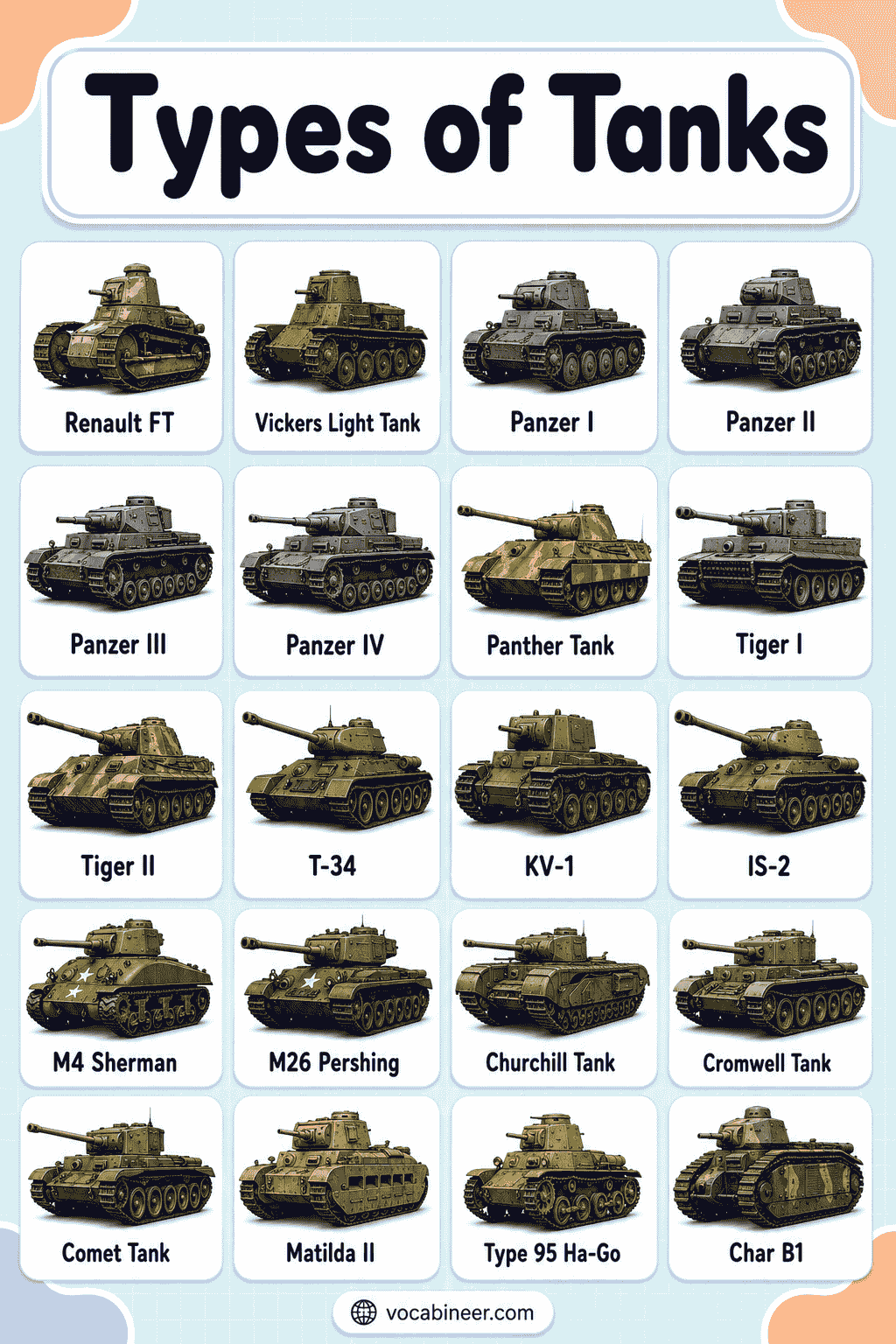
World War I Tanks
The first tanks emerged in response to trench warfare. They were designed to cross difficult ground, crush wire, protect crews from small-arms fire, and help overcome fortified defensive lines.
Early types included:
- large rhomboid tanks;
- smaller turreted tanks;
- male and female armament variants;
- infantry-support designs.
The French Renault FT became especially influential because its general arrangement included a front driver, central rotating turret, and rear engine.
Interwar Tank Designs
Between the world wars, armies experimented with several competing ideas, including:
- tankettes;
- light cavalry tanks;
- infantry tanks;
- cruiser tanks;
- multi-turret vehicles;
- early medium tanks.
No single design philosophy had yet become dominant. As a result, the period produced many unusual combinations of speed, armor, weapon placement, and crew arrangement.
World War II Tank Classes
During World War II, light, medium, and heavy classes became widely recognized. Medium tanks proved particularly important because they balanced firepower, mobility, protection, production cost, and mechanical practicality.
The period also produced numerous specialist vehicles, such as:
- amphibious tanks;
- flame tanks;
- command tanks;
- mine-clearing variants;
- armored recovery vehicles.
Tank destroyers and assault guns also became prominent, although they remained separate armored-vehicle categories.
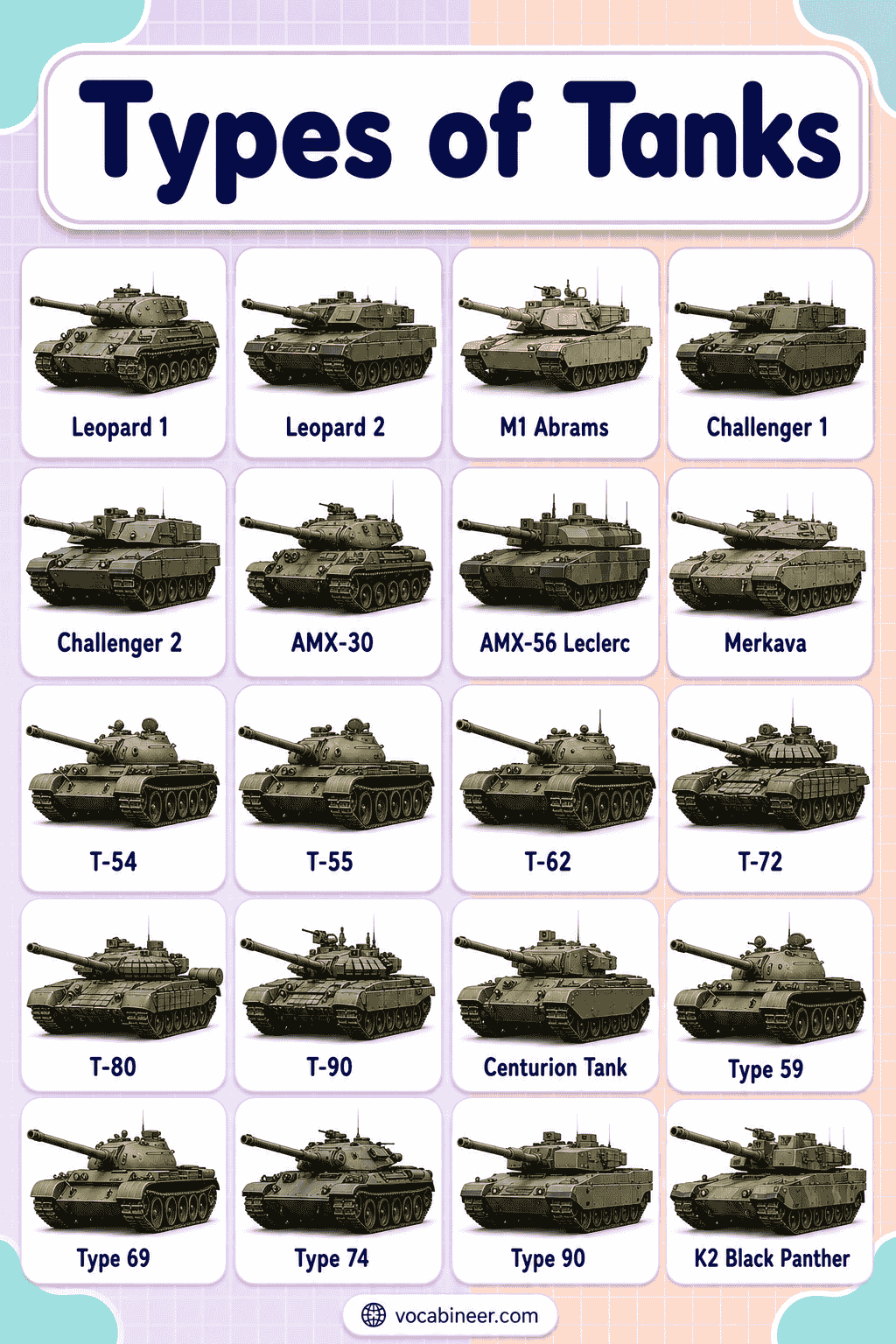
Cold War Tank Development
After World War II, improvements in armor, engines, guns, suspension systems, and ammunition reduced the need for separate medium and heavy classes.
The main battle tank gradually became the dominant front-line design. Meanwhile, light tanks remained relevant for reconnaissance, airborne deployment, amphibious operations, and locations where heavier vehicles were unsuitable.
Modern Main Battle Tanks
Modern armored forces rely principally on main battle tanks supported by a range of specialized vehicles.
Contemporary tank development emphasizes:
- crew protection;
- advanced sensors;
- digital communication;
- mobility;
- modular upgrades;
- reduced logistical demands;
- active protection technology.
Modern designs continue to balance firepower, protection, and mobility while adding improved electronics and battlefield awareness.
How to Identify Different Tank Types
Pictures can provide useful clues about a tank’s category, age, or intended purpose.
Overall Size: Tankettes and many light tanks are noticeably smaller than heavy tanks or main battle tanks.
Main Gun: A large turret-mounted gun commonly indicates a front-line direct-fire role.
Turret Shape: Early tanks may have small or multiple turrets, whereas modern designs often use broad, heavily protected turret structures.
Armor Profile: Thick plates, sloped surfaces, modular panels, or added armor may indicate greater protection.
Track Width: Heavy vehicles generally need wide tracks to distribute their weight over the ground.
Hull Shape: Amphibious tanks may have a boat-like front or a sealed hull designed for water movement.
Engineering Attachments: Mine rollers, plows, cranes, bridge sections, and dozer blades reveal specialist support roles.
Rear Doors or Ramps: A large troop door may indicate an infantry fighting vehicle or armored personnel carrier rather than a tank.
Visual clues can support identification, but they do not always provide a definite classification. Different countries may build vehicles with similar appearances but assign them different official roles.
Vehicles Commonly Mistaken for Tanks
Several armored vehicles resemble tanks without serving the same primary purpose.
Tank Destroyers
A tank destroyer is designed mainly to engage armored vehicles. It may use tracks or wheels and can have either a rotating turret or a fixed main weapon.
Historical examples include:
- M10 Wolverine;
- M18 Hellcat;
- Jagdpanther;
- SU-100.
A tank normally performs broader armored-combat roles, whereas a tank destroyer is more specialized.
Self-Propelled Guns
A self-propelled gun carries artillery on a mobile chassis. Most provide indirect fire from behind forward positions rather than operating as general-purpose tanks.
Examples include:
- M109;
- PzH 2000;
- 2S19 Msta.
Armor and tracks do not automatically make a vehicle a tank.
Infantry Fighting Vehicles
An infantry fighting vehicle, or IFV, transports soldiers and supports them with mounted weapons.
Examples include:
- M2 Bradley;
- BMP family;
- Marder;
- CV90.
The ability to carry an infantry squad is central to an IFV’s purpose. By contrast, a tank devotes most of its internal space to its crew, weapons, ammunition, protection, and mechanical systems.
Armored Personnel Carriers
An armored personnel carrier primarily transports soldiers under protection. It usually carries lighter weapons than an infantry fighting vehicle or tank.
Many APCs use wheels, although tracked designs are also common.
Armored Cars
An armored car normally travels on wheels rather than continuous tracks. Depending on the design, it may support reconnaissance, patrol, security, or direct fire.
Even when an armored car carries a large gun, it is not automatically a wheeled tank.
Common Tank-Type Comparisons
| Comparison | Main difference |
|---|---|
| Light tank vs. main battle tank | A light tank emphasizes lower weight and easier deployment. An MBT generally provides greater armor and front-line firepower. |
| Medium tank vs. main battle tank | A medium tank is mainly a historical weight class. An MBT is a later multi-role tank concept. |
| Heavy tank vs. main battle tank | A heavy tank belonged to a separate historical class. An MBT balances protection, mobility, and firepower in one design. |
| Tank vs. tank destroyer | A tank performs broad armored-combat roles. A tank destroyer specializes in defeating armored targets. |
| Tank vs. infantry fighting vehicle | A tank centers on protected firepower. An IFV transports infantry and supports them with mounted weapons. |
| Tank vs. self-propelled gun | A tank normally uses direct fire during armored movement. A self-propelled gun usually provides mobile artillery fire. |
Basic Parts of a Tank
Recognizing basic tank parts makes different vehicle types easier to understand.
Hull: The main armored body of the vehicle.
Turret: The rotating upper structure that usually carries the main gun.
Main Gun: The tank’s principal direct-fire weapon.
Gun Mantlet: The protected area around the point where the main gun passes through the turret front.
Tracks: Continuous linked belts that move the vehicle.
Road Wheels: Wheels that support the tracks and vehicle weight.
Drive Sprocket: A toothed wheel that transfers engine power to the tracks.
Suspension: The system that supports the hull and controls movement over uneven terrain.
Engine Compartment: The protected section containing the power unit and related equipment.
Driver’s Position: The area from which the driver controls the tank.
Commander’s Cupola: A raised observation and access point on the turret.
Hatch: An armored opening used for entry, exit, observation, or maintenance.
Armor: Protective material surrounding the crew and important systems.
Smoke Launchers: Devices that release smoke to obscure the vehicle.
FAQs
Major categories include tankettes, light tanks, medium tanks, heavy tanks, super-heavy tanks, main battle tanks, amphibious tanks, and several historical role-based types.
The main battle tank is the dominant modern category. It combines strong protection, mobility, direct firepower, sensors, and communication systems.
Traditional medium and heavy tanks are mainly historical classifications. Modern main battle tanks now perform many of their former roles.
No. Infantry fighting vehicles, armored personnel carriers, self-propelled guns, tank destroyers, bridge layers, and recovery vehicles can use tracks without being tanks.
A light tank prioritizes lower weight and easier deployment. A main battle tank generally carries stronger protection and heavier front-line firepower.
Read More
- 100+ Vehicles Name in English
- Types of Emergency Vehicles
- Different Types of Trucks
- Types of Four Wheelers
- Water Transport Names
- Military Vehicle Names
- Construction Vehicle Names