Vehicle parts include the exterior panels, interior controls, mechanical components, electrical equipment, and safety features that allow a vehicle to move, steer, slow down, and protect its occupants. Some components remain easy to see, while others operate inside the engine, beneath the body, or behind interior panels.
Learning vehicle parts names becomes easier when each item is connected to its location and purpose. Therefore, this guide groups common car and vehicle parts into clear sections and explains what they do in simple American English.
In This Page
What Are Vehicle Parts?
Vehicle parts are the individual pieces and assembled components that make up a car, truck, van, bus, or another motor vehicle.
Each part supports a particular function. For example, the engine produces power, the transmission delivers that power, and the brakes slow or stop the vehicle. Meanwhile, mirrors and lights improve visibility, whereas seat belts and airbags help protect occupants.
Although modern vehicles contain thousands of components, drivers and English learners usually need to recognize the most important parts first.
Common Vehicle Parts Names and Uses
The following names provide a quick introduction to essential automotive vocabulary.
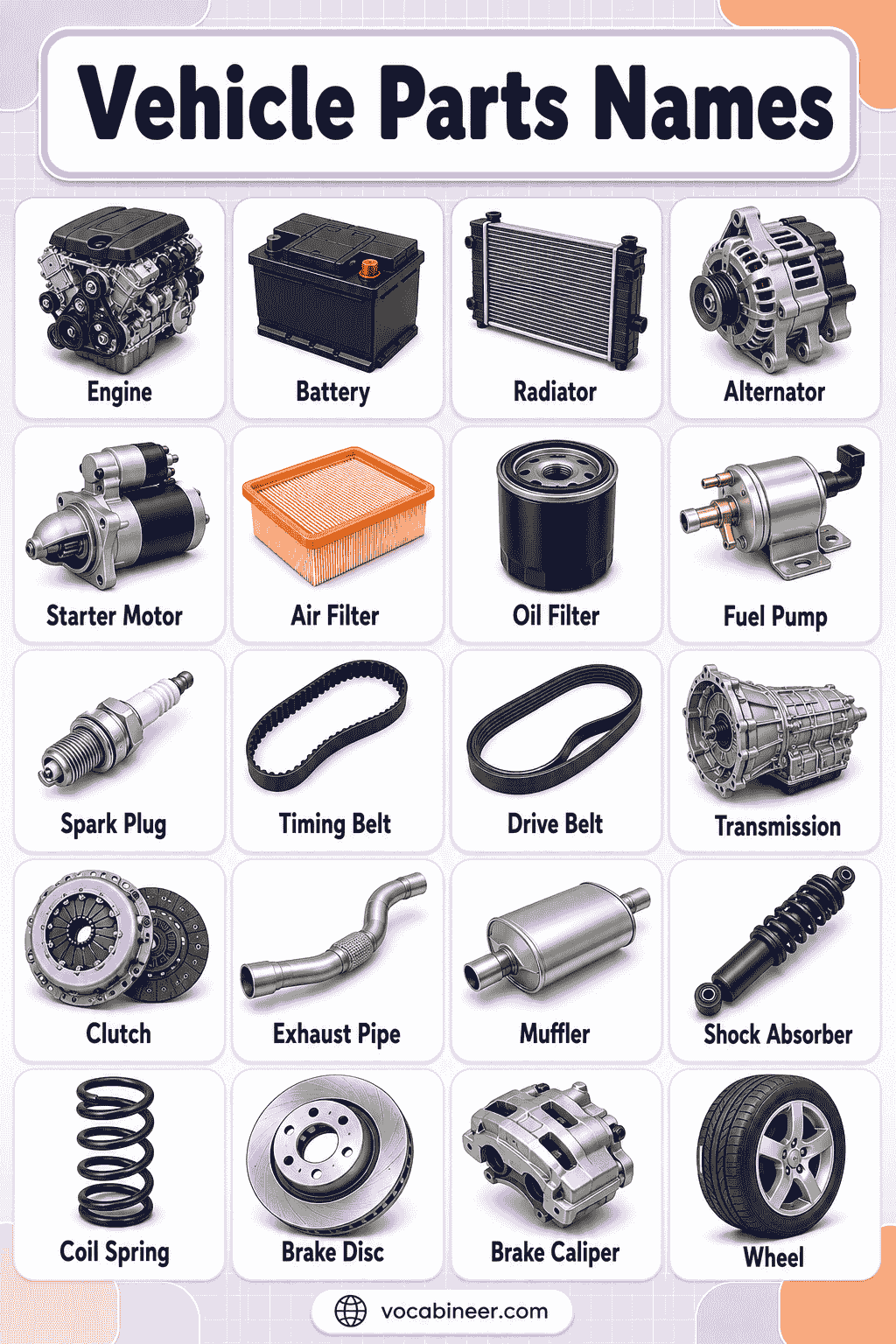
Engine: Produces power in gasoline- and diesel-powered vehicles.
Transmission: Controls gear ratios and transfers power toward the wheels.
Battery: Stores electrical energy for starting and electronic equipment.
Alternator: Generates electricity while the engine runs.
Starter Motor: Turns the engine during startup.
Radiator: Releases heat from the engine coolant.
Steering Wheel: Allows the driver to control direction.
Dashboard: Holds gauges, displays, vents, and controls.
Gear Selector: Lets the driver choose a gear or transmission position.
Accelerator Pedal: Increases engine or motor output.
Brake Pedal: Activates the braking system.
Parking Brake: Keeps the vehicle stationary while parked.
Windshield: Protects occupants while providing a forward view.
Windshield Wiper: Removes rain, snow, and dirt from the glass.
Side Mirror: Shows traffic and objects beside the vehicle.
Rearview Mirror: Provides a view through the rear window.
Hood: Covers the engine compartment on most passenger cars.
Trunk: Provides enclosed storage space, usually at the rear.
Door: Allows occupants to enter and leave the vehicle.
Bumper: Spans the front or rear and helps manage minor impacts.
Fender: Forms the body area around a wheel opening.
Grille: Allows cooling air to enter the front of the vehicle.
Headlight: Illuminates the road ahead.
Taillight: Makes the rear of the vehicle visible.
Turn Signal: Shows an intended turn or lane change.
Wheel: Forms the rigid circular structure attached to the hub.
Tire: Fits around the wheel and provides road grip.
Brake Pad: Presses against the brake disc to create friction.
Shock Absorber: Controls suspension movement and reduces bouncing.
Fuel Tank: Stores gasoline, diesel, or another liquid fuel.
Muffler: Reduces exhaust noise.
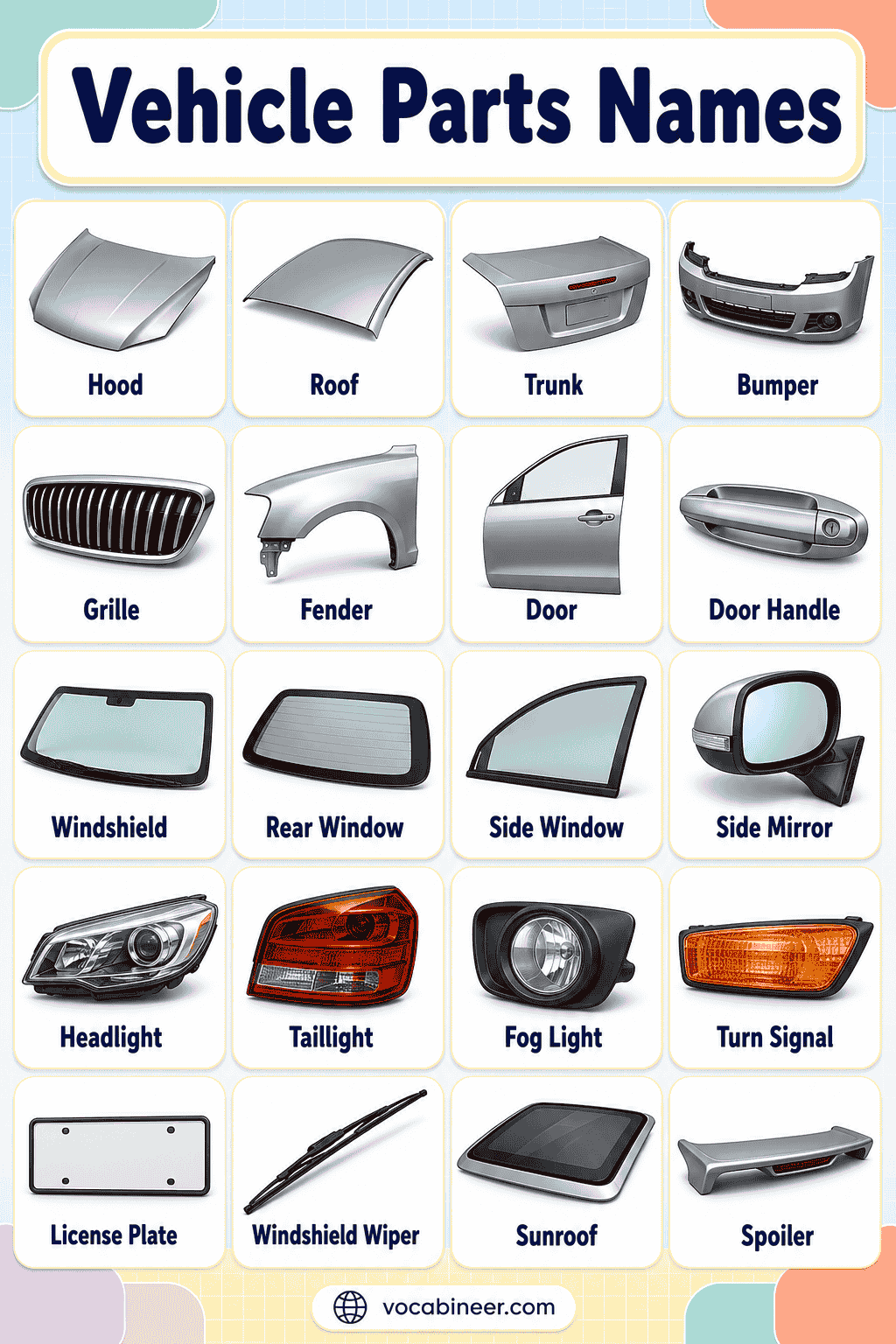
Exterior Vehicle Parts
Exterior parts shape the visible body of a vehicle. In addition, they protect internal components, support airflow, and help other road users see the vehicle.
Front Parts of a Vehicle
The front area contains access panels, lights, glass, and cooling openings.
Hood: Covers the engine bay and opens for inspection or maintenance.
Front Bumper: Helps protect the lower front area during minor contact.
Grille: Allows air to reach the radiator while shielding components behind it.
Headlight: Projects light onto the road ahead.
Fog Light: Produces a low, wide beam during fog or mist.
Turn Signal: Flashes before a turn or lane change.
Windshield: Forms the large protective glass panel at the front.
Windshield Wiper: Clears moisture and debris from the windshield.
Front Fender: Surrounds the upper part of a front wheel opening.
License Plate: Displays the vehicle’s registration number.
Side Parts of a Vehicle
Along each side, doors, windows, mirrors, and body panels provide access and protection.
Door: Opens the passenger compartment.
Door Handle: Releases the door latch.
Side Window: Provides light and outward visibility.
Side Mirror: Helps the driver monitor nearby traffic.
Rocker Panel: Runs beneath the doors and strengthens the lower body.
Quarter Panel: Covers the body area near a rear wheel.
Wheel Arch: Forms the curved opening around a wheel.
Fuel Door: Covers the fuel-filler opening.
Side Marker Light: Makes the vehicle easier to see from the side.
Rear Parts of a Vehicle
At the rear, several components support storage, signaling, visibility, and exhaust release.
Trunk Lid: Opens the storage compartment on many sedans.
Tailgate: Forms a hinged rear panel on trucks, SUVs, vans, and hatchbacks.
Rear Bumper: Protects the lower rear area during minor contact.
Taillight: Makes the vehicle visible from behind.
Brake Light: Brightens when the brakes operate.
Reverse Light: Turns on when the vehicle moves backward.
Rear Window: Provides a view behind the vehicle.
Rear Wiper: Clears moisture or dirt from the rear glass.
Spoiler: Changes airflow and may also serve a styling purpose.
Tailpipe: Releases exhaust gases from the rear or side.
Vehicle Body Parts
Body parts form the vehicle’s outer shell and support its overall shape. While some pieces are clearly visible, others remain partly hidden beneath trim or interior panels.
Roof: Covers the top of the passenger compartment.
Hood: Protects the engine bay.
Door Panel: Forms the outer or inner surface of a door.
Fender: Surrounds part of a wheel opening.
Quarter Panel: Covers the body area near a rear wheel.
Rocker Panel: Strengthens the lower section beneath the doors.
A-Pillar: Supports the roof beside the windshield.
B-Pillar: Stands between the front and rear doors on many vehicles.
C-Pillar: Supports the rear section of the roof.
Frame: Provides a strong base on many trucks, SUVs, and commercial vehicles.
Unibody: Combines the body shell and structural platform into one unit.
Crumple Zone: Absorbs impact energy by deforming in a controlled way.
Because body damage can affect alignment and strength, these parts do more than shape the vehicle’s appearance.
Vehicle Lights, Mirrors, and Wipers
Drivers depend on lights, mirrors, cameras, and wipers to see clearly. At the same time, these parts communicate the vehicle’s position and movement to other road users.
Vehicle Lights
Different lights serve different driving and signaling purposes.
Headlight: Lights the road ahead.
High Beam: Provides a brighter and longer-reaching beam.
Low Beam: Offers normal nighttime lighting with less glare.
Daytime Running Light: Makes the vehicle more visible during daylight.
Fog Light: Projects a low beam during poor weather.
Taillight: Marks the rear of the vehicle.
Brake Light: Warns following drivers that the vehicle is slowing.
Turn Signal: Shows an intended turn or lane change.
Hazard Light: Flashes several indicators during an emergency stop.
Reverse Light: Signals backward movement.
Mirrors, Cameras, and Wipers
These components improve awareness around the vehicle.
Rearview Mirror: Shows the area behind the vehicle through the rear window.
Side Mirror: Displays traffic beside and partly behind the vehicle.
Rearview Camera: Provides a video view while reversing.
Windshield Wiper: Clears rain, snow, and dirt from the front glass.
Rear Wiper: Cleans the rear window on many hatchbacks, SUVs, and vans.
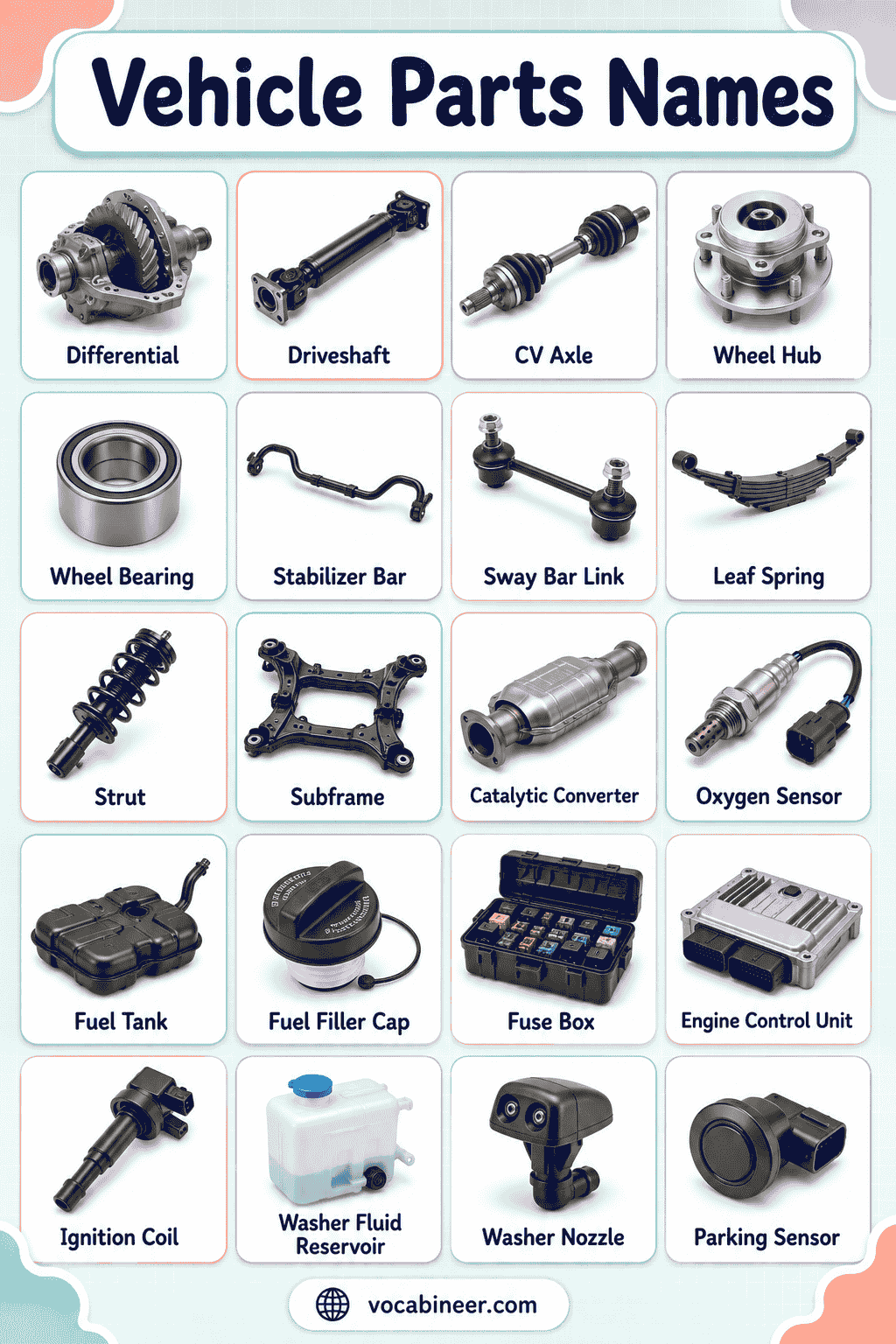
Washer Nozzle: Sprays cleaning fluid onto the windshield.
Clear glass and correctly adjusted mirrors improve visibility. Therefore, drivers should keep these parts clean and unobstructed.
Inside Parts of a Vehicle
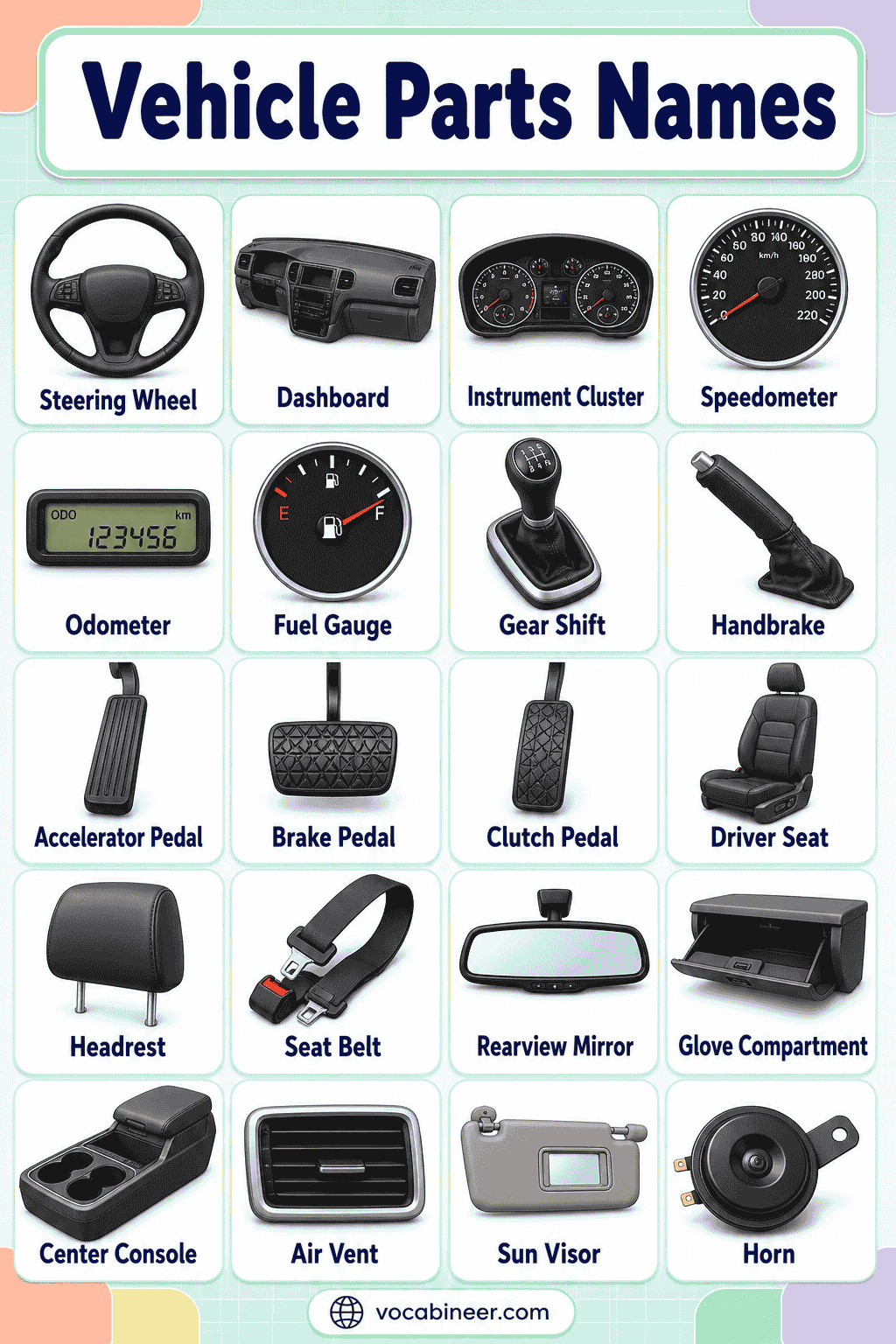
Interior parts allow the driver to operate the vehicle and help passengers travel safely and comfortably.
Dashboard Parts and Gauges
The dashboard displays important information and holds several controls.
Dashboard: Forms the broad front panel inside the cabin.
Instrument Cluster: Groups gauges and warning lights in front of the driver.
Speedometer: Displays vehicle speed.
Tachometer: Shows engine speed in revolutions per minute.
Fuel Gauge: Indicates how much fuel remains.
Temperature Gauge: Displays engine coolant temperature.
Odometer: Records the vehicle’s total traveled distance.
Trip Meter: Measures distance during a selected journey.
Check-Engine Light: Signals that the engine-control system has detected a problem.
Battery Warning Light: Warns of a possible charging-system issue.
Oil-Pressure Light: Indicates low engine oil pressure.
Infotainment Screen: Displays navigation, audio, communication, and vehicle settings.
Climate-Control Panel: Adjusts heating, cooling, airflow, and fan speed.
Driver Controls
Through these controls, the driver starts, steers, accelerates, and stops the vehicle.
Steering Wheel: Changes direction.
Accelerator Pedal: Increases power output.
Brake Pedal: Operates the brakes.
Clutch Pedal: Disconnects engine power during manual gear changes.
Gear Selector: Chooses a gear or transmission setting.
Parking Brake: Holds the vehicle while parked.
Ignition Switch: Activates the vehicle with a key.
Start Button: Starts vehicles equipped with push-button ignition.
Turn-Signal Lever: Operates the directional indicators.
Wiper Control: Adjusts the wipers and washer system.
Horn Button: Produces an audible warning.
Seats and Cabin Parts
Other interior components support comfort, storage, and passenger safety.
Driver’s Seat: Positions the driver near the controls.
Passenger Seat: Provides seating beside the driver.
Rear Seat: Carries passengers behind the front row.
Headrest: Supports the head and helps limit rearward movement.
Seat Belt: Secures an occupant during travel.
Center Console: Holds storage spaces, controls, or the gear selector.
Glove Compartment: Provides enclosed dashboard storage.
Sun Visor: Blocks bright sunlight.
Cup Holder: Holds drink containers.
Air Vent: Directs warm or cool air into the cabin.
Engine Parts
An internal-combustion engine converts fuel energy into mechanical movement. Inside it, several precisely timed components work together.
Main Engine Components
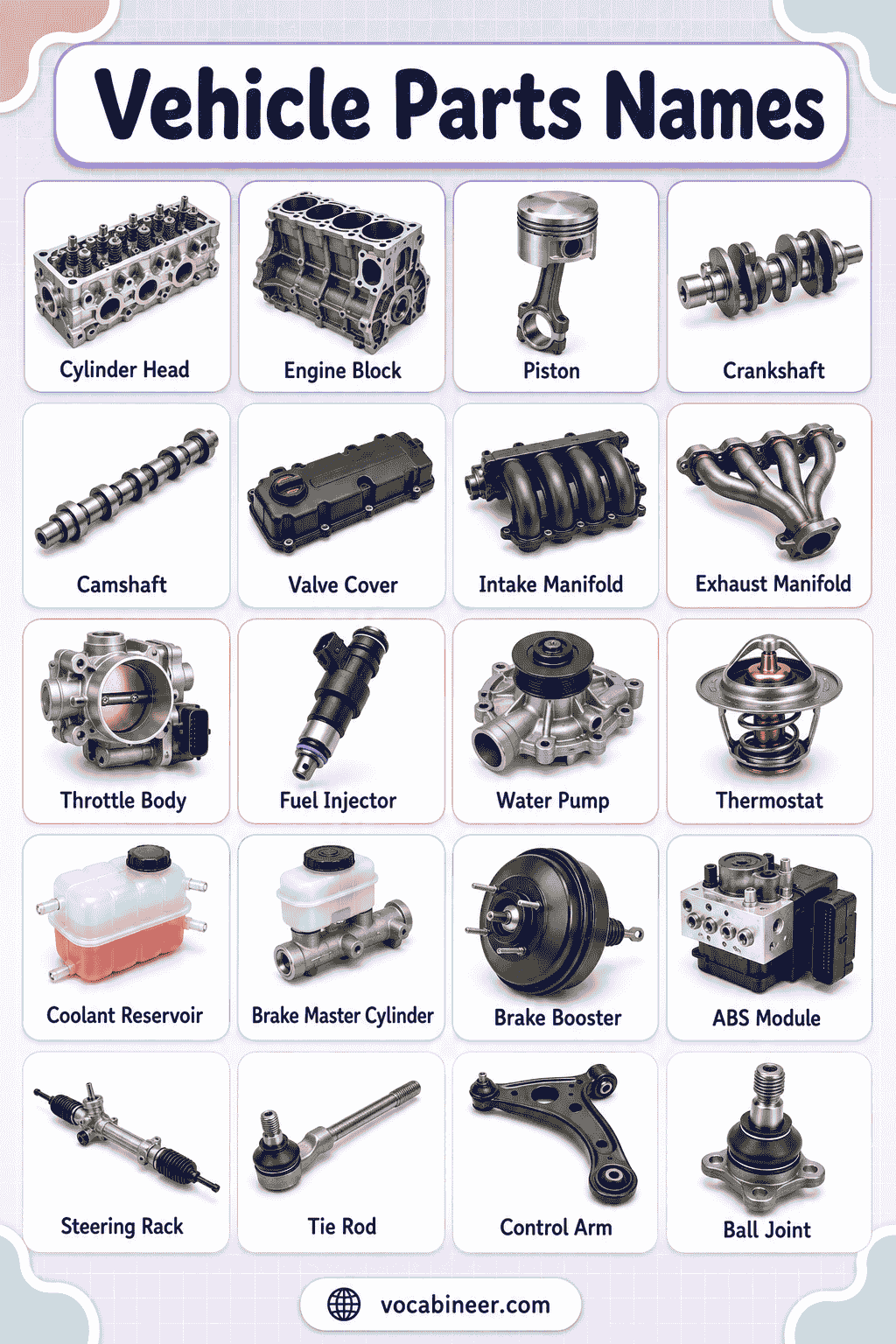
Engine Block: Forms the main engine structure and contains the cylinders.
Cylinder: Provides the chamber in which a piston moves.
Cylinder Head: Seals the cylinder tops and contains valves and passages.
Piston: Moves up and down inside a cylinder.
Piston Ring: Seals the gap between the piston and cylinder wall.
Connecting Rod: Links the piston to the crankshaft.
Crankshaft: Converts piston movement into rotation.
Camshaft: Controls the opening and closing of the valves.
Fuel, Ignition, and Timing Parts
These components regulate airflow, fuel delivery, ignition, and engine timing.
Intake Valve: Allows air or an air-fuel mixture into the cylinder.
Exhaust Valve: Releases burned gases.
Spark Plug: Ignites the mixture in a gasoline engine.
Fuel Injector: Delivers a controlled amount of fuel.
Timing Belt: Synchronizes the crankshaft and camshaft in some engines.
Timing Chain: Performs the same timing job with a metal chain.
Flywheel: Stores rotational energy and smooths engine operation.
Head Gasket: Seals the joint between the engine block and cylinder head.
Because these parts operate in sequence, a failure in one major area can disrupt the entire engine.
Engine Cooling Parts
Engines generate substantial heat during operation. Consequently, cooling parts circulate coolant and release excess heat before it damages internal components.
Radiator: Transfers heat from the coolant to the surrounding air.
Coolant Reservoir: Stores expanding coolant and returns it when needed.
Water Pump: Circulates coolant through the engine and radiator.
Thermostat: Regulates coolant flow according to temperature.
Cooling Fan: Moves air through the radiator.
Radiator Hose: Carries coolant between major components.
Radiator Cap: Seals the system and helps control pressure.
Temperature Sensor: Measures coolant temperature and sends information to the vehicle’s controls.
Together, these parts maintain a suitable operating temperature.
Engine Oil and Lubrication Parts
Lubrication parts reduce friction between moving engine components. In addition, oil helps carry heat and contaminants away from sensitive surfaces.
Oil Pump: Circulates oil through the engine.
Oil Pan: Stores oil beneath the engine.
Oil Filter: Removes contaminants from the oil.
Dipstick: Shows the oil level on many vehicles.
Oil Filler Cap: Covers the opening used to add oil.
Oil-Pressure Sensor: Monitors pressure within the lubrication system.
While coolant mainly controls temperature, engine oil protects moving surfaces from friction and wear.
Vehicle Battery and Electrical Parts
The electrical system starts the engine and powers lights, sensors, controls, and electronic equipment.
Battery: Stores electrical energy.
Alternator: Recharges the battery while the engine runs.
Starter Motor: Uses battery power to turn the engine.
Fuse: Opens a circuit when excessive current flows.
Fuse Box: Organizes fuses and relays.
Relay: Allows a small electrical signal to control a larger current.
Wiring Harness: Groups and routes electrical wires.
Ignition Coil: Raises voltage for gasoline-engine spark plugs.
Electronic Control Unit: Processes data and controls selected functions.
Sensor: Measures conditions such as pressure, temperature, speed, or oxygen level.
Horn: Warns other road users with sound.
Although the battery supplies stored power, several other components must work correctly for the vehicle to start and continue operating.
Transmission and Power-Transfer Parts
After the engine or motor creates power, the transmission and related components deliver it to the wheels.
Transmission Parts
Transmission: Changes gear ratios and manages power delivery.
Gearbox: Another term for the transmission, especially in manual vehicles.
Clutch: Connects or disconnects a manual transmission from the engine.
Clutch Plate: Transfers power through friction.
Torque Converter: Transfers engine power in many automatic transmissions.
Power-Transfer Parts
Driveshaft: Carries rotational power toward the differential.
Differential: Allows driven wheels to rotate at different speeds during turns.
Axle: Supports wheel rotation and may also transmit power.
Constant-Velocity Joint: Transfers power through changing angles.
Universal Joint: Allows a driveshaft to operate at an angle.
Transfer Case: Sends power to multiple axles in many four-wheel-drive vehicles.
Half Shaft: Connects the differential to a driven wheel.
Together, these components create the path from the power source to the road.
Vehicle Steering Parts
Steering parts turn the wheels and control the vehicle’s direction.
Steering Wheel: Provides direct control from the driver.
Steering Column: Connects the steering wheel with the steering mechanism.
Steering Rack: Converts steering-wheel movement into side-to-side motion.
Tie Rod: Links the steering system to the wheel assembly.
Steering Knuckle: Supports the wheel hub and allows steering movement.
Power-Steering Pump: Supplies hydraulic pressure in some systems.
Electric Steering Motor: Assists steering in many modern vehicles.
When these parts move together correctly, the driver can guide the vehicle accurately.
Vehicle Suspension Parts
Suspension components support the vehicle, absorb road movement, and help the tires remain in contact with the surface.
Control Arm: Connects the wheel assembly to the vehicle structure.
Ball Joint: Allows connected parts to move at different angles.
Shock Absorber: Controls bouncing and suspension movement.
Strut: Combines shock control with structural support.
Coil Spring: Supports vehicle weight and absorbs road movement.
Leaf Spring: Uses stacked metal strips to support heavier loads.
Stabilizer Bar: Reduces body roll during turns.
Bushing: Cushions movement between connected metal parts.
A balanced suspension improves comfort, stability, and tire contact with the road.
Brake-System Parts
Brake components convert movement into heat through friction. As a result, the vehicle slows or stops.
Hydraulic Brake Parts
Brake Pedal: Allows the driver to activate the brakes.
Master Cylinder: Converts pedal force into hydraulic pressure.
Brake Booster: Reduces the effort required at the pedal.
Brake Fluid: Transfers hydraulic pressure.
Brake Line: Carries fluid through rigid tubing.
Brake Hose: Carries fluid through flexible sections near the wheels.
Disc and Drum Brake Parts
Brake Disc: Rotates with the wheel.
Brake Pad: Presses against the disc.
Brake Caliper: Holds and moves the brake pads.
Brake Drum: Provides a rotating friction surface.
Brake Shoe: Presses against the inside of the drum.
Parking Brake: Holds the vehicle while parked.
ABS Sensor: Measures wheel speed for the anti-lock braking system.
Disc and drum brakes use different components. However, both systems rely on friction to reduce wheel movement.
Wheel and Tire Parts
A wheel provides rigid support, whereas a tire supplies grip and cushioning.
Wheel: The rigid circular assembly mounted to the hub.
Rim: The outer section that supports the tire.
Tire: The rubber component fitted around the wheel.
Tread: The patterned surface that contacts the road.
Sidewall: The side section between the tread and bead.
Bead: The reinforced edge that seals against the rim.
Wheel Hub: Connects the wheel to the axle and bearing assembly.
Wheel Bearing: Allows smooth rotation.
Lug Nut: Secures the wheel to the hub.
Valve Stem: Provides access for adding or releasing air.
Hubcap: Covers part of a wheel.
Spare Tire: Replaces a damaged tire temporarily or permanently.
Although people sometimes use wheel and tire interchangeably, the terms describe different components.
Fuel-System Parts
The fuel system stores, filters, and delivers fuel to the engine.
Fuel Tank: Stores gasoline or diesel.
Fuel Pump: Moves fuel toward the engine.
Fuel Filter: Removes contaminants.
Fuel Line: Carries fuel through the system.
Fuel Injector: Delivers fuel into the engine.
Fuel Filler Neck: Connects the filling opening to the tank.
Gas Cap: Seals the fuel opening.
Because clean and controlled fuel delivery supports combustion, each of these parts contributes to engine performance.
Exhaust-System Parts
After combustion, the exhaust system carries gases away from the engine and reduces noise and selected pollutants.
Exhaust Manifold: Collects gases from the engine cylinders.
Catalytic Converter: Reduces selected harmful exhaust substances.
Oxygen Sensor: Measures oxygen in the exhaust stream.
Muffler: Reduces exhaust noise.
Resonator: Controls certain exhaust sounds.
Exhaust Pipe: Carries gases through the system.
Tailpipe: Releases gases from the final section.
An exhaust tip may cover or decorate the visible outlet. However, it does not always form part of the tailpipe itself.
Vehicle Safety Parts
Safety parts help prevent injuries or reduce harm during a collision.
Occupant Protection
Seat Belt: Restrains an occupant during sudden movement.
Airbag: Inflates during certain impacts.
Headrest: Helps limit rearward head movement.
Crumple Zone: Absorbs impact energy through controlled deformation.
Child-Safety Lock: Prevents a rear door from opening from inside.
Driver Assistance and Warning Parts
Rearview Camera: Improves visibility while reversing.
Parking Sensor: Detects nearby obstacles.
Horn: Warns other road users.
Brake Light: Signals that the vehicle is slowing.
ABS Sensor: Supports the anti-lock braking system by measuring wheel speed.
These features support safer driving, but they do not replace careful observation and responsible vehicle control.
Electric Vehicle Parts
Electric vehicles use a high-voltage battery and electric motor instead of relying only on a traditional engine.
Electric Drive Parts
Traction Battery: Stores high-voltage energy for movement.
Battery Pack: Contains battery cells and supporting equipment.
Electric Motor: Converts electricity into mechanical motion.
Inverter: Changes electrical current into the form required by the motor.
Electric Drive Unit: Combines the motor, gears, and related controls.
Charging and Battery Parts
Charging Port: Connects the vehicle to charging equipment.
Onboard Charger: Converts incoming electricity for battery charging.
DC Converter: Reduces high voltage for lower-voltage systems.
Battery-Management System: Monitors voltage, temperature, and charging conditions.
Thermal-Management System: Controls battery, motor, and electronic temperatures.
Regenerative Braking: Recovers some energy while the vehicle slows.
Hybrid vehicles may contain both an internal-combustion engine and electric-drive components.
Commonly Confused Vehicle Parts
| Comparison | Difference |
|---|---|
| Wheel vs. Tire | A wheel is the rigid structure attached to the hub. A tire is the rubber covering around it that provides grip and cushioning. |
| Bumper vs. Fender | A bumper runs across the front or rear and helps manage minor impacts. A fender surrounds a wheel opening. |
| Dashboard vs. Instrument Cluster | The dashboard is the full front cabin panel. The instrument cluster is the section that shows gauges and warning lights. |
| Brake Disc vs. Brake Pad | A brake disc rotates with the wheel. A brake pad presses against it to slow the vehicle. |
| Engine vs. Transmission | The engine produces power. The transmission controls how that power reaches the wheels. |
The engine creates power, while the transmission controls how the vehicle uses it.
FAQs
The main groups include exterior body parts, interior controls, engine components, electrical equipment, the transmission, steering, suspension, brakes, wheels, tires, and safety parts.
Common parts include the engine, battery, radiator, alternator, starter motor, air filter, fuse box, coolant reservoir, brake-fluid reservoir, and washer-fluid reservoir.
The wheel is the rigid structure mounted to the hub. In contrast, the tire is the rubber component fitted around it.
The braking system uses the brake pedal, master cylinder, fluid, lines, calipers, pads, discs, drums, shoes, and parking brake.
Important EV components include the traction battery, electric motor, inverter, charging port, onboard charger, battery-management system, and electric drive unit.
Read More