

Guns come in many designs, but most can be understood by looking at three features: their physical form, operating mechanism, and firing mode. A handgun differs from a rifle mainly in size and handling, while terms such as bolt-action, pump-action, and semi-automatic describe how a firearm loads and prepares the next round.
This educational guide explains the main types of guns, familiar firearm names, and the basic differences among handguns, rifles, shotguns, machine guns, and historical firearms. The original page covers these categories along with firing mechanisms, specialized roles, and training devices, so the same broad informational intent remains central here.

In This Page
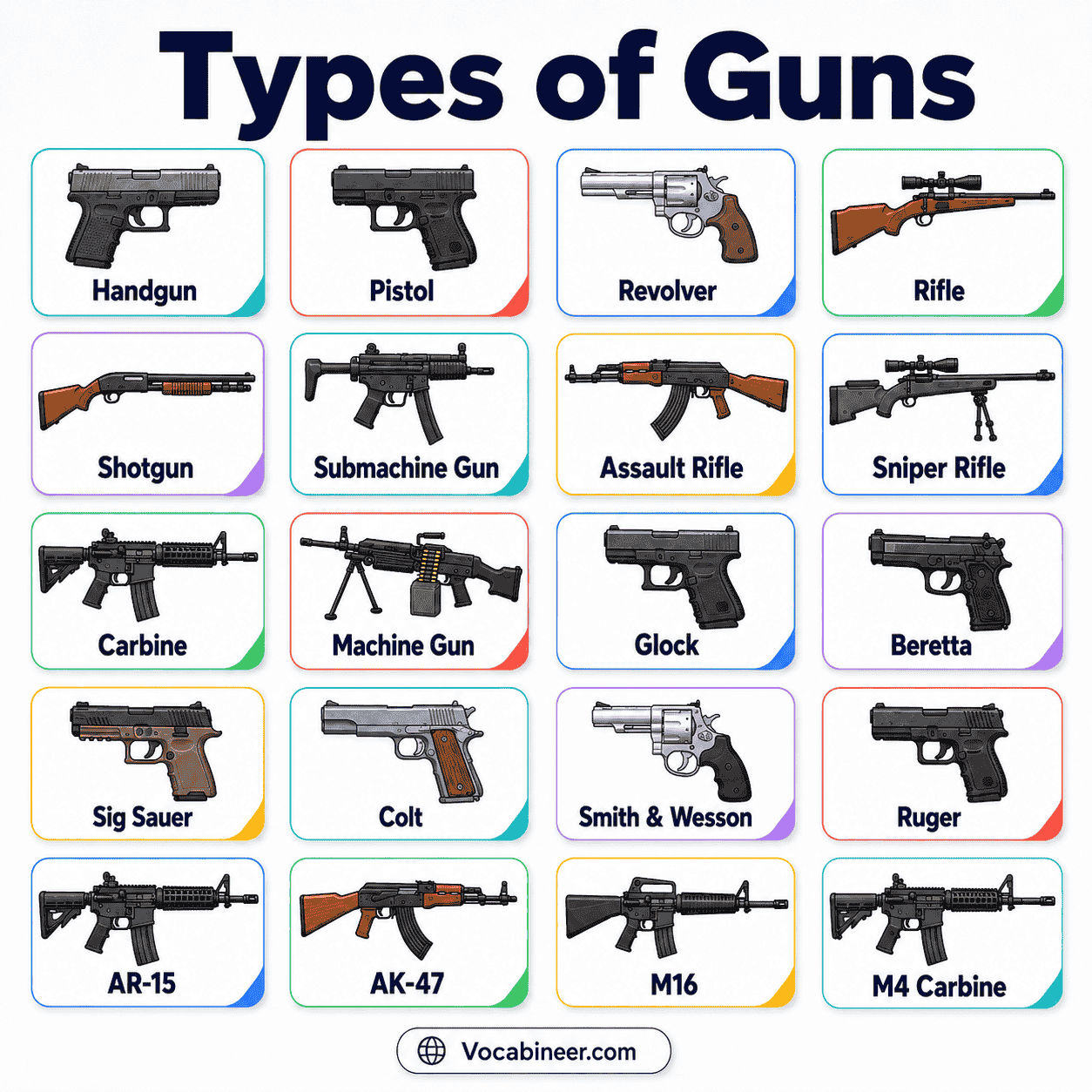
Main Types of Guns
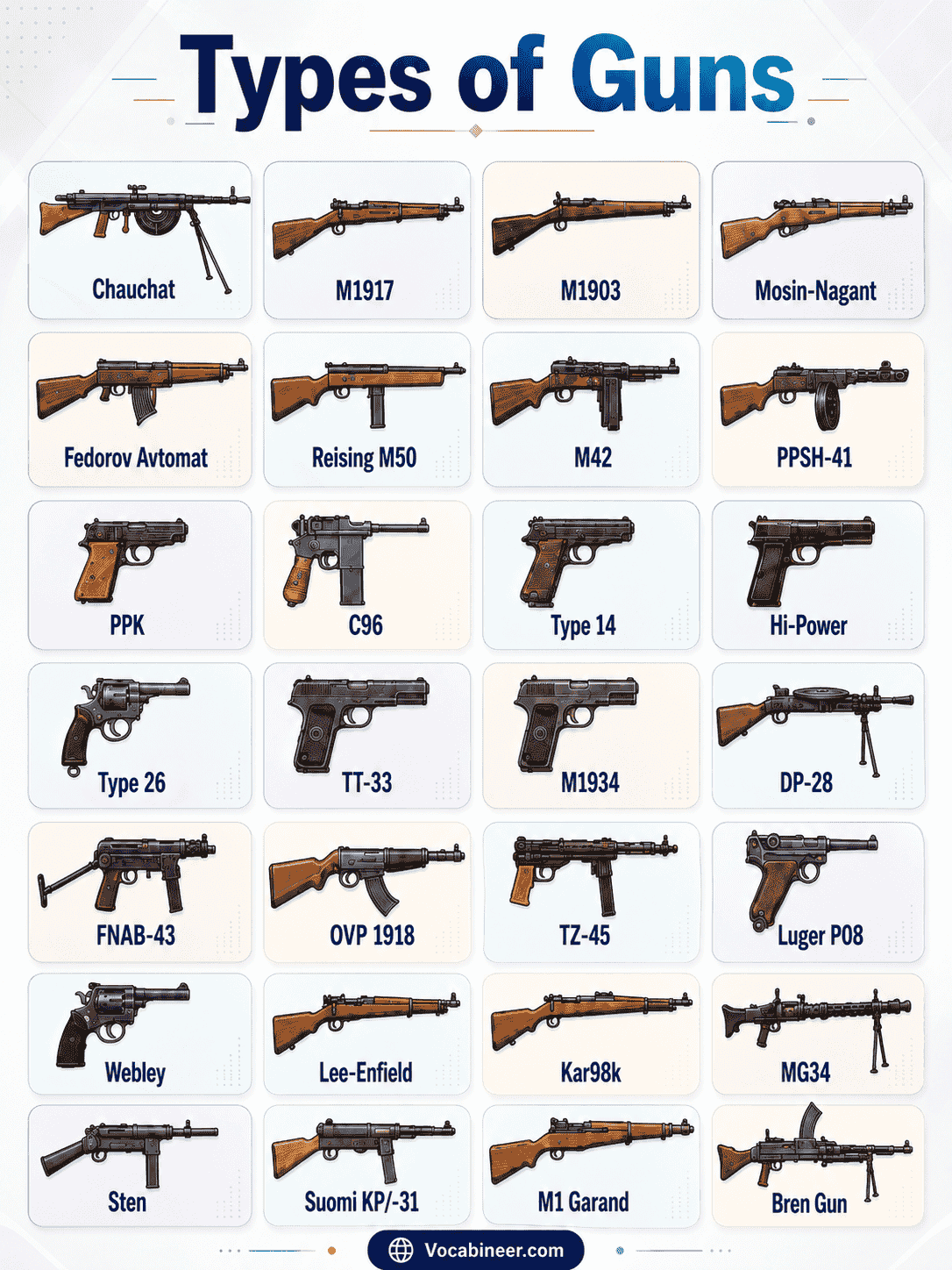
Firearms can be classified by their physical form, action, size, firing capability, or historical design. Therefore, the names below include both broad gun categories and widely recognized subtypes commonly used in firearm education.
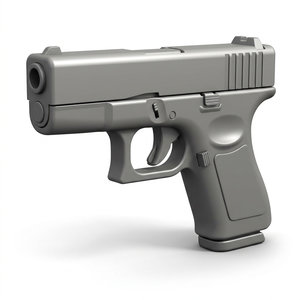
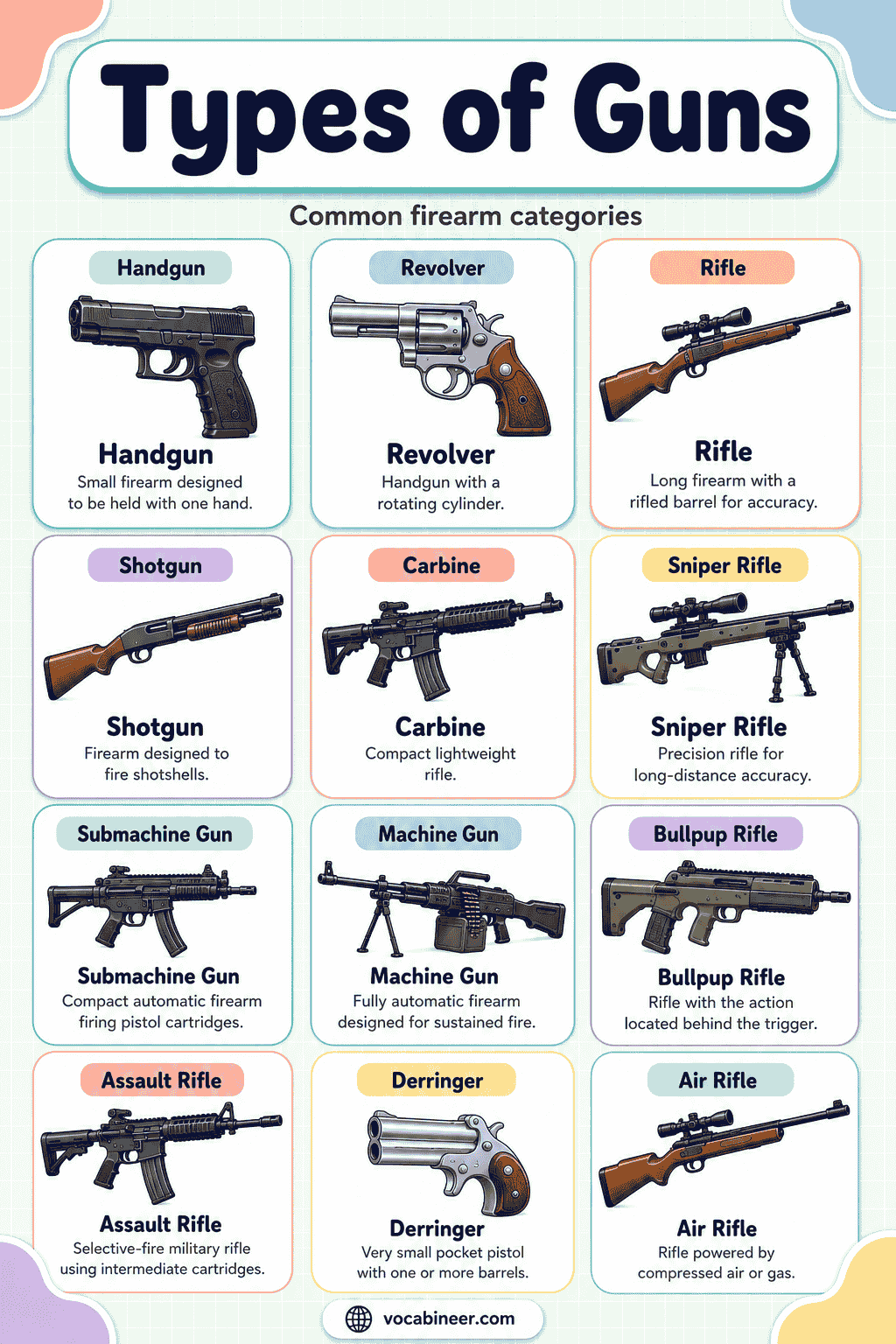
- Handguns: Compact firearms designed to be held and operated with one or both hands.
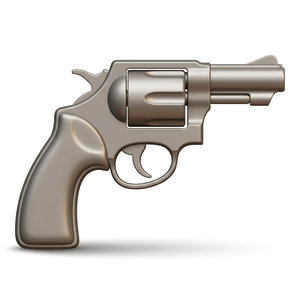
- Revolvers: Handguns that store cartridges in a rotating cylinder.
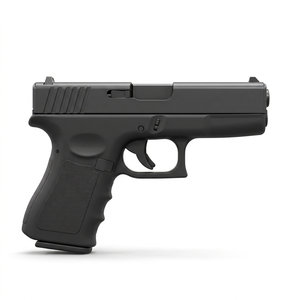
- Semi-Automatic Pistols: Magazine-fed handguns that fire one round per trigger press and automatically prepare the next round.
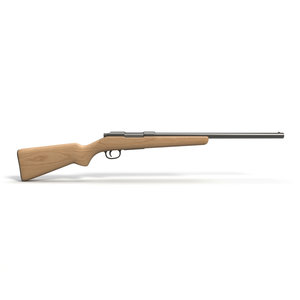
- Rifles: Shoulder-fired firearms with rifled barrels that help stabilize a projectile in flight.
- Carbines: Shorter, lighter shoulder-fired firearms related to full-length rifles.
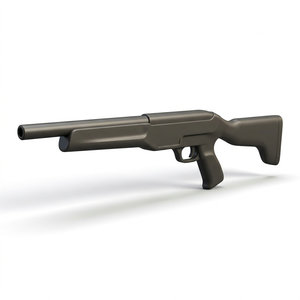
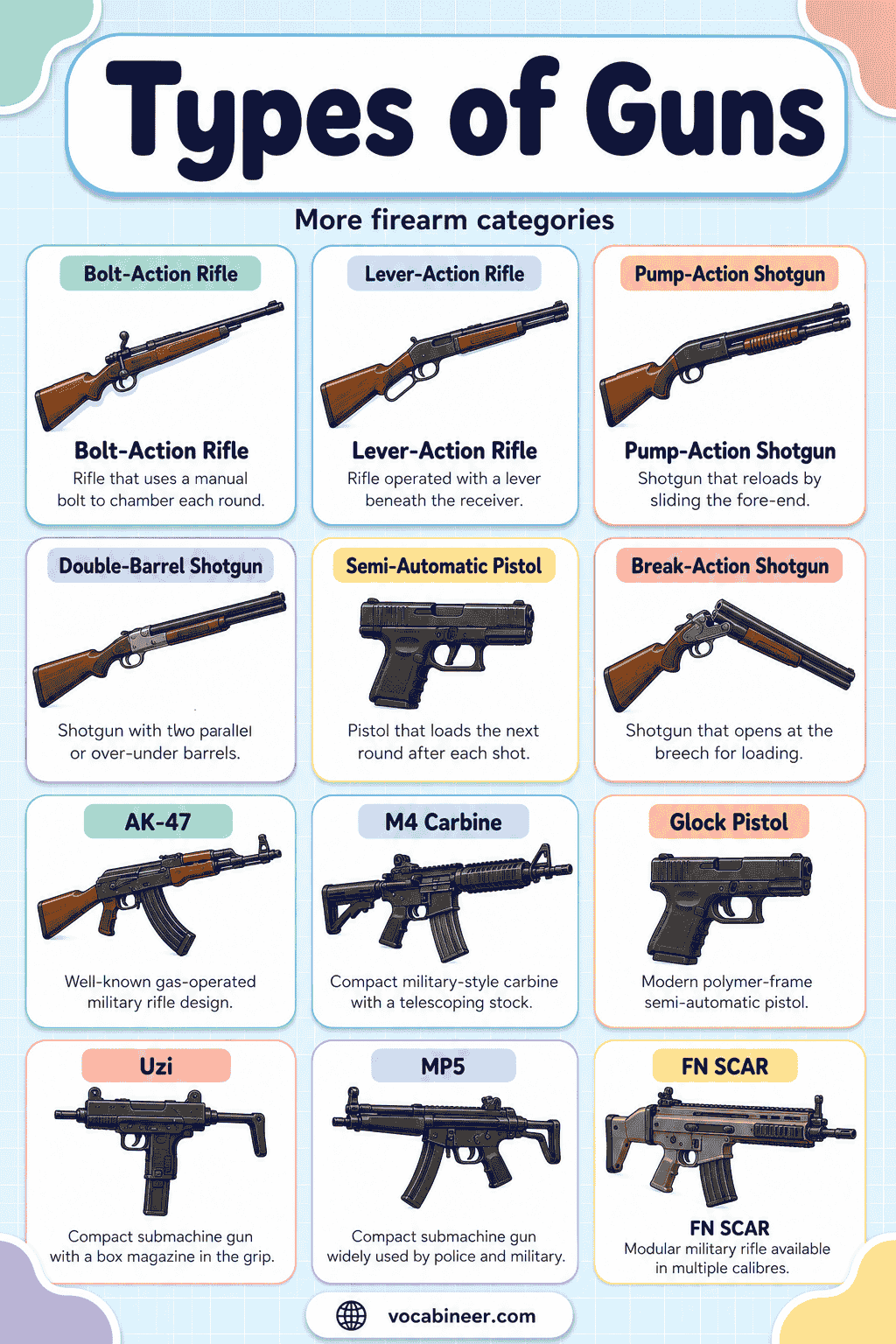
- Bolt-Action Rifles: Rifles that require manual operation of a bolt between shots.
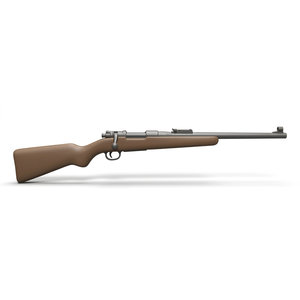
- Lever-Action Rifles: Rifles that use a lever to extract a spent cartridge and load the next one.
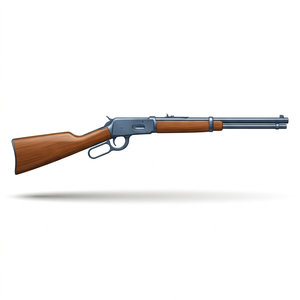
- Semi-Automatic Rifles: Rifles that fire once per trigger press and automatically chamber the next cartridge.
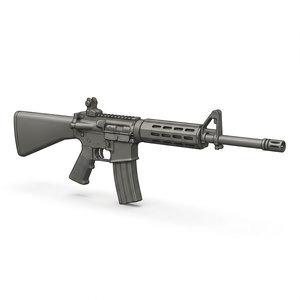
- Shotguns: Shoulder-fired firearms primarily designed for shotshell ammunition.
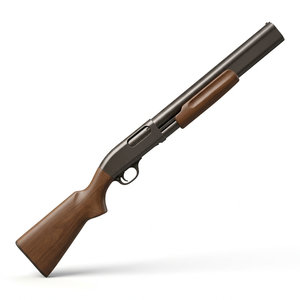
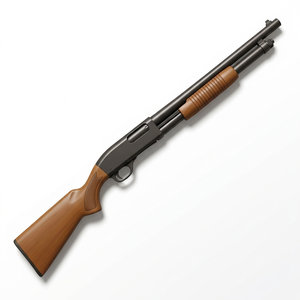
- Pump-Action Shotguns: Shotguns that use a sliding fore-end to cycle the action.
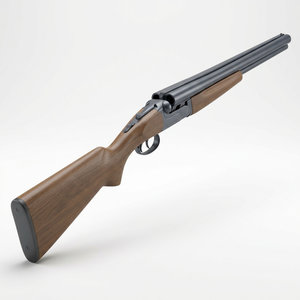
- Break-Action Shotguns: Firearms that open at a hinge so ammunition can be loaded directly into the chamber.
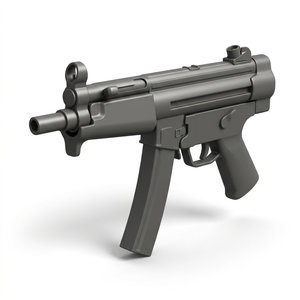
- Submachine Guns: Compact automatic firearms generally designed for pistol-caliber ammunition.
- Machine Guns: Automatic firearms capable of continuous fire while the trigger remains pressed and ammunition is available.
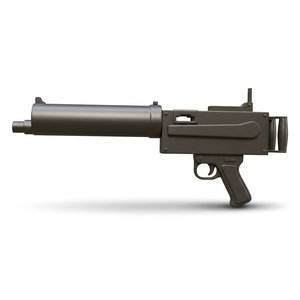
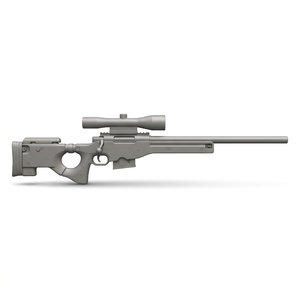
- Precision Rifles: Rifles designed or configured for accurate shooting at extended distances.
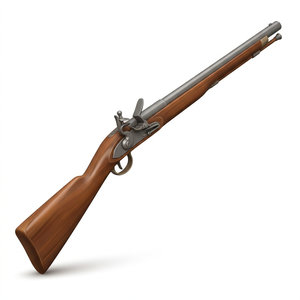
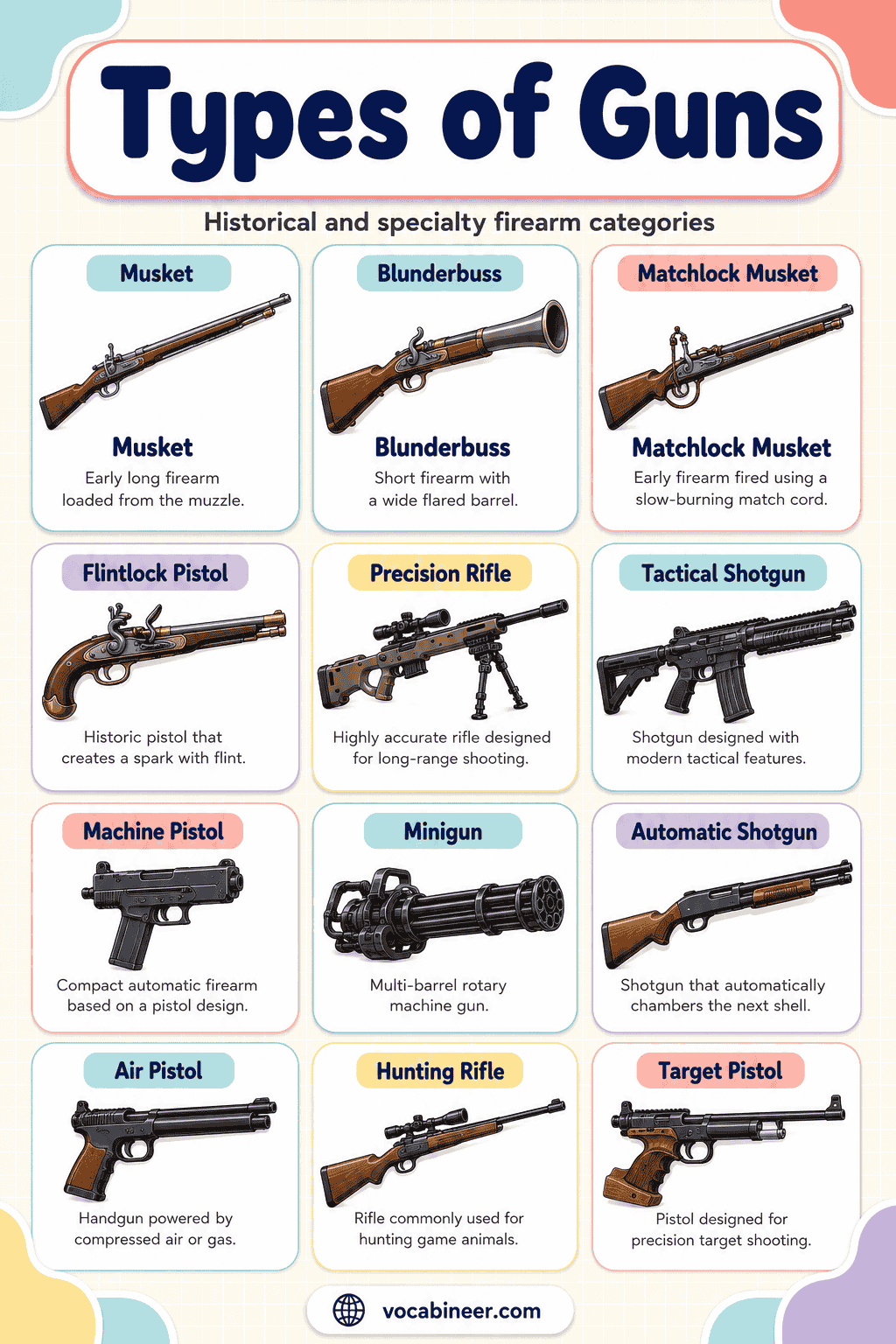
- Historical Firearms: Older designs such as muskets, matchlocks, flintlocks, percussion-cap guns, and early repeating firearms.
Common Types of Handguns
Handguns are compact firearms intended for handheld use. They are found in law enforcement, military service, collecting, competition, and lawful personal-protection contexts. The original article identifies revolvers, semi-automatic pistols, compact pistols, subcompact pistols, single-shot pistols, derringers, and machine pistols as major handgun groups.
Handguns can be classified by action, size, barrel arrangement, or firing capability. Therefore, one model may belong to more than one group.
Revolvers
A revolver carries cartridges in a rotating cylinder. As the action operates, another chamber aligns with the barrel.
Common features include:
- a visible cylinder;
- several separate chambers;
- no detachable box magazine in most traditional designs;
- single-action, double-action, or combined operation.
Representative examples include:
- Colt Python
- Smith & Wesson Model 686
- Ruger GP100
- Ruger LCR
Revolvers are often associated with mechanical simplicity, although their capacity and reloading systems differ from those of most semi-automatic pistols.
Semi-Automatic Pistols
A semi-automatic pistol fires one round for each trigger press. Energy from the fired cartridge operates the action and prepares the next round.
Typical features include:
- a detachable magazine;
- a moving slide;
- one shot per trigger press;
- full-size, compact, and subcompact variations.
Well-known examples include:
- Glock 17
- Glock 19
- SIG Sauer P320
- Beretta 92FS
- Smith & Wesson M&P series
A semi-automatic pistol should not be confused with an automatic firearm. Semi-automatic operation still produces only one shot for each trigger press.
Compact Pistols
Compact pistols are smaller versions of standard full-size handguns. Their shorter slides, barrels, or grips can make them easier to carry, though manufacturers do not apply the word compact according to one universal measurement.
Examples include:
- Glock 19
- CZ P-10 C
- Smith & Wesson M&P Compact
A Glock 19 may appear under both semi-automatic pistols and compact pistols because one label describes its action while the other describes its size.
Subcompact and Micro-Compact Pistols
Subcompact pistols are smaller than conventional compact handguns. Some manufacturers use the newer term micro-compact for very small pistols that retain comparatively high magazine capacity.
Examples include:
- SIG Sauer P365
- Glock 43
- Ruger LCP Max
Industry terminology varies, so one source may call a handgun subcompact while another describes it as micro-compact or pocket-sized.
Single-Shot Pistols
A single-shot pistol holds one cartridge and must be manually reloaded after firing.
These firearms are generally associated with:
- target shooting;
- hunting;
- historical designs;
- specialized competition.
Examples include the Thompson/Center Contender and Traditions Crackshot.
Derringers
A derringer is a very small handgun that usually has one or two barrels. Traditional examples use a break-action design rather than a rotating cylinder.
Recognizable names include:
- Remington Model 95
- Bond Arms derringer models
Machine Pistols
Machine pistols are handgun-sized firearms capable of automatic or burst fire. They are uncommon and are primarily associated with military, police, or historical roles.
Examples include:
- Glock 18
- Beretta 93R
- Stechkin APS
Common Types of Rifles
A rifle is normally fired from the shoulder and has spiral grooves inside the barrel. These grooves make the projectile spin, helping stabilize it in flight.
Rifles can be categorized by operating system, intended role, cartridge, or physical configuration.
Bolt-Action Rifles
A bolt-action rifle uses a manually operated bolt to load and extract cartridges.
This mechanism is commonly associated with:
- hunting rifles;
- precision rifles;
- historical military rifles;
- target and competition firearms.
Representative examples include:
- Remington 700
- Tikka T3x
- Mauser 98
- Ruger Precision Rifle
Bolt-action designs are mechanically different from self-loading rifles because the shooter manually operates the action between shots.
Lever-Action Rifles
A lever positioned below the receiver cycles the action and chambers the next cartridge.
Familiar examples include:
- Winchester Model 94
- Marlin 336
- Henry Big Boy
Lever-action rifles are strongly associated with nineteenth-century American history, although modern versions remain in production.
Pump-Action Rifles
Pump-action rifles use a sliding fore-end to operate the action. They are less common than pump-action shotguns but follow a similar manual cycling principle.
Semi-Automatic Rifles
A semi-automatic rifle fires once per trigger press and automatically prepares the next cartridge.
Examples include:
- Ruger 10/22
- M1 Garand
- AR-15-pattern semi-automatic rifles
- FN SCAR 17S
Civilian semi-automatic rifles and military select-fire rifles should not be treated as mechanically identical merely because they may share a similar appearance.
Single-Shot Rifles
Single-shot rifles hold one cartridge at a time. Their designs may use a falling block, break-action, or another manual loading system.
Examples include:
- Ruger No. 1
- Thompson/Center single-shot platforms
Shotgun Types and Their Uses
Shotguns are usually shoulder-fired firearms primarily designed for shotshell ammunition. Depending on the load and barrel, a shotshell may contain multiple pellets or a single projectile.
The original page organizes shotguns into pump-action, break-action, semi-automatic, single-shot, bolt-action, lever-action, and tactical configurations.
Pump-Action Shotguns
A pump-action shotgun uses a sliding fore-end to eject a fired shell and load another.
Representative examples include:
- Remington 870
- Mossberg 500
- Winchester SXP
Pump-action shotguns are widely recognized in hunting, clay shooting, law enforcement, and defensive contexts.
Break-Action Shotguns
A break-action shotgun opens at a hinge, exposing the chamber or chambers.
Common arrangements include:
- single barrel;
- side-by-side barrels;
- over-under barrels.
Examples include:
- Browning Citori
- Beretta Silver Pigeon
- Stoeger Coach Gun
Semi-Automatic Shotguns
A semi-automatic shotgun uses gas, recoil, or another self-loading system to prepare the next shell. It still fires only once per trigger press.
Examples include:
- Benelli M4
- Beretta A400
- Mossberg 940 Pro
Single-Shot Shotguns
These shotguns hold one shell and require manual reloading after every shot.
Representative examples include:
- Savage 301
- Rossi single-shot shotguns
Their simple construction has made them common in introductory, utility, and traditional sporting contexts.
Bolt-Action Shotguns
A manually operated bolt loads and extracts shells. This shotgun category is less common than pump, break, or semi-automatic designs.
Examples include:
- Savage 210
- Mossberg 695
Lever-Action Shotguns
A lever beneath the action cycles the firearm.
Examples include:
- Winchester Model 1887
- Chiappa 1887
- Henry Lever Action .410
Tactical Shotguns
A tactical shotgun is a configuration rather than a distinct action type.
Such a firearm may be based on a pump-action or semi-automatic design and may include:
- specialized sights;
- accessory rails;
- modified stocks;
- enlarged controls;
- extended ammunition tubes.
The word tactical does not mean that the shotgun is fully automatic.
Machine Guns, Submachine Guns, and PDWs
Automatic-fire categories are often confused because their names refer to ammunition, size, role, and firing capability.
Machine Guns
A machine gun continues firing while the trigger remains pressed, provided ammunition remains available and the mechanism continues functioning. This is the central difference between machine guns and semi-automatic firearms.
Military labels such as light, medium, heavy, and general-purpose are practical categories rather than perfectly fixed boundaries. Different organizations may classify the same design differently.
Light Machine Guns
Light machine guns are intended to provide portable automatic fire for small military units.
Examples include:
- M249 SAW
- FN Minimi
- RPK
The RPK is sometimes described as a squad automatic weapon because its design is closely related to a rifle platform.
Medium Machine Guns
Medium machine guns generally fire full-power rifle ammunition and may be mounted on a tripod or vehicle.
Examples include:
- M240
- PKM
- MG3
Heavy Machine Guns
Heavy machine guns use large-caliber ammunition and are normally mounted rather than carried and fired like an ordinary rifle.
Examples include:
- Browning M2
- DShK
- NSV
General-Purpose Machine Guns
A general-purpose machine gun can serve in multiple support roles depending on its mount, barrel, crew, and ammunition supply.
Examples include:
- FN MAG
- MG3
- PKP Pecheneg
Submachine Guns
A submachine gun is a compact automatic firearm generally chambered for pistol-caliber ammunition.
Recognizable examples include:
- Heckler & Koch MP5
- Uzi
- MP40
- CZ Scorpion EVO 3
- MAC-10
Compared with full-size military rifles, traditional SMGs are designed mainly for shorter-range use.
Personal Defense Weapons
In its original military sense, a personal defense weapon, or PDW, is a compact firearm using specialized ammunition intended to offer greater range or penetration than traditional pistol-caliber submachine guns.
Examples include:
- FN P90
- Heckler & Koch MP7
Commercial manufacturers sometimes use PDW more loosely for compact rifles, pistols, or SMG-style firearms, so the label does not always describe the same technical category.
Precision and Long-Range Firearms
Precision firearms are built or configured to support accurate shooting at extended distances. The original article separates bolt-action precision rifles, semi-automatic precision rifles, anti-materiel rifles, and designated marksman rifles.
Bolt-Action Precision Rifles
A manually operated bolt and rigid action make this category common in precision applications.
Examples include:
- Accuracy International AXMC
- Remington 700
- Tikka T3x TAC A1
- McMillan TAC-50
Semi-Automatic Precision Rifles
Semi-automatic precision rifles allow quicker follow-up shots while retaining optics and features intended to support accuracy.
Examples include:
- M110 SASS
- SR-25
- FN SCAR 20S
- Heckler & Koch PSG1
Designated Marksman Rifles
A designated marksman rifle extends the effective reach of a military squad. It is usually semi-automatic and occupies a role between a standard service rifle and a dedicated sniper system.
Examples include:
- M14 EBR
- HK417
- SR-25
- SVD variants
Military doctrine differs, so some rifles may be described as sniper rifles or designated marksman rifles depending on the organization and role.
Sniper Rifles
The term sniper rifle generally refers to a precision rifle designed or configured as part of a broader sniper system. That system may also include specialized optics, ammunition, observation equipment, and trained personnel.
A rifle does not become a sniper rifle merely because a scope has been attached to it.
Anti-Materiel Rifles
Anti-materiel rifles use powerful cartridges and are designed primarily for military use against equipment, lightly protected material targets, and other high-value objects.
Examples include:
- Barrett M82
- McMillan TAC-50
- Accuracy International AS50
- Denel NTW-20
Historic and Antique Firearms
Historical firearm categories show how ignition and repeating systems developed over several centuries.
Matchlock Firearms
A lit match was mechanically lowered into priming powder to ignite the main charge.
Examples include:
- European arquebus
- Japanese tanegashima
- Indian toradar
Matchlocks were among the earliest widely used shoulder-fired gun systems.
Flintlock Firearms
A piece of flint struck steel, creating sparks that ignited the powder.
Examples include:
- Brown Bess musket
- Charleville musket
- Kentucky-style flintlock rifle
Flintlocks became widespread from the seventeenth through the early nineteenth century.
Percussion-Cap Firearms
A small percussion cap provided a more reliable ignition source than exposed priming powder.
Examples include:
- Colt 1851 Navy revolver
- Springfield Model 1861
- Pattern 1853 Enfield
Early Repeating Firearms
Repeating firearms allowed several shots before complete reloading.
Important examples include:
- Colt Paterson revolver
- Spencer repeating rifle
- Henry rifle
- Winchester Model 1873
These designs influenced the development of modern revolvers, lever-action rifles, and repeating firearm systems.
Training Replicas and Less-Lethal Devices
Not every gun-shaped device is legally or technically a firearm. The original article grouped airsoft guns, paintball markers, blank-firing guns, training pistols, impact launchers, stun guns, and Tasers together.
A clearer classification separates recreational replicas, inert training tools, blank-firing devices, and less-lethal systems.
Airsoft Guns
Airsoft devices launch lightweight plastic pellets through spring, electric, or compressed-gas systems.
They are used in:
- recreational games;
- sporting events;
- certain controlled training environments.
Although they are not conventional firearms, eye injuries and other harm can occur without proper protective equipment and supervision.
Paintball Markers
Paintball markers launch paint-filled capsules for sport and simulation. The word marker is preferred in organized paintball activities.
Blank-Firing Guns
Blank-firing devices discharge cartridges that create noise, pressure, and hot gases without launching a conventional bullet.
Blanks are not harmless. Close-range discharge can still cause severe or fatal injuries.
Inert Training Guns
Solid or permanently disabled replicas allow controlled practice without live ammunition.
Examples include:
- Blueguns;
- ASP Red Guns;
- rubber or polymer training replicas.
Less-Lethal Launchers
Less-lethal systems may launch impact projectiles, chemical agents, or other specialized munitions.
The term less-lethal is more accurate than non-lethal because these devices can still cause serious injury or death.
Tasers and Stun Devices
Tasers and stun guns are conducted-energy devices rather than conventional firearms. Legal classifications vary, but they should not be presented as ordinary gun types.
Firearm Category vs. Firing Mechanism
A common mistake is treating the firearm’s shape, mechanism, firing mode, and role as though they describe the same thing.
| Classification type | Examples |
|---|---|
| Basic firearm category | Handgun, rifle, shotgun |
| Operating mechanism | Bolt-action, pump-action, lever-action, break-action |
| Firing mode | Single-shot, semi-automatic, fully automatic |
| Size or configuration | Compact pistol, subcompact pistol, tactical shotgun |
| Role | Hunting rifle, patrol rifle, competition pistol, precision rifle |
A bolt-action firearm may be a hunting rifle or precision rifle. Likewise, a semi-automatic firearm may be a handgun, rifle, or shotgun.
Firearm Types by Firing Mechanism
The operating mechanism determines how a firearm loads, fires, extracts, and prepares another cartridge.
| Mechanism | Basic operation |
|---|---|
| Single-shot | Holds one cartridge before manual reloading |
| Break-action | Hinges open to expose the chamber |
| Bolt-action | Uses a manually operated bolt |
| Lever-action | Uses a lever to cycle the action |
| Pump-action | Uses a sliding fore-end |
| Revolver action | Rotates a cylinder until a loaded chamber aligns with the barrel |
| Semi-automatic | Fires once per trigger press and prepares the next round automatically |
| Fully automatic | Continues firing while the trigger remains pressed |
| Select-fire | Allows selection between two or more firing modes |
The original article also separates semi-automatic, automatic, and select-fire mechanisms, an important distinction that should remain clear.
Firearms by Common Role
The same firearm category may appear in several practical roles.
| Role | Common firearm categories |
|---|---|
| Hunting | Bolt-action rifles, lever-action rifles, shotguns, and single-shot firearms |
| Competition | Pistols, rifles, and shotguns configured for specific sporting disciplines |
| Law enforcement | Duty handguns, patrol rifles, shotguns, and specialized systems |
| Military | Service rifles, pistols, machine guns, precision rifles, and crew-served weapons |
| Collecting | Antique, historical, surplus, commemorative, and mechanically unusual firearms |
These roles are not mechanical categories. A bolt-action rifle, for example, may be used for hunting, competition, collecting, or military precision work.
Handgun vs. Rifle vs. Shotgun
These three categories differ mainly in physical form, barrel design, ammunition, and common role.
| Feature | Handgun | Rifle | Shotgun |
|---|---|---|---|
| Typical handling | Held in one or both hands | Usually fired from the shoulder | Usually fired from the shoulder |
| Typical barrel and form | Shorter barrel; most have rifling | Longer barrel with rifling | Commonly smoothbore, though rifled versions exist |
| Common ammunition | Usually handgun cartridges | Usually rifle cartridges | Primarily shotshell ammunition |
| Common mechanisms | Revolver, semi-automatic, single-shot | Bolt, lever, pump, semi-automatic, single-shot | Pump, break, semi-automatic, bolt, lever, single-shot |
| Common contexts | Duty, sport, collecting, lawful defense | Hunting, sport, military, precision shooting | Hunting, clay sports, law enforcement, competition |
Exceptions exist. Some handguns use rifle cartridges, while certain rifles and shotguns use specialized ammunition or unconventional barrel designs.
Basic Firearm Safety
Any firearm should be handled only by a legally authorized person with appropriate instruction and supervision.
Core safety principles include:
- treat every firearm as though it is loaded;
- keep the muzzle pointed in a safe direction;
- keep fingers away from the trigger until firing is appropriate;
- identify the target and the area around and beyond it;
- secure firearms from children and unauthorized users;
- follow local storage, transportation, and licensing laws;
- wear appropriate eye and hearing protection at an authorized range;
- never handle firearms while impaired by alcohol, drugs, fatigue, or medication that affects judgment.
FAQs
The main types of guns include handguns, rifles, shotguns, machine guns, submachine guns, and sniper rifles. Each has a specific use.
A rifle fires single bullets through a rifled barrel. A shotgun fires shells with pellets or slugs and often spreads the shot.
Semi-automatic guns fire one bullet per trigger pull. Automatic guns keep firing as long as the trigger is held.
No. BB guns fire metal balls, while air guns may shoot pellets or darts. Both use compressed air but have different ammo.
Less-lethal guns like rubber bullet launchers and paintball markers are used in training, games, or riot control—not for killing.
Read More
- 100 Different Types of Weapons
- Measuring Tools with Names
- Home Safety Tools Names
- Metal Names in English
