

Shellfish include familiar seafood animals such as shrimp, crab, lobster, clams, oysters, mussels, scallops, squid, and octopus. Although many have a visible shell or hard outer covering, others have soft bodies and no external shell. Their body structure, movement, habitat, and appearance vary widely.
This guide explains the main types of shellfish, their names, defining features, and biological groups. It also covers crustaceans, mollusks, common seafood varieties, freshwater and saltwater species, and shellfish names that learners often confuse.
In This Page
What Are Shellfish?
Shellfish is an everyday and culinary term rather than the name of one scientific animal group. It generally includes certain aquatic crustaceans and mollusks commonly recognized as seafood.
Many shellfish have shells or hard outer coverings. Crabs, lobsters, shrimp, and crayfish have rigid exoskeletons, while clams, oysters, and scallops protect their soft bodies between shells. Squid, octopus, and cuttlefish are also classified as shellfish in culinary use even though they do not have visible external shells.
Shellfish live in many aquatic environments, including:
- oceans and seas
- coral reefs
- rocky coastlines
- estuaries
- rivers and streams
- lakes and freshwater wetlands
Common Shellfish Names
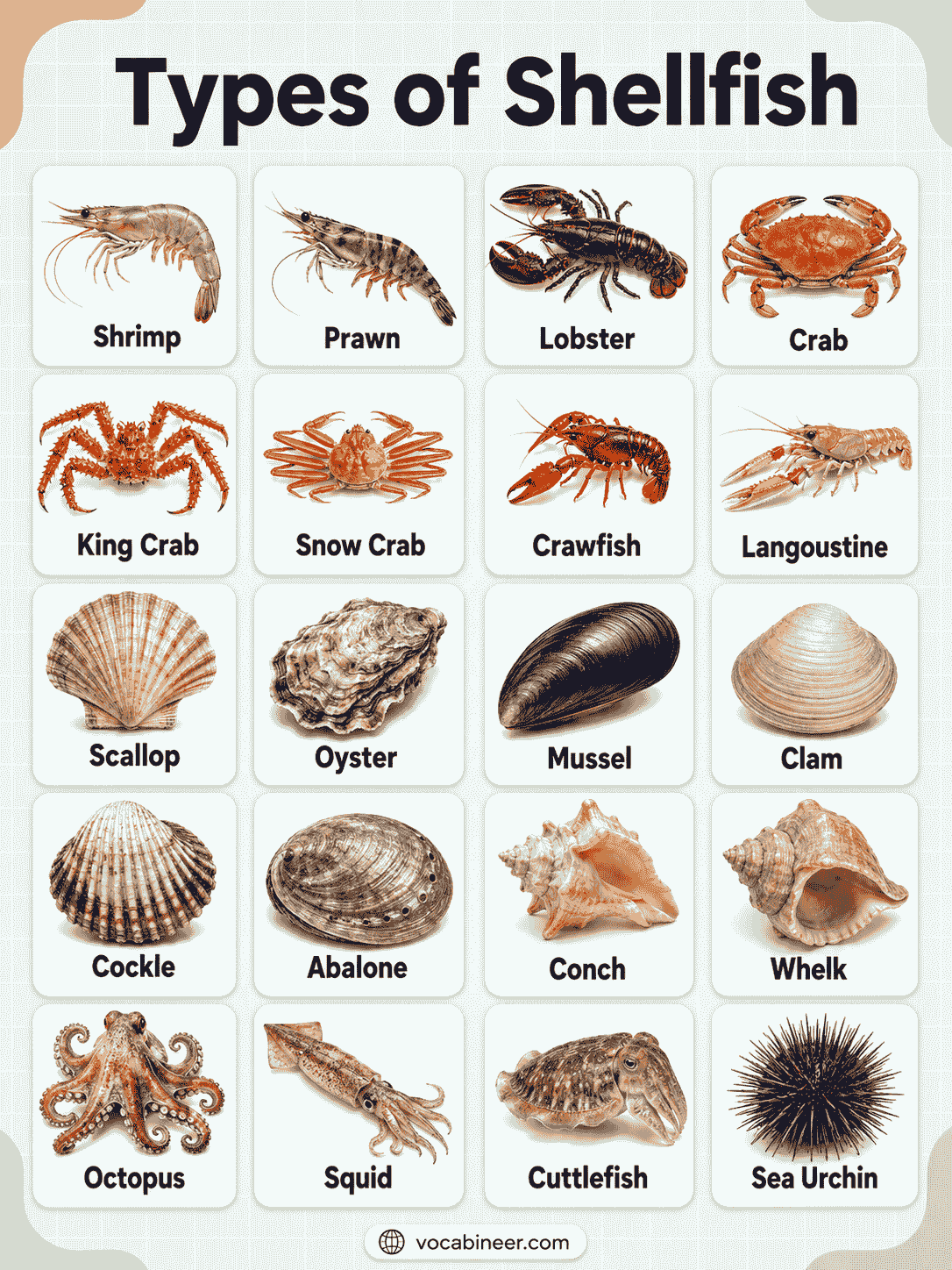
Shellfish include many aquatic animals with shells or shell-like outer coverings, especially crustaceans and mollusks. Learning common shellfish names helps children and English learners build food and marine-life vocabulary while recognizing familiar seafood types.
Shrimp
Shrimp are small crustaceans with curved bodies, thin shells, and long antennae. People commonly boil, grill, fry, or add them to soups, curries, and rice dishes.
Prawn
Prawns are crustaceans that closely resemble shrimp but often grow larger. Cooks use them in grilled dishes, curries, pasta, salads, and many other seafood recipes.
Crab
Crabs have broad bodies, hard shells, and strong claws. People eat many crab species for their sweet, tender meat.
Lobster
Lobsters are large marine crustaceans with hard shells, long antennae, and powerful claws. Their firm meat makes them a popular seafood choice.
Crayfish
Crayfish are small freshwater crustaceans that resemble miniature lobsters. People commonly boil or season them and serve them in regional seafood dishes.
Crawfish
Crawfish is another common name for crayfish, especially in parts of the United States. Their small tails contain the meat most often eaten.
Oyster
Oysters are bivalve mollusks with rough, irregular shells. People eat them raw, grilled, baked, fried, or cooked in stews and other dishes.
Mussel
Mussels are bivalve mollusks with smooth, elongated shells that often appear dark blue or black. They commonly grow in coastal waters and attach themselves to rocks or other surfaces.
Clam
Clams are bivalve mollusks with two hinged shells and soft bodies inside. Cooks use them in soups, pasta, chowders, steamed dishes, and seafood platters.
Scallop
Scallops are bivalve mollusks with fan-shaped shells and tender round muscles that people eat. They have a mild, slightly sweet flavor.
Cockle
Cockles are small bivalve mollusks with rounded, ribbed shells. People often steam, boil, or add them to seafood dishes.
Abalone
Abalone are marine mollusks with ear-shaped shells and firm edible flesh. They often grow on rocky coastal surfaces.
Whelk
Whelks are sea snails with spiral shells and firm meat. People commonly boil or steam them before serving.
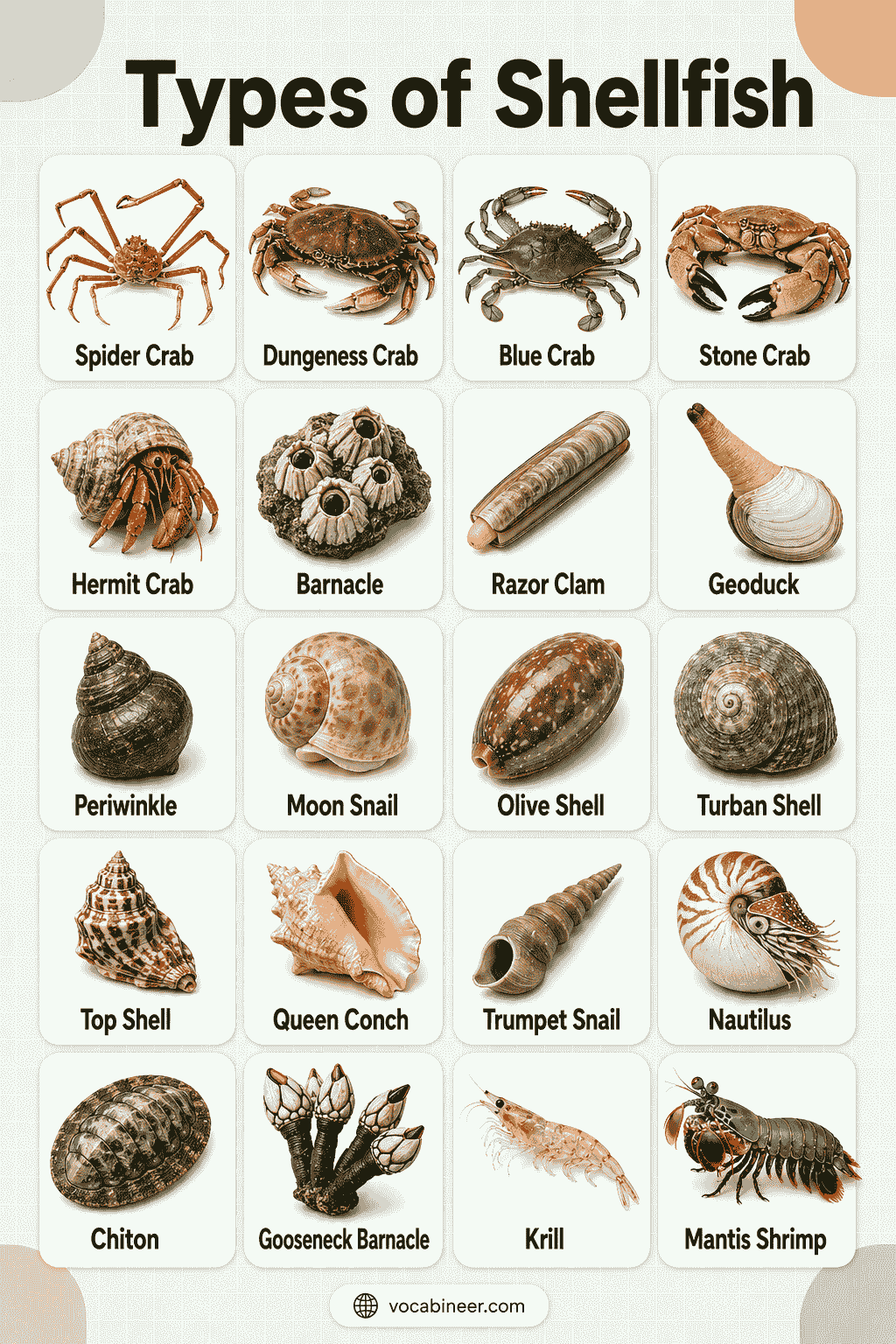
Periwinkle
Periwinkles are small sea snails with compact spiral shells. They live on rocky shores and can be eaten after boiling or steaming.
Conch
Conchs are large marine snails with thick spiral shells. Their meat appears in salads, fritters, soups, and other coastal dishes.
Razor Clam
Razor clams have long, narrow shells that resemble straight razor handles. They live buried in sandy coastal areas and have tender edible flesh.
Geoduck
Geoducks are very large burrowing clams with long siphons that extend beyond their shells. Their crisp, mildly sweet meat appears in several seafood cuisines.
Langoustine
Langoustines are slender crustaceans related to lobsters and resemble large prawns with small claws. Their delicate, sweet meat makes them popular in European seafood dishes.
Krill
Krill are tiny shrimp-like crustaceans that live in large ocean groups. They play an important role in marine food chains and also serve as a food source in some products.
Barnacle
Barnacles are small crustaceans that attach themselves permanently to rocks, ships, and other hard surfaces. Some species, especially goose barnacles, are eaten as seafood in certain regions.
The Two Main Types of Shellfish
Shellfish are commonly divided into crustaceans and mollusks. Their body construction provides the clearest way to separate the two groups.
| Group | Main body features | Common examples |
|---|---|---|
| Crustaceans | Segmented bodies, hard exoskeletons, and jointed legs | Crab, lobster, shrimp, prawn, crayfish |
| Mollusks | Soft bodies, sometimes protected by one or two shells | Clam, oyster, mussel, scallop, squid, octopus |
Crustaceans generally crawl, walk, or swim with jointed limbs. Mollusks move in several ways: some burrow, some attach themselves to surfaces, some crawl with a muscular foot, and others swim freely.

Crustacean Shellfish
Crustaceans have hard outer coverings called exoskeletons. They also have segmented bodies, jointed legs, and usually one or more pairs of antennae.
This shellfish group includes crabs, lobsters, shrimp, prawns, crayfish, krill, and mantis shrimp.
Crabs
Crabs have broad bodies, hard shells, several pairs of walking legs, and two front claws. Most species move sideways, although their exact movement depends on their leg structure and habitat.
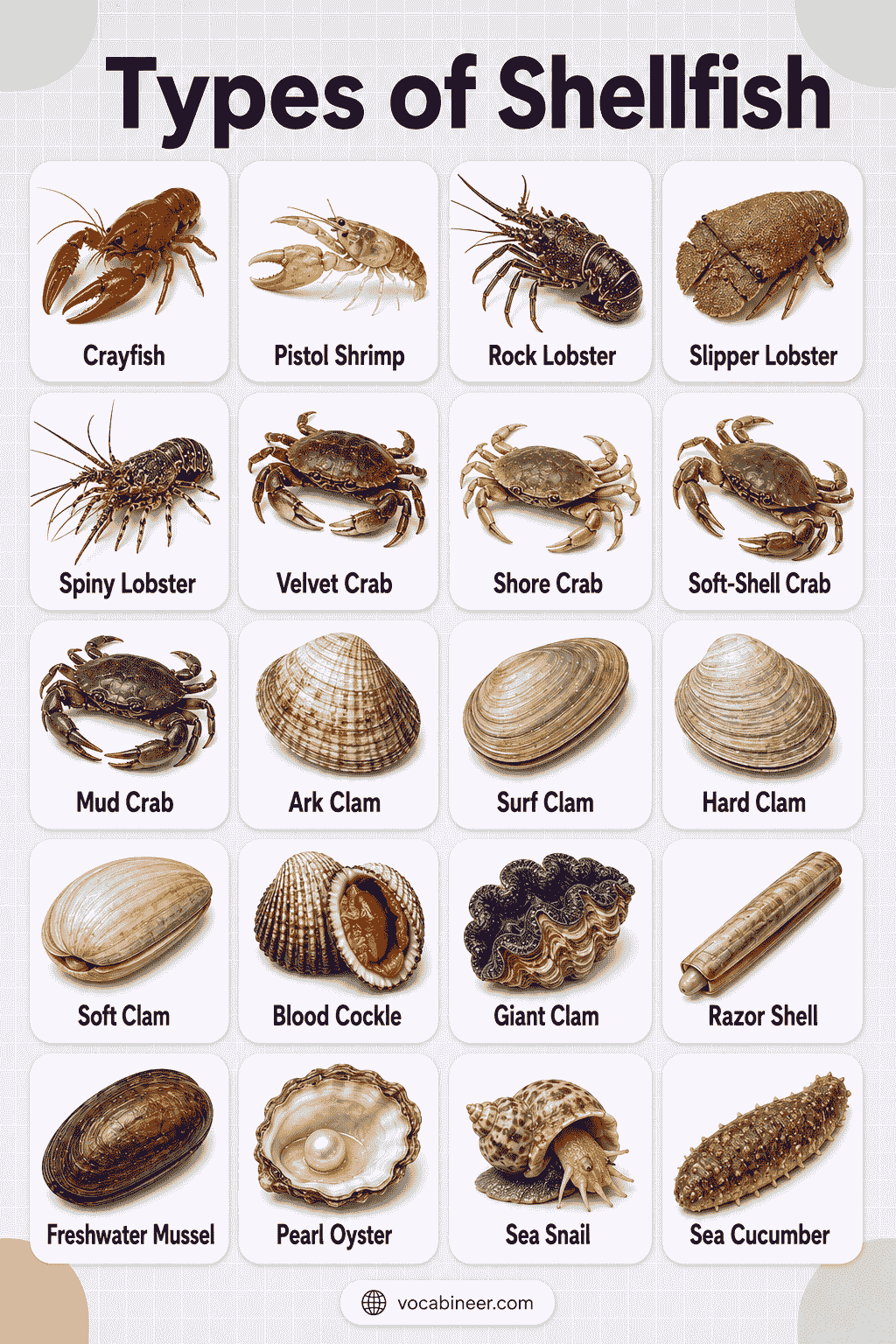
Blue Crab: A medium-sized crab with blue-tinted claws and an olive or bluish shell. It commonly lives in Atlantic coastal waters and estuaries.
King Crab: A large cold-water crab with a heavy body and exceptionally long legs. Much of its edible meat comes from the legs.
Snow Crab: A cold-water crab with long, slender legs and a relatively small body. It is generally lighter and less heavily built than a king crab.
Dungeness Crab: A broad-shelled crab found along the Pacific coast of North America. Its oval body and short, sturdy legs make it easy to recognize.
Mud Crab: A large coastal crab found in mangroves, estuaries, and muddy shorelines. Thick claws and a dark green or brown shell are common features.
Stone Crab: A crab recognized for its large, powerful claws. Its body is smaller in proportion to the heavy pincers.
Soft-Shell Crab: A crab harvested shortly after molting, before its new shell hardens. The name describes a temporary stage rather than a separate crab species.
Lobsters
Lobsters are long-bodied crustaceans with muscular tails, strong walking legs, and prominent antennae. Some types have two large front claws, while others rely more on spines and armored shells.
American Lobster: Also called the Maine lobster, this cold-water species has two large front claws. One claw is usually heavier for crushing, while the other is narrower.
European Lobster: A clawed lobster with a dark blue or bluish-black shell before cooking. It lives in parts of the eastern Atlantic and nearby seas.
Spiny Lobster: A clawless lobster with a heavily armored body and very long antennae. Its strong tail supplies most of the edible meat.
Slipper Lobster: A flat-bodied lobster with broad, plate-like antennae. It lacks the long antennae and large claws seen in other lobster types.
Rock Lobster: A common market name often used for spiny lobsters and other clawless lobster species.
Shrimp and Prawns
Shrimp and prawns are slender crustaceans with curved bodies, long antennae, multiple legs, and flexible tails. Their shells are thinner than those of crabs and lobsters.
The terms shrimp and prawn often overlap in recipes and seafood markets. Size alone does not always separate them, because regional naming practices differ.
White Shrimp: A pale shrimp commonly used in grilling, frying, boiling, and seafood dishes. Its shell may appear grayish before cooking.
Brown Shrimp: A coastal shrimp with a slightly darker shell and firm texture. It may develop a stronger flavor than some pale varieties.
Pink Shrimp: A warm-water shrimp with a naturally pinkish shell. Its mild flavor makes it common in salads, pasta, and chilled dishes.
Rock Shrimp: A small shrimp with a hard, spiny shell and firm meat. Its texture is sometimes compared with lobster.
Tiger Prawn: A large prawn marked with dark bands across its shell. Its striped pattern provides the strongest recognition clue.
Giant River Prawn: A large freshwater prawn with a long body and prominent claws. Mature males may develop extended blue or greenish front limbs.
Crayfish
Crayfish are freshwater crustaceans that resemble small lobsters. They have hard shells, two front claws, segmented tails, and several pairs of walking legs.
Red Swamp Crayfish: A reddish freshwater crayfish commonly found in wetlands, ponds, streams, and rice-growing areas.
Signal Crayfish: A robust crayfish with a pale or bluish patch near the claw joint. The marking resembles a small signal flag.
Northern Crayfish: A freshwater crayfish found in lakes, rivers, streams, and slow-moving waterways.
White River Crayfish: A pale brown or reddish crayfish associated with rivers, wetlands, and muddy freshwater habitats.
Crayfish are also called crawfish or crawdads in parts of the United States.
Other Crustaceans
Some crustaceans do not fit naturally into the crab, lobster, shrimp, or crayfish groups.
Krill: Tiny ocean crustaceans that gather in large groups. They form an important food source for whales, fish, seabirds, and other marine animals.
Mantis Shrimp: A colorful marine crustacean with powerful front limbs. Depending on the species, those limbs may strike or spear prey.
Barnacle: A small crustacean that attaches permanently to rocks, boats, shells, and other hard surfaces. Its shell-like plates often cause people to mistake it for a mollusk.
Mollusk Shellfish
Mollusks have soft bodies and no jointed legs. Many produce protective shells, while others have internal shells or no shell at all.
The mollusks commonly treated as shellfish belong to three main groups:
- bivalves
- gastropods
- cephalopods
Bivalves
Bivalves have two shells joined by a hinge. Their soft bodies rest between the two halves, which open and close through strong muscles.
Many bivalves live buried in sand or mud, while others attach themselves to rocks, reefs, docks, and other surfaces.
Clam: A general name for many bivalves with two shells. Most clams live buried beneath sand, mud, or gravel.
Hard Clam: A thick-shelled clam found in coastal waters. Larger hard clams may also be called quahogs.
Soft-Shell Clam: A clam with a thin, brittle shell and a long siphon that extends beyond the shell’s edge.
Razor Clam: A long, narrow clam whose smooth shell resembles an old-fashioned straight razor.
Geoduck: A very large burrowing clam with a small shell and an exceptionally long siphon.
Mussel: A bivalve with an elongated shell, usually dark blue, black, brown, or green. Many mussels attach themselves to rocks with strong threads.
Blue Mussel: A dark blue or black mussel commonly found in cool coastal waters.
Green-Lipped Mussel: A large mussel recognized by the green edge around its dark shell.
Oyster: A rough-shelled bivalve that usually attaches itself to a hard surface. Oyster shells are often irregular rather than smooth and symmetrical.
Pacific Oyster: A widely farmed oyster with a long, deeply cupped shell and rough outer surface.
Atlantic Oyster: A rounded or oval oyster native to Atlantic coastal waters.
Scallop: A bivalve with a fan-shaped shell and radiating ridges. Unlike many bivalves, scallops can swim by opening and closing their shells rapidly.
Bay Scallop: A smaller scallop commonly found in shallow bays, seagrass areas, and sheltered coastal waters.
Sea Scallop: A larger scallop generally harvested in deeper offshore waters.
Cockle: A small bivalve with a rounded or heart-shaped shell and prominent ribs.
Freshwater Mussel: A mussel that lives in rivers, lakes, and streams rather than marine water.
Asian Clam: A small freshwater clam with a rounded, ridged shell. It lives in rivers, lakes, canals, and reservoirs.
Gastropods
Gastropods are mollusks that usually have one shell and move with a muscular foot. Many shellfish in this group are commonly described as sea snails.
Abalone: A flat marine snail with a broad, ear-shaped shell. The inside of the shell often has an iridescent, pearly appearance.
Whelk: A sea snail with a pointed spiral shell. Its shell usually has visible ridges or whorls.
Periwinkle: A small marine snail commonly found on rocky shores, tidal pools, and coastal surfaces.
Conch: A large tropical sea snail with a thick spiral shell. Mature shells may develop a broad outer lip.
Queen Conch: A large Caribbean conch with a heavy shell and a pink or orange inner lip.
Limpet: A marine gastropod with a low, cone-shaped shell. It clings tightly to rocks in tidal areas.
Sea Snail: A broad name covering many marine gastropods with single shells.
Cephalopods
Cephalopods are active marine mollusks with large eyes, flexible arms, and highly developed nervous systems. Most do not have a visible external shell.
Unlike clams and oysters, cephalopods swim freely and hunt other animals.
Squid: A streamlined cephalopod with eight arms, two longer tentacles, fins, and an internal supporting structure called a pen.
Octopus: A soft-bodied mollusk with eight flexible arms lined with suckers. It has no external or complete internal shell.
Cuttlefish: A broad-bodied cephalopod with eight arms, two tentacles, and an internal shell called a cuttlebone.
Bobtail Squid: A small, rounded cephalopod with short arms and a compact body. It often spends time near the seafloor.
Nautilus: A cephalopod with a visible coiled shell divided into internal chambers. Its external shell separates it clearly from squid and octopus.
Shellfish Names from A to Z
This alphabetical collection brings together the most useful shellfish names for quick reference.
- Abalone
- American Lobster
- Asian Clam
- Atlantic Oyster
- Barnacle
- Bay Scallop
- Blue Crab
- Blue Mussel
- Bobtail Squid
- Brown Shrimp
- Clam
- Cockle
- Conch
- Crab
- Crayfish
- Cuttlefish
- Dungeness Crab
- European Lobster
- Freshwater Mussel
- Geoduck
- Giant River Prawn
- Green-Lipped Mussel
- Hard Clam
- King Crab
- Krill
- Limpet
- Lobster
- Mantis Shrimp
- Mud Crab
- Mussel
- Nautilus
- Northern Crayfish
- Octopus
- Oyster
- Pacific Oyster
- Periwinkle
- Pink Shrimp
- Prawn
- Queen Conch
- Razor Clam
- Red Swamp Crayfish
- Rock Lobster
- Rock Shrimp
- Scallop
- Sea Scallop
- Sea Snail
- Shrimp
- Signal Crayfish
- Slipper Lobster
- Snow Crab
- Soft-Shell Clam
- Spiny Lobster
- Squid
- Stone Crab
- Tiger Prawn
- Whelk
- White River Crayfish
- White Shrimp
Shellfish by Habitat
Shellfish occur in saltwater, freshwater, and brackish environments. The same broad animal group may include species adapted to very different habitats.
Saltwater Shellfish
Most well-known shellfish live in oceans, seas, reefs, coastal bays, or rocky tidal areas.
Common saltwater examples include:
- American lobster
- king crab
- snow crab
- blue crab
- white shrimp
- tiger prawn
- scallop
- oyster
- blue mussel
- squid
- octopus
- cuttlefish
- whelk
- abalone
- conch
Freshwater Shellfish
Freshwater shellfish live in rivers, streams, lakes, ponds, canals, and wetlands.
Examples include:
- crayfish
- red swamp crayfish
- signal crayfish
- northern crayfish
- freshwater mussel
- Asian clam
- giant river prawn
Estuarine Shellfish
Estuaries form where freshwater meets seawater. Salt levels change with tides, rainfall, and river flow, so animals living there must tolerate variable conditions.
Common estuarine shellfish include:
- blue crab
- mud crab
- oysters
- soft-shell clams
- some shrimp species
- certain mussels
Crustaceans and Mollusks Compared
Crustaceans and mollusks differ in body structure, movement, and shell formation.
| Feature | Crustaceans | Mollusks |
|---|---|---|
| Body covering | Hard exoskeleton | Soft body, sometimes protected by a shell |
| Body division | Usually segmented | Varies greatly by group |
| Legs | Jointed legs | No jointed legs |
| Movement | Walk, crawl, burrow, or swim | Burrow, attach, crawl, or swim |
| Examples | Crab, lobster, shrimp | Clam, oyster, squid |
Common Shellfish on Seafood Menus
Some shellfish appear more frequently on restaurant menus and in seafood markets than others.
Shrimp: Commonly boiled, grilled, fried, steamed, or added to rice, soups, noodles, salads, and pasta.
Crab: Served whole, as leg or claw meat, in soups, or in prepared dishes such as crab cakes.
Lobster: Often boiled, steamed, baked, grilled, or served as lobster tail.
Clams: Used in chowders, pasta dishes, soups, steamed preparations, and baked appetizers.
Oysters: Served baked, grilled, fried, or raw in some settings.
Mussels: Usually steamed with broth, herbs, vegetables, garlic, or other flavorings.
Scallops: Commonly pan-seared, grilled, baked, or added to mixed seafood dishes.
Squid: Frequently fried as calamari, grilled, stuffed, or used in stir-fries.
Octopus: Often boiled, braised, grilled, or served in seafood salads.
Unusual Shellfish and Their Features
Some shellfish stand out because of their size, shell shape, color, or behavior.
Geoduck: Its exceptionally long siphon extends far beyond its relatively small shell.
Mantis Shrimp: Its powerful front limbs can strike or spear prey with remarkable speed.
Abalone: Its flat shell has a line of holes and a brightly colored inner surface.
Razor Clam: Its narrow shell looks very different from the rounded form of most clams.
Queen Conch: Its mature shell has a broad lip and a pink or orange interior.
Barnacle: Although it resembles a shell-covered mollusk, it is actually a crustacean permanently attached to a surface.
Nautilus: Unlike most living cephalopods, it carries a visible chambered shell.
Common Shellfish Name Confusions
Several shellfish names overlap in markets or describe animals with similar appearances.
| Names | Main difference |
|---|---|
| Shrimp and Prawn | The terms may refer to different biological groups, but market usage varies by region |
| Lobster and Spiny Lobster | Clawed lobsters have large front pincers; spiny lobsters lack them |
| Crayfish and Lobster | Crayfish mainly live in freshwater and are usually smaller |
| Clam and Oyster | Clams often burrow, while oysters generally attach to hard surfaces |
| Mussel and Clam | Mussels usually have elongated dark shells; clams commonly have rounder shells |
| Squid and Cuttlefish | Squid have a flexible internal pen; cuttlefish have a broad cuttlebone |
| Conch and Whelk | Both are sea snails, but conchs usually have broader shell openings and flared lips |
| Crab and Soft-Shell Crab | Soft-shell crab is a recently molted crab, not a separate biological group |
How Shellfish Are Commonly Prepared
Cooking methods do not change an animal’s classification, but they often affect how its name appears on menus.
Steamed: Clams, mussels, crab, lobster, and shrimp are often prepared with steam.
Boiled: Shrimp, crayfish, crab, and lobster may be boiled in plain or seasoned water.
Grilled: Shrimp, lobster tails, scallops, squid, and octopus can be cooked over direct heat.
Fried: Shrimp, oysters, clams, squid, and soft-shell crab commonly appear in fried dishes.
Baked: Oysters, scallops, lobster, clams, and crab-filled dishes may be baked.
Stir-Fried: Shrimp, prawns, squid, and cuttlefish work well in quick stir-fries.
Added to Soup: Clams, mussels, shrimp, crab, and lobster appear in chowders, bisques, stews, and seafood soups.
Served Raw: Some restaurants serve oysters and certain clams raw. However, raw or undercooked shellfish can carry harmful microorganisms, so sourcing, refrigeration, preparation, and individual health risks require careful consideration.
FAQs
The two main types of shellfish are crustaceans and mollusks. Crustaceans include crab, lobster, and shrimp. Mollusks include clams, oysters, and squid.
Shrimp and prawns are similar but have small anatomical differences. In cooking and menus, the terms are often used interchangeably.
Oysters and some clams are commonly eaten raw when they are fresh and properly handled.
Bivalves have two hinged shells, like clams and mussels. Cephalopods have tentacles and no external shell, like squid and octopus.
No. Some types of shellfish, such as crayfish and freshwater mussels, live in rivers and lakes.
Conclusion
The main types of shellfish include crustaceans and mollusks, each with distinct body structures and species. Crustaceans have hard exoskeletons and jointed legs, while mollusks have soft bodies and may have shells.
This structured overview covered crabs, lobsters, shrimp, prawns, crayfish, clams, mussels, oysters, scallops, squid, and more. Understanding these shellfish names helps you identify them accurately by group, habitat, and physical features.
Read More
