

Weapons have changed from simple stone tools and hand-forged blades into firearms, artillery, guided missiles, and vehicle-mounted systems. Their designs reflect different periods, cultures, technologies, and forms of combat.
Learning the names of different weapons helps readers recognize them in history books, museums, films, games, and general discussions. This guide organizes the subject by weapon type and explains each category at a clear, non-technical level. The original material also spans ancient blades, projectile weapons, firearms, explosives, military systems, and less-lethal devices.
In This Page
What Is a Weapon?
A weapon is an object or system designed or adapted to cause harm, threaten force, or support combat.
Some weapons require direct contact, while others launch projectiles over short or long distances. In addition, large systems may operate from vehicles, aircraft, ships, or fixed positions.
Weapons are commonly classified by:
- physical design;
- operating mechanism;
- effective distance;
- historical period;
- delivery platform;
- military or defensive role.
These categories can overlap. For example, a spear is a polearm when used for thrusting, but it also becomes a thrown weapon when launched by hand.
Main Types of Weapons
Weapons include tools or devices designed for combat, defense, hunting, or law-enforcement use. They vary widely in form and function, so learning the main categories helps students and English learners recognize common weapon-related vocabulary without focusing on operational use.
Firearms
Firearms use expanding gases to launch projectiles through a barrel. Common categories include handguns, rifles, and shotguns.
Bladed Weapons
Bladed weapons use a sharpened edge or point. Examples include knives, swords, daggers, and bayonets.
Impact Weapons
Impact weapons rely on blunt force rather than a cutting edge. Clubs, batons, maces, and similar objects fall into this group.
Archery Weapons
Archery weapons launch arrows or bolts using stored mechanical tension. Bows and crossbows are the main examples.
Pole Weapons
Pole weapons attach a blade, point, or striking head to a long shaft. Spears, pikes, halberds, and lances belong to this category.
Thrown Weapons
Thrown weapons are designed to travel toward a target after release. Examples include throwing spears and some specialized throwing blades.
Explosive Weapons
Explosive weapons use rapidly released energy to damage targets or structures. Military examples include grenades, bombs, and certain types of mines.
Artillery
Artillery includes large weapon systems that launch projectiles over long distances. Cannons, howitzers, and mortars are common examples.
Missile Weapons
Missile weapons use powered projectiles that travel toward distant targets. Military systems may operate from land, sea, or air platforms.
Incendiary Weapons
Incendiary weapons create intense heat or fire. Their effects differ from conventional explosive weapons because they primarily rely on burning.
Chemical Weapons
Chemical weapons use toxic chemicals to harm people or animals. International law heavily restricts and prohibits their use.
Biological Weapons
Biological weapons involve harmful biological agents or toxins. International agreements prohibit their development and use in warfare.
Nuclear Weapons
Nuclear weapons release enormous amounts of energy through nuclear reactions. They can cause catastrophic blast, heat, radiation, and long-term environmental effects.
Directed-Energy Weapons
Directed-energy weapons use concentrated electromagnetic or other forms of energy rather than conventional projectiles. Examples include certain laser and microwave systems.
Electroshock Weapons
Electroshock weapons use electrical current to temporarily disrupt muscle control or movement. Some law-enforcement agencies use devices in this category.
Improvised Weapons
Improvised weapons are ordinary objects adapted or used as weapons rather than designed for that purpose. Their form varies widely depending on the object and situation.
Traditional Swords and Blades
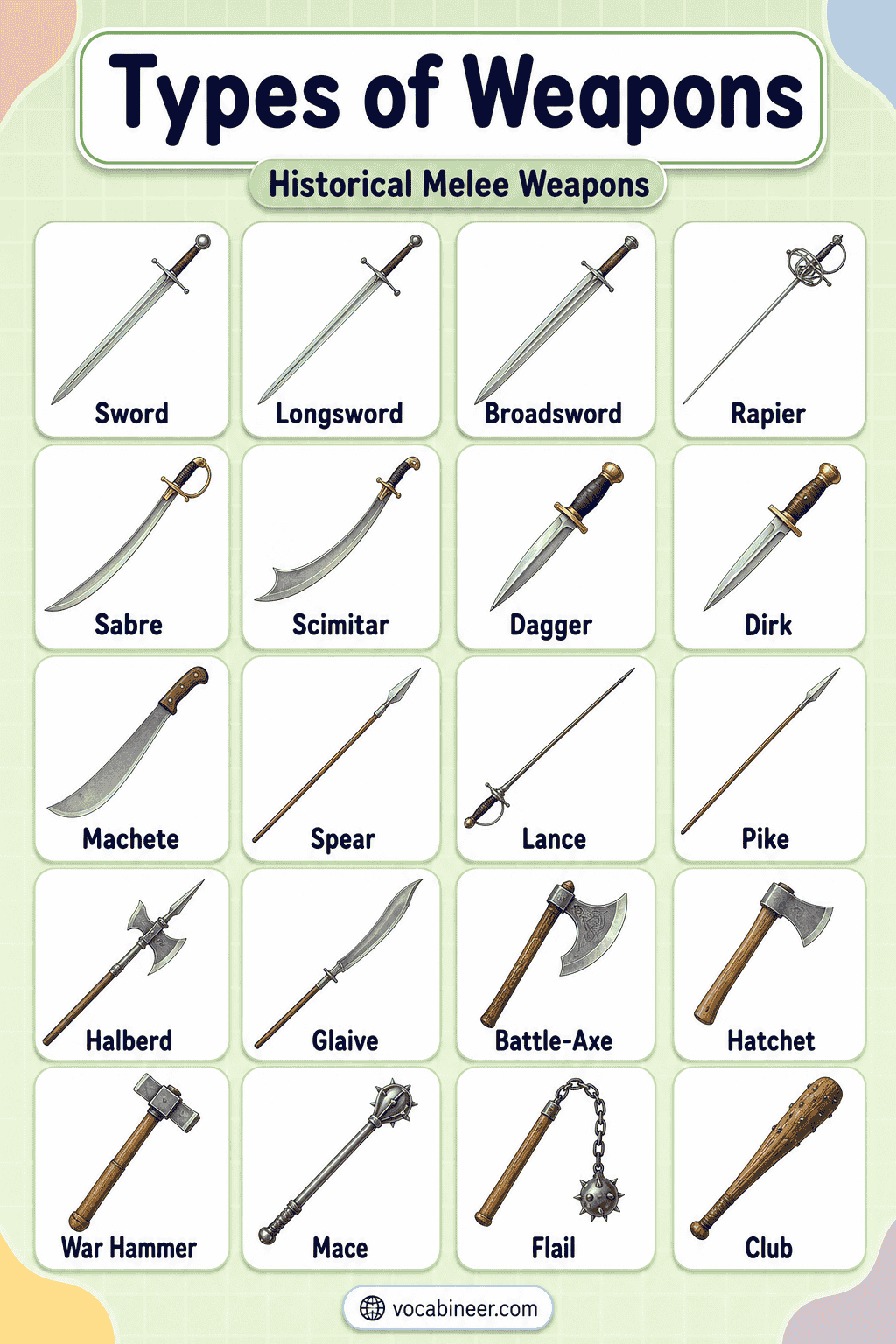
Swords are long-edged weapons created for cutting, thrusting, or a combination of both.
Katana: A curved Japanese sword traditionally associated with samurai warriors.
Gladius: A short Roman sword designed mainly for close combat.
Jian: A straight, double-edged Chinese sword.
Sabre: A single-edged curved sword historically linked with cavalry and military officers.
Longsword: A European sword with a long grip that commonly allowed two-handed use.
Rapier: A slender European sword developed mainly for thrusting.
Khopesh: An ancient Egyptian sword with a distinctive curved, sickle-like blade.
Scimitar: A broad Western term for several curved swords associated with the Middle East and nearby regions.
Dao: A family of Chinese single-edged swords rather than one fixed design.
Ulfberht Sword: A group of medieval European swords marked with the Ulfberht inscription.
Although all of these objects are swords, their blade shapes, lengths, grips, and cultural roles differ considerably.
Daggers and Fighting Knives
Daggers are shorter than swords and usually feature a sharply pointed blade.
Dirk: A long Scottish dagger historically carried as a sidearm.
Kris: A Southeast Asian dagger known for its straight or wavy blade.
Stiletto: A narrow dagger made primarily for thrusting.
Pugio: A Roman military dagger.
Jambiya: A curved dagger traditionally worn in parts of the Arabian Peninsula.
Seax: A single-edged blade associated with early Germanic peoples.
Kukri: A forward-curving blade strongly associated with Nepal.
Rondel Dagger: A medieval dagger recognized by its round hand guards.
Parrying Dagger: A defensive dagger used alongside a sword.
Push Dagger: A compact dagger with a handle placed across the palm.
The term knife covers a much broader group that includes cooking, craft, hunting, and utility tools. By contrast, a dagger usually has a combat-oriented point and design.
Clubs, Maces, and Other Blunt Weapons
Blunt weapons deliver force through impact instead of a sharpened cutting edge.
Club: A simple striking weapon made from wood, metal, or another hard material.
Mace: A weapon with a heavy solid head attached to a handle.
Flail: A striking weapon with a head connected to the handle by a flexible link.
Baton: A straight impact tool associated with security and law-enforcement use.
Morning Star: A spiked club or mace-like weapon, although historical terminology varies.
War Hammer: A medieval striking weapon designed to concentrate force against armor.
Cudgel: A short, heavy club.
Truncheon: A traditional police baton.
Kanabo: A heavy Japanese club, sometimes reinforced with metal.
Sap: A short flexible impact weapon.
Despite their relatively simple forms, blunt weapons developed into many regional and specialized designs.
Axes and Other Edged Weapons
Edged weapons use a sharpened surface to cut or chop.
Battle Axe: An axe designed specifically for combat.
Tomahawk: A small axe associated with Indigenous North American traditions and later military use.
Falchion: A broad single-edged European sword.
Cutlass: A short curved sword commonly associated with sailors.
Talwar: A curved sword from the Indian subcontinent.
Glaive: A single-edged blade attached to a long shaft.
Scythe: Primarily an agricultural tool, though modified versions appeared in historical conflicts.
Hatchet: A small one-handed axe mainly used as a practical tool, but sometimes adapted as a weapon.
Some edged objects began as everyday tools. During conflict, however, people sometimes modified them for combat.
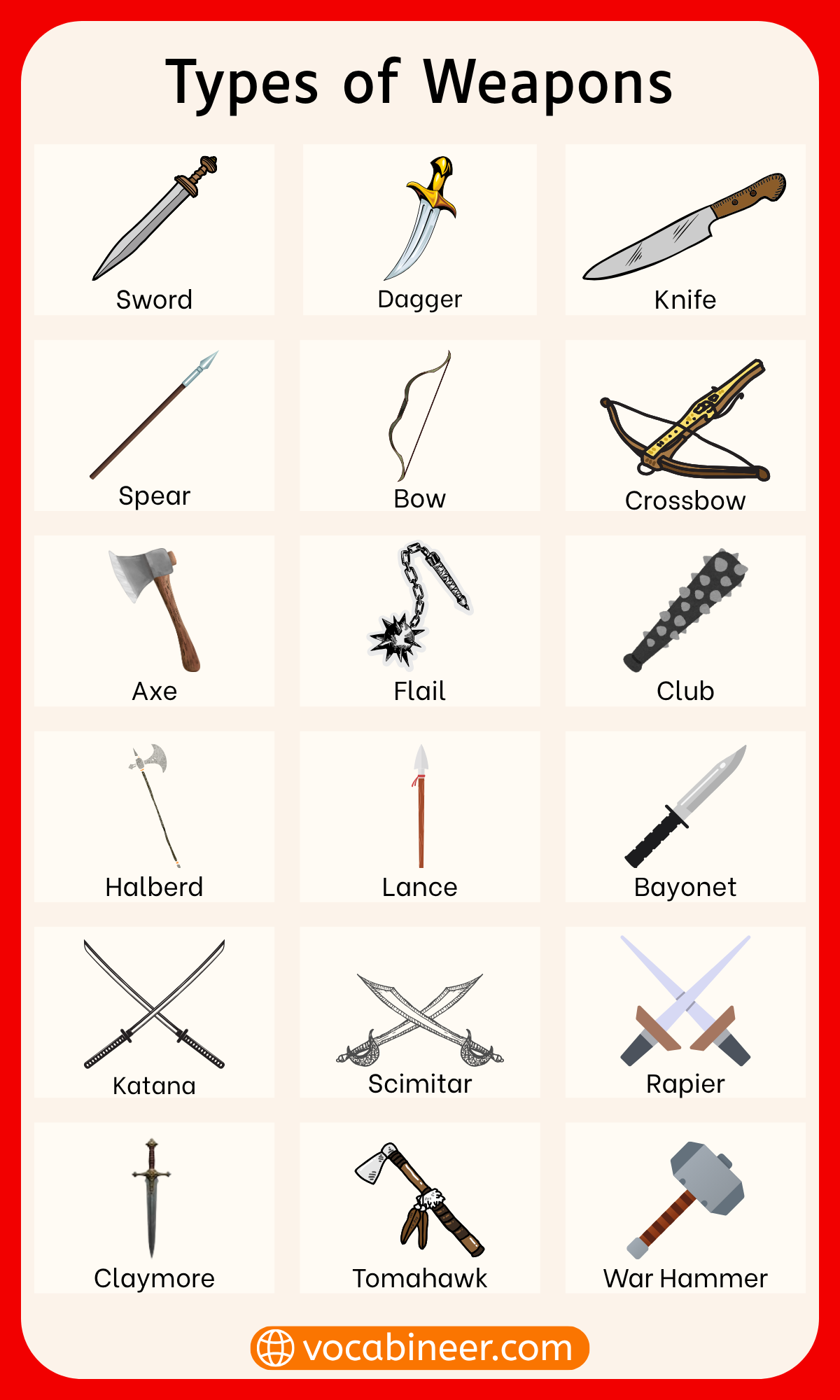
Spears and Other Polearms
Polearms place a blade, spike, or striking head on a long shaft, giving the user greater reach.
Spear: A pointed weapon used for thrusting or throwing.
Halberd: A polearm that combines an axe blade, hook, and spear point.
Pike: A very long thrusting spear used in organized infantry formations.
Glaive: A broad blade mounted on a shaft.
Naginata: A Japanese pole weapon with a curved blade.
Yari: A Japanese spear with a straight blade.
Lance: A long spear strongly associated with mounted soldiers.
Partisan: A spear-like European polearm with side projections near the central point.
Guisarme: A hooked medieval polearm.
Voulge: A broad chopping blade fixed to a shaft.
Because historical names changed across countries and periods, experts may classify some polearms differently.
Hand-Thrown Weapons
Thrown weapons extend the user’s reach without using a mechanical launcher.
Javelin: A light spear made primarily for throwing.
Throwing Axe: A compact axe balanced for controlled flight.
Throwing Knife: A knife designed for throwing practice or combat use.
Chakram: A circular bladed weapon associated with South Asia.
Shuriken: A small Japanese projectile used as a supplementary weapon.
Bola: Weighted cords intended to entangle an animal or target.
Dart: A small pointed projectile thrown by hand or with a launcher.
Tomahawk: Certain tomahawk designs can also function as thrown weapons.
Boomerang: A curved Aboriginal Australian throwing implement; many hunting forms do not return.
These weapons depended on balance, skill, distance, and the materials used in their construction.
Shields and Protective Equipment
Shields are included because they often appear alongside weapons in historical vocabulary, although they are protective equipment rather than ordinary offensive weapons.
Round Shield: A circular shield used by many cultures.
Tower Shield: A tall rectangular shield that covers much of the body.
Buckler: A small handheld shield used in close combat.
Scutum: A large Roman shield associated with legionaries.
Kite Shield: A long shield with a rounded top and pointed lower end.
Targe: A round Scottish shield.
Pavise: A large standing shield used by archers and crossbow users.
Hoplon: A large round shield carried by ancient Greek hoplites.
Heater Shield: A medieval shield shaped roughly like the base of a flatiron.
Although primarily defensive, some shields could also push, strike, or unbalance an opponent.
Bows and Crossbows
Bows and crossbows launch arrows or bolts by storing and releasing mechanical energy.
Common Bow Types
Longbow: A tall bow known for its long draw and historical military use.
Recurve Bow: A bow whose tips curve away from the archer.
Composite Bow: A bow made from several materials to improve strength and flexibility.
Short Bow: A compact bow suited to easier transport or mounted use.
Self Bow: A bow made from one continuous piece of wood.
Reflex Bow: A bow whose limbs curve away from the archer when unstrung.
Flatbow: A bow with wide, relatively flat limbs.
War Bow: A powerful bow made for military use.
The English longbow is one of the best-known historical examples of the longbow category.
Common Crossbow Types
Crossbow: A bow assembly mounted on a stock and held mechanically at full draw.
Repeating Crossbow: A historical system that loads and releases multiple bolts through repeated lever movement.
Arbalest: A powerful medieval European crossbow.
Cranequin Crossbow: A crossbow drawn using a geared winding device.
Pistol Crossbow: A small modern crossbow with a pistol-style grip.
Siege Crossbow: A large historical crossbow-like system used against formations or defenses.
Large devices such as the ballista and scorpion resembled crossbows, but historians generally classify them as ancient artillery.
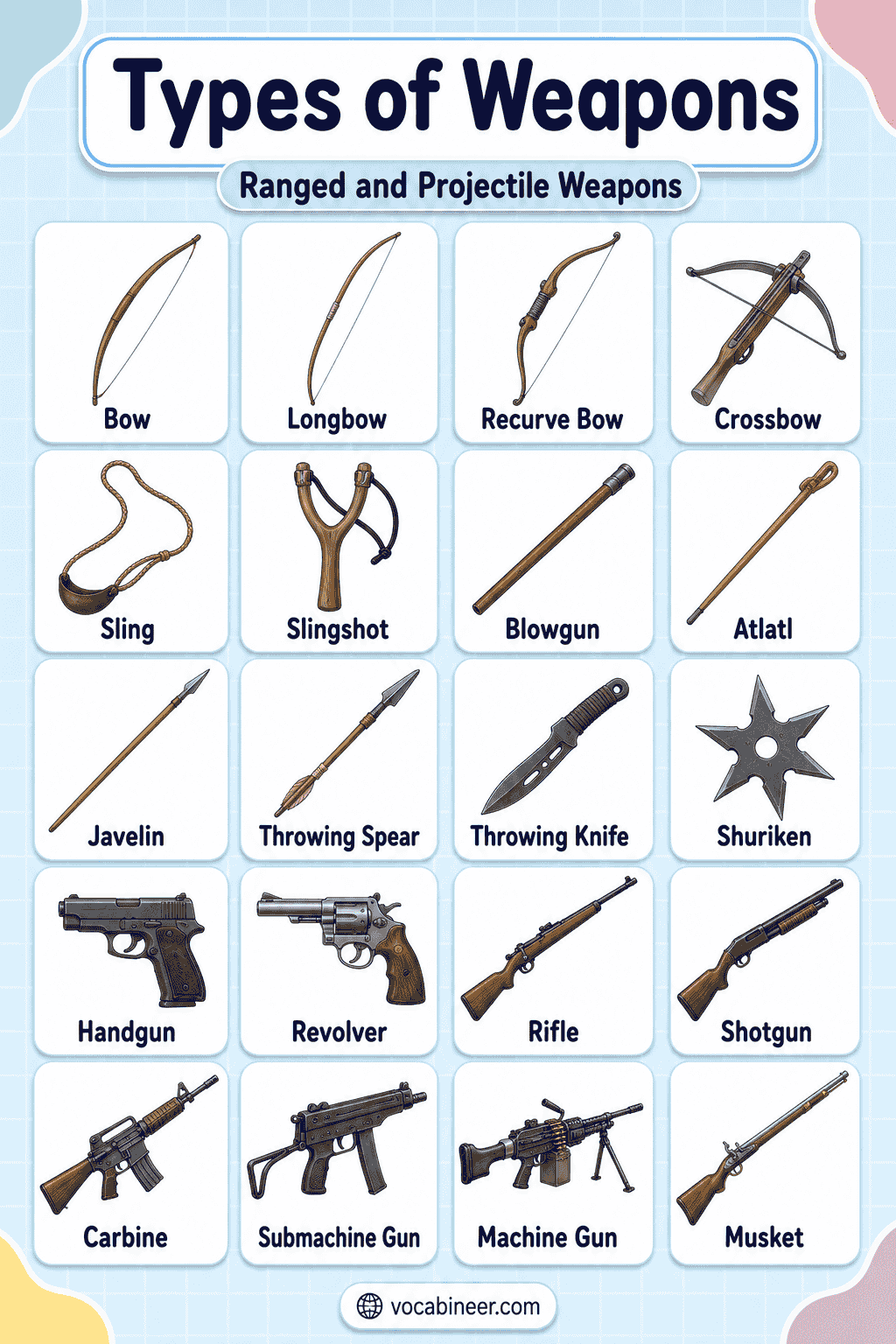
Slings and Early Projectile Launchers
Simple launchers increased the speed or range of stones, darts, and spears.
Sling: Two cords and a pouch used to hurl stones or shaped projectiles.
Staff Sling: A sling attached to a short staff for added leverage.
Shepherd’s Sling: A traditional hand sling associated with herding and defense.
Atlatl: A lever that increases the force and range of a thrown dart.
Woomera: An Aboriginal Australian spear-throwing tool.
Spear Thrower: A general term for a device that increases throwing leverage.
Dart Thrower: A launcher used with long, flexible darts.
These systems appeared thousands of years before firearms and demonstrate early uses of leverage and stored energy.
Early Gunpowder Weapons
Gunpowder transformed warfare by allowing expanding gases to launch projectiles.
Fire Lance: An early Chinese weapon that projected flame and debris.
Hand Cannon: A simple metal barrel fired while held or supported.
Arquebus: An early shoulder-fired gun that preceded the musket.
Matchlock: A firing system that used a burning cord to ignite gunpowder.
Wheellock: A mechanism that produced sparks through a rotating steel wheel.
Snaplock: An early flint-based ignition design.
Flintlock: A system in which flint struck steel to ignite the charge.
Musket: A long gun used widely between the sixteenth and nineteenth centuries.
Blunderbuss: A short firearm known for its flared muzzle.
Tanegashima: A Japanese matchlock firearm based on an imported Portuguese design.
Although these weapons were slow by modern standards, they changed battlefield formations and military tactics.
Common Types of Handguns
Handguns are compact firearms designed to be held in one or both hands.
Revolver: Stores cartridges in a rotating cylinder.
Semi-Automatic Pistol: Fires one round per trigger press and prepares the next cartridge automatically.
Derringer: A very small handgun that commonly has one or two barrels.
Flintlock Pistol: A historical handgun using flintlock ignition.
Pocket Pistol: A general term for a very small handgun.
Service Pistol: A handgun selected for military or police service.
Target Pistol: A pistol designed for precision sporting competition.
Snub-Nosed Revolver: A revolver with a short barrel.
Machine Pistol: A handgun-sized firearm capable of automatic or burst fire.
Some names describe the operating system, whereas others refer to size, role, or historical period.
Common Rifle Types
Rifles are generally shoulder-fired firearms with spiral grooves inside the barrel.
Bolt-Action Rifle: Uses a manually operated bolt between shots.
Lever-Action Rifle: Cycles through the movement of a lever.
Semi-Automatic Rifle: Fires once per trigger press and loads the next cartridge automatically.
Single-Shot Rifle: Holds one cartridge before manual reloading.
Muzzleloader Rifle: Loads powder and projectile from the front of the barrel.
Carbine: A shorter, lighter rifle or rifle-like shoulder weapon.
Battle Rifle: A military rifle generally chambered for a full-power rifle cartridge.
Assault Rifle: A select-fire military rifle that uses an intermediate cartridge.
Precision Rifle: A rifle built or configured for highly accurate shooting.
Air Rifle: Uses compressed air or gas rather than gunpowder.
A sniper rifle is better understood as a precision-role rifle than as one fixed operating mechanism.
Common Shotgun Types
Shotguns are shoulder-fired firearms designed primarily for shotshell ammunition.
Pump-Action Shotgun: Uses a sliding fore-end to cycle the action.
Break-Action Shotgun: Opens at a hinge to expose the chamber.
Double-Barrel Shotgun: Has two barrels and usually uses a break-action design.
Semi-Automatic Shotgun: Fires once per trigger press and prepares the next shell automatically.
Bolt-Action Shotgun: Uses a manually operated bolt.
Lever-Action Shotgun: Cycles through a lever beneath the receiver.
Single-Shot Shotgun: Holds one shell at a time.
Coach Gun: A short double-barrel shotgun associated with historical stagecoach protection.
Automatic Shotgun: A rare shotgun capable of automatic fire.
Tactical Shotgun: A police, military, or defensive configuration rather than a separate action type.
The term sawed-off shotgun describes a shortened configuration, not a unique firing mechanism. Laws governing barrel length also vary by jurisdiction.
Semi-Automatic and Automatic Firearms
These terms describe firing modes rather than physical weapon shapes.
Semi-Automatic: Fires one round for each trigger press and loads the next automatically.
Fully Automatic: Continues firing while the trigger remains pressed and ammunition remains available.
Select-Fire: Allows a choice between two or more firing modes.
Burst-Fire: Releases a limited number of rounds with one trigger press.
The original source grouped weapons such as the AK-47, M16, Uzi, M4, FN FAL, MP5, G36, SCAR, Thompson, and MG42 together, even though they belong to different classes and historical periods.
Explosive Weapons
Explosive weapons produce blast, pressure, heat, or fragmentation effects.
Common Grenade Types
Fragmentation Grenade: Scatters fragments when it detonates.
Smoke Grenade: Produces smoke for signaling, screening, or training.
Stun Grenade: Creates intense light and sound to disorient people temporarily.
Incendiary Grenade: Produces heat or fire.
Tear-Gas Grenade: Releases a chemical irritant.
A flashbang is another common name for a stun grenade.
Common Mine Types
Anti-Personnel Mine: Intended to injure people.
Anti-Tank Mine: Intended to damage heavy vehicles.
Directional Mine: Directs fragments toward a selected area.
Scatterable Mine: Dispersed across an area by another delivery system.
International agreements restrict or prohibit many mines, and unexploded devices can remain dangerous for decades.
Rockets, Missiles, and Guided Weapons
Rockets and missiles carry explosive or specialized payloads over distance.
A rocket generally travels without active guidance after launch. By contrast, a guided missile uses sensors, control signals, or onboard navigation.
Rocket Launcher: Launches an unguided rocket.
Anti-Tank Launcher: A portable or mounted launcher intended for use against armored vehicles.
Recoilless Rifle: Fires a large projectile while venting gases backward to reduce recoil.
Anti-Tank Guided Missile: Uses guidance to travel toward an armored target.
Surface-to-Air Missile: Launches from the ground toward an airborne target.
Surface-to-Surface Missile: Travels between two ground or surface locations.
Cruise Missile: Flies through the atmosphere along a controlled route.
Ballistic Missile: Follows a powered launch followed by a largely ballistic path.
Anti-Ship Missile: Designed for use against naval vessels.
Interceptor Missile: Intended to stop another aircraft or missile.
Examples in the original source include the RPG-7, AT4, Panzerfaust, Bazooka, Carl Gustaf, Javelin, Milan, and M72 LAW.
Artillery Weapons
Artillery delivers heavy projectiles over distances beyond ordinary small arms.
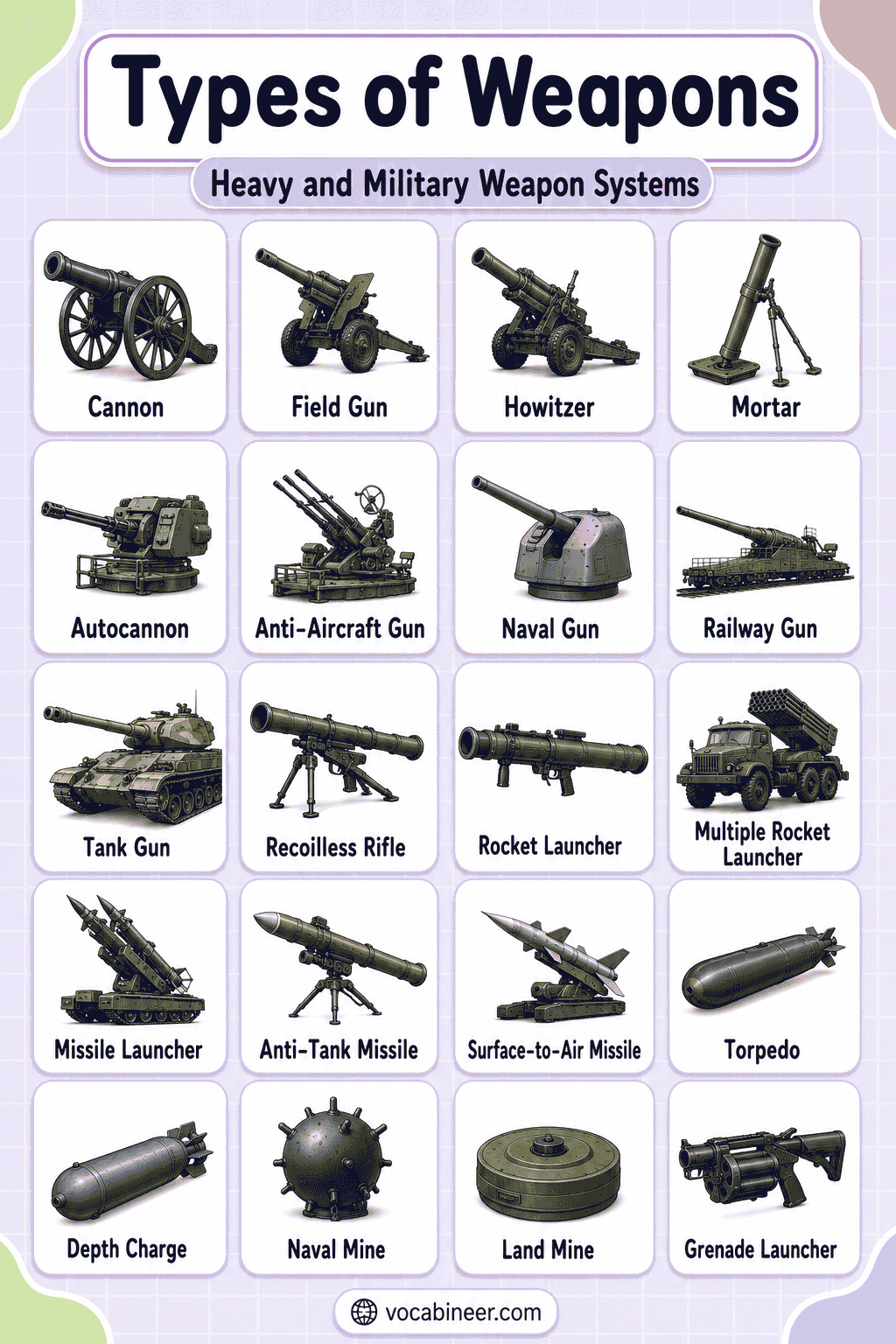
Field Gun: A mobile artillery piece historically used in open terrain.
Howitzer: Fires shells at both lower and higher angles.
Mortar: Launches projectiles at a steep angle from a relatively short barrel.
Anti-Aircraft Gun: Engages aircraft or other airborne threats.
Coastal Gun: Protects shorelines and harbors.
Rocket Artillery: Launches rockets rather than conventional shells.
Siege Cannon: A large historical gun used against fortifications.
Self-Propelled Howitzer: Mounts a howitzer on a tracked or wheeled vehicle.
Modern artillery systems often depend on separate command, radar, ammunition, and support vehicles.
Armored Vehicles as Weapon Platforms
Tanks and armored fighting vehicles are platforms that combine weapons, armor, crews, and mobility.
Main Battle Tank: A heavily armored tracked vehicle designed for frontline combat.
Light Tank: A lighter tank that emphasizes mobility and easier transport.
Infantry Fighting Vehicle: Carries infantry and supports them with mounted weapons.
Armored Personnel Carrier: Primarily transports troops under armor protection.
Armored Car: A wheeled protected vehicle used for reconnaissance, patrol, or security.
Tank Destroyer: A vehicle developed mainly to engage armored targets.
Self-Propelled Gun: Carries a large gun on a mobile chassis.
Mobile Gun System: Mounts a direct-fire weapon on a wheeled or tracked platform.
An APC, IFV, and tank may all carry armor and weapons, but their primary roles remain different.
Airborne Weapon Systems
Aircraft carry different systems according to their mission.
Air-to-Air Missile: Intended for use against another aircraft.
Air-to-Surface Missile: Launched from an aircraft toward a ground or sea target.
Aircraft Cannon: A rapid-firing gun built into or mounted on an aircraft.
Guided Bomb: Uses a control or guidance system to improve accuracy.
Unguided Bomb: Falls without active guidance after release.
Rocket Pod: Carries several small rockets beneath an aircraft.
Gun Pod: An external container holding a gun and ammunition.
Helicopters commonly carry cannons, rockets, and guided missiles, while larger aircraft may carry bombs or long-range missiles.
Naval Weapons and Launch Systems
Ships and submarines use guns, missiles, torpedoes, and specialized launch systems.
Torpedoes
Heavyweight Torpedo: A large torpedo commonly launched from submarines.
Lightweight Torpedo: Often used against submarines from ships or aircraft.
Acoustic-Homing Torpedo: Uses sound to guide toward a target.
Wire-Guided Torpedo: Receives guidance commands through a wire.
Wake-Homing Torpedo: Follows disturbed water behind a vessel.
Ship-Based Systems
Deck Gun: A gun mounted on a ship’s deck or turret.
Close-In Weapon System: A rapid defensive system used against nearby threats.
Vertical Launch System: A group of shipboard cells used to launch missiles.
Anti-Ship Missile: Designed to strike a surface vessel.
Torpedo Tube: A structure used to launch torpedoes.
Depth Charge: An explosive weapon intended for underwater targets.
Frigate, destroyer, cruiser, and battleship describe ship classes rather than individual weapon types.
Less-Lethal Devices
Less-lethal devices aim to reduce the likelihood of fatal injury, but they can still cause serious harm.
Impact Projectile: A projectile designed to cause blunt-force impact rather than penetration.
Beanbag Round: A fabric projectile filled with small pellets.
Rubber Projectile: A flexible impact round used in some crowd-control settings.
Chemical Irritant: A substance such as CS gas or pepper spray that irritates the eyes and respiratory system.
Conducted-Energy Device: Uses electrical energy to disrupt voluntary muscle control or cause pain.
Water Cannon: Projects high-pressure water from a vehicle or fixed system.
Use, legality, and safety standards vary among countries and agencies.
Historical Weapons and Modern Weapons
Historical and modern weapons differ in materials, energy sources, range, and complexity.
| Historical weapons | Modern weapons |
|---|---|
| Often used wood, bronze, iron, or early steel | Commonly use advanced alloys, polymers, and electronics |
| Relied mainly on human force or simple mechanisms | May use chemical energy, motors, sensors, or guidance |
| Usually operated at shorter ranges | Can operate from short to very long range |
| Included swords, spears, bows, and early guns | Include firearms, missiles, drones, and electronic systems |
| Often depended on direct visual judgment | May use optics, radar, satellites, or digital guidance |
Older weapon types have not disappeared completely. Bows, swords, knives, and historical firearms still appear in sport, ceremonies, collecting, and cultural study.
Weapon Names for English Learners
These short examples connect common weapon names with simple meanings.
- Sword: A sword has a long blade.
- Dagger: A dagger is shorter than most swords.
- Spear: A spear has a pointed head on a long shaft.
- Shield: A shield protects the body.
- Bow: A bow launches arrows.
- Pistol: A pistol is a type of handgun.
- Rifle: A rifle is usually fired from the shoulder.
- Shotgun: A shotgun mainly uses shotshell ammunition.
- Grenade: A grenade is a small explosive weapon.
- Missile: A guided missile follows a controlled route.
Pictures, category sorting, and matching exercises can make these terms easier to remember.
FAQs
A dagger has a pointed tip and double edges, made mainly for stabbing in combat. A knife usually has one sharp edge and is more often used for cutting or utility purposes.
Blades longer than about 24 inches are typically considered swords. If it’s under 14 inches, it’s usually called a dagger or knife depending on design.
Most guns fall into three categories: handguns (like pistols and revolvers), rifles, and shotguns. Each is used for different ranges and situations.
A polearm is a weapon with a long shaft and a blade or spike on one end. Examples include spears, halberds, and lances, used mainly in infantry battles.
A sling hurls stones using cords and momentum, while a bow shoots arrows using tension from a string and bent limbs. Both were early long-range weapons, but they work differently.
Read More
