

Carpenter tools are used for measuring, marking, cutting, shaping, drilling, joining, and finishing wood during carpentry work. These tools are common in woodworking, furniture making, house construction, cabinet work, and general repairs.
Learning carpenter tool names makes it easier to identify each tool, understand its purpose, and talk clearly about carpentry tasks in workshops, job sites, and everyday situations.
In This Page
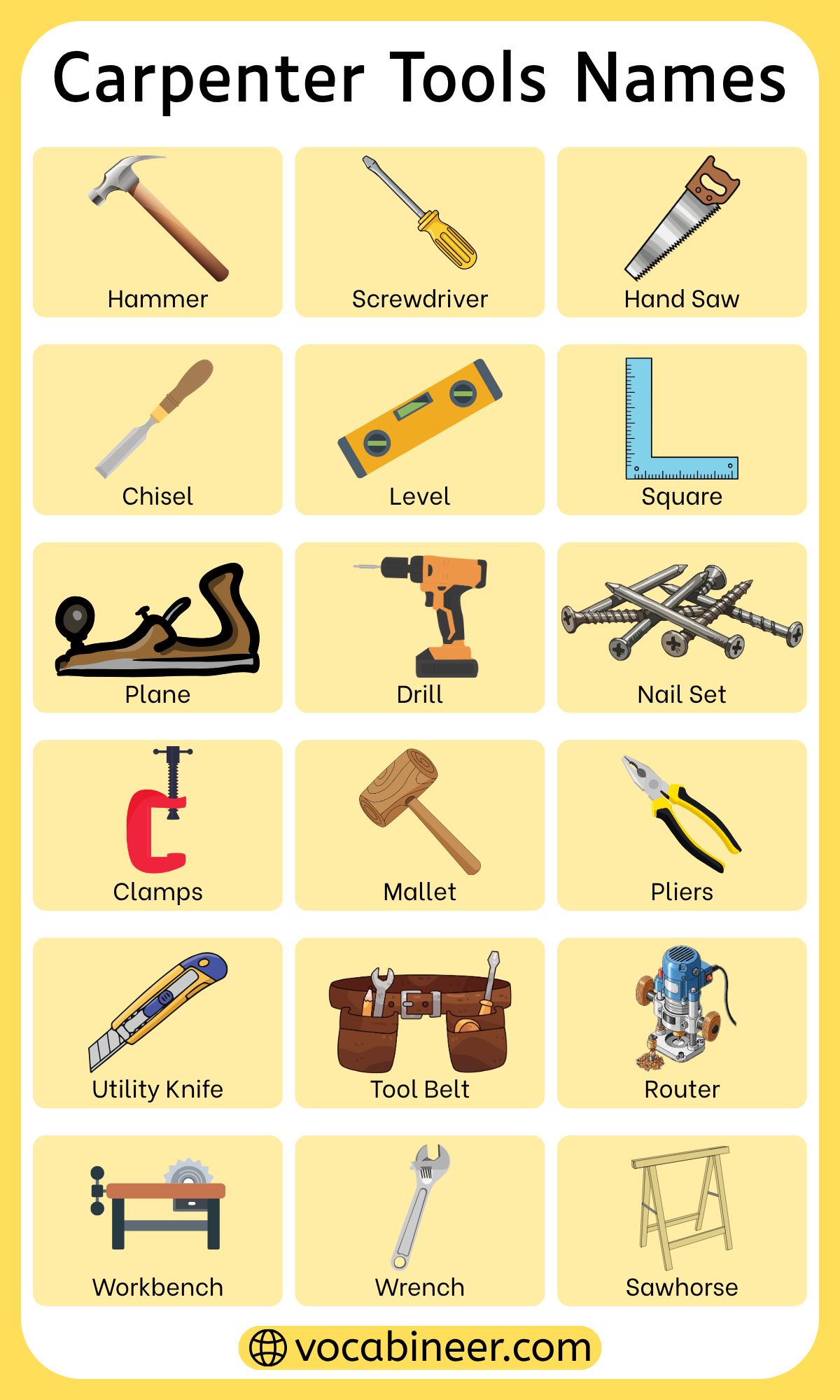
Common Tools Used by Carpenters
Carpenters use different tools for measuring, marking, cutting, shaping, joining, drilling, and finishing wood. Common carpenter tools include hand tools and power tools, with each one designed for a specific woodworking task.
Claw Hammer
A claw hammer drives nails into wood and uses its curved claw to pull nails out when needed.
Hand Saw
A hand saw has a toothed blade used for cutting boards, timber, and other wooden pieces by hand.
Chisel
A chisel has a sharp metal edge used for carving, trimming, and removing small amounts of wood.
Tape Measure
A tape measure provides quick measurements for checking the length, width, and spacing of wooden parts.
Carpenter’s Square
A carpenter’s square helps mark and check right angles, straight lines, and accurate cuts.
Spirit Level
A spirit level checks whether a surface or piece of wood is perfectly horizontal or vertical.
Wood Plane
A wood plane shaves thin layers from a wooden surface to smooth, flatten, or reduce its thickness.
Screwdriver
A screwdriver tightens and removes screws used in furniture, cabinets, frames, and other wood assemblies.
Power Drill
A power drill makes holes in wood and can also drive screws when fitted with the correct bit.
Circular Saw
A circular saw uses a rotating blade to make fast straight cuts through boards, plywood, and timber.
Jigsaw
A jigsaw uses a narrow moving blade to cut curves, shapes, and detailed lines in wood.
Miter Saw
A miter saw makes accurate crosscuts and angled cuts, especially for trim, molding, and framing work.
Clamps
Clamps hold wooden pieces firmly together while cutting, gluing, drilling, or assembling them.
Utility Knife
A utility knife uses a sharp replaceable blade for trimming materials, marking lines, and making light cuts.
Marking Gauge
A marking gauge scratches or marks a straight line parallel to the edge of a wooden piece.
Combination Square
A combination square helps measure and mark right angles, 45-degree angles, depth, and straight reference lines.
Nail Set
A nail set drives nail heads slightly below the wood surface so the holes can be filled for a smoother finish.
Wood Rasp
A wood rasp has a coarse textured surface that removes material quickly and helps shape curved or uneven wooden parts.
Random Orbital Sander
A random orbital sander smooths wood surfaces using a rotating and oscillating sanding pad that helps reduce visible sanding marks.
Router
A router uses a fast-spinning cutting bit to shape edges, cut grooves, make joints, and create decorative profiles in wood.
Carpenter Hand Tools
Hand tools are manually operated and allow greater control during woodworking tasks.
- Claw hammer: Used for nailing and pulling nails
- Wood chisel: Used to cut joints and grooves
- Hand plane: Used to smooth wood surfaces
- Block plane: Used for trimming edges
- Coping saw: Used for curved cuts
- Tenon saw: Used for fine joinery work
- Spokeshave: Used for shaping curved wood
- Wood rasp: Used for rough shaping
Measuring and Marking Tools for Carpentry
Measuring and marking tools help ensure accuracy and proper alignment.
- Measuring tape: Measures long distances
- Steel ruler: Used for short measurements
- Try square: Used to mark right angles
- Combination square: Used for measuring and marking
- Marking gauge: Used to draw parallel lines
- Bevel gauge: Used to mark angles
- Chalk line: Used to mark long straight lines
Cutting Tools for Woodwork
Cutting tools are used to cut wood to the required shape and size.
- Hand saw: Used for straight cuts
- Rip saw: Used to cut along the wood grain
- Crosscut saw: Used to cut across the grain
- Tenon saw: Used for precise cuts
- Bow saw: Used for cutting thick wood
- Coping saw: Used for curved cuts
- Chisel: Used for cutting joints
Shaping and Smoothing Tools
These tools help shape wood and smooth rough surfaces.
- Hand plane: Smooths wood
- Jack plane: Levels rough boards
- Spokeshave: Shapes rounded edges
- Wood file: Refines wood surfaces
- Rasp: Removes excess material
- Sandpaper: Smooths surfaces before finishing
- Sanding block: Provides even sanding
Fastening Tools Used in Carpentry
Fastening tools are used to join wooden parts securely.
- Hammer: Drives nails
- Screwdriver: Drives screws
- Nail set: Pushes nails below the surface
- Staple gun: Fixes thin materials
- Brad nailer: Drives small nails
- Finish nailer: Used for trim work
Striking and Hammering Tools
Striking tools apply force without damaging materials.
- Claw hammer
- Wooden mallet
- Rubber mallet
- Ball-peen hammer
- Dead blow hammer
Drilling and Boring Tools
Drilling tools are used to create holes in wood.
- Hand drill: Manual drilling
- Brace and bit: Traditional drilling tool
- Power drill: Fast drilling and screw driving
- Auger bit: Drills deep holes
- Spade bit: Drills wide holes
- Hole saw: Cuts circular holes
Holding and Clamping Tools
Holding tools keep wood steady during cutting and joining.
- Workbench: Supports woodworking tasks
- Bench vice: Holds wood firmly
- C-clamp: Used for general clamping
- Bar clamp: Holds long boards
- Pipe clamp: Used for wide panels
- Spring clamp: Used for light holding
Woodworking Tools for Furniture Making
Furniture making requires accurate shaping and finishing tools.
- Chisel set
- Hand plane
- Router
- Clamps
- Dovetail saw
- Sanding block
- Wood glue applicator
Carpenter Power Tools
Power tools make carpentry work faster and reduce physical effort.
- Circular saw: Fast straight cuts
- Jigsaw: Curved and detailed cuts
- Table saw: Accurate large cuts
- Electric drill: Drilling and fastening
- Router: Decorative shaping
- Power sander: Surface smoothing
- Planer machine: Thickness leveling
Carpentry Tools Used on Construction Sites
Construction carpentry uses heavy-duty and precision tools.
- Framing hammer
- Power saw
- Laser level
- Nail gun
- Impact driver
- Measuring tape
- Crowbar
Finishing Tools Used by Carpenters
Finishing tools give wood a clean and polished appearance.
- Sandpaper
- Paintbrush
- Putty knife
- Scraper
- Wood filler applicator
- Polishing cloth
Carpenter Tools for Home Projects
Home carpentry tools are basic and easy to use.
- Hammer
- Screwdriver set
- Hand saw
- Measuring tape
- Electric drill
- Spirit level
Professional Carpenter Tools
Professional carpenters use advanced and durable tools.
- Table saw
- Router table
- Thickness planer
- Power nailer
- Dust extractor
- Mitre saw
Conclusion
Carpenter tools are essential for measuring, cutting, shaping, and assembling wood in both small and large projects. From basic hand tools to advanced power tools, each tool has a specific purpose in carpentry work. Knowing the names and uses of carpenter tools helps beginners and professionals work more accurately, safely, and efficiently in home projects, furniture making, and construction tasks.
FAQs
Carpenter tools are tools used to measure, cut, shape, join, and finish wood during carpentry work.
Common carpenter tools include hammer, hand saw, measuring tape, chisel, screwdriver, spirit level, and electric drill.
Hand tools are enough for basic carpentry tasks, but power tools help complete work faster and with less effort.
Beginners usually start with a hammer, measuring tape, hand saw, screwdriver set, chisel, and drill.
Safety is important because carpenter tools can cause injuries if used incorrectly, so protective equipment should always be used.
Read More