Cabinets are storage units used in kitchens, bathrooms, offices, garages, living rooms, bedrooms, and many other spaces. People use them to store dishes, food, towels, documents, tools, medicines, cleaning supplies, and decorative items.
There are many types of cabinets, and each name usually explains where the cabinet is used, what it stores, how it opens, or how it looks. This guide explains common cabinet names with simple meanings, examples, comparisons, and picture-friendly chart ideas.
In This Page
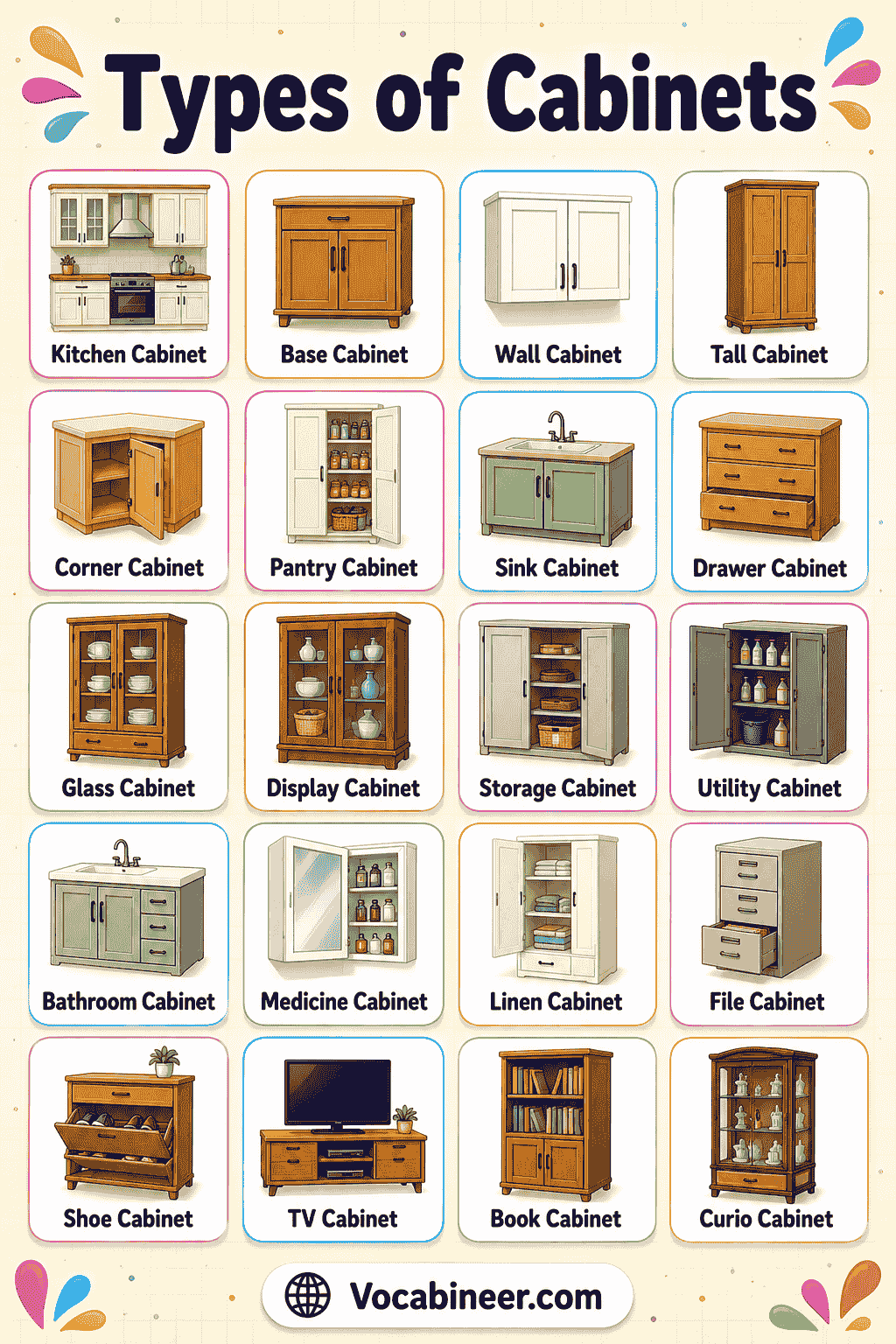
Common Types of Cabinets
These are the cabinet names learners, homeowners, and buyers usually see first. Each type has a clear storage purpose, so the simple meanings make the names easier to understand.
- Base Cabinet — a floor cabinet usually placed under a countertop.
- Wall Cabinet — a cabinet attached to the wall for upper storage.
- Tall Cabinet — a high cabinet used for large vertical storage.
- Corner Cabinet — a cabinet made to fit into a room corner.
- Pantry Cabinet — a kitchen cabinet used for food, spices, and dry goods.
- Vanity Cabinet — a bathroom cabinet placed under a sink.
- Medicine Cabinet — a small cabinet for medicines, first-aid items, and toiletries.
- Linen Cabinet — a cabinet used to store towels, sheets, and bathroom supplies.
- File Cabinet — an office cabinet used to organize papers and documents.
- Display Cabinet — a cabinet with glass doors or shelves for showing items.
- China Cabinet — a display cabinet used for dishes, glassware, and decorative pieces.
- Utility Cabinet — a cabinet for cleaning supplies, tools, and household items.
- Garage Cabinet — a strong storage cabinet for tools, car supplies, and workshop items.
- Laundry Cabinet — a cabinet used for detergent, towels, and cleaning products.
- Media Cabinet — a cabinet for TVs, speakers, remotes, cables, and entertainment devices.
- Shoe Cabinet — a cabinet used to store and organize shoes.
- Book Cabinet — a cabinet or enclosed shelving unit for books, binders, and notebooks.
- Printer Cabinet — an office cabinet for a printer, paper, ink, and printing supplies.
- Locking Cabinet — a cabinet with a lock for documents, valuables, or private items.
- Storage Cabinet — a general cabinet used to store household, office, or utility items.
Kitchen Cabinet Names and Uses
Kitchen cabinets help organize cookware, dishes, food, cleaning products, and small appliances. Also, they make a kitchen easier to use because each item has a proper place.
- Base Cabinet — sits below the countertop and stores pots, pans, trays, and kitchen tools.
- Wall Cabinet — hangs above the countertop and stores plates, cups, glasses, and spices.
- Tall Pantry Cabinet — reaches from the floor toward the upper wall and stores food items.
- Corner Cabinet — fits into a kitchen corner and uses space that might otherwise stay empty.
- Sink Base Cabinet — sits under the kitchen sink and hides plumbing while storing cleaning supplies.
- Drawer Cabinet — includes drawers for cutlery, utensils, towels, and small cooking tools.
- Island Cabinet — sits inside a kitchen island and adds storage, seating space, or work surface.
- Glass-Front Cabinet — has glass doors for displaying dishes, cups, or decorative kitchenware.
Bathroom Cabinet Names and Uses
Bathroom cabinets store toiletries, towels, medicines, skincare items, and cleaning products. However, bathroom cabinets often need better moisture resistance than cabinets used in dry rooms.
- Vanity Cabinet — fits under a bathroom sink and stores toiletries or cleaning products.
- Medicine Cabinet — usually hangs above the sink and keeps medicines, skincare, and grooming items.
- Linen Cabinet — stores towels, washcloths, and extra bathroom supplies.
- Wall-Mounted Bathroom Cabinet — attaches to the wall and saves floor space.
- Over-the-Toilet Cabinet — uses the empty wall space above a toilet for small storage.
- Freestanding Bathroom Cabinet — stands on the floor and can move more easily than built-in cabinets.
Office Cabinet Names and Uses
Office cabinets help organize files, books, stationery, devices, and personal items. As a result, they keep workspaces cleaner, safer, and easier to manage.
- File Cabinet — stores documents in drawers, usually by folder or label.
- Lateral File Cabinet — has wide drawers that hold files side by side.
- Vertical File Cabinet — has narrow, deep drawers for storing files from front to back.
- Locking Cabinet — protects private documents, valuables, or office supplies.
- Printer Cabinet — holds a printer, paper, ink, and other printing supplies.
- Book Cabinet — stores books, binders, notebooks, and reference materials.
Storage Cabinets for Home and Utility Areas
Storage cabinets work well in bedrooms, garages, laundry rooms, living rooms, workshops, and utility areas. In addition, many storage cabinets focus more on function than decoration.
- Utility Cabinet — stores household tools, cleaning supplies, or general items.
- Garage Cabinet — holds tools, car supplies, sports gear, and workshop items.
- Laundry Cabinet — stores detergent, fabric softener, towels, and cleaning products.
- Media Cabinet — holds a TV, gaming console, speakers, remotes, and cables.
- Shoe Cabinet — keeps shoes organized near an entryway, hallway, or bedroom.
- China Cabinet — displays fine dishes, glassware, and decorative pieces.
- Freestanding Cabinet — stands alone and can move to another room.
- Built-In Cabinet — stays fixed to a wall, alcove, or room structure.
Cabinet Door Styles
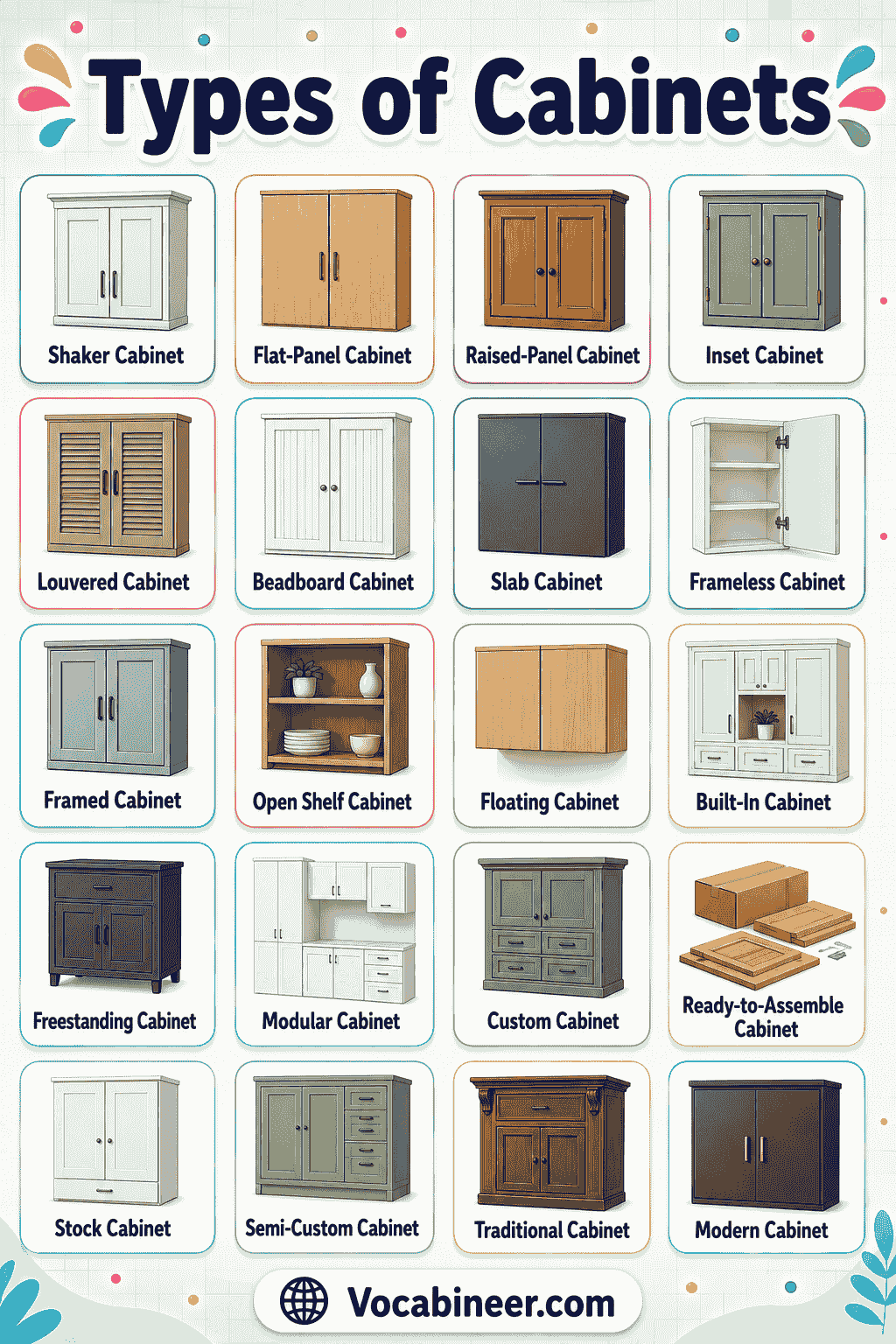
Cabinet door styles affect the look of a room. While some styles look simple and modern, others feel classic, decorative, or traditional.
- Shaker Cabinet — has a simple frame with a recessed center panel. It is popular in kitchens because it looks clean, balanced, and easy to match with many home styles.
- Slab Cabinet — has a flat, smooth door without frames or raised details. Therefore, it works well in modern, minimalist, and contemporary spaces.
- Glass-Front Cabinet — has glass panels that show dishes, books, or decorative items.
- Louvered Cabinet — has horizontal slats on the doors. These slats allow airflow, so this style can work well in laundry rooms, closets, and utility areas.
- Inset Cabinet — has doors and drawers that sit inside the cabinet frame. Because of its fitted design, it often looks neat, detailed, and custom-made.
- Beadboard Cabinet — has narrow vertical grooves on the door front. It often suits cottage, farmhouse, and traditional interiors.
Cabinet Materials Compared
Cabinet materials affect strength, price, appearance, and daily use. This comparison helps readers understand which materials suit kitchens, bathrooms, offices, garages, and display areas.
| Cabinet Material | Best For | Main Benefit |
|---|---|---|
| Solid Wood | Classic homes, premium kitchens, furniture-style cabinets | Strong, long-lasting, and natural-looking |
| Plywood | Kitchens, bathrooms, and busy storage areas | Durable and better with moisture than many cheaper boards |
| MDF | Painted cabinets and smooth modern finishes | Smooth surface and budget-friendly appearance |
| Particle Board | Low-cost cabinets and temporary storage | Affordable and lightweight |
| Metal | Offices, garages, workshops, and utility rooms | Strong, easy to clean, and practical |
| Laminate | Kitchens, bathrooms, and modern cabinets | Easy to wipe and available in many colors |
| Glass | Display cabinets and decorative doors | Shows items clearly and adds a stylish look |
Parts of a Cabinet
Cabinet parts are useful words for furniture, repairs, design, and home improvement. Also, these terms help when buying, fixing, or describing cabinets.
- Cabinet Box — the main body or frame of the cabinet.
- Cabinet Door — the front panel that opens and closes.
- Drawer — a sliding storage box inside a cabinet or furniture piece.
- Shelf — a flat board used to divide storage space.
- Hinge — the metal part that lets a cabinet door swing open.
- Handle — a long piece used to pull a door or drawer.
- Knob — a small round pull used on cabinet doors or drawers.
- Frame — the front structure around some cabinet doors.
- Toe Kick — the recessed space at the bottom of a base cabinet.
- Countertop — the work surface placed above base cabinets.
Cabinet Names with Simple Meanings
Use this quick table to review the most important cabinet names without reading the full explanations again.
| Cabinet Name | Simple Meaning |
|---|---|
| Base Cabinet | A floor cabinet usually placed under a countertop. |
| Wall Cabinet | A cabinet mounted on a wall for upper storage. |
| Tall Cabinet | A high cabinet used for large vertical storage. |
| Pantry Cabinet | A kitchen cabinet used for storing food and dry goods. |
| Corner Cabinet | A cabinet designed to fit into a corner. |
| Vanity Cabinet | A bathroom cabinet placed below a sink. |
| Medicine Cabinet | A small cabinet for medicines and personal care items. |
| File Cabinet | An office cabinet for papers and folders. |
| Display Cabinet | A cabinet used to show decorative or valuable items. |
| Utility Cabinet | A cabinet for tools, cleaning items, or general storage. |
| Media Cabinet | A cabinet for TVs, speakers, remotes, and entertainment devices. |
| Shoe Cabinet | A cabinet used to store and organize shoes. |
Confusing Cabinet Terms Explained
Some cabinet words sound similar, but they do not always mean the same thing. This table explains the most common differences in a simple way.
| Cabinet Terms | Difference |
|---|---|
| Cabinet vs Cupboard | A cabinet is a general storage unit with doors, drawers, or shelves. A cupboard usually stores dishes, food, or household items. |
| Cabinet vs Drawer | A cabinet is the full storage unit, while a drawer is a sliding box inside a cabinet or another piece of furniture. |
| Base Cabinet vs Wall Cabinet | A base cabinet stands on the floor, while a wall cabinet hangs on the wall above a counter or work area. |
| Pantry Cabinet vs Cupboard | A pantry cabinet is usually tall and stores food. A cupboard can be smaller and may store dishes, food, or general household items. |
| Display Cabinet vs Storage Cabinet | A display cabinet shows items through glass doors or open shelves, while a storage cabinet mainly hides and organizes items. |
| Vanity Cabinet vs Medicine Cabinet | A vanity cabinet sits under a bathroom sink, while a medicine cabinet usually hangs above the sink or mirror. |
| Built-In Cabinet vs Freestanding Cabinet | A built-in cabinet stays fixed to the wall or room structure, while a freestanding cabinet can move more easily. |
Types of Cabinets Chart with Pictures
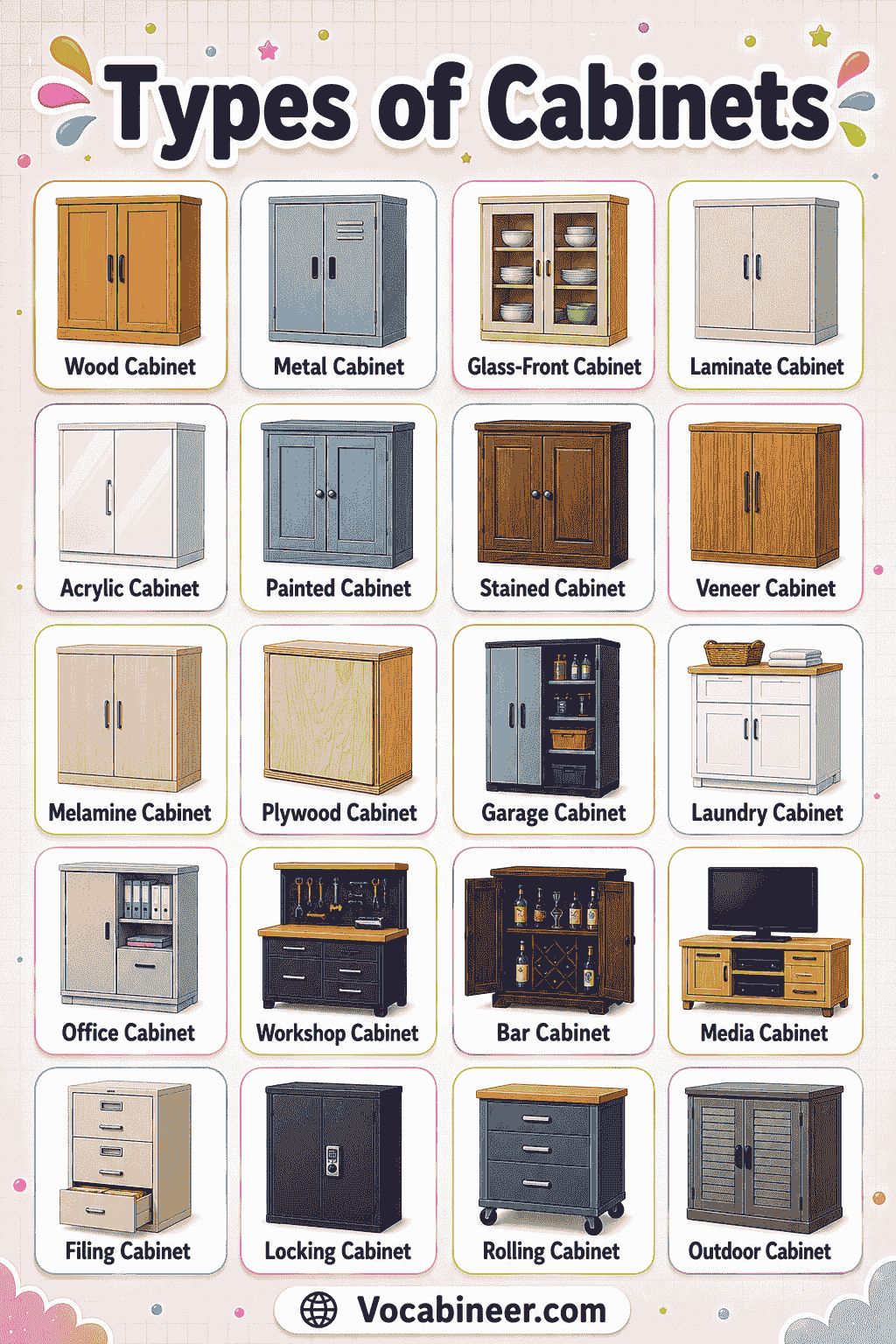
A cabinet chart helps learners compare cabinet groups quickly.
| Cabinet Group | Details |
|---|---|
| Kitchen Cabinets | Best for: food, dishes, cookware, and kitchen tools Examples: base cabinet, wall cabinet, pantry cabinet |
| Bathroom Cabinets | Best for: toiletries, towels, and personal care items Examples: vanity cabinet, medicine cabinet, linen cabinet |
| Office Cabinets | Best for: documents, files, and office supplies Examples: file cabinet, locking cabinet, printer cabinet |
| Display Cabinets | Best for: showing decorative or valuable items Examples: china cabinet, glass-front cabinet, display cabinet |
| Utility Cabinets | Best for: tools, cleaning products, and general storage Examples: garage cabinet, laundry cabinet, utility cabinet |
| Furniture Cabinets | Best for: living rooms, bedrooms, and entryways Examples: media cabinet, shoe cabinet, freestanding cabinet |
Example Sentences with Cabinet Names
Example sentences show how cabinet names appear in daily language. They also help beginners understand each word in a real home, office, or storage context.
- We keep plates and cups in the wall cabinet.
- The base cabinet stores pots, pans, and mixing bowls.
- A pantry cabinet helps organize rice, flour, snacks, and spices.
- She placed extra towels inside the linen cabinet.
- The office manager locked the documents in a file cabinet.
- Their living room has a media cabinet under the television.
- A medicine cabinet keeps small health items easy to find.
- The glass-front cabinet displays cups and decorative plates.
- He stores tools and paint cans in the garage cabinet.
- A corner cabinet makes better use of empty kitchen space.
FAQ
The most common types of cabinets include base cabinets, wall cabinets, tall cabinets, pantry cabinets, vanity cabinets, medicine cabinets, file cabinets, display cabinets, utility cabinets, and storage cabinets.
The main kitchen cabinet names include base cabinet, wall cabinet, tall pantry cabinet, corner cabinet, sink base cabinet, drawer cabinet, island cabinet, and glass-front cabinet.
A cabinet is a general storage unit with doors, drawers, or shelves. A cupboard usually means a simple storage space for dishes, food, or household items. In daily use, many people use both words in similar ways.
The main parts of a cabinet include the cabinet box, door, drawer, shelf, hinge, handle, knob, frame, toe kick, and countertop. Some cabinets may also include glass panels, locks, dividers, or pull-out trays.
Plywood and solid wood are strong choices for long-term cabinets. MDF works well for painted cabinet doors, while metal cabinets suit offices, garages, and utility spaces. The best material depends on budget, room type, moisture level, and daily use.
Read More
- Types of Flooring
- Bedroom Decor Items
- Popular Types of Tiles
- Types of Wall Design
- Parts of a House Names
- Different Types of Tape
- Different Types of Doors