

Bridges come in many forms, from simple beam bridges and arch bridges to large suspension bridges, cable-stayed bridges, movable bridges, and floating bridges. Each bridge type is designed to carry people, vehicles, trains, water, pipes, or animals across rivers, valleys, roads, railways, and other gaps.
Some bridges are chosen for strength, some for long spans, and others for difficult locations or special movement. This guide explains the main types of bridges in a simple way, with names, meanings, uses, materials, parts, and examples.
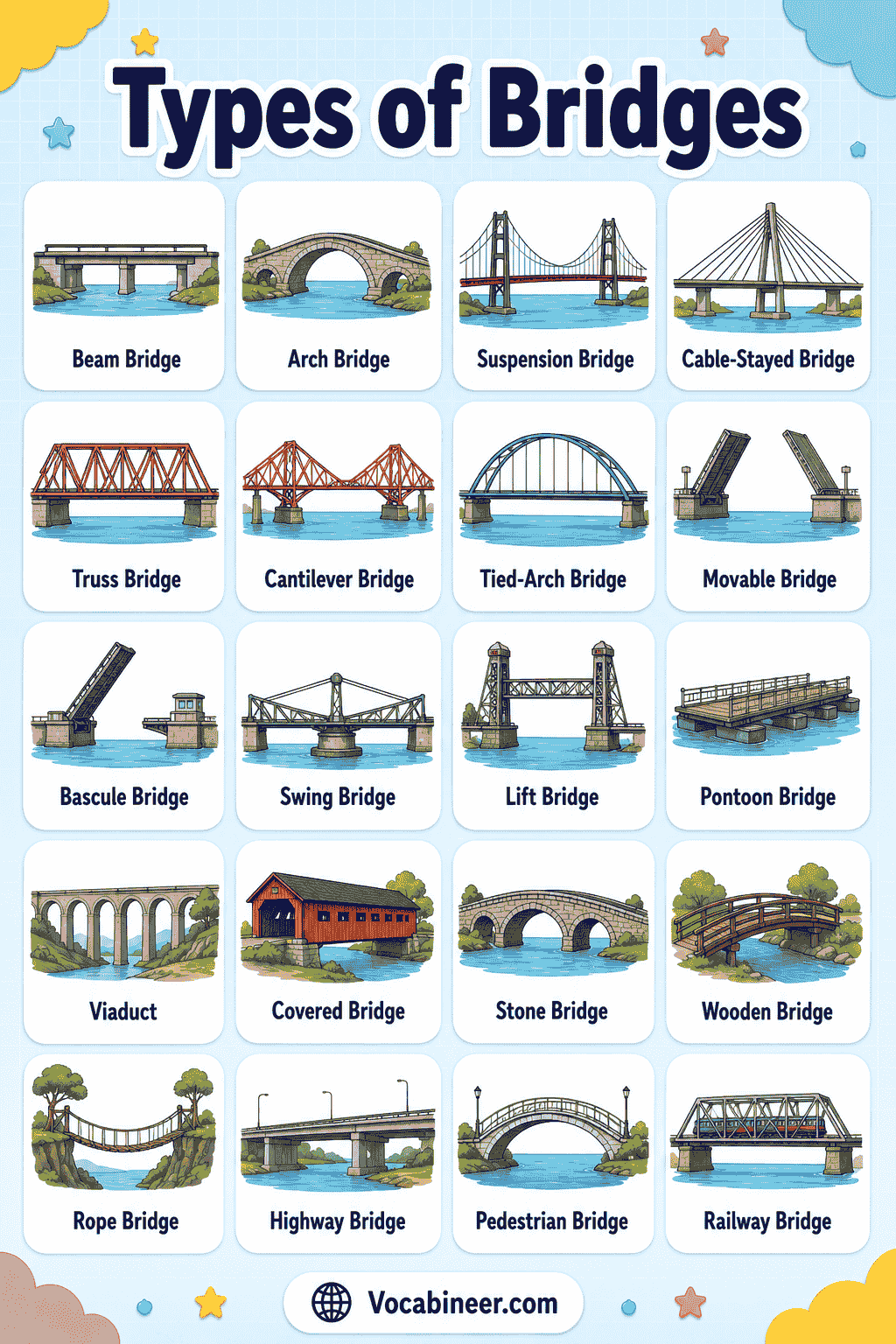
In This Page
Common Types of Bridges
These are some of the most common bridge types used in construction, transport, engineering, and everyday learning.
- Beam Bridge — a simple bridge with a horizontal beam supported at both ends.
- Arch Bridge — a bridge with a curved arch that carries weight toward the supports.
- Truss Bridge — a bridge made with connected triangle-shaped frames.
- Suspension Bridge — a bridge with a deck hanging from strong cables.
- Cable-Stayed Bridge — a bridge with cables running directly from towers to the deck.
- Cantilever Bridge — a bridge with arms that project outward from supports.
- Tied-Arch Bridge — an arch bridge where the arch ends are tied together by the deck.
- Girder Bridge — a bridge supported by strong beams called girders.
- Box Girder Bridge — a bridge supported by hollow box-shaped girders.
- Bascule Bridge — a movable bridge that lifts upward for boats.
- Swing Bridge — a bridge that turns sideways to open a waterway.
- Vertical Lift Bridge — a bridge with a section that moves straight up and down.
- Drawbridge — a general term for a bridge that opens or lifts for traffic below.
- Road Bridge — a bridge used by cars, buses, trucks, and other road vehicles.
- Railway Bridge — a bridge built for trains.
- Pedestrian Bridge — a bridge made for people walking.
- Footbridge — a small pedestrian bridge, often used over streams, roads, or paths.
- Pipeline Bridge — a bridge that carries pipes across a gap.
- Aqueduct Bridge — a bridge that carries water.
- Wildlife Bridge — a bridge that helps animals cross roads safely.
- Concrete Bridge — a bridge made mainly from concrete.
- Steel Bridge — a bridge made mainly from steel.
- Wooden Bridge — a bridge made mostly from wood.
- Stone Bridge — a bridge made from stone blocks or masonry.
- Viaduct — a long bridge made of several spans, usually over valleys, roads, or railways.
- Trestle Bridge — a bridge supported by many short frames or towers.
- Pontoon Bridge — a bridge supported by floating pontoons.
- Floating Bridge — a bridge that floats on water.
- Covered Bridge — a bridge with a roof and side covering.
- Rope Bridge — a bridge made with ropes and light walking surfaces.
- Log Bridge — a simple bridge made from one or more logs.
- Natural Bridge — a bridge-like structure formed by nature.
- Bailey Bridge — a temporary modular bridge often used for emergencies or military needs.
Types of Bridges with Meanings and Examples
Bridge names become easier to understand when each type is explained with a simple meaning.
- Beam Bridge — a straight bridge supported at both ends.
- Arch Bridge — a bridge that uses a curved shape to support weight.
- Truss Bridge — a bridge with triangle frames for strength.
- Suspension Bridge — a bridge hanging from large main cables.
- Cable-Stayed Bridge — a bridge supported by cables connected directly to towers.
- Cantilever Bridge — a bridge built with projecting arms from strong supports.
- Tied-Arch Bridge — an arch bridge where the deck helps hold the arch ends together.
- Girder Bridge — a bridge supported by long strong beams.
- Box Girder Bridge — a bridge supported by box-shaped beams.
- Bascule Bridge — a lifting bridge that opens like a seesaw or leaf.
- Swing Bridge — a bridge that rotates to let boats pass.
- Vertical Lift Bridge — a bridge span that moves upward between towers.
- Transporter Bridge — a bridge that carries people or vehicles in a moving platform.
- Drawbridge — a bridge that can open for water traffic.
- Retractable Bridge — a bridge that slides or pulls back to open a space.
- Road Bridge — a bridge for road vehicles.
- Railway Bridge — a bridge for trains.
- Pedestrian Bridge — a bridge for people walking.
- Footbridge — a smaller bridge for pedestrians.
- Pipeline Bridge — a bridge that carries pipes.
- Aqueduct Bridge — a bridge that carries water.
- Wildlife Bridge — a bridge for animals to cross safely.
- Cycle Bridge — a bridge designed for bicycles.
- Concrete Bridge — a bridge built mainly with concrete.
- Steel Bridge — a bridge built mainly with steel.
- Wooden Bridge — a bridge built mainly with wood.
- Stone Bridge — a bridge built with stone.
- Composite Bridge — a bridge made with two or more main materials.
- River Bridge — a bridge crossing a river.
- Sea Bridge — a bridge crossing sea water, bays, or coastal areas.
- Valley Bridge — a bridge crossing a valley.
- Canal Bridge — a bridge crossing a canal.
- Overpass — a bridge that carries traffic over a road, railway, or path.
- Flyover — an elevated road bridge that helps traffic pass over another road.
- Viaduct — a long bridge with several spans.
- Trestle Bridge — a bridge supported by repeated frames.
- Pontoon Bridge — a bridge floating on pontoons.
- Floating Bridge — a bridge that floats on water.
- Culvert Bridge — a small bridge-like structure that lets water pass under a road.
- Covered Bridge — a bridge with a roof and sides.
- Rope Bridge — a light bridge made with ropes.
- Log Bridge — a simple bridge made from logs.
- Clapper Bridge — an old stone bridge made with flat stone slabs.
- Natural Bridge — a bridge formed naturally by rock or land erosion.
- Moon Bridge — a high arched decorative bridge often seen in gardens.
- Bailey Bridge — a temporary bridge made from modular steel parts.
- Temporary Bridge — a bridge built for short-term use.
- Military Bridge — a bridge used for military movement or emergency access.
Bridge Types and Best Uses
Different bridge types are chosen according to span length, traffic type, location, material, and cost.
- Beam bridges are best for short spans and simple crossings.
- Arch bridges are useful where strong side supports are available.
- Truss bridges are good for roads, railways, and medium spans.
- Suspension bridges are best for very long spans over rivers, bays, or sea channels.
- Cable-stayed bridges are useful for long spans with fewer towers than some other designs.
- Cantilever bridges are helpful where building supports in the middle is difficult.
- Tied-arch bridges are useful for road and railway crossings where a strong arch shape is needed.
- Girder bridges are common for highways, railways, and city roads.
- Box girder bridges are useful for strong, stable road and rail bridges.
- Movable bridges are best for waterways with boat or ship traffic.
- Road bridges are used for cars, buses, trucks, and motorcycles.
- Railway bridges are made strong enough to carry trains.
- Pedestrian bridges and footbridges help people cross roads, rivers, and railway lines safely.
- Aqueduct bridges carry water across valleys, roads, or rivers.
- Pipeline bridges carry oil, gas, water, or other pipelines.
- Wildlife bridges help animals cross roads and reduce accidents.
- Pontoon bridges and floating bridges are useful where water is deep or temporary support is needed.
- Covered bridges protect the bridge deck from weather and are often historical.
- Temporary bridges are useful after floods, disasters, construction work, or military needs.
Main Structural Types of Bridges
Structural bridge types are based on how a bridge carries weight and transfers loads to the ground.
Beam Bridges
A beam bridge is one of the simplest bridge types. It has a horizontal beam or deck supported at both ends.
- Best for: short spans, small roads, footpaths, and simple crossings.
- How it works: the beam carries the load and transfers weight to supports.
- Common materials: concrete, steel, wood, and reinforced concrete.
- Example use: small road bridges, park bridges, and short highway bridges.
Arch Bridges
An arch bridge uses a curved arch to carry weight. The arch pushes the load outward and downward into the supports.
- Best for: rivers, valleys, historic crossings, and strong foundation areas.
- How it works: the curved shape spreads weight toward the abutments.
- Common materials: stone, concrete, steel, and brick.
- Example use: old stone bridges, city bridges, and decorative bridges.
Truss Bridges
A truss bridge uses triangular frames to make the bridge strong and stable. Triangles help spread weight across the structure.
- Best for: railway bridges, road bridges, and medium-length spans.
- How it works: triangle-shaped members share tension and compression forces.
- Common materials: steel, iron, and wood.
- Example use: railway crossings, rural bridges, and older road bridges.
Suspension Bridges
A suspension bridge has a deck hanging from vertical suspenders attached to large main cables. The main cables pass over tall towers and are anchored at both ends.
- Best for: very long spans, deep rivers, bays, and sea crossings.
- How it works: the deck hangs from cables that carry the load to towers and anchors.
- Common materials: steel cables, concrete towers, and steel decks.
- Example use: long-span city bridges and sea-channel bridges.
Cable-Stayed Bridges
A cable-stayed bridge uses cables that run directly from one or more towers to the bridge deck. The cables support the deck without needing large main cables.
- Best for: long spans, modern road bridges, and urban landmarks.
- How it works: cables connect the deck directly to towers and transfer loads downward.
- Common materials: steel cables, concrete towers, and steel or concrete decks.
- Example use: modern highway bridges and river crossings.
Cantilever Bridges
A cantilever bridge is built with arms that project outward from supports. The arms may meet in the middle or hold a suspended span.
- Best for: wide rivers, deep valleys, and difficult construction sites.
- How it works: projecting arms balance loads from fixed supports.
- Common materials: steel and reinforced concrete.
- Example use: large railway bridges, highway bridges, and river crossings.
Tied-Arch Bridges
A tied-arch bridge has an arch above the deck, while the deck acts like a tie that holds the arch ends together.
- Best for: road bridges, railway bridges, and medium to long spans.
- How it works: the arch carries weight, and the deck tie resists outward forces.
- Common materials: steel, concrete, and composite materials.
- Example use: modern city bridges and river crossings.
Girder Bridges
A girder bridge is supported by strong horizontal beams called girders. These girders may be made from steel, concrete, or a combination of materials.
- Best for: highways, railways, overpasses, and short to medium spans.
- How it works: girders carry the bridge deck and transfer loads to piers or abutments.
- Common materials: steel girders, concrete girders, and composite girders.
- Example use: road overpasses and railway bridges.
Box Girder Bridges
A box girder bridge uses hollow box-shaped beams to support the deck. The box shape gives strength, stiffness, and stability.
- Best for: highways, curved bridges, flyovers, and long road bridges.
- How it works: the box-shaped girder resists bending and twisting.
- Common materials: steel, prestressed concrete, and composite materials.
- Example use: modern elevated roads, large flyovers, and long-span road bridges.
Movable Types of Bridges
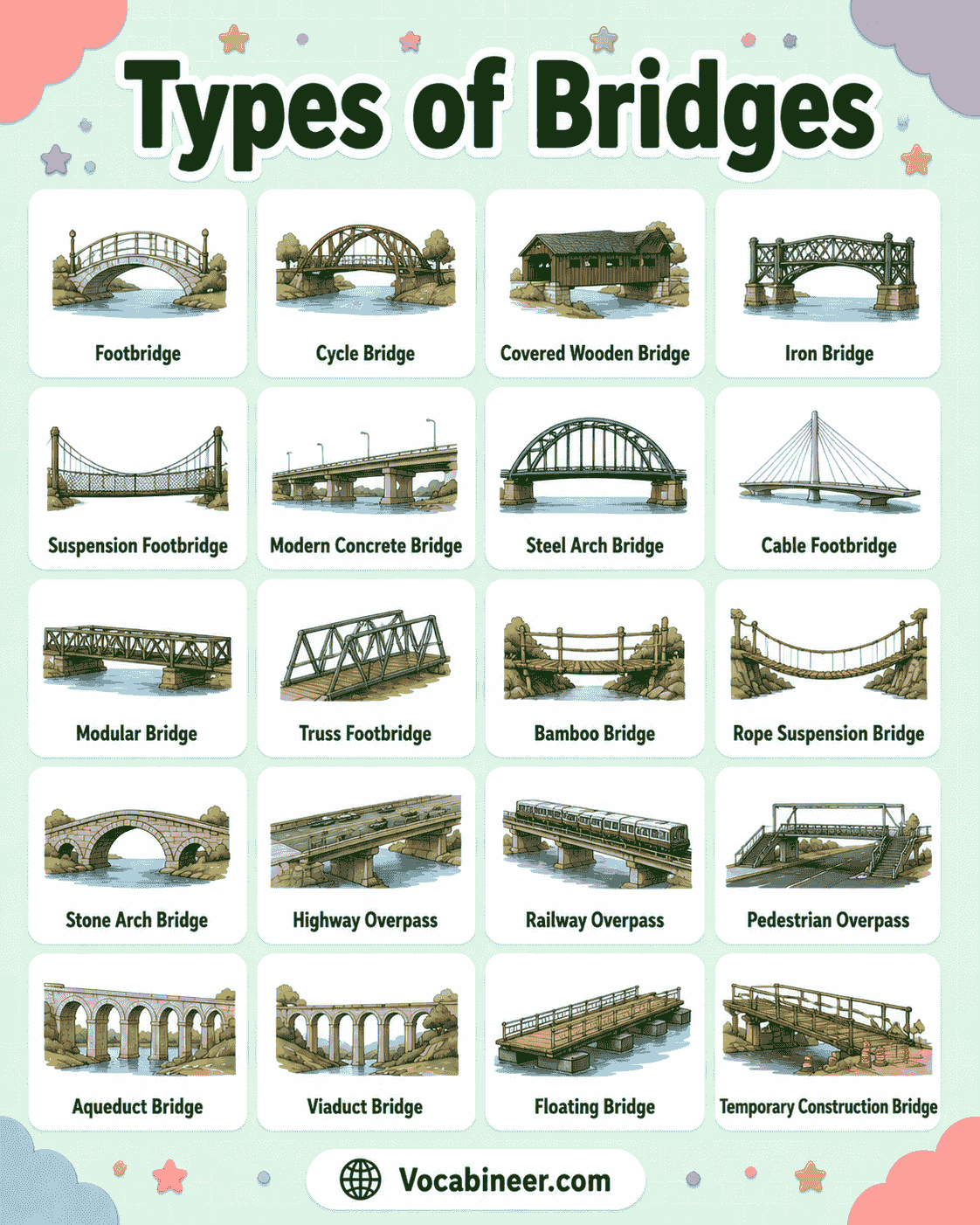
Movable bridges open, lift, rotate, or slide to allow boats and ships to pass.
Bascule Bridges
A bascule bridge has one or two leaves that lift upward. It is one of the most common drawbridge types.
- Best for: rivers, canals, harbors, and busy waterways.
- How it moves: the bridge leaf pivots upward.
- Common use: road crossings over waterways.
Swing Bridges
A swing bridge rotates horizontally around a central or side pivot. It opens by turning sideways.
- Best for: canals, rivers, docks, and waterways.
- How it moves: the bridge span swings open.
- Common use: road or rail crossings with boat traffic.
Vertical Lift Bridges
A vertical lift bridge has a span that moves straight up between towers.
- Best for: busy waterways, rail crossings, and industrial areas.
- How it moves: the central span rises vertically.
- Common use: railway bridges and harbor crossings.
Transporter Bridges
A transporter bridge has a high structure with a moving platform suspended below. The platform carries people or vehicles across the water.
- Best for: places where ships need high clearance.
- How it moves: a suspended platform travels from one side to the other.
- Common use: historic industrial waterways.
Drawbridges
A drawbridge is a general movable bridge that opens to allow boats, ships, or traffic to pass below. A bascule bridge is one common type of drawbridge.
- Best for: canals, rivers, harbors, and ports.
- How it moves: it may lift, tilt, or open.
- Common use: city water crossings and old defensive bridges.
Retractable Bridges
A retractable bridge slides or pulls back to open a gap.
- Best for: special waterways, pedestrian crossings, and modern movable designs.
- How it moves: the bridge deck moves backward, sideways, or into a storage space.
- Common use: limited-space movable crossings.
Bridge Types by Use
Bridge use depends on what the bridge carries across a gap.
Road Bridges
Road bridges carry cars, trucks, buses, motorcycles, and other vehicles.
- Best for: highways, city roads, rural roads, and flyovers.
- Common types: beam bridges, girder bridges, arch bridges, and cable-stayed bridges.
- Main feature: a strong deck for road traffic.
Railway Bridges
Railway bridges are built to carry trains. They must handle heavy loads and repeated vibrations.
- Best for: train lines, valleys, rivers, and rail overpasses.
- Common types: truss bridges, girder bridges, arch bridges, and trestle bridges.
- Main feature: strong support for railway tracks.
Pedestrian Bridges
Pedestrian bridges are built for people walking. They help people cross roads, rivers, railway tracks, or busy areas safely.
- Best for: schools, parks, cities, stations, and highways.
- Common types: beam bridges, truss bridges, suspension footbridges, and arch bridges.
- Main feature: safe walking paths with railings.
Footbridges
A footbridge is usually a smaller pedestrian bridge. It is often used over streams, small roads, gardens, or walking trails.
- Best for: parks, villages, gardens, footpaths, and small water crossings.
- Common types: wooden footbridges, rope footbridges, beam footbridges, and arched footbridges.
- Main feature: light use by people walking.
Pipeline Bridges
Pipeline bridges carry pipes across rivers, valleys, roads, or railways.
- Best for: water pipes, oil pipes, gas pipes, and industrial pipelines.
- Common types: truss-supported pipelines and beam-supported pipelines.
- Main feature: support for long pipe systems.
Aqueduct Bridges
Aqueduct bridges carry water from one place to another. They may be used for canals, irrigation, or water supply.
- Best for: canals, valleys, irrigation routes, and historic water systems.
- Common types: stone aqueducts, concrete aqueducts, and canal aqueducts.
- Main feature: water channel above the ground.
Wildlife Bridges
Wildlife bridges allow animals to cross roads or highways safely. They are often covered with soil, plants, grass, or trees.
- Best for: forests, highways, wildlife areas, and nature reserves.
- Common types: green bridges, animal overpasses, and eco-bridges.
- Main feature: safe animal movement and reduced road accidents.
Cycle Bridges
Cycle bridges are designed for bicycles. Some are shared with pedestrians, while others are built mainly for bike traffic.
- Best for: cities, parks, bike routes, and transport networks.
- Common types: pedestrian-cycle bridges, steel bridges, and small cable-stayed bridges.
- Main feature: smooth and safe bicycle access.
Bridge Types by Material
Bridge material affects strength, cost, durability, appearance, and maintenance.
Concrete Bridges
Concrete bridges are strong, durable, and common in modern construction.
- Best for: roads, highways, flyovers, and city bridges.
- Common forms: reinforced concrete, prestressed concrete, and concrete girder bridges.
- Main benefit: long life and strong load capacity.
Steel Bridges
Steel bridges are strong and can support long spans.
- Best for: truss bridges, suspension bridges, railway bridges, and large road bridges.
- Common forms: steel girder bridges, steel truss bridges, and steel arch bridges.
- Main benefit: high strength and flexible design.
Wooden Bridges
Wooden bridges are made mostly from timber. They are often used for small crossings, parks, rural areas, and decorative paths.
- Best for: footbridges, garden bridges, rural bridges, and small streams.
- Common forms: timber beam bridges, covered bridges, and small truss bridges.
- Main benefit: natural appearance and simple construction.
Stone Bridges
Stone bridges are traditional bridges made from stone blocks or masonry.
- Best for: historic bridges, arch bridges, garden bridges, and old roads.
- Common forms: stone arch bridges and clapper bridges.
- Main benefit: durability and historical appearance.
Composite Bridges
Composite bridges use more than one main material, such as steel and concrete together.
- Best for: modern road bridges, highways, and medium to long spans.
- Common forms: steel-concrete composite girder bridges.
- Main benefit: combines the strengths of different materials.
Iron Bridges
Iron bridges were common in older engineering before modern steel became widely used.
- Best for: historical bridges and restored structures.
- Common forms: cast iron bridges and wrought iron bridges.
- Main benefit: historical importance and strong early metal design.
Reinforced Concrete Bridges
Reinforced concrete bridges use concrete with steel bars inside. The steel helps the concrete resist pulling forces.
- Best for: roads, small bridges, urban crossings, and highway structures.
- Common forms: slab bridges, beam bridges, and arch bridges.
- Main benefit: strong and widely used construction.
Prestressed Concrete Bridges
Prestressed concrete bridges use concrete that is compressed before carrying loads. This makes the bridge stronger and better for longer spans.
- Best for: highways, flyovers, girder bridges, and large road projects.
- Common forms: prestressed concrete girder bridges and box girder bridges.
- Main benefit: strong spans with less cracking.
Bridge Types by Location and Support
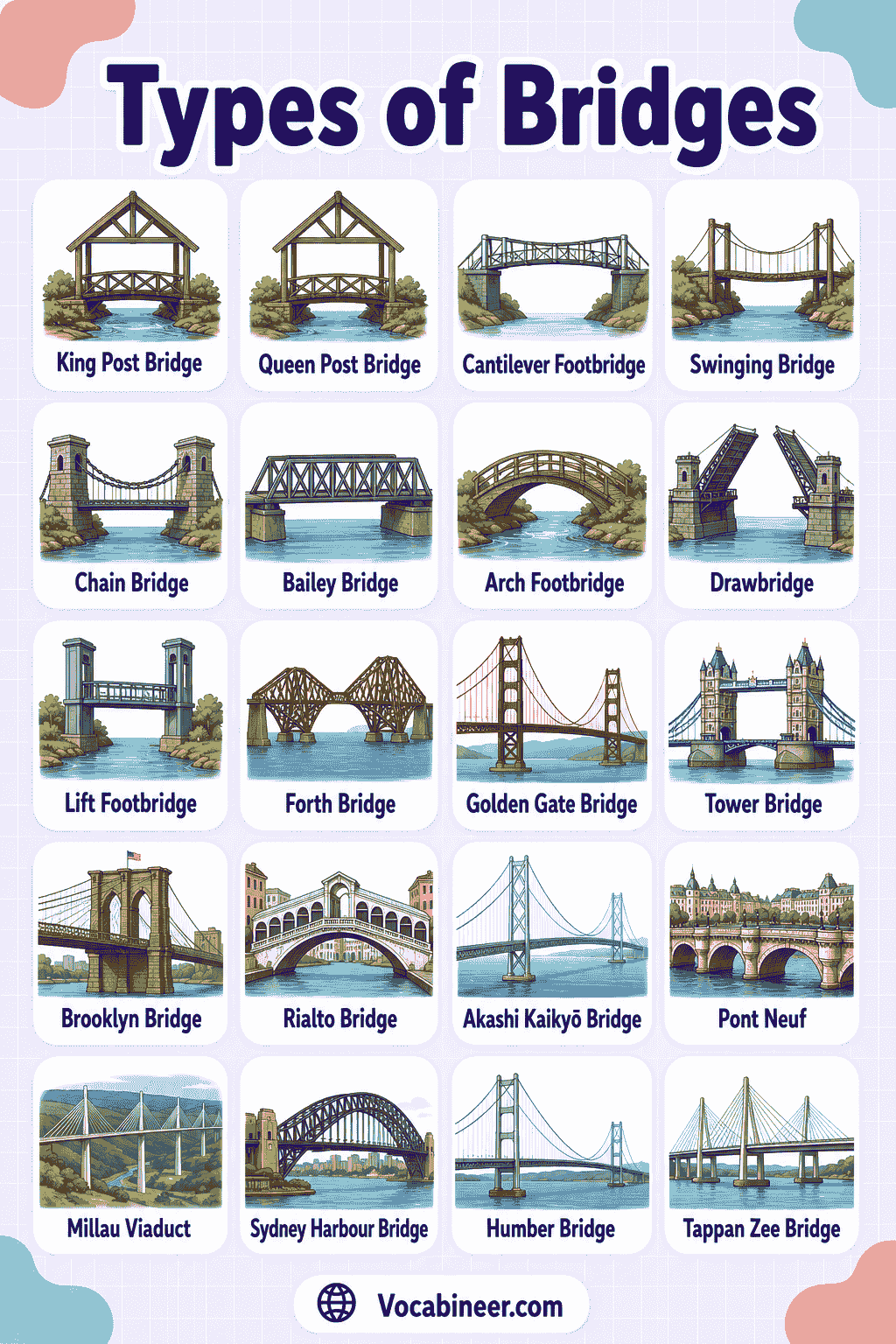
Some bridges are named by where they are built or how they are supported.
River Bridges
River bridges cross rivers and streams.
- Best for: roads, railways, footpaths, and city crossings.
- Common types: beam bridges, arch bridges, truss bridges, and suspension bridges.
- Main challenge: water flow, flooding, and foundation support.
Sea Bridges
Sea bridges cross bays, sea channels, coastal waters, or ocean inlets.
- Best for: coastal roads, islands, ports, and long-distance routes.
- Common types: suspension bridges, cable-stayed bridges, causeway bridges, and viaducts.
- Main challenge: salt water, waves, wind, and long spans.
Valley Bridges
Valley bridges cross deep valleys or low land areas.
- Best for: highways, railways, and mountain roads.
- Common types: arch bridges, viaducts, truss bridges, and cable-stayed bridges.
- Main challenge: height, wind, and support placement.
Canal Bridges
Canal bridges cross canals or carry canals over roads, rivers, or valleys.
- Best for: roads, paths, railways, and water transport systems.
- Common types: small beam bridges, arch bridges, and aqueduct bridges.
- Main challenge: clearance for boats and waterway traffic.
Overpasses
An overpass is a bridge that carries a road, railway, or path over another road, railway, or obstacle.
- Best for: highways, cities, rail crossings, and traffic control.
- Common types: beam bridges, girder bridges, and concrete bridges.
- Main purpose: to separate traffic levels.
Flyovers
A flyover is an elevated road bridge that helps vehicles pass over another road or junction.
- Best for: busy roads, city junctions, highways, and expressways.
- Common types: concrete girder bridges and box girder bridges.
- Main purpose: smooth traffic movement.
Viaducts
A viaduct is a long bridge made of many spans. It often crosses valleys, roads, railways, or low land.
- Best for: railways, highways, valleys, and city transport routes.
- Common types: arch viaducts, concrete viaducts, and railway viaducts.
- Main feature: repeated spans and supports.
Trestle Bridges
A trestle bridge is supported by a series of short frames or towers.
- Best for: railways, valleys, temporary works, and older wooden bridges.
- Common materials: wood, steel, and concrete.
- Main feature: many closely spaced supports.
Pontoon Bridges
A pontoon bridge is supported by floating pontoons or boats.
- Best for: military crossings, temporary roads, and calm water areas.
- Common materials: steel, aluminum, wood, and floating units.
- Main feature: floating support instead of fixed piers.
Floating Bridges
A floating bridge rests on floating supports instead of deep foundations.
- Best for: deep water, lakes, fjords, and temporary crossings.
- Common types: pontoon bridges and floating road bridges.
- Main challenge: movement from water, wind, and waves.
Culvert Bridges
A culvert bridge is a small bridge-like structure that allows water to pass under a road, railway, or path.
- Best for: drainage, small streams, rural roads, and highways.
- Common materials: concrete, steel, stone, and plastic pipe systems.
- Main feature: water passage under a crossing.
Special and Historical Bridge Types
Special and historical bridges are known for their design, age, purpose, or cultural style.
Covered Bridges
A covered bridge has a roof and side walls. Many old covered bridges were made from wood.
- Best for: historic roads, rural areas, and scenic places.
- Main feature: roof protection over the bridge deck.
- Common material: wood.
Rope Bridges
A rope bridge is made with ropes, cables, or light walking materials.
- Best for: mountains, forests, adventure parks, and foot crossings.
- Main feature: flexible walking surface.
- Common use: pedestrian crossing.
Log Bridges
A log bridge is a simple bridge made from one or more logs.
- Best for: small streams, forest paths, trails, and temporary crossings.
- Main feature: very simple construction.
- Common material: wood logs.
Clapper Bridges
A clapper bridge is an old stone bridge made with flat stone slabs placed over stone supports.
- Best for: small streams and historic footpaths.
- Main feature: large flat stones.
- Common material: stone.
Natural Bridges
A natural bridge is formed by natural processes such as erosion. It is not built by people.
- Best for: natural landmarks, rock formations, and tourist sites.
- Main feature: bridge-like shape in rock or land.
- Common material: natural stone or rock.
Moon Bridges
A moon bridge is a high arched decorative bridge often found in gardens.
- Best for: gardens, parks, ponds, and decorative landscapes.
- Main feature: steep curved arch.
- Common material: wood, stone, or concrete.
Bailey Bridges
A Bailey bridge is a portable, modular bridge made from prefabricated steel panels.
- Best for: emergencies, military routes, disaster areas, and temporary crossings.
- Main feature: quick assembly from modular parts.
- Common material: steel.
Temporary Bridges
Temporary bridges are built for short-term use.
- Best for: construction sites, flood recovery, road repairs, and emergency access.
- Main feature: quick installation and removal.
- Common types: modular bridges, pontoon bridges, and temporary steel bridges.
Military Bridges
Military bridges are used for army movement, emergency crossings, and field operations.
- Best for: temporary routes, rough areas, rivers, and emergency transport.
- Main feature: fast setup and strong load capacity.
- Common types: Bailey bridges, pontoon bridges, and portable steel bridges.
Bridge Parts and Basic Terms
Bridge parts help explain how bridges are built and how they carry weight.
- Deck — the surface where vehicles, trains, or people travel.
- Span — the distance between two bridge supports.
- Pier — a vertical support placed under a bridge.
- Abutment — the end support of a bridge.
- Beam — a horizontal support member.
- Girder — a large strong beam that supports the bridge deck.
- Arch — a curved support shape.
- Truss — a frame made of connected triangles.
- Cable — a strong wire rope used in suspension and cable-stayed bridges.
- Tower — a tall support used in suspension and cable-stayed bridges.
- Foundation — the base that supports bridge piers or towers.
- Railing — a safety barrier along the bridge edge.
- Approach — the road or path leading to a bridge.
- Bearing — a part that allows movement between the bridge deck and supports.
- Anchor — a strong support that holds bridge cables in place.
Confusing Bridge Terms Explained
Some bridge terms sound similar, but they have different meanings.
| Term | Simple Difference |
|---|---|
| Bridge vs Viaduct | A bridge crosses a gap. A viaduct is usually a long bridge with many spans, often over valleys, roads, or railways. |
| Bridge vs Overpass | An overpass is a type of bridge that carries traffic over another road, railway, or path. |
| Overpass vs Flyover | Both carry traffic over another route. A flyover is often used for elevated road crossings at busy junctions or highways. |
| Beam Bridge vs Girder Bridge | A beam bridge is a simple bridge using beams. A girder bridge uses larger supporting beams called girders. |
| Suspension Bridge vs Cable-Stayed Bridge | A suspension bridge uses main cables draped over towers. A cable-stayed bridge has cables running directly from towers to the deck. |
| Arch Bridge vs Tied-Arch Bridge | An arch bridge pushes outward into supports. A tied-arch bridge uses the deck tie to hold the arch ends together. |
| Truss Bridge vs Cantilever Bridge | A truss bridge uses triangle frames. A cantilever bridge uses projecting arms from supports. |
| Pontoon Bridge vs Floating Bridge | A floating bridge is the broad term. A pontoon bridge is a type of floating bridge supported by pontoons. |
| Footbridge vs Pedestrian Bridge | A pedestrian bridge is any bridge for walkers. A footbridge is usually a smaller pedestrian bridge over streams, roads, or paths. |
| Aqueduct Bridge vs Pipeline Bridge | An aqueduct bridge carries water in a channel. A pipeline bridge carries pipes for water, gas, oil, or other materials. |
Types of Bridges Chart with Pictures
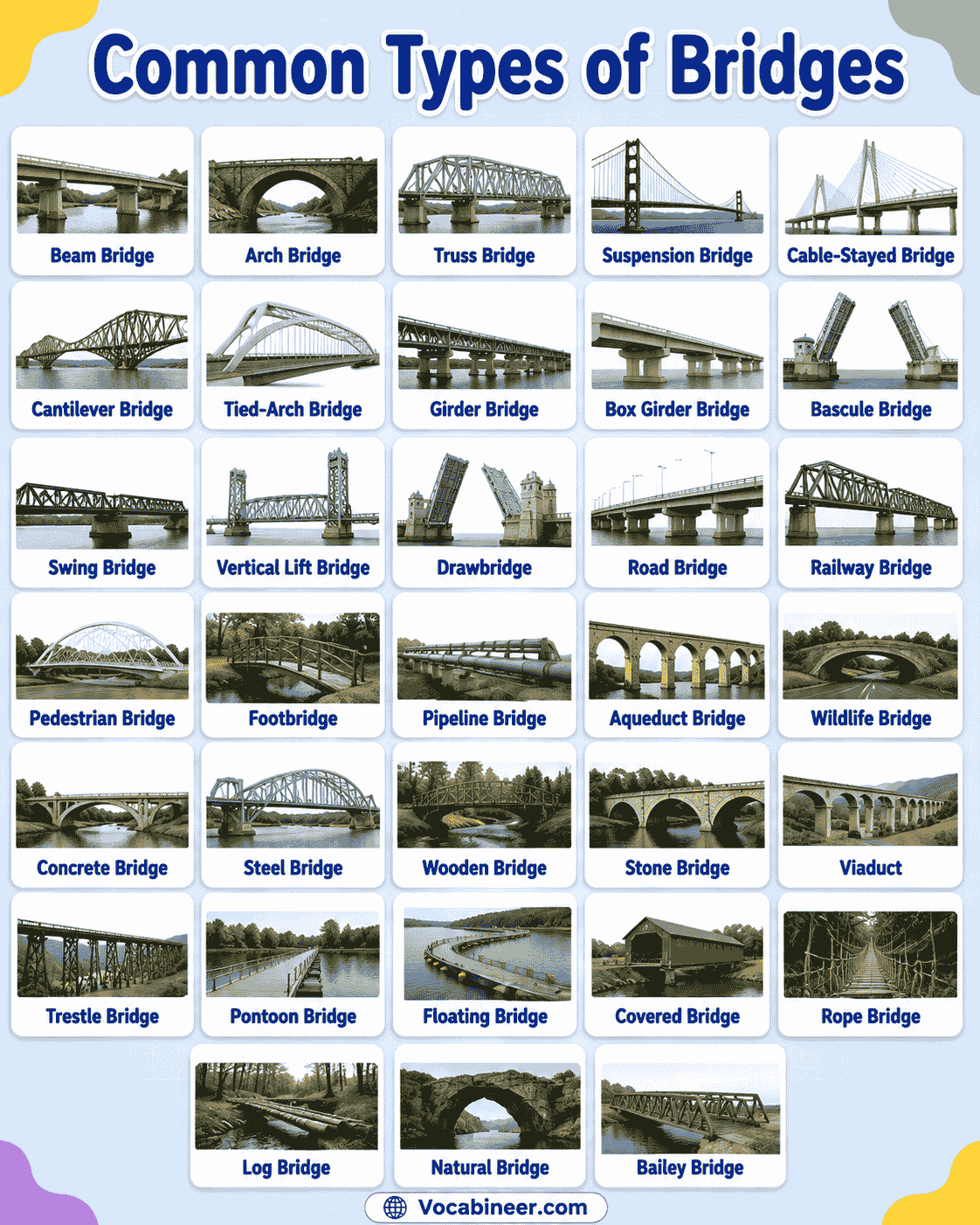
A bridge chart helps compare the main bridge groups, their best uses, and common examples.
| Bridge Group | Details |
|---|---|
| Main Structural Bridges | Best for: understanding bridge design and load support Examples: beam bridges, arch bridges, truss bridges, suspension bridges |
| Movable Bridges | Best for: waterways with boat or ship traffic Examples: bascule bridges, swing bridges, vertical lift bridges |
| Use-Based Bridges | Best for: knowing what crosses the bridge Examples: road bridges, railway bridges, pedestrian bridges, pipeline bridges |
| Material-Based Bridges | Best for: comparing strength, cost, and style Examples: concrete bridges, steel bridges, wooden bridges, stone bridges |
| Location-Based Bridges | Best for: understanding where bridges are built Examples: river bridges, sea bridges, valley bridges, canal bridges |
| Support-Based Bridges | Best for: explaining bridge foundations and spans Examples: viaducts, trestle bridges, pontoon bridges, floating bridges |
| Special Bridges | Best for: historic, decorative, natural, or temporary uses Examples: covered bridges, rope bridges, log bridges, natural bridges |
| Temporary Bridges | Best for: emergency, military, and construction needs Examples: Bailey bridges, pontoon bridges, military bridges |
How to Choose the Right Type of Bridge
Choose a bridge type based on the distance it must cross, the weight it must carry, and the place where it will be built. Short crossings often use beam or girder bridges, while very long crossings may need suspension bridges or cable-stayed bridges. Rivers, valleys, roads, railways, and sea channels all need different bridge designs.
Material and traffic type also matter. Concrete and steel are common for modern road and railway bridges, while wood and stone are often used for smaller, older, or decorative bridges. Movable bridges are useful where boats must pass, and temporary bridges are helpful for emergencies, construction projects, or military routes.
FAQs
The main types of bridges are beam bridges, arch bridges, truss bridges, suspension bridges, cable-stayed bridges, cantilever bridges, tied-arch bridges, and girder bridges.
There is no single strongest bridge for every situation. Truss bridges are very strong for their weight, suspension bridges are strong for very long spans, and arch bridges are strong when they have solid supports.
The simplest type of bridge is a beam bridge. It usually has a straight horizontal beam or deck supported at both ends.
A suspension bridge uses large main cables that hang over towers, with smaller cables holding the deck. A cable-stayed bridge has cables running directly from the towers to the deck.
Suspension bridges and cable-stayed bridges are commonly used for long spans. Suspension bridges are often used for very long crossings over bays, rivers, and sea channels.
Read More
- Bedroom Decor Items
- Popular Types of Tiles
- Parts of a House Names
- Different Types of Tables
- Different Types of Buildings