

Buildings serve different purposes in everyday life, from providing homes and workplaces to supporting education, healthcare, worship, transportation, and public services. Learning the names of different types of buildings makes it easier to describe places, understand directions, and build useful English vocabulary.
This article covers 60 types of buildings with their names, uses, and picture-friendly descriptions. The buildings are grouped by purpose so you can clearly distinguish residential, commercial, educational, industrial, public, agricultural, transport, and other building types.

In This Page
Building Types and Their Main Uses
Different buildings serve different purposes, such as housing people, supporting education, providing healthcare, storing goods, or offering public services. Understanding their main uses helps learners connect each building name with its everyday function.
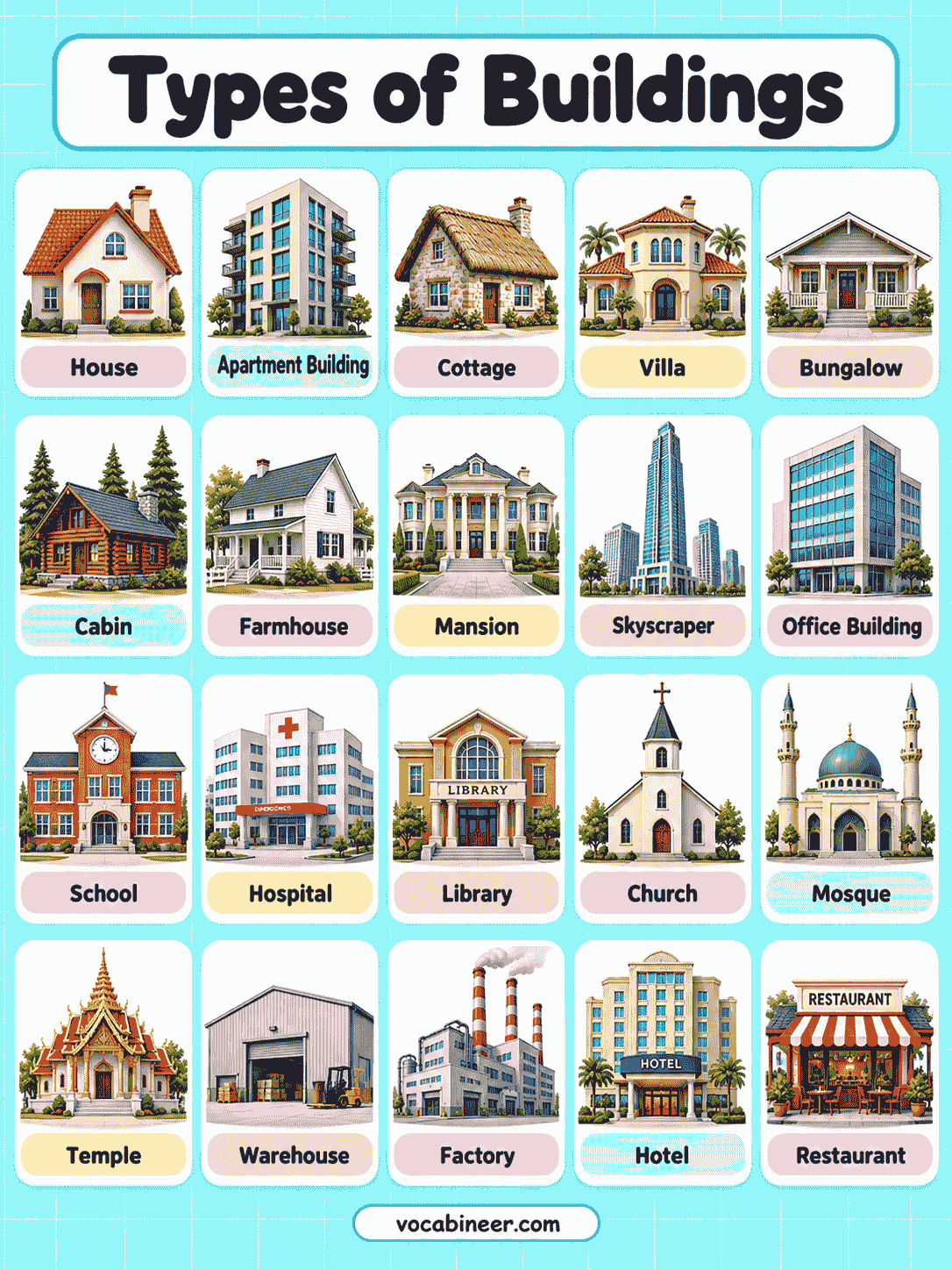
House
A house provides a private place for people or families to live, sleep, cook, and relax.
Apartment Building
An apartment building contains multiple separate homes within one larger structure.
School
A school provides classrooms and learning spaces where students study different subjects.
Hospital
A hospital offers medical treatment, emergency care, surgery, and other healthcare services.
Office Building
An office building provides workspaces for businesses, companies, and professional services.
Library
A library gives people access to books, study areas, information, and other learning resources.
Bank
A bank provides financial services such as deposits, withdrawals, payments, loans, and account management.
Restaurant
A restaurant prepares and serves food and drinks to customers.
Hotel
A hotel provides temporary accommodation and other services for travelers and guests.
Supermarket
A supermarket sells groceries, drinks, household products, and everyday essentials.
Shopping Mall
A shopping mall brings many shops, restaurants, and services together in one large complex.
Factory
A factory provides space for workers and machines to manufacture or process products.
Warehouse
A warehouse stores goods, materials, and products before sale or distribution.
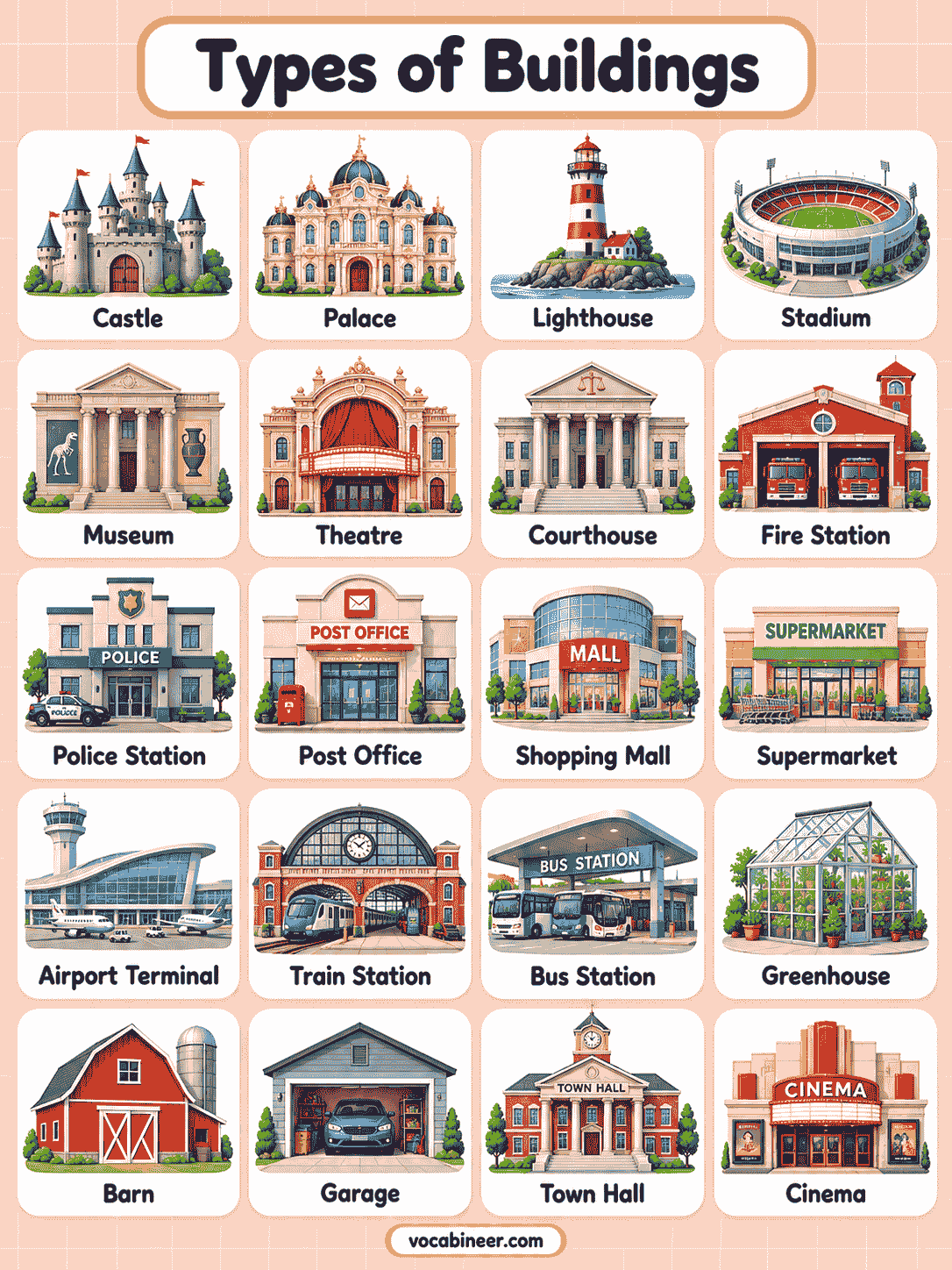
Police Station
A police station serves as a base for officers who handle public safety, reports, and law-enforcement work.
Fire Station
A fire station houses firefighters, fire engines, and emergency equipment.
Museum
A museum preserves and displays objects related to art, history, culture, science, or other subjects.
Cinema
A cinema provides auditoriums where people watch films on large screens.
Post Office
A post office handles letters, parcels, stamps, and other postal services.
Airport Terminal
An airport terminal helps passengers check in, pass through security, wait for flights, and board aircraft.
Train Station
A train station allows passengers to board, leave, or transfer between trains.
Buildings Grouped by Purpose
The sections below organize all 60 building names according to their main use. This makes similar buildings easier to compare and prevents residential, commercial, public, and industrial terms from becoming mixed together.
Residential Buildings
Residential buildings provide places for people to live, either permanently or for an extended period.
Detached House
A detached house stands separately from neighboring homes and usually accommodates one household.
Apartment Building
An apartment building contains several separate residential units within one larger structure.
Bungalow
A bungalow is usually a low-rise home with most or all living spaces arranged on one floor.
Villa
A villa is a spacious residential building, often designed as a comfortable private home or holiday property.
Cottage
A cottage is a relatively small house commonly associated with rural, village, or countryside settings.
Townhouse
A townhouse is a multi-story home that usually shares one or both side walls with neighboring houses.
Duplex
A duplex contains two separate homes within one building, often arranged side by side or on different floors.
Dormitory
A dormitory provides shared residential accommodation, especially for students, workers, or members of an institution.

Commercial Buildings
Commercial buildings support business, shopping, accommodation, food service, and financial activities.
Office Building
An office building provides workspaces for companies, organizations, and professional services.
Shopping Mall
A shopping mall is a large building containing many stores, restaurants, and other customer services.
Supermarket
A supermarket is a large retail building where people buy food, household products, and everyday necessities.
Hotel
A hotel provides temporary accommodation and often includes dining, reception, and guest-service areas.
Restaurant
A restaurant is a building or commercial premises where meals and drinks are prepared and served to customers.
Bank
A bank building provides financial services such as deposits, withdrawals, loans, and account management.
Department Store
A department store is a large retail building divided into sections that sell different categories of goods.
Educational Buildings
Educational buildings provide spaces for teaching, studying, training, and access to learning resources.
School
A school provides classrooms and other facilities where children or young people receive formal education.
College
A college is an educational building or campus facility used for further or higher education.
University
A university includes buildings used for advanced teaching, research, administration, and student activities.
Library
A library stores books and other learning resources and provides spaces for reading, research, and study.
Training Center
A training center provides spaces for practical instruction, professional development, or skill-based learning.
Healthcare Buildings
Healthcare buildings provide medical examinations, treatment, diagnosis, and patient care.
Hospital
A hospital is a large medical building that provides treatment, surgery, emergency care, and inpatient services.
Clinic
A clinic offers medical consultations and treatments, usually without the extensive inpatient facilities of a hospital.
Medical Center
A medical center brings together several healthcare services or specialist departments in one facility.
Dental Clinic
A dental clinic provides examinations, treatments, and other services related to teeth and oral health.
Religious Buildings
Religious buildings provide dedicated places for worship, prayer, ceremonies, and spiritual activities.
Church
A church is a Christian place of worship used for prayer, services, and religious gatherings.
Mosque
A mosque is an Islamic place of worship where Muslims gather for prayer and religious activities.
Temple
A temple is a place of worship associated with several religions and spiritual traditions.
Synagogue
A synagogue is a Jewish place of worship, prayer, study, and community gathering.
Monastery
A monastery provides a place where members of a religious community live and practice their faith.
Pagoda
A pagoda is a tiered religious building commonly associated with Buddhist traditions in parts of Asia.
Government and Public-Service Buildings
These buildings support administration, law, safety, communication, and other public services.
City Hall
City hall contains offices where local government officials manage municipal services and administration.
Courthouse
A courthouse provides courtrooms and offices where judges, lawyers, and officials handle legal proceedings.
Police Station
A police station serves as a local base for police officers and law-enforcement services.
Fire Station
A fire station houses firefighters, fire engines, and emergency-response equipment.
Post Office
A post office handles mail, parcels, postal services, and related customer needs.
Embassy
An embassy represents one country in another and provides diplomatic and consular services.
Parliament Building
A parliament building provides meeting chambers and offices for a country’s legislative body.
Industrial and Utility Buildings
Industrial and utility buildings support manufacturing, storage, repair work, energy, water services, and waste processing.
Factory
A factory is an industrial building where workers and machinery produce or assemble goods.
Warehouse
A warehouse provides large storage areas for products, materials, and supplies.
Workshop
A workshop provides space for making, repairing, or maintaining equipment and other items.
Power Plant
A power plant contains equipment used to generate electricity.
Water Treatment Plant
A water treatment plant processes water so it becomes suitable for drinking or other uses.
Recycling Plant
A recycling plant sorts and processes waste materials so they can be reused or converted into new products.
Agricultural Buildings
Agricultural buildings support farming, animal care, crop storage, and plant production.
Barn
A barn provides storage for hay, equipment, crops, or farm animals.
Stable
A stable contains individual spaces where horses or other livestock can be housed and cared for.
Granary
A granary stores harvested grain and helps protect it from moisture, pests, and spoilage.
Silo
A silo is a tall storage structure commonly used for grain, silage, or other agricultural materials.
Greenhouse
A greenhouse uses transparent walls and roofing to create controlled conditions for growing plants.
Transport Buildings
Transport buildings help passengers travel and provide spaces for vehicles, tickets, waiting, and related services.
Airport Terminal
An airport terminal is the main passenger building where travelers check in, pass through security, and board flights.
Train Station
A train station provides platforms, ticketing, waiting areas, and passenger access to railway services.
Bus Terminal
A bus terminal is a building where bus routes begin, end, or connect and passengers wait for services.
Metro Station
A metro station gives passengers access to underground or urban rapid-transit trains.
Parking Garage
A parking garage is a multi-level or enclosed building designed for vehicle parking.
Cultural and Entertainment Buildings
These buildings support art, history, performances, films, sports, and public recreation.
Museum
A museum displays historical, scientific, artistic, or cultural objects for education and public viewing.
Theater
A theater contains a stage and audience seating for plays, performances, and live entertainment.
Cinema
A cinema contains screens and seating areas where audiences watch films.
Stadium
A stadium is a large building or enclosed venue with spectator seating for sports and major public events.
Special and Landmark Buildings
Some buildings have distinctive historical, ceremonial, or navigational roles that do not fit neatly into everyday functional categories.
Lighthouse
A lighthouse is a tall coastal building or tower that uses a powerful light to guide ships and warn of hazards.
Castle
A castle is a large fortified historic building traditionally built for defense and residence.
Palace
A palace is a grand building traditionally used as the official residence of a monarch, ruler, or other important figure.
House vs. Building
A house is a type of building, but the word building has a much broader meaning.
| House | Building |
|---|---|
| Primarily designed for people to live in | Can serve almost any purpose |
| Residential | May be residential, commercial, public, industrial, or religious |
| Usually accommodates one or a few households | May accommodate people, businesses, machinery, services, or storage |
| One type of building | Broad general category |
Every house is a building, but buildings such as hospitals, factories, schools, and warehouses are not houses.
Apartment vs. Apartment Building
An apartment and an apartment building describe different things.
Apartment
An apartment is an individual living unit containing rooms for one household.
Apartment Building
An apartment building is the complete structure containing several apartments.
For example, a family may live in one apartment on the third floor of an apartment building.
Factory vs. Warehouse
Factories and warehouses often appear in industrial areas, but they serve different purposes.
| Factory | Warehouse |
|---|---|
| Used to manufacture or assemble goods | Used mainly to store goods |
| Often contains production machinery | Often contains shelves, racks, and storage areas |
| Focuses on production | Focuses on storage and distribution |
| Raw materials may enter and finished products leave | Finished goods may arrive, remain stored, and later ship elsewhere |
A simple way to remember the difference is: factories make products, while warehouses store them.
FAQs
The main types include residential, commercial, educational, medical, religious, public, industrial, and transport-related buildings.
Residential buildings are for living, while commercial buildings are used for business or selling services.
Most cities have houses, schools, hospitals, offices, banks, and transport stations.
Start with house, school, hospital, post office, police station, and airport—they are common and useful in daily speech
Read More
- Different Types of Houses
- Parts of Body Names
- Popular Types of Tiles
- Different Types of Fences
- Different Types of Doors
- List of 100 Shapes Names
- Weather Vocabulary Words
