

Shapes are forms, outlines, or structures we see around us every day. Some shapes are flat, like circles, squares, triangles, and rectangles, while others are solid, like cubes, spheres, cones, and cylinders. Learning shape names in English helps kids, students, teachers, and beginners describe objects, understand geometry, recognize patterns, and build useful vocabulary. This guide includes 100 shapes names in English with pictures, types, meanings, examples, pronunciation help, and easy learning tips for school, drawing, math lessons, and everyday use.
In This Page
What Are Shapes?
A shape is the visible form or outline of an object. It can be made with sides, corners, edges, curves, surfaces, or boundaries.
Shapes are usually grouped into two main types:
- 2D shapes: Flat shapes with length and width, such as circles, squares, triangles, and rectangles.
- 3D shapes: Solid shapes with length, width, and height, such as cubes, spheres, cylinders, and cones.
Shape names make it easier to describe objects in English. A coin looks like a circle, a door looks like a rectangle, and dice often look like cubes.
Why Learn Shape Names in English?
Shape names are useful because they appear in school, math, science, art, design, and everyday conversation. Kids use shape words in early learning, while older students use them in geometry, measurement, drawing, and problem-solving.
Learning shape names can help you:
- Understand basic geometry
- Describe objects clearly in English
- Recognize patterns in pictures and designs
- Learn 2D and 3D shapes
- Improve classroom vocabulary
- Follow math, art, and drawing lessons
- Identify shapes in daily life
This topic is also helpful for ESL learners because shape names are common in books, worksheets, classroom instructions, signs, games, and visual learning activities.
Basic 2D Shape Names
2D shapes are flat shapes with length and width but no depth. These shapes are common in books, worksheets, signs, drawings, charts, and classroom activities.
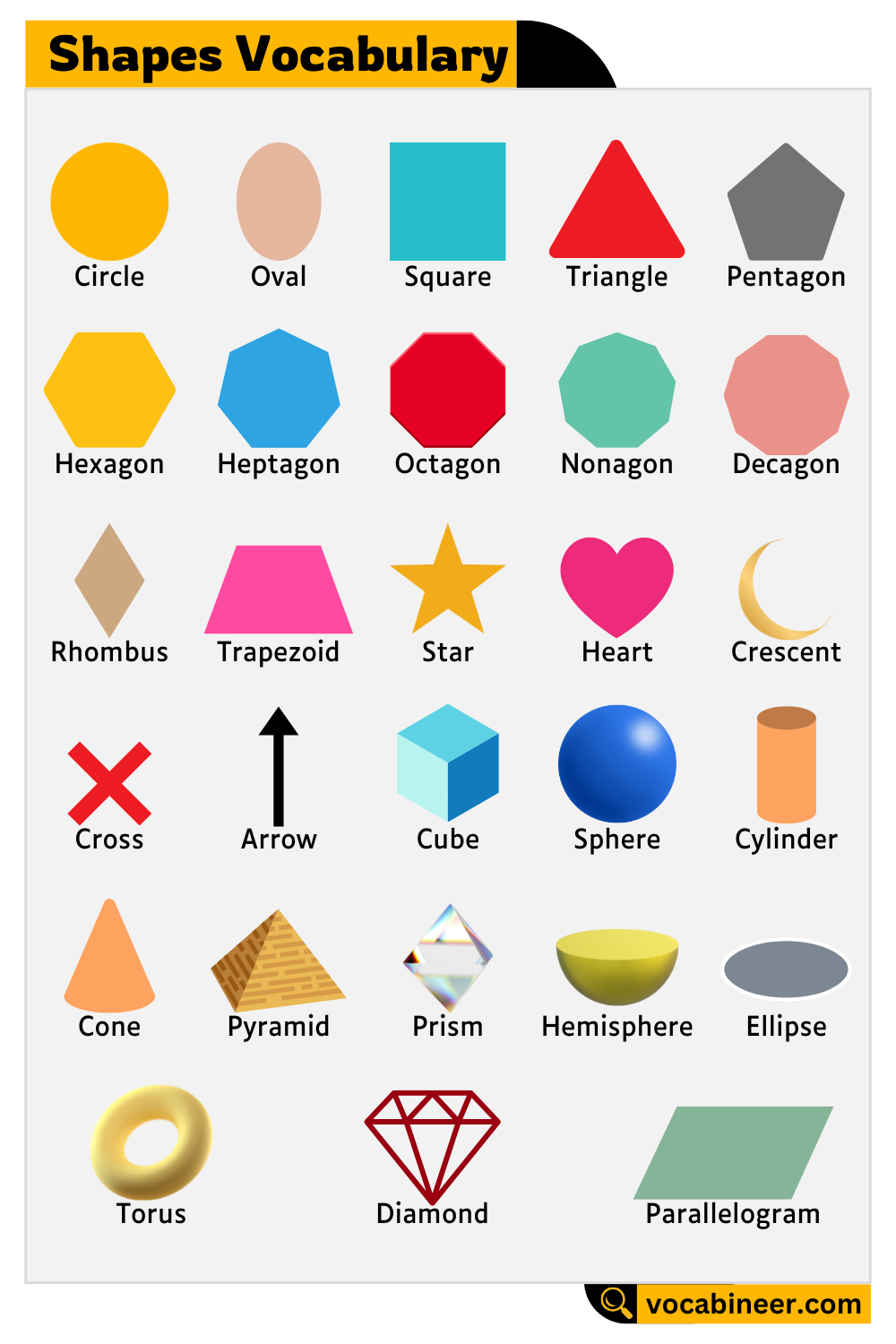
Circle
A circle is a round shape with no corners or straight sides. Coins, wheels, clocks, plates, and the moon often look like circles.
Square
A square has four equal sides and four right angles. Tiles, chessboard squares, gift boxes, and some windows are common examples.
Triangle
A triangle has three sides and three corners. A pizza slice, traffic sign, roof, or clothes hanger can look like a triangle.
Rectangle
A rectangle has four sides and four right angles, with opposite sides equal. Doors, books, mobile screens, tables, and notebooks often look rectangular.
Oval
An oval looks like a stretched circle. Eggs, mirrors, rugs, balloons, and some leaves can have an oval shape.
Pentagon
A pentagon has five straight sides. The Pentagon building, home plate in baseball, and some badge designs use this shape.
Hexagon
A hexagon has six sides. Honeycomb cells, bolts, pencils, and some floor tiles often show hexagon shapes.
Heptagon
A heptagon has seven sides. It is less common in daily life, but it appears in geometry lessons and some coin or design patterns.
Octagon
An octagon has eight sides. A stop sign is the most common real-life example of an octagon.
Nonagon
A nonagon has nine sides. It is mostly used in geometry lessons, shape charts, and polygon practice.
Decagon
A decagon has ten sides. Decorative tiles, badges, and geometric patterns may use decagon shapes.
Star
A star is a pointed shape often used in stickers, flags, ratings, decorations, and classroom charts.
Heart
A heart is a common symbol shape used for love, cards, emojis, jewelry, and decorations.
Diamond
A diamond is a four-sided shape that looks like a tilted square. Kites, playing cards, and jewelry designs often use diamond shapes.
Crescent
A crescent is a curved moon-like shape. It appears in moon phases, symbols, logos, and decorative designs.
Common 3D Shape Names
3D shapes are solid shapes with length, width, and height. You can see 3D shapes in toys, buildings, boxes, balls, cans, food, and household objects.
Cube
A cube has six equal square faces. Dice, ice cubes, toy blocks, and gift boxes are common examples.
Cuboid
A cuboid is a box-shaped solid with rectangular faces. Books, bricks, shoeboxes, and cereal boxes often look like cuboids.
Sphere
A sphere is a round 3D shape. Balls, globes, marbles, and planets are examples of spheres.
Cylinder
A cylinder has two flat circular ends and one curved side. Cans, batteries, candles, pipes, and drums often have this shape.
Cone
A cone has a circular base and a pointed top. Ice cream cones, party hats, traffic cones, and some roofs are easy examples.
Pyramid
A pyramid has a base and triangular sides that meet at one point. Egyptian pyramids, some tents, and pyramid toys have this shape.
Rectangular prism
A rectangular prism has six rectangular faces. Bricks, books, shoeboxes, cereal boxes, and many packages are common examples.
Triangular prism
A triangular prism has two triangular bases and three rectangular sides. Tents, ramps, and some chocolate bars can look like triangular prisms.
Hexagonal prism
A hexagonal prism has two hexagon bases and rectangular side faces. Some pencils, bolts, and crystals can show this shape.
Pentagonal prism
A pentagonal prism has two pentagon bases and rectangular side faces. It is common in geometry models and classroom shape sets.
Spherical cap
A spherical cap is a small part cut from a sphere. Domes, rounded lids, and some architectural tops can resemble this shape.
Hemisphere
A hemisphere is half of a sphere. Bowls, domes, half oranges, and some lamps can look like hemispheres.
Torus
A torus is a doughnut-shaped 3D form. Doughnuts, rings, lifebuoys, and some tires resemble a torus.
Tetrahedron
A tetrahedron has four triangular faces. It is also called a triangular pyramid.
Octahedron
An octahedron has eight triangular faces. It appears in geometry models, crystals, and some dice.
Shape Names Chart
A shape names chart helps learners review common shapes quickly. It is useful for kids, students, teachers, ESL learners, worksheets, and classroom displays.
| Shape Name | Type | Simple Example |
|---|---|---|
| Circle | 2D | Coin, wheel, clock |
| Square | 2D | Tile, box, chessboard |
| Triangle | 2D | Pizza slice, roof, traffic sign |
| Rectangle | 2D | Door, book, phone screen |
| Oval | 2D | Egg, mirror, balloon |
| Cube | 3D | Dice, gift box, ice cube |
| Sphere | 3D | Ball, globe, marble |
| Cylinder | 3D | Can, battery, candle |
| Cone | 3D | Ice cream cone, party hat |
| Pyramid | 3D | Egyptian pyramid, tent |
Shape Names With Pictures and Examples
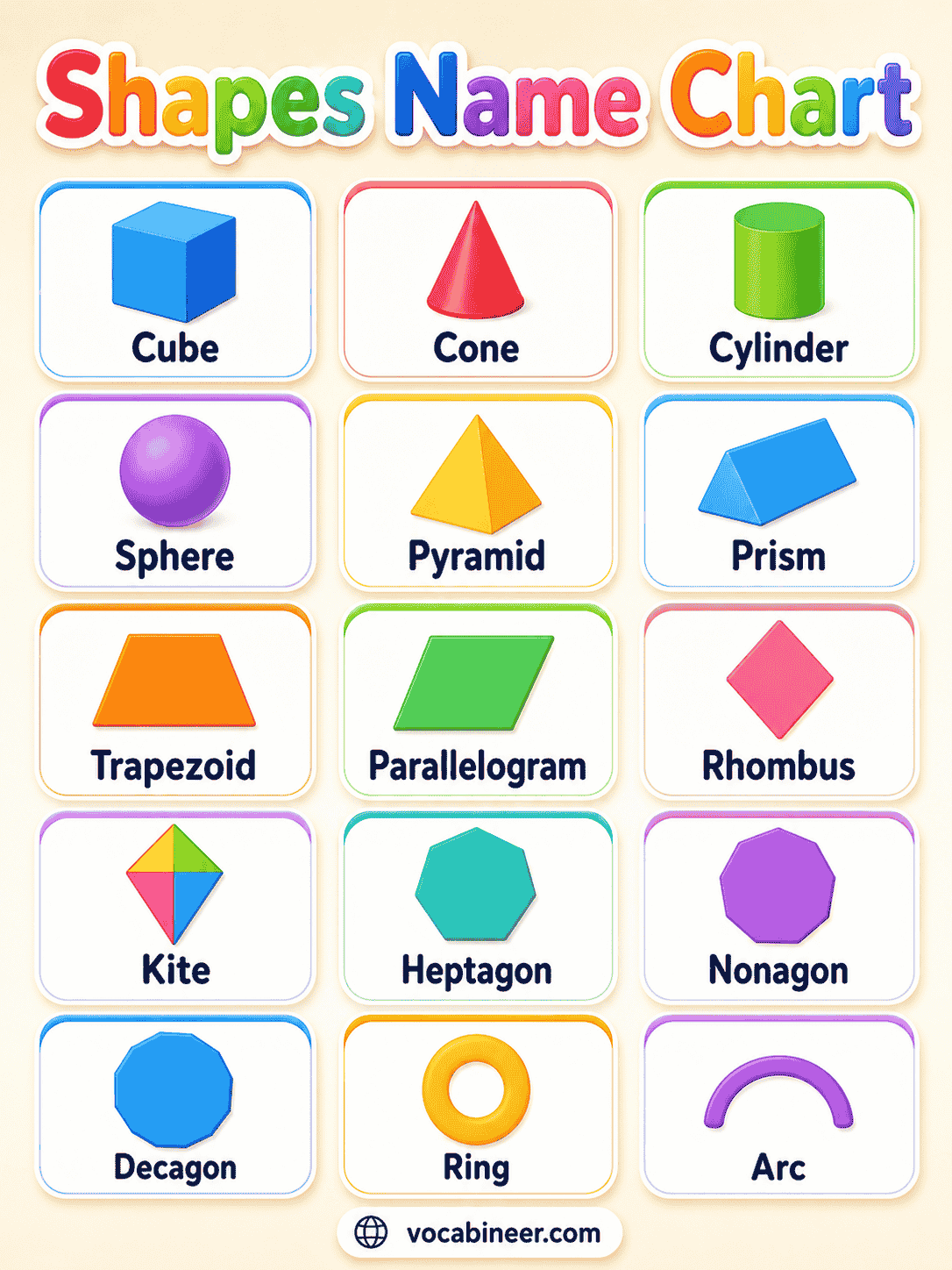
Pictures make shape names easier to remember because learners can connect each word with a clear visual example. A picture-based article should use labeled images for the most common 2D and 3D shapes.
Use picture examples like these:
- Circle: coin, clock, wheel
- Square: tile, box, checkerboard
- Triangle: pizza slice, roof, traffic sign
- Rectangle: book, door, mobile screen
- Oval: egg, mirror, balloon
- Cube: dice, gift box, ice cube
- Sphere: ball, globe, marble
- Cylinder: can, candle, battery
- Cone: ice cream cone, traffic cone, party hat
- Pyramid: Egyptian pyramid, tent, pyramid toy
A strong visual layout can include:
- A large chart for basic shape names
- A separate chart for 2D and 3D shapes
- A kid-friendly picture chart for classroom learning
- Real-life object images beside each shape name
2D and 3D Shapes
2D and 3D shapes are different because 2D shapes are flat and 3D shapes are solid. This difference is important for geometry, drawing, measurement, and real-life object recognition.
| Type | Meaning | Examples |
|---|---|---|
| 2D shapes | Flat shapes with length and width | Circle, square, triangle, rectangle |
| 3D shapes | Solid shapes with length, width, and height | Cube, sphere, cylinder, cone |
A circle is a 2D shape because it is flat. A sphere is a 3D shape because it is solid and round. A square is flat, but a cube has depth, edges, faces, and corners.
Polygon Shape Names by Number of Sides
Polygons are flat closed shapes with straight sides. Many polygon names are based on the number of sides they have.
- Triangle: 3 sides
- Quadrilateral: 4 sides
- Pentagon: 5 sides
- Hexagon: 6 sides
- Heptagon: 7 sides
- Octagon: 8 sides
- Nonagon: 9 sides
- Decagon: 10 sides
- Dodecagon: 12 sides
Shape Names for Kids
Kids learn shape names best through simple pictures, drawings, real objects, and classroom activities. Start with common shapes because they appear often in toys, books, games, worksheets, and daily life.
Easy shape names for kids include:
- Circle: ball, coin, clock
- Square: tile, box, chessboard
- Triangle: pizza slice, roof, traffic sign
- Rectangle: book, door, phone screen
- Oval: egg, mirror, balloon
- Star: sticker, decoration, rating icon
- Heart: card, emoji, jewelry
- Diamond: kite, ring, playing card
- Arrow: road sign, direction icon
- Crescent: moon, symbol, logo
Kids can practice shape names by:
- Drawing each shape
- Matching shape names with pictures
- Coloring shape worksheets
- Finding shapes in the classroom
- Naming shapes in toys, signs, food, and books
Common Shapes in Daily Life
Shapes are everywhere around us. We see them in homes, schools, roads, signs, toys, food, nature, and technology.
Common daily-life examples include:
- Circle: clock, coin, wheel, plate
- Square: tile, window, chessboard, napkin
- Rectangle: book, door, table, screen
- Triangle: roof, hanger, warning sign
- Oval: egg, mirror, rug, balloon
- Star: flag, sticker, decoration
- Heart: card, emoji, pendant
- Arrow: signboard, app icon, road direction
- Cylinder: can, candle, battery
- Sphere: ball, globe, marble
Geometric Shape Names With Meanings
Geometric shapes are used in math and geometry. They include flat 2D shapes, solid 3D shapes, polygons, triangles, and other structured forms.
Equilateral triangle
An equilateral triangle has three equal sides and three equal angles.
Isosceles triangle
An isosceles triangle has two equal sides.
Scalene triangle
A scalene triangle has no equal sides.
Right triangle
A right triangle has one 90-degree angle.
Trapezoid
A trapezoid is a four-sided shape with one pair of parallel sides.
Parallelogram
A parallelogram has opposite sides that are equal and parallel.
Rhombus
A rhombus has four equal sides, with opposite angles equal.
Kite
A kite has two pairs of equal adjacent sides.
Polygon
A polygon is a flat closed shape with straight sides.
Polyhedron
A polyhedron is a 3D solid with flat faces, straight edges, and corners.
100 Shape Names With Types and Examples
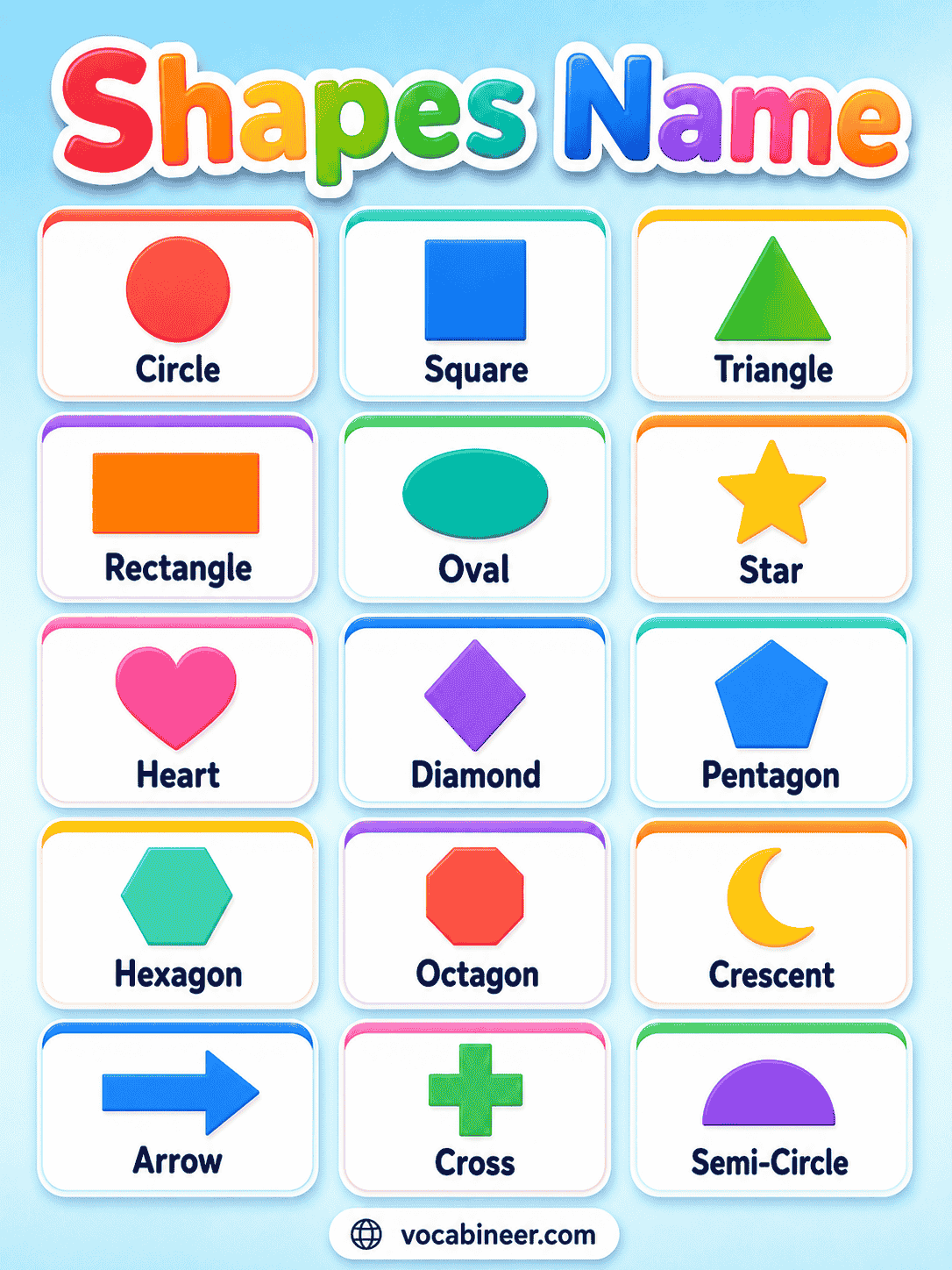
This complete list includes 100 shape names in English with type, meaning, and everyday examples. Some entries are basic shapes, while others are geometry-related forms, symbols, patterns, objects, or advanced terms.
The list is divided into smaller groups so students, kids, ESL learners, and teachers can scan it more easily.
Basic 2D Shapes
Basic 2D shapes are flat shapes that appear often in early geometry, worksheets, signs, and drawings.
| No. | Shape Name | Type | Meaning | Example |
|---|---|---|---|---|
| 1 | Circle | 2D | A round shape with no corners or edges | Coin |
| 2 | Square | 2D | A shape with four equal sides and four right angles | Chessboard square |
| 3 | Rectangle | 2D | A four-sided shape with opposite sides equal | Door |
| 4 | Triangle | 2D | A shape with three sides and three angles | Road sign |
| 5 | Oval | 2D | A stretched circle shape | Egg |
| 6 | Pentagon | 2D | A five-sided polygon | Pentagon building |
| 7 | Hexagon | 2D | A six-sided polygon | Honeycomb cell |
| 8 | Heptagon | 2D | A seven-sided polygon | Coin design |
| 9 | Octagon | 2D | An eight-sided polygon | Stop sign |
| 10 | Nonagon | 2D | A nine-sided polygon | Geometry drawing |
| 11 | Decagon | 2D | A ten-sided polygon | Decorative tile |
| 12 | Dodecagon | 2D | A twelve-sided polygon | Geometric pattern |
| 13 | Trapezoid | 2D | A quadrilateral with one pair of parallel sides | Bridge support |
| 14 | Parallelogram | 2D | A four-sided shape with opposite sides parallel | Floor tile |
| 15 | Rhombus | 2D | A four-sided shape with all sides equal | Diamond pattern |
| 16 | Kite | 2D | A quadrilateral with two pairs of equal adjacent sides | Flying kite |
| 17 | Star | 2D | A shape with pointed arms | Star symbol |
| 18 | Crescent | 2D | A curved moon-like shape | Moon phase |
| 19 | Arrow | 2D | A pointed shape that shows direction | Traffic sign |
| 20 | Heart | 2D | A symbol shape often used for love | Valentine card |
| 21 | Cross | 2D | Two lines crossing each other | First aid symbol |
| 22 | Spiral | 2D | A curve that winds from a central point | Snail shell |
Common 3D Shapes
Common 3D shapes are solid forms that have length, width, and height.
| No. | Shape Name | Type | Meaning | Example |
|---|---|---|---|---|
| 23 | Cube | 3D | A solid with six equal square faces | Dice |
| 24 | Cuboid | 3D | A box-shaped solid with rectangular faces | Book |
| 25 | Sphere | 3D | A round solid shape | Ball |
| 26 | Cylinder | 3D | A solid with two circular ends and one curved side | Can |
| 27 | Cone | 3D | A solid with a circular base and pointed top | Ice cream cone |
| 28 | Pyramid | 3D | A solid with triangular faces meeting at a point | Egyptian pyramid |
| 29 | Triangular prism | 3D | A prism with two triangular bases | Tent |
| 30 | Hexagonal prism | 3D | A prism with hexagon bases | Bolt |
| 31 | Pentagonal prism | 3D | A prism with pentagon bases | Geometry model |
| 32 | Torus | 3D | A doughnut-shaped solid | Lifebuoy |
| 33 | Hemisphere | 3D | Half of a sphere | Bowl |
| 34 | Tetrahedron | 3D | A solid with four triangular faces | Triangular pyramid |
| 35 | Octahedron | 3D | A solid with eight triangular faces | Crystal model |
| 36 | Dodecahedron | 3D | A solid with twelve pentagonal faces | Game dice |
| 37 | Icosahedron | 3D | A solid with twenty triangular faces | Decorative crystal |
Triangles, Polygons, and Flat Shapes
This group includes triangle types, polygon types, and other flat shapes used in geometry and design.
| No. | Shape Name | Type | Meaning | Example |
|---|---|---|---|---|
| 38 | Ellipse | 2D | A regular oval shape | Race track |
| 39 | Scalene triangle | 2D | A triangle with no equal sides | Geometry problem |
| 40 | Isosceles triangle | 2D | A triangle with two equal sides | Roof gable |
| 41 | Equilateral triangle | 2D | A triangle with three equal sides | Warning sign |
| 42 | Right triangle | 2D | A triangle with one right angle | Construction layout |
| 43 | Oblique triangle | 2D | A triangle with no right angle | Design pattern |
| 44 | Concave polygon | 2D | A polygon with at least one inward angle | Abstract shape |
| 45 | Convex polygon | 2D | A polygon with all angles pointing outward | Regular polygon |
| 46 | Irregular polygon | 2D | A polygon with unequal sides or angles | Freehand shape |
| 47 | Regular polygon | 2D | A polygon with equal sides and angles | Honeycomb pattern |
| 48 | Ring | 2D | A circular shape with a hole in the center | Wedding ring outline |
| 49 | Annulus | 2D | A ring-shaped area between two circles | Donut surface |
| 50 | L-shape | 2D | A shape like the letter L | Furniture layout |
| 51 | U-shape | 2D | A shape like the letter U | Sofa arrangement |
Object and Symbol Shapes
Object and symbol shapes include forms found in nature, signs, icons, products, and real-life objects.
| No. | Shape Name | Type | Meaning | Example |
|---|---|---|---|---|
| 52 | Wedge | 3D | A triangular prism-like solid | Doorstop |
| 53 | Ellipsoid | 3D | A stretched sphere | Rugby ball |
| 54 | Oblate spheroid | 3D | A sphere flattened at the poles | Earth shape |
| 55 | Prolate spheroid | 3D | A sphere stretched at the poles | Watermelon |
| 56 | Teardrop | 2D | A shape like a falling drop | Jewelry design |
| 57 | Leaf | 2D | An organic shape like a leaf | Botanical diagram |
| 58 | Clamshell | 3D | A rounded shell-like form | Cosmetic compact |
| 59 | Capsule | 3D | A cylinder with rounded ends | Medicine pill |
| 60 | Peanut shape | 3D | A shape with two rounded lobes | Peanut |
| 61 | Bell curve | 2D | A smooth symmetrical curve | Statistics graph |
| 62 | Fan shape | 2D | A shape that widens from one point | Paper fan |
| 63 | Arrowhead | 2D | A sharp pointed triangular shape | Directional icon |
| 64 | Dome | 3D | A rounded roof-like shape | Mosque roof |
| 65 | Arch | 2D | A curved structure over an opening | Bridge |
Pattern, Design, and Advanced Shapes
Pattern, design, and advanced shapes include decorative forms, symbolic shapes, and geometry-related terms.
| No. | Shape Name | Type | Meaning | Example |
|---|---|---|---|---|
| 66 | Lattice | 2D | A repeating pattern of crossed lines | Garden fence |
| 67 | Net | 2D | A flat layout of a 3D shape | Geometry worksheet |
| 68 | Grid | 2D | Repeating squares or rectangles | Spreadsheet |
| 69 | Arrow loop | 2D | A looped arrow shape | Recycling symbol |
| 70 | Chevron | 2D | A V-shaped pattern | Military badge |
| 71 | Zigzag | 2D | A shape with sharp alternating turns | Lightning |
| 72 | Wave | 2D | A smooth repeated curve | Water symbol |
| 73 | Flower | 2D | A petal-like symmetrical shape | Floral design |
| 74 | Snowflake | 2D | A six-sided crystal-like pattern | Winter decoration |
| 75 | Spiral staircase | 3D | A helical stair form | Architecture design |
| 76 | Knot | 2D | A looping intertwined shape | Celtic art |
| 77 | Möbius strip | 3D | A one-sided loop with a twist | Topology model |
| 78 | Tesseract | Advanced geometry | A four-dimensional cube often shown as a 3D projection | Sci-fi design |
| 79 | Arrow cross | 2D | A cross with arrow ends | Navigation symbol |
| 80 | Yin-yang | 2D | A circular symbol with two curved parts | Philosophy symbol |
| 81 | Mandala | 2D | A circular design with radial symmetry | Meditation art |
| 82 | Tangram | 2D | A shape puzzle made from pieces | Puzzle |
| 83 | Lune | 2D | A crescent-like shape made by arcs | Geometry concept |
| 84 | Arc | 2D | Part of a circle’s circumference | Protractor drawing |
| 85 | Segment | 2D | A region between an arc and a chord | Pizza slice |
| 86 | Sector | 2D | A part of a circle between two radii | Pie chart slice |
| 87 | Gable | 2D | A triangular wall area under a roof | House design |
| 88 | Keystone | 2D | A central top stone shape in an arch | Roman architecture |
| 89 | Prism | 3D | A solid with identical bases and flat sides | Glass block |
| 90 | Polygon | Geometry term | A closed flat shape with straight sides | Geometric figure |
| 91 | Quadrilateral | Geometry term | Any shape with four sides | Window pane |
| 92 | Polyhedron | Geometry term | A solid with flat faces | Crystal model |
| 93 | Line | Geometry term | A straight path with no thickness | Geometry diagram |
| 94 | Ray | Geometry term | A line that starts at one point and continues one way | Sun ray |
| 95 | Line segment | Geometry term | A part of a line with two endpoints | Ruler mark |
| 96 | Curve | Geometry term | A smooth bending line or shape | Road curve |
| 97 | Loop | 2D | A closed or rounded curved path | Ribbon loop |
| 98 | Crescent moon | 2D | A narrow moon-shaped curve | Lunar phase |
| 99 | Spiral cone | 3D | A cone-like shape that spirals upward | Party hat design |
| 100 | Decorative border shape | 2D | A repeated design used as a border | Page decoration |
Shape Name Pronunciation
Pronunciation helps students and English learners say shape names correctly. These simple pronunciation guides make common shape words easier to practice.
- Circle: SUR-kuhl
- Square: skwair
- Triangle: TRY-ang-guhl
- Rectangle: REK-tang-guhl
- Oval: OH-vuhl
- Cube: kyoob
- Sphere: sfeer
- Cone: kohn
- Cylinder: SIL-in-der
- Pyramid: PIR-uh-mid
- Hexagon: HEK-suh-gon
- Octagon: OK-tuh-gon
Students can practice by saying the shape name aloud, pointing to a picture, and naming a real-life object with the same shape.
Most Common Shape Names
Some shape names are used more often than others. These are the best shape words for beginners, kids, and English learners to learn first.
- Circle
- Square
- Triangle
- Rectangle
- Oval
- Star
- Heart
- Arrow
- Diamond
- Cube
- Sphere
- Cylinder
- Cone
- Pyramid
- Hexagon
- Octagon
- Kite
- Parallelogram
- Rhombus
- Trapezoid
Uncommon Shape Names
Some shape names are more advanced and are used in geometry, design, architecture, science, or art. These words are useful after learners understand basic 2D and 3D shapes.
Tetrahedron
A tetrahedron is a 3D shape with four triangular faces.
Octahedron
An octahedron has eight triangular faces.
Dodecahedron
A dodecahedron has twelve pentagonal faces.
Icosahedron
An icosahedron has twenty triangular faces.
Torus
A torus is shaped like a doughnut or ring.
Möbius strip
A Möbius strip is a loop with a twist and only one continuous side.
Tesseract
A tesseract is a four-dimensional cube often shown as a 3D projection.
Annulus
An annulus is the ring-shaped space between two circles.
How to Learn Shape Names
Shape names become easier when learners connect each word with a picture and real-life example. Grouping shapes by type also makes long vocabulary lists easier to remember.
Helpful learning methods include:
- Match shape names with pictures.
- Draw each shape in a notebook.
- Find shapes in the classroom.
- Group shapes into 2D and 3D types.
- Use flashcards with shape names and examples.
- Practice pronunciation aloud.
- Compare similar shapes, such as square and rectangle.
- Create a chart of common shapes and examples.
Kids can also learn shape names by coloring worksheets, building shapes with blocks, and identifying shapes in toys, signs, food, and household objects.
Common Mistakes When Learning Shape Names
Many learners confuse similar shapes because they look close at first. Simple comparisons make these differences easier to remember.
One common mistake is mixing up a square and a rectangle. A square has four equal sides, while a rectangle has opposite sides equal.
Another common confusion is circle vs oval. A circle is perfectly round, but an oval is stretched.
Students may also confuse cube and cuboid because both look like boxes. A cube has six equal square faces, while a cuboid has rectangular faces.
Some learners mix up pentagon, hexagon, heptagon, and octagon. Counting the sides helps solve this problem:
- Pentagon: 5 sides
- Hexagon: 6 sides
- Heptagon: 7 sides
- Octagon: 8 sides
- Nonagon: 9 sides
- Decagon: 10 sides
Common English Spelling Mistakes With Shape Names
Some learners know the shape but spell or pronounce the name incorrectly. Since this article teaches shape names in English, spelling and pronunciation should be clear.
Common spelling mistakes include:
- Circle, not “circel”
- Triangle, not “triangel”
- Rectangle, not “rectangel”
- Cylinder, not “cilinder”
- Rhombus, not “rombus”
- Sphere, not “spear” when talking about the shape
Pronunciation practice can also help. Students should say the shape name aloud, point to the picture, and use it in a simple sentence.
Related Shape and Geometry Vocabulary
Related vocabulary helps learners connect shape names with other English, math, and visual-learning topics. These topics support geometry, drawing, classroom English, and beginner vocabulary practice.
- 2D and 3D shapes
- Types of angles
- Geometric shapes
- Math vocabulary
- Drawing vocabulary
- Classroom objects
- Color names in English
- Pattern names
- Types of lines
- Measurement vocabulary
FAQs
The basic shape names in English include circle, square, triangle, rectangle, and oval. These are usually the first shapes taught to kids and beginners.
2D shapes are flat shapes with length and width, such as circles, squares, and triangles. 3D shapes are solid shapes with length, width, and height, such as cubes, spheres, and cones.
A square has four equal sides and four right angles. A rectangle also has four right angles, but only its opposite sides are equal.
A shape with three sides is called a triangle. Common triangle types include equilateral, isosceles, scalene, and right triangles.
A polygon is a flat closed shape with straight sides. Triangles, squares, pentagons, hexagons, and octagons are common polygons.
Summary
Learning 100 shape names in English with pictures helps students, kids, teachers, and beginners understand geometry, vocabulary, and real-life objects more clearly. Basic 2D shapes include circle, square, triangle, rectangle, and oval, while common 3D shapes include cube, sphere, cylinder, cone, and pyramid. More advanced names, such as tetrahedron, torus, annulus, and dodecahedron, add deeper geometry knowledge. Shape names are useful in math lessons, classroom activities, drawing, design, science, and everyday communication. Pictures, examples, pronunciation, and categories make shape vocabulary easier to remember.
Read More
