

Yoga poses, also called asanas, are body positions used in yoga practice. People practice them to build body awareness, improve movement, support balance, practice breathing, and develop focus.
This guide explains common types of yoga poses with pictures and names. In addition, it covers beginner yoga poses, body positions, English and Sanskrit names, pose categories, comparison charts, safe practice tips, image metadata, semantic keywords, meta titles, and meta descriptions.
In This Page
What Are Yoga Poses?
Yoga poses are structured body positions used during yoga practice. For example, a person may stand, sit, kneel, lie down, twist, bend forward, or balance while practicing different poses.
Some yoga poses feel gentle, while others need more strength, balance, or flexibility. Therefore, beginners should start with simple poses, move slowly, use support when needed, and learn harder poses gradually.
Common Types of Yoga Poses
Yoga poses can be grouped by body position, movement type, difficulty level, and purpose. In addition, these groups help learners understand pose names more easily.
- Standing Poses — Build posture, leg strength, balance, and body awareness during yoga practice.
- Seated Poses — Help learners practice calm alignment, breathing, hip movement, and gentle flexibility.
- Balancing Poses — Train stability, focus, coordination, and controlled movement.
- Forward Bend Poses — Fold the body forward and gently stretch the back body.
- Backbend Poses — Open the front body and help learners practice controlled back extension.
- Twisting Poses — Rotate the body and support gentle spinal movement.
- Inversion Poses — Place the head lower than the heart and require careful guidance.
- Arm Balance Poses — Use the hands and arms for support while building control and balance.
- Restorative Poses — Use relaxed positions and props to support rest and gentle stretching.
- Supine Poses — Start from a lying position on the back and often feel calm and supported.
- Prone Poses — Start from a lying position on the stomach and often involve gentle back extension.
- Kneeling Poses — Begin from the knees and help learners practice posture, hip movement, and alignment.
- Hip-Opening Poses — Focus on hip movement and can feel gentle or challenging depending on the pose.
- Core-Strengthening Poses — Use the center of the body for stability, support, and control.
- Chest-Opening Poses — Open the front upper body and support upright posture practice.
Standing Yoga Poses
Standing yoga poses help learners practice posture, balance, leg engagement, and full-body awareness. Also, many yoga classes use standing poses near the beginning because they prepare the body for other movements.
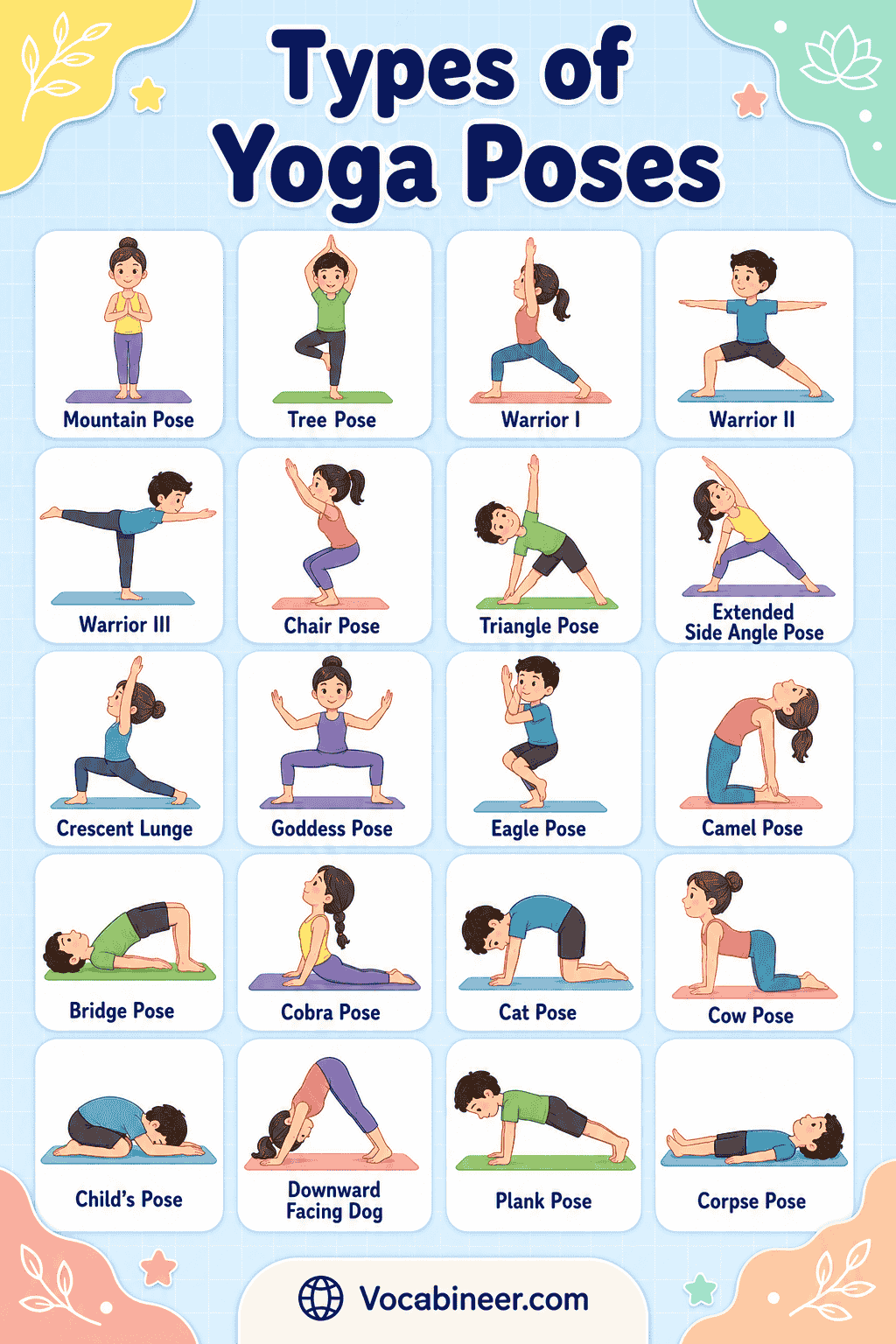
- Mountain Pose — A basic standing pose that teaches alignment, balance, and steady posture.
- Tree Pose — A standing balance pose where one foot rests against the opposite leg.
- Warrior I — A strong standing pose with one leg forward and the arms reaching upward.
- Warrior II — A wide standing pose that trains focus, leg control, and open chest alignment.
- Triangle Pose — A standing side stretch where one hand reaches toward the leg or floor.
- Extended Side Angle Pose — A standing pose that combines a bent front knee with a side-body reach.
- Chair Pose — A standing pose where the knees bend as if sitting on an invisible chair.
- High Lunge — A standing lunge pose that supports balance, leg control, and steady focus.
- Wide-Legged Forward Bend — A standing forward fold with the feet placed wide apart.
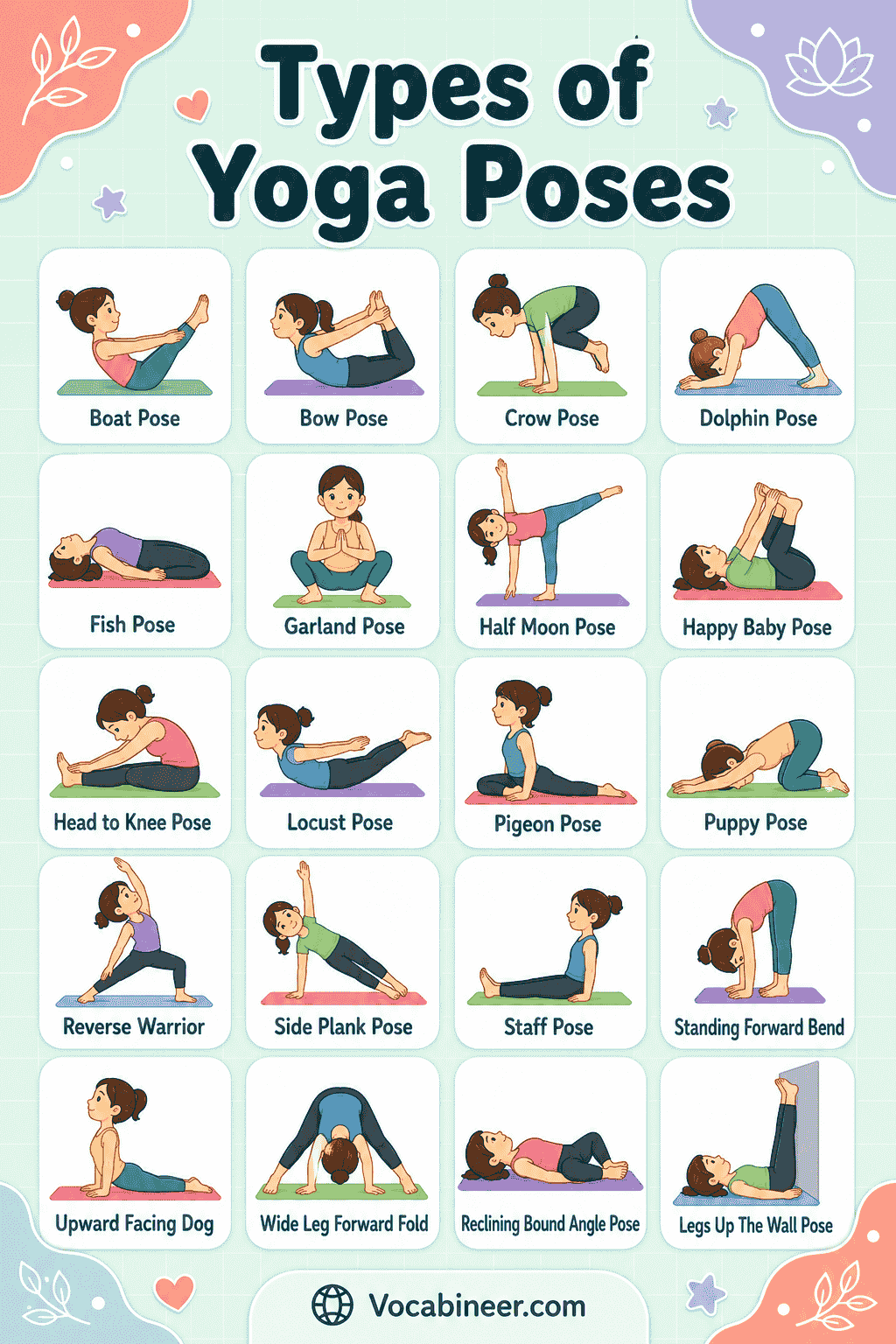
- Half Moon Pose — A standing balance pose where one leg lifts while the body opens sideways.
Seated Yoga Poses
Seated yoga poses often support calm breathing, hip movement, and flexibility practice. Moreover, many seated poses work well for beginners because the floor gives extra support.
- Easy Pose — A simple cross-legged seated pose used for breathing, focus, or meditation.
- Staff Pose — A seated pose with straight legs that teaches upright posture and leg awareness.
- Seated Forward Bend — A seated pose where the body folds gently toward the legs.
- Bound Angle Pose — A seated pose where the soles of the feet touch and the knees open outward.
- Hero Pose — A kneeling seated pose that places the hips between or near the heels.
- Seated Twist — A seated pose that rotates the body gently from the spine.
- Half Lord of the Fishes Pose — A seated twist that uses one bent leg and controlled rotation.
- Wide-Angle Seated Forward Bend — A seated forward fold with the legs spread wide.
- Cow Face Pose — A seated pose that works with crossed legs and optional arm positioning.
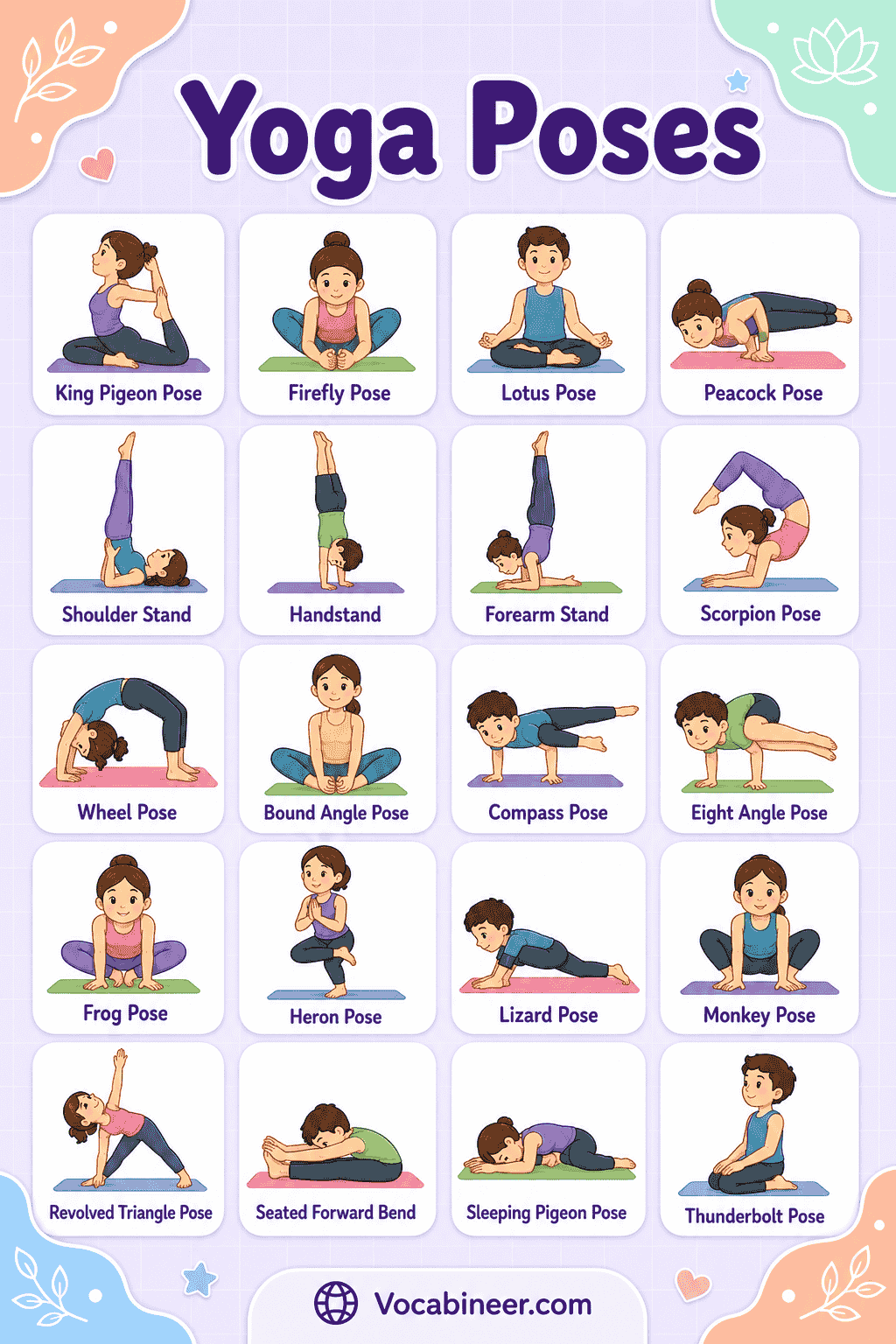
- Lotus Pose — An advanced seated pose often used for meditation, but beginners should avoid forcing it.
Balancing Yoga Poses
Balancing yoga poses train focus, patience, and body control. However, beginners should use a wall, chair, or teacher support when balance feels difficult.
- Tree Pose — A beginner-friendly balancing pose that uses one standing leg.
- Eagle Pose — A standing balance pose with crossed arms and legs.
- Warrior III — A balance pose where the torso leans forward while one leg extends back.
- Half Moon Pose — A side-opening balance pose with one hand reaching toward the floor.
- Dancer Pose — A standing balance pose where one hand holds the lifted foot behind the body.
- Chair Pose on Toes — A balance variation that lifts the heels while the knees stay bent.
- Standing Hand-to-Big-Toe Pose — A balance pose that extends one leg forward or sideways.
- Side Plank Pose — An arm-supported balance pose performed from the side of the body.
- Crow Pose — An arm balance where the knees rest near the upper arms.
- Scale Pose — A seated arm balance that lifts the body with hand support.
Forward Bend Yoga Poses
Forward bend yoga poses fold the body toward the legs or floor. In many cases, they help learners practice patience, breath awareness, and gentle lengthening without forcing the body.
- Standing Forward Bend — A standing pose where the upper body folds toward the legs.
- Seated Forward Bend — A seated pose where the body folds toward straight legs.
- Wide-Legged Forward Bend — A standing forward fold with the feet wide apart.
- Head-to-Knee Pose — A seated forward fold with one leg bent and one leg extended.
- Child’s Pose — A kneeling forward fold that often works as a gentle resting position.
- Pyramid Pose — A standing forward fold over one straight front leg.
- Rabbit Pose — A kneeling forward fold that rounds the back gently.
- Intense Side Stretch Pose — Another name often used for Pyramid Pose.
- Half Forward Bend — A standing pose where the spine lengthens halfway up.
- Wide-Angle Seated Forward Bend — A seated forward fold with the legs open wide.
Backbend Yoga Poses
Backbend yoga poses move the spine into extension and open the front body. Therefore, learners should practice them slowly and avoid pushing into pain or pressure.
- Cobra Pose — A prone pose where the chest lifts gently from the floor.
- Bridge Pose — A supine pose where the hips lift while the shoulders stay grounded.
- Camel Pose — A kneeling backbend that opens the front body with careful support.
- Locust Pose — A prone pose where the chest and legs may lift slightly from the floor.
- Upward-Facing Dog — A stronger backbend often used in flow-style yoga.
- Bow Pose — A prone backbend where the hands hold the feet or ankles.
- Fish Pose — A supine backbend that opens the chest with head and arm support.
- Wheel Pose — An advanced backbend that lifts the body into an arch shape.
- Sphinx Pose — A gentle prone backbend supported by the forearms.
- Puppy Pose — A kneeling chest-opening pose with the arms reaching forward.
Twisting Yoga Poses
Twisting yoga poses rotate the body from the spine and torso. Also, they should feel controlled and comfortable rather than forced.
- Seated Spinal Twist — A seated pose that gently rotates the upper body.
- Revolved Triangle Pose — A standing twist with one hand reaching toward the floor.
- Revolved Side Angle Pose — A twisting lunge pose that combines leg strength and rotation.
- Supine Twist — A lying twist where the knees move to one side.
- Half Lord of the Fishes Pose — A seated twist with one leg crossed or bent.
- Thread the Needle Pose — A kneeling twist that reaches one arm under the body.
- Revolved Chair Pose — A standing twist performed from Chair Pose.
- Twisted Lunge — A lunge variation that adds upper-body rotation.
- Revolved Head-to-Knee Pose — A seated side bend and twist variation.
- Marichi’s Pose — A seated twist that uses one bent knee for support.
Inversion Yoga Poses
Inversion yoga poses place the head below the heart. Because these poses can feel intense, beginners should learn them with guidance and use safer modifications first.
- Downward-Facing Dog — A common mild inversion where the hips lift high and the hands press into the mat.
- Dolphin Pose — A forearm-supported pose that prepares the body for stronger inversions.
- Legs-Up-the-Wall Pose — A gentle supported inversion with the legs resting upward against a wall.
- Shoulderstand — An advanced inversion that needs careful alignment and guidance.
- Headstand — An advanced pose that requires proper preparation and teacher support.
- Handstand — An advanced arm-supported inversion that needs strength and balance.
- Forearm Stand — An advanced inversion supported by the forearms.
- Plow Pose — A deep inversion where the feet move behind the head.
- Wide-Legged Forward Bend — A mild standing inversion when the head drops below the heart.
- Standing Forward Bend — A simple mild inversion that beginners can modify by bending the knees.
Arm Balance Yoga Poses
Arm balance yoga poses use the hands, arms, shoulders, and core for support. However, learners should build strength gradually before trying advanced arm balances.
- Plank Pose — A basic arm-supported pose that trains steady body control.
- Side Plank Pose — A side-facing arm support pose that challenges balance and stability.
- Crow Pose — A common beginner arm balance where the knees rest near the upper arms.
- Eight-Angle Pose — An advanced arm balance with the legs extended to one side.
- Firefly Pose — An advanced arm balance with the legs extended forward.
- Scale Pose — A seated arm balance where the hands lift the body from the mat.
- Peacock Pose — An advanced arm balance that requires strong control and careful practice.
- Flying Pigeon Pose — An advanced balance that combines hip opening and arm support.
- Handstand — An advanced arm balance and inversion.
- Forearm Stand — An advanced pose supported by the forearms instead of the hands.
Restorative Yoga Poses
Restorative yoga poses use gentle positions, slow breathing, and support from props. In addition, they often help learners relax during quieter yoga practice.
- Child’s Pose — A gentle kneeling resting pose with the body folded forward.
- Legs-Up-the-Wall Pose — A supported pose with the legs resting upward against a wall.
- Reclined Bound Angle Pose — A lying pose with the soles of the feet together and knees open.
- Supported Bridge Pose — A back-supported pose where a block or cushion supports the hips.
- Supported Child’s Pose — A resting variation that uses a bolster or cushion under the chest.
- Corpse Pose — A lying relaxation pose often used at the end of practice.
- Supported Fish Pose — A chest-opening pose using a block or bolster.
- Supine Twist — A gentle lying twist that can support relaxation.
- Supported Forward Bend — A seated forward fold supported by cushions or blocks.
- Supported Hero Pose — A kneeling seated pose with props for comfort.
Supine Yoga Poses
Supine yoga poses start from a lying position on the back. As a result, they often feel stable and accessible for breathing practice, gentle movement, or relaxation.
- Bridge Pose — A supine pose where the hips lift from the floor.
- Happy Baby Pose — A lying pose where the hands hold the feet or legs.
- Reclined Bound Angle Pose — A lying pose with the knees open and feet together.
- Supine Twist — A lying twist where the knees move to one side.
- Corpse Pose — A resting pose where the body lies flat and relaxed.
- Knees-to-Chest Pose — A simple pose where the knees draw toward the chest.
- Reclined Hand-to-Big-Toe Pose — A lying pose that extends one leg upward.
- Legs-Up-the-Wall Pose — A supported pose with the legs resting against a wall.
- Supported Bridge Pose — A bridge variation using a block or cushion under the hips.
- Wind-Relieving Pose — A lying pose that draws one or both knees toward the body.
Prone Yoga Poses
Prone yoga poses start from a lying position on the stomach. Similarly, many prone poses help learners practice gentle chest lifting, arm support, and back-body awareness.
- Cobra Pose — A prone pose that lifts the chest gently from the mat.
- Sphinx Pose — A gentle backbend supported by the forearms.
- Locust Pose — A prone pose where the chest, arms, or legs may lift from the floor.
- Bow Pose — A stronger prone backbend where the hands hold the feet or ankles.
- Crocodile Pose — A resting prone pose with the body relaxed on the stomach.
- Upward-Facing Dog — A strong prone-to-backbend pose used in flow practice.
- Half Frog Pose — A prone pose that bends one knee and works with thigh movement.
- Superman Pose — A prone strengthening-style pose with arms and legs lifted.
- Prone Shoulder Opener — A prone position that gently opens the chest and shoulders.
- Prone Twist — A lying twist performed from a stomach-down position.
Yoga Poses by Body Position
Body position helps beginners understand how a yoga pose starts. For example, a pose may begin from standing, sitting, lying on the back, lying on the stomach, kneeling, or supporting weight on the arms.
| Body Position | Common Pose Examples |
|---|---|
| Standing Poses | Mountain Pose, Warrior Pose, Triangle Pose |
| Seated Poses | Easy Pose, Staff Pose, Seated Forward Bend |
| Supine Poses | Bridge Pose, Supine Twist, Reclined Bound Angle Pose |
| Prone Poses | Cobra Pose, Sphinx Pose, Locust Pose |
| Kneeling Poses | Child’s Pose, Camel Pose, Hero Pose |
| Arm-Supported Poses | Plank Pose, Side Plank Pose, Crow Pose |
Yoga Poses by Difficulty Level
Yoga poses can feel easy, moderate, or advanced depending on strength, balance, flexibility, and experience. Therefore, learners should choose poses that match their current ability.
| Difficulty Level | Examples |
|---|---|
| Beginner Yoga Poses | Mountain Pose, Child’s Pose, Easy Pose, Cat-Cow Pose, Cobra Pose |
| Intermediate Yoga Poses | Warrior III, Eagle Pose, Camel Pose, Half Moon Pose, Crow Pose |
| Advanced Yoga Poses | Headstand, Handstand, Wheel Pose, Firefly Pose, Peacock Pose |
Yoga Poses by Purpose
People also group yoga poses by practice purpose. However, these purposes should guide selection only in a general educational way, not as medical advice.
- Yoga Poses for Balance Practice — Tree Pose, Eagle Pose, Half Moon Pose, Warrior III.
- Yoga Poses for Flexibility Practice — Seated Forward Bend, Butterfly Pose, Low Lunge, Wide-Angle Seated Forward Bend.
- Yoga Poses for Strength Practice — Plank Pose, Chair Pose, Warrior Pose, Side Plank.
- Yoga Poses for Relaxation Practice — Child’s Pose, Corpse Pose, Legs-Up-the-Wall Pose, Supported Bridge Pose.
- Yoga Poses for Posture Practice — Mountain Pose, Staff Pose, Cobra Pose, Bridge Pose.
- Yoga Poses for Breathing Practice — Easy Pose, Hero Pose, Corpse Pose, Supported Seated Pose.
Beginner Yoga Poses
Beginner yoga poses should feel simple, steady, and easy to modify. In addition, beginners should focus on comfort, breath, and alignment instead of forcing deeper shapes.
- Mountain Pose — Teaches basic standing alignment and steady posture.
- Child’s Pose — Offers a gentle resting position from a kneeling shape.
- Cat-Cow Pose — Moves the spine between rounded and arched positions.
- Easy Pose — Supports seated breathing, focus, and simple meditation practice.
- Cobra Pose — Gently lifts the chest from a prone position and teaches back extension.
- Downward-Facing Dog — Creates an inverted V shape and can be modified by bending the knees.
- Warrior I — Builds a strong standing shape with one leg forward and the arms lifted.
- Warrior II — Uses a wide stance and steady gaze to practice focus and leg control.
- Tree Pose — Helps beginners practice balance with one foot supported on the opposite leg.
- Bridge Pose — Lifts the hips from a lying position and helps learners practice controlled movement.
Yoga Pose Names in English and Sanskrit
Many yoga classes use both English and Sanskrit pose names. Because of this, learning both names can help beginners recognize poses in classes, books, videos, and charts.
| English Name | Sanskrit Name |
|---|---|
| Mountain Pose | Tadasana |
| Tree Pose | Vrikshasana |
| Child’s Pose | Balasana |
| Cobra Pose | Bhujangasana |
| Downward-Facing Dog | Adho Mukha Svanasana |
| Warrior I | Virabhadrasana I |
| Warrior II | Virabhadrasana II |
| Bridge Pose | Setu Bandhasana |
| Triangle Pose | Trikonasana |
| Seated Forward Bend | Paschimottanasana |
| Corpse Pose | Savasana |
| Camel Pose | Ustrasana |
| Chair Pose | Utkatasana |
| Eagle Pose | Garudasana |
| Lotus Pose | Padmasana |
Difference Between Similar Yoga Pose Types
Some yoga pose types look similar, but they focus on different movements or positions. Therefore, a comparison table helps learners understand each group more clearly.
| Pose Types | Main Difference |
|---|---|
| Standing Poses vs Balancing Poses | Standing poses build posture and leg control, while balancing poses focus more on stability and focus. |
| Forward Bends vs Backbends | Forward bends fold the body forward, while backbends open the front body and extend the spine. |
| Twists vs Side Bends | Twists rotate the body, while side bends stretch one side of the body. |
| Inversions vs Arm Balances | Inversions place the head below the heart, while arm balances rely more on hand or arm support. |
| Restorative Poses vs Active Poses | Restorative poses use relaxed support, while active poses need more effort or control. |
| Supine Poses vs Prone Poses | Supine poses start on the back, while prone poses start on the stomach. |
| Seated Poses vs Kneeling Poses | Seated poses start from the hips on the floor, while kneeling poses start from the knees. |
| Beginner Poses vs Advanced Poses | Beginner poses use simpler shapes, while advanced poses need more strength, balance, or guidance. |
Types of Yoga Poses Chart with Pictures
A types of yoga poses chart helps learners compare yoga pose groups quickly. In addition, it works well as a visual section for readers who want examples before studying each pose group.
| Yoga Pose Group | Details |
|---|---|
| Standing Poses | Best for: posture, balance, and leg strength practice Examples: Mountain Pose, Warrior Pose, Triangle Pose |
| Seated Poses | Best for: calm alignment, breathing, and flexibility practice Examples: Easy Pose, Staff Pose, Seated Forward Bend |
| Balancing Poses | Best for: stability, focus, and body control Examples: Tree Pose, Eagle Pose, Warrior III |
| Forward Bends | Best for: gentle folding and back-body lengthening Examples: Standing Forward Bend, Seated Forward Bend, Child’s Pose |
| Backbends | Best for: front-body opening and controlled back extension Examples: Cobra Pose, Bridge Pose, Camel Pose |
| Twisting Poses | Best for: gentle rotation and spinal movement practice Examples: Seated Twist, Supine Twist, Revolved Triangle |
| Inversions | Best for: advanced body awareness and supported upside-down practice Examples: Downward-Facing Dog, Legs-Up-the-Wall, Shoulderstand |
| Arm Balances | Best for: arm support, core control, and balance practice Examples: Plank Pose, Side Plank, Crow Pose |
| Restorative Poses | Best for: rest, support, and gentle stretching Examples: Child’s Pose, Corpse Pose, Legs-Up-the-Wall |
| Supine Poses | Best for: supported practice from a lying position Examples: Bridge Pose, Supine Twist, Reclined Bound Angle |
| Prone Poses | Best for: stomach-down practice and gentle back extension Examples: Cobra Pose, Sphinx Pose, Locust Pose |
Safe Practice Tips for Yoga Poses
Yoga practice should feel steady and controlled. Therefore, move slowly, listen to your body, and avoid forcing any pose.
A qualified yoga teacher can help learners understand alignment, modifications, and safe progression. Also, people with injuries, pain, pregnancy, dizziness, or medical concerns should speak with a healthcare professional before trying challenging poses.
- Move slowly — Slow movement helps you notice comfort, balance, and control.
- Avoid pain — Stop or modify a pose if it causes sharp pain or strong discomfort.
- Use props — Blocks, straps, blankets, cushions, and bolsters can support safer practice.
- Practice on a mat — A yoga mat helps reduce slipping and improves stability.
- Start with beginner poses — Simple poses help learners build confidence gradually.
- Breathe naturally — Avoid holding the breath unless a qualified teacher guides the practice.
- Use wall support — A wall can help with balance poses and beginner-friendly modifications.
- Avoid forcing flexibility — Gentle progress works better than pushing the body too far.
- Learn inversions carefully — Inversions and arm balances need guidance, preparation, and safe setup.
- Ask for professional guidance — A teacher or healthcare professional can help when poses feel unsafe or unsuitable.
FAQs
The main types of yoga poses include standing poses, seated poses, balancing poses, forward bends, backbends, twisting poses, inversions, arm balances, restorative poses, supine poses, and prone poses.
Mountain Pose, Child’s Pose, Cat-Cow Pose, Easy Pose, Cobra Pose, Downward-Facing Dog, Warrior I, Warrior II, Tree Pose, and Bridge Pose are common beginner yoga poses.
Forward bends fold the body forward, while backbends open the front body and extend the spine. Both pose types should feel controlled and comfortable.
Some mild inversions, such as Downward-Facing Dog or Legs-Up-the-Wall, may suit beginners with modifications. However, advanced inversions need teacher guidance.
Including both English and Sanskrit names helps learners recognize poses in yoga classes, books, videos, charts, and teacher instructions.
Read More
- Different Types of Exercises
- Educational Games Names
- Different Types of Sports
- Gymnastics Sports
- Cycling Sports