

Gates control entry and exit in homes, gardens, farms, schools, offices, commercial buildings, and public areas. In addition, they improve security, define property boundaries, guide movement, and add style to entrances.
Choosing the right gate also helps a property look more organized and function better every day. This guide explains different types of gates with pictures and uses, including swing gates, sliding gates, automatic gates, garden gates, driveway gates, farm gates, security gates, wooden gates, steel gates, and modern gate designs.
In This Page
What Are Gates?
Gates are movable barriers that open and close at an entrance. For example, people use gates to control access to driveways, gardens, farms, schools, factories, parking areas, and public buildings.
A gate can be manual, automatic, decorative, heavy-duty, or security-focused. Therefore, the best gate type depends on the entrance size, available space, material, budget, security needs, and daily use.
Common Types of Gates
Many gate types suit different spaces and purposes. Also, some gates focus on beauty, while others focus on strength, access control, or space-saving movement.
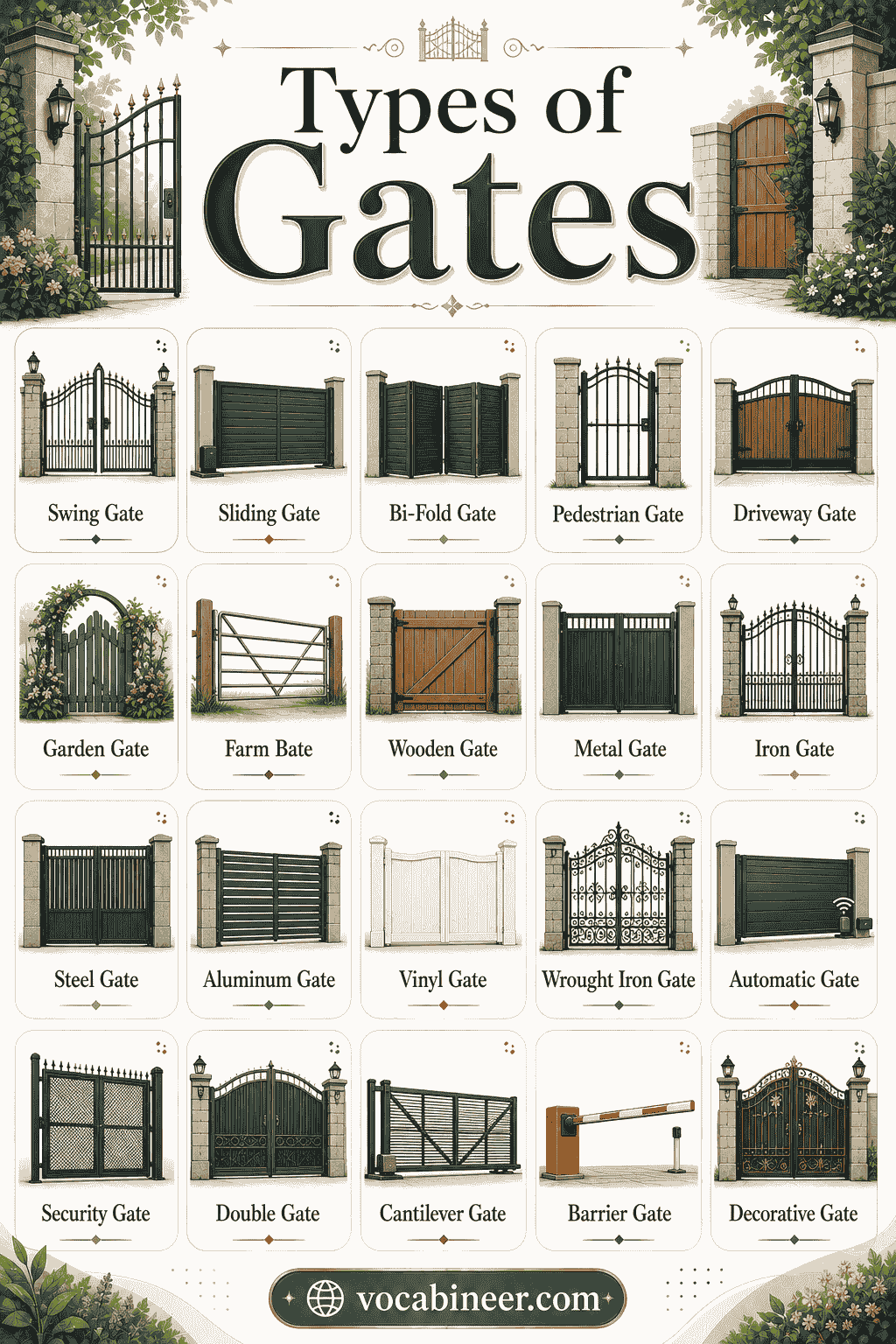
- Swing Gate — Opens inward or outward like a door and works well where the entrance has enough clear space.
- Sliding Gate — Moves sideways along a track and suits driveways or entrances with limited swing room.
- Bi-Folding Gate — Folds into panels and works well in compact areas that need quick opening.
- Cantilever Gate — Slides without a ground track, so it suits uneven surfaces, rough entrances, and sloped driveways.
- Rolling Shutter Gate — Rolls upward like a shutter and protects garages, shops, warehouses, and industrial spaces.
- Barrier Gate — Controls vehicle movement at parking lots, toll areas, offices, and restricted entrances.
- Pedestrian Gate — Allows easy walking access in yards, gardens, parks, schools, and residential entrances.
- Security Gate — Adds strong protection for homes, commercial buildings, storage areas, and restricted zones.
- Garden Gate — Creates a decorative entry point for gardens, backyards, courtyards, and outdoor paths.
- Driveway Gate — Secures vehicle entrances and improves the front look of a property.
- Farm Gate — Covers wide rural entrances and helps manage fields, livestock areas, and agricultural land.
- Pool Gate — Helps control access around swimming pools and supports safer pool-area movement.
- Garage Gate — Protects garages, parking spaces, workshops, and storage areas.
- School Gate — Controls access for students, staff, visitors, and vehicles near school entrances.
- Industrial Gate — Protects factories, warehouses, loading areas, and heavy-use commercial spaces.
- Vertical Lift Gate — Moves upward and suits places where side space or swing clearance is limited.
- Turnstile Gate — Allows one person at a time, so it works well in offices, stations, stadiums, and public facilities.
- Bollard Gate — Blocks vehicle entry while still allowing pedestrian movement in controlled areas.
- Telescopic Gate — Uses multiple sliding panels to cover wide entrances while saving side space.
- Chain Link Gate — Offers a simple and cost-effective gate option for fences, yards, farms, and industrial areas.
Types of Gates by Opening Style
Gate opening style affects space use, convenience, installation, and daily movement. Because of this, the opening method matters as much as the gate material.
- Single Swing Gate — Uses one panel that opens like a door and suits small entrances, gardens, and pedestrian access.
- Double Swing Gate — Uses two panels that open from the center and fits wider driveways or large property entrances.
- Sliding Gate — Slides sideways along a track and works well where a swing gate does not have enough clearance.
- Bi-Folding Gate — Folds in sections and opens faster than many traditional swing gates.
- Cantilever Gate — Slides above the ground without a bottom track, which helps on uneven or dusty surfaces.
- Telescopic Gate — Uses overlapping sliding panels and covers wide spaces with less side room.
- Rolling Shutter Gate — Rolls upward into a compact coil and suits garages, shops, and industrial doors.
- Vertical Lift Gate — Moves straight upward and works in areas with limited horizontal space.
- Vertical Pivot Gate — Rotates upward around a pivot point and suits modern or high-security entrances.
- Folding Gate — Folds sideways like an accordion and works for shops, corridors, and compact openings.
Types of Gates by Location and Use
Different locations need different gate designs. For example, a garden gate focuses more on appearance, while an industrial gate needs strength and durability.
- Driveway Gates — Secure vehicle entrances and make the front of a home or building look more complete.
- Garden Gates — Add charm to outdoor spaces while controlling entry to gardens and yards.
- Pedestrian Gates — Give people a separate walking entrance near homes, parks, schools, and public paths.
- Farm Gates — Cover wide openings and help manage rural land, fields, and animal areas.
- Pool Gates — Control access to swimming pool areas and support safer movement around water.
- Garage Gates — Protect vehicles, tools, storage rooms, and workshop entrances.
- School Gates — Manage student, staff, visitor, and vehicle access around school areas.
- Commercial Gates — Protect offices, shopping areas, apartment complexes, and business entrances.
- Industrial Gates — Handle heavy use at factories, warehouses, loading zones, and restricted work areas.
- Parking Gates — Manage vehicle entry and exit in parking lots, malls, offices, and public buildings.
- Estate Gates — Create a formal entrance for large homes, villas, farms, and private properties.
- Side Gates — Provide smaller access points along the side of a house, wall, or boundary.
- Courtyard Gates — Control access to inner outdoor spaces and add privacy to homes or buildings.
- Community Gates — Secure gated communities, housing societies, and shared residential areas.
- Public Access Gates — Guide people through parks, stadiums, stations, institutions, and public facilities.
Types of Gates by Material
Gate material affects strength, appearance, cost, weight, weather resistance, and maintenance. In addition, the right material can match the style of a home, fence, garden, or commercial building.
- Wooden Gates — Add a warm and natural look to homes, gardens, farms, and traditional entrances.
- Steel Gates — Provide strong protection and suit homes, factories, warehouses, and commercial buildings.
- Aluminum Gates — Resist rust and work well for lightweight modern gate designs.
- Wrought Iron Gates — Combine strength with decorative patterns for classic, luxury, and formal entrances.
- Iron Gates — Offer a strong traditional gate option for homes, boundary walls, and secure entrances.
- Metal Gates — Include steel, iron, and aluminum designs for residential, commercial, and industrial use.
- PVC Gates — Resist moisture and need little maintenance, especially in simple residential spaces.
- Vinyl Gates — Offer a clean look and work well for low-maintenance garden or fence entrances.
- Chain Link Gates — Cost less than many solid gates and suit farms, yards, sports areas, and industrial fences.
- Composite Gates — Mix materials to create durable gates with a modern or wood-like finish.
- Glass Gates — Add a modern transparent look to luxury homes, pools, offices, and interior spaces.
- Bamboo Gates — Create a natural decorative look for gardens, resorts, patios, and outdoor paths.
- Mesh Gates — Allow visibility and airflow while controlling access to yards, warehouses, and utility areas.
- Timber Gates — Use strong wood construction for rustic homes, farms, and garden entrances.
- Stainless Steel Gates — Resist corrosion and suit modern homes, commercial areas, and coastal locations.
Manual and Automatic Gate Types
Gate operation also changes how people use an entrance. Moreover, automatic systems offer more convenience, while manual gates usually cost less and need simpler maintenance.
- Manual Gate — Opens by hand and suits homes, gardens, farms, and low-traffic entrances.
- Automatic Gate — Opens with a motor, remote, keypad, sensor, or app for easier daily access.
- Electric Gate — Uses an electric motor to open and close the gate smoothly.
- Remote-Controlled Gate — Opens from a distance and helps drivers enter without leaving the vehicle.
- Solar-Powered Gate — Uses solar energy and works well where direct electrical wiring is difficult.
- Smart Gate — Connects with apps or smart home systems for modern access control.
- Keypad Gate — Allows entry through a numeric code and suits homes, offices, and shared spaces.
- Sensor Gate — Opens through motion, vehicle detection, or safety sensors.
- Intercom Gate — Lets visitors speak to the owner or guard before entry.
- Card Access Gate — Uses access cards and suits offices, apartments, schools, and controlled facilities.
Security and Access Control Gates
Security gates help manage entry, protect property, and control movement. However, different security gates serve different access needs.
- Security Gate — Protects homes, shops, schools, offices, warehouses, and restricted areas.
- Barrier Gate — Controls vehicle entry at parking lots, toll booths, checkpoints, and office entrances.
- Turnstile Gate — Allows one-person entry and helps manage crowds in public or commercial spaces.
- Bollard Gate — Blocks vehicles while keeping walking areas open for pedestrians.
- Pedestrian Access Gate — Controls foot traffic in schools, parks, offices, and apartment complexes.
- Parking Gate — Manages vehicle flow in parking lots, malls, hospitals, and commercial buildings.
- Commercial Entry Gate — Secures business entrances, office compounds, and shared building access points.
- Industrial Security Gate — Protects factories, warehouses, service yards, and loading areas.
- Anti-Climb Gate — Uses a design that makes climbing difficult, which improves boundary security.
- Access Control Gate — Works with keypads, cards, sensors, guards, or smart systems to manage entry.
Best Gate Types for Different Spaces
Different entrances need different gate types. Therefore, choosing a gate by space can prevent problems with opening clearance, slope, traffic, and daily use.
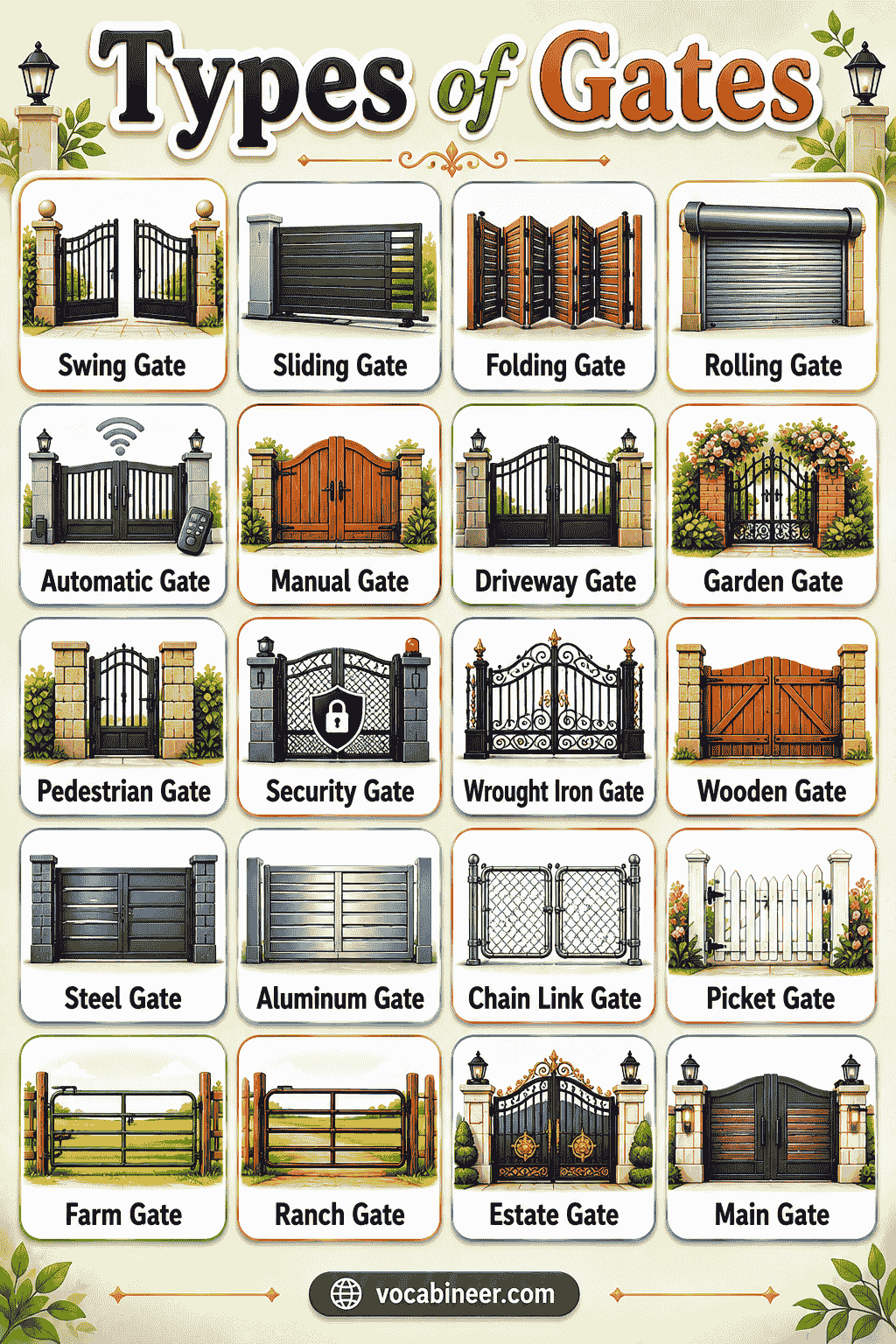
- Narrow Driveways — Sliding gates, bi-folding gates, and cantilever gates work well because they do not need a wide swing area.
- Sloped Driveways — Cantilever gates often work better because they do not need a ground track.
- Wide Entrances — Double swing gates, sliding gates, and telescopic gates can cover wider openings effectively.
- High-Traffic Areas — Automatic gates, barrier gates, and access control gates handle frequent movement better.
- Small Gardens — Pedestrian gates, wooden gates, vinyl gates, and decorative garden gates keep the space simple and attractive.
- Large Farms — Farm gates, chain link gates, metal gates, and timber gates handle wide rural access points.
- Commercial Buildings — Sliding gates, security gates, automatic gates, and barrier gates support controlled access.
- Industrial Areas — Rolling shutter gates, steel gates, industrial gates, and barrier gates suit heavy-duty use.
- Pool Areas — Pool gates and self-closing safety gates help control access around swimming areas.
- Modern Homes — Aluminum gates, glass gates, smart gates, and sliding gates match a clean modern style.
Difference Between Similar Gate Types
Some gate types look similar, but they work differently. As a result, a comparison helps readers choose the right gate for their space.
| Gate Types | Main Difference |
|---|---|
| Swing Gate vs Sliding Gate | Swing gates open inward or outward, while sliding gates move sideways to save swing space. |
| Sliding Gate vs Cantilever Gate | Sliding gates use a ground track, while cantilever gates slide without a bottom track. |
| Bi-Folding Gate vs Swing Gate | Bi-folding gates fold into panels, while swing gates open like regular doors. |
| Automatic Gate vs Manual Gate | Automatic gates use a motor or access system, while manual gates need hand operation. |
| Steel Gate vs Aluminum Gate | Steel gives more strength, while aluminum weighs less and resists rust. |
| Wooden Gate vs Metal Gate | Wooden gates create a natural look, while metal gates usually offer stronger security. |
| Barrier Gate vs Security Gate | Barrier gates control vehicle flow, while security gates protect property from unauthorized access. |
| Vertical Lift Gate vs Rolling Shutter Gate | Vertical lift gates rise as one panel, while rolling shutter gates roll upward into a coil. |
| Turnstile Gate vs Pedestrian Gate | Turnstile gates control one-person entry, while pedestrian gates allow simpler walking access. |
| PVC Gate vs Vinyl Gate | People often use these terms closely, but vinyl gates usually refer to a durable PVC-based fence gate style. |
Gate Type Comparison Chart
This chart compares common gate types by use, space need, security, durability, installation difficulty, and visual appeal. Overall, sliding, cantilever, and automatic gates work well for modern access, while wooden, garden, and wrought iron gates offer more decorative value.
| Gate Type | Best For | Space Use | Security | Durability | Installation Difficulty | Visual Appeal |
|---|---|---|---|---|---|---|
| Swing Gate | Homes and driveways | Medium | Medium | Medium | Easy to medium | Classic |
| Sliding Gate | Narrow entrances | Low | Medium to high | High | Medium | Modern |
| Bi-Folding Gate | Tight spaces | Very low | Medium | Medium | Medium to high | Stylish |
| Cantilever Gate | Sloped or rough ground | Low | High | High | High | Sleek |
| Rolling Shutter Gate | Garages and shops | Medium | High | High | Medium | Industrial |
| Automatic Gate | Daily vehicle access | Medium | High | Medium to high | High | Modern |
| Barrier Gate | Parking lots | Very low | Medium | Medium | Medium | Functional |
| Pedestrian Gate | Walkways and gardens | Low | Low to medium | Medium | Easy | Decorative |
| Farm Gate | Rural entrances | High | Medium | High | Easy to medium | Practical |
| Security Gate | Protected areas | Medium | Very high | High | Medium to high | Strong |
| Garden Gate | Yards and outdoor paths | Low | Low to medium | Medium | Easy | Attractive |
| Wrought Iron Gate | Decorative security | Medium | High | High | Medium | Elegant |
Types of Gates Chart with Pictures
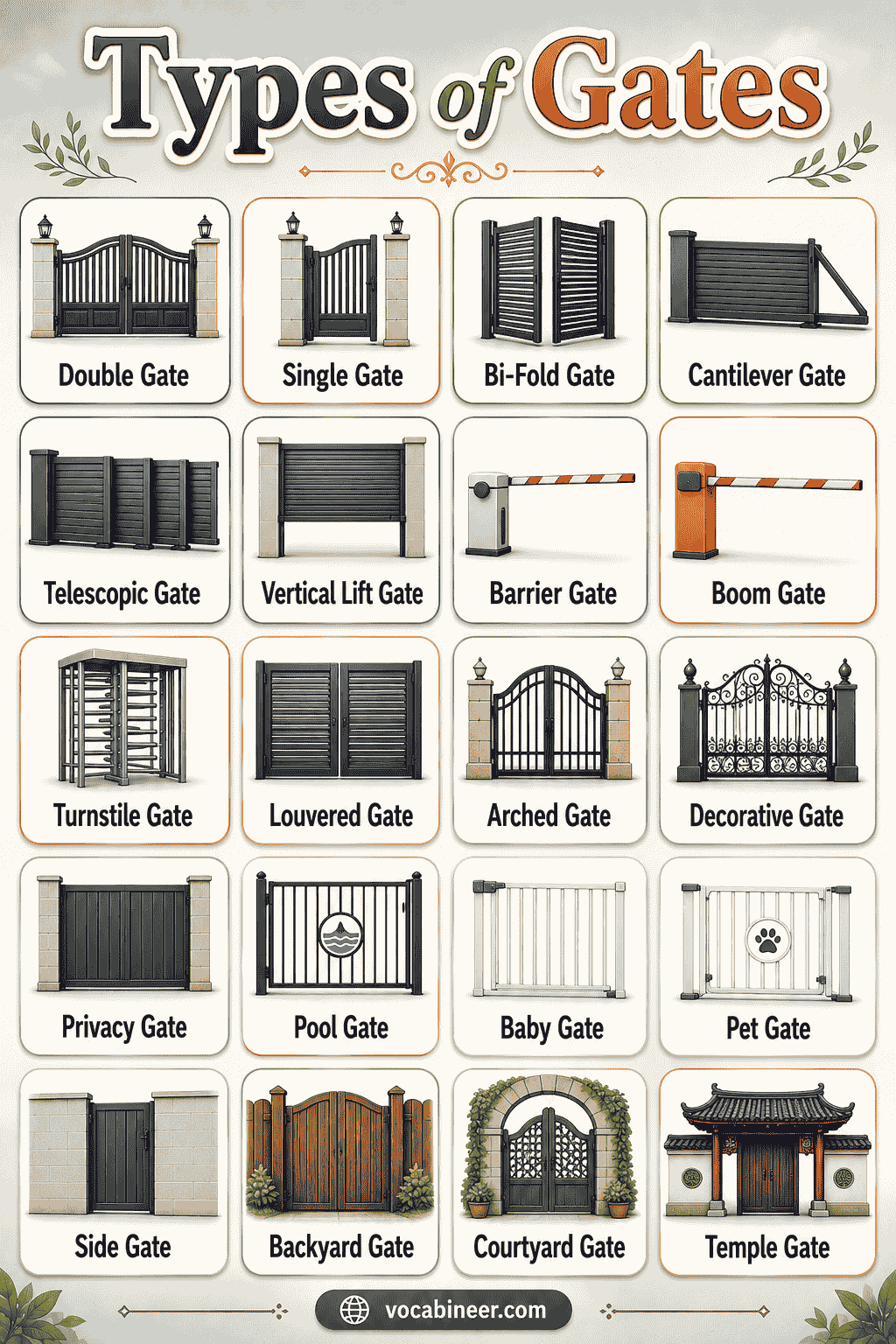
A types of gates chart helps learners compare gate groups quickly. In addition, it works well as a visual section for readers who want a quick overview before reading detailed explanations.
| Gate Group | Details |
|---|---|
| Opening Style Gates | Best for: choosing how a gate movesExamples: swing gate, sliding gate, bi-folding gate, cantilever gate |
| Location-Based Gates | Best for: choosing gates by place or purposeExamples: driveway gate, garden gate, farm gate, school gate |
| Material-Based Gates | Best for: choosing by strength, style, or maintenanceExamples: wooden gate, steel gate, aluminum gate, wrought iron gate |
| Automatic Gates | Best for: easy access and daily convenienceExamples: electric gate, smart gate, remote-controlled gate, sensor gate |
| Security Gates | Best for: protection and controlled entryExamples: security gate, barrier gate, turnstile gate, bollard gate |
| Space-Saving Gates | Best for: narrow entrances and limited clearanceExamples: sliding gate, bi-folding gate, telescopic gate, vertical lift gate |
| Decorative Gates | Best for: homes, gardens, and stylish entrancesExamples: garden gate, wooden gate, wrought iron gate, glass gate |
| Heavy-Duty Gates | Best for: farms, factories, warehouses, and commercial areasExamples: industrial gate, farm gate, rolling shutter gate, steel gate |
Safety and Maintenance Tips for Gates
Gate safety matters because people use gates daily. Therefore, a good gate should open smoothly, lock properly, and remain visible to drivers and pedestrians.
Automatic gates also need extra care because motors, sensors, remotes, and access systems control movement. For this reason, owners should check sensors, tracks, hinges, locks, and warning signs regularly.
- Check hinges and rollers — Loose hinges or worn rollers can make a gate hard to open and unsafe to use.
- Clean sliding tracks — Dirt, stones, and leaves can block sliding gates and damage the movement system.
- Service automatic motors — Regular servicing helps electric and automatic gates move smoothly.
- Apply rust protection — Paint, coating, or anti-rust treatment helps metal gates last longer.
- Inspect locks and latches — Strong locks keep gates secure and prevent accidental opening.
- Check safety sensors — Sensors help automatic gates detect people, vehicles, or objects.
- Keep children away from moving gates — Children should not climb, push, or play near heavy gates.
- Improve visibility — Good lighting helps drivers and pedestrians see gates clearly at night.
- Maintain wooden gates — Wood may need sealing, painting, or polishing to resist weather damage.
- Follow local rules — Electric gates may need safety features that match local building or access-control rules.
FAQs
The main types of gates include swing gates, sliding gates, bi-folding gates, cantilever gates, rolling shutter gates, barrier gates, pedestrian gates, garden gates, farm gates, driveway gates, and security gates.
Swing gates open inward or outward like doors, while sliding gates move sideways along a track. Therefore, sliding gates usually work better when the entrance has limited swing space.
Sliding gates, bi-folding gates, and cantilever gates work well for narrow driveways because they do not need a large opening arc.
Automatic gates can add convenience, security, and easier access, especially for homes, offices, parking areas, and high-traffic entrances.
Steel and wrought iron offer strong durability, while aluminum resists rust and works well in modern low-maintenance gate designs.
Read More
- Types of Flooring
- Bedroom Decor Items
- Popular Types of Tiles
- Types of Drinking Glasses
- Living Room Items Names
- Different Types of Houses
- Types of Rooms in a House