Stairs connect different levels in homes, offices, schools, public buildings, gardens, and outdoor spaces. In addition, stair designs help builders manage space, safety, movement, and visual style.
This guide explains common types of stairs with pictures and uses, including straight stairs, L-shaped stairs, U-shaped stairs, spiral stairs, curved stairs, floating stairs, wooden stairs, concrete stairs, metal stairs, and space-saving stair designs. Moreover, it helps learners compare stair shapes, materials, locations, safety levels, and best uses.
In This Page
What Are Stairs?
Stairs are a series of steps that help people move from one level to another. For example, people use stairs inside houses, outside entrances, in gardens, on terraces, and in commercial buildings.
A stair design can look simple, decorative, compact, wide, straight, curved, open, or closed. Therefore, the best stair type depends on the available space, building style, safety needs, budget, and daily use.
Common Types of Stairs
Different stair types are named according to their shape, direction, structure, or purpose. Because of this, it becomes easier to compare stair designs before choosing the right one.
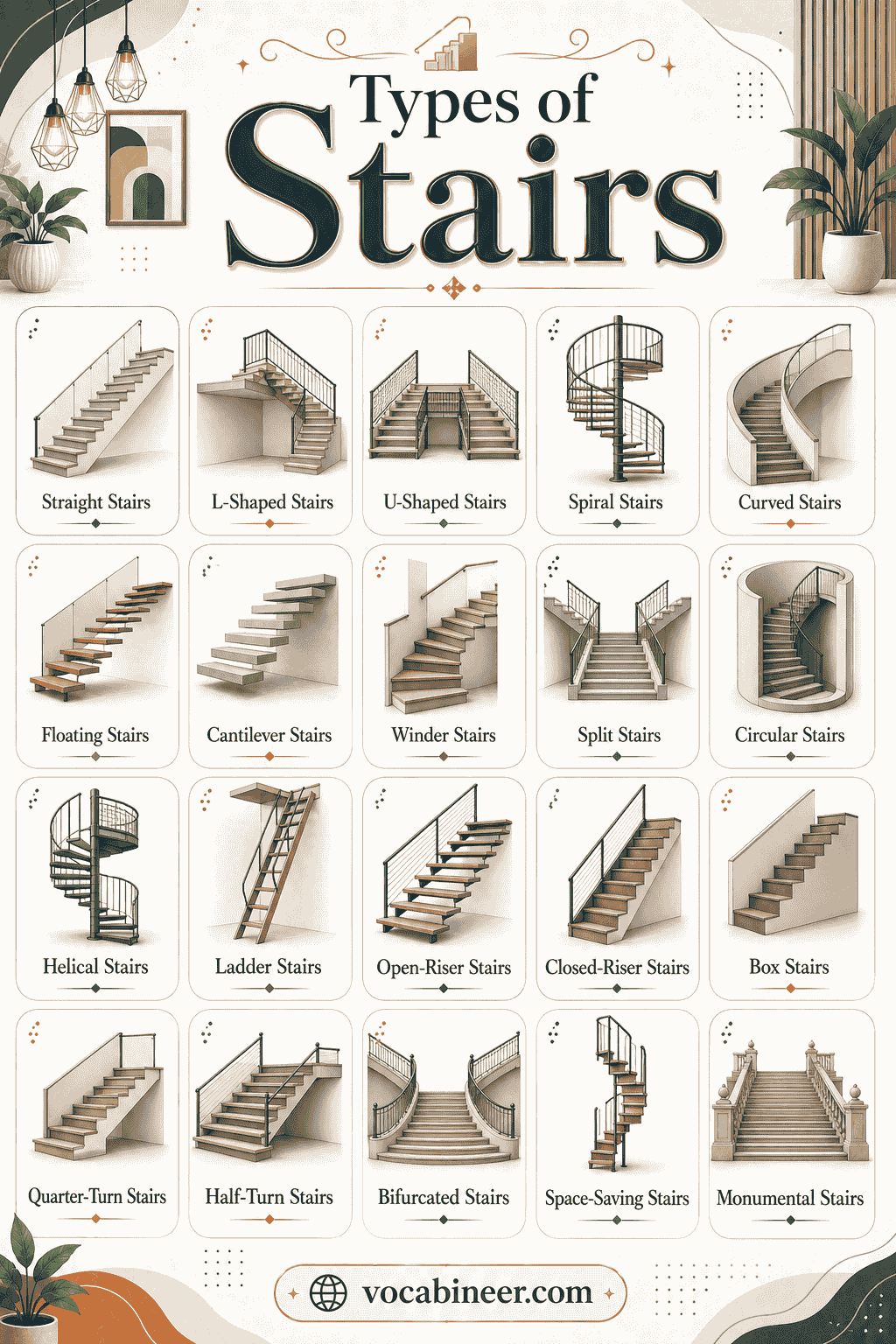
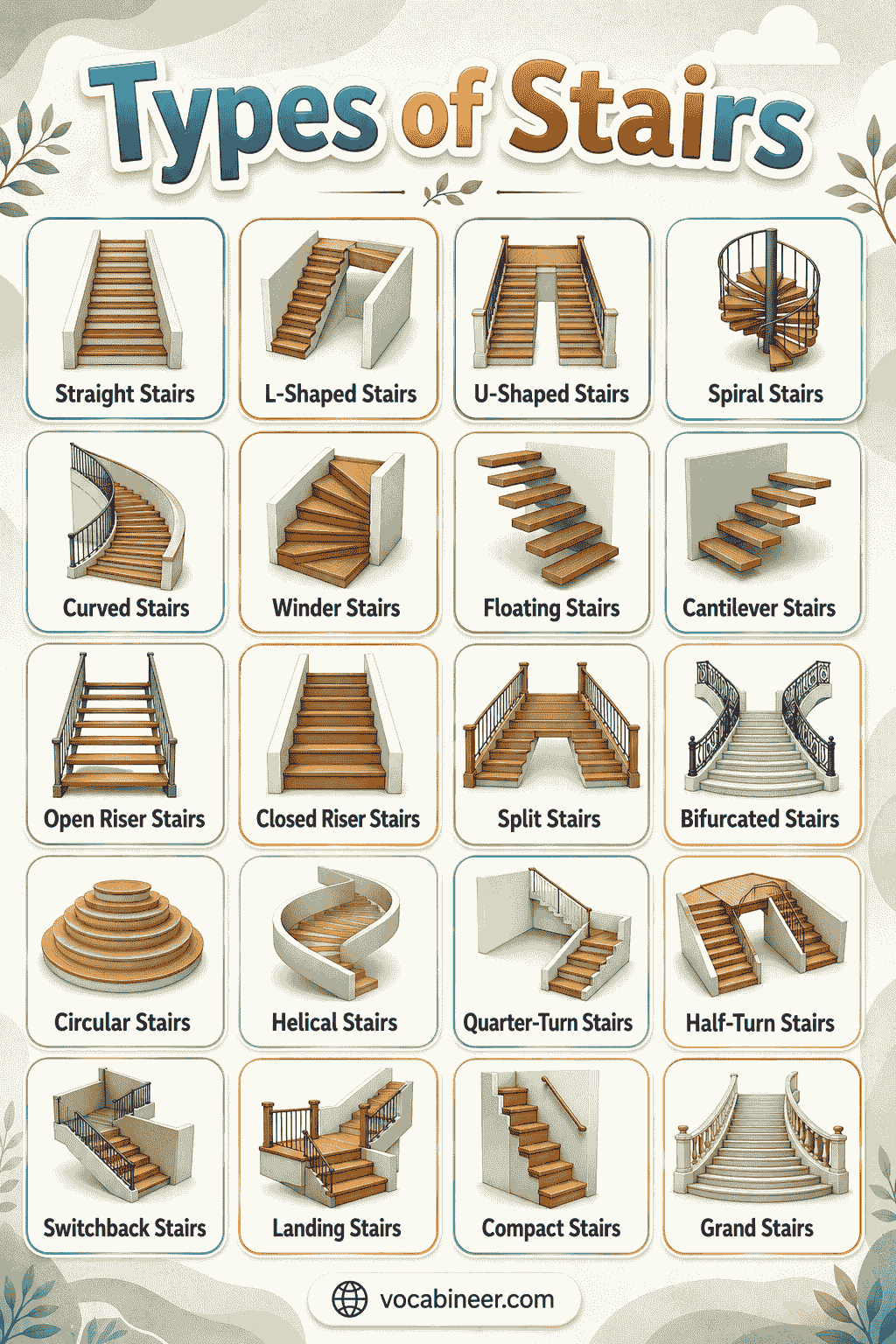
- Straight Stairs — A single linear flight with no turns, commonly used in simple home layouts and long straight spaces.
- L-Shaped Stairs — Stairs that turn at a right angle, usually with a landing between two flights.
- U-Shaped Stairs — Two stair flights connected by a landing, creating a 180-degree turn.
- Winder Stairs — Stairs that turn without a full landing, using wedge-shaped steps in the corner.
- Spiral Stairs — Compact stairs that wind around a central pole and work well in small spaces.
- Curved Stairs — Stairs with a smooth continuous curve, often used as an elegant design feature.
- Circular Stairs — Wide curved stairs that move around an open center without being as tight as spiral stairs.
- Bifurcated Stairs — A grand staircase that starts as one wide flight and splits into two smaller flights.
- Floating Stairs — Modern stairs where the steps appear to float with minimal visible support.
- Cantilever Stairs — Stairs with steps fixed into a wall or hidden support system for a floating effect.
- Switchback Stairs — Stairs that turn back in the opposite direction with a landing between flights.
- Quarter-Turn Stairs — Stairs that change direction by 90 degrees using a landing or winder steps.
- Half-Turn Stairs — Stairs that change direction by 180 degrees with a landing between the flights.
- Ladder Stairs — Steep and narrow stairs used for lofts, attics, or very limited spaces.
- Alternating Tread Stairs — Space-saving stairs with alternating steps for the left and right foot.
- Ship Stairs — Steep stairs with handrails, commonly used in ships, industrial areas, and compact access spaces.
- Split Stairs — A staircase design where the stairway divides into two paths.
- Open Riser Stairs — Stairs with open spaces between the treads for a lighter modern look.
- Closed Riser Stairs — Stairs with solid vertical risers between each step for a traditional and safer design.
- Outdoor Stairs — Stairs built outside buildings, gardens, terraces, entrances, or public areas.
Types of Stairs by Material
Stairs can also be grouped by the material used in their construction. The material affects strength, appearance, maintenance, cost, safety, and overall design.
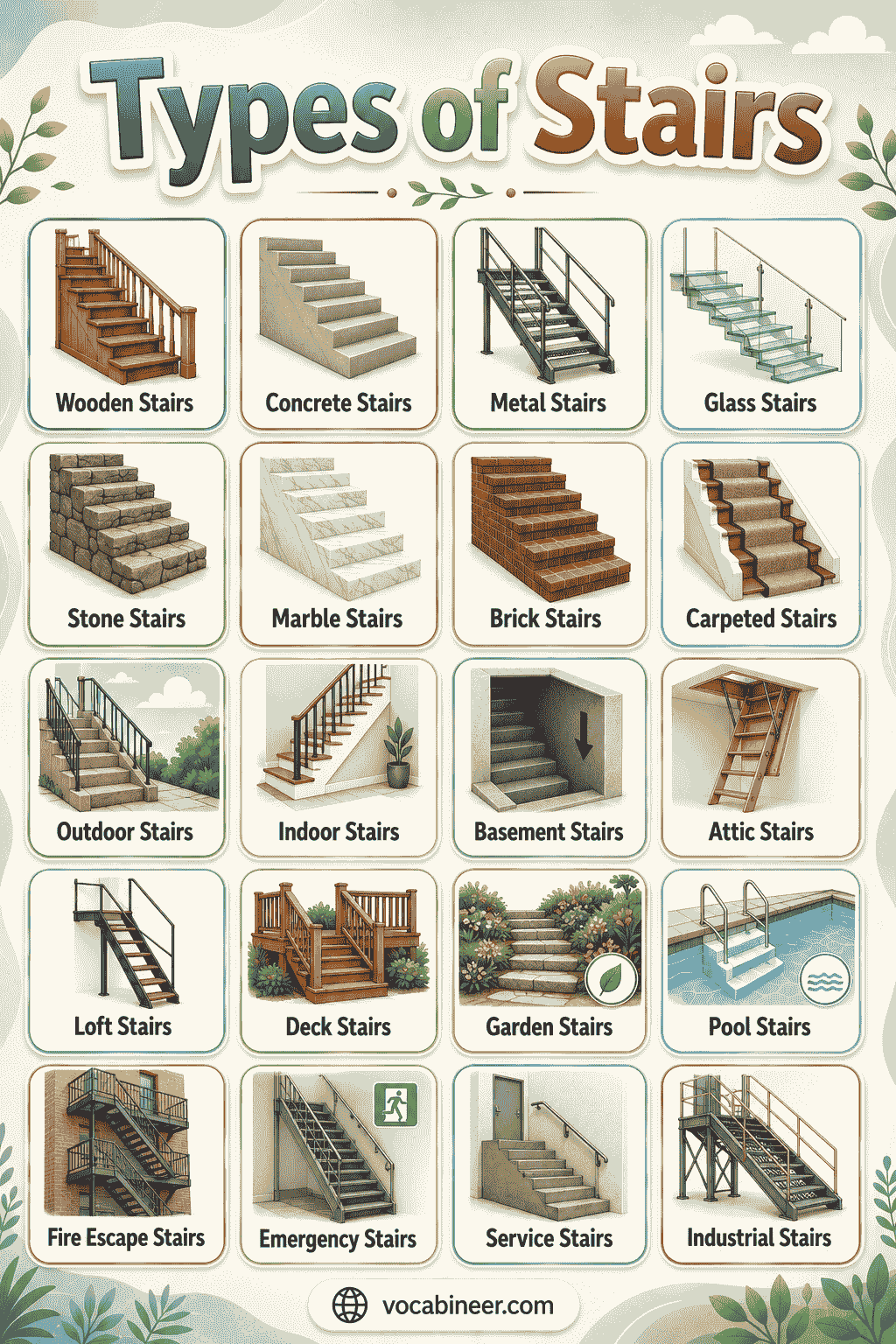
- Wooden Stairs — Classic stairs made from wood, often used in homes for a warm and natural look.
- Concrete Stairs — Strong and durable stairs commonly used in homes, commercial buildings, and outdoor spaces.
- Metal Stairs — Stairs made from steel, iron, or aluminum for modern, industrial, or heavy-duty designs.
- Glass Stairs — Stylish stairs with glass treads or railings, often used in luxury interiors.
- Stone Stairs — Durable stairs made from natural stone, commonly used outdoors or in formal spaces.
- Marble Stairs — Elegant stairs often used in luxury homes, hotels, halls, and grand entrances.
- Brick Stairs — Strong outdoor stairs often used in gardens, porches, and traditional buildings.
- Tile Stairs — Stairs covered with tiles for easy cleaning and decorative appeal.
- Carpeted Stairs — Stairs covered with carpet for comfort, warmth, and better grip.
- Composite Stairs — Stairs made from mixed materials for durability, low maintenance, and modern style.
- Steel Frame Stairs — Stairs built with a steel structure for strength and industrial design.
- Timber Stairs — Wooden stairs made with structural timber for natural interior or exterior use.
- Granite Stairs — Hard stone stairs often used in entrances, outdoor steps, and premium buildings.
- Terrazzo Stairs — Decorative stairs made with stone chips and cement or resin for a polished finish.
- Tiled Concrete Stairs — Concrete stairs finished with tiles for both strength and decorative style.
Types of Stairs by Location and Use
Stair designs also change according to where they are used. Indoor stairs, outdoor stairs, compact stairs, and decorative stairs all serve different purposes.
- Indoor Stairs — Stairs used inside homes, apartments, offices, schools, and commercial buildings.
- Outdoor Stairs — Stairs used in gardens, entrances, terraces, parks, and public spaces.
- Residential Stairs — Stairs designed for homes and apartments where comfort and safety are important.
- Commercial Stairs — Stairs used in offices, malls, hotels, schools, and public buildings.
- Garden Stairs — Outdoor stairs used in landscapes, yards, and sloped garden areas.
- Basement Stairs — Stairs that connect the main floor to a basement or lower level.
- Attic Stairs — Compact stairs used to reach attic rooms or storage spaces.
- Loft Stairs — Space-saving stairs used in loft rooms, studios, and compact apartments.
- Terrace Stairs — Stairs used to access rooftops, terraces, or raised outdoor areas.
- Industrial Stairs — Strong stairs used in factories, warehouses, ships, and maintenance areas.
Space-Saving Stair Types
Some stairs are designed for small homes, lofts, studios, attics, and narrow layouts. However, these stairs may not always be the most comfortable choice for daily use.
- Spiral Stairs — Best for compact spaces because they use a small circular footprint.
- Ladder Stairs — Useful for attic access and very tight areas, but not ideal as main stairs.
- Alternating Tread Stairs — Save space by using separate left and right foot steps.
- Winder Stairs — Save corner space by replacing a full landing with wedge-shaped steps.
- Ship Stairs — Used where a standard staircase cannot fit.
- Compact Straight Stairs — Narrow straight stairs designed for smaller layouts with limited width.
Modern Stair Designs
Modern stair designs often focus on clean lines, open spaces, hidden support, and decorative materials. These stairs are commonly used in contemporary homes, luxury interiors, offices, and showpiece areas.
- Floating Stairs — Modern stairs where each step appears to be suspended in the air.
- Cantilever Stairs — Stairs supported from one side, often fixed into a wall for a minimalist look.
- Glass Stairs — Transparent or semi-transparent stairs used to create a light and open feeling.
- Metal Frame Stairs — Stairs with visible metal structure for a modern industrial style.
- Open Riser Stairs — Stairs with gaps between steps, often used in modern interiors.
- Curved Stairs — Elegant stairs used to create a soft and luxurious design statement.
- Bifurcated Stairs — Grand stairs used in large halls, hotels, and formal buildings.
Difference Between Similar Stair Types
Some stair types look similar, but they have important differences in shape, space use, comfort, and design purpose.
| Stair Types | Main Difference |
|---|---|
| Straight Stairs vs L-Shaped Stairs | Straight stairs go in one direction, while L-shaped stairs turn at a right angle. |
| L-Shaped Stairs vs U-Shaped Stairs | L-shaped stairs turn 90 degrees, while U-shaped stairs turn 180 degrees. |
| Winder Stairs vs L-Shaped Stairs | Winder stairs use wedge-shaped turning steps, while L-shaped stairs usually use a landing. |
| Spiral Stairs vs Circular Stairs | Spiral stairs turn tightly around a central pole, while circular stairs are wider and more open. |
| Curved Stairs vs Circular Stairs | Curved stairs have a smooth arc, while circular stairs follow a broader circular path. |
| Floating Stairs vs Cantilever Stairs | Floating stairs appear suspended, while cantilever stairs are supported from one side or wall. |
| Ladder Stairs vs Ship Stairs | Ladder stairs are very steep and simple, while ship stairs are steep but usually have better rails and treads. |
| Open Riser Stairs vs Closed Riser Stairs | Open riser stairs have gaps between steps, while closed riser stairs have solid vertical risers. |
Stair Type Comparison Chart
This chart compares common stair types by use, space need, climbing comfort, safety, and visual appeal.
| Stair Type | Best For | Space Use | Climbing Comfort | Safety Level | Visual Appeal |
|---|---|---|---|---|---|
| Straight Stairs | Simple homes and straight layouts | Medium to high | Easy | High | Simple |
| L-Shaped Stairs | Corner spaces and family homes | Medium | Easy | High | Balanced |
| U-Shaped Stairs | Multi-level homes and compact layouts | Medium | Easy | High | Neat |
| Winder Stairs | Tight corners | Low to medium | Moderate | Medium | Practical |
| Spiral Stairs | Lofts and small spaces | Very low | Moderate to hard | Medium | Decorative |
| Curved Stairs | Luxury interiors | High | Easy | High | Very high |
| Circular Stairs | Grand interiors | High | Easy to moderate | Medium to high | High |
| Bifurcated Stairs | Hotels and large halls | Very high | Easy | High | Very high |
| Floating Stairs | Modern interiors | Medium | Easy to moderate | Medium | High |
| Cantilever Stairs | Minimalist spaces | Medium | Moderate | Medium | High |
| Ladder Stairs | Attics and loft access | Very low | Hard | Low | Simple |
| Alternating Tread Stairs | Narrow spaces | Very low | Hard | Low to medium | Unusual |
| Ship Stairs | Industrial or compact access | Very low | Hard | Medium | Functional |
| Open Riser Stairs | Modern interiors | Medium | Moderate | Medium | High |
| Closed Riser Stairs | Homes and family spaces | Medium | Easy | High | Classic |
Types of Stairs Chart with Pictures
A types of stairs chart helps learners compare stair shapes, materials, and uses quickly.
| Stair Group | Details |
|---|---|
| Straight Stairs | Best for: simple layouts and easy construction Examples: straight flight stairs, closed riser straight stairs |
| Turned Stairs | Best for: corners and compact layouts Examples: L-shaped stairs, U-shaped stairs, quarter-turn stairs |
| Curved Stairs | Best for: luxury interiors and decorative spaces Examples: curved stairs, circular stairs |
| Space-Saving Stairs | Best for: small homes, lofts, and attics Examples: spiral stairs, ladder stairs, alternating tread stairs |
| Modern Stairs | Best for: contemporary homes and stylish interiors Examples: floating stairs, cantilever stairs, glass stairs |
| Outdoor Stairs | Best for: gardens, terraces, entrances, and public spaces Examples: concrete stairs, stone stairs, brick stairs |
| Material-Based Stairs | Best for: choosing by strength, cost, or design Examples: wooden stairs, metal stairs, marble stairs |
Safety Tips for Choosing Stairs
Stair safety matters because people use stairs every day in homes, schools, offices, and public buildings. Therefore, a good stair design should feel comfortable to climb, easy to see, and safe for children, elderly people, and frequent users.
Choose stairs with proper step size, strong handrails, good lighting, and slip-resistant materials. Also, avoid very steep stair types such as ladder stairs, ship stairs, and alternating tread stairs for main daily access unless local building rules allow that design.
FAQs
The main types of stairs include straight stairs, L-shaped stairs, U-shaped stairs, winder stairs, spiral stairs, curved stairs, circular stairs, floating stairs, ladder stairs, alternating tread stairs, ship stairs, and bifurcated stairs.
Spiral stairs, ladder stairs, alternating tread stairs, winder stairs, and ship stairs are commonly used in small spaces because they take less floor area than standard straight stairs.
Straight stairs, L-shaped stairs, U-shaped stairs, and half-turn stairs are usually more comfortable for regular home use because they are easier to climb and can include proper landings and handrails.
Spiral stairs turn tightly around a central pole, while curved stairs follow a wider and smoother curve without a tight central column.
Common stair materials include wood, concrete, metal, glass, stone, marble, brick, tile, carpet, granite, steel, and composite materials.
Read More
- Types of Flooring
- Bedroom Decor Items
- Popular Types of Tiles
- Types of Drinking Glasses
- Living Room Items Names
- Different Types of Houses
- Types of Rooms in a House