

Pans are common kitchen tools used for frying, sautéing, searing, simmering, baking, roasting, and grilling. A frying pan can cook eggs, a saucepan can make sauce, a wok can stir-fry vegetables, and a sheet pan can roast food in the oven.
Learning pan names helps beginners, students, home cooks, and English learners understand kitchen vocabulary more clearly. This guide explains common types of pans, their uses, materials, shapes, care tips, confusing terms, and simple examples.
In This Page
What Is a Pan?
A pan is a cooking vessel used to prepare food on a stove, in an oven, or sometimes under a broiler. Pans may be shallow, deep, flat, round, square, lidded, or open.
Common pans include:
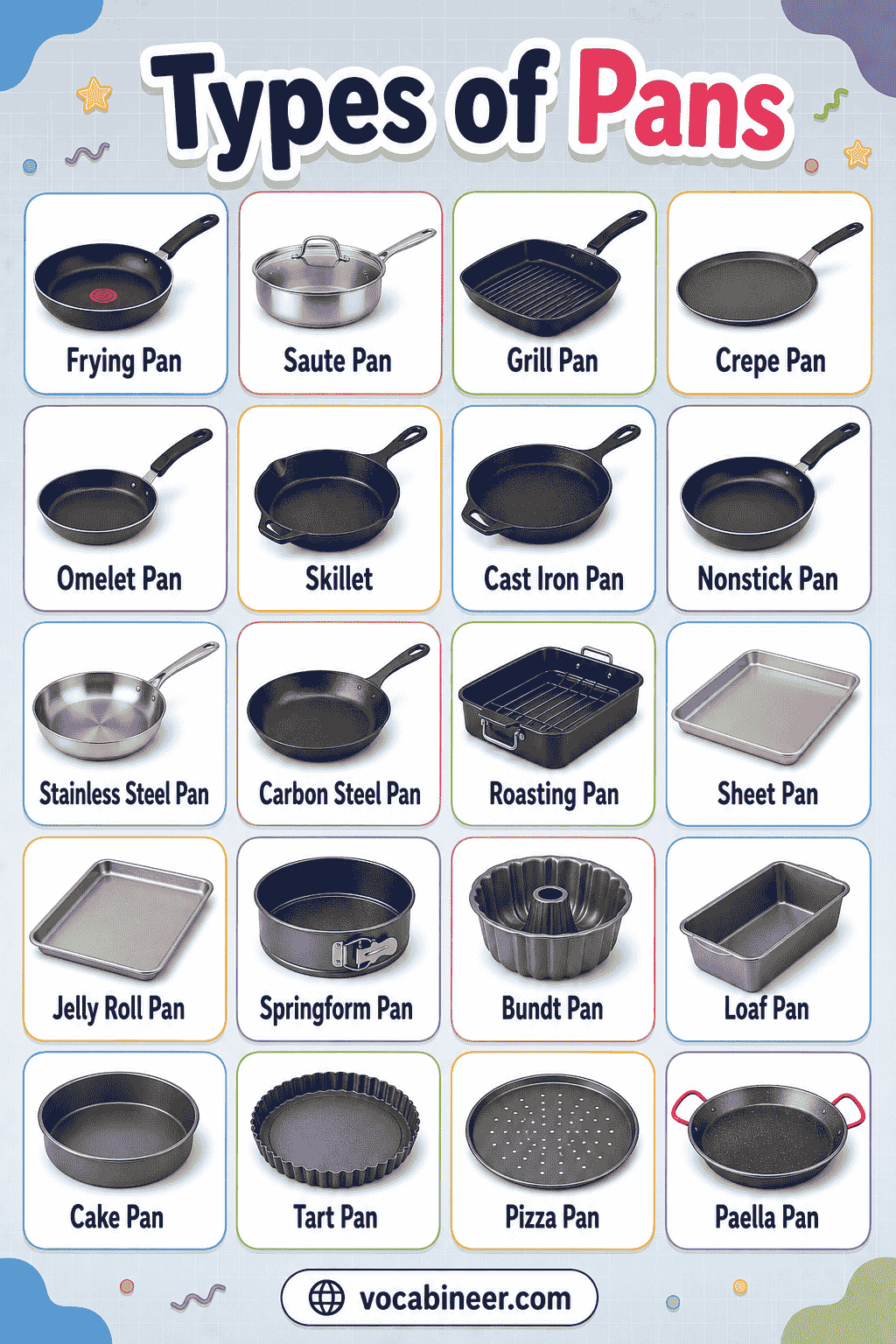
- Frying pan — A shallow pan used for frying eggs, vegetables, meat, and other foods.
- Skillet — A sturdy pan often used for searing, browning, frying, and everyday cooking.
- Saucepan — A deeper pan with a handle, used for sauces, soups, milk, and small portions.
- Sauté pan — A straight-sided pan used for sautéing, simmering, and cooking foods with sauce.
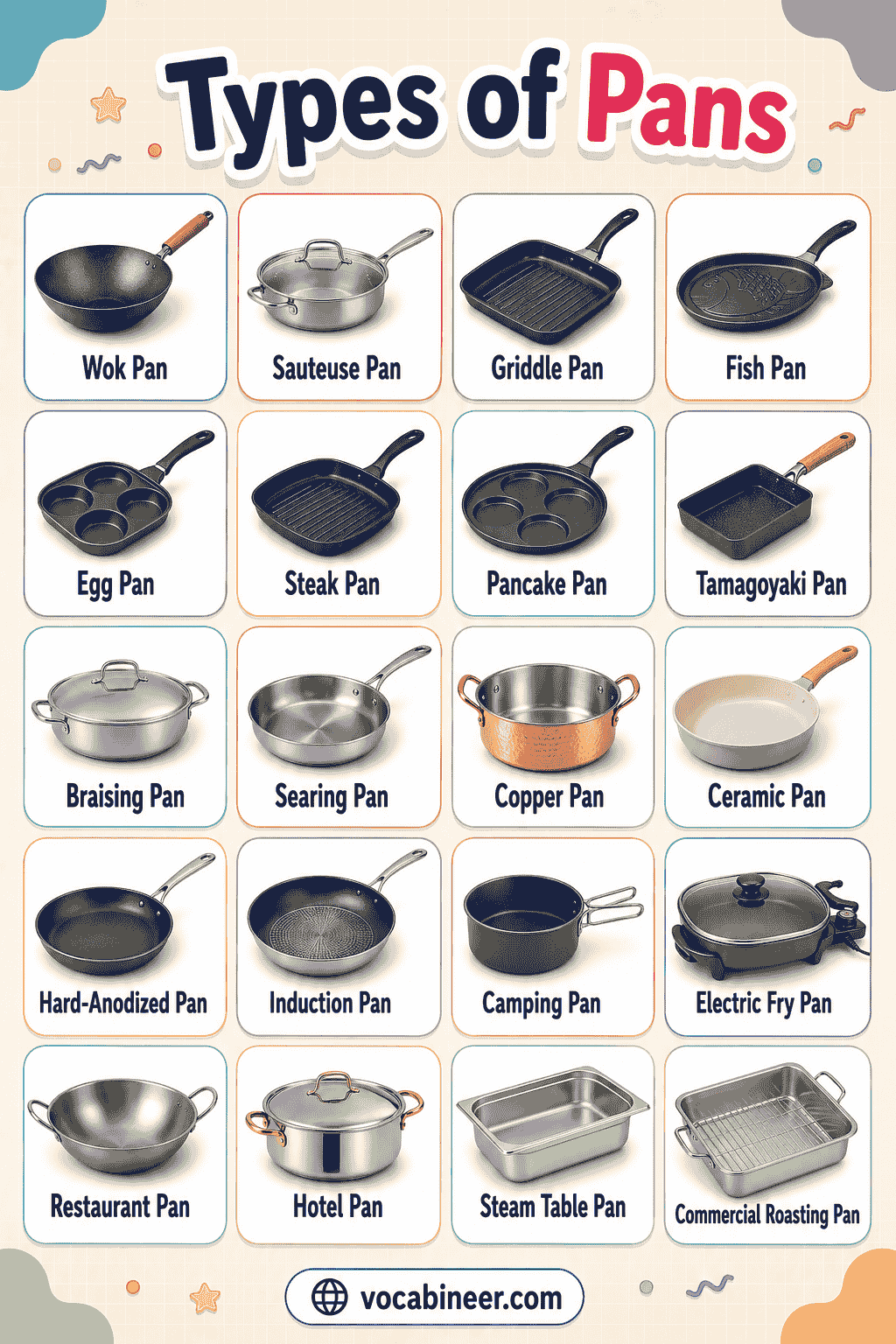
- Wok — A deep rounded pan used for stir-frying and quick high-heat cooking.
- Griddle — A flat pan used for pancakes, eggs, toast, and flat foods.
- Roasting pan — A large oven pan used for roasting meat, poultry, or vegetables.
- Sheet pan — A flat rectangular oven pan used for baking and roasting.
Pan vs Pot vs Cookware: What Is the Difference?
The words pan, pot, and cookware are connected, but they do not mean exactly the same thing.
| Term | Simple Meaning | Examples |
|---|---|---|
| Pan | Usually wider or shallower cookware used for frying, sautéing, baking, or roasting | Frying pan, skillet, sauté pan, sheet pan |
| Pot | Usually deeper cookware used for boiling, simmering, soups, or large liquids | Stockpot, soup pot, pasta pot |
| Cookware | A broad word for cooking vessels used in the kitchen | Pans, pots, skillets, woks |
Essential Pans Every Kitchen Needs
A kitchen does not need every pan, but a few basic pans can handle most daily cooking tasks.
- Frying pan or skillet — Useful for eggs, vegetables, chicken, fish, pancakes, and quick meals.
- Saucepan — Useful for sauces, soups, milk, oatmeal, tea, and small portions.
- Sauté pan — Useful for vegetables, sauces, pasta dishes, shallow frying, and one-pan meals.
- Sheet pan — Useful for roasted vegetables, cookies, fries, snacks, and oven meals.
- Roasting pan — Useful for roasted chicken, meat, turkey, potatoes, and larger oven dishes.
- Nonstick pan — Useful for eggs, pancakes, fish, and delicate foods.
- Cast iron skillet — Useful for searing, frying, baking, and high-heat cooking.
- Griddle — Useful for pancakes, toast, eggs, burgers, and flat foods.
Common Pan Names and Uses
Pans come in many shapes and styles, and each one works best for a different cooking task. Some pans are made for frying and searing, while others are better for sauces, stir-frying, roasting, baking, or everyday meals.
- Frying pan — A shallow pan used for frying, browning, and quick cooking.
- Skillet — A sturdy pan used for frying, searing, baking, and everyday meals.
- Sauté pan — A straight-sided pan used for sautéing, simmering, and cooking with sauce.
- Saucepan — A deep pan with a handle, used for sauce, soup, milk, tea, and small portions.
- Saucier — A pan with rounded sides, used for whisking sauces, custards, and creamy mixtures.
- Wok — A deep rounded pan used for stir-frying vegetables, noodles, rice, and meat.
- Grill pan — A pan with raised ridges, used to give food grill marks.
- Griddle — A flat pan used for pancakes, eggs, toast, burgers, and flatbreads.
- Crepe pan — A flat shallow pan used for crepes and thin pancakes.
- Omelet pan — A small pan used for omelets and eggs.
- Roasting pan — A large oven pan used for roasting meat, poultry, and vegetables.
- Sheet pan — A flat rectangular pan used for baking, roasting, and heating food.
- Braiser — A wide pan with a lid, used for slow cooking, braising, and saucy dishes.
- Paella pan — A wide shallow pan used for paella and rice dishes.
- Cake pan — A baking pan used for cakes.
- Loaf pan — A deep rectangular pan used for bread, loaf cakes, and meatloaf.
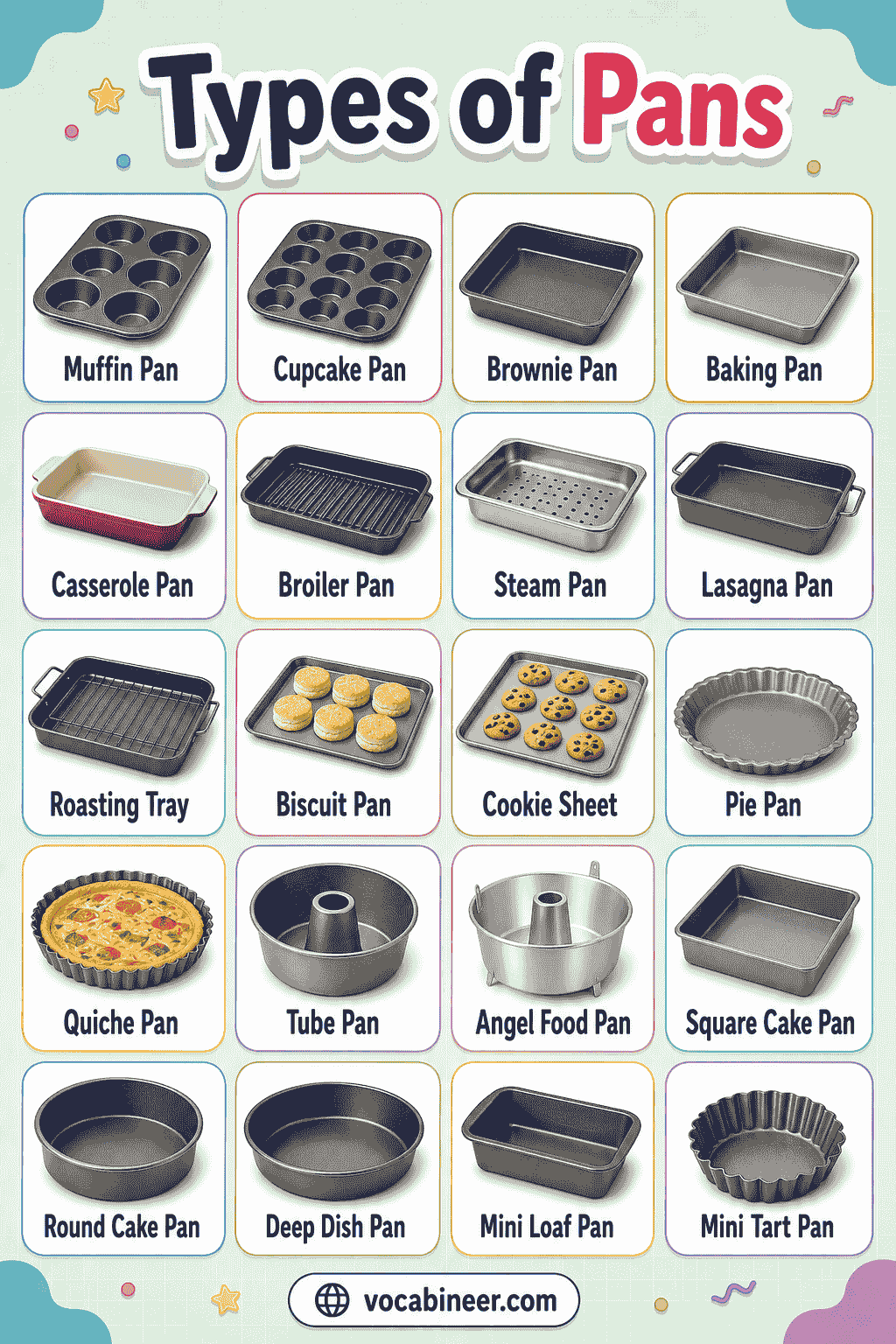
- Muffin pan — A pan with cups used for muffins and cupcakes.
- Tart pan — A shallow pan used for tarts and quiches.
- Springform pan — A cake pan with removable sides.
- Bundt pan — A round decorative pan used for ring-shaped cakes.
Pan Parts and Features
Pan parts and features affect how a pan cooks food. These words also help readers understand product labels and kitchen instructions.
- Base — The bottom part of the pan that touches the heat source.
- Sides — The walls of the pan; they may be straight, sloped, shallow, or deep.
- Rim — The top edge of the pan.
- Handle — The part used to hold or lift the pan.
- Helper handle — A small second handle used on heavier pans.
- Lid — A cover that traps heat and moisture.
- Coating — A surface layer, such as nonstick or enamel.
- Cooking surface — The inside area where food touches the pan.
- Spout — A small pouring edge found on some pans.
- Ridges — Raised lines in grill pans that create grill marks.
- Oven-safe design — A feature that allows the pan to go into the oven.
- Induction-safe base — A base that works on induction cooktops.
Types of Frying Pans and Skillets
Frying pans and skillets are used for quick cooking, frying, searing, and browning. They usually have a flat base and low sides.
- Frying pan — Best for eggs, vegetables, chicken, fish, and everyday frying.
- Skillet — Best for searing, browning, frying, and oven-friendly cooking.
- Nonstick frying pan — Best for eggs, pancakes, fish, and delicate foods.
- Cast iron skillet — Best for searing, frying, baking, and high-heat cooking.
- Stainless steel skillet — Best for browning meat, making pan sauces, and everyday cooking.
- Carbon steel skillet — Best for high-heat cooking, searing, and stir-style dishes.
- Ceramic-coated pan — Best for low-to-medium heat cooking.
- Omelet pan — Best for omelets, scrambled eggs, and small egg dishes.
- Crepe pan — Best for crepes and thin pancakes.
- Egg pan — Best for frying one or two eggs.
Sauce Pans and Sauté Pans
Sauce pans and sauté pans handle liquids, sauces, small portions, and foods that need more depth than a frying pan.
- Saucepan — Best for sauces, milk, soup, tea, oatmeal, noodles, and small boiling tasks.
- Saucier — Best for sauces, custards, gravies, and mixtures that need whisking.
- Sauté pan — Best for vegetables, chicken, pasta sauce, shallow frying, and one-pan meals.
- Milk pan — Best for warming milk, tea, or small liquids.
- Butter warmer — Best for melting butter, chocolate, or small sauce portions.
- Deep skillet — Best for saucy foods, larger meals, and shallow simmering.
- Braiser — Best for slow cooking, braising, and tender meat dishes.
Specialty Pans and Their Uses
Specialty pans are made for specific cooking tasks. Some are used on the stovetop, while others are made for baking or oven cooking.
- Wok — Best for stir-frying, fried rice, noodles, vegetables, and quick high-heat cooking.
- Grill pan — Best for grill marks on meat, vegetables, sandwiches, and fish.
- Griddle — Best for pancakes, eggs, burgers, toast, and flatbreads.
- Crepe pan — Best for crepes and thin pancakes.
- Omelet pan — Best for omelets, scrambled eggs, and small egg dishes.
- Paella pan — Best for paella, rice dishes, and wide shallow cooking.
- Roasting pan — Best for roasted chicken, turkey, meat, potatoes, and vegetables.
- Sheet pan — Best for cookies, roasted vegetables, fries, and oven snacks.
- Loaf pan — Best for bread, loaf cakes, banana bread, and meatloaf.
- Cake pan — Best for round, square, or layered cakes.
- Muffin pan — Best for muffins, cupcakes, and small baked portions.
- Tart pan — Best for tarts, quiches, and pastry dishes.
- Springform pan — Best for cheesecake and delicate cakes.
- Bundt pan — Best for decorative ring-shaped cakes.
- Pizza pan — Best for pizza and flat oven-baked foods.
- Broiler pan — Best for foods cooked under high oven heat.
Pans by Cooking Method
Different cooking methods need different pan shapes, materials, and depths.
- Frying — Frying pans, skillets, nonstick pans, and cast iron pans work well.
- Searing — Cast iron skillets, stainless steel skillets, and carbon steel pans work well.
- Sautéing — Sauté pans, skillets, and deep skillets work well.
- Simmering — Saucepans, sauciers, sauté pans, and braisers work well.
- Stir-frying — Woks and carbon steel pans work well.
- Grilling — Grill pans work well for indoor grill marks.
- Roasting — Roasting pans and sheet pans work well.
- Baking — Sheet pans, cake pans, muffin pans, loaf pans, and tart pans work well.
- Braising — Braisers, deep skillets, and lidded sauté pans work well.
- Melting — Butter warmers, milk pans, and small saucepans work well.
Stovetop Pans vs Oven Pans
Some pans work best on the stovetop, while others work best in the oven. A few pans can do both if they have oven-safe materials and handles.
| Pan Type | Best Use | Examples |
|---|---|---|
| Stovetop pans | Frying, sautéing, simmering, stir-frying | Frying pan, skillet, saucepan, wok |
| Oven pans | Baking, roasting, broiling | Sheet pan, cake pan, loaf pan, roasting pan |
| Stovetop-to-oven pans | Searing first, then finishing in the oven | Cast iron skillet, oven-safe sauté pan, braiser |
Common Pan Materials
Pan material affects heat control, durability, cleaning, weight, and cooking results.
- Stainless steel pans — Durable pans used for browning, searing, sauces, and everyday cooking.
- Cast iron pans — Heavy pans that hold heat well and work for searing, frying, and baking.
- Carbon steel pans — Lighter than cast iron and useful for high-heat cooking.
- Nonstick pans — Easy-release pans used for eggs, pancakes, fish, and delicate foods.
- Ceramic-coated pans — Coated pans used for low-to-medium heat cooking.
- Copper pans — Pans known for quick heat response, often used by experienced cooks.
- Aluminum pans — Lightweight pans that heat quickly.
- Hard-anodized aluminum pans — Strong aluminum pans with a durable surface.
- Enameled cast iron pans — Cast iron pans with enamel coating, often used for slow cooking.
- Glass baking pans — Oven pans used for casseroles, desserts, and baked dishes.
Pan Shapes, Sizes, and Capacity
Pan shape, size, and capacity affect how food cooks. A shallow pan helps food brown, while a deep pan holds more liquid.
- Shallow pans — Best for frying, searing, pancakes, and quick cooking.
- Deep pans — Best for sauces, stews, curries, pasta dishes, and larger portions.
- Straight-sided pans — Best for sautéing, simmering, and holding liquids.
- Sloped-sided pans — Best for flipping, stirring, and sliding food out.
- Wide pans — Best for browning food without crowding.
- Small pans — Best for eggs, sauces, butter, and small portions.
- Large pans — Best for family meals, large batches, and more ingredients.
- Round pans — Common for frying pans, skillets, cake pans, and saucepans.
- Square pans — Useful for brownies, cakes, and some baked dishes.
- Rectangular pans — Common for sheet pans, loaf pans, and roasting pans.
- Lidded pans — Useful for simmering, steaming, and keeping moisture inside.
Best Pans for Different Foods
Choosing a pan becomes easier when you match it to the food.
- Eggs — Nonstick frying pan, omelet pan, or small egg pan.
- Pancakes — Griddle or nonstick frying pan.
- Steak — Cast iron skillet, stainless steel skillet, or carbon steel pan.
- Chicken — Skillet, sauté pan, grill pan, or roasting pan.
- Fish — Nonstick pan, stainless steel pan, or grill pan.
- Vegetables — Skillet, sauté pan, wok, sheet pan, or roasting pan.
- Stir-fry — Wok or carbon steel pan.
- Sauces — Saucepan or saucier.
- Pasta sauce — Saucepan, sauté pan, or deep skillet.
- Curries — Sauté pan, deep skillet, braiser, or saucepan.
- Rice dishes — Sauté pan, paella pan, braiser, or deep skillet.
- Roasted vegetables — Sheet pan or roasting pan.
- Cakes — Cake pan, Bundt pan, or springform pan.
- Bread — Loaf pan.
- Muffins — Muffin pan.
Pan Safety and Care Tips
Good pan care helps pans last longer and keeps food safer to cook.
- Do not overheat nonstick pans.
- Use wooden, silicone, or nylon utensils on coated pans.
- Avoid metal tools on delicate nonstick surfaces.
- Let hot pans cool before washing them.
- Dry cast iron and carbon steel pans after washing.
- Season cast iron and carbon steel when needed.
- Check whether a pan is oven-safe before placing it in the oven.
- Check whether a pan works on induction if you use an induction cooktop.
- Avoid sudden temperature changes that can damage some pans.
- Store pans carefully to prevent scratches and dents.
Types of Pans Chart
| Pan Type | Best Used For |
|---|---|
| Frying pan | Eggs, vegetables, fish, chicken, and quick meals |
| Skillet | Searing, browning, frying, and everyday cooking |
| Saucepan | Sauces, soups, milk, tea, and small portions |
| Sauté pan | Sautéing, simmering, shallow frying, and saucy foods |
| Wok | Stir-fry, fried rice, noodles, and vegetables |
| Grill pan | Grill marks on meat, fish, vegetables, and sandwiches |
| Griddle | Pancakes, eggs, burgers, toast, and flat foods |
| Roasting pan | Roasted meat, poultry, potatoes, and vegetables |
| Sheet pan | Cookies, roasted vegetables, fries, and oven snacks |
| Cake pan | Cakes and baked desserts |
| Loaf pan | Bread, loaf cakes, and meatloaf |
| Muffin pan | Muffins and cupcakes |
Confusing Pan Terms Explained
Some pan terms sound similar. This table explains the differences simply.
| Terms | Simple Difference |
|---|---|
| Pan vs Pot | A pan is usually wider or shallower. A pot is usually deeper and better for liquids. |
| Pan vs Cookware | A pan is one type of cookware. Cookware includes pans, pots, skillets, and woks. |
| Frying pan vs Skillet | Many people use both words similarly, but skillets often sound heavier or more versatile. |
| Skillet vs Sauté pan | A skillet usually has sloped sides. A sauté pan usually has straight sides. |
| Saucepan vs Saucier | A saucepan has taller sides. A saucier has rounded sides for whisking sauces. |
| Wok vs Frying pan | A wok is deeper and rounded for stir-frying. A frying pan is flatter and shallower. |
| Griddle vs Grill pan | A griddle is flat. A grill pan has raised ridges. |
| Roasting pan vs Sheet pan | A roasting pan is deeper. A sheet pan is flatter. |
| Cake pan vs Springform pan | A springform pan has removable sides. A regular cake pan does not. |
| Cast iron vs Carbon steel | Cast iron is heavier and holds heat longer. Carbon steel is lighter and heats faster. |
How to Choose the Right Pan
Choose the right pan by matching it to the food, cooking method, and heat level. A nonstick frying pan works well for eggs, pancakes, and delicate fish, while a cast iron or stainless steel skillet works better for searing meat and browning food. Use a saucepan for sauces, soup, milk, and small liquids; choose a wok for stir-fry; use a sheet pan or roasting pan for oven cooking.
Material, size, and care also matter. Stainless steel is durable, cast iron holds heat well, nonstick is easy for beginners, and carbon steel works well for high-heat cooking. Choose a pan that fits your stove, food amount, and cleaning routine. For daily use, pick pans that feel comfortable to hold, clean easily, and match the meals you cook most often.
Easy Pan Names for Beginners
These pan names are useful for beginners, students, and English learners.
- Pan — A kitchen tool used for cooking food.
- Frying pan — A pan used for frying eggs, vegetables, and meat.
- Skillet — A sturdy pan used for frying and searing.
- Saucepan — A deep pan used for sauces, soup, and milk.
- Sauté pan — A pan used for cooking vegetables, meat, and saucy foods.
- Wok — A deep pan used for stir-fry.
- Grill pan — A pan with ridges used for grill marks.
- Griddle — A flat pan used for pancakes and eggs.
- Baking pan — A pan used in the oven.
- Cake pan — A pan used to bake cake.
- Roasting pan — A large pan used for roasting.
- Muffin pan — A pan with cups used for muffins.
- Loaf pan — A deep rectangular pan used for bread.
Simple sentences:
- Cook eggs in a frying pan.
- Make sauce in a saucepan.
- Use a wok for stir-fry.
- Bake a cake in a cake pan.
- Roast vegetables on a sheet pan.
- Use a griddle for pancakes.
- Sear steak in a cast iron skillet.
FAQs
The main types of pans include frying pans, skillets, saucepans, sauté pans, woks, grill pans, griddles, roasting pans, sheet pans, cake pans, loaf pans, and muffin pans.
A pan is usually wider or shallower and works well for frying, sautéing, baking, or roasting. A pot is usually deeper and works better for boiling, simmering, soups, and large amounts of liquid.
A frying pan and skillet are very similar. Both are used for frying and quick cooking. The word skillet often suggests a heavier or more versatile pan, especially when people talk about cast iron skillets.
A medium frying pan or skillet is best for everyday cooking because it can cook eggs, vegetables, chicken, fish, pancakes, sandwiches, and quick meals.
Nonstick pans are often easiest for beginners because food releases easily and cleanup is simple. Stainless steel is durable, while cast iron and carbon steel need more care.
Read More
- Types of Serving Dishes
- Types of Drinking Glasses
- Types of Cups with Names
- Different Types of Bowls
- Different Types of Baskets
- Types of Keys with Names