

Warships protect naval forces, patrol important waters, operate aircraft, support amphibious missions, and perform specialized work at sea. Although many military vessels look similar from a distance, their designs and roles can differ greatly.
Learning the main types of warships becomes easier when ships are grouped by purpose. This guide explains modern surface combatants, submarines, amphibious ships, support vessels, historical warships, and the differences between commonly confused naval categories.
In This Page
What Is a Warship?
A warship is a naval vessel designed primarily for combat, fleet protection, patrol, deterrence, or another direct military mission at sea.
Some warships defend larger naval groups, while others operate aircraft, patrol coastal waters, travel below the surface, or clear sea mines. Their size and equipment depend on the mission they perform.
Common warship types include:
- aircraft carriers;
- amphibious assault ships;
- cruisers;
- destroyers;
- frigates;
- corvettes;
- patrol ships;
- fast attack craft;
- submarines;
- mine-warfare vessels.
Naval classifications are not universal. A ship called a frigate in one country may resemble a destroyer in another because navies use different traditions, missions, fleet structures, and naming systems.
How Warships Differ from Other Naval Vessels
Navies operate combat ships as well as vessels that provide transport, repair, medical care, surveying, or supplies.
A warship performs a direct military role. Aircraft carriers, destroyers, frigates, corvettes, and submarines normally belong to this category.
A naval vessel is a broader term. It can include warships, fleet oilers, repair ships, hospital ships, survey vessels, training ships, and ocean-going tugs.
| Term | Basic meaning | Examples |
|---|---|---|
| Warship | A vessel designed mainly for direct naval military operations | Destroyer, frigate, submarine |
| Surface combatant | A warship that operates mainly on the sea surface | Cruiser, destroyer, corvette |
| Naval auxiliary | A vessel that supports combat ships | Fleet oiler, repair ship |
| Amphibious vessel | A ship designed to transport and land personnel, vehicles, aircraft, or landing craft | LHD, LPD, landing ship |
| Military vessel | A broad term for ships and boats operated by armed forces | Warships, auxiliaries, patrol craft |
Support ships may carry defensive systems, but their main purpose remains logistics, medical care, repair, command, transport, or another supporting function.
Understanding Warship Types, Classes, and Names
Naval terminology becomes clearer once the difference between a ship type, class, individual name, and hull number is understood.
A ship type describes the broad category. A ship class identifies a group of vessels built to a related design, while the ship name belongs to one individual vessel.
| Term | Example | Meaning |
|---|---|---|
| Ship type | Destroyer | Broad warship category |
| Ship class | Arleigh Burke class | Group of ships built to a related design |
| Ship name | USS Arleigh Burke | Name of one individual ship |
| Hull designation | DDG | Service-specific code |
| Hull number | DDG-51 | Identifier assigned to a vessel |
Hull codes vary among navies. In the U.S. system, for example, DDG identifies a guided-missile destroyer, CG a guided-missile cruiser, and CVN a nuclear-powered aircraft carrier.
Prefixes also follow national traditions. Terms such as USS and HMS identify a navy or service convention rather than a ship type.
Main Types of Modern Warships
Modern navies operate large aviation ships, major surface combatants, smaller coastal vessels, submarines, amphibious ships, and specialized mine-warfare craft.
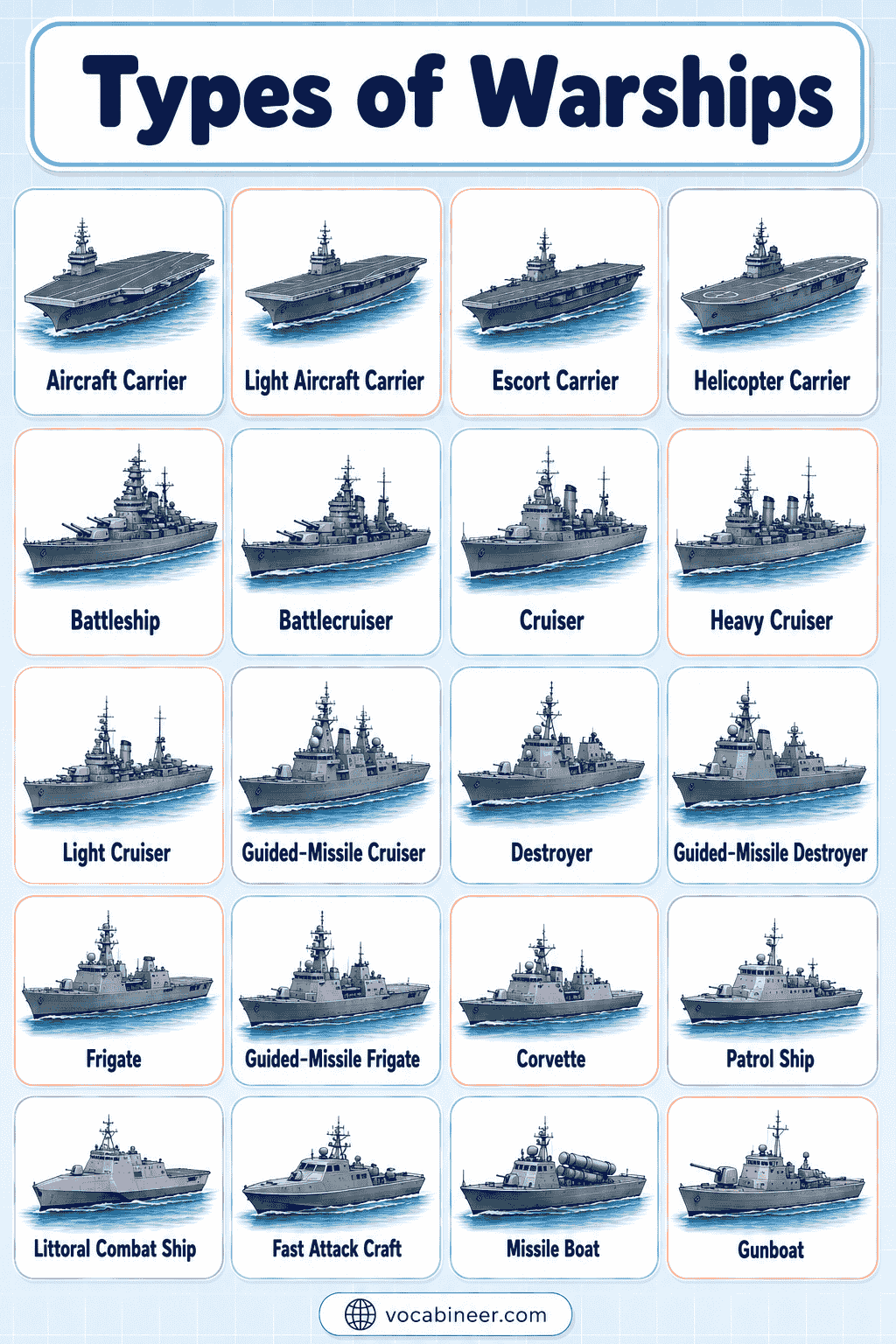
- Aircraft Carrier: A large warship that operates military aircraft from a full-length flight deck.
- Light Aircraft Carrier: A smaller carrier that operates fewer aircraft, often including helicopters and short-takeoff planes.
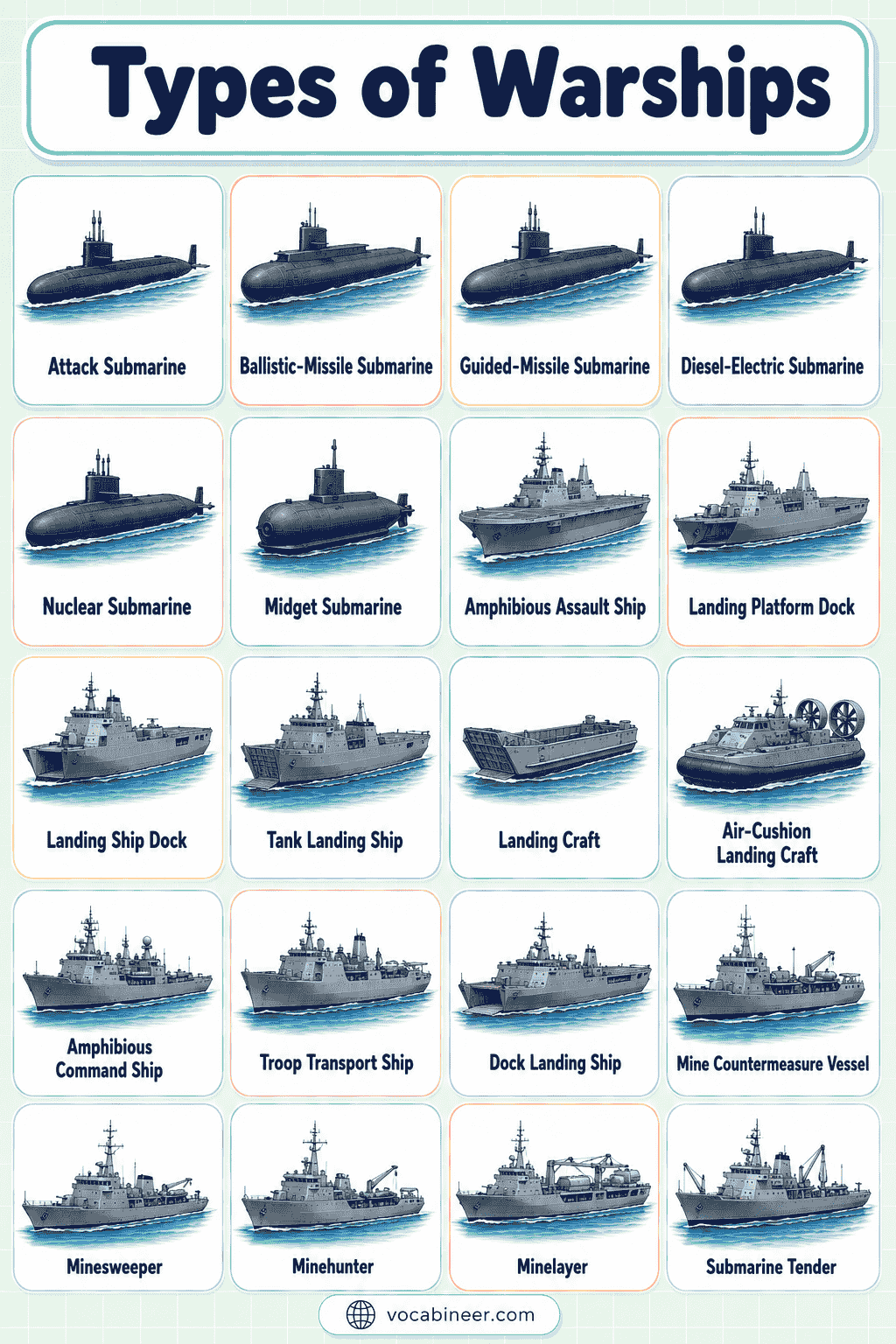
- Amphibious Assault Ship: A flat-deck vessel that carries aircraft, personnel, vehicles, supplies, and landing craft.
- Cruiser: A large surface combatant commonly associated with fleet defense, command, and long-range operations.
- Guided-Missile Cruiser: A cruiser equipped with advanced sensors and guided systems for several naval missions.
- Destroyer: A fast, heavily equipped warship that protects fleets and performs independent operations.
- Guided-Missile Destroyer: A modern destroyer designed for air defense, escort, surface operations, and other fleet duties.
- Frigate: A versatile escort vessel commonly used for patrol, fleet protection, and undersea surveillance.
- Guided-Missile Frigate: A frigate equipped with guided systems for defensive and general-purpose missions.
- Corvette: A smaller surface combatant suited to coastal, regional, patrol, and escort duties.
- Missile Corvette: A compact warship that combines guided systems with modern sensors.
- Offshore Patrol Vessel: A long-range patrol ship used for maritime security, border protection, and monitoring territorial waters.
- Coastal Patrol Craft: A smaller vessel that operates near coastlines, harbors, rivers, and narrow waterways.
- Fast Attack Craft: A small, high-speed combat vessel designed mainly for operations near coasts and islands.
- Missile Boat: A compact and fast warship built around guided antiship systems.
- Gunboat: A small armed vessel used for coastal patrol, river operations, and limited combat duties.
- Attack Submarine: A submarine used for surveillance, fleet protection, and operations against other naval vessels.
- Ballistic-Missile Submarine: A strategic submarine that carries long-range ballistic missiles.
- Guided-Missile Submarine: A submarine equipped with cruise missiles or other guided systems.
- Diesel-Electric Submarine: A conventionally powered submarine that uses diesel engines and batteries.
- Nuclear-Powered Submarine: A submarine whose reactor provides propulsion and extended underwater endurance.
- Mine Countermeasure Vessel: A specialized ship that detects, identifies, and clears naval mines.
- Minesweeper: A vessel designed to clear mines across a wider sea area.
- Minehunter: A vessel that searches for and handles individual naval mines.
- Minelayer: A military vessel designed to deploy naval mines.
Aircraft Carriers and Naval Aviation
Aircraft carriers serve as mobile aviation bases that allow military aircraft to operate far from land.
Fleet Aircraft Carrier: A fleet carrier supports sustained aviation operations and often forms the center of a larger naval group. Its flight deck, elevators, hangars, and control structure support aircraft launch, recovery, maintenance, and storage.
Light Aircraft Carrier: Smaller than a full-sized fleet carrier, a light carrier normally operates fewer aircraft. Some designs focus on helicopters and short-takeoff aircraft.
Historical Escort Carrier: Navies once used escort carriers to protect convoys, transport aircraft, and provide limited air support. They were generally smaller and slower than fleet carriers.
A broad flight deck is the clearest visual clue. However, not every flat-deck naval ship is a conventional aircraft carrier because some amphibious vessels have a similar appearance.
Amphibious Assault Ships
Amphibious assault ships move personnel, helicopters, vehicles, supplies, and landing craft from sea toward shore.
Landing Helicopter Assault Ship: Often shortened to LHA in U.S. terminology, this large ship uses a broad flight deck for helicopters and certain short-takeoff aircraft. It also supports personnel and equipment involved in amphibious operations.
Landing Helicopter Dock: An LHD combines a flight deck with an internal well deck that can launch landing craft.
The phrase helicopter assault ship may describe similar vessels more generally, although official classifications differ among navies.
These ships can resemble smaller aircraft carriers. Nevertheless, their central purpose usually involves transporting and supporting landing forces rather than operating only as fleet aviation bases.
Cruisers as Large Surface Combatants
Cruisers are generally large surface combatants associated with fleet defense, command, and long-range naval operations.
Guided-Missile Cruiser: A modern cruiser carries advanced sensors and guided systems for several defensive and offensive roles. It may protect a carrier group, coordinate fleet defense, or operate independently.
Historical Light Cruiser: Treaty-era definitions separated light cruisers largely by gun size. Despite the name, many were substantial ocean-going warships.
Historical Heavy Cruiser: Heavy cruisers carried larger guns than light cruisers under historical treaty classifications and often performed fleet or independent missions.
Few modern navies still use the cruiser designation. In addition, some destroyers now approach or exceed older cruisers in size, which makes the boundary less clear than it once was.
Destroyers as Multirole Warships
Destroyers are fast surface combatants designed to protect fleets and perform several independent missions.
Guided-Missile Destroyer: This modern destroyer supports air defense, surface warfare, escort, and other fleet tasks.
Air-Defense Destroyer: An air-defense destroyer emphasizes radar coverage and protection against airborne threats.
Historical Escort Destroyer: Smaller escort-focused designs protected convoys and larger ships, particularly from submarines and aircraft.
Destroyers originally developed to counter torpedo boats. Over time, they grew into large multirole combatants capable of patrol, escort, fleet defense, command support, and undersea-warfare missions.
Frigates as Versatile Escort Ships
Frigates are generally medium-sized surface combatants used for escort, patrol, maritime security, and fleet protection.
Guided-Missile Frigate: This frigate carries guided systems and sensors for several naval missions.
Antisubmarine Frigate: An antisubmarine frigate focuses on detecting and tracking submarines. Helicopter facilities often extend its search range.
General-Purpose Frigate: A general-purpose design balances escort, patrol, surveillance, and fleet-support duties.
Frigates often cost less to build and operate than larger destroyers. Even so, some modern frigates approach destroyer size and carry similarly advanced equipment.
Corvettes for Coastal and Regional Missions
Corvettes are usually smaller than frigates and often operate in coastal waters, enclosed seas, or regional naval areas.
Missile Corvette: A compact hull carries guided systems and modern sensors.
Antisubmarine Corvette: This design focuses on coastal and regional undersea surveillance.
Patrol Corvette: A patrol-oriented corvette performs maritime security, escort, and limited combat missions.
Stealth Corvette: Angled surfaces and carefully shaped structures help reduce some radar and infrared signatures.
Corvettes generally have smaller crews and shorter endurance than frigates. However, heavily equipped examples may resemble light frigates in both appearance and capability.
Patrol Ships and Fast Attack Craft
Smaller naval vessels protect coastlines, ports, territorial waters, and important maritime routes.
Offshore Patrol Vessel: An OPV conducts long-range patrol, border, fisheries-protection, and maritime-security missions. It usually carries lighter equipment than a frigate.
Coastal Patrol Craft: This smaller vessel operates closer to shore, around harbors, or in narrow coastal waters.
Fast Attack Craft: Built for speed and concentrated combat capability, these vessels usually operate near coastlines and islands.
Missile Boat: A missile boat is a small, fast warship built around guided antiship systems.
Historical Torpedo Boat: These small vessels used speed and torpedoes to threaten larger ships. Their development helped lead to the earliest destroyers.
Gunboat: A gunboat is a small armed vessel used for coastal, river, patrol, or limited combat duties.
Not every patrol ship is a front-line warship. Some focus mainly on law enforcement, border protection, search and rescue, or maritime monitoring.
Main Types of Military Submarines
Submarines may be classified by mission, propulsion system, or both.
Mission categories include attack, ballistic-missile, and guided-missile submarines. Propulsion categories include diesel-electric, air-independent, and nuclear-powered designs.
Attack Submarine: This submarine supports undersea surveillance, fleet protection, and operations against other naval vessels.
Ballistic-Missile Submarine: A strategic submarine carries long-range ballistic missiles and supports deterrence missions.
Guided-Missile Submarine: This type carries cruise missiles or other guided systems for long-range missions.
Diesel-Electric Submarine: Diesel engines and batteries provide power. The submarine normally uses battery power while submerged and must recharge periodically.
Nuclear-Powered Submarine: A nuclear reactor supplies propulsion and onboard energy, allowing long underwater endurance.
Air-Independent Propulsion Submarine: An AIP system can extend the submerged endurance of certain non-nuclear submarines.
Midget Submarine: This small submarine carries a limited crew and performs specialized coastal or support missions.
An attack submarine may use nuclear, diesel-electric, or another propulsion system. Therefore, mission and propulsion labels should not be treated as identical categories.
Mine-Warfare Vessels
Mine-warfare vessels detect, identify, clear, or deploy naval mines.
Minesweeper: A minesweeper clears mines across a wider area using specialized sweeping systems.
Minehunter: Rather than sweeping an entire zone, a minehunter searches for individual mines and deals with them one at a time.
Mine Countermeasure Vessel: This broader category combines mine detection, identification, and clearance functions.
Minelayer: A minelayer deploys naval mines. Other ships, submarines, and aircraft may also perform this role.
Modern mine countermeasures can also use helicopters, remotely operated vehicles, and unmanned systems.
Amphibious Transport and Landing Ships
From naval forces, amphibious vessels carry personnel, vehicles, equipment, and landing craft toward coastal landing areas.
Amphibious Transport Dock: Often called an LPD in U.S. terminology, an amphibious transport dock carries landing forces, aircraft, vehicles, and smaller boats. Through its internal well deck, landing craft can enter, load, and leave the ship.
Dock Landing Ship: Designed around a large well deck, a dock landing ship transports amphibious vehicles, equipment, and landing craft. Aviation facilities may also support helicopters during sea-to-shore operations.
Landing Platform Dock: Commonly used by navies outside the United States, this term describes a vessel broadly similar to an amphibious transport dock. Flight decks, transport spaces, and docking facilities support several landing operations.
Landing Ship Tank: Known historically as an LST, this ship delivered tanks, vehicles, supplies, and personnel directly onto or close to a beach. A bow ramp often helped unload cargo after arrival.
Landing Craft: Much smaller than ocean-going amphibious ships, landing craft cover the final distance between a larger vessel and the shore. Depending on their design, they can transport personnel, vehicles, equipment, or supplies.
Transport and sea-to-shore support remain their primary purposes, although some amphibious vessels also carry defensive systems.
Naval Support and Command Vessels
Support vessels keep deployed naval forces supplied, coordinated, repaired, and medically supported.
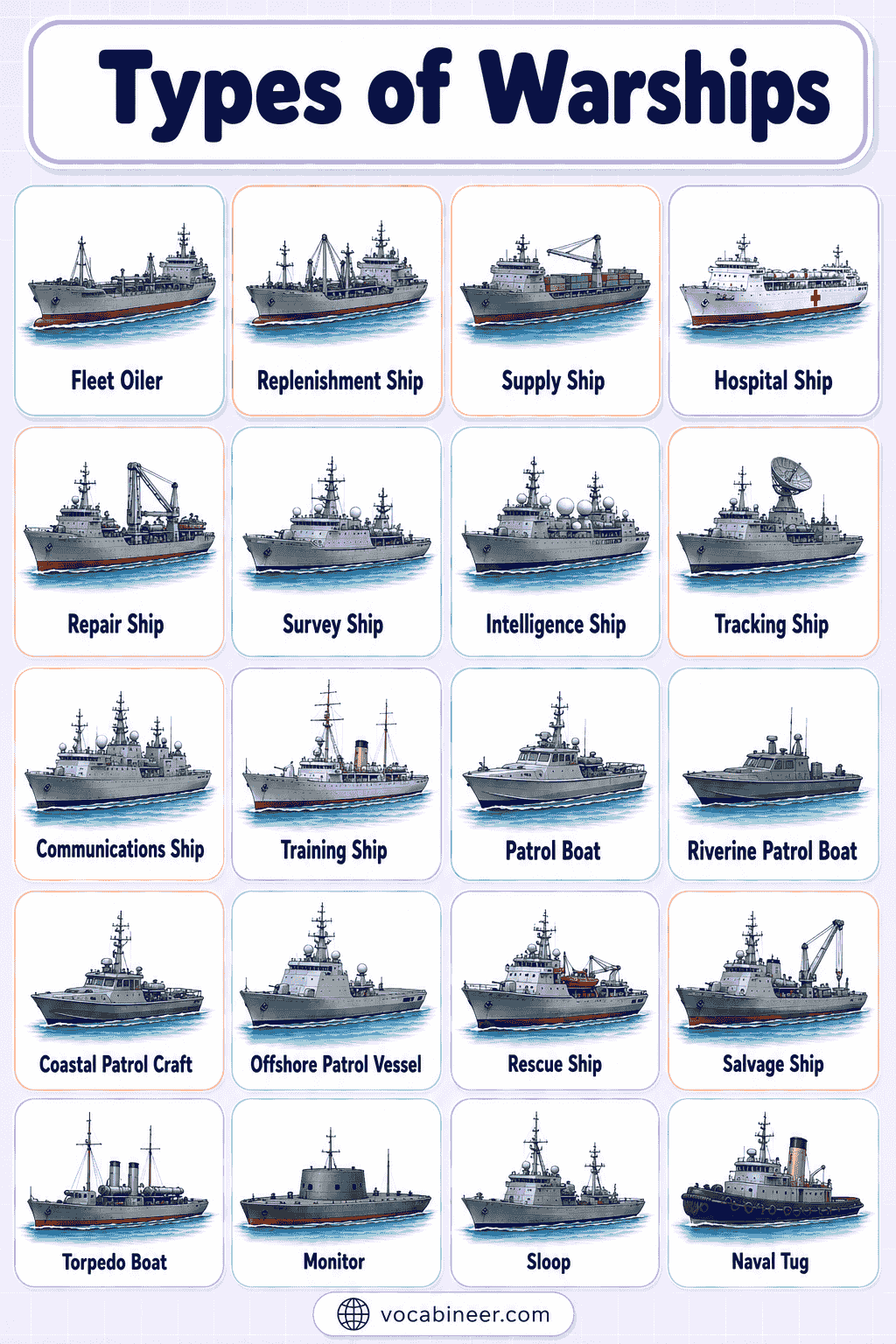
Fleet Oiler: While ships remain at sea, this vessel transfers fuel to them.
Replenishment Ship: Fuel, food, spare parts, and other supplies allow a deployed fleet to remain away from port longer.
Command Ship: Extensive communications and planning facilities help this vessel coordinate naval operations.
Hospital Ship: Medical spaces, treatment facilities, and patient accommodations support care at sea and humanitarian missions.
Repair Ship: Equipped with workshops and technicians, this vessel helps maintain or repair ships away from major naval bases.
These vessels support warships but are not always classified as warships themselves. Their value comes from extending the endurance and operating reach of an entire fleet.
Historical Warship Types and Their Uses
Naval technology changed greatly from the age of sail to armored, steam-powered, and missile-equipped fleets.
Battleship: A battleship was a large, heavily armored capital ship built around powerful naval guns. Battleships no longer serve as standard active fleet combatants.
Battlecruiser: Battlecruisers generally combined heavy armament and high speed with less protection than contemporary battleships, although designs varied.
Dreadnought: A dreadnought carried a main battery made up mostly of large guns of the same caliber. HMS Dreadnought gave the category its name.
Ship of the Line: During the age of sail, these large warships fought in organized battle formations and carried multiple gun decks.
Ironclad: Ironclads used iron armor to protect vessels that might otherwise have been built partly or largely from wood.
Torpedo Boat: Small size and high speed allowed these boats to threaten much larger ships with torpedoes.
Historical labels should not be applied automatically to modern vessels. A large destroyer does not become a battleship simply because it exceeds an older battleship in one measurement.
Destroyer vs. Frigate
Destroyers and frigates are both versatile surface combatants, but broad differences often remain.
| Destroyer | Frigate |
|---|---|
| Usually larger and more heavily equipped | Generally smaller or medium-sized |
| Often supports wider fleet defense | Commonly emphasizes escort and patrol |
| May carry greater sensor and system capacity | Usually operates with a smaller crew and lower cost |
| Frequently protects carriers or amphibious groups | Often protects shipping and other naval vessels |
| Can operate independently or with a fleet | Commonly supports larger formations |
These are general patterns, and national naming conventions create important exceptions.
Frigate vs. Corvette
Frigates and corvettes differ mainly in scale, endurance, and the waters in which they usually operate.
| Frigate | Corvette |
|---|---|
| Usually built for longer ocean-going missions | Often focused on coastal or regional waters |
| Generally has greater endurance | Usually has shorter endurance |
| Commonly performs fleet escort | Often performs patrol and local defense |
| Carries broader support facilities | Uses a more compact hull and crew |
| Typically larger | Generally smaller |
Some corvettes approach the size and capability of smaller frigates. Therefore, the official classification remains more reliable than appearance alone.
Cruiser vs. Destroyer
The traditional difference between cruisers and destroyers has become less clear in modern fleets.
| Cruiser | Destroyer |
|---|---|
| Traditionally a larger surface combatant | Historically developed as a smaller escort |
| Often associated with command and fleet defense | Commonly performs broad multirole missions |
| May operate independently over long distances | Often protects carriers and other fleet units |
| Used as an official label by relatively few modern navies | Remains a widely used modern category |
| Classification may reflect national policy | Modern examples may rival cruisers in size |
A modern destroyer can equal or exceed an older cruiser in size. Consequently, official designation and intended mission matter more than dimensions alone.
Aircraft Carrier vs. Amphibious Assault Ship
Both vessels may have long flight decks, but their primary missions differ.
| Aircraft carrier | Amphibious assault ship |
|---|---|
| Primarily supports sustained naval aviation | Primarily supports sea-to-shore operations |
| Usually operates a larger aviation group | Carries aircraft, landing forces, and vehicles |
| Centers on extensive fixed-wing and rotary-wing operations | Often emphasizes helicopters and short-takeoff aircraft |
| Serves as a mobile aviation base | Serves as an expeditionary transport platform |
| May not have a well deck | Many designs include a well deck |
Appearance alone can be misleading. Internal layout, embarked forces, aircraft mix, and mission priorities reveal the real difference.
Warship Names and Meanings for Kids
Children can remember warship vocabulary by connecting each vessel with one simple role.
- Aircraft Carrier: An aircraft carrier operates airplanes and helicopters at sea.
- Destroyer: A destroyer protects other ships and performs several naval missions.
- Frigate: A frigate escorts other ships and patrols the sea.
- Corvette: A corvette is a smaller warship for coastal or regional waters.
- Cruiser: A cruiser is a large surface warship.
- Submarine: A submarine travels mainly below the water.
- Patrol Ship: A patrol ship watches coastlines and territorial waters.
- Missile Boat: A missile boat is a small, fast warship that carries guided missiles.
- Minesweeper: A minesweeper helps clear dangerous sea mines.
- Amphibious Ship: An amphibious ship carries people, vehicles, and landing craft.
- Supply Ship: A supply ship brings fuel, food, and equipment to a fleet.
- Hospital Ship: A hospital ship provides medical care at sea.
- Battleship: A battleship was a heavily armored historical warship.
- Gunboat: A gunboat is a small armed vessel.
- Landing Craft: A landing craft carries people or vehicles toward shore.
Pictures, sorting activities, and ship-role matching can make these terms easier to remember.
Easy Sentences Using Warship Vocabulary
These short sentences show how naval words appear in context.
- The aircraft carrier operates planes at sea.
- A destroyer protects the naval group.
- The frigate escorts another ship.
- A corvette patrols coastal waters.
- The submarine travels below the surface.
- A patrol vessel monitors the coastline.
- The minesweeper clears a safe route.
- An amphibious ship carries vehicles and personnel.
- The replenishment ship delivers fuel and supplies.
- A hospital ship provides medical care.
Learners can replace the vessel or action to make new sentences. For example, The frigate patrols the sea can become The corvette patrols the harbor.
FAQs
The main groups include aircraft carriers, amphibious assault ships, cruisers, destroyers, frigates, corvettes, patrol ships, fast attack craft, submarines, and mine-warfare vessels.
A destroyer is generally larger and may carry broader fleet-defense capabilities. A frigate usually emphasizes escort, patrol, and undersea-protection duties, although national classifications vary.
Battleships no longer serve as standard active fleet warships. Modern navies rely more heavily on carriers, destroyers, frigates, submarines, and missile-equipped vessels.
An amphibious assault ship may resemble a carrier and operate several aircraft, but its main purpose involves transporting and supporting landing forces rather than serving only as a fleet aviation base.
A ship type is a broad category, such as destroyer or frigate. A ship class is a group of vessels built to a related design, while each individual vessel has its own name and hull number.
Read More
- 100+ Vehicles Name in English
- Types of Emergency Vehicles
- Construction Vehicle Names
- Different Types of Trucks
- Types of Four Wheelers
- Water Transport Names
- Military Vehicle Names