

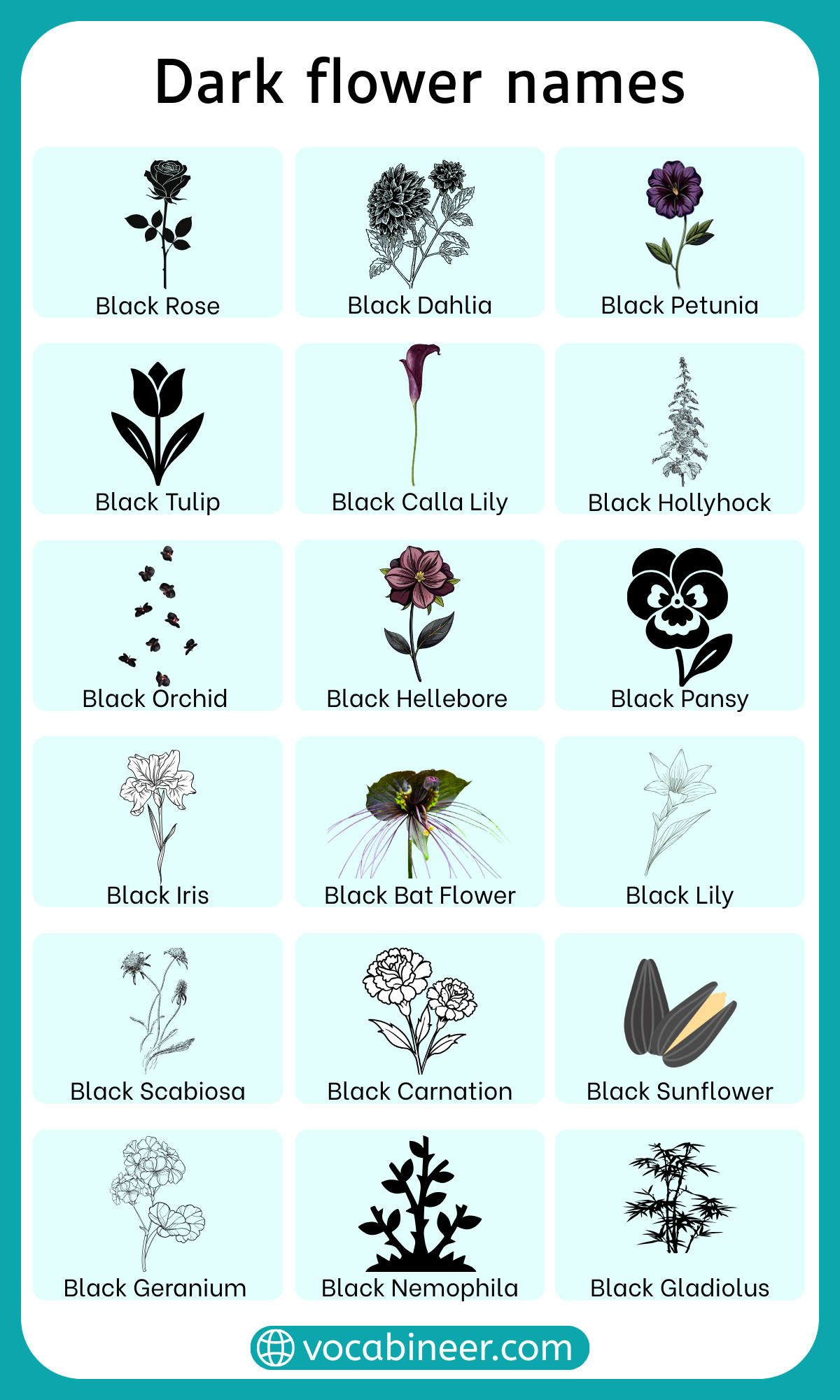
Dark flowers bring dramatic shades of purple, burgundy, maroon, chocolate, and near-black to gardens, bouquets, and floral displays. Although people commonly call them black flowers, most contain such concentrated red, blue, or purple pigments that their blooms only appear black, especially in shade or from a distance.
This guide presents 30 dark flower names with accurate color descriptions and identifying features. It includes familiar roses and tulips, unusual tropical blooms, verified cultivars, seasonal groups, symbolic meanings, and practical notes for recognizing each flower correctly.
In This Page
Common Dark Flower Names and Their Features
Dark flowers vary widely in form. Some produce velvety petals, while others display dark tepals, bracts, spathes, or flower centers. The following names cover near-black, purple-black, burgundy, maroon, and chocolate-colored blooms.
Arabian Night Dahlia
The ‘Arabian Night’ dahlia produces rounded, many-petaled blooms in deep burgundy-red. Its flowers often appear almost black in subdued light and make dramatic garden and bouquet accents.
Beaujolais Bonnets Scabiosa
‘Beaujolais Bonnets’ scabiosa displays burgundy flowers with darker purple-burgundy centers and contrasting pale stamens. Its pincushion-shaped blooms grow on slender stems and attract pollinators.
Black Baccara Rose
The ‘Black Baccara’ rose develops velvety petals in deep burgundy or dark red. It is not truly black, but tightly furled petals and low light can give the bloom a near-black appearance.
Black Barlow Columbine
‘Black Barlow’ columbine produces distinctive pompon-like flowers in deep purple-maroon. The layered, spurless blooms appear on upright stems during spring and early summer.
Black Bat Flower
The black bat flower, Tacca chantrieri, produces broad purple-black bracts resembling wings and long threadlike structures that look like whiskers. This unusual tropical plant prefers warm, humid, shaded conditions.
Black Charm Lily
The ‘Black Charm’ lily produces upward-facing flowers in dark reddish-purple that may look almost black. Its glossy tepals and upright stems make it a striking garden or cut flower.
Black Hero Tulip
The ‘Black Hero’ tulip produces double, peony-like blooms in glossy dark reddish-purple. It flowers in late spring and has a fuller shape than most single dark tulips.
Black Is Black Iris
The ‘Black Is Black’ bearded iris displays ruffled, velvety flowers in an exceptionally dark purple-black shade. Its upright standards, drooping falls, and central beard give it the classic iris form.
Black Jack Dahlia
The ‘Black Jack’ dahlia produces large semi-cactus flowers in very dark red. Its long, pointed petals create a dramatic, slightly spiky bloom from midsummer until frost.
Black Knight Butterfly Bush
The ‘Black Knight’ butterfly bush produces long clusters of fragrant, dark purple flowers. The blooms may look nearly black from a distance and commonly attract butterflies and other pollinators.
Black Narcissus Dahlia
The ‘Black Narcissus’ dahlia develops large cactus-form flowers in very dark red to almost black. Strongly rolled, pointed petals give each bloom a distinctive starburst appearance.
Black Night Petunia
The ‘Black Night’ petunia produces double, ruffled trumpet-shaped blooms in velvety black-purple. Its compact growth makes it suitable for pots, borders, and mixed containers.
Black Parrot Tulip
The ‘Black Parrot’ tulip has large deep-purple flowers with blackish interiors and fringed, twisted edges. Its irregular parrot-style tepals make it easy to distinguish from smooth cup-shaped tulips.
Black Pearl Asiatic Lily
The ‘Black Pearl’ Asiatic lily bears dark burgundy-red flowers with a polished, near-black appearance. Its upward-facing blooms create strong contrast against green foliage.
Black Prince Snapdragon
The ‘Black Prince’ snapdragon produces tall spikes of dark crimson to burgundy flowers. Its upright form suits borders and cut-flower arrangements.
Black Prince Sweet William
The ‘Black Prince’ sweet William displays dense clusters of dark maroon-red flowers, often edged or marked with lighter tones. The blooms may also carry a mild clove-like fragrance.
Black Velvet Petunia
The ‘Black Velvet’ petunia produces smooth, funnel-shaped blooms in an exceptionally dark purple-black shade. It flowers generously in warm weather and works well in containers and hanging baskets.
Bowles’s Black Viola
‘Bowles’s Black’ viola produces small velvety flowers in very dark purple to almost black. A bright yellow eye in the center creates a clear identifying contrast.
Chianti Sunflower
The ‘Chianti’ sunflower develops branching stems with dark wine-red to burgundy flower heads. A deep central disk intensifies its dramatic appearance.
Chocolate Cosmos
Chocolate cosmos, Cosmos atrosanguineus, produces dark maroon to brown-red flower heads on slender stems. Its blooms are especially notable for their chocolate-like fragrance.
Dark and Handsome Hellebore
The ‘Dark and Handsome’ hellebore produces double flowers in deep purple to near-black shades. These nodding blooms appear from winter into early spring, depending on the climate.
Dark Dimension Hyacinth
The ‘Dark Dimension’ hyacinth bears dense spikes of glossy, deep purple flowers that may look black in cool or shaded light. Like other hyacinths, it produces a noticeable sweet fragrance.
Dark Secret Lily
The ‘Dark Secret’ lily produces large trumpet-shaped flowers in dark purple, becoming blackish toward the center. Bright orange anthers create a vivid contrast.
Dark Star Calla Lily
The ‘Dark Star’ calla lily produces dark maroon-red to black spathes wrapped around an upright central spadix. Its spotted leaves add decorative interest even when the plant is not flowering.
Green Wizard Coneflower
The ‘Green Wizard’ coneflower has a tall purple-black central disk surrounded by green leaflike bracts instead of ordinary ray petals. Its unusual structure gives it a bold architectural appearance.
Molly Sanderson Viola
The ‘Molly Sanderson’ viola produces small purple-black flowers with bright yellow centers. Its compact growth suits containers, path edges, and the front of garden borders.
Moulin Rouge Sunflower
The ‘Moulin Rouge’ sunflower produces branching stems with deep burgundy-red flower heads and dark centers. Its pollenless blooms work especially well as cut flowers.
Nigra Hollyhock
The ‘Nigra’ hollyhock develops tall spikes of open, cup-shaped flowers in deep purple-maroon. From a distance, the blooms can appear almost black.
Queen of Night Tulip
The ‘Queen of Night’ tulip produces elegant cup-shaped blooms in deep plum-maroon. It is among the darkest widely grown tulips and flowers during late spring.
Schwarzwalder Calla Lily
The ‘Schwarzwalder’ calla lily, also called ‘Black Forest’, produces slender black-purple spathes around purple central spikes. Its smooth sculptural form makes it popular in containers and bouquets.
Dark Flowers at a Glance
| Flower Name | Main Dark Shade | Plant Type |
|---|---|---|
| Arabian Night Dahlia | Burgundy-maroon | Tuberous perennial |
| Black Baccara Rose | Deep burgundy | Shrub |
| Black Barlow Columbine | Purple-maroon | Perennial |
| Black Bat Flower | Purple-black | Tropical perennial |
| Black Charm Lily | Reddish-purple | Bulbous perennial |
| Black Hero Tulip | Dark reddish-purple | Bulb |
| Black Is Black Iris | Purple-black | Rhizomatous perennial |
| Black Knight Butterfly Bush | Dark purple | Shrub |
| Black Night Petunia | Black-purple | Annual |
| Black Parrot Tulip | Deep purple | Bulb |
| Bowles’s Black Viola | Purple-black | Short-lived perennial |
| Chocolate Cosmos | Chocolate-maroon | Tuberous perennial |
| Dark Dimension Hyacinth | Deep purple | Bulb |
| Dark Star Calla Lily | Maroon-black | Tuberous perennial |
| Queen of Night Tulip | Plum-maroon | Bulb |
Plants grown as perennials in warm regions may be treated as annuals or lifted for winter in colder climates.
Dark Flower Color Groups
| Color Group | Typical Appearance | Examples |
|---|---|---|
| Near-black | Extremely dark blooms that appear black | Black Velvet petunia, Black Baccara rose |
| Purple-black | Deep violet or purple with a black appearance | Black bat flower, Bowles’s Black viola |
| Burgundy | Deep red mixed with purple | Arabian Night dahlia, Beaujolais Bonnets scabiosa |
| Maroon | Dark brownish red | Queen of Night tulip, Black Barlow columbine |
| Chocolate | Deep brown-red | Chocolate cosmos |
Color descriptions are more accurate than calling every bloom pure black.
Why Some Flowers Look Black
Most black-looking flowers contain high concentrations of dark red, blue, or purple pigments rather than a truly black pigment. Their appearance may change because of:
- Direct sunlight or shade
- Temperature
- Soil and growing conditions
- Flower age
- Camera exposure and editing
- Natural variation within a cultivar
- Viewing distance
A flower may appear black in shade but reveal purple, burgundy, or red tones in strong sunlight. Some blooms also fade as they mature.
Flower Type vs Dark Cultivar
| General Flower Type | Dark Cultivar |
|---|---|
| Tulip | ‘Queen of Night’ |
| Rose | ‘Black Baccara’ |
| Hollyhock | ‘Nigra’ |
| Iris | ‘Black Is Black’ |
| Calla lily | ‘Dark Star’ |
| Viola | ‘Bowles’s Black’ |
| Lily | ‘Black Charm’ |
| Columbine | ‘Black Barlow’ |
| Butterfly bush | ‘Black Knight’ |
| Hyacinth | ‘Dark Dimension’ |
The general name identifies the flower group, while the cultivar name identifies a selected variety with particular characteristics.
Petals, Bracts, Spathes, and Flower Heads
Not every colorful flower structure is technically a petal.
| Structure | Example | Explanation |
|---|---|---|
| Petals | Rose, viola | Petals form the visible flower |
| Tepals | Lily, tulip | Petals and sepals look similar |
| Spathe | Calla lily | A modified structure surrounds the central flower spike |
| Bracts | Black bat flower | Modified leaves create the wing-like display |
| Flower head | Sunflower, coneflower | Many small flowers form one visible head |
These terms help distinguish flowers with similar dark colors but different structures.
Dark Flowers for Different Uses
| Use | Suitable Dark Flowers |
|---|---|
| Garden borders | Nigra hollyhock, Black Barlow columbine, Black Knight butterfly bush |
| Spring beds | Queen of Night tulip, Black Hero tulip, Dark Dimension hyacinth |
| Pots and containers | Black Night petunia, Bowles’s Black viola, Dark Star calla lily |
| Bouquets | Black Baccara rose, Queen of Night tulip, Black Charm lily |
| Unusual focal points | Black bat flower, Green Wizard coneflower, Black Is Black iris |
Dark blooms stand out particularly well beside white, blush, silver, pale pink, orange, chartreuse, or bright green elements.
Dark Flowers by Blooming Season
| Season | Examples |
|---|---|
| Winter to early spring | Dark and Handsome hellebore, dark violas |
| Spring | Queen of Night tulip, Black Hero tulip, Dark Dimension hyacinth |
| Late spring to summer | Black Barlow columbine, Nigra hollyhock, Black Is Black iris |
| Summer | Black petunia, Chocolate Cosmos, dark calla lilies, dark dahlias |
| Late summer to autumn | Dark sunflowers, scabiosa, dahlias, butterfly bush |
Exact flowering times vary by climate, planting time, and cultivar.
Mostly Dark Blooms vs Dark Centers
| Mostly Dark Bloom | Mainly Dark Center or Disk |
|---|---|
| Queen of Night tulip | Green Wizard coneflower |
| Black Velvet petunia | Chianti sunflower |
| Bowles’s Black viola | Moulin Rouge sunflower |
| Dark Star calla lily | Some dark scabiosa cultivars |
This distinction helps readers understand whether the whole display or only its center appears dark.
Symbolism of Dark Flowers
| Association | Common Interpretation |
|---|---|
| Mystery | The unknown or hidden emotions |
| Elegance | Sophistication and dramatic beauty |
| Strength | Resilience and independence |
| Transformation | Endings, change, and new beginnings |
| Farewell | Grief, remembrance, or separation |
| Rebellion | Individuality and nonconformity |
| Romance | Intense or unconventional love |
Flower meanings vary among cultures, occasions, flower types, and individuals. A dark rose does not necessarily communicate the same message as a dark tulip or calla lily.
How to Write Dark Flower Names Correctly
| Name Type | Example | Formatting |
|---|---|---|
| Common name | black bat flower | Regular text |
| Botanical name | Tacca chantrieri | Italics |
| Cultivar name | ‘Queen of Night’ | Single quotation marks |
| Combined name | Tulipa ‘Queen of Night’ | Botanical name italicized; cultivar quoted |
Avoid listing one cultivar more than once under different synonyms. For example, ‘Schwarzwalder’ may also appear under the common trade name ‘Black Forest’.
Dark Flowers vs Dark-Foliage Plants
| Dark Flowers | Dark-Foliage Plants |
|---|---|
| The bloom or floral structure provides the dark color | The leaves provide the dark color |
| Queen of Night tulip | Black mondo grass |
| Black Night petunia | Black Coral elephant ear |
| Nigra hollyhock | Obsidian coral bells |
| Dark Star calla lily | Black Lace elderberry |
Dark-foliage plants can complement dark blooms, but they should not be presented as black flowers.
How to Identify Dark Flowers
- Examine the exact color in natural light.
- Observe whether the flower is cup-shaped, trumpet-shaped, ruffled, or clustered.
- Check the number and arrangement of petals or tepals.
- Study the flower center, stamens, and visible bracts.
- Notice the plant’s height and growth habit.
- Identify its blooming season.
- Compare its leaves, stems, and buds.
- Check the botanical or cultivar name.
- Remember that lighting can make purple or burgundy flowers appear black.
Safety and Regional Considerations
- Verify a plant’s toxicity before placing it near children or pets.
- True lilies can present a serious danger to cats.
- Calla lilies and hellebores contain irritating or toxic compounds.
- Plants with food-related names, such as Chocolate Cosmos, are not necessarily edible.
- Butterfly bush may spread aggressively in some regions.
- Wear gloves when handling plants known to irritate the skin.
- Check regional horticultural guidance before planting unfamiliar species.
Final Thoughts
Dark flowers offer much more than one color. Their blooms range from purple-black and plum to burgundy, maroon, chocolate, and blackish red. Accurate identification depends on the flower’s structure, exact color, botanical name, cultivar, foliage, and blooming season.
When choosing or describing a dark flower, use terms such as near-black, purple-black, or deep burgundy instead of assuming the bloom is naturally pure black. This approach makes flower vocabulary clearer and helps readers recognize each variety more accurately.
FAQs about Dark Flower Names
Truly black flowers are exceptionally rare. Most flowers described as black are very dark shades of purple, burgundy, maroon, red, or brown that appear black under certain lighting.
Dark flowers contain concentrated pigments that absorb much of the visible light. Shade, temperature, flower age, and viewing conditions can make their colors appear even darker.
Popular examples include Queen of Night tulip, Black Baccara rose, Nigra hollyhock, Black Velvet petunia, Black Barlow columbine, Chocolate Cosmos, and Dark Star calla lily.
Dark petunias, violas, pansies, compact dahlias, calla lilies, and black bat flowers can grow in containers when their individual light, moisture, and temperature needs are met.
A genuinely black flower would reflect almost no visible color. A near-black flower has extremely dark purple, red, burgundy, or brown pigments that create a black appearance.
Read More
- Different Types of Flowers
- Green Flowers Names
- Purple Flower Names
- White Flower Names
- Spring Flower Names