

Trucks come in many shapes and sizes because each design serves a different job. Some carry everyday freight, while others move liquids, vehicles, construction materials, waste, livestock, or extremely heavy loads.
This guide covers 30 types of trucks with their names, identifying features, and common uses. It also explains important differences between straight trucks, semi-trucks, trailers, truck configurations, and light-, medium-, and heavy-duty vehicles.
In This Page
Truck Types You Commonly See on Roads and Job Sites
The easiest way to identify a truck is to look at its cab, cargo area, body shape, and equipment. These are some of the most recognizable truck types used for transportation, construction, deliveries, municipal work, and specialized jobs.
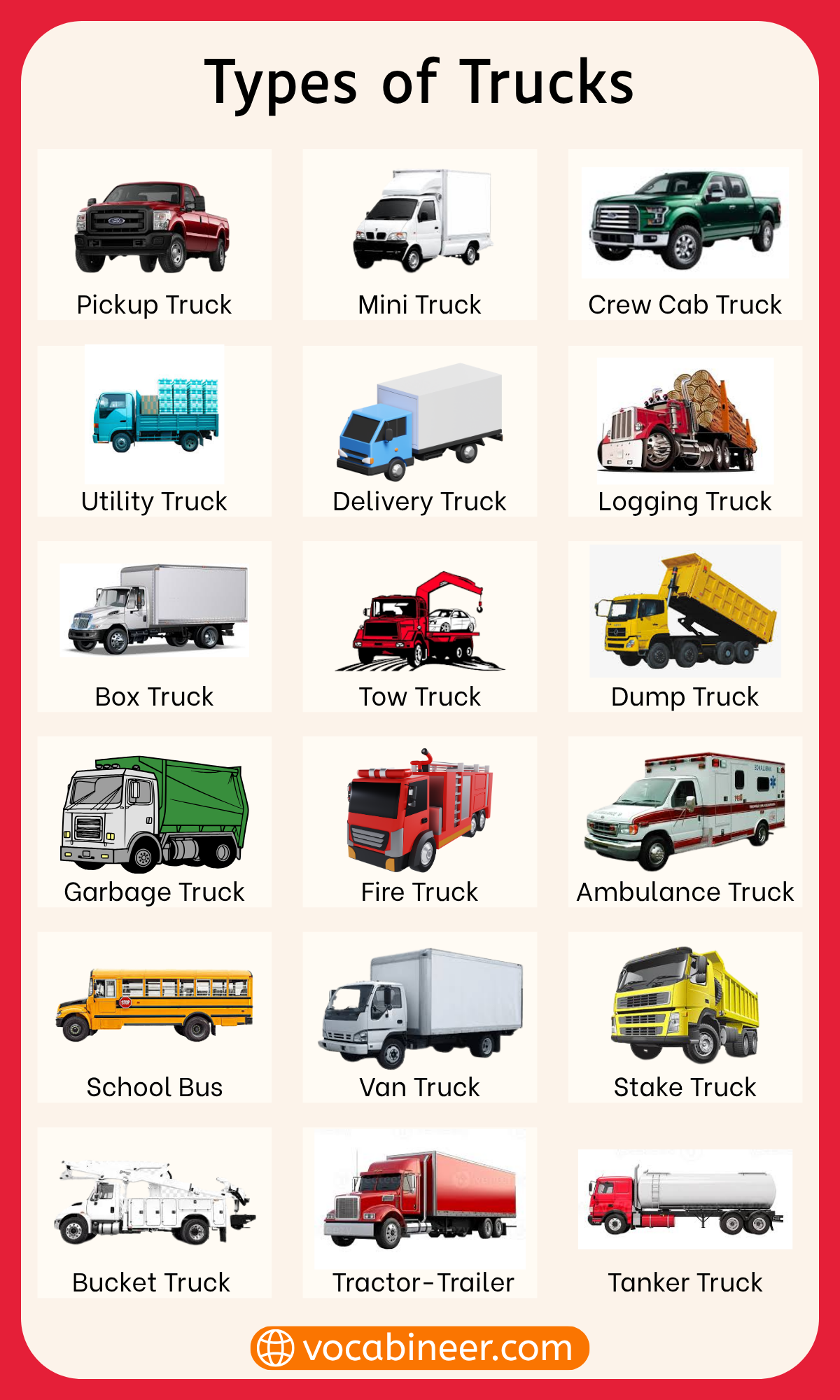
Pickup Truck
A pickup truck combines a passenger-style cab with an open cargo bed behind it. People use pickups for carrying tools, building materials, farm supplies, recreational equipment, and relatively light loads.
Box Truck
A box truck has a large enclosed rectangular cargo body mounted directly behind the cab on the same chassis. Moving companies, retailers, and delivery businesses commonly use it to protect furniture, appliances, packages, and other goods from the weather.
Semi-Truck
A semi-truck is a powered tractor unit designed to pull a separate semi-trailer. Its large cab, fifth-wheel coupling, and detachable trailer make it one of the most familiar vehicles for moving large freight loads over long distances.
Straight Truck
A straight truck carries its cab and cargo body on one continuous chassis rather than pulling a separate semi-trailer. Box trucks, dump trucks, garbage trucks, and some mixer trucks can all use a straight-truck configuration.
Flatbed Truck
A flatbed truck has a flat open cargo platform without permanent enclosed sides or a roof. Its open design allows workers to load machinery, steel, lumber, building materials, and oversized cargo from the rear, sides, or above.
Dump Truck
A dump truck has an open cargo bed that lifts at an angle to discharge loose materials from the rear. Construction and road crews commonly use these trucks for soil, gravel, sand, rock, and demolition debris.
Tanker Truck
A tanker truck carries liquids or other bulk material inside a large tank mounted on the vehicle or trailer. Tank shape and construction vary according to the type of cargo the truck is designed to transport.
Refrigerated Truck
A refrigerated truck has an insulated cargo area and cooling equipment that helps maintain a controlled temperature. Also called a reefer truck, it commonly transports food, flowers, medicine, and other temperature-sensitive products.
Tow Truck
A tow truck recovers or transports vehicles that are disabled, damaged, illegally parked, or unable to move safely. Depending on the design, it may use a wheel lift, boom, towing equipment, or a tilting flatbed.
Garbage Truck
A garbage truck collects household, commercial, or municipal waste in a specialized body. Many designs use hydraulic equipment to lift containers and compress waste so the truck can carry more material.
Concrete Mixer Truck
A concrete mixer truck has a large rotating drum mounted behind the cab. The drum keeps mixed concrete moving during transport so crews can deliver it to construction sites before it hardens.
Logging Truck
A logging truck transports cut timber using an open frame or trailer fitted with upright supports that help hold logs in place. Its long cargo area makes the vehicle easy to recognize on forestry and timber routes.
Car Carrier Truck
A car carrier truck uses an open multi-level structure and loading ramps to transport several cars at once. Also called a car transporter, it commonly moves new, used, or auction vehicles between locations.
Livestock Truck
A livestock truck has a ventilated cargo body with openings or slatted sides that allow airflow. Farmers and livestock businesses use it to transport cattle, sheep, pigs, and other animals.
Moving Truck
A moving truck usually has a tall enclosed box body designed for household furniture, boxes, appliances, and personal belongings. Many models include a rear ramp or lifting platform to make loading easier.
Delivery Truck
A delivery truck carries goods over local or regional routes and often makes frequent stops. The term describes the truck’s job rather than one single body style, so delivery trucks may use box, step-style, refrigerated, or other bodies.
Crane Truck
A crane truck combines a road-going truck chassis with a mounted crane. Construction crews, utility companies, and material-handling businesses use it to lift and position heavy objects while retaining the mobility of a truck.
Boom Truck
A boom truck has a telescoping or articulated lifting boom mounted to its chassis. Depending on the equipment attached, workers may use it for lifting materials, placing equipment, or reaching elevated work areas.
Bucket Truck
A bucket truck carries a hydraulic boom with a small platform or bucket at the end. Utility workers, tree crews, sign installers, and maintenance teams use it to reach overhead locations safely.
Haul Truck
A haul truck is a massive off-road truck built for mines, quarries, and major earthmoving operations. Its oversized tires, high-capacity dump body, and extreme dimensions separate it clearly from ordinary highway dump trucks.
Water Truck
A water truck carries a large tank along with hoses, pumps, or spray bars. Construction crews commonly use it for dust control, soil compaction, road work, landscaping, and supplying water at job sites.
Fire Truck
A fire truck carries specialized emergency equipment such as ladders, hoses, rescue tools, storage compartments, or elevated platforms. Specific fire-service terminology can vary depending on what equipment and function the vehicle has.
Street Sweeper Truck
A street sweeper truck cleans paved surfaces using rotating brushes, suction equipment, water sprays, or a combination of systems. Municipal crews use these vehicles to remove dirt, leaves, litter, and road debris.
Snowplow Truck
A snowplow truck has a large blade mounted at the front or side to push snow away from roads, streets, and parking areas. Many also carry salt or grit spreading equipment for winter road maintenance.
Vacuum Truck
A vacuum truck combines a storage tank with powerful suction equipment and large hoses. Service crews use it to remove liquids, sludge, mud, or loose debris from drains, tanks, sewers, and industrial sites.
Utility Truck
A utility truck carries tools, parts, compartments, and specialized equipment for field work. Electric, telecommunications, plumbing, repair, and public-service crews often use these trucks for maintenance and installation jobs.
Stake Bed Truck
A stake bed truck has a flat cargo deck surrounded by removable vertical stakes or side panels. It offers more load containment than a plain flatbed while still allowing convenient side access.
Platform Truck
A platform truck uses a broad flat cargo deck for carrying equipment, materials, or loads that do not require an enclosed body. Unlike some flatbeds, the term often describes the basic platform-style body rather than a particular freight industry.
Cab-Over Truck
A cab-over truck places the driver cab above or close to the front axle and engine area, creating a short, flat-faced front. This configuration can improve maneuverability and maximize cargo length within an overall vehicle-length limit.
Heavy Haul Truck
A heavy haul truck is configured to move exceptionally large or heavy equipment such as industrial machinery, construction components, or oversized loads. These operations often use powerful tractor units with specialized multi-axle trailers.
Truck Types by Their Main Use
Truck names do not all describe the same kind of classification. Some refer to the body, some to the cargo, and others to the job the vehicle performs.
| Main Use | Truck Types |
|---|---|
| General freight | Semi-Truck, Box Truck, Flatbed Truck |
| Temperature-controlled freight | Refrigerated Truck |
| Liquid or bulk cargo | Tanker Truck |
| Construction | Dump Truck, Mixer Truck, Crane Truck, Water Truck |
| Heavy off-road work | Haul Truck |
| Vehicle transport | Tow Truck, Car Carrier Truck |
| Timber and livestock | Logging Truck, Livestock Truck |
| Municipal services | Garbage Truck, Street Sweeper, Snowplow |
| Elevated work | Bucket Truck, Boom Truck |
| Specialized maintenance | Vacuum Truck, Utility Truck |
| Oversized loads | Heavy Haul Truck |
A single truck can sometimes fit more than one category. For example, a refrigerated box truck can be both a straight truck and a temperature-controlled delivery truck.
Freight and Cargo Truck Types
Freight trucks differ mainly in how they hold, protect, or support cargo.
- Box trucks protect goods inside a permanently enclosed body.
- Semi-trucks pull detachable trailers and handle large commercial freight loads.
- Flatbed trucks provide open access for machinery and oversized material.
- Refrigerated trucks maintain controlled cargo temperatures.
- Tanker trucks carry liquid or other bulk material in tanks.
- Logging trucks use open frames designed around long timber.
- Car carriers use ramps and multi-level platforms for automobiles.
- Livestock trucks provide ventilation for transporting animals.
- Stake bed trucks combine a flat deck with removable sides.
- Heavy haul trucks move unusually large or heavy equipment.
The body design usually reflects the cargo. Enclosed trucks prioritize protection, while open bodies make loading large or irregularly shaped materials easier.
Construction and Heavy-Work Trucks
Construction sites require trucks that can transport materials, lift equipment, control dust, and operate away from normal highways.
Dump trucks carry loose materials and unload them by tipping the cargo bed.
Concrete mixer trucks transport fresh concrete in rotating drums.
Crane and boom trucks combine lifting equipment with a mobile truck chassis.
Water trucks support road building, earthwork, dust suppression, and soil preparation.
Haul trucks perform extremely heavy off-road material transport in mines and quarries.
Heavy haul trucks serve a different purpose: instead of repeatedly carrying loose earth, they transport oversized machinery or structural loads, often using specialized trailers.
This distinction is important because dump truck, haul truck, and heavy haul truck are not interchangeable names.
Service and Municipal Truck Types
Many trucks perform services rather than hauling ordinary commercial freight.
- Tow Truck: recovers or transports other vehicles.
- Garbage Truck: collects and often compacts waste.
- Fire Truck: carries emergency and rescue equipment.
- Bucket Truck: gives workers access to elevated locations.
- Street Sweeper Truck: cleans paved streets and roads.
- Snowplow Truck: clears snow and may spread deicing material.
- Vacuum Truck: removes liquids, sludge, or debris with suction equipment.
- Utility Truck: carries tools and equipment for field maintenance.
These trucks often use highly specialized bodies even when the underlying chassis resembles an ordinary commercial truck.
Trucks Designed for Specific Cargo
Some truck names tell you almost immediately what the vehicle carries.
Logging Truck
Carries timber.
Car Carrier Truck
Carries automobiles.
Livestock Truck
Carries live animals.
Refrigerated Truck
Carries temperature-sensitive goods.
Tanker Truck
Carries bulk liquid or similar material.
Other names describe the job rather than the cargo. A moving truck, for example, may structurally be a box truck, while a delivery truck can take several different physical forms.
Straight Truck vs. Semi-Truck
Straight trucks and semi-trucks differ mainly in how the cargo section connects to the powered vehicle.
| Feature | Straight Truck | Semi-Truck |
|---|---|---|
| Basic structure | Cab and body on same chassis | Tractor pulls separate trailer |
| Articulated connection | No | Yes |
| Cargo section | Permanently attached body | Detachable trailer |
| Common use | Local or regional work | Regional and long-distance freight |
| Typical examples | Box truck, dump truck, mixer truck | Tractor-trailer combination |
| Trailer required | No | Yes |
A straight truck is therefore a configuration category, not one specific cargo body. The same straight-truck layout can support a box, dump body, mixer drum, garbage body, or specialized equipment.
Truck vs. Trailer: What Is the Difference?
A truck and a trailer are not the same thing.
Truck
A truck:
- has its own engine;
- moves under its own power;
- may carry cargo on its chassis;
- may also pull a trailer.
Trailer
A trailer:
- has no engine for independent road travel;
- must be pulled by another vehicle;
- mainly provides cargo-carrying space.
For example, the powered front vehicle in a tractor-trailer combination is the tractor or semi-truck, while the detachable cargo section behind it is the semi-trailer.
This distinction is why flatbed trailer, refrigerated trailer, lowboy trailer, and dry van trailer should not automatically be counted as separate powered truck types.
Truck Configurations and Cab Styles
Truck terminology can also describe the way the vehicle itself is arranged.
Straight Truck Configuration
A straight truck keeps the cab and load-carrying body on the same chassis.
Common examples include:
- box trucks;
- dump trucks;
- some garbage trucks;
- some refrigerated trucks;
- mixer trucks.
Cab-Over Configuration
A cab-over truck places the cab above or close to the front axle. The design creates a short front end and can improve maneuverability in cities or other restricted spaces.
Conventional Configuration
A conventional truck has a hood that extends ahead of the cab, with the engine positioned in the front section. This produces the familiar long-nose appearance seen on many North American heavy trucks.
Cab style does not determine what cargo the truck carries. A truck’s configuration and its job are separate classifications.
Light-, Medium-, and Heavy-Duty Trucks
Trucks can also be grouped broadly according to their weight and carrying capability.
Light-Duty Trucks
This group commonly includes smaller pickups and similar work vehicles used for lighter loads, personal transportation, and everyday jobs.
Medium-Duty Trucks
Medium-duty vehicles often include:
- box trucks;
- delivery trucks;
- utility trucks;
- some tow trucks;
- smaller service vehicles.
They provide greater commercial capacity without reaching the size of the largest road trucks.
Heavy-Duty Trucks
Heavy-duty trucks may include:
- semi-tractors;
- large dump trucks;
- concrete mixers;
- heavy garbage trucks;
- specialized heavy transport vehicles.
Exact weight-class definitions vary by country and regulatory system, so light-, medium-, and heavy-duty should be treated as broad categories unless a specific jurisdiction is being discussed.
Different Names Used for the Same Truck
Truck terminology varies between regions and industries.
| Main Name | Other Common Name |
|---|---|
| Truck | Lorry |
| Semi-Truck | Semi / Semi-Tractor / Tractor Unit |
| Refrigerated Truck | Reefer Truck |
| Garbage Truck | Refuse Truck / Waste Collection Truck |
| Concrete Mixer Truck | Mixer Truck |
| Car Carrier Truck | Car Transporter |
| Pickup Truck | Pickup; Ute in some regions |
| Tanker Truck | Tank Truck |
These alternate terms should not be counted as entirely different truck types.
Vehicles That Are Not Truck Types
Some vocabulary lists mix trucks with other road vehicles or construction equipment. For an accurate truck article, keep these categories separate.
- Forklift: material-handling equipment.
- Bulldozer: tracked or wheeled earthmoving machine.
- Excavator: digging and construction machine.
- Farm Tractor: agricultural power vehicle.
- Van: separate road-vehicle body category, although some commercial uses overlap with trucks.
- Trailer: unpowered unit that must be pulled.
Keeping these terms separate prevents the truck count from becoming artificially inflated.
FAQs
The main types of trucks include pickup trucks, cargo trucks, heavy-duty trucks, construction trucks, emergency trucks, utility trucks, military trucks, and off-road trucks.
Construction trucks include dump trucks, cement mixers, crane trucks, and tipper trucks, all designed to handle building materials and site work.
Cargo trucks are used to transport goods, packages, and bulk items over short and long distances.
Pickup trucks and utility trucks are most common on farms because they can carry tools, feed, and equipment across fields.
Light trucks, such as pickups, are built for smaller loads, while heavy-duty trucks are designed for carrying large cargo over long distances.
Read More