

Fighter jets are fast military aircraft designed mainly for air combat, interception, escort, and related missions. Although many models look similar, their roles can differ greatly depending on their size, equipment, operating environment, and design priorities.
Some fighters specialize in controlling the air, while others can attack targets on land or operate from aircraft carriers. This guide explains the main types of fighter jets, well-known aircraft names, major differences, and useful aviation vocabulary in clear language.
In This Page
What Is a Fighter Jet?
A fighter jet is a jet-powered military aircraft built primarily for combat against other aircraft. Modern fighters may also perform surveillance, interception, escort, reconnaissance, and surface-attack missions.
Compared with bombers and transport aircraft, fighter jets are usually smaller, faster, and more maneuverable. Their designs commonly include powerful engines, advanced radar, communication systems, and equipment that helps pilots understand activity around the aircraft.
However, not every armed military plane is a fighter jet. Dedicated bombers, attack aircraft, trainers, transports, and reconnaissance planes belong to different aircraft categories.
Fighter Jets, Fighter Aircraft, and Combat Aircraft
These aviation terms are related, but they do not have exactly the same meaning.
A fighter jet is a jet-powered aircraft designed mainly for air combat or closely connected military roles.
The term fighter aircraft is broader because it also includes older propeller-driven fighters, such as the P-51 Mustang and Supermarine Spitfire.
A combat aircraft is the broadest category. It may include fighters, bombers, attack aircraft, armed trainers, electronic-warfare aircraft, and certain unmanned aircraft.
Therefore, every fighter jet is a combat aircraft, but not every combat aircraft is a fighter jet. For example, the A-10 Thunderbolt II is primarily an attack aircraft rather than a conventional fighter.
Fighter Types, Models, Names, and Variants
Aircraft terminology can become confusing when categories, designations, official names, and versions appear together.
A fighter type describes the aircraft’s broad role. Air-superiority fighter, interceptor, and multirole fighter are examples of role-based types.
The model designation identifies a particular aircraft design. F-16, J-20, and Su-35 are model designations.
An official name may accompany the model number. For example, the F-16 is officially called the Fighting Falcon, while the F-22 carries the name Raptor.
A variant is a specific version of the basic aircraft. The F-35A, F-35B, and F-35C belong to the same aircraft family, but each version supports different operating requirements.
Aircraft may also receive informal nicknames from pilots, crews, or the public. These unofficial names should not be confused with formal designations.
Main Types of Fighter Jets
Fighter jets can be classified by mission, operating environment, size, engine arrangement, and technological generation.
| Fighter type | Main purpose | Familiar examples |
|---|---|---|
| Air-superiority fighter | Control the air and engage opposing aircraft | F-15 Eagle, F-22 Raptor |
| Multirole fighter | Perform both air-to-air and surface missions | F-16, Rafale, Gripen |
| Interceptor | Respond rapidly to approaching aircraft | MiG-31, F-106 |
| Strike fighter | Combine fighter ability with strong attack capability | F-15E, F/A-18E/F |
| Carrier-based fighter | Operate from aircraft carriers | F-35C, Rafale M |
| Stealth fighter | Reduce detectability while performing combat missions | F-22, F-35 |
| Light fighter | Use a smaller and often less costly airframe | JF-17, Tejas |
| Heavy fighter | Carry more fuel, sensors, or equipment in a larger airframe | F-15, Su-35 |
These categories often overlap. For instance, the F-35C is a multirole, stealth, carrier-based fighter rather than belonging to only one group.
Air-Superiority Fighters
Air-superiority fighters focus on gaining and maintaining control of the airspace.
Their design usually emphasizes speed, maneuverability, powerful sensors, pilot awareness, and effective air-to-air performance. Once friendly forces control the air, other aircraft and ground units can operate with less risk from opposing aviation.
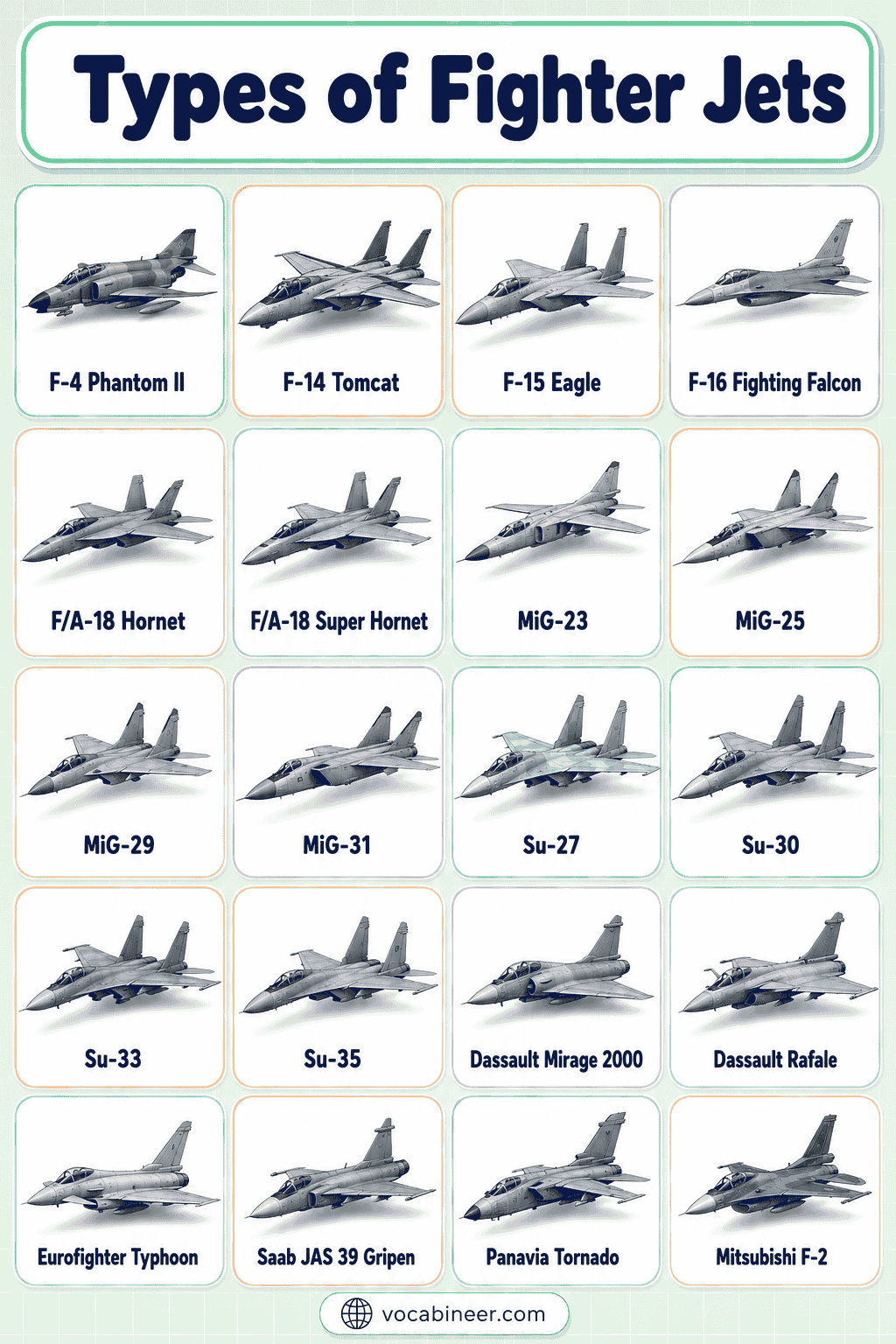
F-15 Eagle: Developed as a high-performance air-superiority fighter, the F-15 became one of the most recognizable twin-engine military jets.
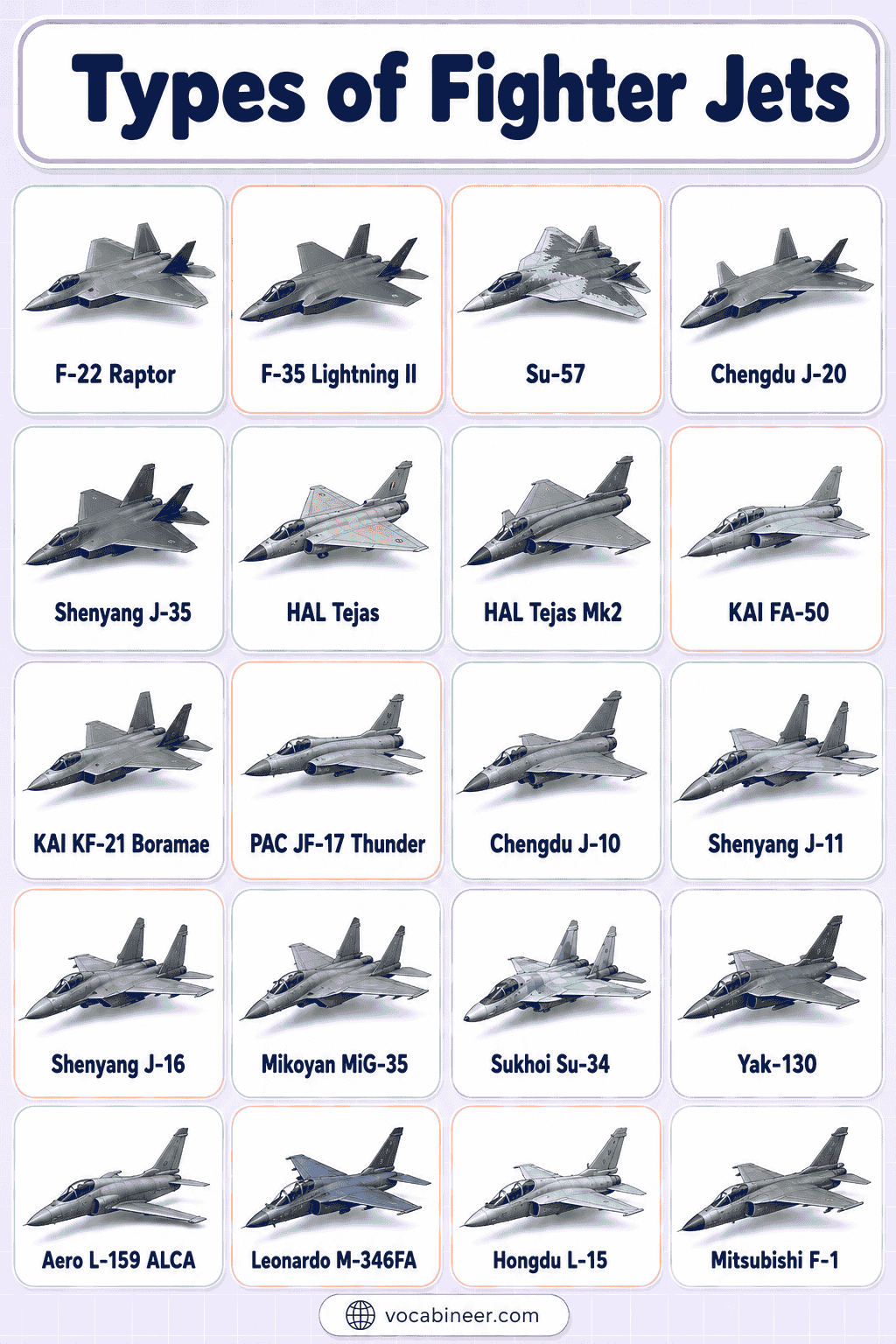
F-22 Raptor: This stealth aircraft places strong emphasis on air dominance, advanced sensors, and high maneuverability.
Sukhoi Su-27: The Su-27 became the foundation of a large family of heavy fighters developed for long-range air combat.
Sukhoi Su-35: An advanced member of the Su-27 family, the Su-35 combines a large airframe with modern sensors and high agility.
Eurofighter Typhoon: Designed by a European partnership, the Typhoon performs air-defense and multirole duties, although air combat remains a major strength.
Air-superiority fighters may later receive surface-attack capability. Even so, their original or primary mission often remains control of the surrounding airspace.
Multirole Fighter Jets
Multirole fighters can perform several major mission types instead of specializing in only one task.
A single aircraft may conduct air defense on one mission and support a surface operation on another. This flexibility can reduce the number of specialized aircraft a military needs to maintain.
F-16 Fighting Falcon: A widely used single-engine fighter, the F-16 supports air-to-air and air-to-surface missions.
Dassault Rafale: France developed the Rafale to perform air defense, strike, reconnaissance, and carrier-related missions across different versions.
Saab JAS 39 Gripen: The Gripen is a compact multirole fighter designed around flexible operations and relatively efficient support requirements.
JF-17 Thunder: Jointly developed by Pakistan and China, the JF-17 is a lightweight multirole combat aircraft.
Chengdu J-10: This Chinese single-engine fighter supports interception, air combat, and surface-attack roles.
HAL Tejas: India’s Tejas is a lightweight multirole fighter with a delta-wing design.
F-35 Lightning II: Built in three main variants, the F-35 family combines multirole capability with low-observable design and advanced sensor integration.
Multirole does not mean that an aircraft performs every mission equally well. Most fighters still have design strengths, operational priorities, and limitations.
Interceptor Fighters
Interceptors are designed to reach approaching aircraft quickly and prevent them from entering protected airspace.
Historically, interceptors often defended cities, military bases, and strategic areas from bombers or reconnaissance aircraft. Their designs commonly emphasized speed, climb performance, radar, and rapid response.
MiG-31 Foxhound: This large, fast interceptor was developed for long-range air-defense missions across vast areas.
MiG-25 Foxbat: Known for its high speed and high-altitude performance, the MiG-25 served interception and reconnaissance roles.
English Electric Lightning: Britain designed this Cold War aircraft for fast interception and air defense.
F-106 Delta Dart: The United States used the F-106 as a dedicated all-weather interceptor.
F-104 Starfighter: Although used in several roles, the F-104 became famous for its narrow shape, small wings, and high speed.
Dedicated interceptors are less common today because modern multirole and air-superiority fighters can perform interception duties while supporting additional missions.
Strike Fighters and Fighter-Bombers
Strike fighters combine fighter characteristics with a strong ability to attack targets on the ground or at sea.
Unlike dedicated bombers, they generally retain air-combat capability. Their equipment may support navigation, precision targeting, extended-range missions, and operations in difficult weather.
F-15E Strike Eagle: Based on the F-15 family, the F-15E was developed as a dual-role aircraft with a strong emphasis on long-range strike missions.
F/A-18E/F Super Hornet: This carrier-based aircraft supports fleet defense, strike, escort, and several other naval aviation missions.
Panavia Tornado: Different Tornado versions supported strike, reconnaissance, and air-defense missions.
Mirage 2000D: This version of the Mirage 2000 family was developed mainly for surface-attack operations.
The older term fighter-bomber describes a fighter adapted or designed to attack surface targets while retaining fighter qualities.
Well-known historical fighter-bombers include the F-4 Phantom II, F-105 Thunderchief, Republic P-47 Thunderbolt, Hawker Typhoon, and several Mirage III versions.
Today, the terms multirole fighter and strike fighter are more common, although fighter-bomber remains important when discussing aviation history.
Carrier-Based Fighter Jets
Carrier-based fighters operate from aircraft carriers instead of relying only on conventional land airfields.
Carrier operations place unusual stress on an aircraft. As a result, naval fighters may need reinforced landing gear, arresting equipment, folding wings, corrosion protection, and specialized landing systems.
F/A-18 Super Hornet: A major carrier-based multirole fighter, the Super Hornet performs air defense, strike, and fleet-support missions.
F-35C Lightning II: Designed for large aircraft carriers, this variant has a larger wing and carrier-specific landing equipment.
Rafale M: The naval version of the Rafale operates from aircraft carriers while retaining broad multirole capability.
MiG-29K: This carrier-capable version of the MiG-29 supports naval air-defense and strike missions.
Shenyang J-15: China developed the J-15 for carrier aviation and maritime operations.
F-14 Tomcat: A famous historical naval fighter, the F-14 used variable-sweep wings and served aboard U.S. aircraft carriers.
Carrier-based describes where and how the aircraft operates. A carrier fighter may also be multirole, stealthy, light, heavy, or strike-oriented.
Stealth Fighter Jets
Stealth fighters use design features that reduce how easily certain sensors can detect or track them.
Their shaping, materials, engine placement, surface details, and internal arrangements may help reduce detectability. Internal weapon bays can also preserve a cleaner exterior shape.
F-22 Raptor: Developed around air-superiority requirements, the F-22 combines low observability with speed, maneuverability, and integrated sensors.
F-35 Lightning II: The F-35 family uses stealth features alongside multirole systems and advanced information-sharing capabilities.
Chengdu J-20: China’s J-20 is a large stealth fighter with a twin-engine layout.
Sukhoi Su-57: Russia developed the Su-57 as a low-observable multirole fighter.
Stealth does not make an aircraft invisible. Instead, it can make detection, tracking, or engagement more difficult under particular conditions.
Furthermore, stealth is a design characteristic rather than a complete mission category. A stealth aircraft may still be classified as air-superiority, multirole, carrier-based, or strike-oriented.
Light and Heavy Fighters
Light and heavy fighters differ mainly in overall size, fuel capacity, equipment load, operating cost, and intended mission range.
A light fighter usually has a smaller airframe and may use one engine. These aircraft can be easier to support and less expensive to operate, although no universal weight limit defines the category.
Common light fighters include:
- JF-17 Thunder
- HAL Tejas
- F-5 Tiger II
- FA-50 Fighting Eagle
- MiG-21
- Saab Gripen
A heavy fighter generally uses a larger airframe, often with two engines. The extra space may support more fuel, larger sensors, longer range, or greater carrying capacity.
Familiar heavy fighters include:
- F-15 Eagle
- F-22 Raptor
- Su-27
- Su-30
- Su-35
- MiG-31
- Chengdu J-20
Size categories remain descriptive rather than universal. One country may describe an aircraft as medium-weight while another source places it closer to the light or heavy category.
Single-Engine and Twin-Engine Fighters
Engine count provides another way to describe fighter aircraft.
Single-engine fighters use one main engine. Their designs may offer lower weight, reduced maintenance demands, and lower operating costs.
Examples include:
- F-16 Fighting Falcon
- Saab Gripen
- JF-17 Thunder
- HAL Tejas
- Chengdu J-10
- F-35 Lightning II
Twin-engine fighters use two engines. Larger fighters often need two engines to support their size, range, and performance requirements.
Examples include:
- F-15 Eagle
- F/A-18 Super Hornet
- F-22 Raptor
- Dassault Rafale
- Eurofighter Typhoon
- MiG-29
- Su-35
- J-20
However, engine count and weight class are not identical systems. A twin-engine aircraft is not automatically a heavy fighter, and a single-engine jet is not always considered light.
Fighter Jets by Generation
Fighter generations group jet aircraft into broad technological periods.
The system helps readers understand major developments in engines, radar, weapons, electronics, maneuverability, and low-observable design. Nevertheless, generation labels are informal and may vary between sources.
First-Generation Jet Fighters
Early jet fighters appeared during and shortly after World War II.
These aircraft often had simple radar or no radar, limited electronics, and performance that reflected the early stage of jet development.
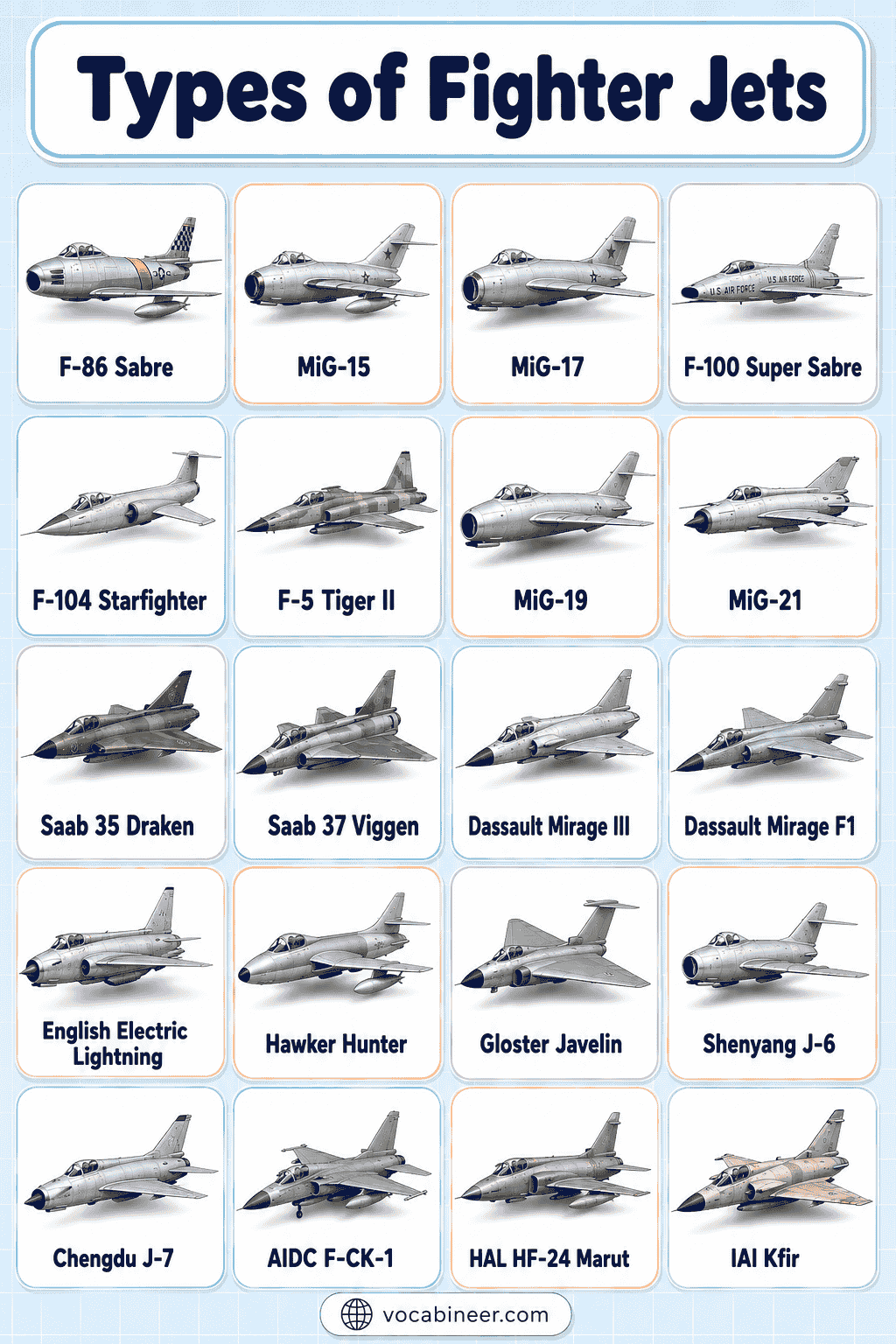
Examples include the Me 262, Gloster Meteor, F-80 Shooting Star, MiG-15, and F-86 Sabre.
Second-Generation Fighters
Second-generation fighters commonly introduced supersonic speed, improved radar, and early guided missiles.
Representative aircraft include the MiG-21, F-104 Starfighter, Mirage III, English Electric Lightning, and F-106 Delta Dart.
Third-Generation Fighters
Third-generation aircraft gained better radar, more capable missiles, improved engines, and broader mission flexibility.
Examples include the F-4 Phantom II, MiG-23, Mirage F1, Saab 37 Viggen, and MiG-25.
Fourth-Generation Fighters
Fourth-generation fighters generally emphasize maneuverability, advanced radar, improved cockpit systems, and more capable guided weapons.
Familiar examples include the F-15, F-16, F/A-18, MiG-29, Su-27, and Mirage 2000.
4.5-Generation Fighters
The informal 4.5-generation label describes advanced fourth-generation designs or extensively upgraded aircraft.
Such fighters may have modern electronically scanned radar, improved electronic systems, updated weapons integration, reduced detectability, and advanced networking.
Examples often include the Dassault Rafale, Eurofighter Typhoon, Saab Gripen E, Su-35, and F-15EX.
Fifth-Generation Fighters
Fifth-generation fighters generally combine low-observable design, advanced sensors, integrated information systems, and modern networking.
Frequently cited examples include the F-22 Raptor, F-35 Lightning II, Chengdu J-20, and Sukhoi Su-57.
Sixth-Generation Fighter Programs
Sixth-generation fighter concepts remain under development. Proposed features may include advanced networking, improved sensors, artificial-intelligence-supported systems, and cooperation with uncrewed aircraft.
Because these programs continue to evolve, final designs, capabilities, and service dates may change.
Famous Modern Fighter Jet Names
Modern fighter aircraft come from several countries and support a wide range of military roles.
F-15 Eagle: A large American twin-engine fighter known primarily for air-superiority missions.
F-16 Fighting Falcon: A widely exported single-engine multirole fighter.
F/A-18 Super Hornet: A carrier-based American multirole and strike fighter.
F-22 Raptor: An American stealth fighter designed mainly for air dominance.
F-35 Lightning II: A stealthy multirole fighter family with land-based, short-takeoff, and carrier-based variants.
Eurofighter Typhoon: A European twin-engine fighter used for air defense and multirole missions.
Dassault Rafale: A French multirole aircraft available in land-based and naval versions.
Saab JAS 39 Gripen: A Swedish single-engine multirole fighter.
MiG-29: A Soviet-designed twin-engine fighter widely used in several countries.
MiG-31: A large Russian long-range interceptor.
Su-30: A two-seat multirole development of the Su-27 family.
Su-35: An advanced heavy fighter based on the Su-27 design lineage.
Su-57: Russia’s low-observable multirole fighter.
Chengdu J-10: A Chinese single-engine multirole fighter.
Chengdu J-20: A Chinese twin-engine stealth fighter.
JF-17 Thunder: A lightweight multirole fighter jointly developed by Pakistan and China.
HAL Tejas: An Indian lightweight multirole fighter.
Mirage 2000: A French delta-wing fighter used in interception and multirole operations.
Famous Historical Fighter Jets
Historical fighter jets show how military aviation developed from simple early jets into advanced supersonic aircraft.
Me 262: The German Me 262 became the first operational jet-powered fighter used in combat.
Gloster Meteor: Britain’s Meteor was the first Allied jet fighter to enter operational service.
F-86 Sabre: This swept-wing American fighter became closely associated with early jet combat.
MiG-15: A Soviet-designed fighter recognized for its swept wings and strong climbing performance.
Hawker Hunter: A British transonic fighter that later served in several additional roles.
MiG-21: Produced in large numbers, the MiG-21 became one of the most widely used supersonic fighters.
F-104 Starfighter: Its thin wings and streamlined body made the Starfighter visually distinctive.
Mirage III: This French delta-wing fighter served with numerous air forces.
F-4 Phantom II: A large twin-engine fighter that performed interception, air combat, reconnaissance, and surface-attack missions.
F-14 Tomcat: Known for its variable-sweep wings, the F-14 served as a carrier-based fleet-defense fighter.
Saab 35 Draken: Sweden’s Draken used a distinctive double-delta wing.
English Electric Lightning: Built for rapid interception, the Lightning became known for its speed and unusual stacked-engine arrangement.
Important Differences Between Fighter-Jet Types
Fighter categories become easier to understand when their primary purposes are compared directly.
Air-Superiority Fighter vs. Multirole Fighter
| Air-superiority fighter | Multirole fighter |
|---|---|
| Focuses strongly on air combat | Performs several mission types |
| Prioritizes airspace control | Balances air and surface roles |
| May later gain secondary attack capability | Usually designed for mission flexibility |
| Examples include the F-22 and F-15 | Examples include the F-16 and Rafale |
An air-superiority fighter may support several missions, but controlling the air remains its central purpose.
Interceptor vs. Air-Superiority Fighter
| Interceptor | Air-superiority fighter |
|---|---|
| Responds rapidly to approaching aircraft | Seeks broader control of the airspace |
| Historically emphasized speed and climb rate | Often emphasizes sustained air combat |
| Commonly supports defensive missions | May conduct defensive or offensive missions |
| MiG-31 is a familiar example | F-22 is a familiar example |
Interception is a specific task, while air superiority describes a wider objective.
Multirole Fighter vs. Strike Fighter
| Multirole fighter | Strike fighter |
|---|---|
| Balances several combat roles | Places stronger emphasis on surface attack |
| Can switch between mission types | Retains fighter ability during strike work |
| Broad classification | More role-focused description |
| Examples include the Gripen and F-16 | Examples include the F-15E and Super Hornet |
Because the categories overlap, some aircraft may reasonably receive both labels.
Land-Based vs. Carrier-Based Fighter
| Land-based fighter | Carrier-based fighter |
|---|---|
| Operates mainly from conventional runways | Operates from aircraft carriers |
| Usually lacks carrier landing equipment | Uses reinforced landing gear and arresting systems |
| Avoids the weight of naval modifications | Must withstand demanding deck operations |
| F-22 is land-based | F-35C is carrier-based |
Carrier capability describes the aircraft’s operating environment rather than its complete combat role.
Stealth Fighter vs. Conventional Fighter
| Stealth fighter | Conventional fighter |
|---|---|
| Uses measures intended to reduce detectability | Does not emphasize low-observable shaping to the same degree |
| May carry equipment internally | Commonly carries equipment externally |
| Often integrates advanced sensors | May also possess highly capable modern sensors |
| F-35 is a stealth fighter | F-16 is a conventional fighter |
A conventional fighter can still be modern, powerful, and effective. Stealth represents one design approach rather than a complete measure of quality.
Fighter Jet Names Explained for Kids
Aircraft names often describe speed, strength, weather, animals, or national symbols.
Raptor: A raptor is a bird of prey, such as an eagle, hawk, or falcon.
Fighting Falcon: A falcon is a fast hunting bird known for speed and sharp vision.
Eagle: The eagle often represents power, strength, and keen eyesight.
Lightning: Lightning suggests extreme speed and sudden movement.
Typhoon: A typhoon is a powerful tropical storm.
Rafale: The French word rafale can refer to a burst or sudden gust.
Gripen: The Swedish name refers to the griffin, a legendary creature with features of an eagle and a lion.
Thunder: Thunder creates a loud, powerful sound during a storm.
Tomcat: A tomcat is an adult male cat.
Foxhound: A foxhound is a dog traditionally bred for tracking foxes.
Model numbers also carry meaning. In designations such as F-16 and F-22, the letter commonly identifies the aircraft category within a national naming system, while the number identifies the model or sequence.
Easy Sentences Using Fighter-Jet Vocabulary
- The fighter jet flew above the clouds.
- An interceptor responds quickly to approaching aircraft.
- The multirole fighter can perform several missions.
- A carrier-based fighter lands on an aircraft carrier.
- The pilot sits inside the cockpit.
- Two engines power the heavy fighter.
- The light fighter uses a compact airframe.
- A stealth design can reduce detectability.
- The air-superiority fighter helps control the sky.
- The landing gear supports the aircraft on the runway.
- The afterburner provides additional engine thrust.
- A variant is a different version of the same aircraft family.
- The F-16 is a single-engine fighter.
- The F-22 is designed mainly for air dominance.
- The F-35 family includes three major variants.
Related Fighter Aircraft Vocabulary
Fighter aviation uses many specialized words that describe aircraft parts, personnel, flight operations, and military roles.
Afterburner: An engine system that temporarily produces additional thrust by burning extra fuel.
Airframe: The main physical structure of an aircraft.
Canopy: The transparent cover above the cockpit.
Canard: A small control surface positioned near the front of some aircraft.
Cockpit: The area where the pilot controls the aircraft.
Delta wing: A triangular wing shape used by aircraft such as the Mirage 2000 and HAL Tejas.
Engine intake: An opening that directs air into the jet engine.
Fuselage: The main body of the aircraft.
Landing gear: The wheels and supporting structures used during takeoff, landing, and ground movement.
Pilot: A trained person who flies the aircraft.
Radar: A system that uses radio waves to detect and track objects.
Runway: A prepared strip where aircraft take off and land.
Squadron: A military aviation unit containing aircraft, pilots, and support personnel.
Tail fin: A vertical surface that helps stabilize the aircraft.
Wing: A major surface that creates lift during flight.
FAQs
The principal role-based types include air-superiority fighters, multirole fighters, interceptors, strike fighters, and carrier-based fighters. Aircraft may also be described as stealth, light, heavy, single-engine, or twin-engine.
Yes. A fighter may be multirole, stealthy, carrier-based, and twin-engine at the same time because these labels describe different features.
A fighter jet is designed mainly for air combat or related missions, while an attack aircraft focuses more heavily on engaging surface targets.
No. Many modern fighters use conventional designs without the same level of low-observable shaping found on aircraft such as the F-22 or F-35.
Carrier-based fighters are designed or modified for naval operations. Examples include the F/A-18 Super Hornet, F-35C, Rafale M, MiG-29K, and J-15.
Read More
- 100+ Vehicles Name in English
- Types of Emergency Vehicles
- Construction Vehicle Names
- Different Types of Trucks
- Types of Four Wheelers
- Water Transport Names
- Military Vehicle Names