Carpets are soft floor coverings used in homes, offices, hotels, halls, and other indoor spaces. They add comfort, warmth, decoration, and sound absorption to a room. In addition, carpets come in many materials, textures, colors, patterns, and sizes.
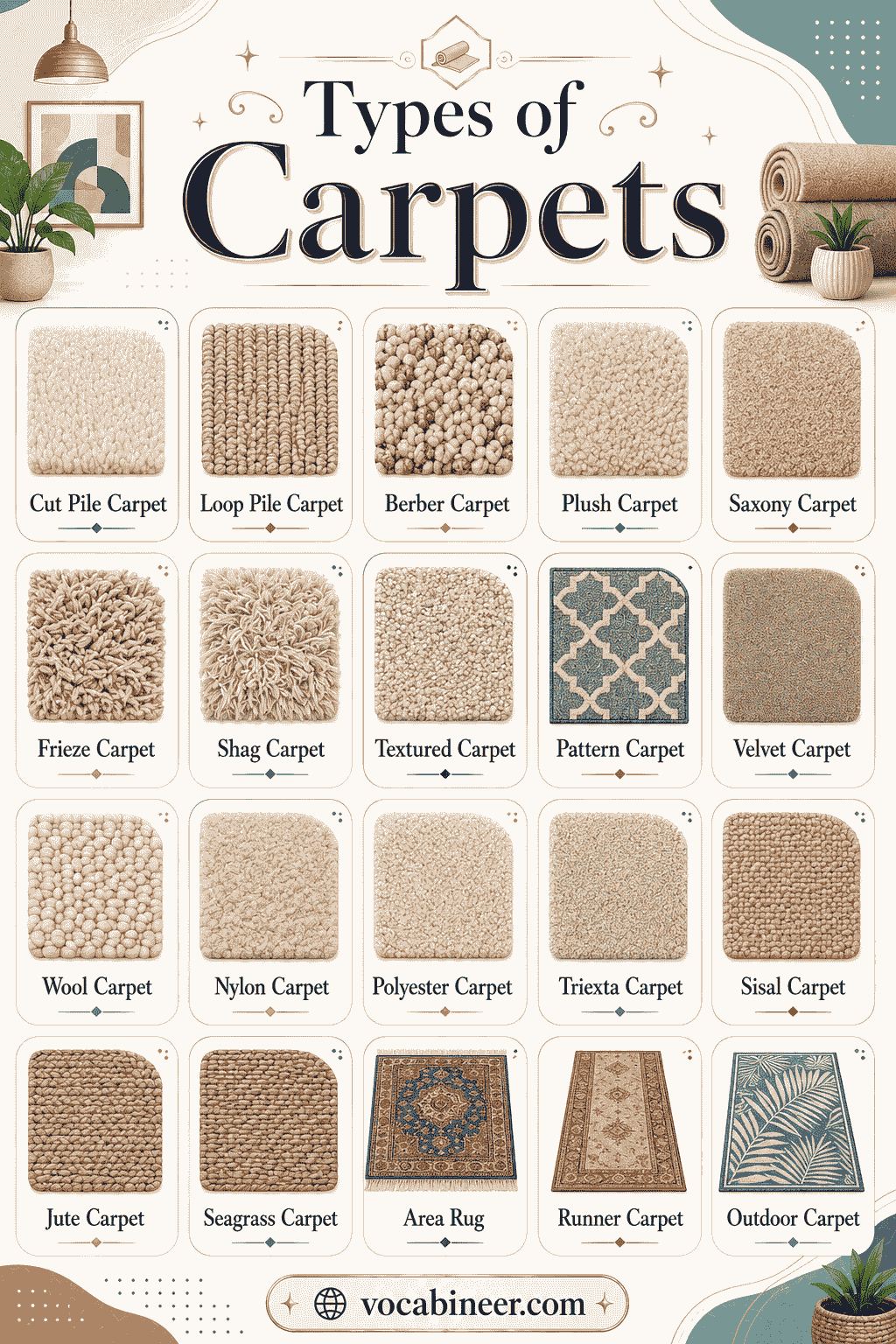
Common types of carpets include area carpet, wall-to-wall carpet, Persian carpet, wool carpet, nylon carpet, sisal carpet, Berber carpet, shag carpet, cut pile carpet, and loop pile carpet. This guide explains carpet types in English with simple meanings, pictures, room uses, material words, design terms, and helpful comparisons.
In This Page
What Are Carpets?
Carpets are floor coverings made from fibers, yarns, or woven materials. People use them to cover floors, make rooms more comfortable, reduce noise, and improve interior design.
Usually, carpets are made from materials such as wool, nylon, polyester, olefin, cotton, silk, jute, or sisal. Some carpets cover a whole room, while others cover only one area of the floor. Because carpets vary in texture and thickness, each type can feel different under the feet.
Common Carpet Types
These are some of the most common carpet types in English. They are useful for home vocabulary, flooring vocabulary, interior design words, and ESL learning.
Area carpet
An area carpet covers one part of a room instead of the whole floor. It is often placed under a table, sofa, or bed.
Wall-to-wall carpet
A wall-to-wall carpet covers the entire floor from one wall to another. It is common in bedrooms, offices, hotels, and large rooms.
Persian carpet
A Persian carpet is a traditional decorative carpet from Iran. It often has detailed patterns, rich colors, and fine craftsmanship.
Wool carpet
A wool carpet is made from natural wool fibers. It feels soft, warm, and comfortable.
Nylon carpet
A nylon carpet uses synthetic nylon fibers. It is durable and often used in busy areas of the home.
Sisal carpet
A sisal carpet is made from natural plant fibers. It has a firm texture and a natural look.
Berber carpet
A Berber carpet usually has looped fibers and a textured surface. It is popular for practical home flooring.
Shag carpet
A shag carpet has long, thick fibers. It feels soft and fluffy under the feet.
Cut pile carpet
A cut pile carpet has yarn tips that are cut open. It feels softer than many loop pile carpets.
Loop pile carpet
A loop pile carpet keeps the yarn in loop shapes. It is often strong, textured, and durable.
Carpets for Different Rooms and Spaces
Different rooms need different carpet types. For example, a bedroom may need a soft carpet, while a hallway may need a more durable carpet.
Living Room Carpets
Living room carpets add comfort, warmth, and style to seating areas. They can also connect furniture pieces and make the room feel complete.
Common living room carpets include:
- Area carpet
- Persian carpet
- Wool carpet
- Patterned carpet
- Shag carpet
- Textured carpet
- Low-pile carpet
- Vintage carpet
Bedroom Carpets
Bedroom carpets usually feel soft, warm, and relaxing. They help make the room more comfortable, especially near the bed.
Common bedroom carpets include:
- Plush carpet
- Wool carpet
- Shag carpet
- Saxony carpet
- Area carpet
- High-pile carpet
- Cotton carpet
- Soft textured carpet
Hallway and Stair Carpets
Hallway and stair carpets need durability because people walk on them often. Shorter pile and strong fibers usually work better in these areas.
Common hallway and stair carpets include:
- Nylon carpet
- Loop pile carpet
- Berber carpet
- Low-pile carpet
- Carpet runner
- Anti-slip carpet
- Stain-resistant carpet
- Wall-to-wall carpet
Office Carpets
Office carpets should look neat and handle regular foot traffic. They often use practical materials, simple textures, and low-pile designs.
Common office carpets include:
- Carpet tiles
- Modular carpet
- Low-pile carpet
- Nylon carpet
- Loop pile carpet
- Soundproof carpet
- Stain-resistant carpet
- Textured carpet
Kids’ Room Carpets
Kids’ room carpets should feel comfortable, safe, and easy to clean. Bright colors, soft textures, and washable options are often useful.
Common kids’ room carpets include:
- Washable carpet
- Anti-slip carpet
- Soft area carpet
- Patterned carpet
- Polyester carpet
- Low-pile carpet
- Foam-backed carpet
- Stain-resistant carpet
Outdoor Carpets
Outdoor carpets are made for patios, balconies, gardens, and outdoor seating areas. They need stronger materials that can handle moisture, dust, and sunlight.
Common outdoor carpets include:
- Outdoor carpet
- Sisal-style carpet
- Jute-style carpet
- Waterproof carpet
- Patio carpet
- Artificial grass carpet
- Anti-slip carpet
- Weather-resistant carpet
Carpet Styles and Textures
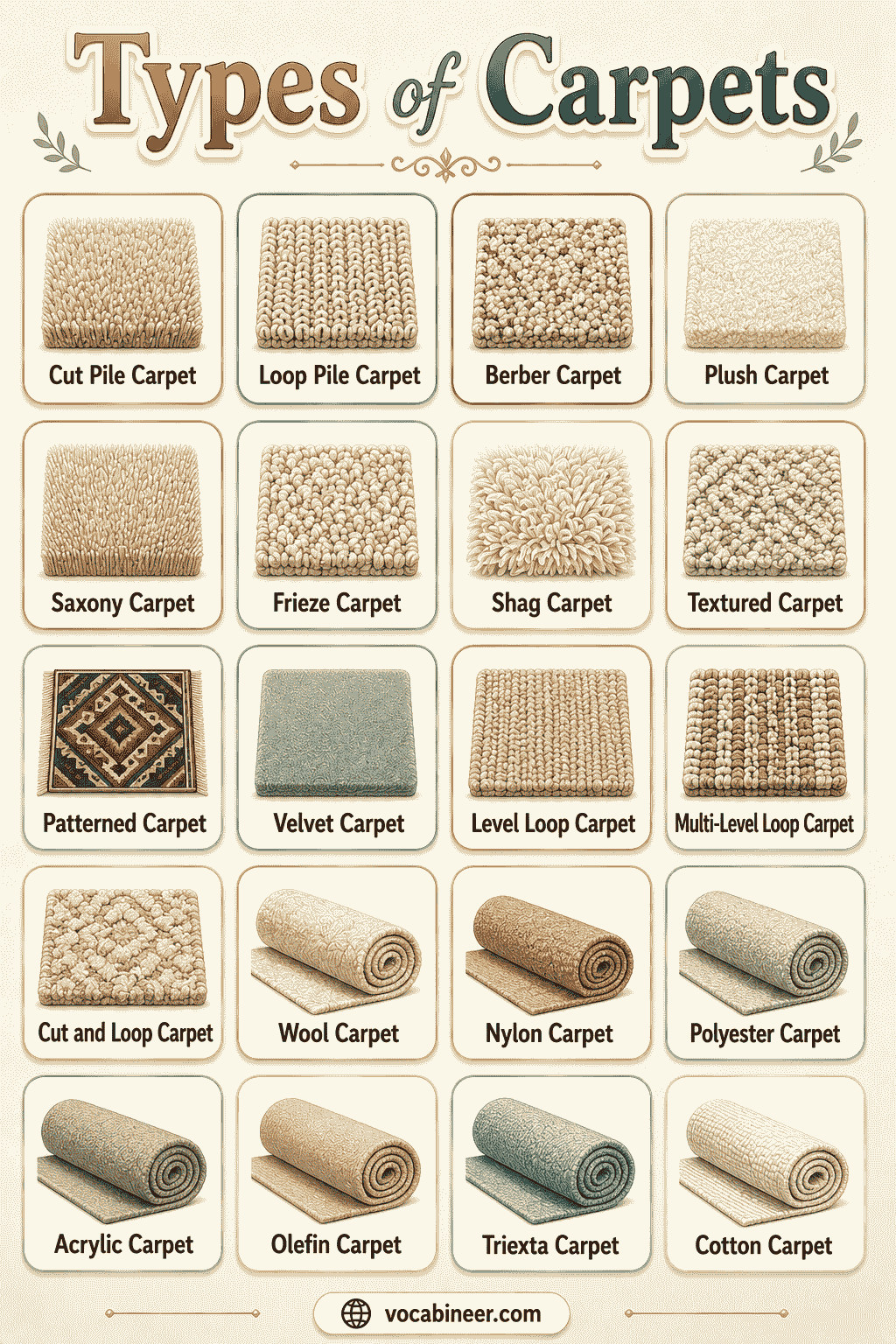
Carpet style and texture affect how a carpet feels, looks, and performs. Some carpets feel smooth and soft, while others feel firm, thick, or patterned.
Cut pile carpet
Cut pile carpet has open yarn ends. It usually feels soft and comfortable.
Loop pile carpet
Loop pile carpet keeps the yarn in loops. It often feels textured and strong.
Cut and loop carpet
Cut and loop carpet combines cut yarn and looped yarn. This creates patterns and texture.
Plush carpet
Plush carpet has a smooth, soft surface. It gives a neat and elegant look.
Saxony carpet
Saxony carpet has dense, upright fibers. It often looks formal and soft.
Frieze carpet
Frieze carpet has twisted fibers that create a slightly curly texture. It can hide footprints better than some smooth carpets.
Berber carpet
Berber carpet has a looped texture. It is known for durability and a casual look.
Shag carpet
Shag carpet has long, loose fibers. It feels thick, fluffy, and cozy.
Textured carpet
Textured carpet has an uneven surface. It can help hide marks, footprints, and vacuum lines.
Patterned carpet
Patterned carpet has visible designs, shapes, or repeated patterns. It adds decoration to a room.
Carpet Materials and Fibers
Carpet material affects softness, durability, cleaning, price, and appearance. Therefore, choosing the right material is important for each room.
Wool carpet
Wool carpet uses natural wool fibers. It feels soft, warm, and luxurious.
Nylon carpet
Nylon carpet uses strong synthetic fibers. It is durable and works well in high-traffic areas.
Polyester carpet
Polyester carpet feels soft and often comes in bright colors. It can work well in bedrooms and low-traffic spaces.
Olefin carpet
Olefin carpet is a synthetic carpet fiber that resists moisture and stains. It is often used in indoor-outdoor carpets.
Acrylic carpet
Acrylic carpet can look and feel similar to wool. It is lightweight and often used in decorative carpets.
Cotton carpet
Cotton carpet feels soft and natural. It is often used in casual rugs and lightweight floor coverings.
Silk carpet
Silk carpet has a smooth and luxurious feel. It is usually delicate and decorative.
Jute carpet
Jute carpet is made from natural plant fibers. It gives a rustic and earthy look.
Sisal carpet
Sisal carpet uses strong natural fibers from the sisal plant. It has a firm texture and natural appearance.
Bamboo carpet
Bamboo carpet uses bamboo fibers or bamboo-style material. It often suits natural and eco-style interiors.
Traditional and Decorative Carpets
Traditional and decorative carpets often focus on design, culture, pattern, and craftsmanship. They can become a main decorative feature in a room.
Persian carpet
Persian carpet comes from Iran and is known for detailed patterns, rich colors, and fine weaving.
Oriental carpet
Oriental carpet refers to handmade carpets from several Asian regions. It often has traditional designs and careful craftsmanship.
Turkish carpet
Turkish carpet is a traditional carpet style from Turkey. It often includes geometric patterns and strong colors.
Kilim carpet
Kilim carpet is a flatwoven carpet with no thick pile. It usually has bold patterns and a lightweight feel.
Moroccan carpet
Moroccan carpet often has tribal, geometric, or simple line patterns. It can feel soft, textured, and decorative.
Aubusson carpet
Aubusson carpet is a decorative carpet style from France. It often includes elegant floral patterns and classic designs.
Tribal carpet
Tribal carpet features designs inspired by traditional communities. It often uses bold patterns and handmade details.
Vintage carpet
Vintage carpet has an older or aged appearance. It may include faded colors, traditional patterns, or antique-style designs.
Hand-knotted carpet
Hand-knotted carpet is made by tying knots by hand. It often takes a long time to make and may be valuable.
Embroidered carpet
Embroidered carpet includes stitched decorative details. It adds texture and artistic design to the floor covering.
Modern Carpet Options and Features
Modern carpets often focus on comfort, easy cleaning, durability, safety, and practical home use. Some options are designed for busy rooms, pets, kids, or offices.
Carpet tiles
Carpet tiles are square carpet pieces installed separately. They are useful because damaged tiles can often be replaced one by one.
Modular carpet
Modular carpet uses separate carpet sections. It is common in offices and commercial spaces.
Stain-resistant carpet
Stain-resistant carpet is designed to resist spills and marks. It is useful in homes with kids, pets, or heavy use.
Waterproof carpet
Waterproof carpet helps resist moisture. It can work in basements, outdoor areas, or damp spaces.
Low-pile carpet
Low-pile carpet has short fibers. It is easier to clean and works well in busy areas.
High-pile carpet
High-pile carpet has longer fibers. It feels softer and thicker than low-pile carpet.
Anti-slip carpet
Anti-slip carpet helps reduce slipping. It is useful for stairs, hallways, kids’ rooms, and entry areas.
Washable carpet
Washable carpet can be cleaned more easily than many regular carpets. It is useful for casual rooms and family spaces.
Soundproof carpet
Soundproof carpet helps reduce noise. It is common in apartments, offices, bedrooms, and media rooms.
Eco-friendly carpet
Eco-friendly carpet uses natural, recycled, or low-impact materials. It suits people who prefer sustainable home products.
Carpet Parts and Design Vocabulary
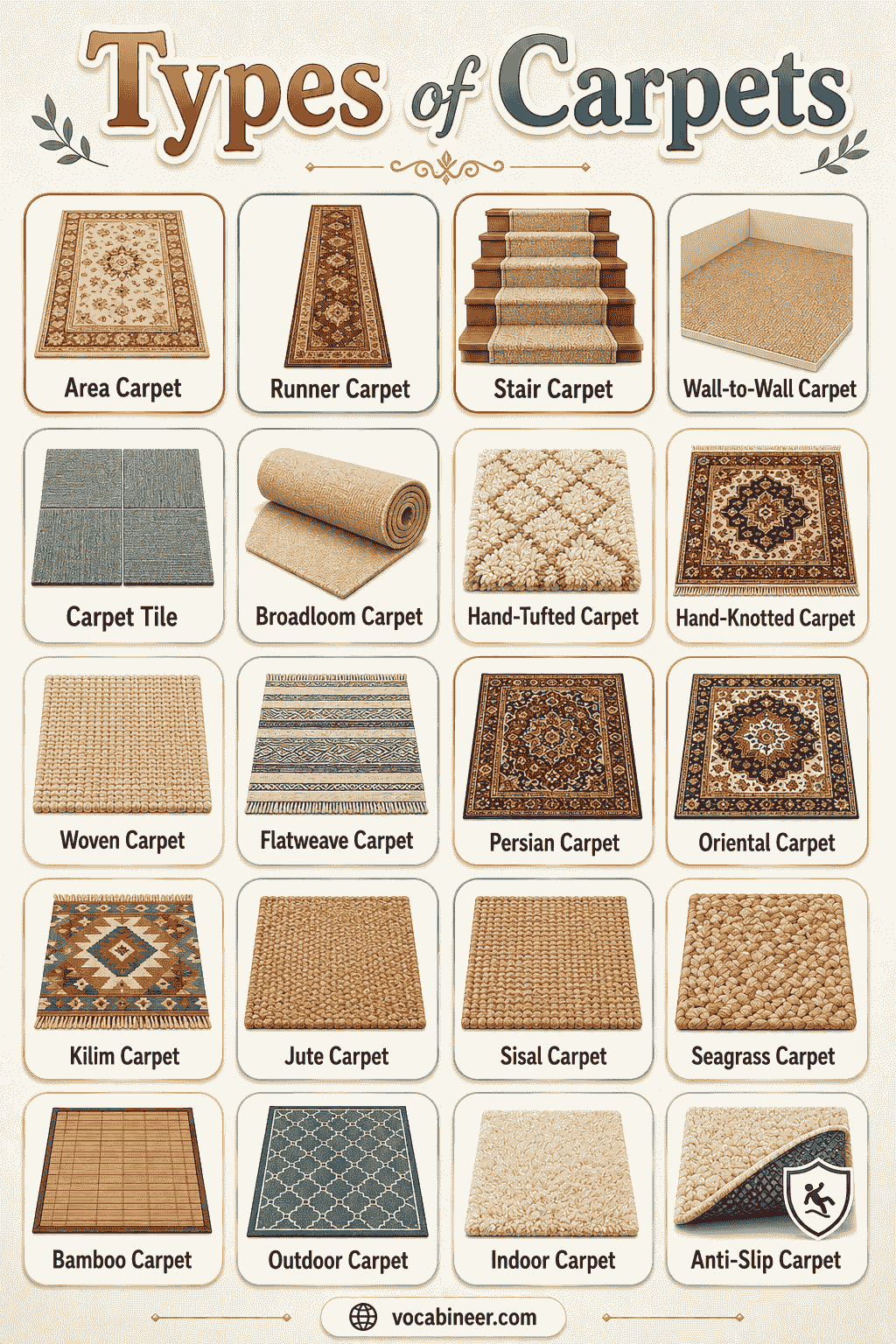
Carpet design vocabulary helps learners describe how carpets are made and how they look. These terms are useful for shopping, cleaning, interior design, and product descriptions.
Pile
Pile means the visible fibers on the surface of a carpet. It affects softness, thickness, and texture.
Backing
Backing is the bottom layer of a carpet. It holds the fibers together and gives support.
Fiber
Fiber is the material used to make the carpet yarn. Wool, nylon, polyester, and sisal are common carpet fibers.
Weave
Weave describes how threads or fibers are arranged. It affects the carpet’s pattern and strength.
Pattern
Pattern means the repeated design or shape on a carpet. It can be floral, geometric, striped, or plain.
Border
Border is the outer design around the edge of a carpet. Many traditional carpets have decorative borders.
Fringe
Fringe is the loose thread detail at the ends of some carpets. It is common in traditional and handmade carpets.
Texture
Texture describes how a carpet feels or looks on the surface. It may be smooth, rough, soft, fluffy, or firm.
Underlay
Underlay is a layer placed under the carpet. It can add comfort, support, and sound reduction.
Padding
Padding is soft material placed below carpet. It makes the carpet feel thicker and more comfortable.
Carpet vs Rug
The words carpet and rug are related, but they do not always mean the same thing.
| Term | Meaning |
|---|---|
| Carpet | A larger floor covering, often fixed or used to cover a wide floor area. |
| Rug | A smaller movable floor covering used in one part of a room. |
In simple words, a carpet usually covers more floor space, while a rug is usually smaller and easier to move.
Differences Between Common Carpet Types
Some carpet words look similar, but they describe different sizes, textures, materials, or uses.
| Comparison | Main Difference |
|---|---|
| Carpet vs rug | A carpet usually covers a larger area; a rug is usually smaller and movable. |
| Cut pile vs loop pile carpet | Cut pile has yarn tips cut open; loop pile keeps yarn in loops. |
| Wool vs nylon carpet | Wool is natural and soft; nylon is synthetic, durable, and often stain-resistant. |
| Shag vs low-pile carpet | Shag carpet has long fibers; low-pile carpet has short fibers and is easier to clean. |
| Persian vs Oriental carpet | Persian carpets come from Iran; Oriental carpets refer to handmade carpets from several Asian regions. |
| Carpet tiles vs wall-to-wall carpet | Carpet tiles are separate square pieces; wall-to-wall carpet covers the floor in one continuous layer. |
How to Choose a Carpet for Your Room
Choosing a carpet becomes easier when you think about room use, foot traffic, material, texture, cleaning needs, and style. A good carpet should match both the room and the people who use it.
Helpful points:
- Use a soft carpet for bedrooms and relaxing spaces.
- Choose a durable carpet for hallways, stairs, and busy rooms.
- Pick a low-pile carpet for easier cleaning.
- Use a stain-resistant carpet in homes with kids or pets.
- Choose a wool carpet for natural softness and warmth.
- Pick a nylon carpet for strength and long-term use.
- Use carpet tiles in offices or areas where replacement may be needed.
- Choose a pattern and color that match the room’s furniture and design.
Common Carpet Buying and Cleaning Mistakes
Carpet mistakes can make a room harder to clean, less comfortable, or less practical. However, simple planning can help avoid common problems.
Common mistakes include:
- Choosing a carpet only by color
- Ignoring material and fiber type
- Using high-pile carpet in very busy areas
- Choosing a delicate carpet for kids’ rooms or pet areas
- Forgetting to check stain resistance
- Ignoring underlay or padding
- Using the wrong cleaning method for the carpet material
- Placing outdoor carpets in areas where they cannot dry properly
Carpet Types and Materials Chart with Pictures
A carpet picture chart helps learners connect carpet names with real floor coverings. It is useful for students, ESL learners, home vocabulary lessons, interior design words, worksheets, and visual learning.
Picture chart ideas:
- Common carpets: area carpet, wall-to-wall carpet, wool carpet
- Textures: cut pile, loop pile, shag, Berber
- Materials: wool, nylon, polyester, jute, sisal
- Traditional carpets: Persian, Oriental, Turkish, Kilim
- Modern options: carpet tiles, waterproof carpet, washable carpet
- Room carpets: bedroom carpet, living room carpet, hallway carpet
FAQ
Common types of carpets include area carpet, wall-to-wall carpet, Persian carpet, wool carpet, nylon carpet, sisal carpet, Berber carpet, shag carpet, cut pile carpet, and loop pile carpet.
A carpet usually covers a larger floor area and may be fixed in place, while a rug is usually smaller, movable, and used in one part of a room.
Wool and nylon are common choices for homes. Wool feels natural and soft, while nylon is strong, durable, and practical for busy rooms.
Low-pile carpets, carpet tiles, washable carpets, and stain-resistant carpets are usually easier to clean than thick high-pile or delicate decorative carpets.
Soft carpets such as plush carpet, wool carpet, Saxony carpet, shag carpet, or high-pile carpet can work well in bedrooms because they feel warm and comfortable.
Read More
- Types of Jewelry
- Bedroom Decor Items
- Crockery Items Names
- Types of Drinking Glasses
- Living Room Items Names