Mining equipment includes the machines, vehicles, tools, and processing systems that help locate mineral deposits, remove rock, transport ore, and recover valuable minerals. Large machines usually operate in open-pit mines, while compact, low-profile equipment works inside underground tunnels.
Learning mining equipment names becomes easier when each machine is connected to its job. Some machines drill and excavate rock, whereas others load, haul, crush, screen, grind, or separate the material.
In This Page
What Is Mining Equipment?
Mining equipment supports every major stage of mineral extraction. Exploration teams use drilling rigs to locate deposits and collect rock samples. After mining begins, excavators, shovels, loaders, and cutting machines remove the material.
Haul trucks, conveyors, underground vehicles, and shaft systems then move ore and waste rock. Once the material reaches a processing plant, crushers, screens, mills, and separators prepare it for mineral recovery.
Support equipment also keeps the mine operating. Pumps remove water, ventilation fans circulate air, graders maintain roads, and service vehicles deliver fuel, tools, and replacement parts.
Surface Mining vs. Underground Mining Equipment
The location and depth of a deposit determine the size, shape, and type of machinery a mine requires.
| Surface mining equipment | Underground mining equipment |
|---|---|
| Works in open pits, quarries, and exposed deposits | Operates inside shafts, tunnels, and underground rooms |
| Can include extremely large machines | Usually has a compact or low-profile design |
| Uses wide work areas and prepared haul roads | Must fit through narrow openings |
| Includes draglines, shovels, drills, and haul trucks | Includes LHDs, roof bolters, shuttle cars, and continuous miners |
| Faces fewer height and width limits | Must account for airflow, visibility, and turning space |
Surface mines can accommodate enormous electric rope shovels, draglines, and rigid haul trucks. Consequently, these machines can move very large quantities of rock and soil.
Underground mines create different challenges. Low ceilings, narrow passages, limited visibility, and controlled airflow require short machines, powerful lights, tight turning circles, and suitable protective systems.
Main Types of Mining Equipment
Mining equipment falls into several practical categories:
- exploration and drilling equipment;
- excavation and overburden-removal machines;
- loading equipment;
- hauling and transport vehicles;
- underground extraction machines;
- ground-support equipment;
- ventilation and safety systems;
- crushing and grinding equipment;
- screening, feeding, and conveying systems;
- mineral-separation equipment;
- pumps and dewatering systems;
- support and maintenance vehicles.
Some machines perform more than one job. An LHD, for example, loads broken ore, carries it through a tunnel, and unloads it at a transfer point.
Exploration and Drilling Equipment
Exploration and drilling machines help mining teams locate deposits, collect samples, and create holes in rock.
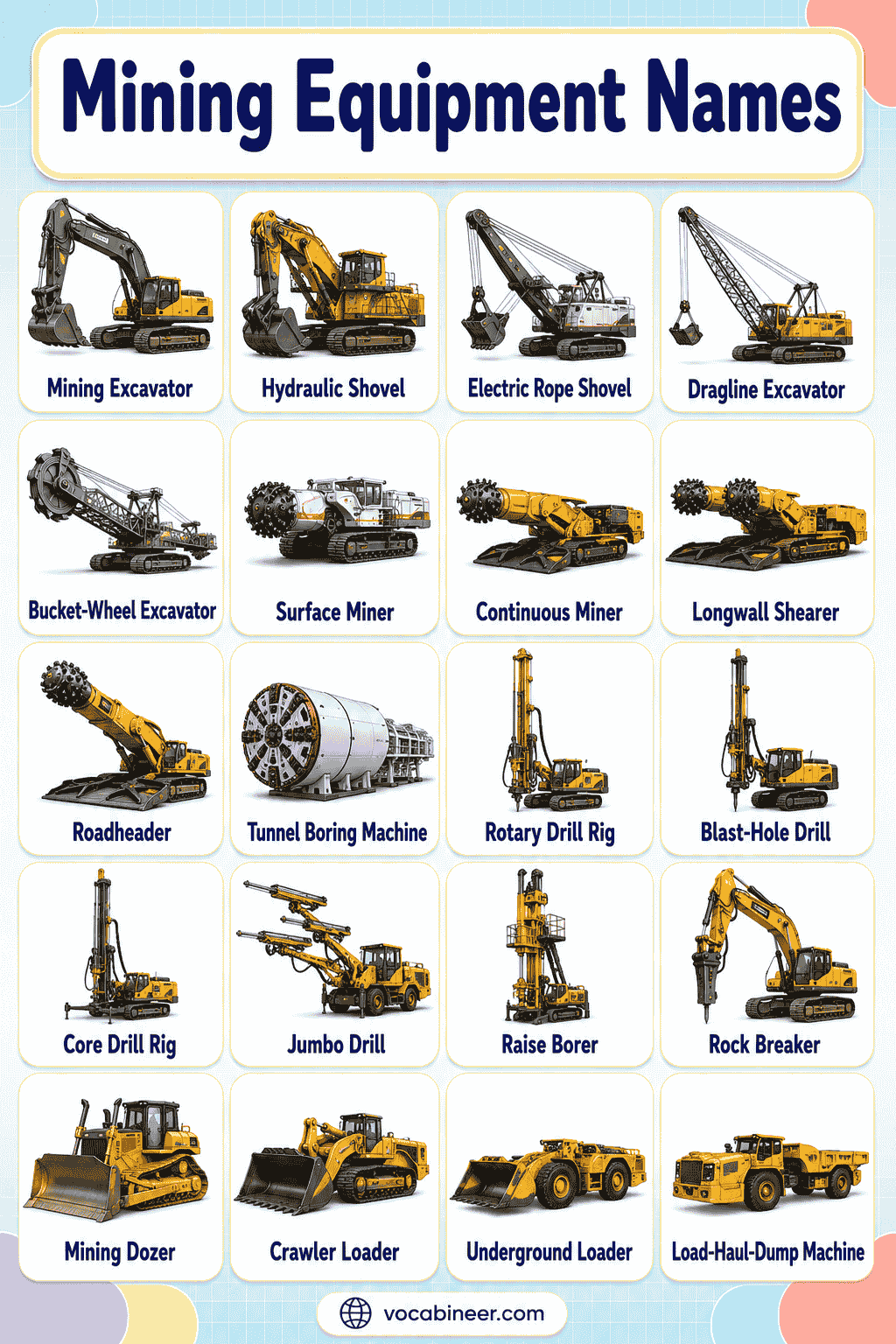
Core Drill Rig: A core drill removes a cylindrical sample of rock from below the surface. Geologists examine the sample to study underground layers and mineral content.
Exploration Drill Rig: This machine creates test holes during the early investigation of a deposit. Depending on the drilling method, it may recover rock chips or complete core samples.
Diamond Drill: A diamond-tipped bit cuts through hard rock and produces detailed cores. Because the sample preserves the original rock layers, it provides useful geological information.
Reverse-Circulation Drill: Compressed air carries rock chips to the surface through an internal tube. Workers then collect and label the samples.
Blast-Hole Drill: Surface mines use this large machine to create production holes in rock. Trained crews later prepare those holes according to controlled site procedures.
Rotary Drill Rig: A rotating drill bit cuts through compacted ground or hard rock. Large open-pit operations commonly use heavy rotary rigs.
Jumbo Drill: Also called a drilling jumbo or face drill, this underground machine uses one or more hydraulic booms to drill a tunnel face.
Long-Hole Drill: Underground mines use this rig to create long production holes at different angles.
Raise-Boring Machine: A raise borer creates vertical or steep openings between underground levels. These openings may support ventilation, access, or material movement.
Tunnel-Boring Machine: Commonly shortened to TBM, this specialized machine excavates a circular tunnel with a rotating cutting head. Only projects suited to its size, cost, and working method use it.
Excavation and Overburden Equipment
Before miners can reach some deposits, they must remove the soil and rock covering them. This upper layer is called overburden.
Hydraulic Excavator: A hydraulic excavator uses a boom, arm, and bucket to dig or load material. Mining models are generally larger and more heavily built than standard construction excavators.
Hydraulic Mining Shovel: Designed for high-volume production, this machine uses hydraulic power to operate a large front shovel or backhoe attachment.
Electric Rope Shovel: Also called a rope shovel or cable shovel, this enormous machine uses electric motors and cables to move its bucket. Large open-pit mines often pair it with rigid haul trucks.
Dragline Excavator: A dragline controls a suspended bucket with cables. Its long reach allows it to remove overburden across a broad area.
Bucket-Wheel Excavator: A rotating wheel fitted with buckets continuously cuts and lifts relatively soft material. Selected large surface mines use these giant machines.
Bulldozer: A bulldozer pushes soil, loose rock, and waste material with a broad front blade. It also clears work areas and helps maintain mine roads.
Ripper Dozer: A strong tooth mounted behind the machine breaks compacted soil or fractured rock before other equipment removes it.
Wheel Tractor Scraper: A scraper cuts, collects, carries, and spreads loose earth. It works best where ground conditions and haul distance suit its design.
Excavators, bulldozers, and scrapers also work in construction and quarrying. Therefore, they are machines widely used in mining rather than equipment found only at mines.
Loading Equipment Used in Mines
After workers break the rock, loading machines transfer it into trucks, conveyors, crushers, or stockpiles.
Wheel Loader: Also called a front-end loader, this machine uses a large bucket to scoop loose material. Surface mines often use it to load trucks and manage stockpiles.
Track Loader: A track loader performs similar work but travels on crawler tracks. Those tracks provide better grip on soft, rough, or loose ground.
Load-Haul-Dump Machine: Usually shortened to LHD, this low-profile underground machine loads broken ore, carries it through a tunnel, and dumps it at another location.
Scoop Tram: Scoop tram is a common name for an underground LHD or a closely related loader. It should not count as a completely separate machine.
Gathering-Arm Loader: Rotating arms pull loose coal or rock toward a central conveyor. The machine then transfers the material into another haulage system.
Mining Shovel: Large mining shovels act as high-capacity loaders in open pits, where they fill rigid haul trucks with broken rock.
The most suitable loader depends on bucket capacity, available space, material size, travel distance, and the height of the receiving truck or hopper.
Hauling and Transport Equipment
Haulage equipment moves ore, waste rock, supplies, and workers between different parts of a mine.
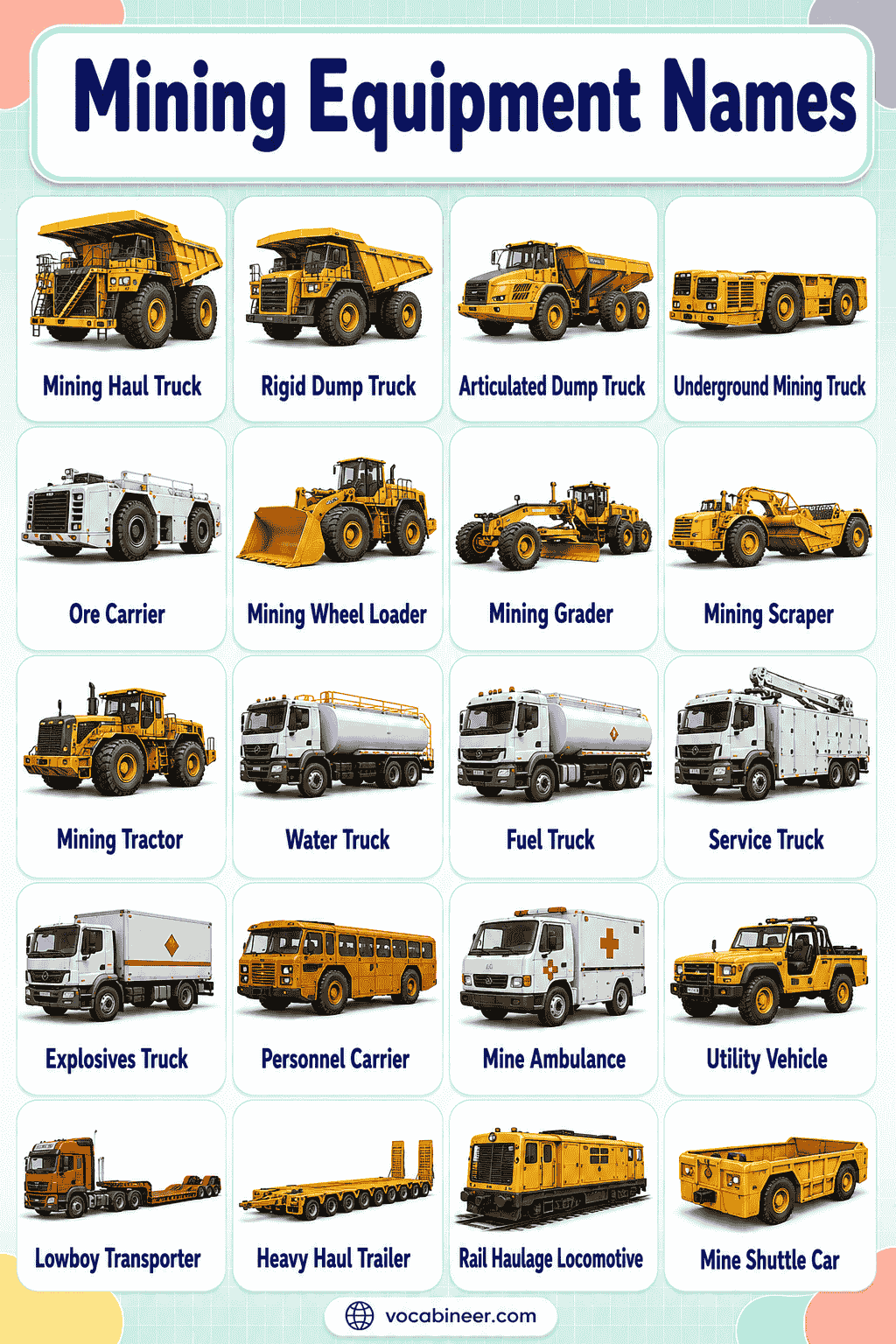
Rigid Haul Truck: This massive off-highway truck has a rigid frame and an open dump body. It carries extremely heavy loads along prepared surface roads.
Articulated Dump Truck: Often called an ADT or articulated hauler, this vehicle bends at a central joint. As a result, it handles rough ground and tighter routes more effectively.
Underground Mining Truck: A shorter, lower-profile truck carries ore through mine tunnels. Manufacturers design its dimensions around tunnel height, width, and turning space.
Shuttle Car: Common in underground coal mining, a shuttle car moves material from a continuous miner to a feeder or conveyor.
Mine Rail Locomotive: This locomotive pulls ore cars, supply wagons, or personnel vehicles along mine tracks.
Mine Cart: A smaller rail vehicle transports rock, tools, equipment, or supplies.
Belt Conveyor: A moving belt carries material continuously between mining or processing stages.
Overland Conveyor: This long surface conveyor transports bulk material across considerable distances. In some operations, it reduces reliance on trucks.
Skip: A skip lifts ore or waste vertically through a mine shaft.
Personnel Carrier: This vehicle transports workers and may include protective features suited to underground conditions.
Utility Vehicle: Utility vehicles carry tools, replacement parts, maintenance crews, and supplies around the site.
Rigid haul trucks provide exceptional capacity. By comparison, articulated trucks carry smaller loads but move more easily across uneven ground.
Underground Mining Machines
Underground machines must fit confined spaces while cutting, loading, and transporting material.
Continuous Miner: A rotating cutting head removes coal or softer rock without a separate drilling-and-blasting cycle. Gathering arms direct the broken material toward a conveyor.
Longwall Shearer: This machine travels along a long coal face and cuts material with rotating drums. The coal falls onto an armored face conveyor.
Roadheader: A boom-mounted cutting head excavates tunnels and softer rock. Unlike a continuous miner, a roadheader can create several tunnel shapes.
Coal Plow: Pulled along a longwall face, the plow slices coal from the seam and directs it toward the conveyor.
Hard-Rock Miner: This specialized mechanical machine cuts stronger rock formations. Its usefulness depends on rock strength and project design.
LHD Machine: The compact LHD handles short-distance loading and transport underground.
Underground Truck: When haul distances increase, underground trucks carry material to crushers, ore passes, or shaft systems.
Shuttle Car: In room-and-pillar coal mining, the shuttle car moves material between the cutting machine and the conveyor.
Jumbo Drill: Before some underground excavations begin, the jumbo drills a planned pattern of holes into the working face.
Mechanical Scaler: A hydraulic boom removes loose rock from tunnel walls and ceilings before other work continues.
Together, these machines cut, load, and move material while fitting within the physical limits of an underground mine.
Ground-Support Equipment
Underground openings often need reinforcement after excavation exposes fractured or loose rock.
Roof Bolter: A roof bolter drills holes and installs bolts that strengthen the rock above an underground opening.
Cable Bolter: Longer cable bolts provide reinforcement deeper inside the surrounding rock.
Rock-Bolting Rig: This specialized rig drills and installs bolts in tunnel roofs and walls.
Scaling Machine: A scaling machine removes loose rock before workers or other equipment enter the area.
Shotcrete Sprayer: This machine sprays concrete onto exposed rock and creates a supportive surface layer.
Mesh Handler: Hydraulic equipment lifts and positions steel mesh against tunnel walls or ceilings before workers secure it.
Concrete Mixer Carrier: Built for confined workings, this vehicle transports concrete for shotcrete and other support tasks.
Although these machines do not extract minerals directly, they help keep underground openings stable.
Mine Ventilation and Safety Equipment
Underground mines rely on controlled airflow, dust management, gas monitoring, and emergency systems.
Mine Ventilation Fan: A main fan moves large volumes of air through underground workings and replaces contaminated air with fresh air.
Auxiliary Ventilation Fan: Smaller fans direct airflow into active headings and remote tunnel areas.
Ventilation Ducting: Flexible or rigid ducts carry air from a fan to the required location.
Dust Collector: This system captures fine airborne particles around enclosed work areas or processing machinery.
Wet Scrubber: Water and airflow work together to remove dust and selected contaminants from mine air.
Water-Spray System: Fine sprays reduce dust around roads, crushers, conveyors, and transfer points.
Gas Detector: Portable or fixed detectors monitor oxygen levels and potentially hazardous gases.
Refuge Chamber: This protected emergency space may provide temporary shelter and essential supplies during an underground incident.
Mine Communication System: Radios, alarms, tracking devices, and communication networks connect workers with control areas.
Fire-Suppression System: Installed on selected vehicles and machines, this system helps detect or control fires.
Because every mine has different conditions, trained personnel follow site-specific ventilation, safety, and emergency procedures.
Rock-Crushing Equipment
Once ore reaches the processing area, crushers reduce large rocks into smaller pieces.
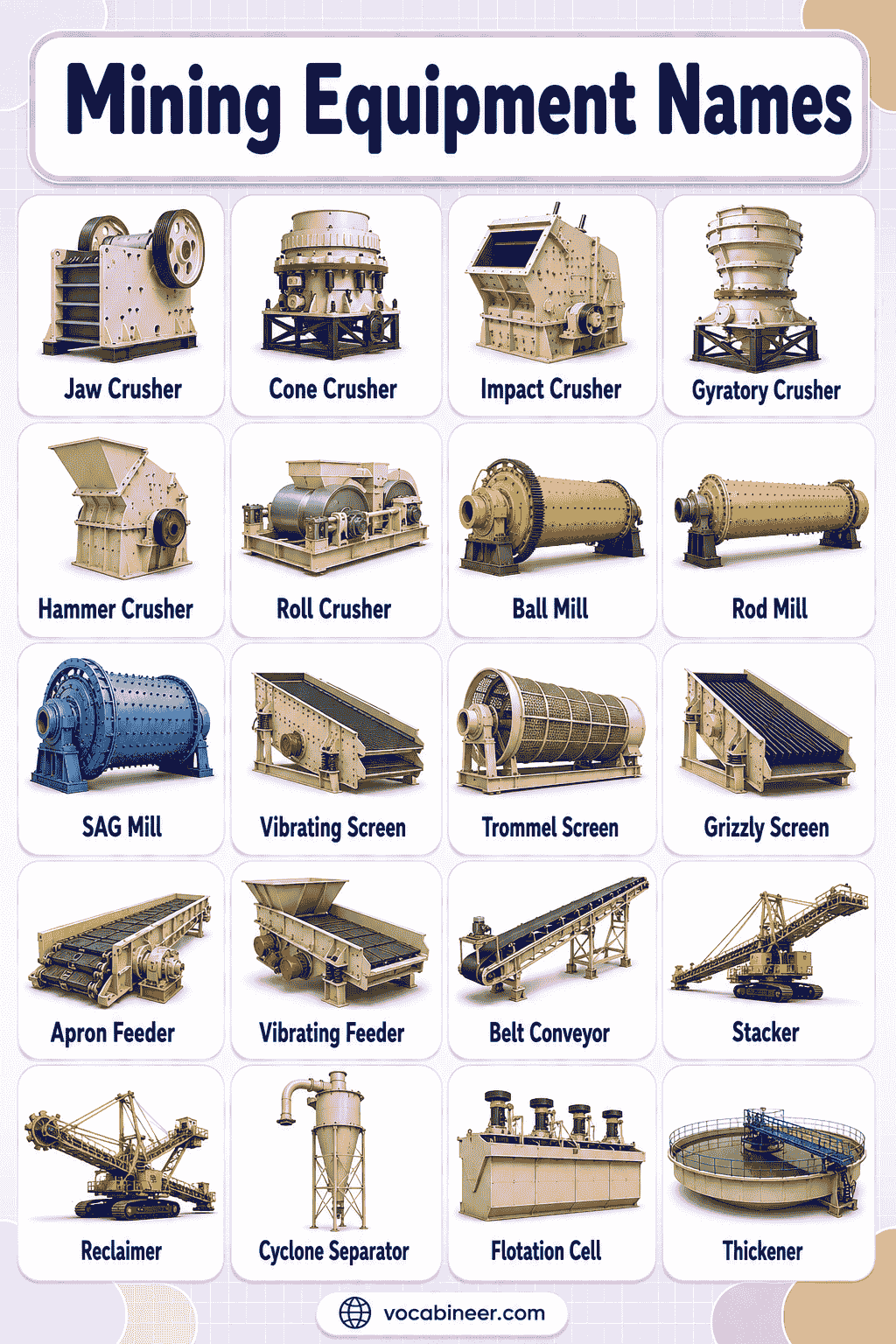
Jaw Crusher: Two strong plates compress the rock. Since it can accept relatively large material, a jaw crusher often handles primary crushing.
Gyratory Crusher: A central crushing head moves inside a large outer shell. High-capacity plants commonly use it as a primary crusher.
Cone Crusher: This compression crusher reduces material during secondary or tertiary stages. It normally receives rock that has already passed through a primary crusher.
Impact Crusher: Rapidly moving components strike the material and break it through impact.
Hammer Crusher: Rotating hammers hit softer or more brittle material until the pieces become small enough to pass through an opening.
Roll Crusher: Rotating rolls pull in the material and compress it.
Sizer Crusher: Toothed shafts break material while controlling the size of the discharged pieces.
Feeder Breaker: This machine controls material flow while breaking oversized lumps. Underground and bulk-material operations commonly use it.
Mobile Crusher: Mounted on tracks or wheels, a mobile crushing unit can operate closer to the excavation area.
Rock Breaker: A hydraulic hammer reduces oversized boulders before they enter the crusher.
Primary crushers accept the largest feed. Secondary and tertiary machines then reduce it to the size required for the next stage.
Grinding and Milling Equipment
After crushing, grinding mills reduce ore into finer particles so processing systems can separate valuable minerals more effectively.
Ball Mill: A rotating cylinder containing steel balls grinds material through impact and abrasion.
Rod Mill: Long steel rods act as the grinding media and often produce a relatively uniform product.
SAG Mill: A semi-autogenous grinding mill uses large ore pieces together with a smaller quantity of steel balls.
Autogenous Mill: Instead of relying on steel grinding media, this mill mainly uses pieces of the ore itself.
Vertical Grinding Mill: Internal components apply pressure and movement to grind material inside a vertical structure.
Stirred Media Mill: Small grinding media move rapidly through the material and support fine or ultrafine grinding.
Crushing and grinding serve different purposes. A crusher breaks large rock into manageable pieces, whereas a mill produces much finer particles.
Screening, Feeding, and Conveying Equipment
Processing plants must control material flow, separate particles by size, and move ore between machines.
Screens Used in Mining
Vibrating Screen: Vibration moves material across a perforated surface. Smaller particles pass through while larger pieces continue forward.
Grizzly Screen: Strong parallel bars remove oversized rocks before they reach a crusher.
Trommel Screen: A rotating cylindrical drum sorts material as it travels through the machine.
Dewatering Screen: This screen removes water while retaining solid particles.
Scalping Screen: Positioned early in the process, a scalping screen removes oversized or unwanted material.
Feeders Used in Mining
Vibrating Feeder: Controlled vibration moves rock or ore forward at a steady rate.
Apron Feeder: Heavy metal plates carry large, abrasive, or high-impact material.
Belt Feeder: A short belt conveyor regulates the quantity of material leaving a hopper.
Grizzly Feeder: This machine feeds material while smaller pieces pass between strong bars.
Mine Conveyor Systems
Belt Conveyor: A continuous belt carries bulk material horizontally or along an incline.
Armored Face Conveyor: In longwall mining, this heavy-duty conveyor transports coal away from the cutting face.
Chain Conveyor: Chains and attached flights drag material through a channel.
Overland Conveyor: Built for long distances, this system moves material between widely separated site areas.
Stacker Conveyor: A movable discharge point places processed material into organized stockpiles.
Feeders prevent sudden surges, screens control particle size, and conveyors maintain a steady flow of material.
Mineral-Separation Equipment
After crushers and mills reduce the ore to a suitable size, separation equipment helps recover valuable minerals.
Flotation Cell: Air bubbles and controlled chemical conditions cause selected particles to rise into a froth, which the plant then collects.
Magnetic Separator: Magnetic forces remove or recover particles according to their magnetic properties.
Electrostatic Separator: Electrical differences separate conductive materials from less-conductive particles. Only suitable minerals and processing conditions support this method.
Shaking Table: A sloped, vibrating deck separates particles according to density and movement.
Spiral Concentrator: A spiral channel uses flowing water and gravity to separate lighter material from denser mineral particles.
Jig Concentrator: Pulsing water sorts particles according to density.
Centrifugal Concentrator: Rapid rotation creates forces that concentrate dense mineral particles.
Hydrocyclone: Pressurized slurry enters a conical chamber, where swirling motion classifies particles by size and density.
Dense-Medium Separator: A fluid with controlled density separates material that floats from material that sinks.
Ore Sorter: Sensors identify selected properties in pieces of rock before mechanical systems separate them.
Different minerals require different recovery methods. Therefore, processing plants choose equipment according to particle size, density, magnetic behavior, and other material properties.
Mine Pumps and Dewatering Equipment
Water enters mines naturally and also supports mineral processing. Pumps and dewatering systems manage it at different stages.
Dewatering Pump: This pump removes water from pits, tunnels, shafts, and collection areas.
Slurry Pump: Designed for abrasive mixtures, a slurry pump moves water containing fine rock or mineral particles.
Sump Pump: Installed at a low collection point, this pump removes accumulated water.
Submersible Pump: Because it operates while submerged, this pump works well in flooded or consistently wet locations.
Filter Press: Pressure forces liquid through filtering material while solids remain behind as a compact cake.
Thickener: Solid particles settle toward the bottom of a large tank while clearer liquid rises.
Clarifier: Similar settling principles remove suspended solids from process water.
Belt Filter: Moving filter belts separate water from solids continuously.
Dewatering Screen: Vibration removes water while retaining coarser particles.
Pumps move water or slurry between locations. In contrast, filters, thickeners, and screens reduce the moisture contained in mineral products or waste material.
Mining Support and Maintenance Vehicles
Mine production depends on usable roads, fuel delivery, repairs, power, and material handling.
Motor Grader: A long adjustable blade levels and shapes haul roads. Smooth roads reduce vibration and support efficient truck movement.
Water Truck: This truck sprays mine roads and work areas to control dust.
Fuel Truck: Mobile fuel delivery allows large machines to remain near their working areas.
Service Truck: Mechanics use this vehicle to carry tools, fluids, spare parts, and repair equipment.
Lube Truck: A lubrication truck supplies oils, greases, and other service fluids to mobile machinery.
Tire Handler: Built for extremely large mining tires, this machine lifts and positions them during replacement.
Mobile Crane: A crane lifts engines, buckets, machine components, and structural parts during maintenance or installation.
Telehandler: Its telescopic boom moves supplies to elevated or difficult-to-reach areas.
Forklift: Workshops and storage facilities use forklifts to move pallets, tools, and packaged materials.
Generator: Portable or fixed generators provide electricity where permanent power is unavailable.
Air Compressor: Compressed air supports tools, maintenance work, and selected drilling systems.
Rescue Vehicle: Emergency teams use this vehicle to transport trained personnel and specialized equipment.
Support vehicles do not remove ore, but production would stop without road maintenance, fuel, repairs, power, and emergency services.
30 Common Mining Equipment Names and Uses
This quick-reference list covers widely recognized equipment used in surface mines, underground workings, and processing plants.
Excavator: Digs soil, rock, and loose material.
Mining Shovel: Loads large volumes of broken rock into haul trucks.
Dragline: Removes overburden with a cable-controlled bucket.
Bucket-Wheel Excavator: Continuously removes soft surface material.
Bulldozer: Pushes and spreads soil, rock, or waste.
Wheel Loader: Scoops material and loads trucks or stockpiles.
LHD Machine: Loads, carries, and dumps material underground.
Rigid Haul Truck: Transports large loads on prepared mine roads.
Articulated Dump Truck: Carries material across rough or uneven ground.
Underground Truck: Moves ore through restricted mine tunnels.
Blast-Hole Drill: Creates production holes in surface rock.
Jumbo Drill: Drills underground tunnel faces.
Continuous Miner: Cuts coal or softer rock underground.
Longwall Shearer: Cuts material along an extended coal face.
Roadheader: Excavates tunnels with a boom-mounted cutting head.
Shuttle Car: Carries material from a continuous miner to a conveyor.
Roof Bolter: Installs reinforcement bolts in underground openings.
Scaling Machine: Removes loose rock from tunnel surfaces.
Jaw Crusher: Breaks large rocks during primary crushing.
Cone Crusher: Reduces material during secondary or tertiary crushing.
Ball Mill: Grinds crushed ore into finer particles.
SAG Mill: Grinds ore using ore pieces and steel balls.
Vibrating Screen: Separates material according to particle size.
Apron Feeder: Delivers heavy material at a controlled rate.
Belt Conveyor: Moves ore continuously between locations.
Flotation Cell: Helps separate selected minerals from waste.
Magnetic Separator: Recovers or removes magnetic particles.
Slurry Pump: Moves water mixed with mineral particles.
Motor Grader: Maintains smooth mine roads.
Ventilation Fan: Circulates air through underground workings.
Alternate Names for Mining Equipment
Mining terminology can vary among countries, industries, companies, and manufacturers.
- Articulated dump truck may also be called an ADT or articulated hauler.
- Rigid haul truck may be called a mining truck or off-highway truck.
- Wheel loader is also widely known as a front-end loader.
- Load-haul-dump machine may be shortened to LHD or called an underground loader.
- Scoop tram commonly refers to an LHD or closely related underground loader.
- Jumbo drill may be called a drilling jumbo or face drill.
- Blast-hole drill may also be described as a production drill.
- Electric rope shovel is sometimes called a cable shovel.
- Longwall shearer may be called a shearer loader.
- Roof bolter may be known as a bolting machine.
- Tunnel-boring machine is commonly shortened to TBM.
- Semi-autogenous grinding mill is usually shortened to SAG mill.
- Belt conveyor and conveyor belt refer to the same general system.
Related names should appear together rather than count as separate machines.
Commonly Confused Mining Machines
Several mining machines perform similar jobs, but their designs and operating environments differ.
Excavator vs. Mining Shovel: An excavator is flexible and works across several industries, whereas a mining shovel focuses mainly on high-volume loading at large mines.
Rigid Haul Truck vs. Articulated Dump Truck: A rigid truck carries much larger loads on prepared roads. An articulated truck, however, handles rough ground and tighter routes more effectively.
Wheel Loader vs. LHD Machine: A wheel loader usually works in open surface areas, while an LHD has a compact underground design.
Continuous Miner vs. Longwall Shearer: A continuous miner cuts individual rooms or entries. By contrast, a longwall shearer travels along an extended mining face.
Crusher vs. Grinding Mill: A crusher breaks large rocks into smaller pieces, whereas a mill turns crushed material into fine particles.
Mining Equipment Vocabulary in Sentences
- The excavator removed loose rock from the pit.
- A haul truck carried ore along the mine road.
- The bulldozer pushed waste material into a pile.
- The blast-hole drill created holes in the rock.
- A wheel loader filled the truck with broken stone.
- The LHD transported ore through the tunnel.
- A continuous miner cut material from the underground face.
- The roof bolter reinforced the rock above the tunnel.
- A jaw crusher broke large rocks into smaller pieces.
- After crushing, the ball mill ground the ore more finely.
- The vibrating screen separated particles by size.
- A conveyor carried material toward the processing plant.
- The slurry pump moved water and mineral particles.
- A ventilation fan supplied fresh air underground.
- The water truck sprayed the haul road to reduce dust.
Related Mining Vocabulary
Ore: Rock containing enough valuable mineral to justify mining or processing.
Overburden: Soil and rock covering a mineral deposit.
Waste Rock: Material removed during mining that does not contain enough valuable mineral.
Open Pit: A large surface excavation used to reach a deposit.
Mine Shaft: A vertical or steep opening that provides underground access.
Tunnel: A horizontal or sloping underground passage.
Mine Face: The exposed area where workers or machines actively remove rock or mineral.
Bench: A step-like working level in an open-pit mine.
Haul Road: A road designed for mining trucks and support vehicles.
Stockpile: A stored pile of ore, rock, or processed material.
Processing Plant: A facility where machines crush, grind, separate, or concentrate ore.
Slurry: A mixture of fine solid particles and liquid.
Concentrate: Processed material containing a higher proportion of valuable mineral.
Tailings: Material remaining after processing systems recover the valuable minerals.
Ground Support: Bolts, mesh, concrete, and related systems that stabilize underground openings.
Ventilation: The controlled movement of air through underground workings.
Dewatering: The removal of unwanted water from a mine or mineral product.
FAQs
The main categories include drilling rigs, excavators, loaders, haul trucks, underground cutting machines, crushers, grinding mills, screens, conveyors, separators, pumps, and support vehicles.
Surface mines commonly use blast-hole drills, hydraulic excavators, mining shovels, draglines, bulldozers, wheel loaders, rigid haul trucks, motor graders, and water trucks.
Common underground machines include jumbo drills, LHDs, underground trucks, continuous miners, longwall shearers, roadheaders, shuttle cars, roof bolters, scaling machines, and ventilation fans.
Mining equipment includes large machinery, vehicles, and processing systems. Mining tools are generally smaller items used for sampling, inspection, repair, and manual work.
Crushers reduce large rocks to smaller pieces. Grinding mills then turn the crushed material into finer particles for mineral separation.
Read More
- Computer Accessories Names
- Sportswear Items Names
- Sports Equipment Names
- Different Types of Clothes
- Religious Symbols Names
- Beach Items Names