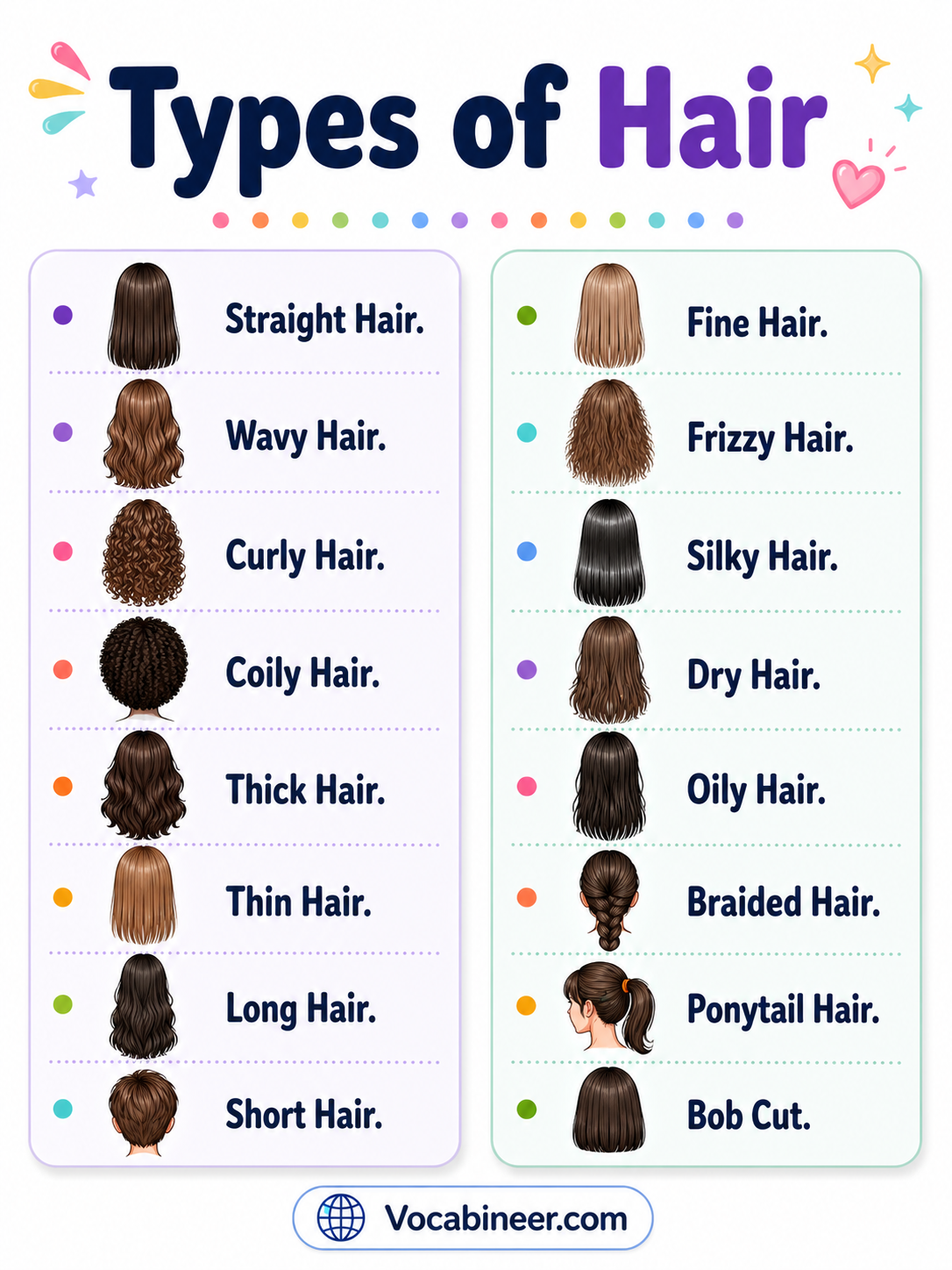
Hair has different natural patterns, including straight, wavy, curly, and coily. These patterns describe the natural shape of your strands after washing and drying without heat styling, heavy products, or brushing them into a different form.
This guide explains 12 different hair patterns from 1A to 4C with pictures, a simple chart, and clear descriptions. You will also learn the difference between hair pattern, texture, density, and porosity, so you can describe hair more clearly and understand each type in simple words.
In This Page
12 Hair Patterns Chart
| Hair Pattern | Group | Simple Description |
|---|---|---|
| 1A | Straight | Very straight, fine, and flat hair. |
| 1B | Straight | Straight hair with more body and volume. |
| 1C | Straight | Straight, thicker hair with a slight bend. |
| 2A | Wavy | Loose waves with a soft S-shape. |
| 2B | Wavy | Clear waves with more shape and texture. |
| 2C | Wavy | Strong waves that may look close to curls. |
| 3A | Curly | Loose curls with a large, rounded shape. |
| 3B | Curly | Springy curls with more volume and bounce. |
| 3C | Curly | Tight curls with a corkscrew shape. |
| 4A | Coily | Soft coils with a visible S-shaped pattern. |
| 4B | Coily | Tight coils with a zigzag shape. |
| 4C | Coily | Very tight coils with less visible definition. |
Straight Hair
Straight hair has little or no natural wave. It usually lies flat from the roots to the ends and often looks smooth, shiny, or sleek.
1A Hair
1A hair is very straight, fine, and soft. It often lies flat on the scalp and may not hold curls easily.
1B Hair
1B hair is straight but has a little more body and thickness than 1A hair. It may look fuller while still staying mostly straight.
1C Hair
1C hair is straight, thicker, and stronger. It may feel slightly coarse and can have a small bend near the ends.
Wavy Hair
Wavy hair has a natural S-shaped pattern. It sits between straight and curly hair, so it can look loose, soft, or more defined.
2A Hair
2A hair has loose, gentle waves. It usually looks soft and light, with a mild S-shape and little frizz.
2B Hair
2B hair has more visible waves with a stronger S-shape. The waves often start around the middle of the hair.
2C Hair
2C hair has thick, defined waves that may begin near the roots. It can sometimes look close to loose curls.
Curly Hair
Curly hair forms loops, spirals, or ringlets. It usually has more volume than straight or wavy hair and may need extra moisture.
3A Hair
3A hair has loose, large curls with a soft round shape. These curls usually look bouncy and easy to notice.
3B Hair
3B hair has springy curls with more definition and volume. It often looks fuller and thicker than 3A hair.
3C Hair
3C hair has tight corkscrew curls. This pattern often looks dense, full, and highly textured.
Coily Hair
Coily hair has tight curls, coils, or zigzag patterns. It often looks full and textured and may have more shrinkage than other hair patterns.
4A Hair
4A hair has soft coils with a clear S-shaped pattern. The coils are tight but still easy to see.
4B Hair
4B hair has tight coils with a fluffy zigzag pattern. It may look less rounded than 4A hair.
4C Hair
4C hair has very tight coils with less visible curl definition. It often has strong volume and noticeable shrinkage.
Hair Texture
Hair texture means the thickness of each strand. It is different from hair pattern because pattern describes shape, while texture describes strand size.
Fine Hair
Fine hair has thin strands that feel soft, light, and delicate. It may look flat if there is not much volume.
Medium Hair
Medium hair has balanced strands that are not too thin or too thick. It is often easier to style than very fine or very thick hair.
Thick Hair
Thick hair has wider strands that feel strong, full, coarse, or heavy. It often creates a fuller-looking hairstyle.
Hair Density
Hair density means how much hair grows on the scalp. A person can have fine strands but still have high hair density.
Low Density Hair
Low density hair means there is less hair on the scalp. The scalp may be easier to see, especially when the hair is parted.
Medium Density Hair
Medium density hair means there is a balanced amount of hair. It does not look too thin or too full.
High Density Hair
High density hair means there is a lot of hair on the scalp. It often creates a thicker and fuller appearance.
Hair Porosity
Hair porosity means how well hair absorbs and holds moisture. It can affect dryness, frizz, product buildup, and how hair responds to oils or creams.
Low Porosity Hair
Low porosity hair absorbs moisture slowly. Products may sit on the surface instead of entering the hair easily.
Medium Porosity Hair
Medium porosity hair absorbs and keeps moisture fairly well. It is often easier to manage than very low or high porosity hair.
High Porosity Hair
High porosity hair absorbs moisture quickly but may also lose it quickly. It can feel dry, frizzy, or easily damaged.
How to Know Your Hair Type
To know your hair type, wash your hair and let it dry naturally without heat styling or heavy products. Look at the shape of your strands after your hair is fully dry.
If your hair dries straight, it is type 1. If it forms soft S-shaped waves, it is type 2. If it forms curls or ringlets, it is type 3. If it forms tight coils or zigzag shapes, it is type 4.
For a better understanding, also check your hair texture, density, and porosity. These details help you describe your hair clearly and choose better care methods.
Hair Type vs Hair Texture
Hair type and hair texture are related, but they do not mean the same thing. Hair type describes the natural pattern, while hair texture describes the thickness of each strand.
| Term | Meaning | Examples |
|---|---|---|
| Hair Type | Natural shape or pattern of hair. | Straight, wavy, curly, coily. |
| Hair Texture | Thickness of each strand. | Fine, medium, thick. |
| Hair Density | Amount of hair on the scalp. | Low, medium, high. |
| Hair Porosity | How hair absorbs moisture. | Low, medium, high. |
FAQs
The main types of hair are straight, wavy, curly, and coily. These four groups are often divided into 12 patterns, from 1A to 4C.
There are four main hair groups and 12 common hair patterns. The full pattern system includes 1A, 1B, 1C, 2A, 2B, 2C, 3A, 3B, 3C, 4A, 4B, and 4C.
The 1A to 4C system describes natural hair patterns. Type 1 is straight, type 2 is wavy, type 3 is curly, and type 4 is coily.
Wash your hair and let it dry naturally without heat styling or heavy products. Then check whether your hair looks straight, wavy, curly, or coily.
Wavy hair forms soft S-shaped bends, while curly hair forms more rounded loops, spirals, or ringlets. Curly hair usually has more volume and definition than wavy hair.
Summary
Hair types are commonly grouped into straight, wavy, curly, and coily patterns. These groups include 12 common patterns from 1A to 4C. Learning your hair pattern, texture, density, and porosity helps you describe your hair clearly and understand what kind of care it may need.
Read More
- Types of Hair Colors
- Short Haircut Styles Names
- Cleaning Tools Names in English
- Human Parts of the Face in English