

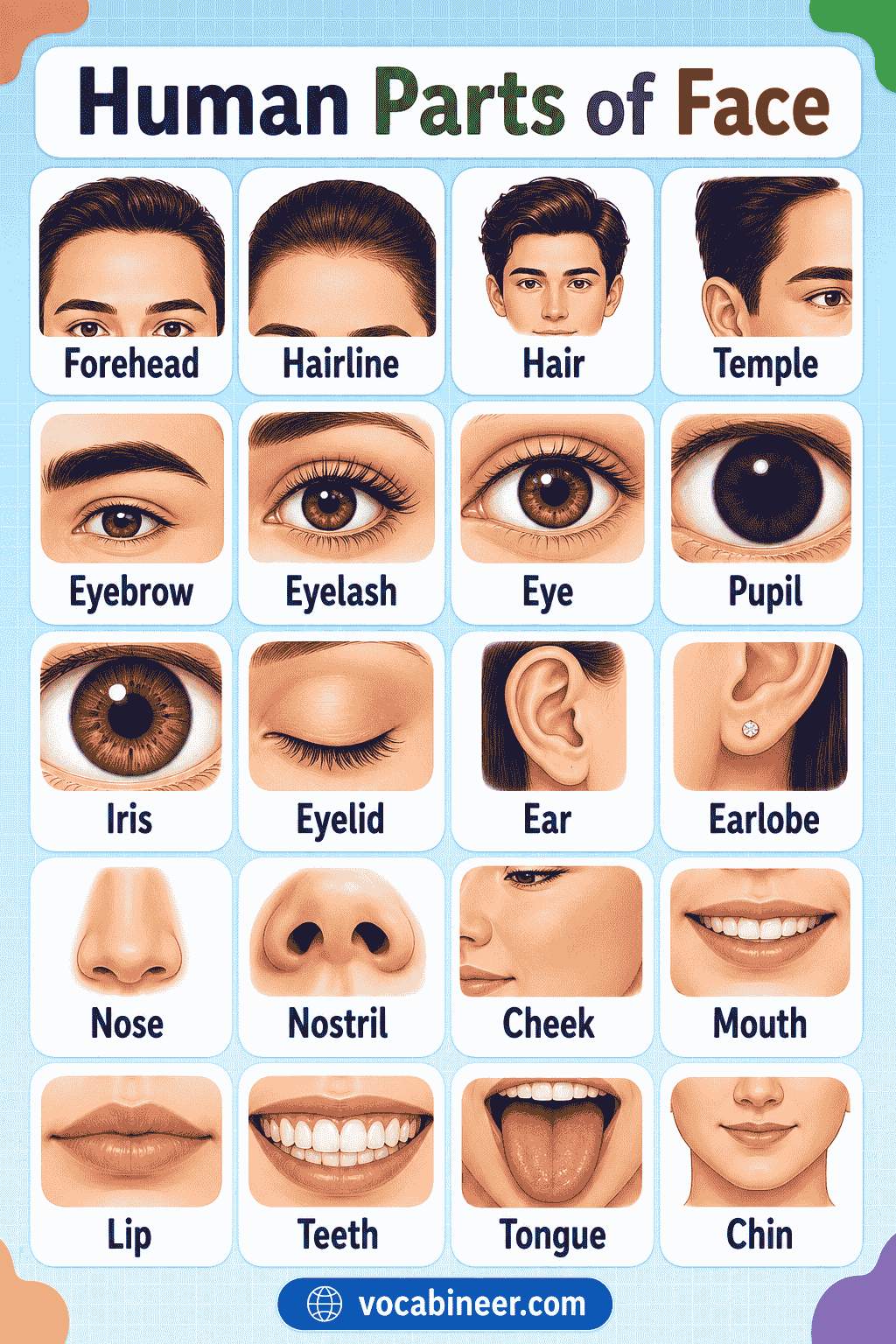
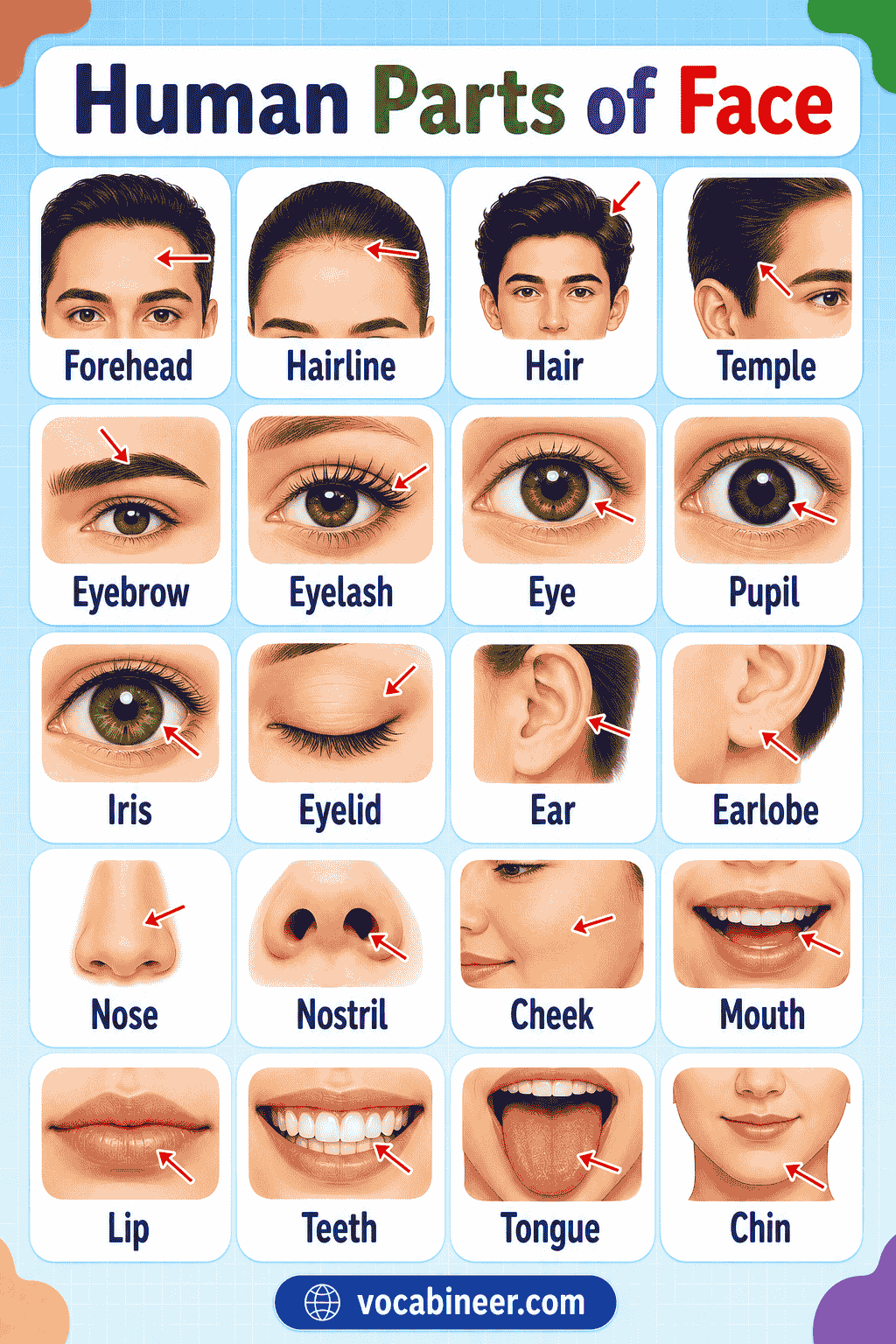
The face has many important parts, such as the eyes, nose, mouth, lips, cheeks, chin, forehead, eyebrows, eyelashes, and jaw. Learning the parts of the face in English with pictures helps kids, students, and English learners understand facial features and build useful vocabulary.
You will also learn simple meanings, functions, example sentences, singular and plural forms, face description words, common mistakes, kids activities, worksheet ideas, and a labeled face parts diagram.

In This Page
What Are the Parts of the Face?
Parts of the face are the visible features on the front of the head. These parts help us see, smell, speak, eat, smile, show feelings, and recognize people.
The main parts of the face include:
- Eyes
- Nose
- Mouth
- Lips
- Teeth
- Tongue
- Cheeks
- Chin
- Forehead
- Eyebrows
- Eyelashes
- Eyelids
- Jaw
- Nostrils
Words like hair, head, ears, neck, and skin are often included in face vocabulary lessons because they appear close to the face or help describe a person’s appearance.
Face Parts Names List in English
Here is a clean list of face parts names in English for kids, students, and English learners.
- Face
- Forehead
- Eye
- Eyes
- Eyebrow
- Eyebrows
- Eyelid
- Eyelids
- Eyelash
- Eyelashes
- Pupil
- Iris
- Nose
- Nostril
- Nostrils
- Cheek
- Cheeks
- Cheekbone
- Mouth
- Lip
- Lips
- Tooth
- Teeth
- Tongue
- Gum
- Gums
- Jaw
- Jawline
- Chin
Face Parts Names with Simple Meanings
This list explains the most important face parts in simple English.
- Face — the front part of the head with the eyes, nose, mouth, and other features.
- Forehead — the area above the eyebrows and below the hairline.
- Eye — the part of the face used for seeing.
- Eyebrow — the line of hair above the eye.
- Eyelid — the skin that opens and closes over the eye.
- Eyelash — the small hair on the edge of the eyelid.
- Pupil — the dark center of the eye.
- Iris — the colored part of the eye around the pupil.
- Nose — the part used for smelling and breathing.
- Nostril — one opening at the bottom of the nose.
- Cheek — the soft side area of the face below the eye.
- Cheekbone — the bone that shapes the upper cheek.
- Mouth — the opening used for eating and speaking.
- Lip — the soft outer edge of the mouth.
- Tooth — one hard white part in the mouth.
- Teeth — more than one tooth.
- Tongue — the soft part inside the mouth used for tasting and speaking.
- Gum — the soft part around the teeth.
- Jaw — the lower part of the face that moves when chewing and speaking.
- Jawline — the line along the lower edge of the jaw.
- Chin — the lower front part of the face below the mouth.
Face Parts by Area
Grouping face parts by area helps learners understand where each part is located.
Upper Face Parts
- Forehead — the upper front part of the face.
- Eyebrows — the hair lines above the eyes.
- Eyes — the parts used for seeing.
- Eyelids — the skin that covers and protects the eyes.
- Eyelashes — the small hairs on the eyelids.
- Pupils — the dark centers of the eyes.
- Irises — the colored parts of the eyes.
Middle Face Parts
- Nose — the part used for smelling and breathing.
- Nostrils — the two openings of the nose.
- Cheeks — the soft side areas of the face.
- Cheekbones — the bones that shape the upper cheeks.
Lower Face Parts
- Mouth — the opening used for eating and speaking.
- Lips — the soft outer parts of the mouth.
- Teeth — the hard white parts used for biting and chewing.
- Tongue — the soft part used for tasting and speaking.
- Gums — the soft tissue around the teeth.
- Jaw — the lower face area that moves when we chew.
- Chin — the lowest front part of the face.
Parts Around the Eyes
The eyes have several small parts around them. These words are useful for kids and English learners.
- Eye — helps us see light, colors, shapes, and people.
- Eyebrow — hair above the eye that helps protect it and show feelings.
- Eyelid — skin that opens and closes over the eye.
- Eyelash — small hair that helps protect the eye from dust.
- Pupil — the dark center of the eye.
- Iris — the colored part of the eye.
- Eyeball — the round part of the eye.
Parts of the Nose
The nose is in the middle of the face. It helps us breathe and smell.
- Nose — the main part used for breathing and smelling.
- Nostril — one opening at the bottom of the nose.
- Nostrils — the two openings of the nose.
- Bridge of the nose — the upper part of the nose between the eyes.
- Tip of the nose — the front end of the nose.
Parts of the Mouth
The mouth helps us speak, eat, smile, taste, chew, and swallow.
- Mouth — the opening used for eating and speaking.
- Lips — the soft outer edges of the mouth.
- Upper lip — the top lip.
- Lower lip — the bottom lip.
- Tooth — one hard white part in the mouth.
- Teeth — more than one tooth.
- Tongue — helps us taste, speak, chew, and swallow.
- Gums — the soft tissue around the teeth.
- Jaw — helps the mouth open and close.
- Chin — the lower part below the mouth.
Ear Words Often Taught with Face Parts
The ears are related head parts often taught with face parts. They help us hear sounds and are usually included in beginner body vocabulary lessons.
- Ear — the part that helps us hear.
- Outer ear — the visible outside part of the ear.
- Earlobe — the soft lower part of the ear.
Related Face and Head Vocabulary
These words are useful when learning face vocabulary, but they are not all strict face parts.
- Head — the upper part of the body that includes the face, skull, hair, and brain area.
- Hair — the strands that grow on the head.
- Hairline — the edge where the hair begins on the forehead.
- Neck — the part that connects the head to the body.
- Skin — the outer covering of the face and body.
- Temple — the side area of the head near the eyes and forehead.
- Earlobe — the soft lower part of the ear.
- Dimple — a small hollow that may appear on the cheek when smiling.
- Freckle — a small brown spot on the skin.
- Beard — hair that grows on the lower face.
- Mustache — hair that grows above the upper lip.
Facial Features in English
Facial features are the noticeable parts of a person’s face. These words help us describe how someone looks.
Common facial features include:
- Eyes — blue eyes, brown eyes, big eyes, small eyes.
- Nose — small nose, long nose, straight nose, wide nose.
- Mouth — small mouth, wide mouth, smiling mouth.
- Lips — thin lips, full lips, pink lips.
- Cheeks — round cheeks, soft cheeks, red cheeks.
- Chin — pointed chin, round chin, small chin.
- Jawline — strong jawline, soft jawline.
- Forehead — wide forehead, high forehead.
- Eyebrows — thick eyebrows, thin eyebrows, dark eyebrows.
- Hair — curly hair, straight hair, short hair, long hair.
Face Parts and Their Functions
Each face part has a simple function. Some parts help us sense the world, while others help us eat, speak, and show feelings.
- Eyes — help us see.
- Ears — related head parts that help us hear.
- Nose — helps us smell and breathe.
- Mouth — helps us eat, speak, breathe, and smile.
- Lips — help us speak, eat, and show expressions.
- Teeth — help us bite and chew food.
- Tongue — helps us taste, speak, chew, and swallow.
- Eyebrows — help protect the eyes and show feelings.
- Eyelids — protect the eyes.
- Eyelashes — help keep dust away from the eyes.
- Cheeks — help shape the face and support expressions.
- Jaw — helps us chew and speak.
- Chin — gives shape to the lower face.
- Forehead — helps show expressions with the eyebrows.
- Skin — covers and protects the face and body.
Basic Face Parts Names for Kids
Kids should first learn the easiest and most common face words. These words are simple and useful in daily speech.
- Eye
- Eyes
- Ear
- Ears
- Nose
- Mouth
- Teeth
- Tongue
- Lip
- Lips
- Chin
- Cheek
- Cheeks
- Hair
- Head
- Neck
- Eyebrow
- Eyelash
- Forehead
- Face
Face Parts for Preschool and Kindergarten
Preschool and kindergarten learners should start with short, clear words and simple sentences.
- Eyes — I see with my eyes.
- Ears — I hear with my ears.
- Nose — I smell with my nose.
- Mouth — I eat with my mouth.
- Teeth — I chew with my teeth.
- Tongue — I taste with my tongue.
- Lips — I smile with my lips.
- Hair — Hair grows on the head.
- Chin — The chin is below the mouth.
- Cheeks — The cheeks are on the sides of the face.
Singular and Plural Face Part Words
Some face part words change when we talk about more than one. These forms are important for English learners.
- Eye → Eyes
- Ear → Ears
- Eyebrow → Eyebrows
- Eyelid → Eyelids
- Eyelash → Eyelashes
- Nostril → Nostrils
- Cheek → Cheeks
- Lip → Lips
- Tooth → Teeth
- Gum → Gums
- Dimple → Dimples
- Freckle → Freckles
Examples:
- One tooth is loose.
- My teeth are clean.
- One eye is blue.
- Both eyes are brown.
Face Parts Names with Example Sentences
Example sentences help students use face part words in real English.
- Eye — I can see with my eyes.
- Ear — I hear music with my ears.
- Nose — My nose helps me smell flowers.
- Mouth — I use my mouth to speak.
- Lips — Her lips are pink.
- Teeth — Brush your teeth every day.
- Tongue — The tongue helps us taste food.
- Cheek — The baby has soft cheeks.
- Chin — He touched his chin.
- Forehead — She has a small mark on her forehead.
- Eyebrow — His eyebrows are thick.
- Eyelash — An eyelash fell on my cheek.
- Nostril — Air passes through the nostrils.
- Jaw — The jaw moves when we chew.
- Earlobe — The earlobe is the soft part of the ear.
- Hair — She has curly hair.
- Face — His face looks happy.
- Skin — Skin covers the face.
Words to Describe a Face in English
These words and phrases help learners describe a person’s face in simple English.
- Round face — a face with a round shape.
- Oval face — a face shaped like an oval.
- Long face — a face that looks longer than wide.
- Small nose — a nose that is not big.
- Long nose — a nose that looks long.
- Big eyes — eyes that look large.
- Blue eyes — eyes with a blue color.
- Brown eyes — eyes with a brown color.
- Thick eyebrows — eyebrows with a lot of hair.
- Thin eyebrows — narrow eyebrows.
- Curly hair — hair with curls.
- Straight hair — hair without curls.
- Thin lips — lips that look narrow.
- Full lips — lips that look thick or rounded.
- Wide smile — a big smile.
- Soft cheeks — cheeks that look smooth or gentle.
- Pointed chin — a chin with a pointed shape.
- Strong jawline — a clear lower face shape.
Simple Phrases to Describe a Face
These short phrases help English learners use face part words naturally.
- big eyes
- small eyes
- brown eyes
- blue eyes
- long nose
- small nose
- wide mouth
- pink lips
- thin lips
- full lips
- white teeth
- round cheeks
- red cheeks
- curly hair
- straight hair
- wide forehead
- thick eyebrows
- long eyelashes
- pointed chin
- strong jawline
- happy face
- smiling face
- round face
- oval face
Common Mistakes with Face Parts Words
These common mistakes are easy to fix with simple examples.
- Do not say “tooths.” Say teeth for more than one tooth.
- Do not confuse eyebrow and eyelash. Eyebrows are above the eyes; eyelashes are on the eyelids.
- Do not call the whole mouth a lip. Lips are only the soft outer edges.
- Do not call the head and face the same thing. The face is the front part of the head.
- Use plural words for pairs. Say eyes, ears, cheeks, lips, and eyebrows when talking about both.
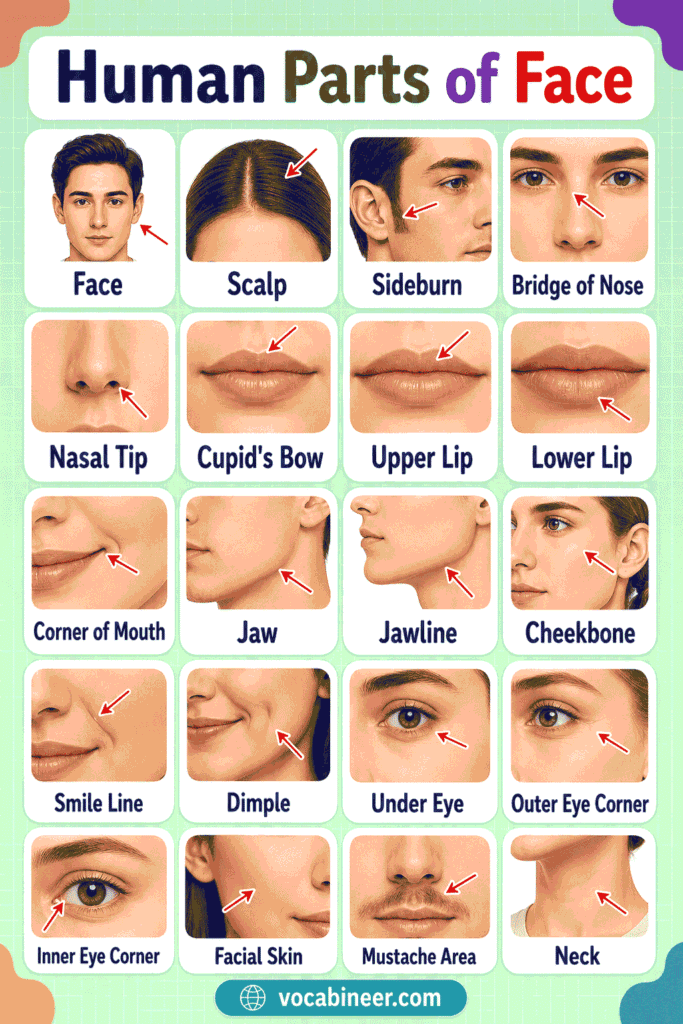
Labeled Face Parts Diagram
A labeled face parts diagram shows where each face part is located. It is useful for kids, students, teachers, and English learners because it connects each word with a clear picture.
A good labeled face diagram should show:
- Hair
- Forehead
- Eyebrow
- Eye
- Eyelid
- Eyelash
- Pupil
- Iris
- Nose
- Nostril
- Cheek
- Cheekbone
- Ear
- Earlobe
- Mouth
- Lip
- Teeth
- Tongue
- Jaw
- Chin
- Neck
Face Parts Activities and Worksheet Ideas
Activities and worksheets make face vocabulary easier to remember. They also help kids connect each word with a real face part.
- Point and say — point to a face part and say its name.
- Touch your face game — say “Touch your nose” or “Touch your chin.”
- Label the face worksheet — match words to a face picture.
- Draw and label — draw a face and write the names.
- Mirror practice — look in a mirror and name each face part.
- Flashcard matching — match picture cards with word cards.
- Guess the face part — describe a part and ask kids to guess the word.
- Fill in missing letters — use words like n_se, m_uth, and e_e.
- Sort by area — group words into upper face, middle face, and lower face.
- Write a sentence — write one short sentence using each face part word.
Parts of the Face Chart with Pictures
A chart helps learners review face parts quickly.
| Face Part | Simple Meaning | Example Sentence |
|---|---|---|
| Eye | Helps us see | I can see with my eyes. |
| Ear | Related head part that helps us hear | I hear music with my ears. |
| Nose | Helps us smell and breathe | My nose smells flowers. |
| Mouth | Helps us eat and speak | I use my mouth to speak. |
| Lip | Soft outer edge of the mouth | Her lips are pink. |
| Teeth | Help us bite and chew | Brush your teeth every day. |
| Tongue | Helps us taste and speak | My tongue tastes sweet food. |
| Cheek | Soft side part of the face | The baby has soft cheeks. |
| Chin | Lower front part of the face | He touched his chin. |
| Forehead | Area above the eyebrows | She has a mark on her forehead. |
| Eyebrow | Hair above the eye | His eyebrows are thick. |
| Eyelash | Small hair on the eyelid | An eyelash fell on my cheek. |
| Eyelid | Skin that covers the eye | The eyelid protects the eye. |
| Nostril | Opening of the nose | Air passes through the nostrils. |
| Jaw | Lower face area used for chewing | The jaw moves when we chew. |
| Earlobe | Soft lower part of the ear | The earlobe is soft. |
Confusing Face Part Words Explained
Some face part words are easy to confuse. This table explains the differences in simple English.
| Term | Simple Difference |
|---|---|
| Lip vs Mouth | Lips are the soft outer edges. The mouth includes the lips, teeth, tongue, and opening used for eating and speaking. |
| Tooth vs Teeth | Tooth means one hard white part in the mouth. Teeth means more than one. |
| Eyebrow vs Eyelash | Eyebrows are above the eyes. Eyelashes grow on the eyelids. |
| Pupil vs Iris | The pupil is the dark center of the eye. The iris is the colored part around it. |
| Jaw vs Chin | The jaw is the lower area that moves when chewing. The chin is the front lower part below the mouth. |
| Face vs Head | The face is the front part with eyes, nose, and mouth. The head includes the face, skull, hair, and brain area. |
| Cheek vs Cheekbone | The cheek is the soft side area of the face. The cheekbone is the bone under the upper cheek. |
How to Teach Face Parts to Kids
Start with the easiest words: eyes, ears, nose, mouth, teeth, tongue, lips, chin, cheeks, and hair. Use a picture, point to each part, say the word clearly, and ask the child to repeat it. Simple actions also help, such as “Touch your nose,” “Open your mouth,” and “Close your eyes.”
Next, add picture cards, songs, drawing activities, and matching games. For example, show a labeled face diagram and ask kids to match each word to the correct part. Then use short sentences like “I see with my eyes,” “I smell with my nose,” and “I eat with my mouth.”
FAQs
The main parts of the face include the eyes, nose, mouth, lips, cheeks, chin, forehead, eyebrows, eyelashes, jaw, and nostrils. Ears are also often taught with face vocabulary.
Facial features are the visible parts of a person’s face, such as eyes, nose, mouth, lips, eyebrows, cheeks, chin, jawline, forehead, and hair.
Lips are the soft outer parts of the mouth. The mouth includes the lips, teeth, tongue, gums, and the opening used for eating and speaking.
Tooth means one hard white part in the mouth. Teeth means more than one tooth.
Kids should first learn simple face parts like eyes, ears, nose, mouth, teeth, tongue, lips, cheeks, chin, hair, and head.
Read More
- Parts of Body Names in English
- Hand Parts Name in English
- Parts of Laptop with Name
- Parts of a House Names
- Parts of a Computer