Hair colors appear in both natural and dyed forms, ranging from deep black and rich brown to blonde, red, platinum, and silver. Creative shades such as blue, purple, and pink are also popular, allowing people to express personal style and follow beauty trends.
This post covers different types of hair colors with names and pictures. Learning these names can help in daily conversations, school projects, fashion discussions, and beauty salon visits while making each shade easier to recognize.
In This Page
What Hair Color Names Describe
A hair color name may describe the main shade, how light or dark it looks, or the undertone visible in the hair.
For example:
- dark brown describes depth;
- ash brown describes a cool tone;
- golden blonde describes a warm tone;
- silver gray describes both shade and finish.
Most hair colors belong to one of these broad groups:
| Hair color family | Common examples |
|---|---|
| Black | Natural black, soft black, jet black, blue black |
| Brown | Chocolate, chestnut, caramel, ash brown |
| Blonde | Golden, honey, sandy, ash, platinum |
| Red | Ginger, copper, auburn, burgundy |
| Gray and white | Natural gray, silver, salt and pepper, white |
| Creative colors | Pink, purple, blue, green, peach, rainbow |
Popular Hair Color Names With Pictures
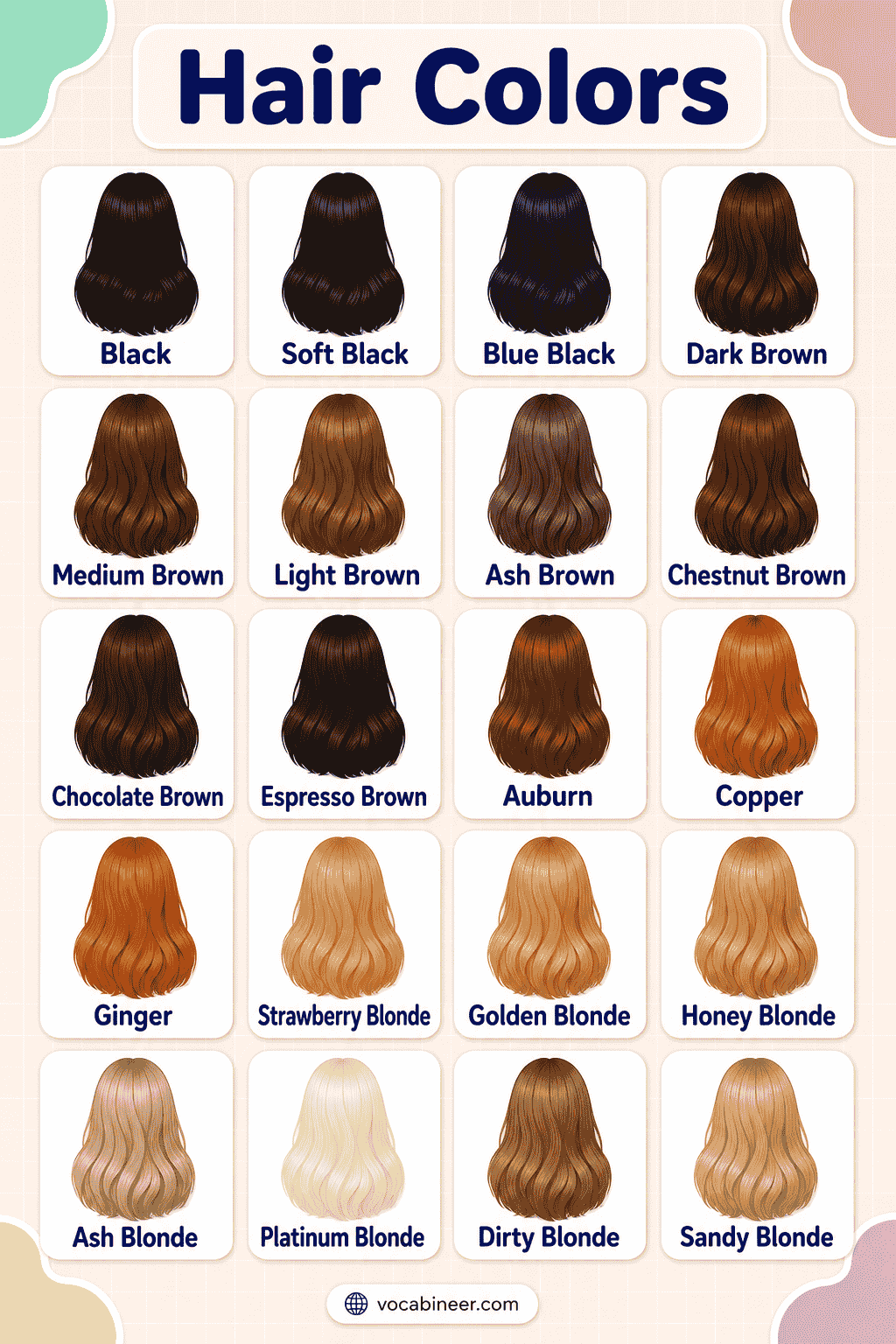
Hair colors range from natural shades such as black, brown, blonde, and red to lighter, darker, and fashion-inspired tones. Learning common hair color names with pictures helps readers recognize different shades and describe hair more clearly.
Black Hair
Black hair has the deepest natural shade and can appear soft black, blue-black, or jet black depending on tone and lighting.
Dark Brown Hair
Dark brown hair has a rich, deep color that looks softer than black while still giving strong contrast.
Medium Brown Hair
Medium brown hair sits between dark and light brown and often has warm or neutral undertones.
Light Brown Hair
Light brown hair has a softer brown shade that may include golden, beige, or caramel tones.
Chocolate Brown Hair
Chocolate brown hair has a rich, warm brown color inspired by dark or milk chocolate shades.
Chestnut Brown Hair
Chestnut brown combines brown with subtle reddish or warm undertones for a rich, dimensional look.
Caramel Brown Hair
Caramel brown blends warm brown with golden tones and often creates a soft, sunlit appearance.
Ash Brown Hair
Ash brown has cool gray or smoky undertones instead of warm red or golden tones.
Golden Brown Hair
Golden brown combines medium brown with warm golden highlights or undertones.
Blonde Hair
Blonde hair includes a wide range of light shades from pale beige to warm golden tones.
Platinum Blonde Hair
Platinum blonde is an extremely light blonde shade with cool, almost white undertones.
Golden Blonde Hair
Golden blonde has warm yellow-gold tones that create a bright and sunny appearance.
Ash Blonde Hair
Ash blonde uses cool gray or silver undertones for a softer, less golden look.
Honey Blonde Hair
Honey blonde blends warm golden and light brown tones for a rich, natural-looking color.
Strawberry Blonde Hair
Strawberry blonde combines light blonde with soft red or copper tones.
Auburn Hair
Auburn hair mixes red and brown shades to create a deep, warm color.
Copper Hair
Copper hair has bright orange-red tones that create a vivid, warm appearance.
Burgundy Hair
Burgundy combines deep red with purple or wine-colored undertones.
Silver Hair
Silver hair has cool gray-white tones that can look natural or intentionally styled.
Rose Gold Hair
Rose gold blends soft pink with warm blonde or golden tones for a modern fashion color.
Natural Hair Colors
Natural hair colors usually fall into four main groups: black, brown, blonde, and red. Gray and white may appear gradually as natural pigment decreases with age.
Natural hair rarely looks like one completely flat shade. Light, texture, and undertones can make the same color appear warmer, cooler, lighter, or darker.
Black
Black is the darkest natural hair color. It may look neutral, slightly brown, or faintly blue under strong light.
Brown
Brown is a broad natural color that ranges from light brown to shades that appear almost black.
Blonde
Blonde hair ranges from dark beige and sandy tones to pale golden shades.
Red
Natural red hair may appear ginger, copper, strawberry blonde, or auburn.
Gray
Gray hair combines strands that have lost pigment with darker or naturally colored strands.
White
White hair contains very little visible pigment and may look bright, soft, or slightly silver.
Black Hair Colors
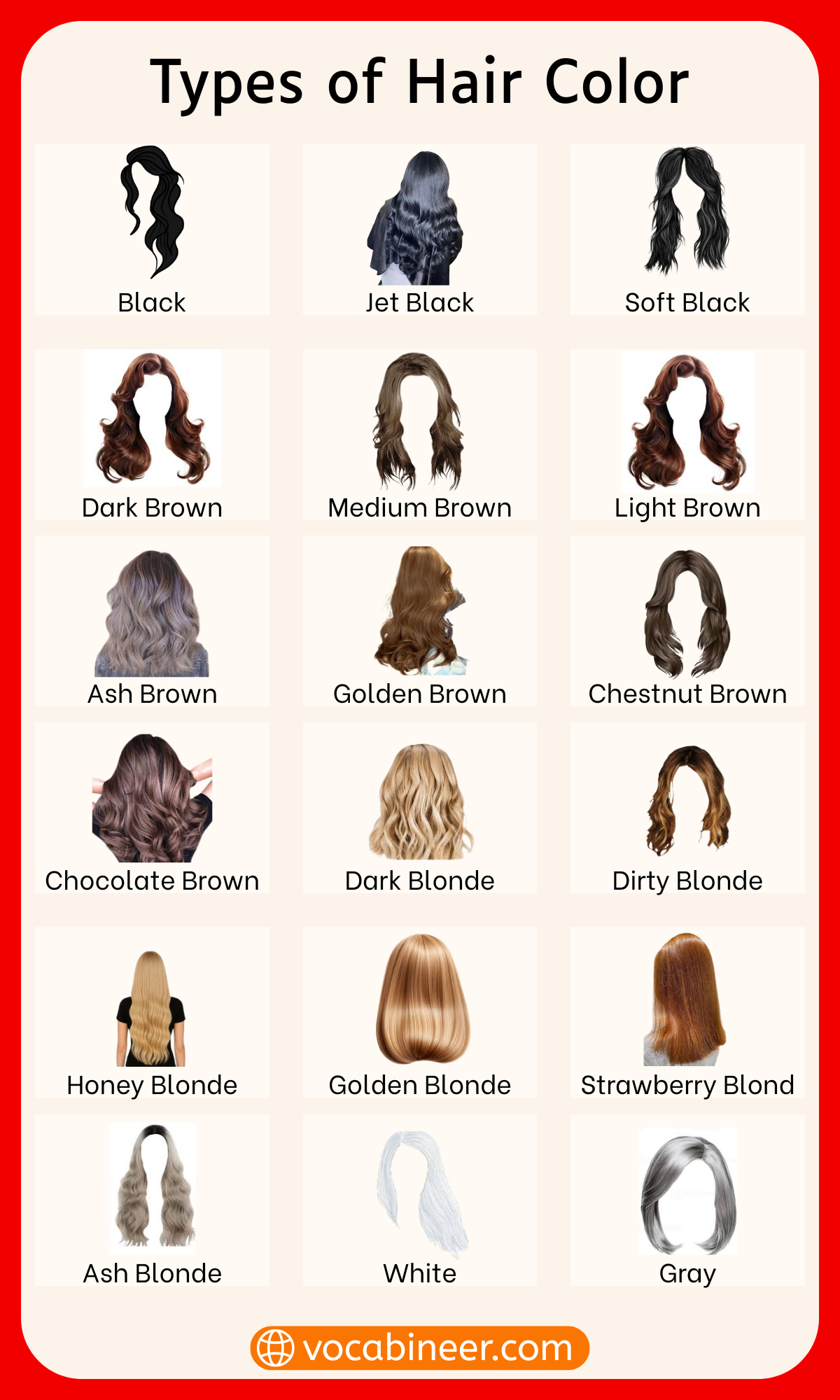
Black shades can appear natural and soft or intense and glossy. Their differences are often easiest to see in bright light.
Natural Black
Natural black is a deep shade with slight variation between individual strands.
Soft Black
Soft black looks less intense than jet black and often produces a gentler, more natural appearance.
Jet Black
Jet black is extremely dark, glossy, and uniform. It usually looks stronger than natural black.
Blue Black
Blue black has a black base with cool blue reflections that become more visible under light.
Brown Black
Brown black looks black indoors but reveals dark brown undertones in sunlight.
Brown Hair Colors
Brown hair includes warm golden shades, cool smoky tones, and deep colors close to black.
Dark Brown
Dark brown is a deep brunette shade that may appear almost black in dim light.
Medium Brown
Medium brown has a balanced depth between dark and light brunette shades.
Light Brown
Light brown sits close to dark blonde and may have beige, golden, or neutral undertones.
Chocolate Brown
Chocolate brown is a rich, smooth brunette shade with noticeable warmth.
Chestnut Brown
Chestnut brown combines brown with mild red or golden undertones.
Ash Brown
Ash brown has a cool, muted finish with gray or smoky tones.
Golden Brown
Golden brown contains warm yellow or gold reflections.
Caramel Brown
Caramel brown blends medium brown with soft golden warmth.
Honey Brown
Honey brown is a warm brunette shade with golden and amber undertones.
Mocha Brown
Mocha brown has a balanced or slightly cool finish and usually appears less red than chocolate brown.
Mushroom Brown
Mushroom brown mixes ash brown, taupe, and soft gray tones.
Espresso Brown
Espresso is an extremely dark brown that still shows a brunette base.
Cinnamon Brown
Cinnamon brown combines medium brown with copper or soft red warmth.
Mahogany Brown
Mahogany brown blends deep brunette color with red or violet undertones.
Blonde Hair Colors
Blonde shades can look warm and golden, cool and smoky, or balanced and beige.
Dark Blonde
Dark blonde sits between light brown and traditional blonde.
Golden Blonde
Golden blonde has warm yellow and gold reflections that create a sunlit appearance.
Honey Blonde
Honey blonde combines gold, amber, and soft brown tones.
Sandy Blonde
Sandy blonde is a muted beige shade with a soft, natural finish.
Dirty Blonde
Dirty blonde mixes darker blonde with light brown strands.
Ash Blonde
Ash blonde has gray or smoky undertones that create a cool appearance.
Beige Blonde
Beige blonde balances warm and cool tones for a neutral finish.
Champagne Blonde
Champagne blonde is a pale shade with soft beige, gold, or pink undertones.
Butter Blonde
Butter blonde is a creamy warm shade with gentle yellow-gold color.
Strawberry Blonde
Strawberry blonde blends light blonde with subtle copper or red.
Platinum Blonde
Platinum blonde is an extremely pale shade close to white.
Icy Blonde
Icy blonde has strong silver, violet, or blue undertones.
White Blonde
White blonde has very little visible yellow and appears almost white.
Red Hair Colors
Red shades range from bright orange-red to deep reddish brown and wine-inspired colors.
Ginger
Ginger is a warm red-orange shade with golden brightness.
Copper
Copper is a vivid red shade with orange and metallic gold tones.
Copper Blonde
Copper blonde combines a blonde base with light orange-red warmth.
Auburn
Auburn is a rich reddish-brown shade with more depth than copper.
Dark Auburn
Dark auburn contains deeper brown and red tones.
Cinnamon Red
Cinnamon red blends brown, copper, and soft red shades.
Cherry Red
Cherry red is a bright and highly saturated true-red color.
Burgundy
Burgundy is a deep red shade with purple or wine-colored undertones.
Wine Red
Wine red combines dark red with plum or violet depth.
Mahogany
Mahogany mixes dark brown with rich red or violet reflections.
Gray, White, and Silver Hair
Gray and white hair may develop naturally, while silver and charcoal shades are also popular dyed colors.
Natural Gray
Natural gray often contains a mixture of darker, gray, and white strands.
Salt and Pepper
Salt-and-pepper hair blends dark strands with gray or white ones.
Silver
Silver is a bright, cool shade with a metallic appearance.
Silver Gray
Silver gray looks deeper and smokier than bright silver.
Charcoal Gray
Charcoal gray is a dark, smoky shade with black, blue, or violet undertones.
Steel Gray
Steel gray has a cool metallic finish between charcoal and silver.
Pearl White
Pearl white is pale with subtle silver, beige, pink, or violet reflections.
Pure White
Pure white contains very little visible pigment and appears brighter than gray.
Creative Hair Colors
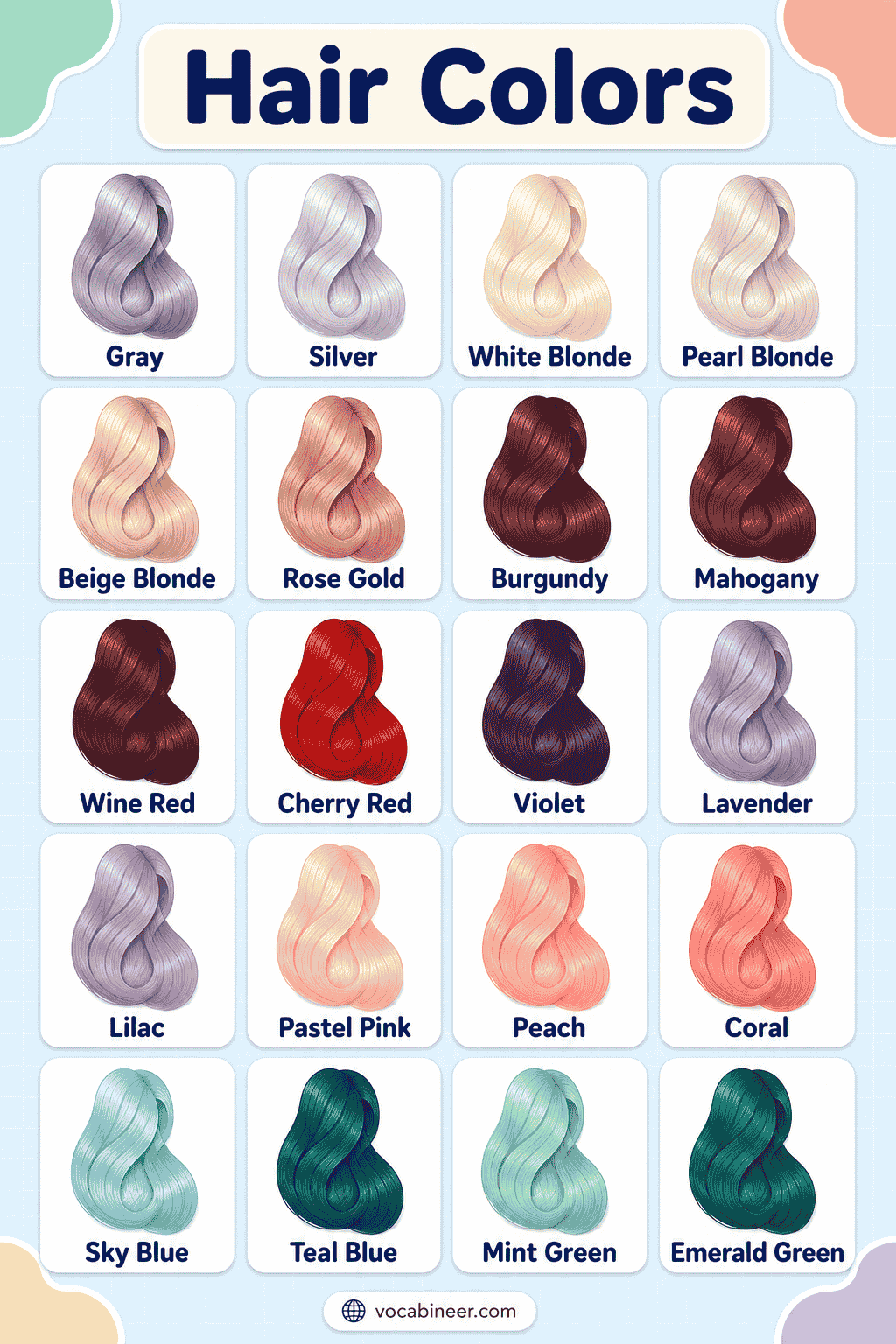
Creative colors offer bolder choices beyond natural-looking shades. They may be bright, pastel, metallic, or mixed with several colors.
Pastel Pink
Pastel pink is a soft, pale shade with a delicate finish.
Hot Pink
Hot pink is bright, vivid, and highly noticeable.
Rose Gold
Rose gold blends pink with peach or golden undertones.
Lavender
Lavender is a pale purple shade with a cool, powdery appearance.
Lilac
Lilac is a light purple color that often contains soft pink tones.
Violet
Violet is a stronger purple shade with noticeable blue undertones.
Plum
Plum is a deep purple-red color with rich depth.
Pastel Blue
Pastel blue is a light, softened blue shade.
Navy Blue
Navy blue is deep and may look almost black in low light.
Electric Blue
Electric blue is bright, bold, and strongly saturated.
Teal
Teal combines blue and green in a deep shade.
Turquoise
Turquoise is a brighter and lighter blue-green color.
Mint Green
Mint green is a pale, cool green with a soft pastel finish.
Emerald Green
Emerald green is a deep jewel-toned shade.
Peach
Peach combines soft orange, pink, and golden tones.
Orange
Orange hair ranges from pale apricot to bright, saturated orange.
Rainbow Hair
Rainbow hair combines several colors in sections, layers, or blended transitions.
Similar Hair Colors and Their Differences
Closely related hair colors can be difficult to identify from names alone. Their undertones and depth usually reveal the main difference.
| Similar shades | Main difference |
|---|---|
| Natural black and jet black | Jet black looks deeper, glossier, and more uniform |
| Dark brown and espresso | Espresso is generally darker and may look cooler |
| Chocolate and chestnut brown | Chocolate is deeper, while chestnut has more red warmth |
| Caramel and honey brown | Caramel appears browner; honey looks more golden |
| Golden and honey blonde | Honey blonde is usually deeper and more amber |
| Ash and beige blonde | Ash is cooler; beige has a more balanced tone |
| Platinum and icy blonde | Icy blonde has stronger blue, violet, or silver tones |
| Copper and auburn | Copper is brighter and more orange; auburn is darker and browner |
| Burgundy and mahogany | Burgundy looks more purple-red; mahogany contains more brown |
| Gray and silver | Gray appears softer; silver looks brighter and more metallic |
| Lavender and lilac | Lavender is often cooler; lilac usually has more pink |
| Teal and turquoise | Teal is darker, while turquoise is brighter |
Hair Colors from Darkest to Lightest
Hair color depth shows how dark or light a shade appears. It does not describe undertone, so two colors at the same depth may still look different. For example, dark chocolate brown appears warm, while dark ash brown looks cooler and smokier.
| Color depth | Common hair colors |
|---|---|
| Very dark | Jet black, blue black, brown black, espresso brown |
| Dark | Dark brown, chocolate brown, mahogany, burgundy |
| Medium | Medium brown, chestnut brown, mocha brown, auburn |
| Medium-light | Light brown, caramel brown, honey brown, dark blonde |
| Light | Golden blonde, sandy blonde, strawberry blonde, copper blonde |
| Very light | Platinum blonde, icy blonde, white blonde, pearl white |
Very dark shades may look nearly identical indoors. However, bright light can reveal whether the hair has brown, blue, red, or violet undertones.
Dark and medium colors show more visible variation. Chocolate brown looks warmer than espresso, while chestnut, mahogany, and auburn reveal reddish tones.
Light brown and dark blonde often sit close together. A warm golden shade may be described as dark blonde, whereas a deeper neutral shade may look more like light brown.
Platinum, icy blonde, white blonde, and pearl white belong at the lightest end. Platinum may appear neutral or slightly cool, while icy blonde usually shows stronger silver, blue, or violet tones.
Because the same color family can appear at different depths, the most accurate description combines both features, such as dark ash brown, medium copper, or light golden blonde.
How to Identify Hair Colors in Pictures
Start by identifying the main color family. Decide whether the hair appears black, brown, blonde, red, gray, white, or a creative shade.
Next, look at the depth:
- Very dark: black, blue black, espresso
- Dark: dark brown, chocolate, burgundy
- Medium: chestnut, mocha, auburn
- Light: light brown, golden blonde, copper blonde
- Very light: platinum, icy blonde, white blonde
Then check the undertone. Warm shades often show gold, yellow, orange, copper, or red. Cool shades may contain ash, gray, blue, violet, or silver. Neutral colors usually balance warm and cool tones without showing either one strongly.
The following clues can help:
| Visual clue | Possible description |
|---|---|
| Golden or yellow reflection | Golden blonde, honey blonde, golden brown |
| Orange-red reflection | Copper, ginger, cinnamon red |
| Soft red-brown depth | Auburn, chestnut, mahogany |
| Gray or smoky finish | Ash brown, mushroom brown, ash blonde |
| Blue reflection on dark hair | Blue black |
| Bright metallic gray | Silver |
| Pale purple tone | Lavender or lilac |
| Blue-green tone | Teal or turquoise |
Finally, check whether the hair has one solid color or several shades. Highlights, darker roots, balayage, ombré, and lowlights can make one hairstyle include multiple color names.
For example, a picture may show:
- dark brown hair with caramel highlights;
- ash blonde hair with shadow roots;
- copper hair with golden reflections;
- black hair with blue undertones;
- silver hair fading into lavender ends.
A clear description should mention the main color first, followed by its depth, undertone, or blended style.
Why Hair Color Looks Different in Various Lighting
The same hair color can appear warmer, cooler, lighter, or darker depending on the lighting. This is why one shade may look different in salon photos, outdoor pictures, and indoor mirrors.
Black hair often looks completely dark indoors. In sunlight, natural black may reveal brown undertones, while blue black can show a cool blue reflection.
Brown hair changes noticeably under warm and cool light. Chocolate and chestnut brown look richer in sunlight, while ash and mushroom brown may appear grayer beneath cool white lighting.
Blonde hair reflects light strongly. Golden and honey blonde look warmer outdoors, whereas ash, platinum, and icy blonde may appear silver or nearly white under cool light.
Red hair usually becomes brighter in direct sunlight. Copper may show orange-gold reflections, while auburn can look brown indoors and red outdoors.
Burgundy and mahogany often appear very dark in dim rooms. Their wine, red, or violet tones become easier to see under bright natural light.
Gray and silver hair may look white, blue-gray, or metallic depending on the surroundings. Warm lighting can soften silver tones, while cool lighting makes them appear sharper and icier.
For accurate comparison, use pictures that are:
- taken in natural daylight;
- free from strong filters;
- shown from more than one angle;
- photographed against a simple background;
- captured under similar lighting conditions.
Warm, Cool, and Neutral Hair Colors
Undertones affect how a hair color looks even when two shades belong to the same family.
| Tone | Common color hints | Examples |
|---|---|---|
| Warm | Gold, yellow, orange, copper, red | Honey blonde, caramel brown, copper |
| Cool | Ash, gray, silver, blue, violet | Ash brown, icy blonde, silver |
| Neutral | Balanced warm and cool tones | Mocha brown, beige blonde, soft black |
Warm colors often appear golden, rich, or glowing. Cool shades look smoky, muted, icy, or metallic. Neutral colors do not have a strongly warm or cool finish.
Useful words for describing tone include:
- golden
- ashy
- coppery
- smoky
- beige
- silvery
- warm
- cool
- neutral
Hair Coloring Styles
Some familiar terms describe how color is placed in the hair rather than naming a particular shade.
All-Over Color
One main shade covers most or all of the hair.
Highlights
Lighter strands create brightness and contrast.
Lowlights
Darker strands add depth to the base color.
Balayage
Color or lightener is painted onto selected sections for a soft blend.
Ombré
The hair gradually changes from darker roots to lighter or differently colored ends.
Sombré
Sombré creates a softer and less noticeable version of ombré.
Money-Piece Highlights
Lighter sections around the face create strong contrast.
Shadow Roots
The roots remain darker and blend into lighter lengths.
Color Melt
Several shades blend together without harsh dividing lines.
Peekaboo Color
Bright or contrasting color is placed beneath the top layer of hair.
Two-Tone Hair
Two clearly different colors appear together.
Dip-Dyed Ends
A separate shade is applied mainly to the ends.
How to Describe Hair Color in English
A complete description may include the depth, main shade, undertone, length, or coloring style.
Instead of saying:
She has brown hair.
You can give a more accurate description:
She has long, dark chocolate-brown hair.
Other natural examples include:
- He has short, natural black hair.
- Her hair is light ash brown.
- She dyed her hair copper red.
- He has salt-and-pepper hair.
- Her blonde hair has warm golden highlights.
- She chose a silver ombré style.
- His hair is dark brown with caramel highlights.
- She has pastel pink ends and dark roots.
- Her hair is naturally auburn.
- He colored his hair jet black.
Useful descriptive words include:
- dark
- medium
- light
- deep
- pale
- bright
- vivid
- muted
- smoky
- pastel
- metallic
- glossy
Conclusion
Hair colors come in a wide range of natural and dyed shades, from black, brown, blonde, and red to modern tones such as ash, caramel, burgundy, and platinum. Learning the names of different hair colors with pictures makes it easier to recognize shades, compare tones, and describe hair color more accurately.
FAQs
The most common natural hair colors are black, brown, blonde, and red. Black and dark brown dominate globally, while blonde is more common in Northern Europe. Red hair is the rarest, making up less than 2% of the world’s population.
Natural red hair is the rarest hair color in the world. It occurs due to a genetic variation in the MC1R gene and is mostly found in people of Northern and Western European ancestry. This unique shade ranges from bright copper to deep auburn tones.
Yes, hair colors can change throughout life. Babies often have lighter hair that darkens as they grow. Similarly, some people experience hair lightening from sun exposure, while aging can bring shades of gray, white, or silver as melanin production decreases.
In modern fashion, dyed shades such as platinum blonde, silver, pastel pink, purple, and blue are very popular. These creative tones allow people to express individuality and are commonly seen in celebrities, social media trends, and beauty salons worldwide.
Learning the types of hair colors with names and pictures helps people talk confidently in beauty salons, fashion discussions, or everyday conversations. It is also useful for students in school projects, hairstylists in their profession, and anyone interested in personal style.
Read More
- Short Haircut Styles Names
- Hairstyle Names for Women With Pictures
- Cleaning Tools Names in English
- Human Parts of the Face in English