

Farming vehicles help farmers prepare land, plant crops, protect growing plants, harvest produce, transport materials, and care for livestock. Some vehicles perform several jobs, while others specialize in one crop or farming task.
Learning farming vehicle names becomes easier when each machine is connected to its purpose. This guide explains common tractors, harvesters, crop-care vehicles, livestock vehicles, and farm transport machines in clear English.
In This Page
What Is a Farming Vehicle?
A farming vehicle is a mobile machine used for agricultural work, transport, crop care, harvesting, or material handling.
Some farm vehicles move under their own power and complete a specific task. For example, a combine harvester cuts and collects grain, while a self-propelled sprayer applies liquid treatments across a field. Other vehicles, such as tractors, provide power for many different jobs.
Farmers choose vehicles according to crop type, farm size, soil conditions, working space, and transport needs.
Farm Vehicles, Machines, and Implements
These terms are related, but they do not mean exactly the same thing.
Farm vehicle: A mobile unit that carries people, crops, animals, tools, or materials, or performs agricultural work.
Agricultural machine: A powered machine that completes a farming operation. Many harvesters and crop-care machines are both vehicles and agricultural machines.
Farm implement: Equipment that a tractor pulls or carries. Plows, harrows, cultivators, seed drills, and many balers belong to this group.
Farm attachment: A component fitted to another machine. Common examples include front loaders, pallet forks, mower decks, and post-hole diggers.
Farm tool: A smaller item used by hand, such as a hoe, rake, shovel, or sickle.
A tractor is a vehicle because it moves under its own power. By contrast, a plow is an implement because it normally depends on a tractor.
30 Common Farming Vehicle Names and Uses
Farming vehicles help farmers prepare land, plant crops, carry materials, harvest produce, spray fields, and manage livestock more efficiently. Learning common farming vehicle names and their uses helps students and English learners understand basic agricultural vocabulary and recognize the machines used on farms.
Tractor
A tractor provides power for pulling plows, trailers, seeders, and other farm equipment. Farmers use it for many field and transport tasks.
Combine Harvester
A combine harvester cuts, threshes, and separates grain crops such as wheat, barley, and corn in one operation.
Harvester
A harvester collects mature crops from fields. Different models handle crops such as potatoes, sugarcane, cotton, and vegetables.
Plow Tractor
A plow tractor pulls heavy plowing equipment through the soil. Farmers use it to turn and loosen the ground before planting.
Seeder Tractor
A seeder tractor pulls or carries planting equipment that places seeds into prepared soil at regular spacing.
Sprayer Vehicle
A sprayer vehicle carries tanks and spraying equipment for applying fertilizers, herbicides, pesticides, or other agricultural treatments.
Farm Truck
A farm truck transports crops, tools, feed, fuel, livestock supplies, and other materials around farms and between locations.
Pickup Truck
A pickup truck provides flexible transport for smaller loads, tools, workers, and farm supplies.
Grain Truck
A grain truck carries harvested grain from fields to storage facilities, markets, or processing areas.
Dump Truck
A dump truck transports loose materials such as soil, gravel, manure, feed, or harvested crops and unloads them by lifting its bed.
Farm Trailer
A farm trailer attaches to a tractor or truck and carries crops, hay, equipment, animals, or other farm materials.
Utility Terrain Vehicle
A utility terrain vehicle, or UTV, carries workers, tools, feed, and supplies across rough farm roads and fields.
All-Terrain Vehicle
An all-terrain vehicle, or ATV, helps farmers travel quickly across fields, check livestock, inspect fences, and carry small supplies.
Telehandler
A telehandler uses an extendable lifting arm to move hay bales, pallets, feed, and heavy materials to elevated or hard-to-reach areas.
Front Loader
A front loader uses a large bucket to lift and move soil, manure, feed, gravel, and other loose farm materials.
Skid-Steer Loader
A skid-steer loader is a compact vehicle that works well in barns, yards, and tight farm spaces. Farmers attach buckets, forks, and other tools to it.
Backhoe Loader
A backhoe loader combines a front bucket with a rear digging arm. Farmers use it for digging trenches, moving soil, and completing construction work.
Forage Harvester
A forage harvester cuts crops such as grass and corn into small pieces for silage and livestock feed.
Cotton Picker
A cotton picker removes cotton fibers from mature plants while moving through the field.
Sugarcane Harvester
A sugarcane harvester cuts sugarcane stalks, removes excess leaves, and collects the crop for transport.
Potato Harvester
A potato harvester lifts potatoes from the soil, separates much of the dirt, and gathers the crop for collection.
Beet Harvester
A beet harvester lifts sugar beets or similar root crops from the ground and prepares them for transport.
Rice Harvester
A rice harvester cuts and gathers mature rice plants and may also thresh the grain depending on the machine design.
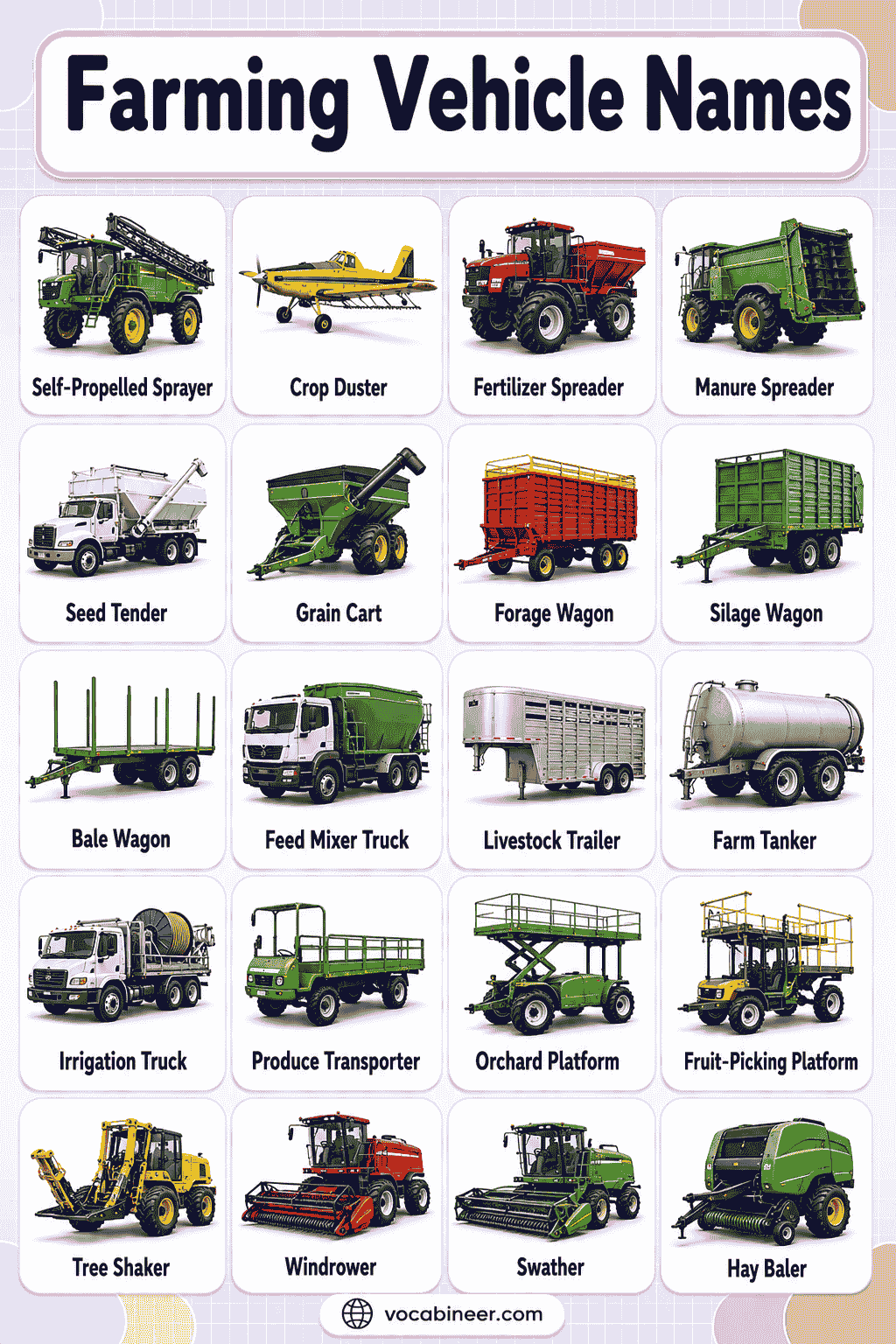
Bale Wagon
A bale wagon collects and transports hay or straw bales from fields to storage areas.
Hay Rake Tractor
A hay rake tractor pulls raking equipment that gathers cut grass or hay into rows before baling.
Baler Tractor
A baler tractor pulls a baling machine that compresses dry hay or straw into round or rectangular bales.
Manure Spreader
A manure spreader carries and distributes manure evenly across fields to add nutrients to the soil.
Feed Mixer Wagon
A feed mixer wagon blends different livestock feed ingredients and carries the mixture to feeding areas.
Livestock Transport Truck
A livestock transport truck carries cattle, sheep, goats, pigs, or other farm animals between farms, markets, and other locations.
Irrigation Vehicle
An irrigation vehicle carries or operates equipment that supplies water to crops, especially in fields where fixed irrigation systems are not available.
Common Types of Farm Tractors
Tractors provide power, traction, and movement for many agricultural tasks. However, different tractor designs suit different crops and working conditions.
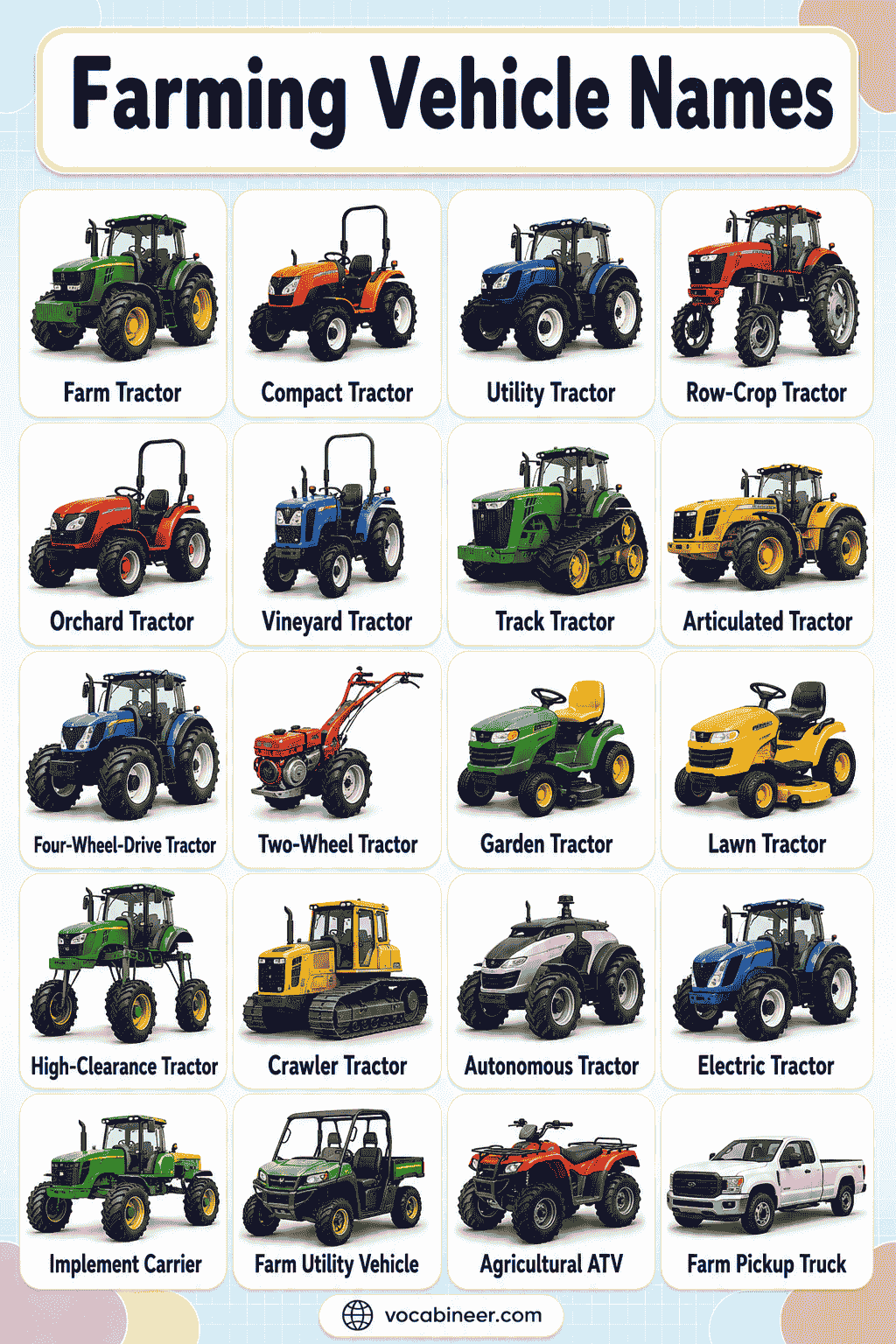
Utility Tractor: This general-purpose tractor handles mowing, towing, loading, and routine fieldwork. Mixed farms often use it because of its versatility.
Row-Crop Tractor: A row-crop tractor works between planted rows. Adjustable wheel spacing and higher crop clearance help protect growing plants.
Compact Tractor: A compact tractor combines useful power with a smaller frame. Farmers use it for mowing, light tillage, loader work, and property maintenance.
Subcompact Tractor: Smaller than a compact tractor, this machine suits gardens, small holdings, and light jobs. Many models accept mower decks and small loader attachments.
Orchard Tractor: A narrow, low-profile body allows this tractor to pass beneath branches and between fruit trees.
Vineyard Tractor: This tractor has an especially slim body for narrow vineyard rows. Tight steering also helps it turn at row ends.
Crawler Tractor: Tracks spread the vehicle’s weight across a larger area and provide strong grip on loose or soft ground.
Wheeled Tractor: Tires allow faster travel and easier road movement. As a result, wheeled tractors remain common for everyday farm work.
Articulated Tractor: This powerful tractor bends at a central joint to steer. Large farms use it for heavy tillage and broad-acre operations.
High-Clearance Tractor: A raised frame allows the tractor to travel over taller crops. Farmers may use it for cultivation, inspection, or crop treatment.
Some tractor categories overlap. One machine may be compact, four-wheel drive, and designed for orchard work at the same time.
Harvesting Vehicles Used on Farms
Harvesting vehicles collect mature crops and prepare them for transport, storage, or feeding.
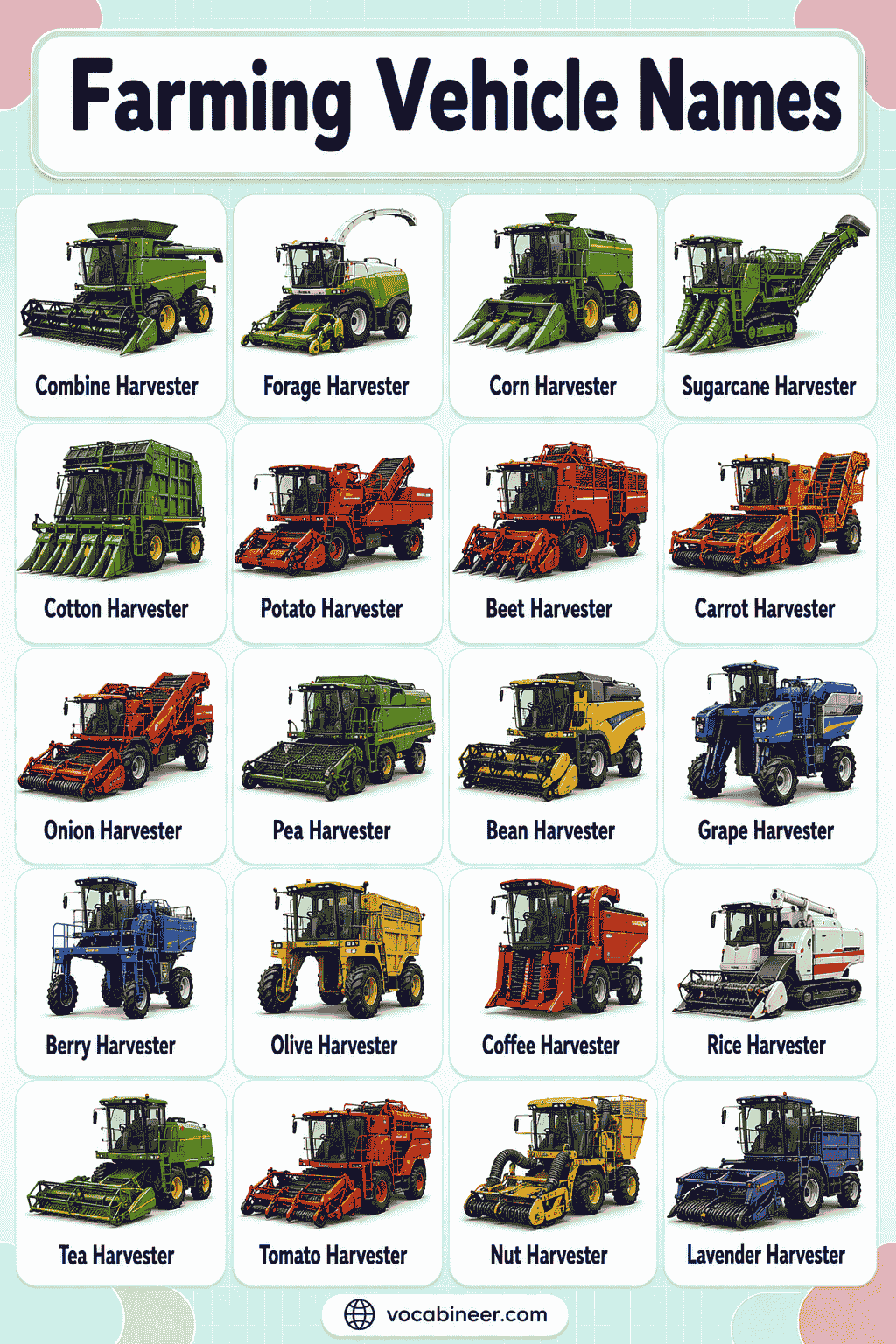
Combine Harvester: A combine cuts the crop, separates the grain, and removes much of the unwanted plant material. Farmers use suitable headers for wheat, corn, rice, soybeans, and other crops.
Forage Harvester: This machine chops the whole crop into small pieces for silage or animal feed. A curved chute sends the material into a nearby wagon or truck.
Cotton Picker: Rotating spindles remove cotton fibers from open bolls while leaving much of the plant standing.
Cotton Stripper: A cotton stripper removes a larger portion of the boll and plant material. Internal systems then help clean the crop.
Sugarcane Harvester: This vehicle cuts cane near the ground, removes leaves, chops the stalks, and transfers the pieces into a transport vehicle.
Potato Harvester: A potato harvester lifts the crop, separates loose soil, and carries the potatoes through a cleaning system.
Beet Harvester: This machine lifts sugar beets or similar root crops. It may also remove leaves and clean the roots.
Grape Harvester: A grape harvester travels over vineyard rows and shakes ripe fruit from the vines.
Tree Shaker: A tree shaker grips a trunk or branch and creates controlled vibration. Nuts or fruit then fall onto catching equipment or the ground.
Windrower: This machine cuts crops and lays them in long rows called windrows. The crop can then dry before another machine collects it.
Each harvester suits a particular crop and method. Therefore, a combine cannot replace a cotton picker, forage harvester, or grape harvester.
Self-Propelled Planting and Crop-Care Vehicles
Most planters and seed drills rely on tractors. However, several specialized planting and crop-care machines move under their own power.
Rice Transplanter: A riding rice transplanter places young seedlings into prepared soil at regular spacing. It helps farmers cover paddy fields more quickly and evenly.
Self-Propelled Planter: This machine carries its own engine and drive system. It remains less common than tractor-pulled planters but serves selected crops and farming systems.
Self-Propelled Sprayer: A tank, pump, and long boom allow this vehicle to spray large fields efficiently.
High-Clearance Sprayer: A raised frame and narrow wheels help this sprayer pass over taller crops with less damage.
Self-Propelled Fertilizer Spreader: This machine distributes dry or granular fertilizer across wide fields.
A machine’s design determines its classification. A self-propelled sprayer is a farming vehicle, while a tractor-mounted sprayer is an attachment.
Orchard and Vineyard Vehicles
Orchards and vineyards need compact vehicles that can pass between closely planted rows.
Orchard Tractor: Its narrow body and low profile help it move beneath branches and between trees.
Vineyard Tractor: This tractor fits tight vine rows and turns within restricted spaces.
Grape Harvester: The machine travels over the vines, separates ripe grapes, and collects them.
Tree Shaker: Controlled vibration removes nuts or selected fruits from trees.
Nut Harvester: Depending on the crop, this machine gathers, cleans, or collects nuts after they fall.
Fruit-Harvesting Platform: Workers stand on a raised mobile platform while picking fruit, pruning trees, or inspecting branches.
Pruning Platform: This mobile platform helps workers reach higher branches without repeatedly using ladders.
Orchard Buggy: A compact utility vehicle carries workers, tools, containers, and harvested fruit.
Narrow bodies, smooth outer panels, and tight turning ability help these machines avoid damaging crops.
Livestock and Dairy Farm Vehicles
Livestock farms use specialized vehicles to deliver feed, move animals, handle waste, and transport farm products.
Self-Propelled Feed Mixer: This machine collects ingredients, mixes feed, and distributes it along feeding areas.
Feed Truck: A feed truck carries grain, silage, or prepared feed to livestock.
Livestock Truck: Ventilated compartments allow this vehicle to transport farm animals.
Cattle Truck: This livestock vehicle mainly carries cattle.
Milk Tanker: A milk tanker collects milk from dairy farms and transports it to a processing facility.
Bale Transporter: This vehicle carries hay or straw for feeding and bedding.
Farm Utility Vehicle: A UTV carries feed bags, fencing materials, tools, and veterinary supplies around livestock areas.
These vehicles support daily farm routines even though they do not prepare soil or harvest crops.
Farm Transport and Utility Vehicles
Farmers use transport vehicles to move crops, workers, tools, animals, and supplies.
Farm Truck: This general term covers trucks that carry feed, produce, machinery, or equipment.
Pickup Truck: Its open cargo bed makes it useful for tools, seed bags, fencing supplies, and repair materials.
Grain Truck: A grain truck carries harvested grain and often uses a tipping body for unloading.
Flatbed Truck: The open platform transports pallets, hay, machinery, containers, and building materials.
Livestock Truck: This vehicle carries animals in a ventilated body.
Produce Truck: Farmers use it to transport fruits, vegetables, and other fresh products.
Utility Terrain Vehicle: Commonly shortened to UTV, this side-by-side vehicle usually has a steering wheel, passenger seats, and a cargo bed.
All-Terrain Vehicle: An ATV normally has a straddle seat and handlebars. It works well for inspecting fields, checking fences, and reaching rough areas.
Farm Buggy: This compact vehicle carries workers and light loads around fields, barns, and orchards.
Telehandler: Also called a telescopic handler, it uses an extendable boom to lift bales, pallets, and farm supplies.
Loader Tractor: A tractor with a front loader can move feed, soil, manure, hay, and other materials.
Farm trucks and UTVs move under their own power. Grain carts and trailers, however, rely on tractors or trucks.
Modern Farming Vehicles
Modern farming vehicles increasingly use positioning systems, sensors, cameras, electric motors, and automated controls.
Autonomous Tractor: This tractor follows planned routes and completes selected field tasks with limited direct driving.
GPS-Guided Tractor: Satellite guidance helps the tractor travel along accurate field paths. A driver may still control or supervise it.
Electric Tractor: Batteries and electric motors power this machine. Smaller models currently suit lighter work and operations close to charging facilities.
Robotic Farm Vehicle: A compact robotic vehicle may carry crops, inspect rows, control weeds, or support workers during harvesting.
These machines can improve accuracy and reduce repeated passes. However, farm size, cost, crop type, field conditions, and available support systems influence their usefulness.
Alternate Farming Vehicle Names
Farm vehicle names often vary by country and region.
- Combine is a shorter name for combine harvester.
- Forage harvester may also be called a silage harvester or forage chopper.
- Windrower and swather often describe similar crop-cutting machines.
- Utility terrain vehicle is shortened to UTV and commonly called a side-by-side.
- All-terrain vehicle is shortened to ATV and may be called a quad bike or four-wheeler.
- Telehandler is another name for telescopic handler.
- Grain cart may be called a grain buggy or chaser bin.
- Rice transplanter may also be called a paddy transplanter.
Related names should appear together instead of counting as separate vehicles.
Common Farming Vehicle Comparisons
Several farming vehicles look similar or work during the same stage of production. Their main purposes, however, differ.
Tractor vs. Combine Harvester
| Tractor | Combine harvester |
|---|---|
| Powers or pulls many implements | Specializes in harvesting grain |
| Performs towing, loading, and fieldwork | Cuts, threshes, and cleans crops |
| Works throughout much of the year | Works mainly during harvest |
| Handles many farm jobs | Completes one major harvesting process |
A tractor supplies general power, while a combine completes several grain-harvesting steps in one pass.
Combine Harvester vs. Forage Harvester
| Combine harvester | Forage harvester |
|---|---|
| Collects and cleans grain | Chops most or all of the crop |
| Stores grain in an onboard tank | Sends chopped material through a chute |
| Produces grain for food, feed, or sale | Produces silage or forage |
| Uses grain-specific headers | Uses cutting and chopping systems |
A combine preserves the grain, whereas a forage harvester chops the crop into animal feed.
ATV vs. UTV
| ATV | UTV |
|---|---|
| Usually has a straddle seat | Has side-by-side seating |
| Uses handlebars | Uses a steering wheel |
| Commonly carries one rider | Carries passengers and cargo |
| Smaller and more agile | Usually includes a cargo bed |
An ATV suits quick individual travel, while a UTV carries workers, tools, and larger loads.
Farming Vehicles vs. Tractor Implements
Farm vehicles move under their own power. Implements usually depend on tractors.
Plow: Turns and loosens soil before planting.
Disc Harrow: Breaks soil clods and levels the ground.
Cultivator: Loosens soil and controls weeds.
Seed Drill: Places seeds at a controlled depth and spacing.
Planter: Places seeds or crop pieces in rows.
Baler: Compresses hay or straw into bales.
Hay Rake: Gathers cut forage into rows.
Tedder: Spreads and turns forage to help it dry.
Mower: Cuts grass, hay, or forage crops.
Fertilizer Spreader: Distributes dry plant nutrients.
Farm Trailer: Carries crops, animals, tools, or machinery.
Some equipment exists in both powered and non-powered forms. Therefore, the exact design determines whether it counts as a vehicle, machine, implement, or attachment.
Farming Vehicle Vocabulary in Sentences
- The tractor pulled a planter across the field.
- A combine harvester collected the ripe wheat.
- The forage harvester chopped corn for silage.
- A cotton picker moved between the crop rows.
- The sugarcane harvester cut the tall cane.
- A potato harvester lifted the crop from the soil.
- The windrower placed hay into long rows.
- A sprayer applied liquid across the field.
- The rice transplanter placed seedlings in straight lines.
- A grape harvester collected fruit from the vines.
- The farm truck carried vegetables to the market.
- A grain truck transported wheat from the field.
- The UTV carried tools to the barn.
- A telehandler lifted hay bales onto a stack.
- The livestock truck transported cattle.
Useful Farm Machinery Vocabulary
Implement: Equipment that a tractor pulls or carries.
Attachment: A component added to another machine.
Header: The front section of a harvester that gathers or cuts a crop.
Crop Row: A straight line of planted crops.
Tillage: The preparation and working of soil.
Threshing: The separation of grain from stalks and husks.
Baling: The process of compressing hay or straw into bales.
Forage: Plant material grown or collected as animal feed.
Silage: Fermented green crop material stored as livestock feed.
Windrow: A long row of cut crop material placed on the ground.
Ground Clearance: The distance between the bottom of a vehicle and the soil.
Traction: The grip that tires or tracks maintain on the ground.
FAQs
Common farming vehicles include tractors, combine harvesters, forage harvesters, self-propelled sprayers, farm trucks, UTVs, ATVs, telehandlers, and specialized crop harvesters.
The tractor is the most widely recognized farm vehicle because it can tow implements, operate attachments, pull trailers, and complete many general tasks.
No. A combine is a specialized harvesting machine that cuts, threshes, and cleans grain. A tractor provides power for many different operations.
Most plows and seed drills are implements because tractors pull or carry them. A few specialized planting machines have their own engines.
A UTV usually has side-by-side seating, a steering wheel, and a cargo bed. An ATV commonly has a straddle seat, handlebars, and space for one rider.
Read More
- 100+ Vehicles Name in English
- Types of Emergency Vehicles
- Different Types of Trucks
- Types of Four Wheelers
- Water Transport Names
- Military Vehicle Names
- Construction Vehicle Names