

Bowls are used every day for eating, serving, mixing, cooking, baking, snacks, desserts, and table setting. Some bowls are deep and round for soup, while others are wide and shallow for pasta, salad, fruit, or shared food.
This guide explains different types of bowls with names, simple meanings, uses, materials, shapes, parts, confusing terms, and a helpful bowl chart with pictures.
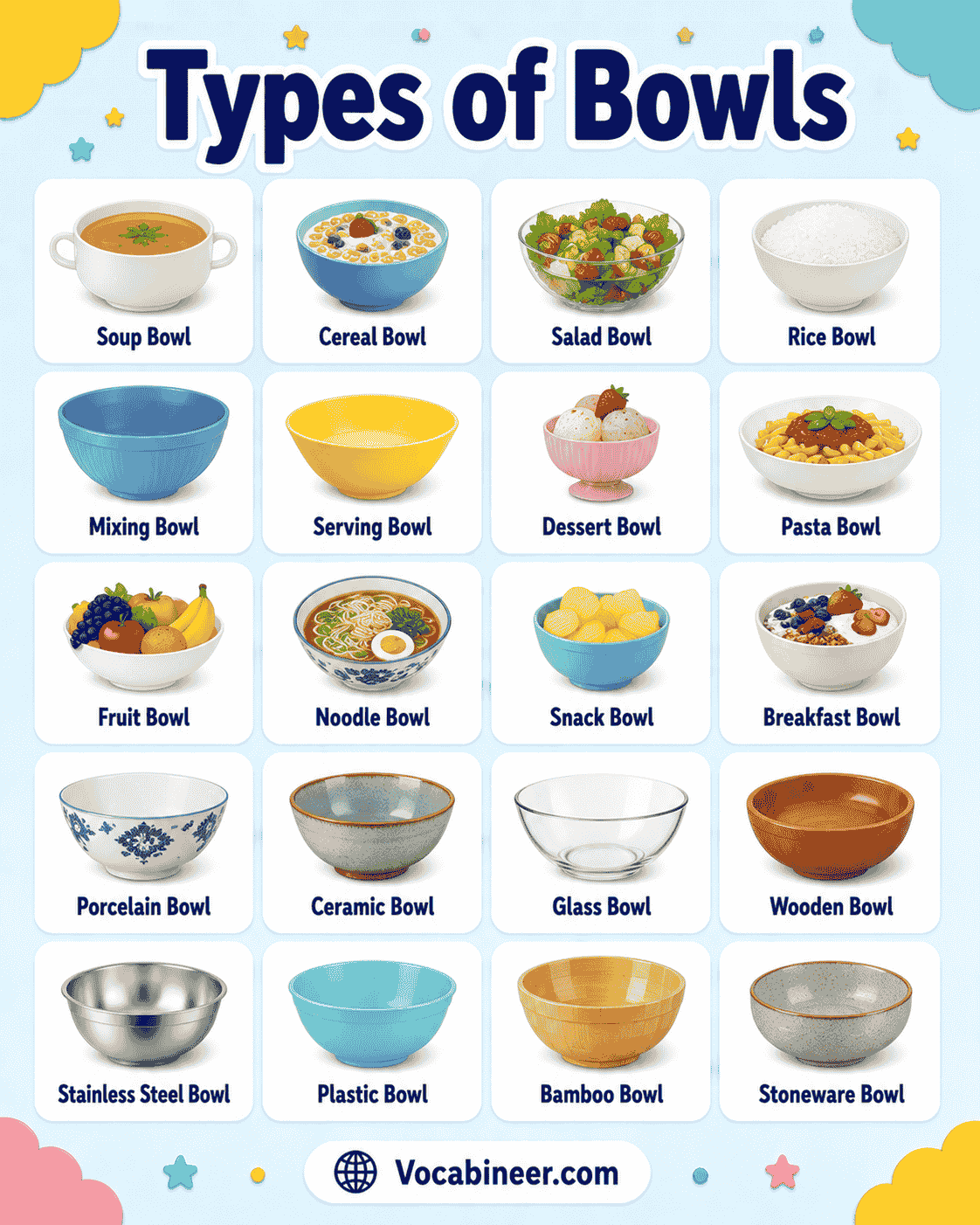
In This Page
Common Types of Bowls
These are some of the most common bowl types used in kitchens, dining rooms, restaurants, cafes, and homes.
- Soup bowl — a bowl used for soup, broth, stew, or other liquid foods.
- Cereal bowl — a bowl used for cereal, oatmeal, porridge, milk, or snacks.
- Rice bowl — a bowl used for rice, grain dishes, curries, or small meals.
- Pasta bowl — a wide bowl used for pasta, noodles, saucy dishes, and salads.
- Salad bowl — a bowl used for mixing or serving salad.
- Serving bowl — a larger bowl used to serve food for sharing.
- Mixing bowl — a bowl used to mix ingredients while cooking or baking.
- Prep bowl — a small bowl used to hold measured ingredients before cooking.
- Dessert bowl — a small bowl used for desserts, pudding, custard, or fruit.
- Fruit bowl — a bowl used to hold or display fresh fruit.
- Snack bowl — a bowl used for chips, nuts, popcorn, crackers, or small snacks.
- Dip bowl — a small bowl used for dips, sauces, salsa, or chutney.
- Sauce bowl — a small bowl used for sauces, dressings, or condiments.
- Noodle bowl — a bowl used for noodles, ramen, pho, or noodle soups.
- Ramekin — a small bowl-like dish used for dips, desserts, baking, or sauces.
- Glass bowl — a bowl made from glass.
- Ceramic bowl — a bowl made from ceramic material.
- Wooden bowl — a bowl made from wood, often used for salads or serving.
- Plastic bowl — a lightweight bowl made from plastic.
Bowl Types and Their Uses
Bowls are often named by the food they hold, the task they are used for, or the material they are made from.
- For soup — soup bowls, deep bowls, handled bowls, and tureens.
- For cereal — cereal bowls, oatmeal bowls, porridge bowls, and everyday bowls.
- For rice — rice bowls, grain bowls, small bowls, and dinner bowls.
- For pasta — pasta bowls, wide bowls, shallow bowls, and plate bowls.
- For salad — salad bowls, wooden bowls, serving bowls, and large bowls.
- For serving food — serving bowls, lidded bowls, fruit bowls, punch bowls, and compote bowls.
- For mixing ingredients — mixing bowls, stainless steel bowls, glass bowls, and nesting bowls.
- For meal prep — prep bowls, measuring bowls, small bowls, and sauce bowls.
- For desserts — dessert bowls, ice cream bowls, ramekins, and compote bowls.
- For dips and sauces — dip bowls, sauce bowls, condiment bowls, and ramekins.
- For snacks — snack bowls, chip bowls, popcorn bowls, candy bowls, and nut bowls.
- For baking — mixing bowls, batter bowls, ramekins, oven-safe bowls, and glass bowls.
Eating and Dinnerware Bowls
Eating and dinnerware bowls are used for daily meals. They are usually placed at the table and may match plates, cups, and other dinnerware.
- Dinner bowl — a general bowl used for meals, rice dishes, pasta, salads, or soups.
- Everyday bowl — a simple bowl used for daily eating.
- Soup bowl — a deeper bowl for soup, stew, broth, or chili.
- Cereal bowl — a medium bowl for cereal, oatmeal, porridge, fruit, or snacks.
- Rice bowl — a smaller bowl for rice, grains, curries, or side dishes.
- Pasta bowl — a wide, shallow bowl for pasta, noodles, and saucy meals.
- Noodle bowl — a deeper bowl for noodles, ramen, pho, or noodle soup.
- Small bowl — a bowl for side dishes, snacks, sauces, or desserts.
- Large bowl — a bigger bowl for meals, salads, shared food, or serving.
Soup, Cereal, Rice, and Pasta Bowls
Soup, cereal, rice, and pasta bowls are among the most common household bowls. Their shape often depends on the type of food they hold.
- Soup bowl — usually deeper and suitable for liquid foods.
- Handled soup bowl — a soup bowl with one or two handles for easier carrying.
- Cereal bowl — often wider and useful for cereal, oatmeal, snacks, or fruit.
- Rice bowl — usually smaller and easy to hold in one hand.
- Pasta bowl — wide and shallow, with enough space for pasta and sauce.
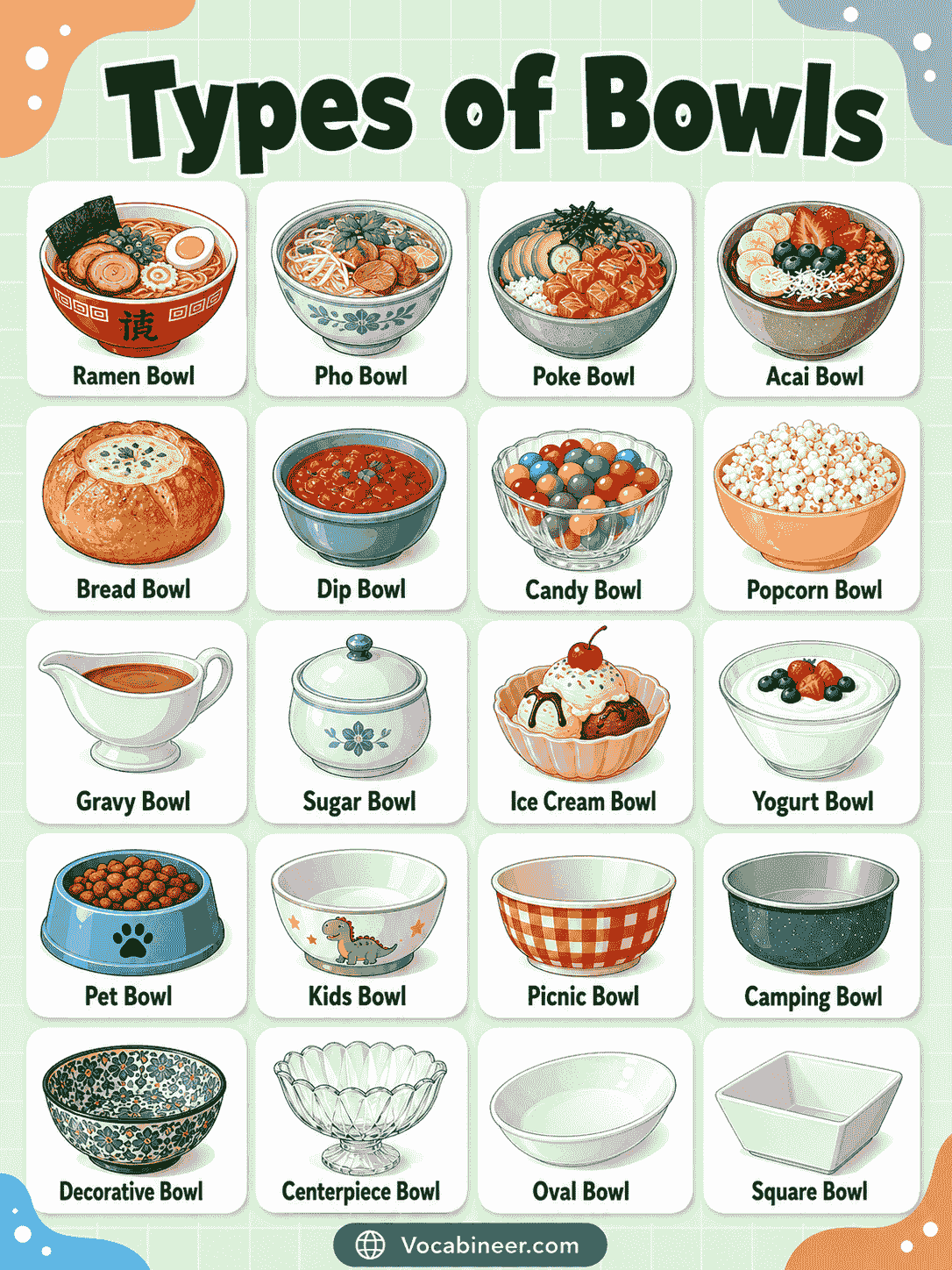
- Ramen bowl — a deep bowl for ramen noodles, broth, toppings, and soup.
- Noodle bowl — a bowl for noodles, noodle soups, and stir-fried noodle dishes.
- Pho bowl — a large bowl used for Vietnamese pho and similar noodle soups.
- Porridge bowl — a bowl used for porridge, oatmeal, or warm breakfast foods.
- Oatmeal bowl — a breakfast bowl used for oatmeal, grains, or warm cereal.
Serving and Salad Bowls
Serving bowls are used for shared food at meals, parties, and family tables. Salad bowls are usually wide enough for tossing or serving salad.
- Serving bowl — a larger bowl used to serve food for sharing.
- Salad bowl — a bowl used to mix or serve salad.
- Fruit bowl — a bowl used to display or serve fresh fruit.
- Chip bowl — a bowl used for chips, crisps, or party snacks.
- Popcorn bowl — a large bowl used for popcorn.
- Punch bowl — a large bowl used for punch or party drinks.
- Tureen — a deep serving bowl with a lid, often used for soup or stew.
- Compote bowl — a footed bowl used for fruit, desserts, or decorative serving.
- Lidded serving bowl — a serving bowl with a lid to keep food covered.
Mixing, Prep, and Cooking Bowls
Mixing, prep, and cooking bowls are kitchen tools used before or during cooking. They are often larger, stronger, and more practical than table bowls.
- Mixing bowl — a large bowl used to mix batter, dough, salads, or ingredients.
- Prep bowl — a small bowl used to hold chopped or measured ingredients.
- Batter bowl — a bowl used for pancake batter, cake batter, or other mixtures.
- Stainless steel bowl — a durable bowl used for mixing, chilling, and prep work.
- Glass mixing bowl — a clear bowl used for mixing and seeing ingredients.
- Microwave-safe bowl — a bowl that can be used safely in a microwave.
- Oven-safe bowl — a bowl that can handle oven heat.
- Nesting bowl — one bowl from a set that stacks inside other bowls.
- Measuring bowl — a bowl with measurement marks for liquids or ingredients.
Dessert, Snack, and Dip Bowls
Smaller bowls are useful for desserts, sauces, dips, snacks, and side servings.
- Dessert bowl — a small bowl for pudding, custard, fruit, or sweet dishes.
- Ice cream bowl — a small bowl used for ice cream, frozen yogurt, or gelato.
- Snack bowl — a bowl used for chips, nuts, candy, crackers, or small snacks.
- Dip bowl — a small bowl used for dips, salsa, hummus, or chutney.
- Sauce bowl — a small bowl used for sauce, gravy, dressing, or syrup.
- Condiment bowl — a small bowl used for condiments like ketchup, mustard, or relish.
- Ramekin — a small dish used for baking, sauces, dips, or individual desserts.
- Sugar bowl — a small covered bowl used for sugar.
- Nut bowl — a bowl used for nuts or small snacks.
- Candy bowl — a bowl used for candies, sweets, or chocolates.
Specialty and Cultural Bowls
Some bowls are linked to specific meals, food styles, traditions, or special uses. Keep these terms simple when explaining them to beginners.
- Ramen bowl — a deep bowl used for ramen noodles, broth, and toppings.
- Pho bowl — a large bowl used for pho and similar noodle soups.
- Buddha bowl — a meal bowl with grains, vegetables, protein, and sauce.
- Smoothie bowl — a thick smoothie served in a bowl with toppings.
- Grain bowl — a bowl meal based on grains such as rice, quinoa, or barley.
- Poke bowl — a bowl meal often made with rice, fish, vegetables, and sauce.
- Acai bowl — a fruit-based bowl made with acai and toppings.
- Finger bowl — a small bowl of water used for rinsing fingers at the table.
- Tea bowl — a bowl used for drinking or serving tea in some traditions.
- Singing bowl — a non-food bowl used to make sound in meditation or music.
Bowl Types by Material
Bowl material affects weight, durability, appearance, cleaning, heat safety, and everyday use.
- Ceramic bowl — a common bowl made from fired clay.
- Porcelain bowl — a smooth, refined ceramic bowl often used for dinnerware.
- Stoneware bowl — a heavier ceramic bowl known for durability.
- Bone china bowl — a fine, lightweight bowl often used in formal dinnerware.
- Glass bowl — a clear or colored bowl made from glass.
- Stainless steel bowl — a strong metal bowl used for mixing, prep, and kitchen work.
- Wooden bowl — a bowl made from wood, often used for salads or serving.
- Bamboo bowl — a lightweight bowl made from bamboo or bamboo fiber.
- Plastic bowl — a lightweight bowl used for casual meals, kids, picnics, or storage.
- Melamine bowl — a durable bowl often used for outdoor dining or casual serving.
- Silicone bowl — a flexible bowl used for kids, prep work, or kitchen tasks.
- Disposable bowl — a bowl made for one-time use.
- Paper bowl — a disposable bowl made from paper.
- Metal bowl — a general metal bowl used for cooking, prep, or serving.
Bowl Types by Shape and Design
Bowl shape affects how food sits, how easy it is to mix, and how the bowl looks on the table.
- Deep bowl — a bowl with higher sides, good for soup, noodles, cereal, or saucy dishes.
- Shallow bowl — a low bowl used for pasta, salads, desserts, or plated meals.
- Wide bowl — a broad bowl for pasta, salad, rice bowls, or serving.
- Small bowl — a bowl for sauces, snacks, dips, or side dishes.
- Large bowl — a bowl for mixing, serving, salad, or family meals.
- Rimmed bowl — a bowl with a wide rim around the top edge.
- Footed bowl — a bowl with a raised base or foot.
- Handled bowl — a bowl with one or two handles.
- Lidded bowl — a bowl with a lid for covering food.
- Spouted bowl — a bowl with a spout for pouring.
- Divided bowl — a bowl with separate sections.
- Stackable bowl — a bowl designed to stack neatly with others.
- Nesting bowl — a bowl that fits inside another bowl in a set.
- Oval bowl — an oval-shaped bowl for serving or display.
- Round bowl — the most common bowl shape.
- Square bowl — a bowl with square edges or a square design.
Bowl Parts You Should Know
Bowl parts are useful when describing shape, size, design, and function.
- Rim — the top edge of a bowl.
- Base — the bottom part that supports the bowl.
- Foot — a raised base under some bowls.
- Body — the main curved part of the bowl.
- Interior — the inside surface of the bowl.
- Exterior — the outside surface of the bowl.
- Lip — the edge around the top opening.
- Handle — the part used to hold or carry some bowls.
- Lid — a cover used to close a bowl.
- Spout — a pouring edge on some bowls.
- Divider — a section separator inside a divided bowl.
Confusing Bowl Terms Explained
Some bowl names sound similar, but they are used in different ways.
| Term | Simple Difference |
|---|---|
| Soup Bowl vs Cereal Bowl | A soup bowl is usually deeper and made for liquids. A cereal bowl is often wider and used for cereal, oatmeal, or snacks. |
| Pasta Bowl vs Plate Bowl | A pasta bowl is wide and shallow for pasta and saucy meals. A plate bowl is a plate-like bowl with a low rim. |
| Mixing Bowl vs Prep Bowl | A mixing bowl is larger for combining ingredients. A prep bowl is smaller for holding measured ingredients. |
| Serving Bowl vs Salad Bowl | A serving bowl holds food for sharing. A salad bowl is usually wide enough for tossing or serving salad. |
| Ramekin vs Small Bowl | A ramekin is a small dish often used for baking, sauces, dips, or desserts. A small bowl is a general small serving bowl. |
| Bowl vs Dish | A bowl is usually deeper with curved sides. A dish is a broader word for many food containers, including plates and bowls. |
| Glass Bowl vs Stainless Steel Bowl | A glass bowl lets you see the contents. A stainless steel bowl is lighter, stronger, and common for mixing or prep work. |
Types of Bowls Chart with Pictures
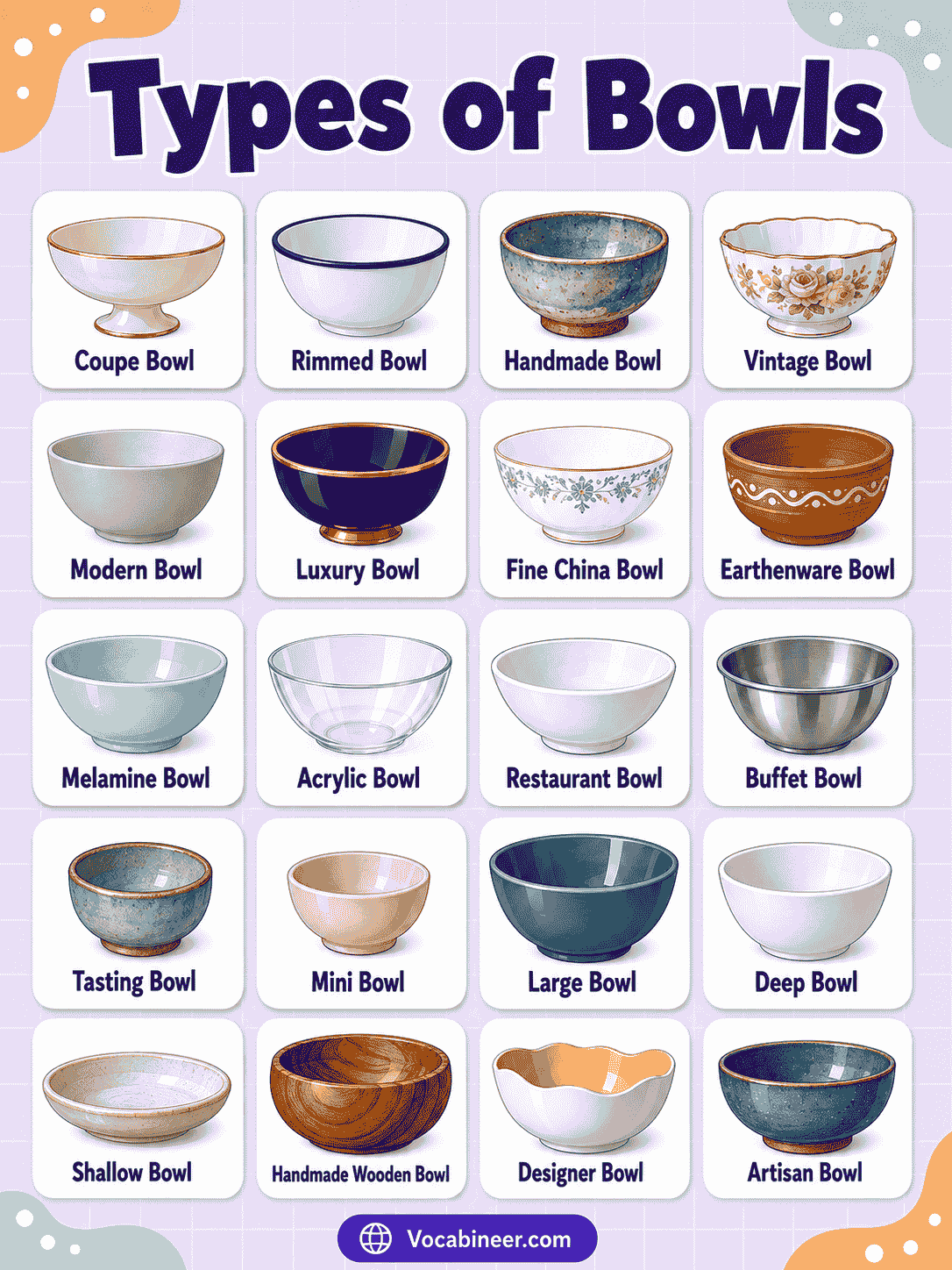
A bowl chart helps compare bowl groups, best uses, and common examples.
| Bowl Group | Details |
|---|---|
| Eating Bowls | Best for: everyday meals, soup, cereal, rice, and pasta Examples: soup bowl, cereal bowl, rice bowl, pasta bowl |
| Serving Bowls | Best for: shared food, salads, snacks, and table serving Examples: serving bowl, salad bowl, fruit bowl, chip bowl |
| Cooking Bowls | Best for: mixing, prepping, baking, and cooking Examples: mixing bowl, prep bowl, batter bowl, microwave-safe bowl |
| Dessert and Snack Bowls | Best for: sweets, snacks, sauces, and small servings Examples: dessert bowl, ice cream bowl, dip bowl, ramekin |
| Specialty Bowls | Best for: specific meals or cultural uses Examples: ramen bowl, pho bowl, buddha bowl, smoothie bowl |
| Material-Based Bowls | Best for: choosing by durability, heat use, and style Examples: ceramic, porcelain, glass, stainless steel, wooden |
| Shape-Based Bowls | Best for: matching food type and serving style Examples: deep, shallow, wide, rimmed, handled, lidded |
| Small Bowls | Best for: dips, sauces, condiments, desserts, and sides Examples: sauce bowl, dip bowl, condiment bowl, ramekin |
How to Choose the Right Bowl
Choosing the right bowl depends on the food, serving style, material, size, and cleaning needs.
- For soup and noodles — choose a deep bowl, soup bowl, ramen bowl, noodle bowl, or handled bowl.
- For cereal and breakfast — choose a cereal bowl, oatmeal bowl, porridge bowl, or everyday bowl.
- For pasta and saucy meals — choose a wide pasta bowl or shallow bowl.
- For rice and grain meals — choose a rice bowl, grain bowl, buddha bowl, or dinner bowl.
- For salads — choose a large salad bowl, wooden bowl, or wide serving bowl.
- For mixing ingredients — choose a mixing bowl, stainless steel bowl, glass mixing bowl, or nesting bowl.
- For meal prep — choose prep bowls, measuring bowls, sauce bowls, or small bowls.
- For snacks and dips — choose snack bowls, chip bowls, dip bowls, condiment bowls, or ramekins.
- For everyday use — choose ceramic, porcelain, stoneware, glass, plastic, or melamine bowls.
- For outdoor meals — choose melamine, plastic, bamboo, or lightweight bowls.
FAQs
The most common types of bowls include soup bowls, cereal bowls, rice bowls, pasta bowls, salad bowls, serving bowls, mixing bowls, dessert bowls, snack bowls, dip bowls, and fruit bowls.
A soup bowl is usually deeper and better for liquids like soup or stew. A cereal bowl is often wider and used for cereal, oatmeal, fruit, or snacks.
A pasta bowl is best for pasta because it is usually wide and shallow. This shape gives enough space for pasta, sauce, toppings, and easy mixing.
A mixing bowl is used for combining ingredients while cooking or baking. It can be used for batter, dough, salads, marinades, eggs, and sauces.
Ceramic, porcelain, stoneware, glass, plastic, and melamine bowls are common for everyday use. Stoneware and porcelain are good for daily meals, while plastic and melamine are useful for kids or outdoor dining.
Read More
- Types of Baskets
- Bedroom Decor Items
- Popular Types of Tiles
- Parts of a House Names
- Different Types of Tables
- Different Types of Drawers