Sinks are used in kitchens, bathrooms, laundry rooms, garages, bars, outdoor kitchens, public spaces, and commercial areas. A kitchen sink helps wash dishes and food, a bathroom sink helps with handwashing and grooming, and a utility sink handles heavier cleaning jobs.
Learning sink names makes it easier to understand home design, plumbing, fixtures, and vocabulary. This guide explains common types of sinks, their uses, parts, materials, bowl designs, installation styles, space-saving options, cleaning tips, and simple comparison terms.
In This Page
What Is a Sink?
A sink is a plumbing fixture with a basin, faucet, and drain. It holds water for washing hands, dishes, food, clothes, tools, and other items.
Common sinks include kitchen sinks, bathroom sinks, laundry sinks, utility sinks, bar sinks, prep sinks, outdoor sinks, and commercial sinks.
Sink vs Basin vs Vanity: What Is the Difference?
These words are often used together, but they do not mean the same thing.
| Term | Simple Meaning | Example |
|---|---|---|
| Sink | A full washing fixture with a basin and drain | Kitchen sink |
| Basin | The bowl part that holds water | Bathroom basin |
| Vanity | A bathroom cabinet or counter that may hold a sink | Bathroom vanity |
Common Sink Names and Uses
Here are common sink names with simple uses.
- Drop-in sink — A sink that drops into a hole in the countertop.
- Undermount sink — A sink installed below the countertop for a clean edge.
- Farmhouse sink — A deep kitchen sink with a large front-facing design.
- Apron-front sink — A sink with an exposed front panel.
- Vessel sink — A bowl-style sink that sits on top of a counter.
- Pedestal sink — A bathroom sink supported by a pedestal base.
- Wall-mounted sink — A sink attached directly to the wall.
- Console sink — A bathroom sink supported by legs or a slim frame.
- Integrated sink — A sink built into the countertop or vanity surface.
- Corner sink — A sink designed to fit into a corner.
- Trough sink — A long sink that may serve more than one user.
- Drainboard sink — A sink with a built-in sloped area for drying dishes.
- Workstation sink — A kitchen sink with accessories such as cutting boards, colanders, or racks.
- Bar sink — A small sink used in a bar or drink area.
- Prep sink — A small kitchen sink used for food preparation.
- Laundry sink — A deep sink used for soaking, rinsing, and handwashing clothes.
- Utility sink — A heavy-duty sink used for cleaning tools, buckets, shoes, and large items.
- Commercial sink — A strong sink used in restaurants, schools, hospitals, and workplaces.
- Outdoor sink — A sink used in a patio, garden, or outdoor kitchen.
- Single-bowl sink — A sink with one open basin.
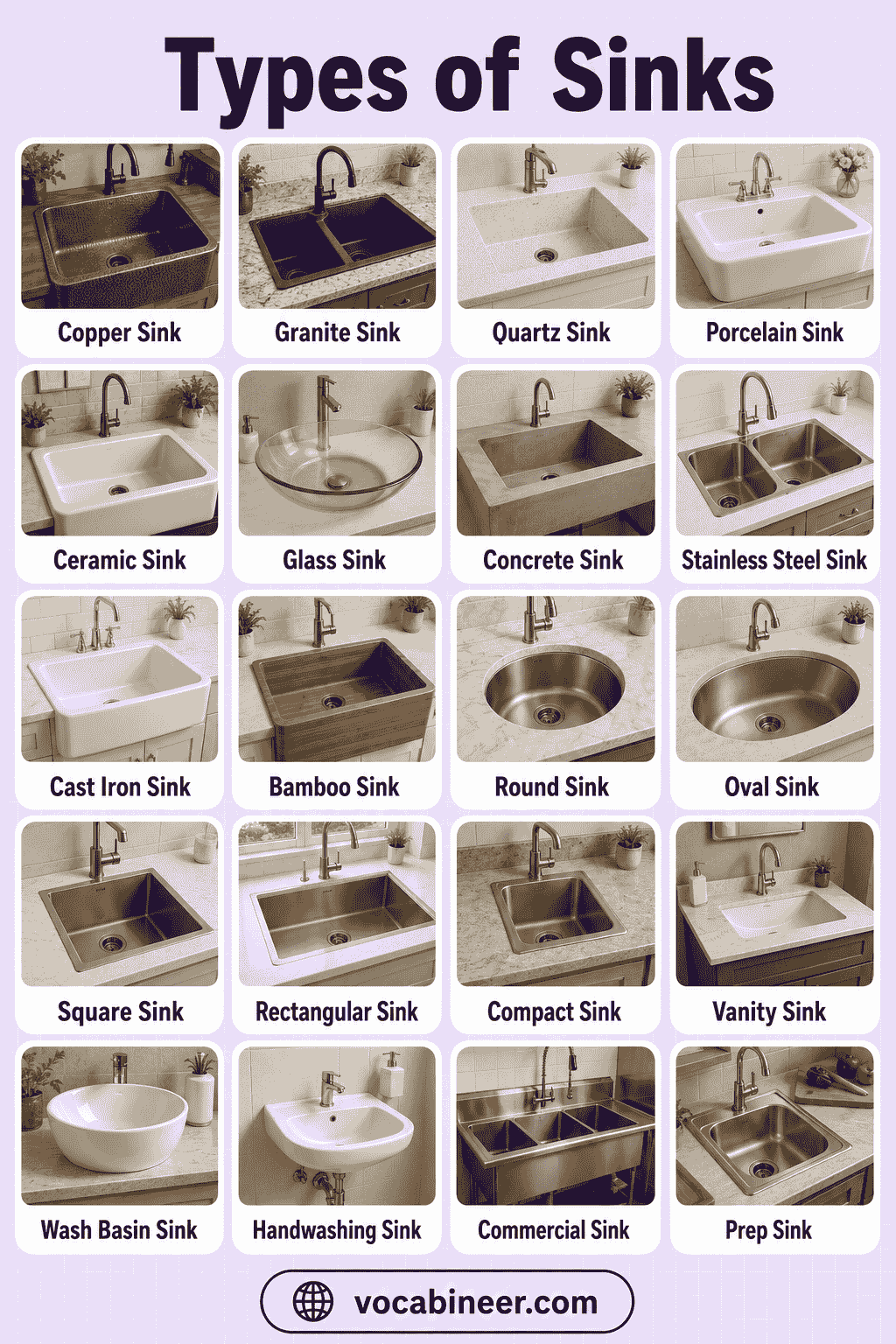
Sink Parts and Features
Sink parts affect washing, draining, cleaning, installation, and daily use.
- Basin — The bowl area that holds water.
- Bowl — Another word for the water-holding part of a sink.
- Faucet — The fixture that brings water into the sink.
- Drain — The opening where water leaves the sink.
- Strainer — A removable part that catches food scraps or debris.
- Stopper — A plug used to hold water in the basin.
- Overflow — A small opening that helps prevent water from spilling over.
- Rim — The top edge around the sink.
- Apron — The exposed front panel on some farmhouse sinks.
- Mounting clips — Small hardware pieces that help secure a sink.
- Drainboard — A sloped surface beside the basin for drying items.
- Backsplash — A raised back area that protects the wall from splashes.
- Pedestal — A support base under some bathroom sinks.
- Trap — A curved pipe under the sink that helps block sewer gases.
- Supply lines — Pipes or tubes that bring water to the faucet.
- Shutoff valves — Valves that control water supply under the sink.
- Sprayer — A spray attachment used for rinsing.
- Soap dispenser — A built-in dispenser for hand soap or dish soap.
- Soundproofing pad — A pad under some sinks that reduces noise.
- Overflow hole — The visible hole connected to the overflow channel.
Main Types of Sinks
Sinks can be grouped by room, use, installation style, bowl design, material, and size.
- Kitchen sinks — Used for dishes, food washing, cooking prep, and cleanup.
- Bathroom sinks — Used for handwashing, brushing teeth, shaving, and grooming.
- Laundry sinks — Used for soaking clothes, rinsing fabric, and handwashing laundry.
- Utility sinks — Used for heavy cleaning tasks in garages, workshops, and mudrooms.
- Bar sinks — Used for drinks, glasses, ice, and small cleanup tasks.
- Prep sinks — Used for washing fruits, vegetables, and food-prep items.
- Outdoor sinks — Used in patios, gardens, and outdoor kitchens.
- Commercial sinks — Used in restaurants, schools, hospitals, and public work areas.
- Specialty sinks — Designed for specific spaces, styles, or tasks.
Kitchen Sink Types
Kitchen sinks are made for washing dishes, rinsing food, filling pots, and cleaning cooking tools.
- Drop-in kitchen sink — Easy to install because it rests on top of the counter opening.
- Undermount kitchen sink — Installed below the counter for a smooth, modern look.
- Farmhouse sink — Deep and wide, useful for large pots, trays, and heavy kitchen washing.
- Apron-front sink — Similar to a farmhouse sink, with a visible front panel.
- Workstation sink — Includes accessories such as a cutting board, drying rack, or colander.
- Drainboard sink — Includes a built-in drying area beside the basin.
- Single-bowl kitchen sink — Gives one large open space for washing big items.
- Double-bowl kitchen sink — Has two basins for separating washing and rinsing.
- Triple-bowl kitchen sink — Has three sections for washing, rinsing, and prep.
- Bar sink — A smaller sink for drinks, glasses, and secondary cleanup.
- Prep sink — A small sink used for vegetables, fruits, and food preparation.
- Corner kitchen sink — Fits into a kitchen corner to save counter space.
Bathroom Sink Types
Bathroom sinks are used for handwashing, brushing teeth, shaving, face washing, and daily grooming.
- Vessel sink — Sits above the counter like a bowl.
- Pedestal sink — Has a basin supported by a pedestal base.
- Wall-mounted sink — Attaches to the wall and leaves open floor space below.
- Undermount bathroom sink — Fits below the vanity counter for a clean surface.
- Drop-in bathroom sink — Drops into a vanity or countertop opening.
- Integrated vanity sink — Built into the vanity top as one smooth piece.
- Console sink — Supported by legs or a frame for a light, open look.
- Trough sink — Long and wide, often used in shared or modern bathrooms.
- Corner bathroom sink — Fits into a corner in small bathrooms.
- Semi-recessed sink — Partly sits inside the counter and partly extends forward.
Laundry and Utility Sink Types
Laundry and utility sinks are deeper and stronger than many bathroom sinks.
- Laundry sink — Used for soaking clothes, rinsing fabric, and handwashing laundry.
- Utility sink — Used for cleaning buckets, shoes, tools, paintbrushes, and larger items.
- Deep sink — Has extra depth for soaking and washing bulky items.
- Mop sink — A low or floor-level sink used for filling and emptying mop buckets.
- Freestanding utility sink — Stands on its own legs or base.
- Wall-mounted utility sink — Attaches to the wall to save floor space.
- Stainless steel utility sink — Durable and useful for garages, laundries, and work areas.
- Plastic utility sink — Lightweight and common in laundry rooms or garages.
- Garage sink — Used for cleaning tools, hands, shoes, and outdoor items.
- Workshop sink — Used for cleaning supplies, small tools, and work materials.
Bar, Prep, and Outdoor Sinks
These sinks support cooking, serving, gardening, and extra cleanup areas.
- Bar sink — A small sink used for drinks, glassware, and quick rinsing.
- Prep sink — A small kitchen sink used for washing fruits, vegetables, and herbs.
- Wet bar sink — A sink placed in a drink-serving area with running water.
- Island prep sink — A prep sink installed in a kitchen island.
- Outdoor kitchen sink — A sink used for outdoor cooking and cleanup.
- Garden sink — A sink used for washing hands, tools, pots, or garden produce.
- Patio sink — A sink placed in a patio or outdoor entertainment area.
- Commercial prep sink — A sink used in food-prep areas in restaurants or workplaces.
Sink Types by Installation Style
Installation style affects how the sink fits the counter, vanity, wall, or cabinet.
- Drop-in sink — Drops into a countertop cutout and rests on its rim.
- Undermount sink — Mounts under the countertop.
- Farmhouse sink — Fits into the cabinet with a deep front-facing design.
- Apron-front sink — Shows an exposed front panel.
- Vessel sink — Sits above the counter.
- Wall-mounted sink — Attaches directly to the wall.
- Pedestal sink — Uses a pedestal base for support.
- Console sink — Uses legs or a frame for support.
- Integrated sink — Is built into the countertop or vanity top.
- Corner sink — Fits into a corner.
- Semi-recessed sink — Partly sits inside the counter and partly extends forward.
Drop-In, Undermount, and Farmhouse Sinks
These are some of the most common kitchen sink installation styles.
- Drop-in sink — Sits into a countertop opening with the rim visible on top.
- Undermount sink — Attaches below the counter, making the countertop easier to wipe.
- Farmhouse sink — Has a deep basin and broad front-facing design.
- Apron-front sink — Shows the sink front instead of hiding it behind the cabinet.
- Best for easy installation: Drop-in sink.
- Best for a seamless counter look: Undermount sink.
- Best for large washing tasks: Farmhouse or apron-front sink.
Vessel, Pedestal, and Wall-Mounted Sinks
These sink styles are common in bathrooms, powder rooms, and compact spaces.
- Vessel sink — Sits on top of the counter and gives a decorative bowl-like look.
- Pedestal sink — Uses a pedestal base and works well in classic bathrooms.
- Wall-mounted sink — Saves floor space because it attaches to the wall.
- Console sink — Combines a basin with slim legs or an open frame.
- Best for style: Vessel sink.
- Best for classic bathrooms: Pedestal sink.
- Best for small spaces: Wall-mounted sink.
- Best for an open furniture-style look: Console sink.
Integrated, Corner, Trough, and Console Sinks
These sinks are useful for special layouts, shared spaces, and design-focused rooms.
- Integrated sink — Built into the counter or vanity top as one continuous surface.
- Corner sink — Fits into a corner to save space.
- Trough sink — Long sink that can serve one or more users.
- Console sink — Uses a basin with legs or a frame.
- Semi-recessed sink — Extends slightly beyond the counter front.
- Ramp sink — Has a sloped surface instead of a deep bowl.
- Basinless sink — Uses a flat or sloped surface where water drains away without a traditional bowl.
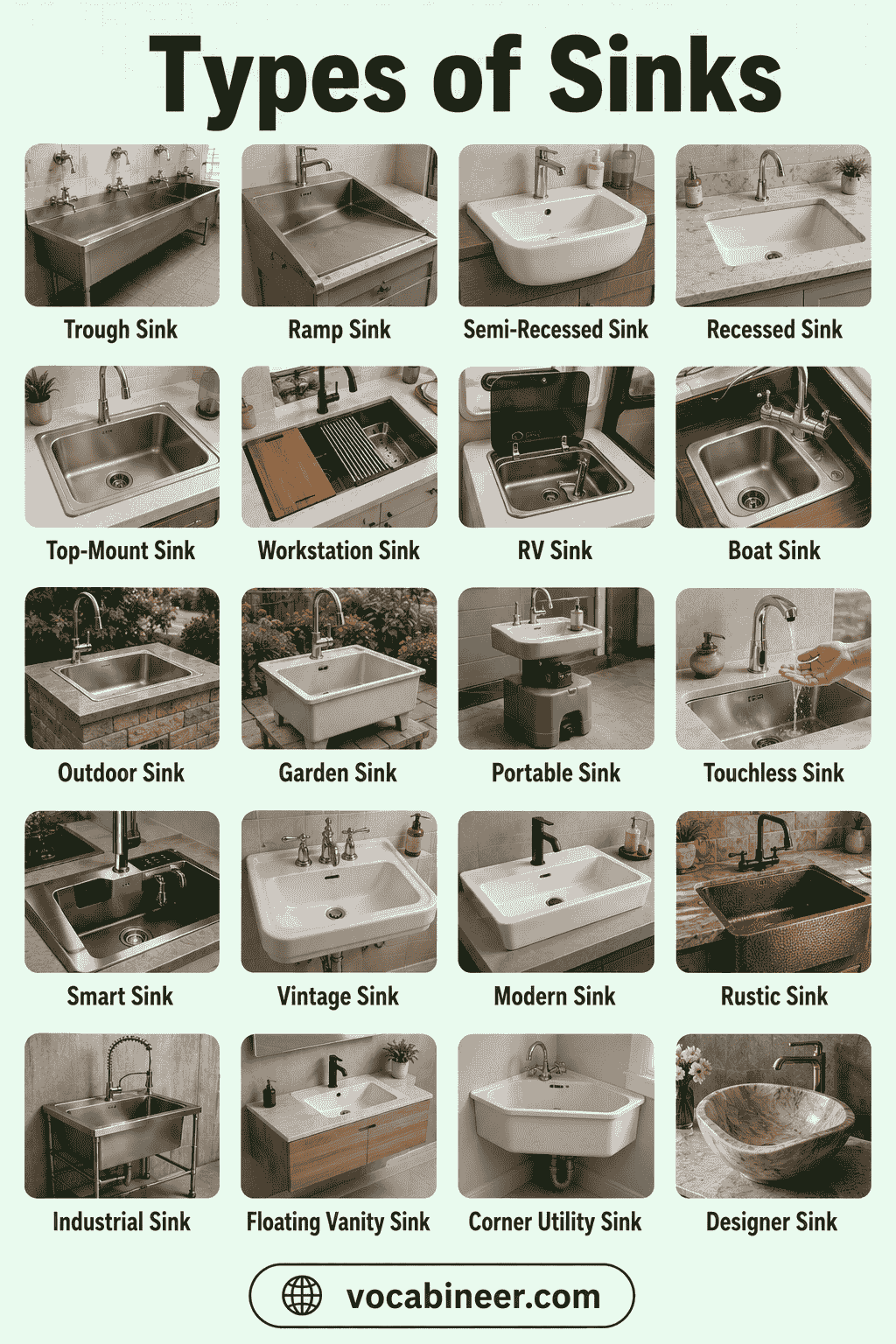
Sink Types by Bowl Design
Bowl design affects washing space, rinsing space, and daily workflow.
- Single-bowl sink — Has one open basin.
- Double-bowl sink — Has two basins.
- Triple-bowl sink — Has three sections.
- Low-divide sink — Has two basins with a lower center divider.
- Equal double-bowl sink — Has two basins of the same size.
- Offset double-bowl sink — Has one larger basin and one smaller basin.
- Deep-bowl sink — Offers more room for pots, trays, and soaking.
- Shallow-bowl sink — Easier to reach into and often used in bathrooms.
- Trough sink — Has a long basin shape.
Single-Bowl, Double-Bowl, and Triple-Bowl Sinks
These bowl styles are especially common in kitchens.
| Bowl Type | Simple Meaning | Best For |
|---|---|---|
| Single-bowl sink | One open basin | Large pots, trays, and simple washing |
| Double-bowl sink | Two separate basins | Washing and rinsing at the same time |
| Triple-bowl sink | Three sections | Busy kitchens and multi-step tasks |
| Low-divide sink | Two basins with a lower divider | More flexibility for large items |
| Offset double-bowl sink | One large basin and one small basin | Separate washing and prep tasks |
Sink Shapes and Sizes
Sink shape and size affect style, comfort, counter space, and washing room.
- Round sink — Common for small bathroom vessel sinks.
- Oval sink — Soft-shaped sink often used in bathrooms.
- Square sink — Modern sink shape with straight edges.
- Rectangular sink — Common in kitchens, bathrooms, trough sinks, and utility sinks.
- Compact sink — Small sink for powder rooms, bars, or tight spaces.
- Deep sink — Useful for soaking, laundry, pots, and large items.
- Shallow sink — Easier to reach into and suitable for light washing.
- Narrow sink — Useful for small rooms and tight counters.
- Wide sink — Gives more washing space.
- Long trough sink — Useful for shared bathrooms or commercial spaces.
Common Sink Materials
Sink material affects durability, cleaning, weight, appearance, cost, and daily use.
- Stainless steel sink — Durable, common, and easy to use in kitchens and utility spaces.
- Ceramic sink — Smooth, classic, and common in bathrooms.
- Porcelain sink — Smooth, glossy, and often used in bathrooms.
- Fireclay sink — Strong, classic, and common for farmhouse sinks.
- Cast iron sink — Heavy sink with an enamel surface.
- Granite composite sink — Durable stone-look sink made from granite and resin.
- Quartz composite sink — Durable sink with a stone-like appearance.
- Copper sink — Decorative metal sink with a warm finish.
- Glass sink — Stylish material often used for vessel sinks.
- Stone sink — Natural-looking sink made from stone materials.
- Acrylic sink — Lightweight sink material used in some kitchens and bathrooms.
- Solid surface sink — Smooth sink often integrated with a counter.
Stainless Steel Sinks
Stainless steel sinks are common in kitchens, bars, prep areas, laundry rooms, and commercial spaces.
- Best for: Kitchens, utility rooms, bar areas, and commercial spaces.
- Common styles: Drop-in, undermount, workstation, bar, prep, and utility sinks.
- Main benefit: Durable, lightweight, and easy to clean.
- Possible issue: Can show scratches, water spots, and noise.
- Helpful feature: Soundproofing pads can reduce noise.
Ceramic, Porcelain, and Fireclay Sinks
Ceramic, porcelain, and fireclay sinks are popular for bathrooms and classic kitchen styles.
- Ceramic sink — Smooth and common in bathrooms.
- Porcelain sink — Glossy and easy to wipe clean.
- Fireclay sink — Strong, heavy, and common in farmhouse kitchens.
- Best for: Bathrooms, powder rooms, farmhouse kitchens, and classic interiors.
- Main benefit: Clean, smooth, and attractive appearance.
- Possible issue: Heavy impact can chip or crack some surfaces.
Granite, Quartz, and Composite Sinks
Composite sinks are popular in modern kitchens because they offer a durable stone-like look.
- Granite composite sink — Made from granite particles and resin.
- Quartz composite sink — Made with quartz material and resin.
- Stone-look sink — Gives a modern, solid appearance.
- Best for: Modern kitchens and busy family kitchens.
- Main benefit: Durable feel and color options.
- Possible issue: Some finishes may need careful cleaning to avoid marks.
Cast Iron, Copper, Glass, and Stone Sinks
These sink materials are often chosen for strength, design, or style.
- Cast iron sink — Heavy sink with a hard enamel coating.
- Copper sink — Decorative sink with a warm metal finish.
- Glass vessel sink — Stylish bathroom sink that sits above the counter.
- Natural stone sink — Made from stone for a high-end look.
- Marble sink — Elegant stone sink that needs careful cleaning.
- Soapstone sink — Durable stone sink with a natural appearance.
- Best for design impact: Copper, glass, marble, and natural stone sinks.
- Best for heavy-duty style: Cast iron and soapstone sinks.
Best Sinks for Different Spaces
The best sink depends on the room, available space, and daily use.
- Small bathroom — Wall-mounted sink, corner sink, pedestal sink.
- Powder room — Vessel sink, pedestal sink, compact sink.
- Family bathroom — Vanity sink, integrated sink, undermount sink.
- Main bathroom — Double vanity sink, trough sink, undermount sink.
- Kitchen — Undermount sink, farmhouse sink, workstation sink, double-bowl sink.
- Small kitchen — Single-bowl sink, compact sink, corner sink.
- Laundry room — Deep laundry sink or utility sink.
- Garage — Utility sink or stainless steel sink.
- Workshop — Utility sink, wall-mounted sink, or stainless steel sink.
- Bar area — Bar sink or wet bar sink.
- Outdoor kitchen — Stainless steel outdoor sink.
- Commercial space — Stainless steel commercial sink.
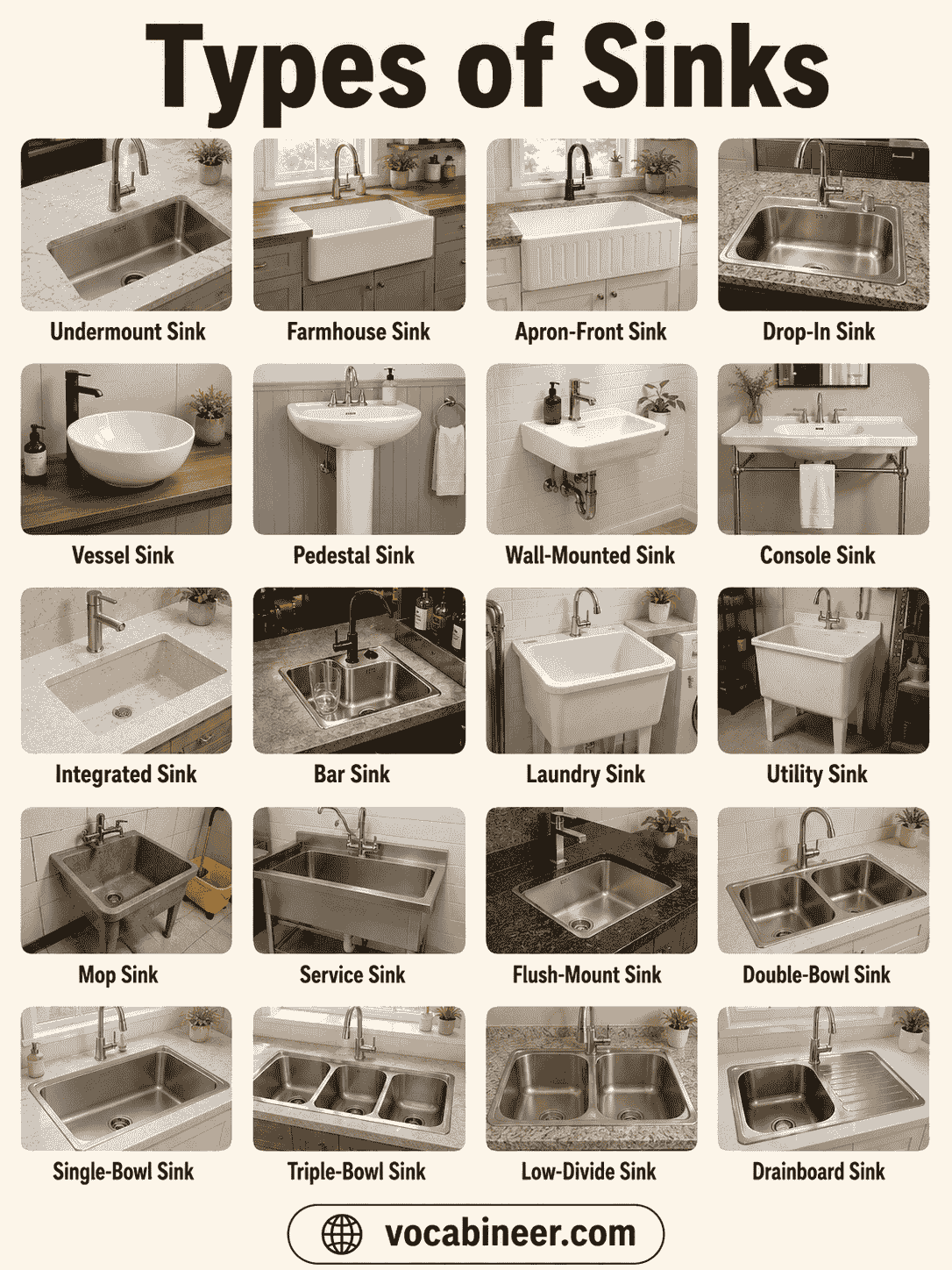
Small Sink Types for Compact Spaces
Small sinks are useful in powder rooms, small bathrooms, apartments, tiny kitchens, bars, and laundry corners.
- Corner sink — Fits into a corner and saves wall space.
- Wall-mounted sink — Leaves open floor space below.
- Pedestal sink — Gives a clean look without a large vanity.
- Compact vanity sink — Fits small bathroom cabinets.
- Semi-recessed sink — Gives basin space without needing a very deep counter.
- Small vessel sink — Adds style to a powder room.
- Narrow trough sink — Works in slim bathroom layouts.
- Bar sink — Works in small drink or prep areas.
- Prep sink — Adds a small washing station in a kitchen island.
- Single-bowl compact sink — Saves counter space in small kitchens.
Commercial and Public Sink Types
Commercial and public sinks are made for frequent use, sanitation, and heavy cleaning.
- Commercial sink — General heavy-duty sink used in workplaces.
- Handwashing sink — Used in restaurants, clinics, schools, and public areas.
- Mop sink — Used for filling and emptying mop buckets.
- Service sink — Used for cleaning tasks in public or commercial buildings.
- Three-compartment sink — Used for washing, rinsing, and sanitizing dishes.
- Prep sink — Used in food preparation areas.
- Stainless steel commercial sink — Durable sink for restaurants and workspaces.
- Public restroom sink — Used in schools, malls, offices, and public bathrooms.
- Trough sink — Long sink that can serve multiple users.
- Wall-mounted commercial sink — Saves floor space and supports easy cleaning below.
Sink Faucet, Drain, and Plumbing Features
Faucet, drain, and plumbing features affect installation and daily use.
- Single-hole faucet — Uses one faucet hole.
- Three-hole faucet — Uses three holes for handles and spout.
- Faucet spread — The distance between faucet holes.
- Deck-mounted faucet — Installed on the sink or countertop.
- Wall-mounted faucet — Installed on the wall above the sink.
- Pull-down sprayer — Sprayer that pulls down from the faucet head.
- Side sprayer — Separate sprayer beside the faucet.
- Drain placement — The location of the drain in the basin.
- Center drain — Drain placed near the center.
- Rear drain — Drain placed toward the back to save under-sink space.
- Overflow hole — Helps prevent overflow in some bathroom sinks.
- P-trap — Curved pipe under the sink.
- Supply lines — Lines that bring hot and cold water to the faucet.
- Shutoff valves — Valves that control water flow under the sink.
- Garbage disposal compatibility — A feature to check for some kitchen sinks.
Sink Cleaning and Maintenance Tips
Cleaning methods depend on sink material, finish, and daily use.
- Clean each sink according to its material.
- Wipe stainless steel dry to reduce water spots.
- Avoid harsh cleaners on copper, stone, glass, and delicate finishes.
- Avoid dropping heavy items into ceramic, porcelain, fireclay, or glass sinks.
- Keep drains clear to prevent slow draining.
- Clean strainers and stoppers often.
- Check under-sink areas for leaks.
- Use a soft cloth or sponge on glossy finishes.
- Protect stone sinks with proper care.
- Avoid leaving standing water on materials that may stain or mark.
- Rinse soap, toothpaste, food, and cleaning products after use.
- Keep faucet areas dry to reduce buildup.
Types of Sinks Chart
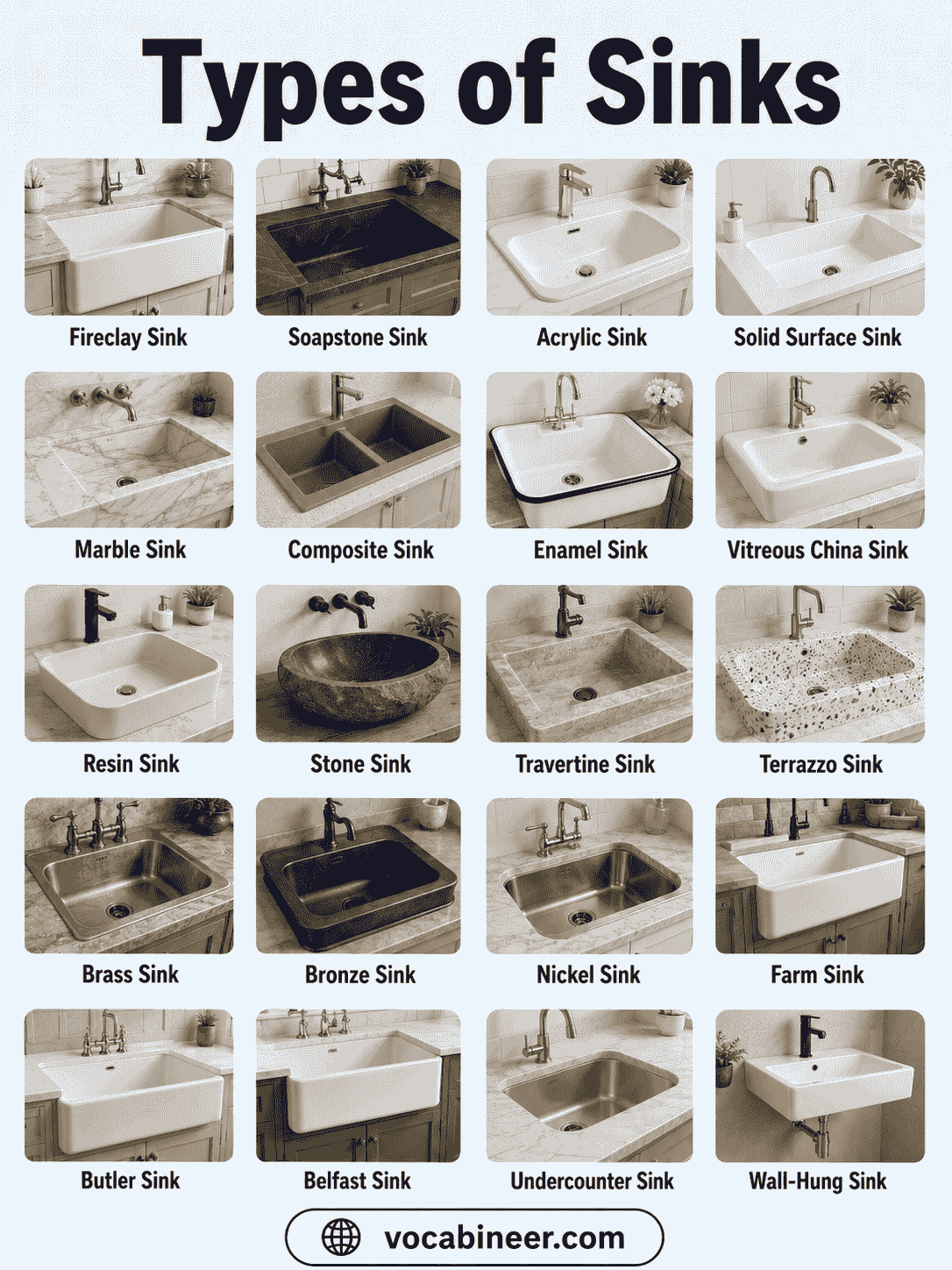
This chart gives a quick view of common sink types and uses.
| Sink Type | Best Used For |
|---|---|
| Drop-in sink | Easy countertop installation |
| Undermount sink | Clean modern counters |
| Farmhouse sink | Deep kitchen washing |
| Vessel sink | Stylish bathroom counters |
| Pedestal sink | Small bathrooms and powder rooms |
| Wall-mounted sink | Compact spaces |
| Integrated sink | Smooth vanity or counter surfaces |
| Corner sink | Tight bathrooms or kitchens |
| Workstation sink | Kitchen prep and cleanup |
| Drainboard sink | Dish drying and kitchen cleanup |
| Laundry sink | Soaking and rinsing clothes |
| Utility sink | Garage, workshop, and heavy cleaning tasks |
| Bar sink | Drink areas and small cleanup tasks |
| Outdoor sink | Patios, gardens, and outdoor kitchens |
| Commercial sink | Restaurants, schools, workplaces, and public areas |
Confusing Sink Terms Explained
Some sink terms sound similar. This table explains the difference clearly.
| Terms | Simple Difference |
|---|---|
| Sink vs Basin | A sink is the full fixture; a basin is the bowl part. |
| Sink vs Vanity | A sink is for washing; a vanity is the cabinet or counter that may hold it. |
| Drop-In vs Undermount Sink | Drop-in sinks sit on top; undermount sinks attach below the counter. |
| Farmhouse vs Apron-Front Sink | Farmhouse is the style; apron-front describes the exposed front panel. |
| Vessel vs Undermount Sink | Vessel sinks sit above the counter; undermount sinks sit below it. |
| Pedestal vs Wall-Mounted Sink | Pedestal sinks have a support base; wall-mounted sinks attach to the wall. |
| Single-Bowl vs Double-Bowl Sink | Single-bowl sinks have one basin; double-bowl sinks have two. |
| Laundry Sink vs Utility Sink | Laundry sinks are often used for clothes; utility sinks handle heavier cleaning tasks. |
| Bar Sink vs Prep Sink | Bar sinks serve drink areas; prep sinks help with food preparation. |
| Ceramic vs Porcelain Sink | Ceramic is the base material; porcelain is often a smooth glazed finish. |
How to Choose the Right Sink
Choose the right sink by matching it to the room, use, size, countertop, cabinet space, and installation style. A kitchen may need a deep undermount, farmhouse, workstation, or double-bowl sink, while a small bathroom may work better with a pedestal, wall-mounted, corner, or compact vanity sink. Laundry rooms, garages, and workshops usually need deeper utility sinks that can handle heavier cleaning tasks.
Material, faucet fit, drain placement, cleaning, and budget also matter. Stainless steel works well in kitchens and utility areas, ceramic and porcelain suit many bathrooms, and composite sinks fit modern kitchen designs. Check faucet holes, cabinet width, countertop support, plumbing space, and daily cleaning needs before choosing a sink.
FAQs
The main types of sinks include kitchen sinks, bathroom sinks, laundry sinks, utility sinks, bar sinks, prep sinks, outdoor sinks, commercial sinks, drop-in sinks, undermount sinks, farmhouse sinks, vessel sinks, pedestal sinks, and wall-mounted sinks.
A sink is the full washing fixture with a basin, faucet, and drain. A basin is the bowl part of the sink that holds water.
The best kitchen sink depends on space and use. Undermount sinks work well for clean counters, farmhouse sinks work well for deep washing, workstation sinks help with prep, and double-bowl sinks help separate washing and rinsing.
The best bathroom sink depends on room size and style. Pedestal and wall-mounted sinks work well in small bathrooms, vessel sinks add style, and undermount or integrated vanity sinks work well in family bathrooms.
Stainless steel, porcelain, ceramic, and solid surface sinks are often easy to clean with regular care. The easiest choice depends on the finish, water quality, cleaning products, and how the sink is used.
Read More