Kitchen appliances are machines and devices that help with cooking, heating, cooling, cleaning, food preparation, and food storage. A refrigerator keeps food cold, an oven bakes meals, a blender makes smoothies, and a dishwasher cleans plates and glasses.
Learning kitchen appliance names helps students, English learners, home cooks, and kids understand common kitchen vocabulary. This guide explains common kitchen appliance names, their uses, main categories, parts, task-based appliances, small-kitchen choices, pictures, examples, and simple comparison terms.
In This Page
What Are Kitchen Appliances?
Kitchen appliances are machines or powered devices used in the kitchen. They help people cook food, prepare ingredients, keep food fresh, heat drinks, clean dishes, and complete daily kitchen tasks faster.
Common kitchen appliances include refrigerators, freezers, ovens, stoves, cooktops, microwave ovens, dishwashers, toasters, electric kettles, blenders, food processors, coffee makers, air fryers, rice cookers, and range hoods.
Kitchen Appliances vs Utensils vs Cookware: What Is the Difference?
Kitchen appliances, utensils, and cookware are all used in the kitchen, but they are different things.
| Term | Simple Meaning | Examples |
|---|---|---|
| Kitchen appliances | Machines or devices used for cooking, cooling, cleaning, or food preparation | Refrigerator, oven, blender |
| Kitchen utensils | Hand tools used to stir, flip, cut, whisk, or serve food | Spoon, spatula, whisk |
| Cookware | Pots, pans, and vessels used to cook food | Frying pan, saucepan, stockpot |
Common Kitchen Appliances Names and Uses
Here are common kitchen appliances names with simple uses.
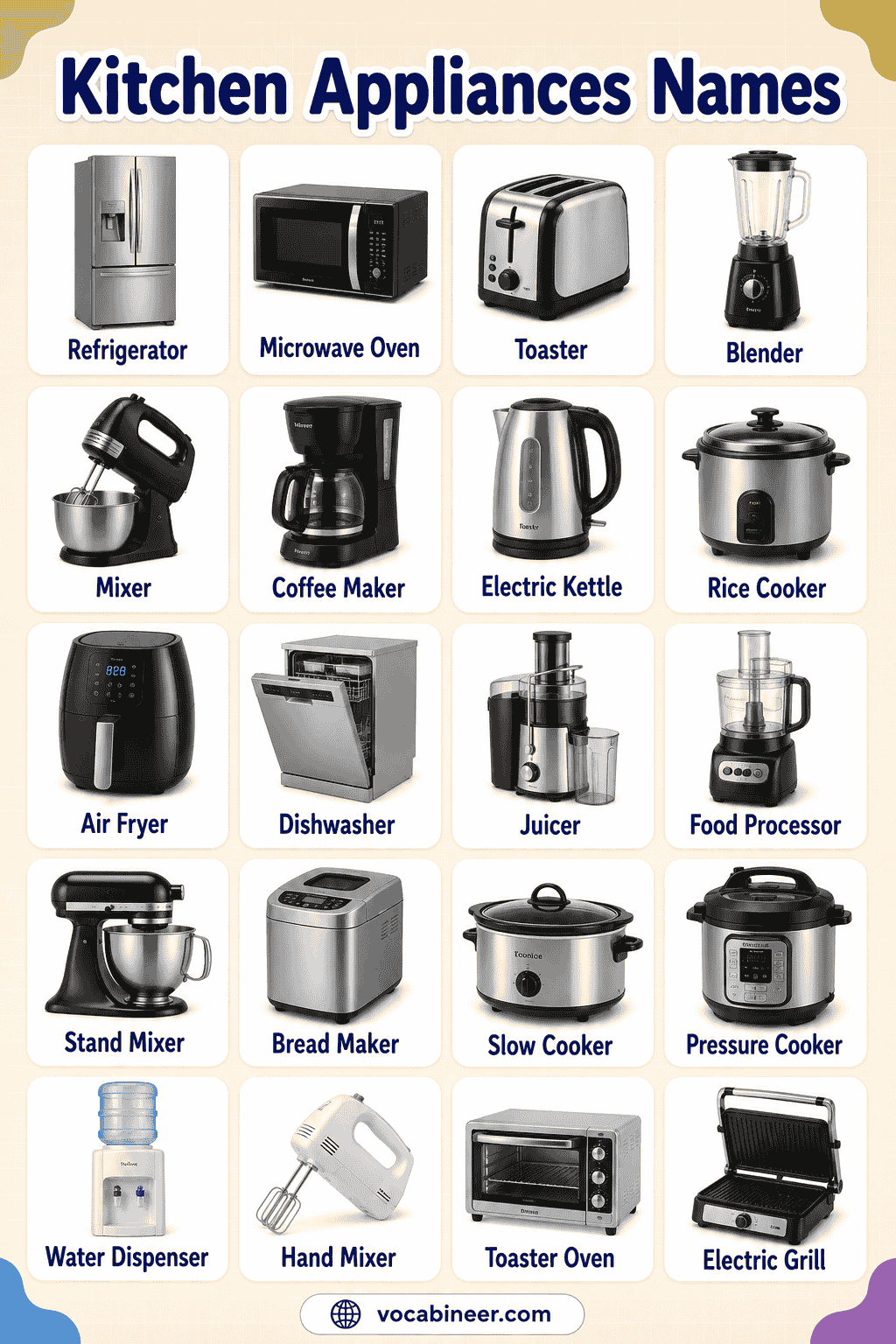
- Refrigerator — An appliance used to keep food, drinks, fruits, vegetables, dairy, and leftovers cold.
- Freezer — An appliance used to freeze food, ice, meat, vegetables, and frozen meals.
- Oven — An appliance used for baking, roasting, broiling, and heating food.
- Stove — An appliance used for cooking food on burners.
- Cooktop — A flat cooking surface with burners but no oven below.
- Range — A kitchen appliance that usually combines a cooktop and an oven.
- Microwave oven — An appliance used to heat, defrost, and reheat food quickly.
- Dishwasher — An appliance used to wash plates, bowls, glasses, and utensils.
- Range hood — An appliance used to remove smoke, steam, heat, and cooking smells.
- Toaster — An appliance used to toast bread slices.
- Toaster oven — A small oven used to toast, bake, warm, and roast small foods.
- Electric kettle — An appliance used to boil water quickly.
- Blender — An appliance used to blend smoothies, shakes, soups, sauces, and purees.
- Hand blender — A handheld appliance used to blend soups, sauces, and drinks directly in a container.
- Food processor — An appliance used to chop, slice, shred, mix, and process food.
- Mixer grinder — An appliance used to grind spices, blend mixtures, and make pastes.
- Stand mixer — An appliance used to mix dough, batter, cream, and frosting.
- Hand mixer — A handheld appliance used to beat eggs, mix batter, and whip cream.
- Juicer — An appliance used to extract juice from fruits and vegetables.
- Coffee maker — An appliance used to brew coffee.
- Espresso machine — An appliance used to make espresso and espresso-based drinks.
- Coffee grinder — An appliance used to grind coffee beans.
- Air fryer — An appliance used to cook crispy food with hot air and little oil.
- Deep fryer — An appliance used to fry food in hot oil.
- Rice cooker — An appliance used to cook rice and sometimes steam food.
- Slow cooker — An appliance used to cook food slowly over several hours.
- Multicooker — An appliance that can cook in different ways, such as pressure cooking, slow cooking, steaming, or rice cooking.
- Pressure cooker — An appliance used to cook food quickly with pressure and steam.
- Electric grill — An appliance used to grill food indoors.
- Electric griddle — A flat electric cooking surface used for pancakes, eggs, burgers, and flatbreads.
- Sandwich maker — An appliance used to toast and press sandwiches.
- Waffle maker — An appliance used to make waffles.
- Bread maker — An appliance used to mix, knead, rise, and bake bread.
- Ice maker — An appliance used to make ice.
- Water dispenser — An appliance used to dispense hot, cold, or room-temperature water.
- Garbage disposal — An appliance installed under a sink to grind small food waste.
Main Types of Kitchen Appliances
Kitchen appliances can be grouped by size, use, power source, placement, and function.
- Major appliances — Large appliances such as refrigerators, ovens, ranges, dishwashers, and freezers.
- Small appliances — Portable or countertop appliances such as toasters, blenders, kettles, and air fryers.
- Cooking appliances — Appliances used to cook food, such as stoves, ovens, cooktops, air fryers, and rice cookers.
- Food preparation appliances — Appliances used to chop, blend, grind, mix, slice, or juice food.
- Heating appliances — Appliances used to heat food or water, such as microwaves, kettles, and toaster ovens.
- Drink appliances — Appliances used for coffee, tea, juice, water, and other drinks.
- Cooling appliances — Appliances used to keep food and drinks cold or frozen.
- Cleaning appliances — Appliances used to wash dishes, remove smells, or handle food waste.
- Baking appliances — Appliances used for baking bread, cakes, waffles, and other baked foods.
- Smart appliances — Appliances with digital controls, sensors, apps, or connected features.
Kitchen Appliances by Use
This list groups kitchen appliances by the jobs they do.
- Cooking food — Stove, oven, cooktop, range, air fryer, rice cooker, pressure cooker.
- Heating food — Microwave oven, toaster oven, electric oven.
- Keeping food cold — Refrigerator, mini fridge, wine cooler, beverage cooler.
- Freezing food — Freezer, chest freezer, upright freezer.
- Washing dishes — Dishwasher, countertop dishwasher.
- Removing smoke and smells — Range hood, kitchen exhaust fan.
- Making drinks — Coffee maker, espresso machine, electric kettle, juicer, blender.
- Blending food — Blender, hand blender, mixer grinder.
- Chopping food — Food processor, electric chopper.
- Grinding food — Coffee grinder, spice grinder, meat grinder.
- Mixing dough and batter — Stand mixer, hand mixer, dough mixer.
- Toasting bread — Toaster, toaster oven, sandwich maker.
- Indoor grilling — Electric grill, electric griddle.
- Making ice — Ice maker.
- Dispensing water — Water dispenser.
- Grinding food waste — Garbage disposal.
Major Kitchen Appliances Names
Major kitchen appliances are large appliances used for the main kitchen tasks.
- Refrigerator — Keeps food and drinks cold.
- Freezer — Freezes food for longer storage.
- Oven — Bakes, roasts, broils, and heats food.
- Stove — Cooks food on burners.
- Range — Combines an oven and cooktop in one appliance.
- Cooktop — Provides burners without an oven below.
- Microwave oven — Reheats and defrosts food quickly.
- Dishwasher — Washes dishes and utensils.
- Range hood — Removes smoke, steam, and cooking odors.
- Built-in oven — Fits into kitchen cabinetry.
- Wall oven — Installed into a wall cabinet.
- Wine cooler — Keeps wine bottles at a controlled temperature.
- Chest freezer — A large freezer with a top-opening lid.
- Upright freezer — A freezer shaped like a refrigerator.
- Built-in refrigerator — A refrigerator installed to match cabinets.
Small Kitchen Appliances Names
Small kitchen appliances are often portable, countertop-sized, or easy to store.
- Toaster — Toasts bread slices.
- Toaster oven — Toasts and heats small foods.
- Blender — Blends smoothies, soups, and sauces.
- Hand blender — Blends food directly in a pot, bowl, or cup.
- Food processor — Chops, slices, shreds, and mixes food.
- Electric kettle — Boils water quickly.
- Coffee maker — Brews coffee.
- Espresso machine — Makes espresso drinks.
- Juicer — Extracts juice from fruits and vegetables.
- Air fryer — Cooks crispy food with hot air.
- Rice cooker — Cooks rice automatically.
- Slow cooker — Cooks food slowly at low heat.
- Stand mixer — Mixes dough, batter, frosting, and cream.
- Hand mixer — Beats and mixes ingredients by hand.
- Sandwich maker — Toasts or presses sandwiches.
- Waffle maker — Makes waffles.
- Bread maker — Mixes and bakes bread.
- Electric grinder — Grinds coffee, spices, or dry ingredients.
Portable and Countertop Kitchen Appliances
Portable and countertop appliances are useful when you want appliances that can move, store, or sit on a counter.
- Blender — Good for smoothies, sauces, and soups.
- Toaster — Good for toast and breakfast use.
- Electric kettle — Good for tea, coffee, noodles, and hot water.
- Air fryer — Good for crispy foods with less oil.
- Rice cooker — Good for rice, grains, and simple steaming.
- Food processor — Good for chopping, shredding, and mixing.
- Coffee maker — Good for daily coffee.
- Hand mixer — Good for light baking and mixing.
- Sandwich maker — Good for quick snacks.
- Waffle maker — Good for breakfast foods.
- Countertop dishwasher — Good for small kitchens and apartments.
- Mini fridge — Good for drinks, snacks, offices, dorms, and small rooms.
Built-In Kitchen Appliances
Built-in kitchen appliances are installed into cabinets, counters, walls, or fixed kitchen spaces.
- Built-in oven — Installed inside a cabinet or wall unit.
- Wall oven — Placed at a comfortable height inside a wall cabinet.
- Built-in microwave — Installed into cabinets or above a cooking area.
- Built-in dishwasher — Installed under the kitchen counter.
- Built-in refrigerator — Designed to sit flush with kitchen cabinets.
- Built-in freezer — Installed into cabinetry for a fitted look.
- Cooktop — Installed into the countertop.
- Built-in range hood — Installed above the stove or cooktop.
- Warming drawer — Built into cabinets to keep food warm.
- Wine cooler — Built into cabinets or placed under the counter.
Cooking Appliances Names
Cooking appliances use heat to cook, roast, fry, boil, steam, grill, or bake food.
- Stove — Cooks food on burners.
- Cooktop — Cooks food on a flat burner surface.
- Range — Combines a cooktop and oven.
- Oven — Bakes and roasts food.
- Microwave oven — Heats and reheats food quickly.
- Air fryer — Cooks crispy food with hot air.
- Deep fryer — Fries food in hot oil.
- Rice cooker — Cooks rice and grains.
- Slow cooker — Cooks food slowly over time.
- Multicooker — Performs several cooking functions.
- Pressure cooker — Cooks food quickly with pressure.
- Electric grill — Grills food indoors.
- Electric griddle — Cooks flat foods on a heated surface.
- Induction cooker — Uses induction heat for compatible cookware.
- Toaster oven — Toasts, heats, and bakes small foods.
Food Preparation Appliances Names
Food preparation appliances help before cooking, baking, or serving.
- Blender — Blends liquids, smoothies, soups, and sauces.
- Hand blender — Blends food directly in a container.
- Food processor — Chops, slices, shreds, and mixes ingredients.
- Mixer grinder — Grinds spices and blends mixtures.
- Stand mixer — Mixes dough, batter, cream, and frosting.
- Hand mixer — Beats eggs, batter, and cream.
- Juicer — Extracts juice from fruits and vegetables.
- Citrus juicer — Extracts juice from oranges, lemons, and limes.
- Coffee grinder — Grinds coffee beans.
- Spice grinder — Grinds dry spices.
- Meat grinder — Grinds meat for cooking.
- Vegetable chopper — Chops vegetables quickly.
- Electric slicer — Slices bread, meat, or vegetables.
- Food dehydrator — Removes moisture from fruits, vegetables, and snacks.
Heating and Drink Appliances Names
These appliances help heat food, boil water, toast bread, and prepare drinks.
- Electric kettle — Boils water for tea, coffee, noodles, and hot drinks.
- Coffee maker — Brews regular coffee.
- Espresso machine — Makes espresso and espresso-based drinks.
- Coffee grinder — Grinds coffee beans before brewing.
- Milk frother — Makes milk foam for coffee drinks.
- Tea maker — Brews tea automatically or semi-automatically.
- Hot water dispenser — Provides hot water quickly.
- Microwave oven — Reheats drinks and food quickly.
- Toaster — Toasts bread slices.
- Toaster oven — Toasts, warms, and bakes small foods.
- Sandwich maker — Heats and presses sandwiches.
- Water dispenser — Dispenses hot, cold, or room-temperature water.
Cooling and Food Storage Appliances Names
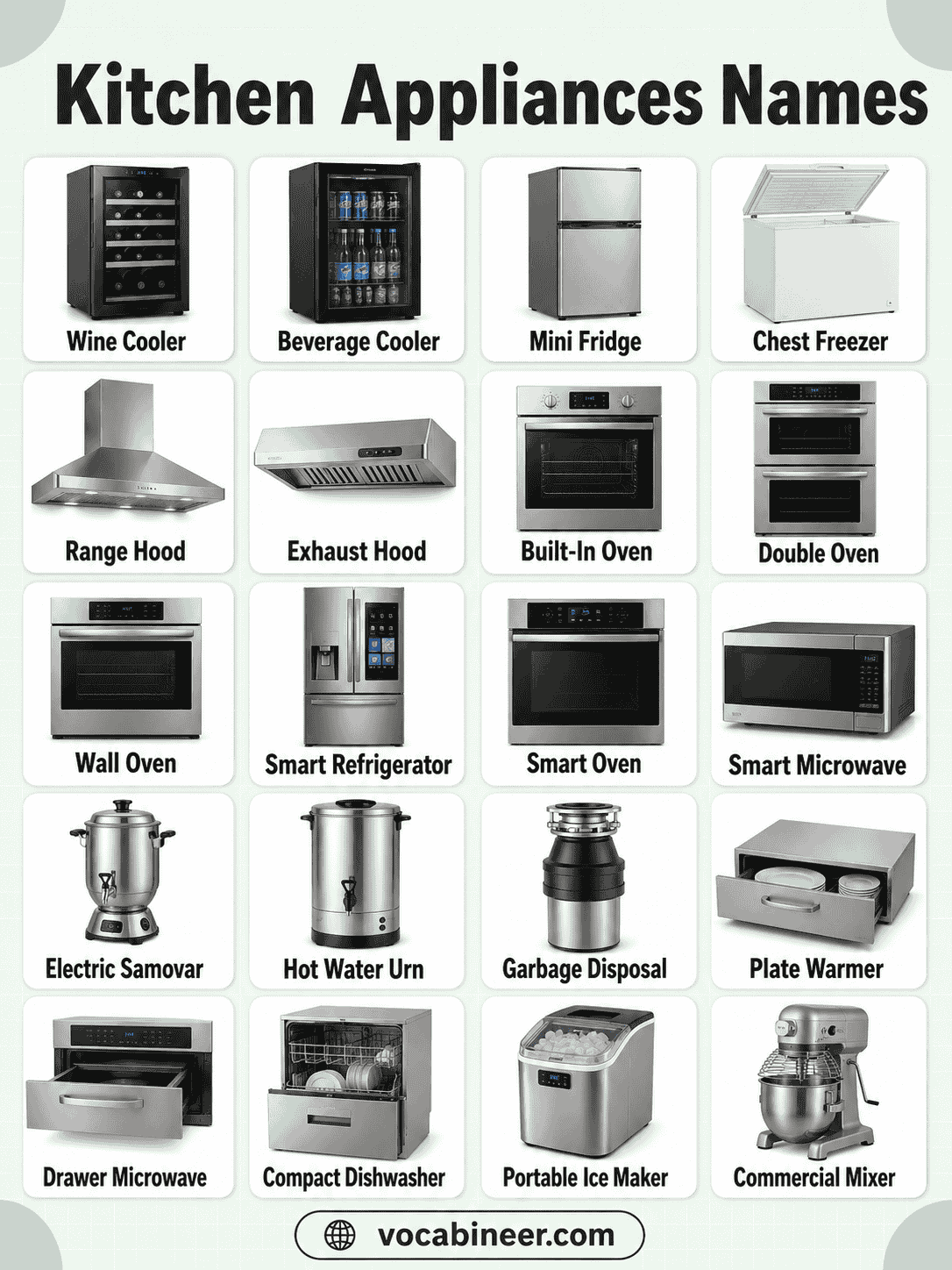
Cooling and food storage appliances help keep food fresh, cold, frozen, or ready to use.
- Refrigerator — Keeps fresh food and drinks cold.
- Freezer — Freezes food for longer storage.
- Chest freezer — Stores large amounts of frozen food.
- Upright freezer — Freezer with shelves and a front door.
- Mini fridge — Small refrigerator for drinks, snacks, dorms, or offices.
- Wine cooler — Keeps wine at a steady temperature.
- Beverage cooler — Stores cold drinks.
- Ice maker — Makes ice cubes or ice pieces.
- Water dispenser — Provides drinking water.
- Ice dispenser — Dispenses ice from a refrigerator or separate machine.
Cleaning Kitchen Appliances Names
Cleaning appliances help wash dishes, remove odors, filter air, and manage waste.
- Dishwasher — Washes plates, bowls, glasses, and utensils.
- Countertop dishwasher — A small dishwasher for compact kitchens.
- Garbage disposal — Grinds small food waste under the sink.
- Range hood — Removes smoke, steam, heat, and cooking smells.
- Kitchen exhaust fan — Pulls air, steam, and odors out of the kitchen.
- Air purifier — Helps clean kitchen air in some homes.
- Appliance sterilizer — Sterilizes bottles, utensils, or small kitchen items.
- Bottle sterilizer — Cleans baby bottles with heat or steam.
- Dish dryer — Helps dry dishes after washing.
- Food waste disposer — Another name for a garbage disposal.
Baking Appliances Names
Baking appliances help make bread, cakes, cookies, waffles, dough, and baked meals.
- Oven — Bakes cakes, cookies, bread, casseroles, and roasted foods.
- Wall oven — Built-in oven installed in a wall cabinet.
- Convection oven — Uses a fan to move hot air during cooking.
- Toaster oven — Bakes and toasts small foods.
- Bread maker — Mixes, kneads, rises, and bakes bread.
- Stand mixer — Mixes dough, batter, frosting, and cream.
- Hand mixer — Beats eggs, cake batter, and cream.
- Waffle maker — Cooks waffle batter into waffles.
- Electric whisk — Whisks eggs, cream, and light mixtures.
- Dough mixer — Mixes heavy dough for bread or pizza.
- Proofing appliance — Helps dough rise at a steady temperature.
Smart and Modern Kitchen Appliances
Smart and modern kitchen appliances use digital controls, sensors, apps, or connected features.
- Smart refrigerator — May include touch controls, cameras, or app features.
- Smart oven — Offers digital cooking programs and connected controls.
- Smart microwave — Uses preset cooking programs or smart controls.
- Smart dishwasher — May track cycles, timing, and settings.
- Smart coffee maker — Can brew coffee through timers or app controls.
- Smart air fryer — Offers preset programs and digital temperature control.
- Smart range — Combines modern cooking controls with oven and cooktop features.
- Smart cooktop — Uses digital or touch controls for burner settings.
- Touch-control appliance — Uses touch buttons instead of physical knobs.
- App-controlled appliance — Can be controlled through a phone app.
- Voice-controlled appliance — Can respond to voice commands when connected to a smart system.
Electric Kitchen Appliances Names
Electric kitchen appliances use electricity to cook, heat, cool, clean, blend, grind, or prepare food.
- Electric kettle — Boils water.
- Electric toaster — Toasts bread.
- Electric blender — Blends drinks and sauces.
- Electric food processor — Chops, slices, and mixes ingredients.
- Electric rice cooker — Cooks rice.
- Electric pressure cooker — Cooks quickly with pressure.
- Electric grill — Grills food indoors.
- Electric griddle — Cooks flat foods on a heated surface.
- Electric mixer — Mixes batter, dough, and cream.
- Electric juicer — Extracts fruit or vegetable juice.
- Electric grinder — Grinds coffee, spices, or dry ingredients.
- Electric oven — Bakes and roasts food.
- Electric stove — Cooks food using electric burners.
- Electric chopper — Chops vegetables and small ingredients.
Kitchen Appliance Parts and Features
Kitchen appliance parts and features help control, power, heat, blend, mix, cool, and clean.
- Power cord — Connects the appliance to electricity.
- Plug — Goes into the electrical outlet.
- Control panel — Area with buttons, knobs, or settings.
- Buttons — Used to start, stop, or choose settings.
- Display — Shows time, temperature, or mode.
- Knob — Turns to control heat, speed, or time.
- Timer — Controls cooking or operating time.
- Temperature control — Sets heat level.
- Heating element — Produces heat in ovens, toasters, and kettles.
- Motor — Powers blades, mixers, fans, or moving parts.
- Blade — Cuts, blends, or chops food.
- Jar — Holds ingredients in a blender.
- Lid — Covers the appliance or container.
- Basket — Holds food in air fryers, deep fryers, and dishwashers.
- Tray — Holds food in ovens or toaster ovens.
- Rack — Holds dishes or food inside appliances.
- Door — Opens and closes ovens, microwaves, refrigerators, and dishwashers.
- Handle — Helps open, close, lift, or hold parts.
- Filter — Catches grease, odor, dust, or particles.
- Vent — Lets air, heat, or steam move out.
- Fan — Moves air in ovens, hoods, or cooling systems.
- Light — Lights the inside of an appliance.
- Water tank — Holds water in coffee makers, steamers, or dispensers.
- Removable bowl — Comes out for cleaning or serving.
- Safety lock — Helps prevent unsafe operation.
- Auto shutoff — Turns the appliance off automatically.
Best Kitchen Appliances for Different Tasks
Choose appliances by the task you need to do.
- Keeping food cold — Refrigerator.
- Freezing food — Freezer.
- Baking food — Oven.
- Boiling water — Electric kettle.
- Reheating food — Microwave oven.
- Washing dishes — Dishwasher.
- Making smoothies — Blender.
- Chopping vegetables — Food processor.
- Grinding spices — Spice grinder or mixer grinder.
- Mixing dough — Stand mixer.
- Beating eggs — Hand mixer.
- Making coffee — Coffee maker or espresso machine.
- Grinding coffee — Coffee grinder.
- Frying with less oil — Air fryer.
- Deep frying food — Deep fryer.
- Cooking rice — Rice cooker.
- Slow cooking meals — Slow cooker.
- Cooking quickly with pressure — Pressure cooker.
- Grilling indoors — Electric grill.
- Making toast — Toaster.
- Making waffles — Waffle maker.
- Making sandwiches — Sandwich maker.
- Making ice — Ice maker.
Kitchen Appliances for Small Kitchens
Small kitchens need appliances that save counter space, storage space, and cooking time.
- Mini fridge — Good for small rooms, dorms, offices, and compact kitchens.
- Countertop microwave — Good for quick heating without a built-in setup.
- Two-slice toaster — Smaller than a four-slice toaster.
- Compact blender — Good for smoothies and small batches.
- Hand blender — Easy to store and useful for soups and sauces.
- Electric kettle — Small and useful for hot water.
- Rice cooker — Helpful for simple meals in small kitchens.
- Air fryer — Can cook many foods without a large oven.
- Countertop dishwasher — Useful for apartments and small homes.
- Single-serve coffee maker — Good for one-person kitchens.
- Multicooker — Replaces several appliances in one machine.
- Toaster oven — Can toast, warm, and bake small foods.
Kitchen Appliances Chart
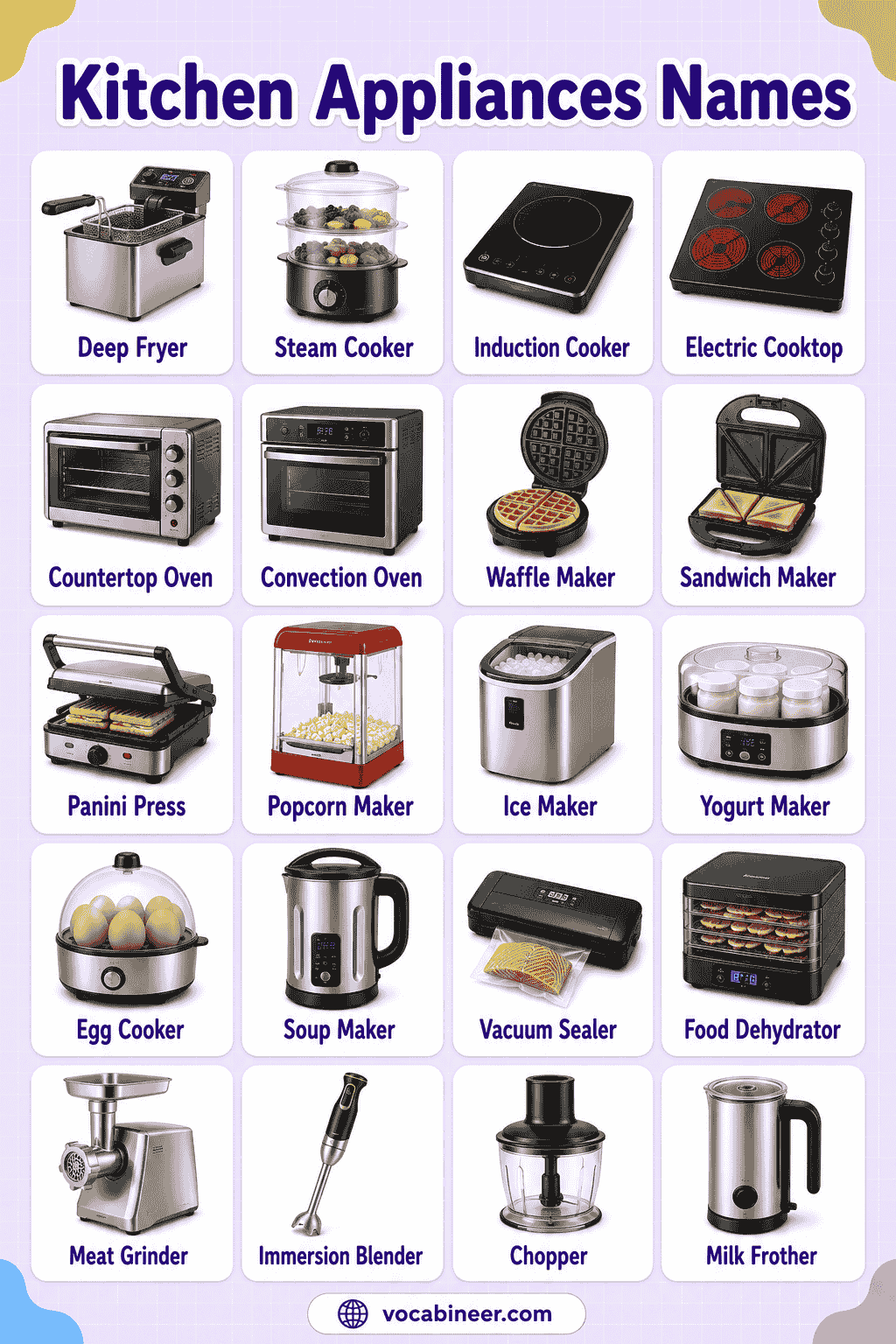
This chart gives a quick look at common kitchen appliances and their main uses.
| Kitchen Appliance | Main Use |
|---|---|
| Refrigerator | Keeps food cold |
| Freezer | Freezes food |
| Oven | Bakes and roasts food |
| Stove | Cooks food on burners |
| Cooktop | Cooks food on a flat burner surface |
| Range | Combines cooktop and oven |
| Microwave oven | Heats and reheats food quickly |
| Dishwasher | Washes dishes |
| Range hood | Removes smoke and cooking smells |
| Toaster | Toasts bread |
| Electric kettle | Boils water |
| Blender | Blends drinks and sauces |
| Food processor | Chops and mixes food |
| Stand mixer | Mixes dough and batter |
| Juicer | Extracts juice |
| Coffee maker | Brews coffee |
| Air fryer | Cooks crispy food with hot air |
| Rice cooker | Cooks rice |
| Slow cooker | Cooks food slowly |
| Garbage disposal | Grinds small food waste |
Confusing Kitchen Appliance Terms Explained
Some kitchen appliance terms sound similar. This table explains the difference clearly.
| Terms | Simple Difference |
|---|---|
| Appliance vs Utensil | Appliances are machines or devices; utensils are hand tools. |
| Appliance vs Cookware | Appliances use power or built-in systems; cookware holds food while cooking. |
| Major vs Small Appliances | Major appliances are large; small appliances are portable or countertop-sized. |
| Stove vs Cooktop vs Range | A stove or range often includes burners and an oven; a cooktop has burners only. |
| Oven vs Microwave Oven | An oven bakes or roasts; a microwave heats food quickly. |
| Blender vs Food Processor | A blender works best with liquids; a food processor works better for chopping and mixing solids. |
| Mixer vs Blender | A mixer beats or mixes ingredients; a blender blends or purees food. |
| Toaster vs Toaster Oven | A toaster browns bread slices; a toaster oven can heat, toast, and bake small foods. |
| Air Fryer vs Deep Fryer | An air fryer uses hot air; a deep fryer cooks food in hot oil. |
| Coffee Maker vs Espresso Machine | A coffee maker brews regular coffee; an espresso machine makes concentrated espresso. |
How to Choose the Right Kitchen Appliances
Choose the right kitchen appliances by looking at your kitchen size, daily cooking habits, family size, counter space, storage space, and budget. A refrigerator, stove or cooktop, oven, microwave oven, and dishwasher are useful in many kitchens, while small appliances like a blender, toaster, electric kettle, rice cooker, and air fryer depend on your daily meals.
Focus on appliances you will use often. A small kitchen may need compact or multi-use appliances, while a family kitchen may need larger cooling, cooking, and cleaning appliances. Check power use, cleaning needs, safety features, storage space, and whether the appliance solves a real kitchen task before buying it.
FAQs
Common kitchen appliances include refrigerator, freezer, oven, stove, cooktop, microwave oven, dishwasher, toaster, electric kettle, blender, food processor, coffee maker, air fryer, rice cooker, slow cooker, and range hood.
Kitchen appliances are machines or powered devices used for cooking, cooling, cleaning, or food preparation. Utensils are hand tools such as spoons, spatulas, whisks, knives, tongs, and ladles.
Major kitchen appliances are large appliances used for main kitchen tasks. Examples include refrigerator, freezer, oven, stove, range, cooktop, microwave oven, dishwasher, range hood, built-in oven, and wall oven.
Small kitchen appliances are portable or countertop appliances used for daily kitchen tasks. Examples include toaster, blender, electric kettle, coffee maker, food processor, air fryer, rice cooker, hand mixer, sandwich maker, and waffle maker.
Cooking appliances include stove, cooktop, range, oven, microwave oven, air fryer, rice cooker, slow cooker, multicooker, pressure cooker, electric grill, electric griddle, induction cooker, and toaster oven.
Read More
- Electrical Items Names
- Electrical Tools Names
- Lighting Equipment
- Types of Drinking Glasses
- Different Types of Baskets
- Types of Keys with Names