

Closets come in many styles, from simple reach-in closets to large walk-in closets, wardrobe closets, linen closets, coat closets, pantry closets, and utility closets. Some closets store clothes and shoes, while others hold towels, coats, cleaning supplies, laundry items, food, office materials, or craft tools.
This guide explains different types of closets with names, simple meanings, uses, layouts, door styles, storage features, parts, confusing terms, and a helpful closet chart with pictures.
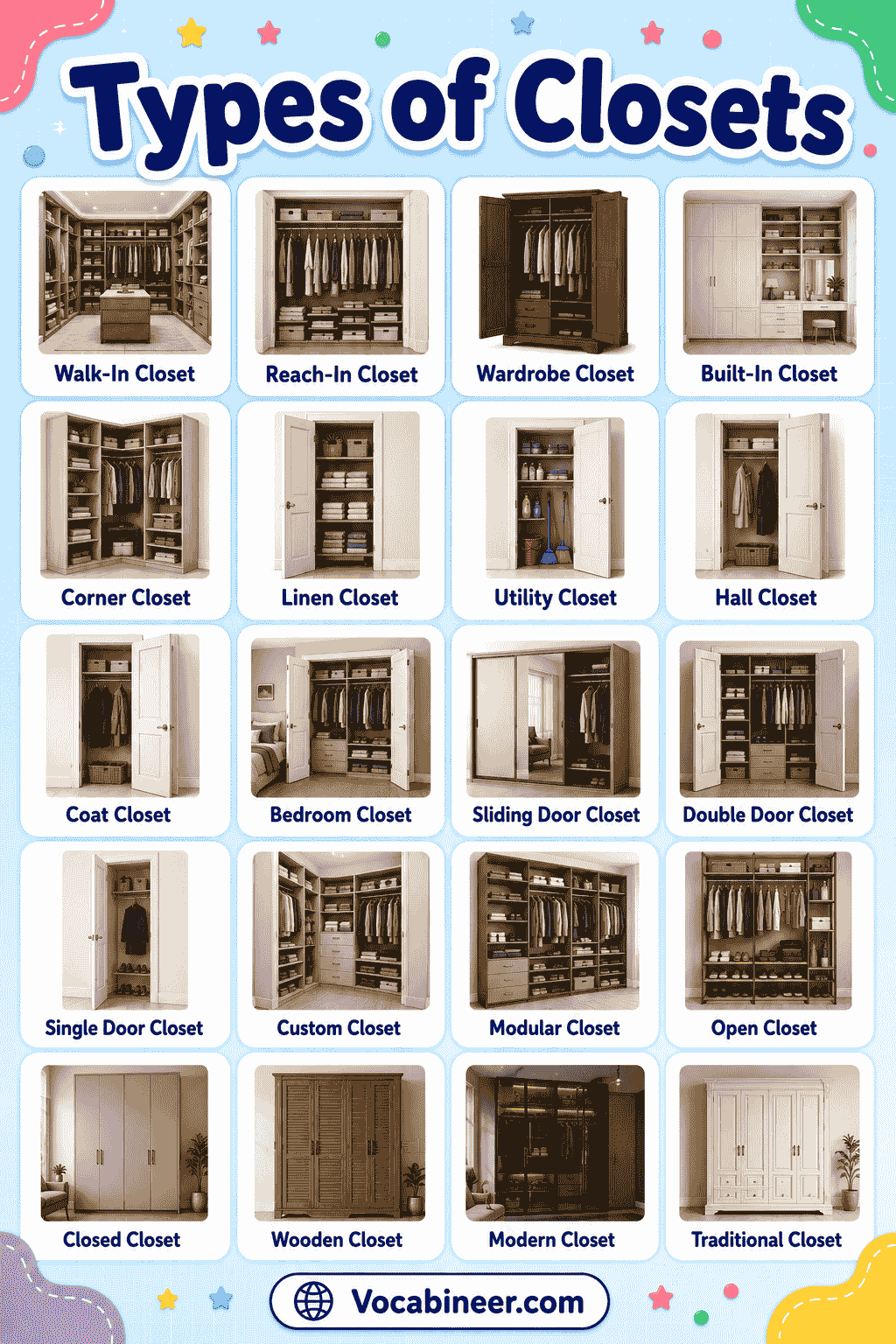
In This Page
Common Types of Closets
These are some of the most common closet types used in bedrooms, hallways, entryways, kitchens, laundry rooms, offices, and storage areas.
- Walk-in closet — a large closet that is big enough to step inside.
- Reach-in closet — a shallow closet that is accessed from the front.
- Wardrobe closet — a freestanding or built-in unit used for clothes storage.
- Built-in closet — a closet fixed into the room structure.
- Freestanding wardrobe — a movable furniture piece used like a closet.
- Bedroom closet — a closet used for clothes, shoes, and accessories.
- Linen closet — a closet used for towels, sheets, blankets, and bedding.
- Coat closet — a closet used for coats, jackets, hats, and umbrellas.
- Hall closet — a closet placed in a hallway for general storage.
- Entryway closet — a closet near the entrance of a home.
- Pantry closet — a closet used for food, jars, cans, and kitchen supplies.
- Utility closet — a closet used for cleaning tools and household supplies.
- Laundry closet — a closet area used for laundry items or machines.
- Kids closet — a closet designed for children’s clothes, toys, and school items.
- Office closet — a closet used for files, supplies, books, and work materials.
- Shoe closet — a closet used mainly for shoes and footwear storage.
- Open closet — a closet without doors.
- Closed closet — a closet with doors or covered storage.
Closet Types and Their Uses
Closets are often named by what they store or where they are placed. For example, a pantry closet stores food, while a coat closet stores jackets and outerwear.
- For clothes — bedroom closets, walk-in closets, reach-in closets, wardrobe closets, and dressing room closets.
- For shoes — shoe closets, wardrobe closets, entryway closets, and closet systems with shoe racks.
- For towels and bedding — linen closets, hall closets, and bathroom storage closets.
- For coats and outdoor items — coat closets, entryway closets, mudroom closets, and hall closets.
- For food storage — pantry closets, kitchen closets, and walk-in pantries.
- For cleaning supplies — utility closets, broom closets, cleaning closets, and supply closets.
- For laundry items — laundry closets, linen closets, and utility closets.
- For children’s items — kids closets, nursery closets, toy closets, and school closets.
- For work materials — office closets, file closets, supply closets, and study room closets.
- For hobbies — craft closets, hobby closets, sewing closets, and storage closets.
Bedroom Closet Types
Bedroom closets are used for clothes, shoes, bags, accessories, seasonal items, and personal storage. They can be small and simple or large enough to feel like a dressing room.
- Bedroom closet — a general closet inside a bedroom.
- Master closet — a larger bedroom closet, often connected to a main bedroom.
- Walk-in bedroom closet — a bedroom closet large enough to enter and move around in.
- Reach-in bedroom closet — a shallow bedroom closet with front access.
- Wardrobe closet — a closet-style furniture unit used when a room has no built-in closet.
- Dressing room closet — a large closet space used for clothes, dressing, mirrors, and accessories.
- Shoe closet — a closet or closet section made mainly for shoes.
- Open closet — a closet without doors, often used for easy access.
- Closed closet — a closet with doors to hide clothes and reduce visual clutter.
Walk-In, Reach-In, and Wardrobe Closets
Walk-in, reach-in, and wardrobe closets are the main closet types people compare when planning clothes storage.
- Walk-in closet — a large closet that a person can step into. It may include hanging rods, shelves, drawers, mirrors, lighting, shoe racks, and seating.
- Reach-in closet — a shallower closet that is opened from the front. It is common in bedrooms, hallways, and smaller homes.
- Wardrobe closet — a tall storage unit used for clothes. It may be built-in or freestanding.
- Freestanding wardrobe — a movable wardrobe that works like a closet but is not fixed into the room.
- Built-in wardrobe — a wardrobe fixed into a wall or room design.
- Dressing room closet — a larger closet area used for storing clothes and getting dressed.
Walk-in closets work well for larger rooms and bigger clothing collections. Reach-in closets are better for smaller rooms, while wardrobes are useful when a room does not have a built-in closet.
Linen, Coat, Hall, and Entryway Closets
These closets are often placed outside bedrooms. They help store household items that people use in shared spaces.
- Linen closet — a closet for towels, sheets, blankets, pillowcases, and bedding.
- Coat closet — a closet for coats, jackets, scarves, hats, gloves, and umbrellas.
- Hall closet — a closet in a hallway for extra household storage.
- Entryway closet — a closet near the main door for coats, shoes, bags, and outdoor items.
- Mudroom closet — a closet near an entry or mudroom for shoes, coats, sports gear, and wet outdoor items.
- Guest closet — a closet used for guest coats, spare bedding, or temporary storage.
- Seasonal closet — a closet used for holiday items, winter clothing, extra blankets, or seasonal decor.
Pantry, Utility, and Laundry Closets
These closets are made for household tasks, food storage, cleaning supplies, and laundry organization.
- Pantry closet — a closet used for dry food, canned goods, jars, snacks, and kitchen supplies.
- Walk-in pantry closet — a larger pantry space with shelves and room to step inside.
- Utility closet — a closet used for household supplies, tools, cleaning items, or equipment.
- Laundry closet — a closet area used for a washer, dryer, detergent, baskets, or laundry supplies.
- Cleaning closet — a closet used for sprays, cloths, brushes, and cleaning products.
- Broom closet — a narrow closet used for brooms, mops, dusters, and tall cleaning tools.
- Supply closet — a closet used for extra household, office, school, or cleaning supplies.
- Water heater closet — a closet that holds a water heater or similar household equipment.
- Storage closet — a general closet for items that do not fit into regular room storage.
Kids, Office, and Craft Closets
Some closets are designed around specific users, rooms, or activities. These closets often need flexible shelves, bins, baskets, hooks, and easy access.
- Kids closet — a closet for children’s clothes, shoes, toys, bags, and school items.
- Nursery closet — a closet for baby clothes, blankets, diapers, toys, and care supplies.
- School closet — a closet used for backpacks, uniforms, books, crafts, and school supplies.
- Toy closet — a closet used mainly for toys, games, puzzles, and bins.
- Office closet — a closet for files, folders, books, printer supplies, and work tools.
- File closet — a closet used for documents, records, folders, and storage boxes.
- Craft closet — a closet used for art supplies, paper, fabric, tools, and hobby items.
- Hobby closet — a closet for sewing, painting, crafting, photography, or other hobby materials.
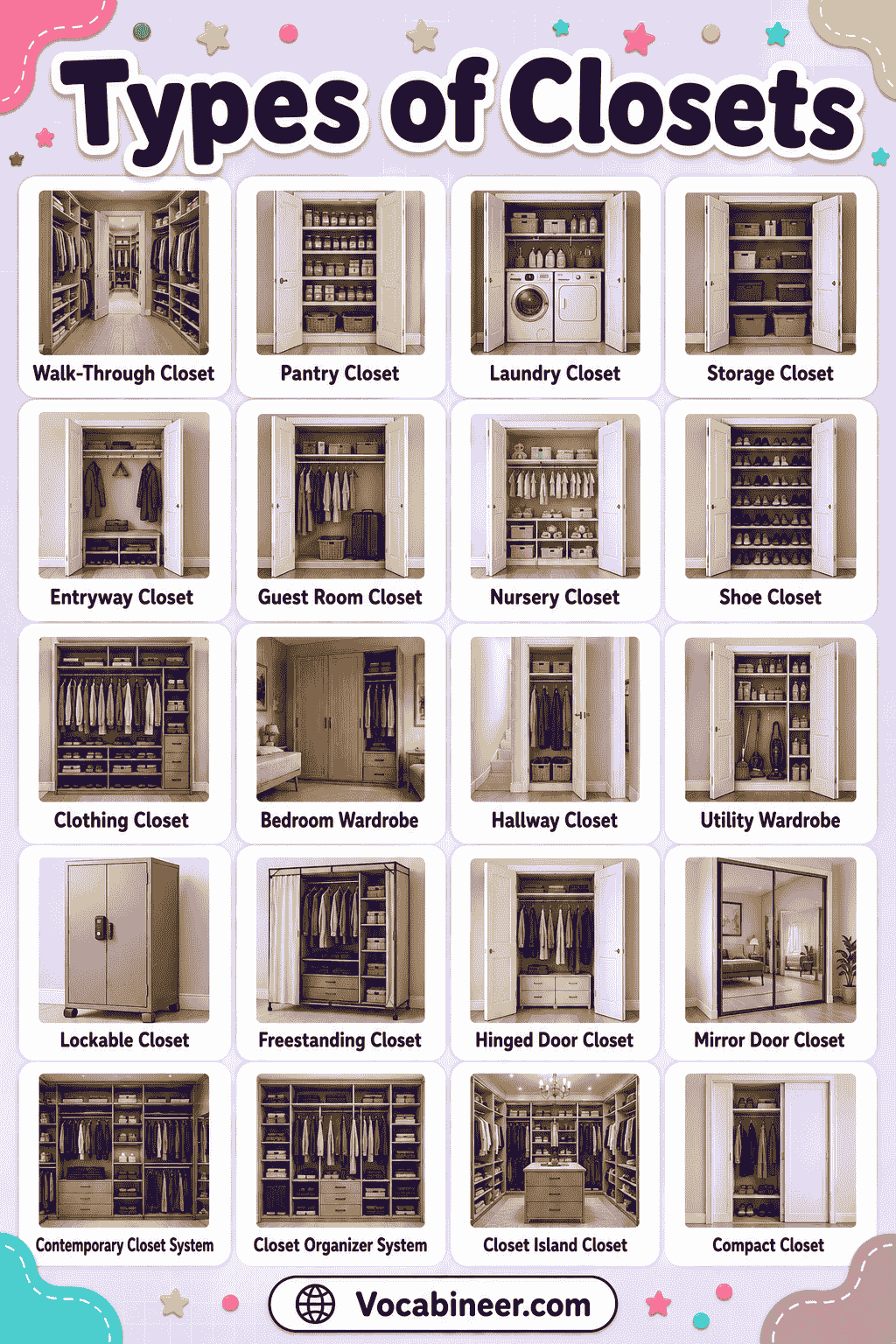
Closet Types by Layout
Closet layout describes how the closet is arranged inside the room. Layout affects walking space, storage capacity, and how easily items can be reached.
- Single-wall closet — a closet with storage along one wall.
- Galley closet — a closet with storage on two opposite sides and a walkway in the middle.
- L-shaped closet — a closet with storage along two connected walls.
- U-shaped closet — a closet with storage along three walls.
- Walk-through closet — a closet that connects two areas, such as a bedroom and bathroom.
- Corner closet — a closet designed to use corner space.
- Floor-to-ceiling closet — a tall closet that uses the full height of the wall.
- Wall-to-wall closet — a closet that stretches across a full wall.
Closet Types by Door Style
Closet doors affect how the closet looks, opens, and fits in a room. In small spaces, door style can make a big difference.
- Sliding-door closet — a closet with doors that slide side to side.
- Bifold-door closet — a closet with folding doors that open in panels.
- Hinged-door closet — a closet with doors that swing open on hinges.
- Mirrored closet — a closet with mirror panels on the doors.
- Pocket-door closet — a closet with a door that slides into the wall.
- Curtain closet — a closet covered with a curtain instead of a door.
- Open closet — a closet with no doors.
- Closed closet — a closet with doors or covered storage.
- Bypass-door closet — a closet with sliding doors that pass in front of each other.
Closet Systems and Storage Features
Closet systems and storage features help organize clothes, shoes, accessories, linens, supplies, and household items.
- Modular closet system — a closet system made from separate parts that can be arranged in different ways.
- Custom closet system — a closet system designed for a specific room or storage need.
- Wire closet system — a closet system with wire shelves, rods, and baskets.
- Wood closet system — a closet system made with wood or wood-style panels.
- Closet rods — horizontal rods used for hanging clothes.
- Hanging rods — rods used for shirts, coats, dresses, pants, and jackets.
- Double-hang rods — two hanging rods stacked vertically to save space.
- Shelves — flat surfaces used for folded clothes, boxes, bags, and bins.
- Drawers — pull-out storage spaces for clothes, accessories, or small items.
- Shoe racks — racks or shelves used for shoes.
- Hooks — small hanging pieces used for bags, belts, hats, or scarves.
- Baskets — containers used for grouped storage inside closets.
- Bins — storage containers used for toys, seasonal items, supplies, or folded items.
- Pull-out shelves — shelves that slide out for easier access.
- Lighting — lights added inside or near a closet.
- Mirrors — mirrors placed on doors, walls, or closet panels.
Closet Materials and Design Styles
Closets can look simple, modern, traditional, open, closed, built-in, or furniture-like. Materials and design style affect durability, appearance, and cost.
- Wood closet — a closet made with wood or wood-style panels.
- Wire closet — a closet system made with wire shelves and rods.
- Laminate closet — a closet with laminate surfaces over engineered material.
- Melamine closet — a closet system with a smooth melamine-coated surface.
- Metal closet — a closet or storage system made with metal parts.
- Glass closet doors — closet doors with glass panels.
- Mirrored closet — a closet with mirror doors or mirror panels.
- Modern closet — a clean closet style with simple lines and organized storage.
- Traditional closet — a classic closet style with familiar wood, doors, and shelving.
- Minimalist closet — a simple closet design with fewer visible items.
- Open wardrobe — a wardrobe-style closet without doors.
- Closed wardrobe — a wardrobe-style closet with doors.
Closet Parts You Should Know
Closet parts are useful to know when describing, planning, organizing, or comparing closets.
- Rod — a horizontal bar used for hanging clothes.
- Shelf — a flat surface used for folded items, boxes, baskets, or shoes.
- Drawer — a pull-out compartment for small items or folded clothes.
- Door — the panel that opens and closes the closet.
- Track — the rail used by sliding or bypass closet doors.
- Hinge — the hardware that lets a hinged door swing open.
- Handle — the part used to pull a door or drawer.
- Hanger — an item used to hang clothes on a rod.
- Rack — a support used for shoes, bags, hats, or accessories.
- Hook — a small hanging piece for bags, belts, scarves, or hats.
- Basket — a container used for grouped closet storage.
- Bin — a storage container for small or loose items.
- Divider — a piece that separates closet sections.
- Shoe rack — a rack or shelf made for shoes.
- Mirror — a reflective surface used for dressing.
- Light — lighting added for better visibility.
- Closet frame — the outer structure that supports the closet opening or system.
Confusing Closet Terms Explained
Some closet terms sound similar, but they do not always mean the same thing.
| Term | Simple Difference |
|---|---|
| Walk-In vs Reach-In Closet | A walk-in closet is large enough to step inside. A reach-in closet is shallower and accessed from the front. |
| Closet vs Wardrobe | A closet is usually built into a room. A wardrobe is usually a freestanding furniture piece. |
| Wardrobe vs Armoire | A wardrobe is a tall storage unit for clothes. An armoire is often a larger decorative wardrobe with doors. |
| Built-In vs Freestanding Closet | A built-in closet is fixed into the room. A freestanding closet can be moved. |
| Linen Closet vs Utility Closet | A linen closet stores towels and bedding. A utility closet stores cleaning tools, supplies, or household equipment. |
| Sliding vs Bifold Closet Door | A sliding door moves side to side. A bifold door folds open in panels. |
| Open Closet vs Closed Closet | An open closet has no doors. A closed closet has doors or covered storage. |
Types of Closets Chart with Pictures
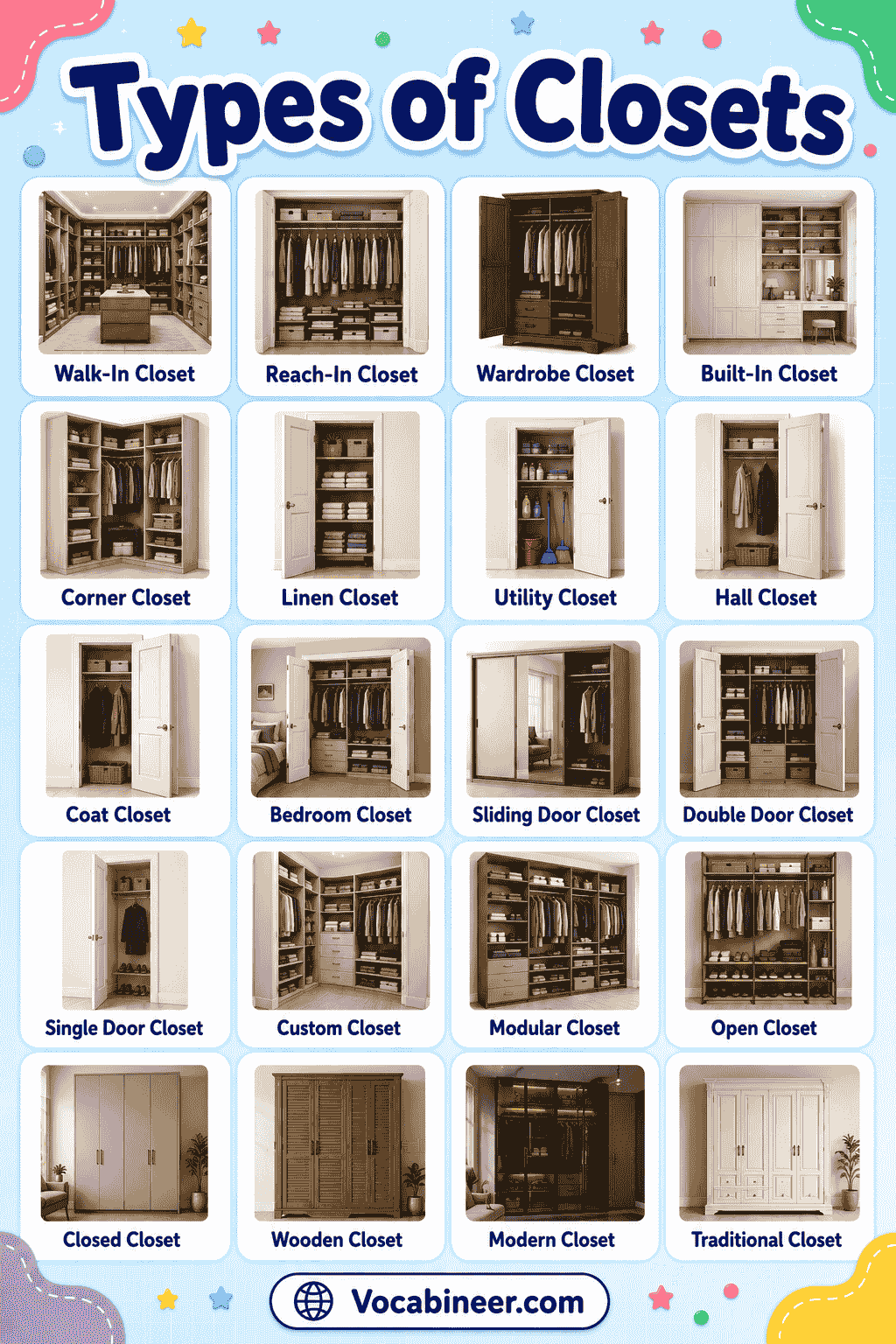
A closet chart helps compare closet groups, best uses, and common examples.
| Closet Group | Details |
|---|---|
| Bedroom Closets | Best for: clothes, shoes, bags, and accessories Examples: bedroom closet, master closet, dressing room closet |
| Main Closet Types | Best for: general clothes storage Examples: walk-in closet, reach-in closet, wardrobe closet |
| Home Storage Closets | Best for: towels, coats, pantry items, and household supplies Examples: linen closet, coat closet, pantry closet, utility closet |
| Task Closets | Best for: laundry, cleaning, office, crafts, and kids’ items Examples: laundry closet, broom closet, office closet, craft closet |
| Layout-Based Closets | Best for: matching room shape and storage space Examples: single-wall, galley, L-shaped, U-shaped, walk-through |
| Door-Style Closets | Best for: controlling access, privacy, and room space Examples: sliding-door, bifold-door, hinged-door, mirrored, open |
| Closet Systems | Best for: organized clothes, shoes, accessories, and supplies Examples: modular, custom, wire, wood closet systems |
| Material and Design Styles | Best for: matching room style and durability needs Examples: wood, wire, laminate, melamine, metal, modern, traditional |
How to Choose the Right Closet
Choosing the right closet depends on the room, storage need, available space, door clearance, and the type of items you want to store.
- For small bedrooms — choose a reach-in closet, wardrobe closet, sliding-door closet, or open closet.
- For large clothing collections — choose a walk-in closet, dressing room closet, or custom closet system.
- For towels and bedding — choose a linen closet with shelves.
- For coats and shoes — choose a coat closet, entryway closet, mudroom closet, or shoe closet.
- For food storage — choose a pantry closet or walk-in pantry closet.
- For cleaning supplies — choose a utility closet, broom closet, or cleaning closet.
- For laundry areas — choose a laundry closet with shelves, baskets, and space for supplies.
- For kids’ rooms — choose a low, easy-access kids closet with bins, rods, shelves, and baskets.
- For office storage — choose an office closet, file closet, or supply closet.
- For flexible storage — choose a modular closet system with adjustable shelves and rods.
FAQs
The most common types of closets include walk-in closets, reach-in closets, wardrobe closets, bedroom closets, linen closets, coat closets, pantry closets, utility closets, laundry closets, and entryway closets.
A walk-in closet is large enough to step inside and move around. A reach-in closet is shallower and is usually accessed from the front through doors.
A closet is usually built into a room or wall. A wardrobe is usually a freestanding furniture piece used for storing clothes.
A reach-in closet, sliding-door closet, wardrobe closet, open closet, or modular closet system can work well in a small bedroom.
Walk-in closets, reach-in closets, wardrobe closets, dressing room closets, and custom closet systems are best for clothes storage.
Read More
- Types of Baskets
- Bedroom Decor Items
- Popular Types of Tiles
- Parts of a House Names
- Different Types of Tables
- Different Types of Drawers