

Bookcases come in many styles, from simple freestanding bookcases to built-in bookcases, ladder bookcases, cube bookcases, and glass-door bookcases. Some are made for heavy books, while others are better for display items, small rooms, kids’ books, offices, or home libraries.
This guide explains different types of bookcases with names, simple meanings, uses, materials, shapes, storage features, parts, confusing terms, and a helpful bookcase chart with pictures.
In This Page
Common Types of Bookcases
These are some of the most common bookcase types used in homes, offices, schools, libraries, and living rooms.
- Standard bookcase — a basic bookcase with shelves for books and decor.
- Freestanding bookcase — a movable bookcase that stands on the floor.
- Built-in bookcase — a fixed bookcase built into a wall or room design.
- Wall-mounted bookcase — a bookcase attached to a wall.
- Floating bookcase — a wall-mounted bookcase or shelf unit with hidden support.
- Ladder bookcase — a bookcase shaped like a ladder, often wider at the bottom.
- Leaning bookcase — a bookcase that leans against a wall at an angle.
- Corner bookcase — a bookcase designed to fit into a room corner.
- Cube bookcase — a bookcase with square compartments.
- Modular bookcase — a bookcase made from separate sections that can be arranged in different ways.
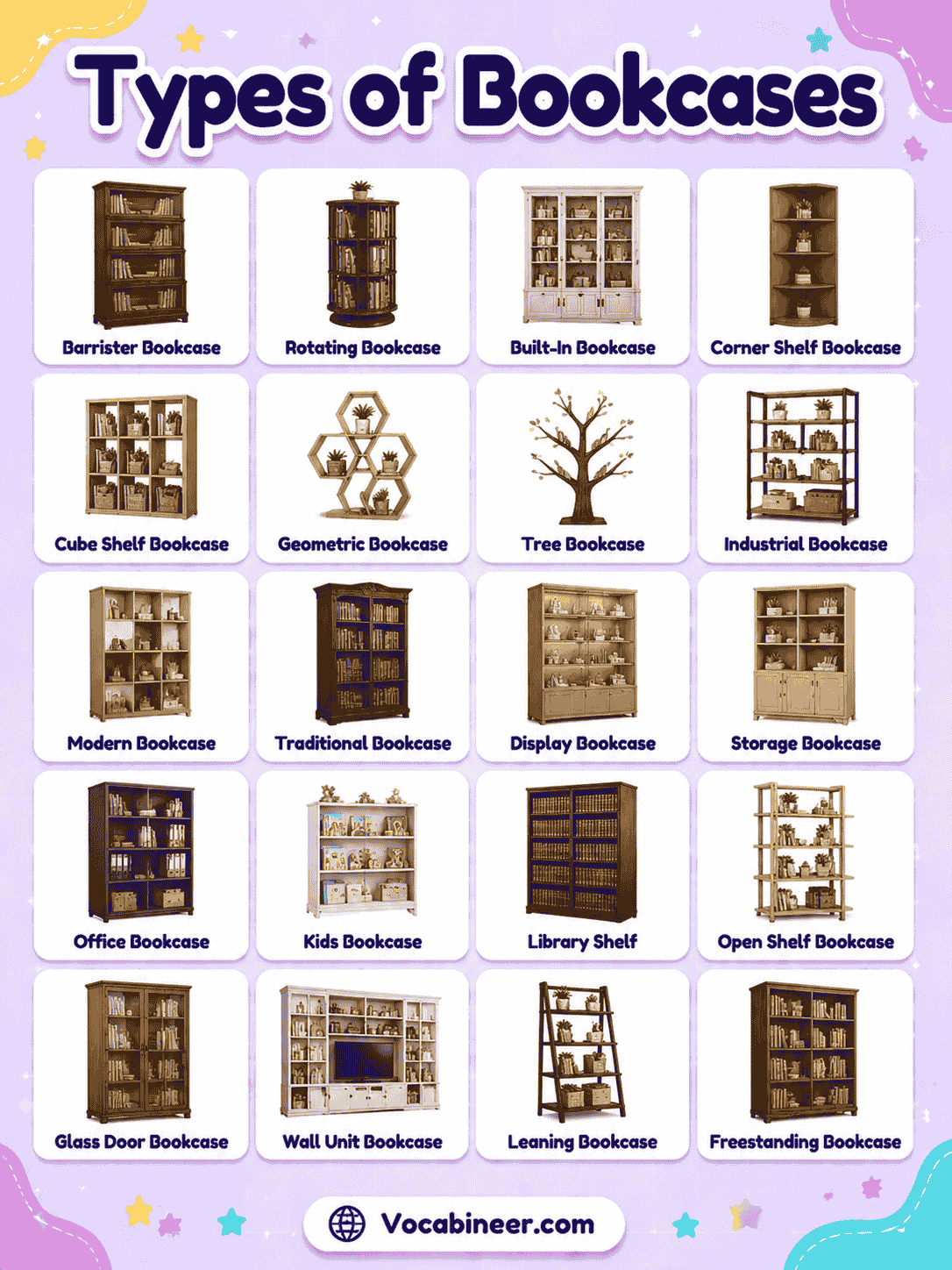
- Barrister bookcase — a bookcase with stacked sections and glass-front doors.
- Glass-door bookcase — a bookcase with glass doors to protect books from dust.
- Etagere bookcase — an open, decorative bookcase often used for display.
- Display bookcase — a bookcase used for books, decor, photos, collectibles, or plants.
- Cabinet bookcase — a bookcase with cabinet-style storage.
- Open bookcase — a bookcase with exposed shelves.
- Closed bookcase — a bookcase with doors or covered storage.
- Kids bookcase — a lower, child-friendly bookcase for children’s books and toys.
- Office bookcase — a bookcase used for files, books, folders, and work supplies.
- Library bookcase — a tall or large bookcase used for bigger book collections.
Bookcase Types and Their Uses
Bookcases are often chosen by room, storage need, design style, and book weight.
- For everyday books — standard bookcases, freestanding bookcases, open bookcases, and wooden bookcases.
- For small rooms — ladder bookcases, leaning bookcases, corner bookcases, narrow bookcases, and floating bookcases.
- For heavy books — solid wood bookcases, metal bookcases, wide bookcases, and fixed-shelf bookcases.
- For living rooms — display bookcases, etagere bookcases, glass-door bookcases, and cabinet bookcases.
- For offices — office bookcases, file bookcases, adjustable-shelf bookcases, and bookcases with doors.
- For kids’ rooms — kids bookcases, low bookcases, nursery bookcases, and cube bookcases.
- For home libraries — built-in bookcases, floor-to-ceiling bookcases, library bookcases, and wall-to-wall bookcases.
- For decor display — etagere bookcases, display bookcases, geometric bookcases, and open bookcases.
- For hidden storage — closed bookcases, cabinet bookcases, bookcases with drawers, and glass-door bookcases.
Freestanding and Built-In Bookcases
Freestanding and built-in bookcases are two of the main bookcase categories. The main difference is that one can move, while the other is fixed.
- Freestanding bookcase — a movable bookcase that can be placed in different rooms.
- Built-in bookcase — a fixed bookcase built into a wall, corner, alcove, or room layout.
- Custom built-in bookcase — a built-in bookcase made to fit a specific wall or space.
- Wall-to-wall bookcase — a large bookcase that covers an entire wall.
- Floor-to-ceiling bookcase — a tall bookcase that reaches from the floor to the ceiling.
- Recessed bookcase — a bookcase set into a wall opening or niche.
Freestanding bookcases are easier to move and replace. However, built-in bookcases can look more polished and can use wall space very efficiently.
Ladder, Leaning, and Corner Bookcases
These bookcases are popular for small rooms, apartments, corners, and decorative storage.
- Ladder bookcase — a bookcase with a ladder-like frame and open shelves.
- Leaning bookcase — a bookcase that rests against the wall at an angle.
- Corner bookcase — a bookcase made to fit into a corner.
- Triangular corner bookcase — a corner bookcase with a triangular shape.
- Narrow corner bookcase — a slim bookcase for tight corners or small spaces.
- Small-space bookcase — a compact bookcase made for apartments, bedrooms, or narrow rooms.
Ladder and leaning bookcases are often used for decor, plants, small books, and lightweight items. Corner bookcases are useful when wall space is limited.
Cube, Modular, and Display Bookcases
These bookcase styles are often used for both storage and decoration. They can hold books, baskets, toys, photo frames, plants, and display items.
- Cube bookcase — a bookcase with square cubbies or compartments.
- Modular bookcase — a bookcase made from separate units that can be rearranged.
- Display bookcase — a bookcase used to show books, decor, awards, photos, or collectibles.
- Etagere bookcase — an open decorative bookcase with light, airy shelves.
- Open bookcase — a bookcase with no doors, making items easy to see and reach.
- Room divider bookcase — a bookcase used to divide one room into separate areas.
- Geometric bookcase — a bookcase with unusual shapes or angled shelves.
- Tree bookcase — a bookcase shaped like a tree or branching structure.
- Rotating bookcase — a bookcase that turns around a center point for easy access.
Barrister, Glass-Door, and Cabinet Bookcases
These bookcases are useful when you want to protect books from dust, hide clutter, or create a more formal look.
- Barrister bookcase — a bookcase with stacked sections and glass-front doors that often lift or slide.
- Glass-door bookcase — any bookcase with glass doors.
- Cabinet bookcase — a bookcase with cabinet-style doors or lower cabinets.
- Closed bookcase — a bookcase with covered storage.
- Bookcase with doors — a bookcase that uses solid, glass, or framed doors.
- Bookcase with drawers — a bookcase with drawers for hidden storage.
- Display cabinet bookcase — a bookcase that combines display shelves with cabinet-style protection.
Glass-door bookcases are good for books, collectibles, and decorative items. Cabinet bookcases are useful when you want both open shelves and hidden storage.
Wall-Mounted and Floating Bookcases
Wall-mounted and floating bookcases save floor space because they attach to the wall instead of standing fully on the floor.
- Wall-mounted bookcase — a bookcase fixed directly to a wall.
- Floating bookcase — a wall-mounted bookcase or shelf unit with hidden brackets or supports.
- Wall shelf bookcase — a shelf-style bookcase attached to the wall.
- Hanging bookcase — a bookcase or shelf unit designed to hang from wall supports.
- Mounted bookshelf unit — a wall-fixed unit used for books and decor.
- Space-saving wall bookcase — a wall bookcase designed for small rooms or narrow areas.
Kids, Office, and Library Bookcases
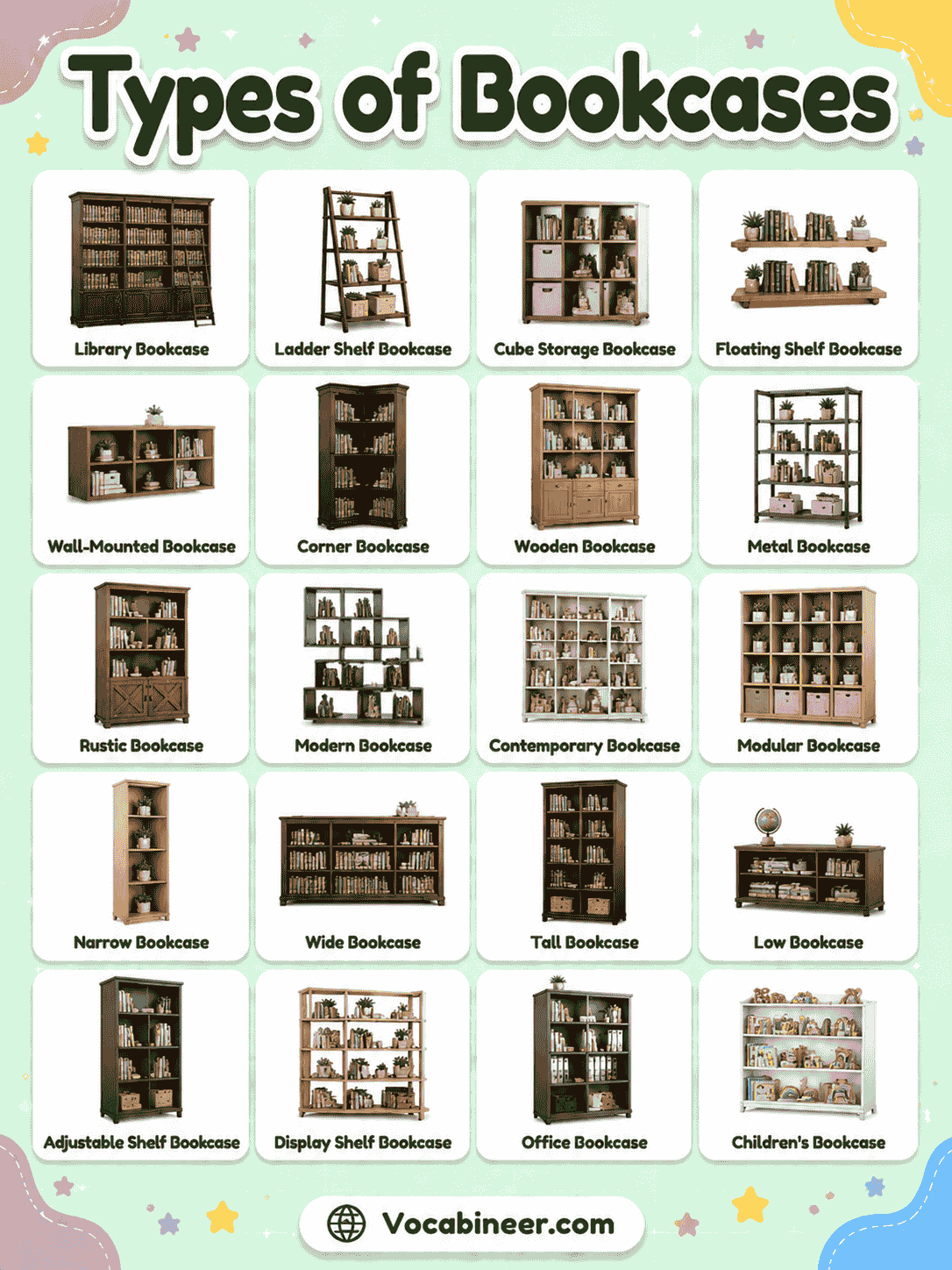
Some bookcases are designed for specific rooms or users. These bookcases differ in height, strength, shelf spacing, and storage features.
- Kids bookcase — a low bookcase made for children’s books, toys, and learning items.
- Nursery bookcase — a small bookcase used in baby rooms for storybooks and supplies.
- Classroom bookcase — a sturdy bookcase used for school books, bins, and learning materials.
- Office bookcase — a bookcase used for files, folders, books, and work supplies.
- Study room bookcase — a bookcase used near a desk or study area.
- Library bookcase — a tall or wide bookcase for larger book collections.
- Home library bookcase — a bookcase used to create a library-style room at home.
- Living room bookcase — a bookcase used for books, decor, plants, photos, and media items.
- Bedroom bookcase — a bookcase used for reading books, baskets, decor, or personal items.
Bookcase Types by Material
Bookcase material affects strength, weight, price, appearance, and durability.
- Wooden bookcase — a bookcase made from wood or wood-based material.
- Solid wood bookcase — a strong bookcase made from natural wood.
- Engineered wood bookcase — a bookcase made from manufactured wood products.
- MDF bookcase — a bookcase made from medium-density fiberboard.
- Laminate bookcase — a bookcase with a laminate surface over wood-based material.
- Metal bookcase — a strong bookcase made from metal.
- Glass bookcase — a bookcase with glass shelves, glass panels, or glass doors.
- Rattan bookcase — a bookcase with rattan panels or woven rattan details.
- Bamboo bookcase — a bookcase made from bamboo or bamboo-style material.
- Industrial bookcase — a bookcase that often combines metal frames with wood shelves.
Solid wood and metal bookcases are usually better for heavy books. MDF, laminate, and engineered wood bookcases are common for everyday home storage.
Bookcase Types by Shape and Design
Bookcase shape matters because it affects how the furniture fits into a room.
- Tall bookcase — a high bookcase with several shelves.
- Low bookcase — a shorter bookcase that can fit under windows or along low walls.
- Wide bookcase — a broad bookcase with more horizontal storage.
- Narrow bookcase — a slim bookcase for tight spaces.
- Vertical bookcase — a bookcase that uses height more than width.
- Horizontal bookcase — a low and wide bookcase.
- Arched bookcase — a bookcase with an arched top or curved design.
- Asymmetrical bookcase — a bookcase with uneven shelf sizes or an irregular design.
- Tree bookcase — a bookcase with branch-like shelves.
- Rotating bookcase — a turning bookcase that gives access from different sides.
- Room divider bookcase — a bookcase used to separate spaces while storing items.
Bookcase Storage Features
Bookcase features can make storage easier, safer, and more flexible.
- Adjustable shelves — shelves that can move up or down.
- Fixed shelves — shelves that stay in one position.
- Doors — panels that cover shelves and protect items from dust.
- Drawers — pull-out storage spaces for small items.
- Cabinets — closed storage sections, often at the bottom.
- Open shelves — shelves without doors for easy access.
- Closed storage — covered areas for hiding clutter.
- Glass doors — clear doors that protect books while keeping them visible.
- Lower cabinets — closed cabinets below open shelves.
- Display shelves — shelves used for decor, collectibles, or photos.
- Anti-tip hardware — straps or brackets that help secure the bookcase to the wall.
Anti-tip hardware is especially important for tall bookcases, kids’ rooms, and homes with pets.
Bookcase Parts You Should Know
Knowing bookcase parts helps when describing, buying, assembling, or comparing bookcases.
- Shelves — flat horizontal boards that hold books and items.
- Side panels — vertical panels on the left and right sides.
- Back panel — the rear panel behind the shelves.
- Top panel — the upper board of the bookcase.
- Bottom panel — the lower board of the bookcase.
- Frame — the main supporting structure.
- Base — the bottom support area.
- Legs — raised supports under some bookcases.
- Doors — panels that open and close over shelves.
- Drawers — pull-out compartments.
- Hardware — hinges, handles, knobs, brackets, screws, and fasteners.
- Anti-tip strap — a safety strap used to secure the bookcase to a wall.
Confusing Bookcase Terms Explained
Some bookcase terms sound similar, but they do not always mean the same thing.
| Term | Simple Difference |
|---|---|
| Bookcase vs Bookshelf | A bookcase is usually a furniture unit with shelves. A bookshelf can mean one shelf or a shelving unit for books. |
| Freestanding vs Built-In Bookcase | A freestanding bookcase can be moved. A built-in bookcase is fixed into a wall or room design. |
| Ladder vs Leaning Bookcase | A ladder bookcase has a ladder-like shape. A leaning bookcase rests against a wall at an angle. |
| Cube vs Modular Bookcase | A cube bookcase has square compartments. A modular bookcase is made of sections that can be arranged in different ways. |
| Barrister vs Glass-Door Bookcase | A barrister bookcase has stacked glass-front sections. A glass-door bookcase is any bookcase with glass doors. |
| Open vs Closed Bookcase | An open bookcase has exposed shelves. A closed bookcase has doors or covered storage. |
| Bookcase vs Display Cabinet | A bookcase is mainly for books and shelf storage. A display cabinet is mainly for showing items and often has glass doors. |
Types of Bookcases Chart with Pictures
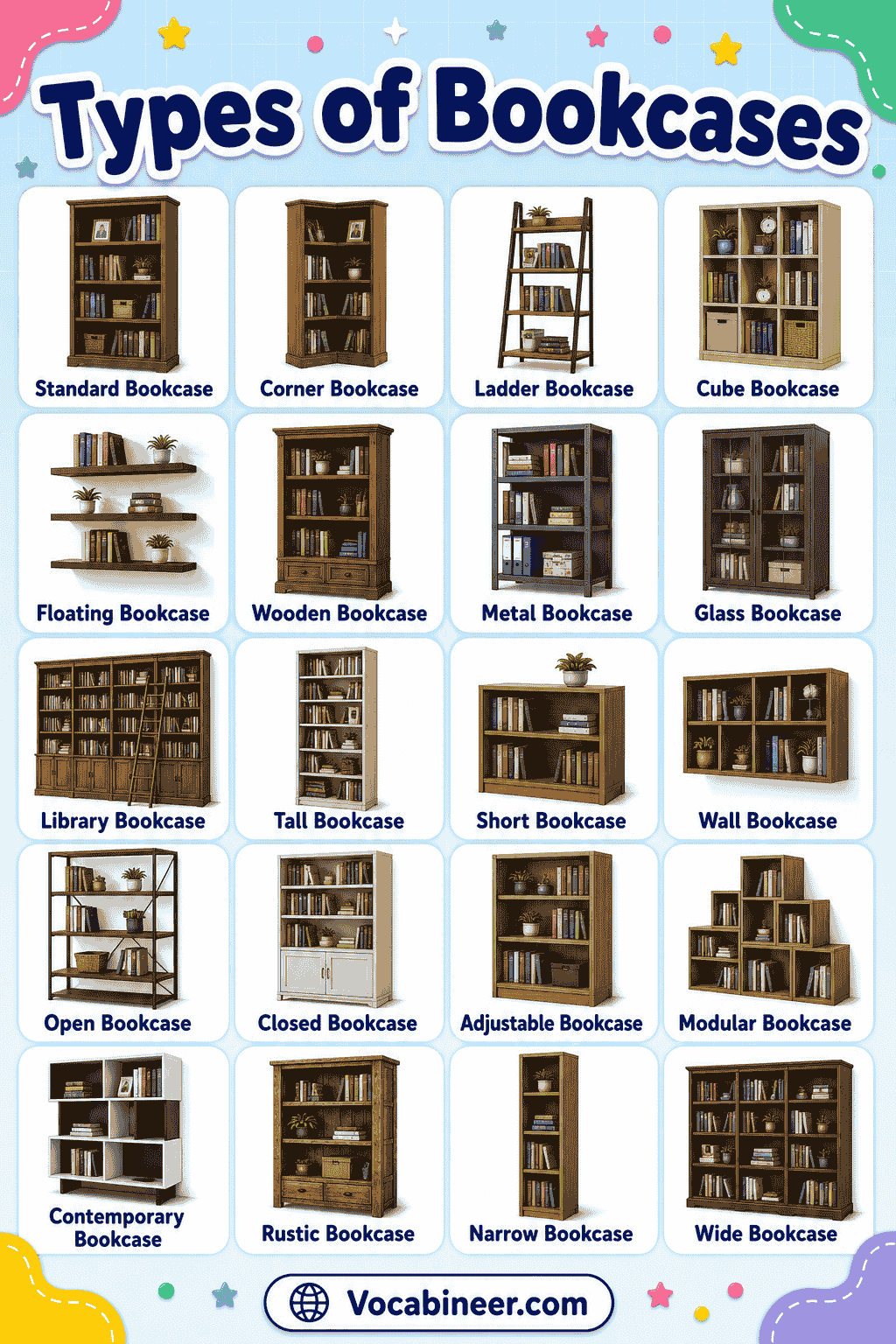
A bookcase chart helps compare the main bookcase groups, best uses, and examples.
| Bookcase Group | Details |
|---|---|
| Common Bookcases | Best for: everyday book storage and display Examples: standard, freestanding, open, closed |
| Built-In Bookcases | Best for: permanent wall storage and custom rooms Examples: built-in, wall-to-wall, floor-to-ceiling, recessed |
| Space-Saving Bookcases | Best for: small rooms, apartments, and corners Examples: ladder, leaning, corner, floating, narrow |
| Display Bookcases | Best for: books, decor, photos, plants, and collectibles Examples: display, etagere, geometric, tree, room divider |
| Door and Cabinet Bookcases | Best for: dust protection and hidden storage Examples: barrister, glass-door, cabinet, closed, drawer bookcase |
| Room-Based Bookcases | Best for: specific rooms and users Examples: kids, nursery, office, classroom, library, living room |
| Material-Based Bookcases | Best for: choosing by strength, style, and durability Examples: wooden, metal, glass, rattan, bamboo, laminate |
| Shape-Based Bookcases | Best for: matching room size and layout Examples: tall, low, wide, narrow, arched, horizontal, rotating |
How to Choose the Right Bookcase
Choosing the right bookcase depends on your room size, book weight, storage needs, style, and safety.
- For small rooms — choose ladder, leaning, corner, narrow, floating, or wall-mounted bookcases.
- For heavy books — choose solid wood, metal, fixed-shelf, wide, or library-style bookcases.
- For living rooms — choose display, etagere, glass-door, cabinet, or built-in bookcases.
- For kids’ rooms — choose low, sturdy, open, cube, or nursery bookcases with anti-tip hardware.
- For offices — choose adjustable-shelf, cabinet, glass-door, or office bookcases.
- For home libraries — choose built-in, floor-to-ceiling, wall-to-wall, or library bookcases.
- For decor display — choose open, etagere, geometric, room divider, or arched bookcases.
- For hidden storage — choose closed, cabinet, drawer, or glass-door bookcases.
FAQs
The most common types of bookcases include standard bookcases, freestanding bookcases, built-in bookcases, ladder bookcases, corner bookcases, cube bookcases, barrister bookcases, glass-door bookcases, and office bookcases.
A bookcase is usually a furniture unit with several shelves. A bookshelf can mean one shelf or a full shelving unit used for books.
Ladder bookcases, leaning bookcases, corner bookcases, narrow bookcases, floating bookcases, and wall-mounted bookcases are good choices for small rooms.
Solid wood bookcases, metal bookcases, fixed-shelf bookcases, wide bookcases, and library-style bookcases are better for heavy books because they offer stronger support.
Display bookcases, etagere bookcases, glass-door bookcases, cabinet bookcases, built-in bookcases, and open bookcases work well in living rooms.
Read More
- Types of Baskets
- Bedroom Decor Items
- Popular Types of Tiles
- Parts of a House Names
- Different Types of Tables
- Different Types of Drawers