Faucets come in many styles, from simple bathroom sink faucets to pull-down kitchen faucets, wall-mounted faucets, touchless faucets, and waterfall faucets. Each faucet type has a different shape, handle style, installation method, water flow, and best use.
Some faucets are made for kitchens, bathrooms, bathtubs, showers, laundry rooms, outdoor areas, or utility sinks. This guide explains the main types of faucets with simple meanings, examples, handle styles, spout styles, valve types, finishes, parts, and choosing tips.
In This Page
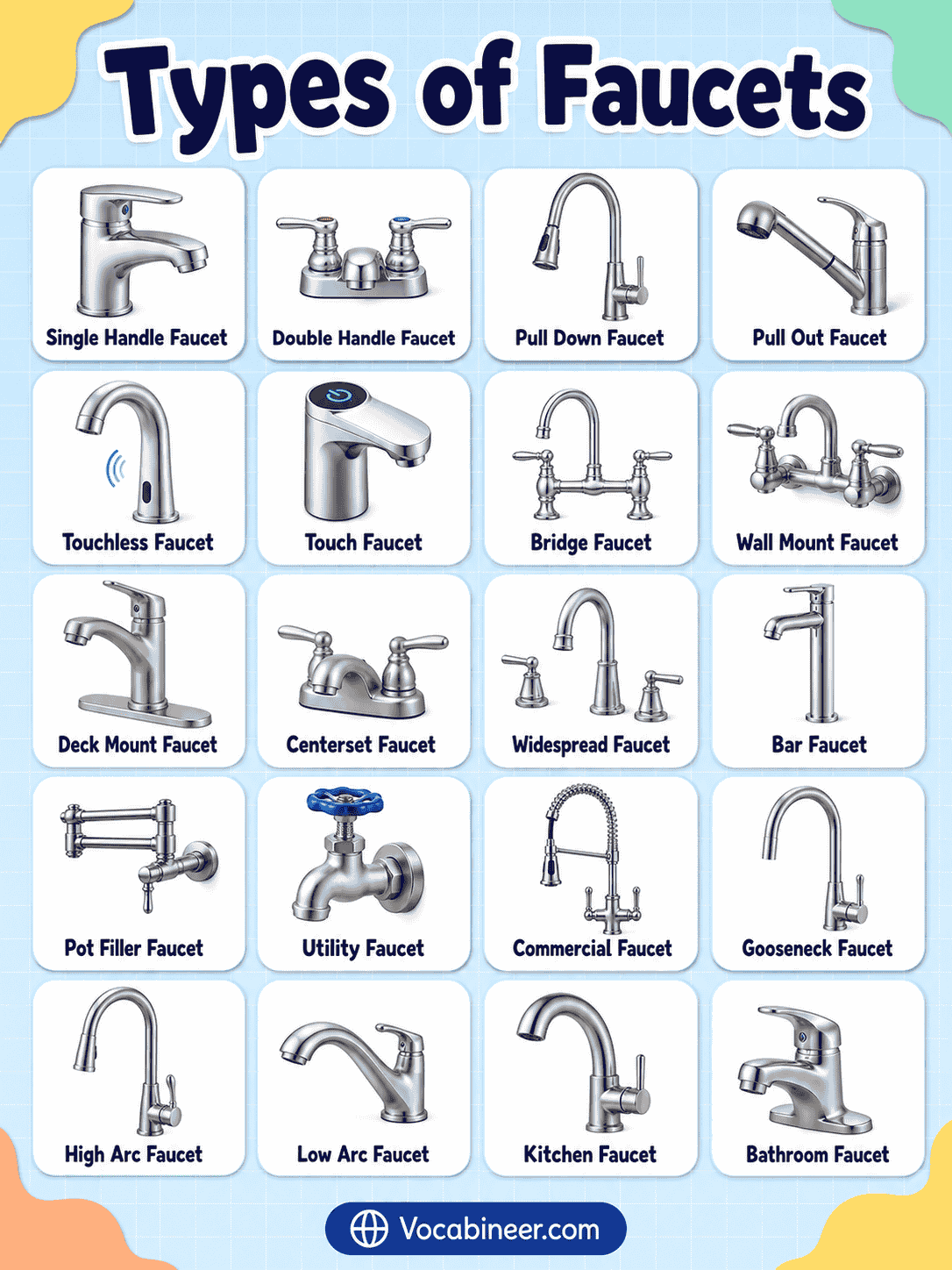
Most Common Faucet Types for Homes
These are the faucet types most people see in homes, kitchens, bathrooms, laundry rooms, and outdoor spaces.
- Kitchen Faucet — a faucet used at a kitchen sink for washing dishes, food, and cookware.
- Bathroom Sink Faucet — a faucet used on a bathroom basin or vanity sink.
- Bathtub Faucet — a faucet used to fill a bathtub.
- Shower Faucet — a faucet or control system used to manage shower water.
- Laundry Sink Faucet — a strong faucet used in laundry rooms or wash areas.
- Utility Sink Faucet — a practical faucet used with deep utility sinks.
- Outdoor Faucet — a faucet installed outside for hoses, gardens, and cleaning.
- Pull-Down Faucet — a kitchen faucet with a spray head that pulls downward.
- Pull-Out Faucet — a faucet with a spray head that pulls outward toward the user.
- Single-Hole Faucet — a faucet installed through one sink or countertop hole.
- Centerset Faucet — a bathroom faucet with handles and spout close together on one base.
- Widespread Faucet — a faucet with separate hot and cold handles spaced apart.
- Wall-Mounted Faucet — a faucet installed on the wall instead of the sink or counter.
- Vessel Sink Faucet — a tall faucet made for above-counter vessel sinks.
- Single-Handle Faucet — a faucet controlled by one handle.
- Two-Handle Faucet — a faucet with separate handles for hot and cold water.
- Touchless Faucet — a faucet that turns on with a motion sensor.
- Touch-Activated Faucet — a faucet that turns on when touched.
- Gooseneck Faucet — a faucet with a tall curved spout.
- High-Arc Faucet — a faucet with a high spout for more sink space.
- Low-Arc Faucet — a faucet with a lower spout for compact sinks.
- Bridge Faucet — a faucet with a raised bridge connecting hot and cold handles.
- Pot Filler Faucet — a wall or stove-area faucet used to fill large pots.
- Waterfall Faucet — a faucet with water flowing in a flat, open stream.
- Compression Faucet — an older faucet type that uses washers to control water.
- Cartridge Faucet — a faucet that uses a cartridge to control water flow.
- Ceramic Disc Faucet — a faucet with ceramic discs for smooth water control.
- Chrome Faucet — a shiny silver faucet finish.
- Matte Black Faucet — a black faucet finish often used in modern bathrooms and kitchens.
- Brushed Nickel Faucet — a soft metallic faucet finish with a brushed look.
Faucet Types with Simple Meanings and Examples
Faucet names are easier to understand when each type is explained with a simple meaning and example.
- Pull-Down Faucet — has a spray head that pulls down into the sink; common in kitchens.
- Pull-Out Faucet — has a spray head that pulls outward; useful for smaller kitchen sinks.
- Bridge Faucet — has a visible bridge between handles and spout; common in farmhouse kitchens.
- Pot Filler Faucet — fills pots near a stove; useful in larger kitchens.
- Bar Faucet — a smaller faucet used at a bar sink or prep sink.
- Pre-Rinse Faucet — has a tall spring-style sprayer; common in commercial-style kitchens.
- Single-Hole Faucet — fits one mounting hole; common for modern bathroom sinks.
- Centerset Faucet — has spout and handles on one compact base; common for small bathroom sinks.
- Widespread Faucet — has separate handles and spout; common for larger bathroom vanities.
- Minispread Faucet — looks like a widespread faucet but fits a smaller space.
- Vessel Faucet — tall faucet used with a bowl-style sink.
- Wall-Mount Faucet — installed on the wall; used for sinks, tubs, or kitchens.
- Roman Tub Faucet — deck-mounted faucet used for bathtubs.
- Freestanding Tub Faucet — floor-mounted faucet used beside freestanding tubs.
- Hose Bib Faucet — outdoor faucet used for attaching a garden hose.
- Frost-Free Faucet — outdoor faucet designed to reduce freezing risk.
- Touchless Faucet — uses a sensor to turn water on and off.
- Metering Faucet — shuts off automatically after a short time.
- Low-Flow Faucet — uses less water than a standard faucet.
- Gooseneck Faucet — has a tall curved neck; useful for deep sinks.
- Waterfall Faucet — creates a flat flowing water stream; often used in bathrooms.
- Compression Faucet — uses a washer and stem; often found in older fixtures.
- Ball Faucet — uses a ball mechanism; often found in older single-handle faucets.
- Cartridge Faucet — uses a replaceable cartridge; common in many modern faucets.
- Ceramic Disc Faucet — uses ceramic discs; known for smooth operation and durability.
Kitchen Faucet Types
Kitchen faucets are designed for cooking, washing dishes, rinsing food, filling pots, and cleaning large items.
Pull-Down Kitchen Faucets
A pull-down kitchen faucet has a spray head that pulls downward from the spout.
- Best for: deep kitchen sinks, rinsing dishes, and washing large cookware.
- Look: tall spout with a hidden pull-down sprayer.
- Main benefit: easy rinsing inside the sink.
- Common example: a high-arc kitchen faucet with a pull-down spray head.
Pull-Out Kitchen Faucets
A pull-out kitchen faucet has a spray head that pulls outward toward the user.
- Best for: smaller sinks, shallow sinks, and flexible rinsing.
- Look: lower or medium-height spout with a pull-out hose.
- Main benefit: easy reach around the sink area.
- Common example: a compact kitchen faucet with a pull-out sprayer.
Bridge Kitchen Faucets
A bridge kitchen faucet has hot and cold handles connected by a raised bridge pipe.
- Best for: farmhouse kitchens, traditional kitchens, and vintage-style sinks.
- Look: classic bridge shape with two handles.
- Main benefit: decorative old-style design.
- Common example: a brass bridge faucet over an apron-front sink.
Pot Filler Faucets
A pot filler faucet is usually installed near a stove or cooktop. It is used to fill large pots without carrying them from the sink.
- Best for: large kitchens, frequent cooking, and heavy pots.
- Look: wall-mounted or foldable arm faucet.
- Main benefit: fills pots near the cooking area.
- Common example: a wall-mounted pot filler above a stove.
Bar and Prep Faucets
Bar and prep faucets are smaller faucets used with secondary sinks.
- Best for: bar sinks, prep sinks, islands, and beverage areas.
- Look: smaller than a main kitchen faucet.
- Main benefit: adds a second washing or prep area.
- Common example: a small faucet on a kitchen island sink.
Pre-Rinse Kitchen Faucets
A pre-rinse faucet has a tall spring-style spray hose. It is inspired by commercial kitchen faucets.
- Best for: heavy dishwashing, large sinks, and modern kitchens.
- Look: tall spring neck with a strong spray head.
- Main benefit: powerful rinsing.
- Common example: a commercial-style kitchen faucet with a coil spring.
Side-Spray Kitchen Faucets
A side-spray faucet has a separate sprayer installed beside the main faucet.
- Best for: older kitchen sinks, two-hole setups, and extra rinsing reach.
- Look: main faucet plus a separate side sprayer.
- Main benefit: extra spray function without changing the main faucet.
- Common example: a kitchen sink with a small pull-out sprayer beside the faucet.
Filtered Water Faucets
A filtered water faucet is connected to a water filtration system.
- Best for: drinking water, cooking water, and filtered kitchen use.
- Look: small separate faucet near the main sink faucet.
- Main benefit: gives filtered water from a separate spout.
- Common example: a small drinking-water faucet beside a kitchen sink.
Bathroom Sink Faucet Types
Bathroom sink faucets are chosen by sink size, hole layout, vanity style, and water flow preference.
Single-Hole Faucets
A single-hole faucet fits through one sink or countertop hole. It usually has one handle.
- Best for: small sinks, modern vanities, and compact bathrooms.
- Look: simple and clean.
- Main benefit: easy installation with one hole.
- Common example: a modern single-handle faucet on a bathroom basin.
Centerset Faucets
A centerset faucet has the spout and handles close together on one base. It usually fits a standard three-hole sink.
- Best for: small bathroom sinks and standard vanity tops.
- Look: compact base with one spout and two handles.
- Main benefit: practical and space-saving.
- Common example: a bathroom faucet with hot and cold handles on one plate.
Widespread Faucets
A widespread faucet has separate hot and cold handles with the spout placed between them.
- Best for: larger bathroom sinks and wider vanity tops.
- Look: elegant and spaced-out.
- Main benefit: flexible spacing and premium appearance.
- Common example: a bathroom vanity faucet with three separate pieces.
Minispread Faucets
A minispread faucet looks like a widespread faucet but fits a smaller sink area.
- Best for: bathrooms that need a stylish look in limited space.
- Look: separate-looking handles with closer spacing.
- Main benefit: widespread style without taking much room.
- Common example: a compact three-piece bathroom faucet.
Vessel Sink Faucets
A vessel sink faucet is taller than a standard bathroom faucet. It is made for above-counter bowl sinks.
- Best for: vessel sinks and modern bathroom vanities.
- Look: tall spout that reaches over the bowl.
- Main benefit: proper height for above-counter sinks.
- Common example: a tall faucet beside a glass vessel sink.
Wall-Mounted Bathroom Faucets
A wall-mounted bathroom faucet is installed on the wall above the sink.
- Best for: vessel sinks, modern bathrooms, and clean countertop designs.
- Look: spout and handles coming from the wall.
- Main benefit: saves counter space.
- Common example: a wall faucet above a rectangular bathroom basin.
Waterfall Bathroom Faucets
A waterfall bathroom faucet lets water flow out in a flat stream.
- Best for: decorative bathroom sinks and modern designs.
- Look: open spout with sheet-like water flow.
- Main benefit: stylish water flow.
- Common example: a glass waterfall faucet on a vanity sink.
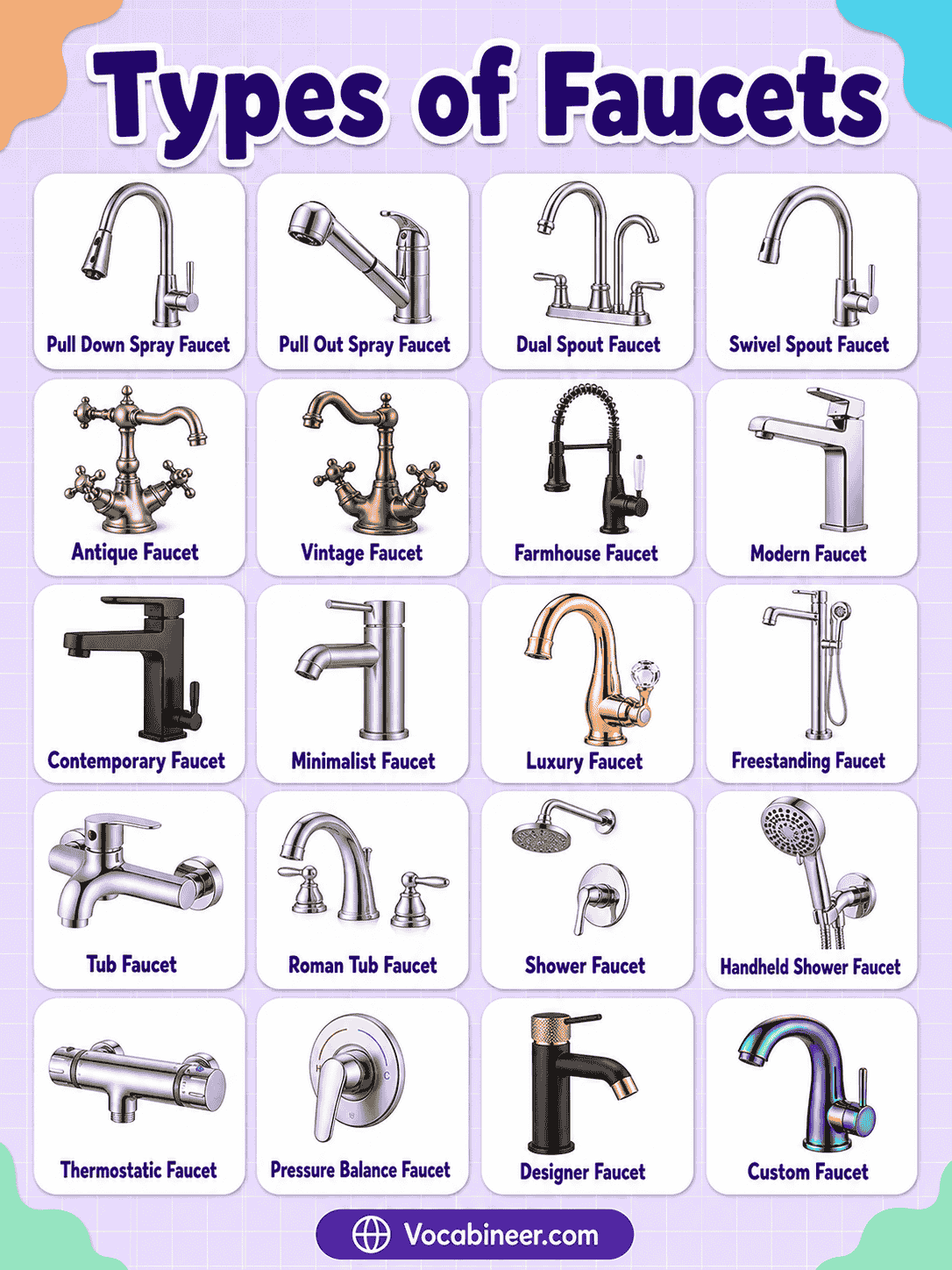
Bathtub and Shower Faucet Types
Tub and shower faucets control water for bathing, showering, filling tubs, and mixing hot and cold water.
Roman Tub Faucets
Roman tub faucets are mounted on the tub deck or surrounding platform.
- Best for: built-in bathtubs and soaking tubs.
- Look: deck-mounted spout with separate handles.
- Main benefit: elegant tub-filling design.
- Common example: a wide tub faucet on a tiled bathtub deck.
Freestanding Tub Faucets
A freestanding tub faucet is mounted on the floor beside a freestanding bathtub.
- Best for: freestanding tubs and luxury bathrooms.
- Look: tall floor-mounted faucet with a tub filler spout.
- Main benefit: works where the tub is away from the wall.
- Common example: a floor faucet next to a standalone bathtub.
Wall-Mounted Tub Faucets
A wall-mounted tub faucet is installed on the wall above a bathtub.
- Best for: alcove tubs, standard bathtubs, and compact bathrooms.
- Look: spout and handles on the wall.
- Main benefit: simple tub filling.
- Common example: a wall tub spout above a bathtub.
Tub and Shower Faucets
A tub and shower faucet controls both the bathtub spout and showerhead.
- Best for: bathtub-shower combinations.
- Look: wall controls with a tub spout and showerhead.
- Main benefit: one setup for bathing and showering.
- Common example: a bathroom with a tub spout, showerhead, and diverter.
Shower Mixer Faucets
A shower mixer faucet mixes hot and cold water for shower use.
- Best for: showers that need one control for temperature.
- Look: single or dual control on the shower wall.
- Main benefit: blends hot and cold water.
- Common example: a shower control that adjusts water temperature.
Thermostatic Shower Faucets
A thermostatic shower faucet helps maintain a steady water temperature.
- Best for: safer showers, family bathrooms, and comfort.
- Look: shower control with temperature setting.
- Main benefit: keeps temperature more stable.
- Common example: a shower valve with a temperature dial.
Pressure-Balancing Shower Faucets
A pressure-balancing faucet helps reduce sudden temperature changes when water pressure changes.
- Best for: showers in busy households.
- Look: standard shower control with pressure-balancing valve inside.
- Main benefit: helps prevent sudden hot or cold changes.
- Common example: a shower valve that reacts when another tap is used.
Laundry, Utility, Commercial, and Outdoor Faucets
These faucets are designed for practical work areas, outdoor water access, heavy use, and cleaning tasks.
Laundry Sink Faucets
Laundry sink faucets are used in laundry rooms for washing clothes, soaking items, and cleaning tools.
- Best for: laundry rooms and wash sinks.
- Look: practical spout with strong handles.
- Main benefit: useful for cleaning and soaking.
- Common example: a faucet over a deep laundry sink.
Utility Sink Faucets
Utility sink faucets are made for deep sinks in garages, workshops, basements, and cleaning areas.
- Best for: heavy cleaning, buckets, tools, and messy tasks.
- Look: simple, strong, and practical.
- Main benefit: handles tough cleaning jobs.
- Common example: a faucet over a deep utility sink.
Outdoor Faucets
Outdoor faucets are installed outside a house or building.
- Best for: gardens, hoses, washing cars, and outdoor cleaning.
- Look: simple wall-mounted spout.
- Main benefit: provides water outside.
- Common example: a faucet on an exterior wall.
Hose Bib Faucets
A hose bib faucet is an outdoor faucet designed for connecting a hose.
- Best for: watering gardens, washing outdoor areas, and filling buckets.
- Look: short outdoor spout with threaded end.
- Main benefit: connects easily to a garden hose.
- Common example: a hose faucet beside a backyard wall.
Frost-Free Faucets
A frost-free faucet is designed to reduce freezing risk in cold weather.
- Best for: outdoor areas in colder climates.
- Look: outdoor faucet with longer internal shutoff design.
- Main benefit: helps protect against freezing.
- Common example: an exterior wall faucet used in winter-prone regions.
Commercial Faucets
Commercial faucets are built for frequent use in restaurants, public bathrooms, shops, schools, and workplaces.
- Best for: high-use sinks and public or business spaces.
- Look: durable and practical.
- Main benefit: handles repeated use.
- Common example: a heavy-duty faucet in a restaurant kitchen.
Faucet Installation Styles
Installation style tells where and how the faucet is mounted.
Deck-Mounted Faucets
A deck-mounted faucet is installed on the sink deck or countertop.
- Best for: kitchen sinks, bathroom sinks, and standard installations.
- Main requirement: holes in the sink or counter.
- Common example: a bathroom faucet mounted on the vanity top.
Wall-Mounted Faucets
A wall-mounted faucet is installed on the wall instead of the sink or counter.
- Best for: vessel sinks, modern bathrooms, tubs, and some kitchens.
- Main requirement: plumbing inside the wall.
- Common example: a faucet coming from the wall above a sink.
Floor-Mounted Faucets
A floor-mounted faucet rises from the floor.
- Best for: freestanding bathtubs.
- Main requirement: floor plumbing near the tub.
- Common example: a tall tub filler beside a freestanding bath.
Sink-Mounted Faucets
A sink-mounted faucet is installed directly through holes in the sink.
- Best for: standard kitchen and bathroom sinks.
- Main requirement: matching faucet holes.
- Common example: a centerset faucet mounted on a bathroom sink.
Countertop Faucets
A countertop faucet is installed through the counter behind or beside a sink.
- Best for: vessel sinks and modern vanity counters.
- Main requirement: counter hole and correct faucet height.
- Common example: a tall faucet beside a bowl sink.
Single-Hole Faucets
A single-hole faucet needs only one hole for installation.
- Best for: compact sinks and modern designs.
- Main requirement: one mounting hole.
- Common example: a single-handle bathroom faucet.
Three-Hole Faucets
A three-hole faucet setup uses three holes for the spout and two handles, or for a faucet with extra features.
- Best for: centerset, widespread, and some kitchen faucet setups.
- Main requirement: three matching sink or counter holes.
- Common example: a widespread bathroom faucet with separate handles.
Faucet Handle Styles
Handle style affects how a faucet looks and how the water is controlled.
Single-Handle Faucets
A single-handle faucet uses one handle to control water flow and temperature.
- Best for: kitchens, bathrooms, and simple operation.
- Main benefit: easy one-hand control.
- Common example: a modern kitchen faucet with one side handle.
Two-Handle Faucets
A two-handle faucet has separate hot and cold handles.
- Best for: traditional bathrooms, kitchens, and precise control.
- Main benefit: separate hot and cold adjustment.
- Common example: a bathroom faucet with two handles.
Cross-Handle Faucets
Cross-handle faucets have handles shaped like crosses.
- Best for: vintage, classic, and farmhouse designs.
- Main benefit: decorative traditional look.
- Common example: a bridge kitchen faucet with cross handles.
Lever-Handle Faucets
Lever-handle faucets use lever-style handles that are easy to move.
- Best for: kitchens, bathrooms, and accessible designs.
- Main benefit: easy grip and movement.
- Common example: a bathroom faucet with two lever handles.
Knob-Handle Faucets
Knob-handle faucets use round or shaped knobs to control water.
- Best for: older fixtures and simple designs.
- Main benefit: familiar basic control.
- Common example: a utility sink faucet with round knobs.
Joystick Faucets
Joystick faucets use a small stick-like control that moves in different directions.
- Best for: modern sinks and compact designs.
- Main benefit: smooth control in a small form.
- Common example: a modern basin faucet with a slim joystick handle.
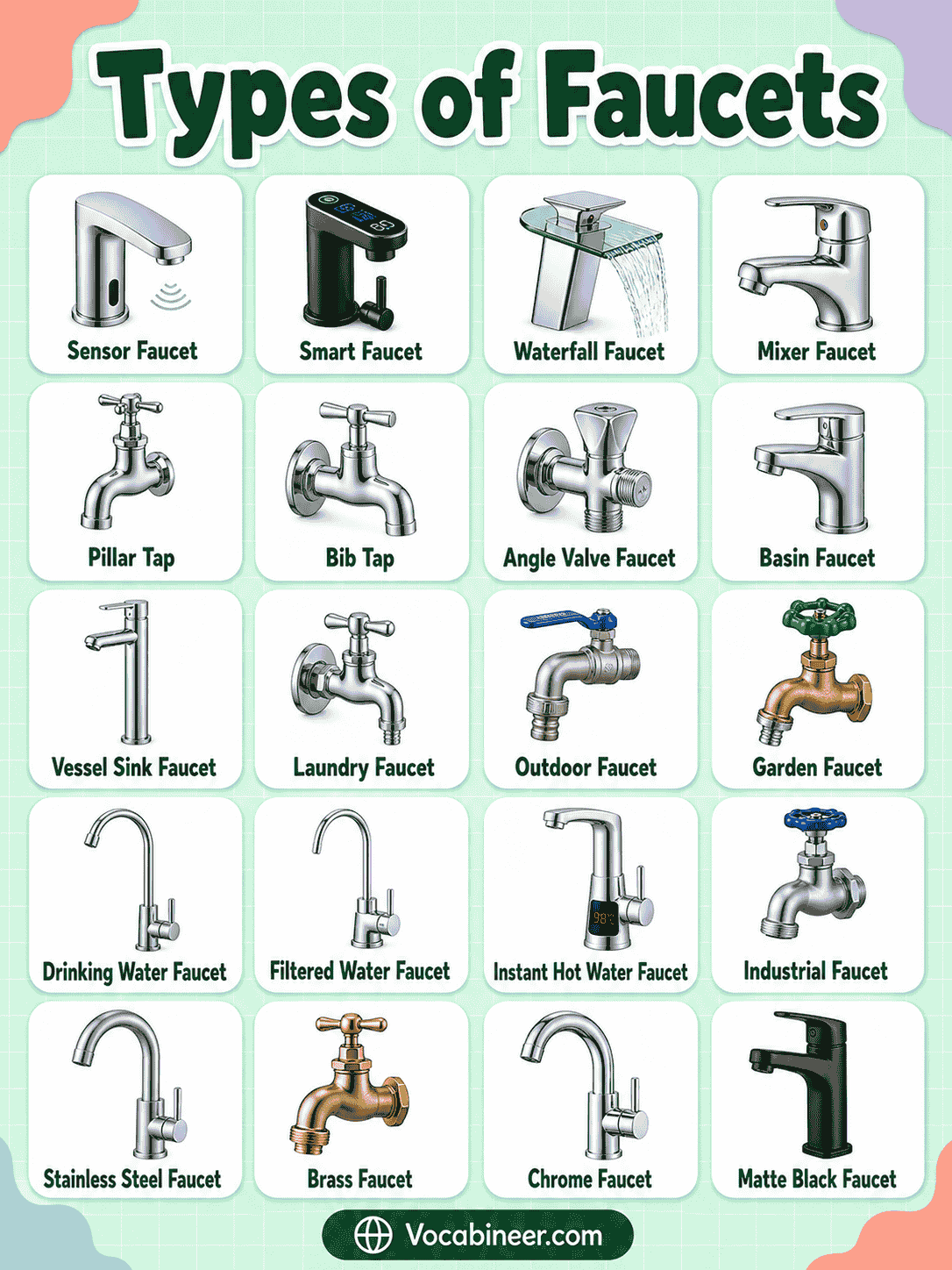
Smart and Water-Saving Faucets
Smart and water-saving faucets help reduce water waste, improve hygiene, or make the faucet easier to use.
Touchless Faucets
A touchless faucet uses a motion sensor to turn water on and off.
- Best for: kitchens, public bathrooms, and hygiene-focused spaces.
- Main benefit: hands-free use.
- Common example: a sensor faucet in a bathroom or kitchen.
Touch-Activated Faucets
A touch-activated faucet turns on when the user touches part of the faucet.
- Best for: kitchens and busy sinks.
- Main benefit: easy use when hands are messy.
- Common example: a kitchen faucet that starts with a tap of the hand.
Sensor Faucets
Sensor faucets use electronic sensors to detect movement.
- Best for: public bathrooms, offices, restaurants, and homes.
- Main benefit: water turns off automatically.
- Common example: a public restroom faucet that runs when hands are nearby.
Metering Faucets
A metering faucet releases water for a set time and then shuts off.
- Best for: public bathrooms, schools, and commercial spaces.
- Main benefit: helps reduce water waste.
- Common example: a push-button faucet that stops by itself.
Low-Flow Faucets
A low-flow faucet uses less water than a standard faucet.
- Best for: water-saving homes and eco-friendly bathrooms.
- Main benefit: reduces water use.
- Common example: a bathroom faucet with a low-flow aerator.
Filtered Water Faucets
A filtered water faucet connects to a filtration system and provides cleaner drinking water.
- Best for: kitchens, drinking water stations, and beverage areas.
- Main benefit: separate filtered water supply.
- Common example: a small filtered water faucet beside the main kitchen faucet.
Faucet Spout Styles
Spout style affects water direction, sink clearance, and appearance.
Gooseneck Faucets
A gooseneck faucet has a tall curved spout shaped like a goose’s neck.
- Best for: deep kitchen sinks and vessel sinks.
- Main benefit: extra clearance under the spout.
- Common example: a tall curved kitchen faucet.
High-Arc Faucets
A high-arc faucet has a tall spout with a high curve.
- Best for: washing large pots and filling tall containers.
- Main benefit: more working space in the sink.
- Common example: a high-arc kitchen faucet.
Low-Arc Faucets
A low-arc faucet has a shorter spout.
- Best for: small sinks, shallow sinks, and tight spaces.
- Main benefit: compact design.
- Common example: a low bathroom faucet under a mirror cabinet.
Straight Spout Faucets
A straight spout faucet has a simple straight outlet.
- Best for: modern sinks, utility sinks, and simple bathrooms.
- Main benefit: clean and direct water flow.
- Common example: a straight bathroom basin faucet.
Swivel Spout Faucets
A swivel spout faucet can turn from side to side.
- Best for: double sinks and kitchen sinks.
- Main benefit: directs water to different sink areas.
- Common example: a kitchen faucet that rotates between two basins.
Spring Spout Faucets
A spring spout faucet has a visible spring around the spray hose.
- Best for: commercial-style kitchens and heavy rinsing.
- Main benefit: flexible spray movement.
- Common example: a pre-rinse kitchen faucet with a spring neck.
Waterfall Spout Faucets
A waterfall spout faucet releases water in a wide, open stream.
- Best for: decorative bathroom sinks and modern vanities.
- Main benefit: stylish water flow.
- Common example: a flat-spout waterfall faucet.
Faucet Valve Types
Valve type explains how the faucet controls water inside.
Compression Faucets
Compression faucets use washers that press down to stop water flow.
- Best for: older homes, utility sinks, and traditional fixtures.
- Main feature: handles usually turn several times.
- Common issue: washers can wear out and cause dripping.
Ball Faucets
Ball faucets use a rotating ball inside the faucet body to control water.
- Best for: older single-handle faucets.
- Main feature: one handle moves over a rounded cap.
- Common issue: internal parts may wear over time.
Cartridge Faucets
Cartridge faucets use a cartridge to control water flow and temperature.
- Best for: many modern bathroom and kitchen faucets.
- Main feature: smooth handle movement.
- Common benefit: cartridges can often be replaced.
Ceramic Disc Faucets
Ceramic disc faucets use two ceramic discs to control water.
- Best for: modern faucets and long-lasting performance.
- Main feature: smooth and precise control.
- Common benefit: durable and less prone to leaks.
Mixer Faucets
Mixer faucets mix hot and cold water before it leaves the spout.
- Best for: bathrooms, kitchens, showers, and modern sinks.
- Main feature: blends water temperature.
- Common example: a single-handle sink faucet that controls hot and cold water together.
Faucet Finish and Material Types
Faucet finish and material affect appearance, cleaning, durability, and how well the faucet matches other fixtures.
Chrome Faucets
Chrome faucets have a shiny silver finish.
- Best for: bathrooms, kitchens, and budget-friendly designs.
- Look: bright, reflective, and clean.
- Main benefit: common and easy to match.
Stainless Steel Faucets
Stainless steel faucets have a silver metal look and are popular in kitchens.
- Best for: kitchen sinks and modern homes.
- Look: smooth metallic finish.
- Main benefit: durable and practical.
Brushed Nickel Faucets
Brushed nickel faucets have a soft silver finish with a brushed texture.
- Best for: bathrooms, kitchens, and warm modern interiors.
- Look: muted silver with less shine.
- Main benefit: hides fingerprints better than shiny finishes.
Matte Black Faucets
Matte black faucets have a flat black finish.
- Best for: modern bathrooms, kitchens, and bold contrast designs.
- Look: clean, dark, and stylish.
- Main benefit: strong modern appearance.
Brass Faucets
Brass faucets may be made from brass material or have a brass finish.
- Best for: classic, vintage, and warm interior styles.
- Look: golden yellow or warm metallic.
- Main benefit: traditional and decorative look.
Bronze Faucets
Bronze faucets have a darker warm metal finish.
- Best for: rustic, traditional, and farmhouse spaces.
- Look: brown, dark gold, or aged metal.
- Main benefit: warm and classic style.
Copper Faucets
Copper faucets have a reddish-brown metal appearance.
- Best for: rustic kitchens, farmhouse bathrooms, and decorative sinks.
- Look: warm copper tone.
- Main benefit: unique natural color.
Gold Faucets
Gold faucets have a gold-colored finish.
- Best for: luxury bathrooms, glam kitchens, and decorative vanities.
- Look: polished or brushed gold.
- Main benefit: premium appearance.
Polished Nickel Faucets
Polished nickel faucets have a shiny warm silver finish.
- Best for: traditional and luxury bathrooms.
- Look: reflective with a warmer tone than chrome.
- Main benefit: elegant classic finish.
Oil-Rubbed Bronze Faucets
Oil-rubbed bronze faucets have a dark bronze finish with an aged look.
- Best for: rustic, vintage, and traditional designs.
- Look: dark brown or black-bronze.
- Main benefit: antique-style appearance.
Faucet Parts You Should Know
These faucet parts help explain how faucets are installed, used, and repaired.
- Spout — the part where water comes out.
- Handle — the part used to turn water on, off, or adjust temperature.
- Aerator — a small screen at the spout tip that mixes air with water.
- Cartridge — an internal part that controls water flow and temperature.
- Valve — the part that opens, closes, or directs water.
- Deck Plate — a plate used to cover extra sink holes.
- Escutcheon — a decorative plate around a faucet or pipe opening.
- Sprayer — a spray head used for rinsing.
- Hose — a flexible tube used with pull-down or pull-out faucets.
- Mounting Hole — a hole in the sink, counter, wall, or tub deck for faucet installation.
- Water Supply Line — a pipe or tube that brings water to the faucet.
- Flow Rate — the amount of water a faucet releases.
- Mixer — a part or faucet style that blends hot and cold water.
- Drain Assembly — parts that connect the sink drain.
- Pop-Up Drain — a drain stopper controlled by a lever or push system.
Confusing Faucet Terms Explained
Some faucet terms sound similar, but they have different meanings.
| Term | Simple Difference |
|---|---|
| Faucet vs Tap | Faucet is common in American English, while tap is common in British English and many other regions. Both can mean a fixture that controls water flow. |
| Faucet vs Spigot | Faucet is often used for indoor sink fixtures. Spigot is often used for outdoor or simple water outlets. |
| Single-Hole vs Centerset Faucet | A single-hole faucet uses one mounting hole. A centerset faucet usually fits three holes but has the spout and handles on one compact base. |
| Widespread vs Minispread Faucet | A widespread faucet has more space between the handles and spout. A minispread faucet has a similar look but fits a smaller area. |
| Pull-Down vs Pull-Out Faucet | A pull-down faucet pulls the spray head downward into the sink. A pull-out faucet pulls the spray head outward toward the user. |
| Touchless vs Touch-Activated Faucet | A touchless faucet uses a motion sensor. A touch-activated faucet turns on when the user touches the faucet body or handle. |
| Deck-Mount vs Wall-Mount Faucet | A deck-mount faucet is installed on the sink or counter. A wall-mount faucet is installed on the wall. |
| Vessel Faucet vs Tall Faucet | A vessel faucet is a tall faucet made for above-counter vessel sinks. A tall faucet may be used for other sink styles too. |
| Cartridge vs Ceramic Disc Faucet | A cartridge faucet uses a replaceable cartridge. A ceramic disc faucet uses ceramic discs to control water flow. |
| Single-Handle vs Mixer Faucet | A single-handle faucet uses one handle. A mixer faucet blends hot and cold water before it leaves the spout. |
| Chrome vs Stainless Steel Faucet | Chrome is usually a shiny finish. Stainless steel can be a material or finish with a softer metallic look. |
| Pot Filler vs Wall-Mount Faucet | A pot filler is a faucet used to fill pots near a stove. A wall-mount faucet is any faucet installed on a wall. |
Types of Faucets Chart with Pictures
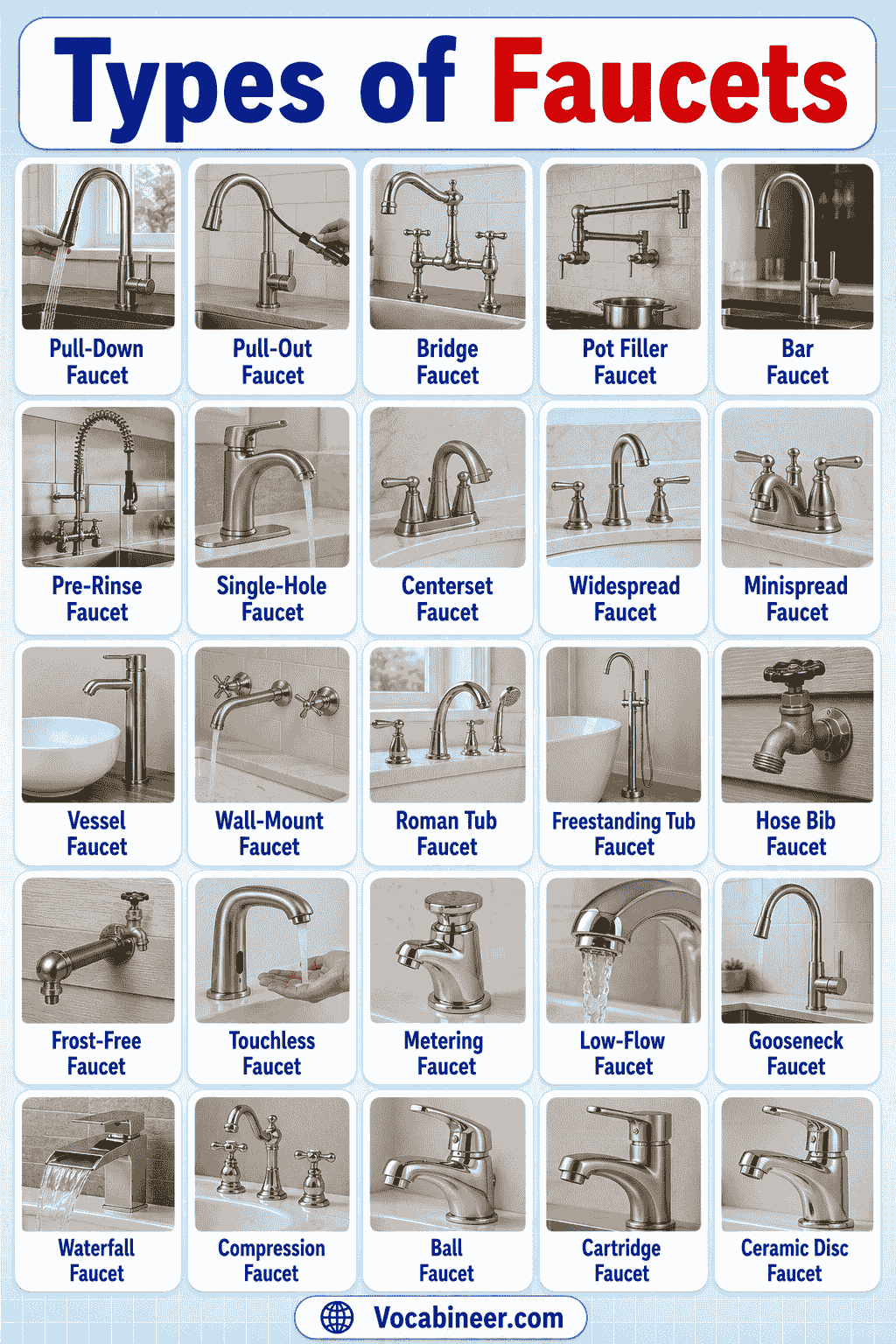
A faucet chart helps compare the main faucet groups, best uses, and examples in one place.
| Faucet Group | Details |
|---|---|
| Kitchen Faucets | Best for: cooking, rinsing, dishwashing, and food prep Examples: pull-down faucets, pull-out faucets, bridge faucets, pot fillers |
| Bathroom Sink Faucets | Best for: bathroom basins, vanity sinks, and handwashing Examples: single-hole faucets, centerset faucets, widespread faucets, vessel faucets |
| Tub and Shower Faucets | Best for: bathing, showering, and tub filling Examples: Roman tub faucets, freestanding tub faucets, shower mixer faucets |
| Utility and Outdoor Faucets | Best for: laundry, cleaning, gardens, hoses, and work areas Examples: laundry faucets, utility faucets, hose bib faucets, frost-free faucets |
| Installation Styles | Best for: matching sink, wall, counter, or tub setup Examples: deck-mounted, wall-mounted, floor-mounted, single-hole |
| Handle Styles | Best for: water control and appearance Examples: single-handle, two-handle, cross-handle, lever-handle |
| Spout Styles | Best for: sink clearance and water direction Examples: gooseneck, high-arc, low-arc, waterfall, swivel |
| Valve Types | Best for: understanding how faucets work inside Examples: compression, ball, cartridge, ceramic disc |
| Finish Types | Best for: matching bathroom and kitchen design Examples: chrome, stainless steel, brushed nickel, matte black, brass |
How to Choose a Faucet for Your Sink, Tub, or Shower
Choose a faucet by checking where it will be installed first. Kitchen sinks often work well with pull-down, pull-out, bridge, pre-rinse, or filtered water faucets, while bathroom sinks may need single-hole, centerset, widespread, vessel, or wall-mounted faucets.
The sink holes, counter space, wall plumbing, and fixture height also matter. A vessel sink usually needs a tall faucet, a freestanding tub needs a floor-mounted tub faucet, and a compact vanity may need a single-hole or centerset faucet. Finish, handle style, water-saving features, and valve type should match the room design and daily use.
FAQs
The main types of faucets include kitchen faucets, bathroom sink faucets, bathtub faucets, shower faucets, laundry faucets, outdoor faucets, single-hole faucets, centerset faucets, widespread faucets, pull-down faucets, pull-out faucets, wall-mounted faucets, and touchless faucets.
Pull-down faucets and pull-out faucets are popular for kitchen sinks because they make rinsing dishes, washing food, and cleaning the sink easier. Bridge faucets, pre-rinse faucets, pot fillers, and filtered water faucets are also useful for specific kitchen needs.
Single-hole faucets are good for small modern sinks, centerset faucets work well for compact vanity tops, and widespread faucets are best for larger bathroom sinks. Vessel sinks usually need taller vessel faucets.
A centerset faucet has the spout and handles close together on one base. A widespread faucet has separate handles and a separate spout, usually spaced farther apart.
Faucet and tap can both mean a fixture that controls water flow. Faucet is more common in American English, while tap is more common in British English and many other regions.
Read More
- Bedroom Decor Items
- Popular Types of Tiles
- Parts of a House Names
- Different Types of Tables
- Different Types of Drawers