

Driveways come in many styles, from simple gravel driveways and concrete driveways to decorative paver driveways, circular driveways, grass driveways, and modern resin driveways. Each type has a different look, cost, strength, drainage quality, and maintenance need.
Some driveways are best for daily home use, while others work better for long entrances, sloped areas, heavy vehicles, farms, or decorative curb appeal. This guide explains the main types of driveways with simple meanings, examples, best uses, surface materials, layout styles, drainage options, parts, and confusing terms.
In This Page
Common Types of Driveways
These are some of the most common driveway types used for homes, garages, farms, commercial spaces, and outdoor entrances.
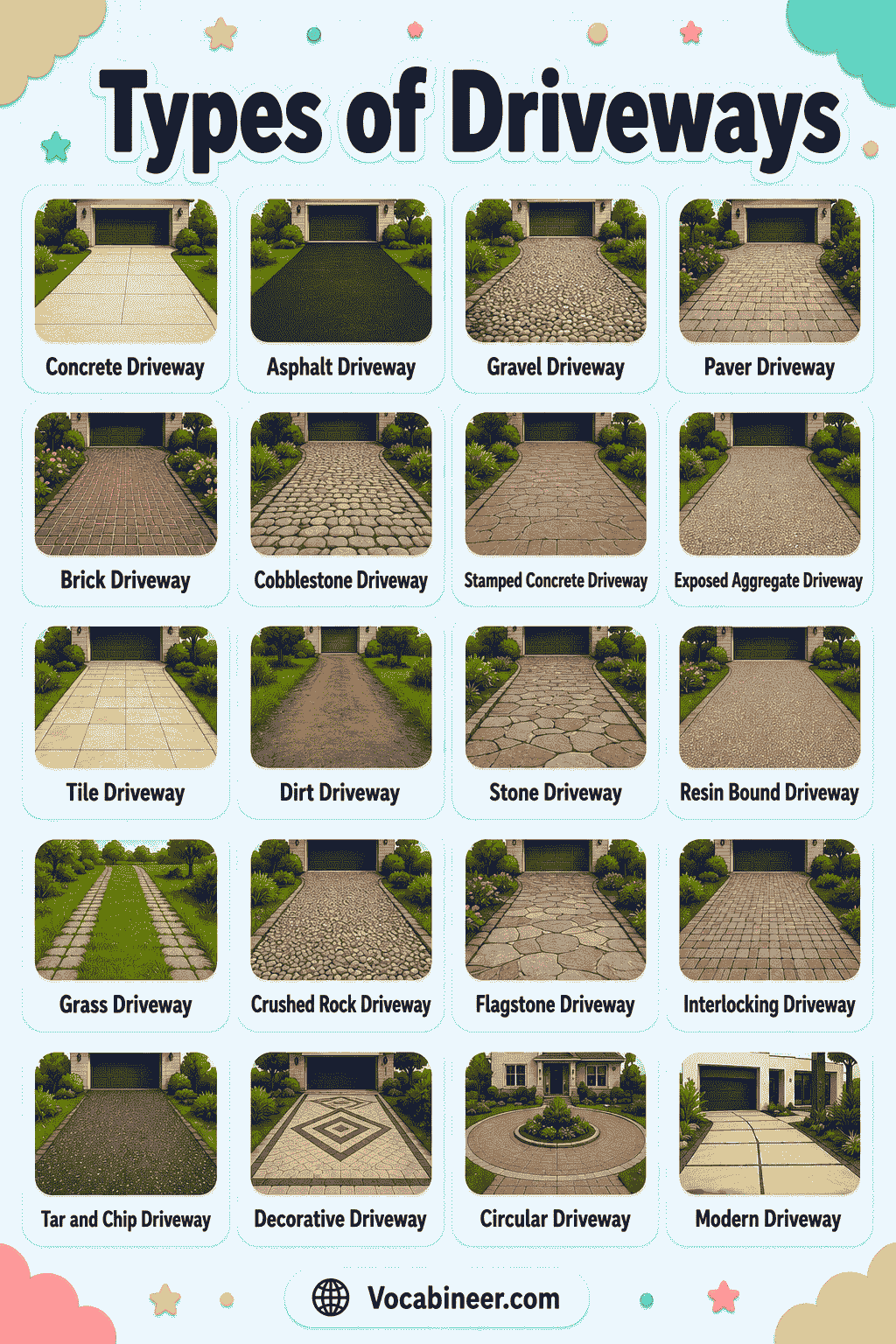
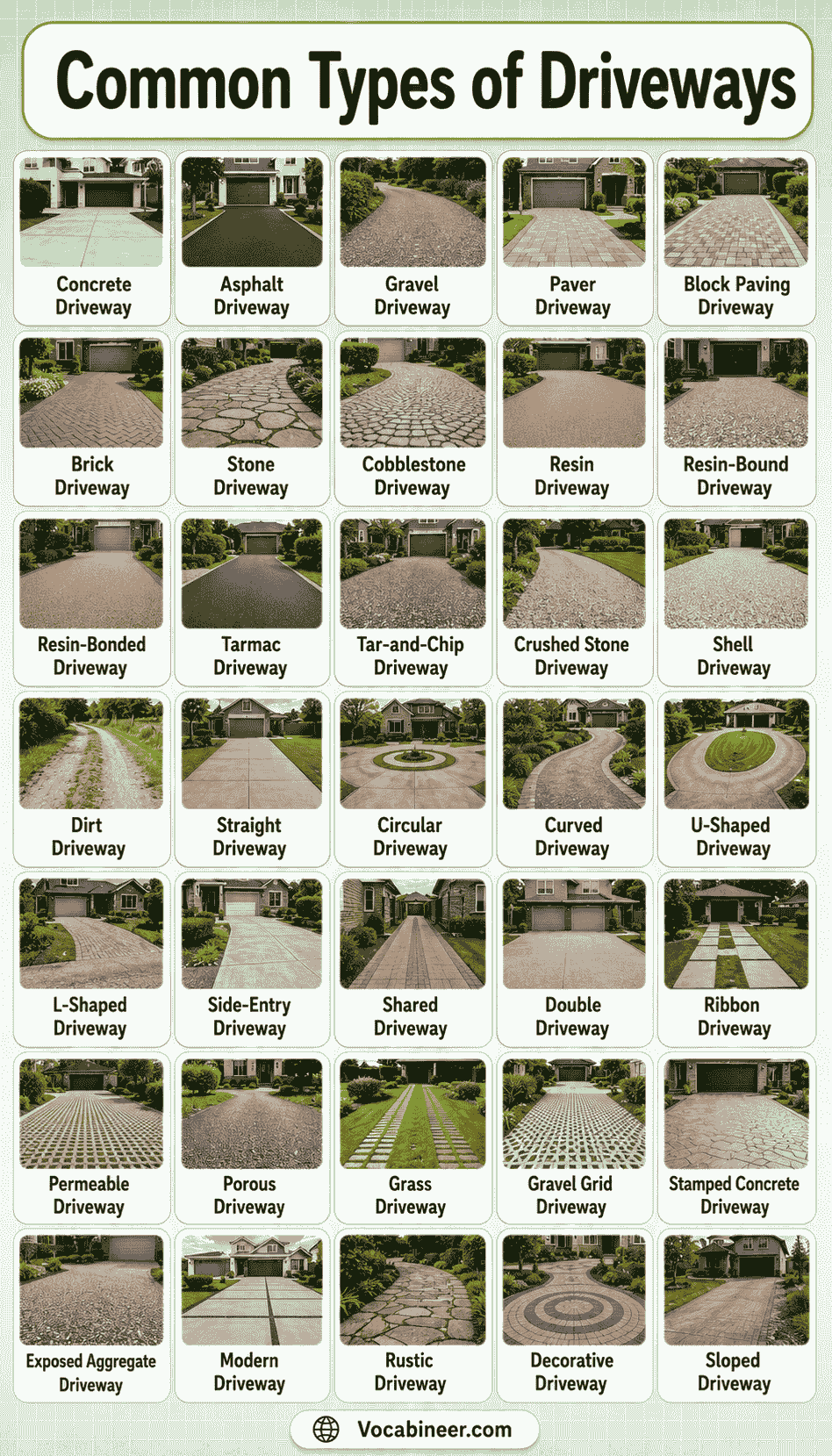
- Concrete Driveway — a strong driveway made with poured concrete.
- Asphalt Driveway — a dark, smooth driveway surface made with asphalt mix.
- Gravel Driveway — a driveway covered with loose gravel stones.
- Paver Driveway — a driveway made with individual paving blocks or slabs.
- Block Paving Driveway — a driveway made with small blocks laid in patterns.
- Brick Driveway — a driveway made with brick pavers.
- Stone Driveway — a driveway made with natural stone pieces or slabs.
- Cobblestone Driveway — a driveway made with rounded or shaped stones.
- Resin Driveway — a driveway made with resin and decorative stones.
- Resin-Bound Driveway — a resin driveway where stones are mixed with resin before laying.
- Resin-Bonded Driveway — a resin driveway where loose stones are scattered onto a resin layer.
- Tarmac Driveway — a dark road-like driveway surface, especially used as a common term in some regions.
- Tar-and-Chip Driveway — a driveway made with hot liquid asphalt and stone chips.
- Crushed Stone Driveway — a driveway made with crushed rock pieces.
- Shell Driveway — a driveway made with crushed shells.
- Dirt Driveway — a simple driveway made from compacted soil.
- Straight Driveway — a driveway that runs directly from the road to the house or garage.
- Circular Driveway — a driveway that curves around and returns to the road.
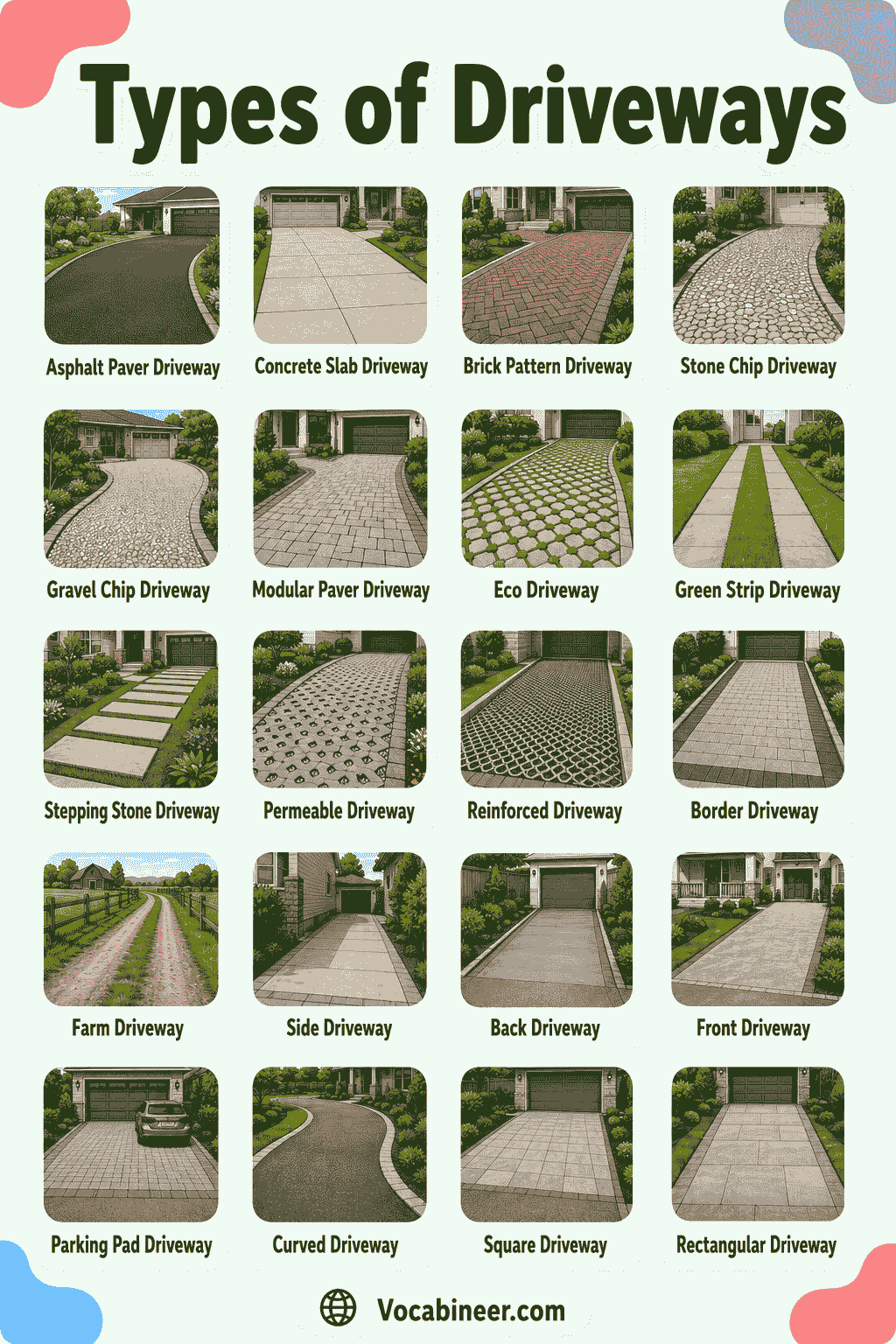
- Curved Driveway — a driveway with a smooth curved path.
- U-Shaped Driveway — a driveway with two entrances shaped like a U.
- L-Shaped Driveway — a driveway with a turn shaped like the letter L.
- Side-Entry Driveway — a driveway that leads to a garage from the side.
- Shared Driveway — a driveway used by more than one home or property.
- Double Driveway — a wide driveway made for two cars side by side.
- Ribbon Driveway — a driveway with two paved tracks and grass or gravel between them.
- Permeable Driveway — a driveway that allows water to pass through or between materials.
- Porous Driveway — a driveway surface that lets water soak through the material.
- Grass Driveway — a driveway made with grass and support grids.
- Gravel Grid Driveway — a gravel driveway supported by grid panels.
- Stamped Concrete Driveway — a concrete driveway stamped with patterns.
- Exposed Aggregate Driveway — a concrete driveway with small stones visible on the surface.
- Modern Driveway — a clean driveway style with simple lines and neat materials.
- Rustic Driveway — a natural-looking driveway often made with gravel, stone, or brick.
- Decorative Driveway — a driveway designed for appearance and curb appeal.
- Sloped Driveway — a driveway built on an inclined surface.
Driveway Types with Meanings and Examples
Driveway names become easier to understand when each type has a short meaning and example.
- Concrete Driveway — a durable driveway made from poured concrete; common for homes and garages.
- Asphalt Driveway — a smooth black driveway surface; common in cold-weather areas and long driveways.
- Gravel Driveway — a loose stone driveway; common for rural homes, farms, and budget-friendly entrances.
- Paver Driveway — a driveway made from individual paving pieces; common for decorative home entrances.
- Block Paving Driveway — a patterned driveway made from paving blocks; common for neat residential designs.
- Brick Driveway — a driveway made with brick pavers; common for classic and traditional homes.
- Stone Driveway — a driveway made with natural stone; common for premium or rustic properties.
- Cobblestone Driveway — a driveway made with small stone blocks; common for historic or luxury looks.
- Resin Driveway — a driveway made with resin and small stones; common for smooth decorative surfaces.
- Resin-Bound Driveway — a permeable resin driveway with stones mixed into resin before installation.
- Resin-Bonded Driveway — a resin driveway with stones spread over a resin-coated surface.
- Tarmac Driveway — a dark road-like driveway surface; common as a regional term for similar driveway surfacing.
- Tar-and-Chip Driveway — a textured driveway made with asphalt and stone chips; common for long rural drives.
- Crushed Stone Driveway — a driveway made with crushed rock; common for farms and large outdoor areas.
- Shell Driveway — a driveway made from crushed shells; common in coastal areas.
- Dirt Driveway — a basic driveway made from compacted earth; common in rural or temporary areas.
- Straight Driveway — a direct driveway path; common for homes close to the road.
- Circular Driveway — a loop-style driveway; common for large front yards and easy vehicle flow.
- Curved Driveway — a driveway with a bend; common for landscaped homes.
- U-Shaped Driveway — a driveway with two road connections; common for larger properties.
- L-Shaped Driveway — a driveway with a turn; common where the garage is not directly in front.
- Side-Entry Driveway — a driveway leading to a garage from the side; common for better curb appeal.
- Shared Driveway — a driveway used by multiple homes; common in tight residential areas.
- Double Driveway — a wide driveway for two vehicles; common for family homes.
- Ribbon Driveway — two paved strips for car tires; common for traditional or garden-style driveways.
- Permeable Driveway — a driveway system that helps water drain into the ground.
- Grass Driveway — a green driveway with grass and support grids; common for eco-friendly homes.
- Sloped Driveway — a driveway built on a slope; common for hillside homes.
- Decorative Driveway — a driveway made to improve the front look of a property.
Types of Driveway and Best Uses
Different driveways are chosen for different budgets, weather conditions, looks, and property needs.
- Concrete driveways are best for strong, long-lasting home driveways.
- Asphalt driveways are best for smooth surfaces, long driveways, and colder climates.
- Gravel driveways are best for budget-friendly homes, rural properties, and long entrances.
- Paver driveways are best for decorative designs and strong curb appeal.
- Block paving driveways are best for patterned residential driveways.
- Brick driveways are best for classic homes and traditional exterior styles.
- Stone driveways are best for luxury, rustic, or natural-looking entrances.
- Cobblestone driveways are best for historic, premium, and decorative designs.
- Resin-bound driveways are best for smooth surfaces with good drainage.
- Resin-bonded driveways are best for a textured stone look.
- Tar-and-chip driveways are best for long country driveways.
- Crushed stone driveways are best for farms, wide areas, and drainage.
- Shell driveways are best for coastal homes and decorative natural surfaces.
- Circular driveways are best for large front yards and easy entry and exit.
- U-shaped driveways are best for properties that need two access points.
- Side-entry driveways are best for homes where the garage is placed to the side.
- Double driveways are best for homes with two cars or more parking space.
- Permeable driveways are best for drainage, stormwater control, and eco-friendly design.
- Grass driveways are best for green spaces and low-traffic areas.
- Sloped driveways are best for hillside homes when built with proper drainage and grip.
Driveway Types by Surface Material
Surface material is the most important driveway choice because it affects cost, strength, drainage, maintenance, and appearance.
Concrete Driveways
A concrete driveway is made from poured concrete. It is strong, smooth, and common for residential properties.
- Best for: homes, garages, parking areas, and modern driveways.
- Look: clean, solid, and simple.
- Maintenance: needs occasional cleaning and crack repair.
- Main benefit: durable and long-lasting.
- Common example: a plain gray driveway leading to a garage.
Asphalt Driveways
An asphalt driveway has a dark, smooth surface made from asphalt mix. It is commonly used for roads and driveways.
- Best for: long driveways, colder climates, and smooth vehicle access.
- Look: black, neat, and road-like.
- Maintenance: may need sealing over time.
- Main benefit: smooth surface and quick installation.
- Common example: a black driveway in front of a suburban home.
Gravel Driveways
A gravel driveway is made with loose gravel spread over a prepared base. It is one of the most affordable driveway types.
- Best for: rural homes, farms, long driveways, and budget projects.
- Look: natural, loose, and textured.
- Maintenance: needs raking, refilling, and weed control.
- Main benefit: low cost and good drainage.
- Common example: a long country driveway with small loose stones.
Paver Driveways
A paver driveway is made with individual paving stones, concrete pavers, or slabs. Pavers can be arranged in many patterns.
- Best for: decorative homes, strong curb appeal, and custom designs.
- Look: patterned, neat, and stylish.
- Maintenance: may need weed control and joint sand replacement.
- Main benefit: attractive and repairable.
- Common example: a driveway with interlocking paving stones.
Block Paving Driveways
A block paving driveway is made with small paving blocks placed in a pattern. It is especially popular for residential driveways.
- Best for: homes, front yards, decorative entrances, and patterned surfaces.
- Look: neat blocks in patterns such as herringbone or basketweave.
- Maintenance: needs joint cleaning and weed control.
- Main benefit: strong design choice with many color options.
- Common example: a patterned driveway made with rectangular paving blocks.
Brick Driveways
A brick driveway uses brick pavers to create a classic surface. It gives a traditional and warm appearance.
- Best for: traditional homes, cottage-style houses, and decorative entrances.
- Look: classic, warm, and patterned.
- Maintenance: may need cleaning and occasional brick replacement.
- Main benefit: timeless appearance.
- Common example: a red brick driveway with a patterned layout.
Stone Driveways
A stone driveway uses natural stone pieces, slabs, or setts. It often has a premium or rustic look.
- Best for: luxury homes, countryside properties, and natural landscapes.
- Look: natural, textured, and high-end.
- Maintenance: depends on stone type and joint material.
- Main benefit: strong visual appeal.
- Common example: a natural stone driveway leading to a large home.
Cobblestone Driveways
A cobblestone driveway is made with small rounded or shaped stones. It is often used for historic or decorative designs.
- Best for: historic homes, luxury entrances, and traditional streetscapes.
- Look: old-world, textured, and decorative.
- Maintenance: may need joint repair and cleaning.
- Main benefit: strong character and long life.
- Common example: a cobbled driveway in front of a classic house.
Resin Driveways
A resin driveway uses resin with small stones to create a decorative surface. It may be resin-bound or resin-bonded.
- Best for: modern homes, decorative surfaces, and smooth finishes.
- Look: neat, colorful, and stone-textured.
- Maintenance: needs regular cleaning.
- Main benefit: attractive finish with many color choices.
- Common example: a smooth stone-look driveway with resin coating.
Resin-Bound Driveways
A resin-bound driveway is made by mixing stones with resin before laying the surface. It often allows water to drain through when installed over a suitable base.
- Best for: modern homes, drainage-friendly surfaces, and smooth walking areas.
- Look: smooth, seamless, and decorative.
- Maintenance: low to moderate cleaning.
- Main benefit: attractive surface with good drainage potential.
- Common example: a smooth golden gravel-look driveway.
Resin-Bonded Driveways
A resin-bonded driveway is made by applying resin to a base and scattering stones over the top. It gives a textured surface.
- Best for: decorative stone finishes and improved surface grip.
- Look: textured, natural, and stone-coated.
- Maintenance: loose stones may appear over time.
- Main benefit: gives the look of loose gravel with a fixed surface.
- Common example: a textured driveway with stone chips bonded on top.
Tarmac Driveways
A tarmac driveway is a dark road-like surface often used for driveways and outdoor access areas. In some regions, the word tarmac is also used generally for similar dark surfacing.
- Best for: simple home driveways, long entrances, and practical surfaces.
- Look: dark, smooth, and plain.
- Maintenance: may need patching or resurfacing over time.
- Main benefit: practical and familiar.
- Common example: a dark driveway leading from the street to a garage.
Tar-and-Chip Driveways
A tar-and-chip driveway is made by spreading hot liquid asphalt and covering it with stone chips.
- Best for: long driveways, rural homes, and textured surfaces.
- Look: natural, rough, and stone-like.
- Maintenance: may need additional stone chips later.
- Main benefit: more textured than asphalt.
- Common example: a country driveway with a rough stone-chip finish.
Crushed Stone Driveways
A crushed stone driveway uses crushed rock pieces instead of rounded gravel. It creates a firmer surface than some loose gravel options.
- Best for: rural properties, farms, large driveways, and drainage.
- Look: angular, natural, and textured.
- Maintenance: needs leveling and occasional refilling.
- Main benefit: good drainage and solid base feel.
- Common example: a driveway made with crushed limestone or granite.
Shell Driveways
A shell driveway is made with crushed shells. It is often used in coastal areas because of its light color and natural look.
- Best for: beach homes, coastal properties, and decorative natural driveways.
- Look: light, coastal, and textured.
- Maintenance: needs refilling and leveling over time.
- Main benefit: unique natural appearance.
- Common example: a white shell driveway near a coastal home.
Dirt Driveways
A dirt driveway is made from compacted soil. It is one of the simplest driveway types.
- Best for: rural areas, temporary access, farms, and low-budget use.
- Look: plain, natural, and unfinished.
- Maintenance: can become muddy, dusty, or uneven.
- Main benefit: very low cost.
- Common example: an unpaved driveway on a farm or rural property.
Driveway Types by Layout and Shape
A Driveway layout affects vehicle movement, parking space, safety, and curb appeal.
Straight Driveways
A straight driveway runs directly from the road to the garage, house, or parking area.
- Best for: small front yards, simple homes, and direct access.
- Main benefit: easy to design and build.
- Example: a straight concrete driveway from the street to a garage.
Circular Driveways
A circular driveway loops around and returns to the road. It allows cars to enter and exit without reversing.
- Best for: large front yards, big homes, and formal entrances.
- Main benefit: smooth traffic flow.
- Example: a circular paver driveway around a front garden.
Curved Driveways
A curved driveway follows a bend instead of a straight line. It can make a property entrance look softer and more decorative.
- Best for: landscaped homes, long entrances, and large lots.
- Main benefit: attractive flow and flexible design.
- Example: a curved gravel driveway through a garden.
U-Shaped Driveways
A U-shaped driveway has two road connections and a curved or angled center section.
- Best for: large properties and homes with enough front space.
- Main benefit: easy entry and exit.
- Example: a U-shaped driveway in front of a large house.
L-Shaped Driveways
An L-shaped driveway has a straight path with a turn, forming an L shape.
- Best for: side garages, corner lots, and homes with offset parking areas.
- Main benefit: works well when the garage is not directly facing the road.
- Example: a driveway that turns left toward a side garage.
Side-Entry Driveways
A side-entry driveway leads vehicles to a garage from the side of the house.
- Best for: homes where the garage door is not the main front feature.
- Main benefit: improves front curb appeal.
- Example: a driveway that turns to a side-facing garage.
Shared Driveways
A shared driveway is used by two or more homes or properties.
- Best for: narrow lots, multi-home properties, and tight spaces.
- Main benefit: saves land and access space.
- Example: one driveway serving two neighboring homes.
Double Driveways
A double driveway is wide enough for two vehicles side by side.
- Best for: family homes, two-car garages, and extra parking.
- Main benefit: more parking space.
- Example: a wide concrete driveway in front of a double garage.
Ribbon Driveways
A ribbon driveway has two paved strips for vehicle tires, with grass, gravel, or soil between them.
- Best for: traditional homes, garden-style entrances, and lower-cost paving.
- Main benefit: uses less paving material.
- Example: two concrete strips with grass in the middle.
Driveway Types by Drainage and Eco-Friendly Design
Drainage-friendly driveways help reduce puddles, runoff, flooding, and surface water problems.
Permeable Driveways
A permeable driveway allows water to pass through or between materials into the ground below.
- Best for: drainage control, eco-friendly homes, and rainy areas.
- Common materials: permeable pavers, gravel grids, resin-bound surfaces, and grass grids.
- Main benefit: helps reduce water runoff.
Porous Driveways
A porous driveway has a surface material that lets water pass through the material itself.
- Best for: areas needing direct water absorption.
- Common materials: porous asphalt, porous concrete, and some resin-bound systems.
- Main benefit: surface-level drainage.
Grass Driveways
A grass driveway uses grass supported by grid panels or reinforced systems.
- Best for: green spaces, eco-friendly designs, and low-traffic parking.
- Look: natural and grassy.
- Main benefit: blends with lawns and supports drainage.
Gravel Grid Driveways
A gravel grid driveway uses plastic or concrete grids to hold gravel in place.
- Best for: gravel driveways, parking areas, sloped sections, and drainage.
- Look: neat gravel surface with less movement.
- Main benefit: reduces gravel spreading and improves stability.
Permeable Paver Driveways
A permeable paver driveway uses pavers with gaps that allow water to drain through.
- Best for: decorative driveways with drainage needs.
- Look: patterned and neat.
- Main benefit: combines style with water control.
Resin-Bound Driveways
A resin-bound driveway can be part of an eco-friendly drainage design because water may pass through the surface when installed correctly.
- Best for: smooth modern driveways with drainage.
- Look: seamless and decorative.
- Main benefit: attractive surface with permeability.
Concrete Grid Driveways
A concrete grid driveway uses concrete blocks or grid sections with open spaces for grass, gravel, or soil.
- Best for: parking areas, green driveways, and erosion control.
- Look: grid-patterned surface.
- Main benefit: strong surface with drainage gaps.
Green Driveways
A green driveway is a broad term for an eco-friendly driveway that supports drainage, reduces runoff, or includes plants.
- Best for: sustainable homes and natural landscapes.
- Common examples: grass driveways, permeable pavers, gravel grids, and concrete grids.
- Main benefit: better water management and natural appearance.
Driveway Types by Finish and Style
Finish and style affect how a driveway looks, even when the material is the same.
Stamped Concrete Driveways
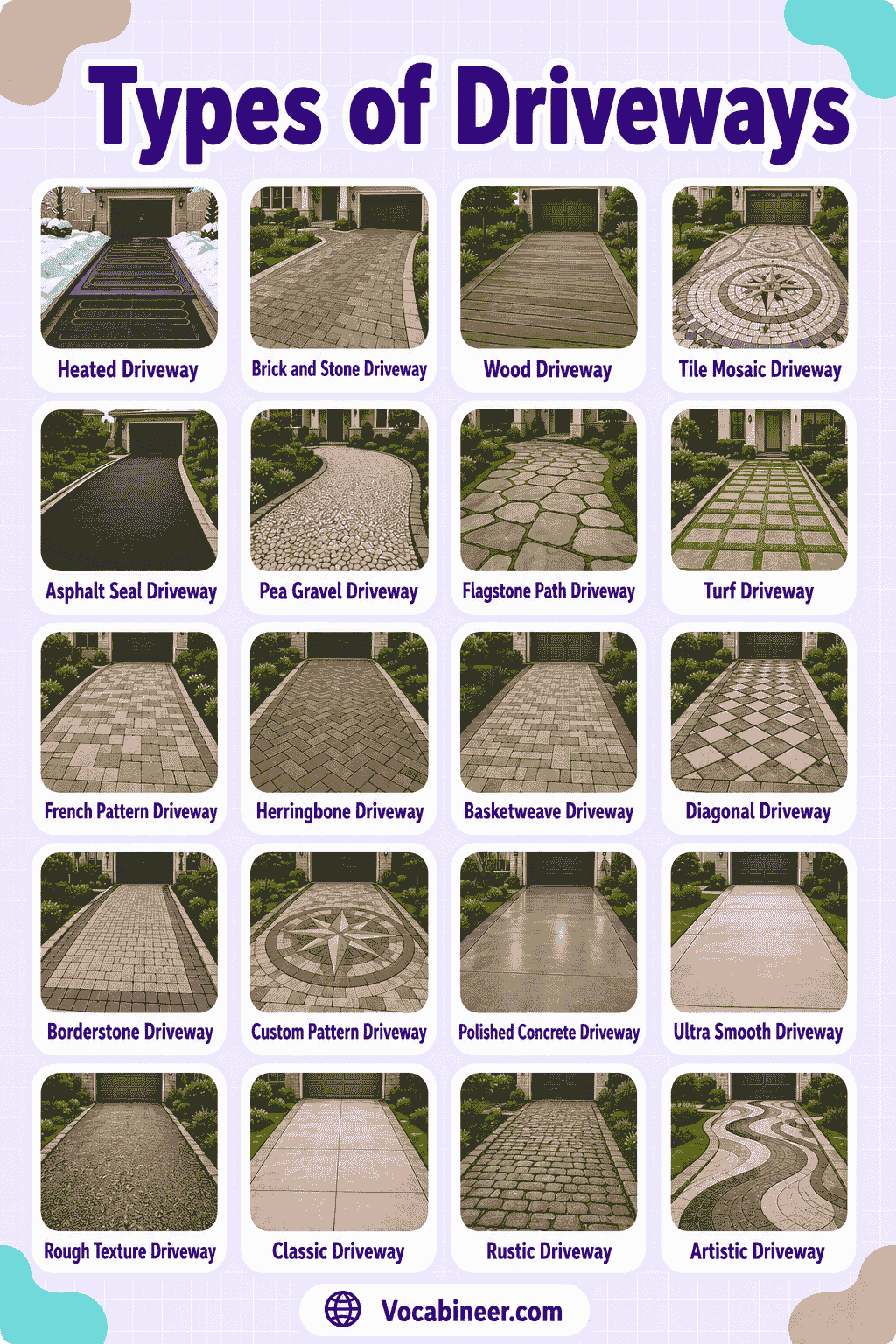
A stamped concrete driveway is concrete pressed with patterns before it fully hardens.
- Best for: decorative homes and custom exterior designs.
- Look: can copy stone, brick, tile, or paver patterns.
- Main benefit: decorative finish with concrete strength.
Exposed Aggregate Driveways
An exposed aggregate driveway is concrete with small stones visible on the surface.
- Best for: textured driveways, slip resistance, and decorative concrete.
- Look: speckled, stone-like, and textured.
- Main benefit: strong surface with visual interest.
Brushed Concrete Driveways
A brushed concrete driveway has a surface brushed with a broom or tool to add texture.
- Best for: simple concrete driveways and better grip.
- Look: plain concrete with fine lines.
- Main benefit: affordable texture and slip resistance.
Colored Concrete Driveways
A colored concrete driveway uses pigment or stain to change the concrete color.
- Best for: homes that need a warmer or more decorative concrete look.
- Look: gray, tan, brown, red, charcoal, or custom shades.
- Main benefit: color options without changing the main material.
Patterned Driveways
A patterned driveway uses shapes, lines, blocks, or repeated designs to improve appearance.
- Best for: decorative home entrances and curb appeal.
- Common materials: pavers, bricks, stamped concrete, and stone.
- Main benefit: more visual detail than plain surfaces.
Modern Driveways
A modern driveway has a clean, simple, and stylish design.
- Best for: modern homes, minimalist exteriors, and neat front yards.
- Common materials: concrete, large pavers, resin, stone, and gravel grids.
- Main benefit: clean curb appeal.
Rustic Driveways
A rustic driveway has a natural, countryside, or weathered look.
- Best for: cottages, farms, cabins, and natural landscapes.
- Common materials: gravel, crushed stone, brick, cobblestone, and wood edging.
- Main benefit: natural charm.
Decorative Driveways
A decorative driveway is designed to improve the look of the property entrance.
- Best for: curb appeal, premium homes, and front-yard design.
- Common materials: pavers, stamped concrete, exposed aggregate, stone, and resin.
- Main benefit: attractive appearance.
Driveway Types by Property and Use
Driveways can also be grouped by where they are used and what kind of traffic they handle.
Residential Driveways
Residential driveways are built for homes and daily family use.
- Best for: cars, small vans, garages, and home parking.
- Common materials: concrete, asphalt, gravel, pavers, and resin.
- Main feature: practical access with curb appeal.
Commercial Driveways
Commercial driveways are used for businesses, shops, offices, and service areas.
- Best for: higher traffic, delivery vehicles, and customer access.
- Common materials: asphalt, concrete, pavers, and heavy-duty surfaces.
- Main feature: strength and frequent-use durability.
Farm Driveways
Farm driveways are used on rural land and agricultural properties.
- Best for: tractors, trucks, farm vehicles, and long entrances.
- Common materials: gravel, crushed stone, dirt, and tar-and-chip.
- Main feature: practical access over large outdoor areas.
Garage Driveways
Garage driveways lead directly to a garage.
- Best for: home parking and daily vehicle storage.
- Common layouts: straight, side-entry, double, L-shaped, and sloped.
- Main feature: easy access to garage doors.
Long Driveways
Long driveways cover a longer distance from the road to the property.
- Best for: rural homes, estates, farms, and large lots.
- Common materials: gravel, asphalt, tar-and-chip, and crushed stone.
- Main feature: cost and maintenance matter more because of length.
Short Driveways
Short driveways are compact driveways near the road.
- Best for: small homes, townhouses, garages, and limited front yards.
- Common materials: concrete, pavers, asphalt, and brick.
- Main feature: simple access and efficient use of space.
Sloped Driveways
Sloped driveways are built on inclined land.
- Best for: hillside homes and properties above or below road level.
- Common materials: concrete, asphalt, pavers, and textured surfaces.
- Main feature: good grip, drainage, and safe slope design.
Heavy-Duty Driveways
Heavy-duty driveways are built for heavier vehicles or frequent use.
- Best for: trucks, vans, commercial spaces, farms, and workshops.
- Common materials: reinforced concrete, asphalt, crushed stone, and pavers.
- Main feature: stronger base and load support.
Driveway Parts and Basic Terms
These driveway terms help explain how driveways are built and maintained.
- Driveway Surface — the top layer that vehicles drive on.
- Driveway Base — the support layer under the surface.
- Sub-Base — the deeper foundation layer below the base.
- Driveway Apron — the section where the driveway meets the road.
- Driveway Edging — the border that holds the driveway edges in place.
- Driveway Border — a visible edge or decorative boundary around the driveway.
- Drainage Channel — a channel that helps carry water away.
- Curb Cut — the lowered curb section where vehicles enter the driveway.
- Slope — the incline or angle of the driveway.
- Sealcoat — a protective layer used on some asphalt driveways.
- Joint — a gap or line that helps control cracking or movement.
- Paver Sand — sand used between paving blocks.
- Gravel Grid — a grid system used to hold gravel in place.
- Driveway Foundation — the prepared ground and support layers under the driveway.
- Runoff — rainwater that flows over the driveway surface.
Confusing Driveway Terms Explained
Some driveway terms sound similar, but they have different meanings.
| Term | Simple Difference |
|---|---|
| Asphalt vs Tarmac | Asphalt is a common driveway surface made with bitumen and aggregates. Tarmac is often used as a general term for dark road-like surfacing, especially in some regions. |
| Concrete vs Cement Driveway | Concrete is the finished driveway material. Cement is one ingredient used to make concrete. |
| Paver Driveway vs Brick Driveway | A paver driveway can use concrete, stone, or brick pavers. A brick driveway specifically uses brick pavers. |
| Paver Driveway vs Block Paving Driveway | A paver driveway is a broad term for surfaces made with paving units. Block paving usually means small blocks arranged in patterns. |
| Gravel vs Crushed Stone Driveway | Gravel can be rounded or mixed stones. Crushed stone is made from broken rock with sharper edges. |
| Resin-Bound vs Resin-Bonded Driveway | Resin-bound driveways mix stones with resin before laying. Resin-bonded driveways scatter stones over a resin-coated surface. |
| Permeable vs Porous Driveway | A permeable driveway lets water pass through or between the system. A porous driveway lets water pass through the surface material itself. |
| Tar-and-Chip vs Asphalt Driveway | Tar-and-chip has stone chips pressed into a binder for a textured surface. Asphalt is smoother and more road-like. |
| Cobblestone vs Stone Driveway | Cobblestone uses small rounded or shaped stones. Stone driveways can use many natural stone types, slabs, or pieces. |
| Driveway Apron vs Driveway Entrance | The driveway apron is the section near the road. The driveway entrance is the general access point into the driveway. |
| Driveway Edging vs Driveway Border | Edging helps hold the driveway sides in place. A border can be structural, decorative, or both. |
Types of Driveways Chart with Pictures
A driveway chart helps compare the main driveway groups, best uses, and examples in one place.
| Driveway Group | Details |
|---|---|
| Surface Material Driveways | Best for: choosing the main driveway surface Examples: concrete driveways, asphalt driveways, gravel driveways, paver driveways |
| Layout and Shape Driveways | Best for: planning traffic flow and property access Examples: straight driveways, circular driveways, U-shaped driveways |
| Drainage and Eco-Friendly Driveways | Best for: reducing water runoff and improving drainage Examples: permeable driveways, grass driveways, gravel grid driveways |
| Finish and Style Driveways | Best for: improving curb appeal Examples: stamped concrete driveways, exposed aggregate driveways, decorative driveways |
| Property and Use Driveways | Best for: matching driveway strength to property needs Examples: residential driveways, commercial driveways, farm driveways |
| Budget Driveways | Best for: lower-cost projects Examples: gravel driveways, dirt driveways, crushed stone driveways |
| Premium Driveways | Best for: decorative or luxury entrances Examples: cobblestone driveways, stone driveways, paver driveways |
| Heavy-Use Driveways | Best for: frequent traffic or heavier vehicles Examples: asphalt driveways, reinforced concrete driveways, heavy-duty driveways |
How to Choose the Right Type of Driveway
Choose a driveway based on your budget, property size, weather, drainage needs, vehicle weight, and preferred appearance. Gravel and crushed stone are often useful for long or rural driveways, while concrete, asphalt, pavers, and resin surfaces are common for homes and garages.
Drainage and maintenance are also important. Permeable pavers, grass grids, gravel grids, and resin-bound driveways can help manage water better than fully sealed surfaces. Decorative options such as stamped concrete, exposed aggregate, brick, stone, and block paving can improve curb appeal when appearance is a major goal.
FAQs
The main types of driveways include concrete driveways, asphalt driveways, gravel driveways, paver driveways, block paving driveways, brick driveways, stone driveways, resin driveways, tarmac driveways, and tar-and-chip driveways.
Gravel and dirt driveways are usually among the cheapest driveway types. Gravel is more practical than dirt because it drains better and creates a more usable surface.
Paver, concrete, stone, and cobblestone driveways can last a long time when installed on a strong base and maintained properly. Asphalt can also last well, but it usually needs sealing and resurfacing sooner than stone or paver options.
Asphalt is a common driveway surface made with bitumen and aggregates. Tarmac is often used as a general term for dark road-like surfacing, especially in some regions.
Permeable driveways, gravel driveways, gravel grid driveways, grass driveways, permeable paver driveways, and resin-bound driveways are good drainage-friendly options.
Read More
- Bedroom Decor Items
- Popular Types of Tiles
- Parts of a House Names
- Different Types of Tables
- Different Types of Drawers