

Clocks are time-telling devices used in homes, schools, offices, stations, shops, hotels, and public places. Some clocks hang on walls, while others sit on tables, stand on floors, ring alarms, show digital numbers, or work with special mechanisms.
In this guide, you will learn different types of clocks with names, simple meanings, best uses, placement types, decorative clock styles, display and mechanism types, functional clocks, room-based clocks, confusing clock terms, and picture chart ideas.
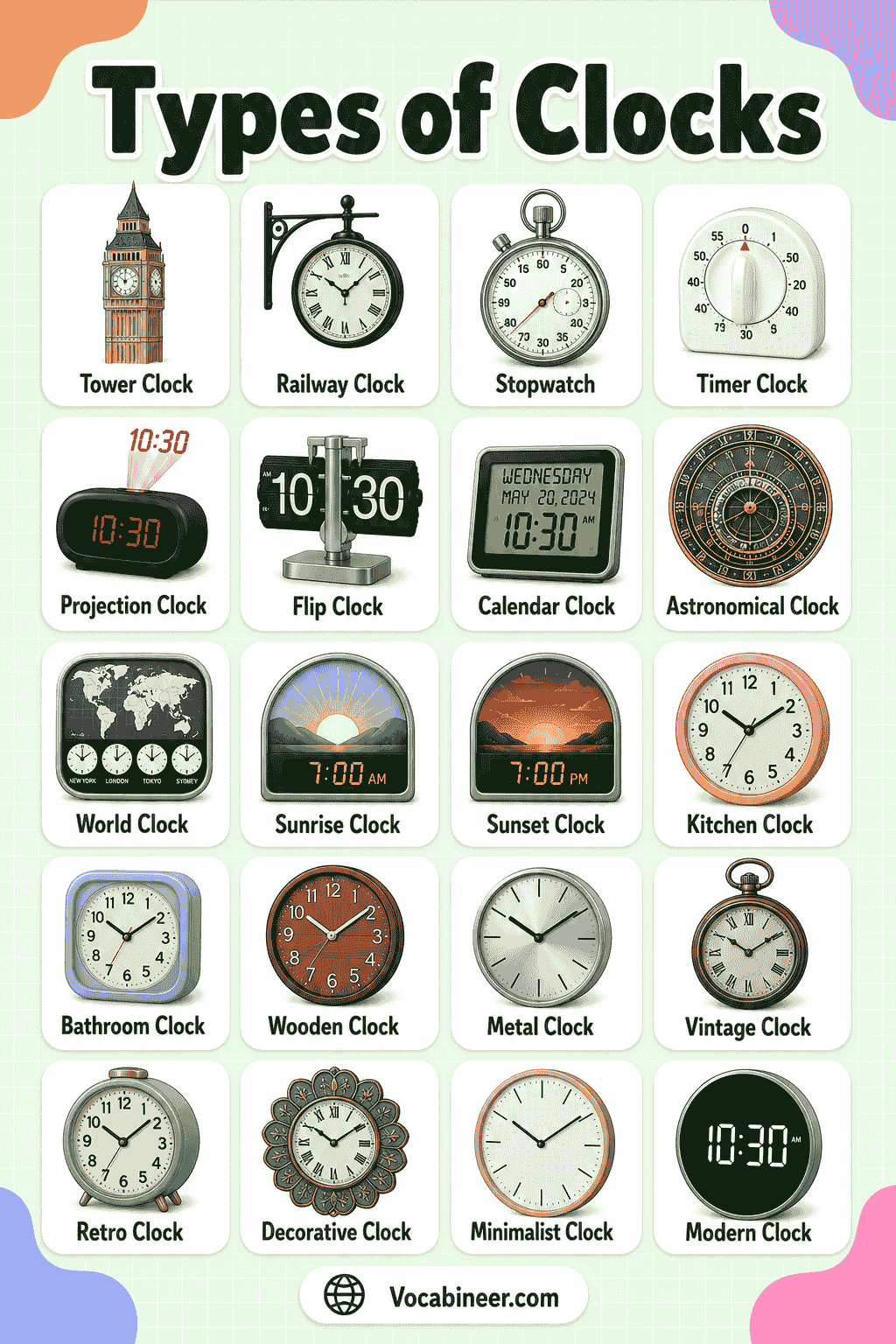
In This Page
Common Types of Clocks
These are the clock types people commonly use for time-telling, decoration, alarms, classrooms, offices, travel, and home interiors.
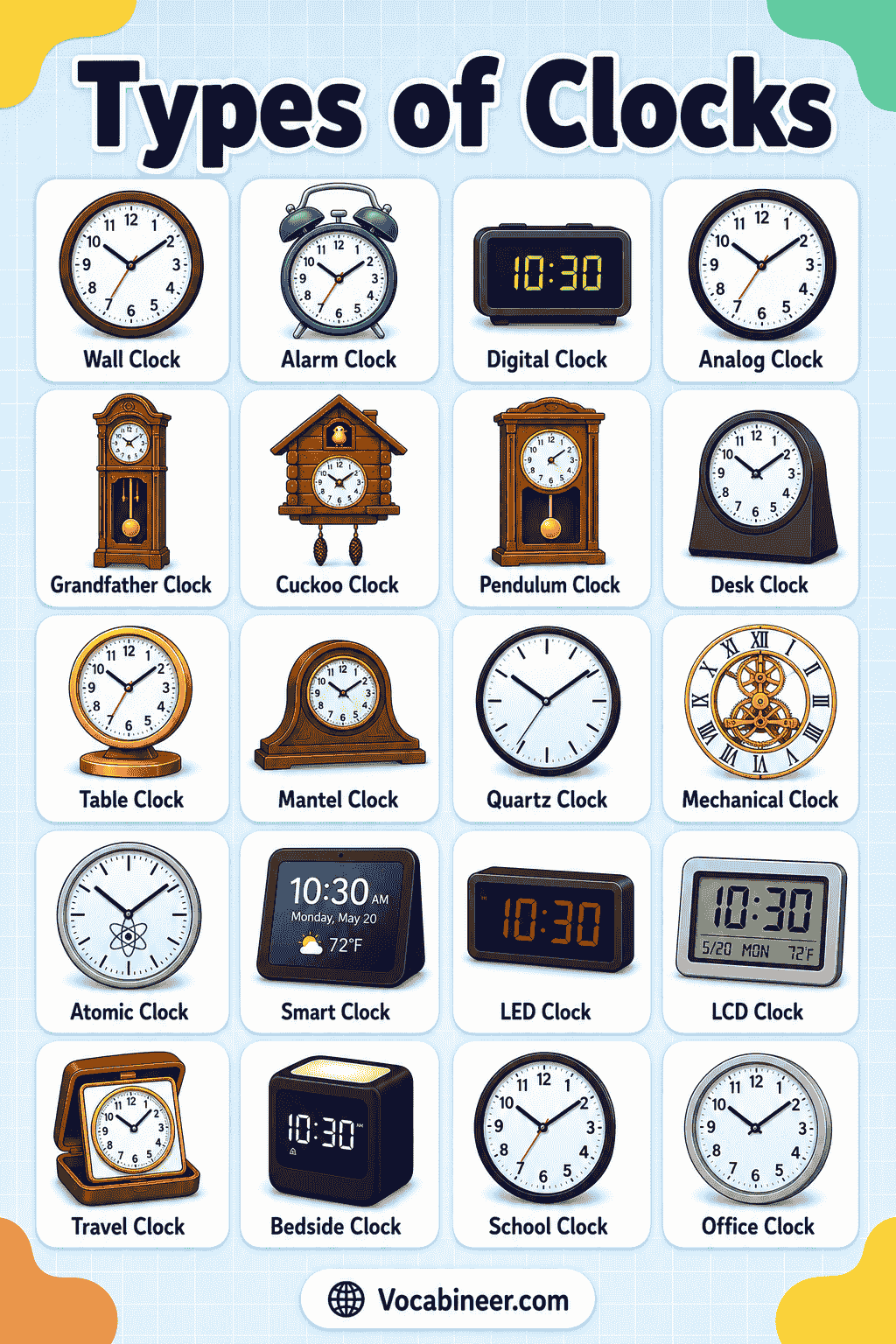
- Wall Clock — a clock fixed or hung on a wall.
- Table Clock — a clock placed on a table, shelf, or flat surface.
- Desk Clock — a small clock used on an office desk or study table.
- Alarm Clock — a clock that rings or alerts at a set time.
- Digital Clock — a clock that shows time with numbers.
- Analog Clock — a clock that shows time with hour and minute hands.
- Mantel Clock — a decorative clock placed on a mantel or shelf.
- Grandfather Clock — a tall floor clock with a pendulum.
- Cuckoo Clock — a clock that often has a cuckoo sound or moving bird.
- Pendulum Clock — a clock that uses a swinging pendulum.
- Quartz Clock — a clock powered by a quartz crystal and battery.
- Atomic Clock — a highly accurate clock based on atomic timekeeping.
Clock Types and Their Simple Meanings
Simple meanings help readers understand clock names before comparing designs, displays, mechanisms, or room uses.
| Clock Type | Simple Meaning |
|---|---|
| Wall Clock | A clock that hangs on a wall. |
| Table Clock | A clock placed on a table or shelf. |
| Desk Clock | A small clock used on a desk. |
| Alarm Clock | A clock that alerts at a set time. |
| Digital Clock | A clock that shows time in numbers. |
| Analog Clock | A clock with hands and a dial. |
| Mantel Clock | A decorative clock placed on a mantel or shelf. |
| Grandfather Clock | A tall standing clock with a pendulum. |
| Cuckoo Clock | A clock with a cuckoo sound or moving bird feature. |
| Pendulum Clock | A clock that uses a swinging pendulum. |
| Quartz Clock | A battery clock that uses a quartz crystal. |
| Atomic Clock | A very accurate clock that follows atomic time signals. |
Clock Types and Best Uses
Different clocks work better for different places, purposes, rooms, and time-telling needs.
| Clock Type | Best Use |
|---|---|
| Wall Clock | Living rooms, classrooms, kitchens, offices, and hallways. |
| Table Clock | Shelves, side tables, mantels, and decorative corners. |
| Desk Clock | Study desks, office desks, and workspaces. |
| Alarm Clock | Bedrooms, bedside tables, and morning routines. |
| Digital Clock | Quick time reading, bedrooms, offices, and public spaces. |
| Analog Clock | Time-learning, classrooms, homes, and traditional decor. |
| Mantel Clock | Fireplace mantels, shelves, and classic home decor. |
| Grandfather Clock | Large rooms, hallways, and formal interiors. |
| Cuckoo Clock | Decorative walls, traditional rooms, and themed interiors. |
| Travel Clock | Trips, hotel rooms, and portable timekeeping. |
| World Clock | Offices, airports, hotels, and global time zones. |
| Outdoor Clock | Gardens, patios, pool areas, and exterior walls. |
Wall, Table, and Desk Clock Types
Placement-based clocks are named by where people put them in a room or space.
- Wall Clock — hangs on a wall and is easy to see from a distance.
- Large Wall Clock — used as a bold decorative piece in big rooms.
- Kitchen Wall Clock — placed in kitchens for cooking and daily routines.
- Classroom Wall Clock — used in schools to help students follow time.
- Table Clock — sits on a table, shelf, cabinet, or sideboard.
- Desk Clock — used on office desks, study tables, or workstations.
- Bedside Clock — placed near a bed for checking time at night.
- Mantel Clock — sits on a fireplace mantel or display shelf.
- Shelf Clock — placed on a shelf for time-telling and decor.
- Floor Clock — stands on the floor and often works as furniture-style decor.
- Station Clock — large clock used in stations, public spaces, or waiting areas.
- Outdoor Wall Clock — designed for patios, gardens, and exterior walls.
Decorative and Antique Clock Types
Decorative and antique clocks add style, history, character, and visual interest to a room.
- Grandfather Clock — a tall standing clock, often with a pendulum and chime.
- Cuckoo Clock — a decorative clock with a cuckoo call or moving figure.
- Mantel Clock — a classic clock placed on a mantel, shelf, or console.
- Carriage Clock — a small portable clock with a handle and classic design.
- Skeleton Clock — shows visible gears or inner parts.
- Lantern Clock — an old-style clock with a lantern-like shape.
- Regulator Clock — a precise pendulum clock often used in traditional settings.
- Bracket Clock — a decorative clock usually placed on a shelf or bracket.
- Vintage Clock — an older-style clock with a classic look.
- Retro Clock — a clock inspired by past design trends.
- Rustic Clock — a clock with a farmhouse, wood, or natural-style look.
- Decorative Clock — a clock mainly used for style as well as time-telling.
Clock Types by Display and Mechanism
Some clocks are named by how they show time or how their internal mechanism works.
- Analog Clock — shows time with hands, numbers, and a dial.
- Digital Clock — shows time with electronic numbers.
- Quartz Clock — uses a quartz crystal and battery for timekeeping.
- Mechanical Clock — uses gears, springs, weights, or winding mechanisms.
- Pendulum Clock — uses a swinging pendulum to help keep time.
- Atomic Clock — uses atomic time signals for very accurate timekeeping.
- Electric Clock — runs with electricity instead of winding.
- Battery Clock — works with batteries and is common in homes.
- Solar Clock — uses solar power or light-based energy.
- Radio-Controlled Clock — receives time signals to stay accurate.
- Smart Clock — connects to digital features, apps, alarms, or voice assistants.
- Projection Clock — projects the time onto a wall or ceiling.
Alarm, Travel, and Functional Clock Types
Functional clocks are designed for alarms, timing, travel, weather, classrooms, offices, and special tasks.
- Alarm Clock — alerts the user at a selected time.
- Travel Clock — small clock made for carrying during trips.
- World Clock — shows time in different countries or time zones.
- Timer Clock — measures a set amount of time.
- Countdown Clock — counts down to a specific event or time.
- Stopwatch — measures elapsed time for sports, tasks, or activities.
- Weather Clock — shows time along with weather details.
- Projection Clock — displays time on a wall or ceiling.
- Classroom Clock — helps students learn and follow time.
- Office Clock — used in workplaces, meeting rooms, and desks.
- Teaching Clock — helps children learn how to read time.
- Kitchen Timer Clock — used for cooking and timed kitchen tasks.
Clocks for Different Rooms and Places
Room-based clocks help people choose the right size, style, and function for each space.
- Living Room Clock — decorative clock used as a main room feature.
- Bedroom Clock — used for bedtime, waking up, and checking time at night.
- Kitchen Clock — useful for cooking, meals, and daily routines.
- Bathroom Clock — helps track time while getting ready.
- Office Clock — supports work schedules, meetings, and time management.
- Hallway Clock — adds function and style to entry areas or corridors.
- Classroom Clock — helps students and teachers manage lesson time.
- Outdoor Clock — designed for patios, gardens, and outside walls.
- Garden Clock — decorative outdoor clock for garden spaces.
- Entryway Clock — placed near the door for quick time checks.
- Shop Clock — used in stores, counters, and business spaces.
- Station Clock — used in train stations, bus stations, and public waiting areas.
Clock Materials and Design Styles
Clock material and style affect how a clock looks, where it fits, and how it matches room decor.
- Wooden Clock — gives a warm, natural, or traditional look.
- Metal Clock — strong and useful for modern, industrial, or office spaces.
- Glass Clock — sleek and decorative for modern interiors.
- Plastic Clock — lightweight, affordable, and common for classrooms or homes.
- Acrylic Clock — clear, modern, and lightweight.
- Modern Clock — has a clean and updated design.
- Vintage Clock — has an old-fashioned or classic appearance.
- Retro Clock — uses design styles from earlier decades.
- Minimalist Clock — has a simple design with fewer details.
- Industrial Clock — uses metal, bold numbers, or factory-style details.
- Rustic Clock — uses wood, farmhouse details, or natural textures.
- Decorative Clock — focuses on style, shape, color, or wall decor.
Confusing Clock Terms Explained
Some clock terms sound similar, but they describe different devices, displays, mechanisms, or placements.
| Clock Terms | Difference |
|---|---|
| Clock vs Watch | A clock is usually placed in a room or space, while a watch is worn or carried. |
| Analog Clock vs Digital Clock | An analog clock uses hands, while a digital clock shows numbers. |
| Quartz Clock vs Mechanical Clock | A quartz clock uses a battery and quartz crystal, while a mechanical clock uses springs, gears, or weights. |
| Mantel Clock vs Table Clock | A mantel clock usually sits on a fireplace mantel, while a table clock can sit on many flat surfaces. |
| Grandfather Clock vs Floor Clock | A grandfather clock is a tall floor clock, while floor clock is a broader term. |
| Pendulum Clock vs Cuckoo Clock | A pendulum clock uses a swinging pendulum, while a cuckoo clock often has a cuckoo sound or moving bird feature. |
| Alarm Clock vs Timer Clock | An alarm clock alerts at a set time, while a timer clock measures a set duration. |
Types of Clocks Chart with Pictures
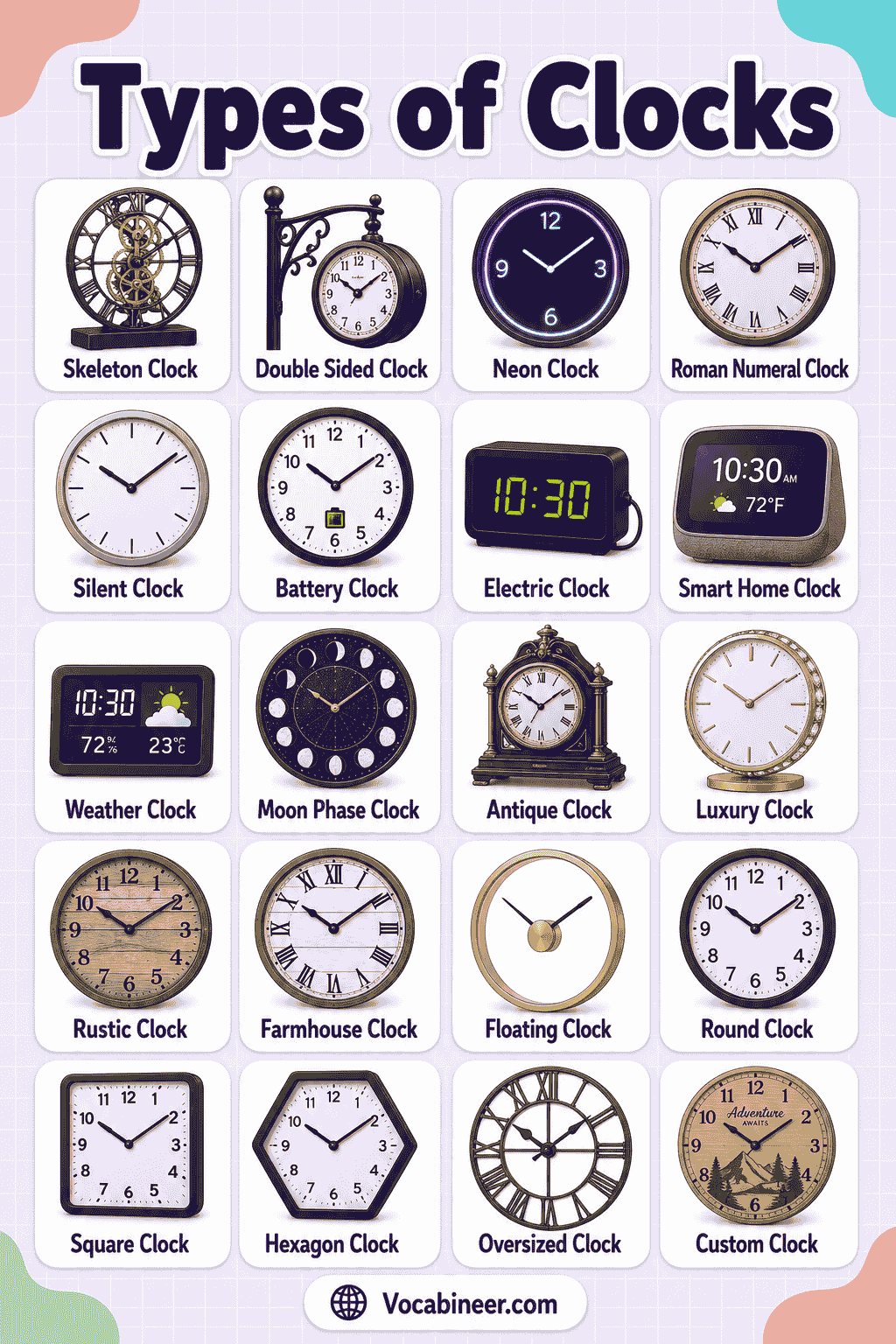
A clock chart helps readers compare clock groups quickly by purpose, place, and examples.
| Clock Group | Details |
|---|---|
| Wall Clocks | Best for: homes, classrooms, offices, and public spaces Examples: wall clock, station clock, kitchen wall clock |
| Table and Desk Clocks | Best for: shelves, desks, mantels, and bedside tables Examples: table clock, desk clock, mantel clock |
| Decorative Clocks | Best for: room style and visual display Examples: grandfather clock, cuckoo clock, vintage clock |
| Display-Based Clocks | Best for: different time-reading styles Examples: analog clock, digital clock, projection clock |
| Mechanism-Based Clocks | Best for: different timekeeping systems Examples: quartz clock, mechanical clock, atomic clock |
| Functional Clocks | Best for: alarms, timing, travel, and tasks Examples: alarm clock, travel clock, timer clock |
| Room-Based Clocks | Best for: matching clocks to specific spaces Examples: bedroom clock, office clock, outdoor clock |
How to Choose the Right Type of Clock
Choosing the right clock depends on the room, size, display style, purpose, design, and how easily you want to read the time. A large wall clock works well in a living room, kitchen, classroom, or office, while a small desk clock suits a workspace. For bedrooms, an alarm clock, digital clock, or projection clock can be more useful than a decorative wall clock.
Style also matters. A wooden clock can suit rustic or traditional rooms, while a metal or glass clock can match modern interiors. Analog clocks are helpful for teaching children how to read time, but digital clocks are easier to read quickly. For accurate timekeeping, quartz, radio-controlled, or atomic clocks are practical choices.
FAQs
The main types of clocks include wall clocks, table clocks, desk clocks, alarm clocks, digital clocks, analog clocks, mantel clocks, grandfather clocks, cuckoo clocks, pendulum clocks, quartz clocks, and atomic clocks.
An analog clock shows time with moving hands on a dial, while a digital clock shows time with numbers on a screen.
A wall clock, large decorative clock, wooden clock, metal clock, vintage clock, or grandfather clock can work well in a living room, depending on the room size and decor style.
A quartz clock uses a battery and quartz crystal, while a mechanical clock uses gears, springs, weights, or winding parts.
An analog learning clock, classroom clock, teaching clock, or color-coded clock is useful for teaching kids how to read hours, minutes, and clock hands.
Read More