

A bridge has many parts that work together to carry people, vehicles, trains, or other loads across a gap. Some parts create the top travel surface, while others support the bridge from below, protect the edges, control movement, drain water, or connect the bridge to the road.
This guide explains the main parts of a bridge in simple terms, including deck parts, support parts, safety features, approach areas, diagram-friendly labels, confusing bridge terms, and a clear bridge parts chart.
In This Page
Parts of a Bridge Diagram
A parts of a bridge diagram usually labels the most important visible and structural parts of a bridge. These labels help readers understand where each bridge part is located.
Common labels in a bridge diagram include:
- Deck — the main platform of the bridge.
- Roadway — the part where vehicles travel.
- Span — the distance between two bridge supports.
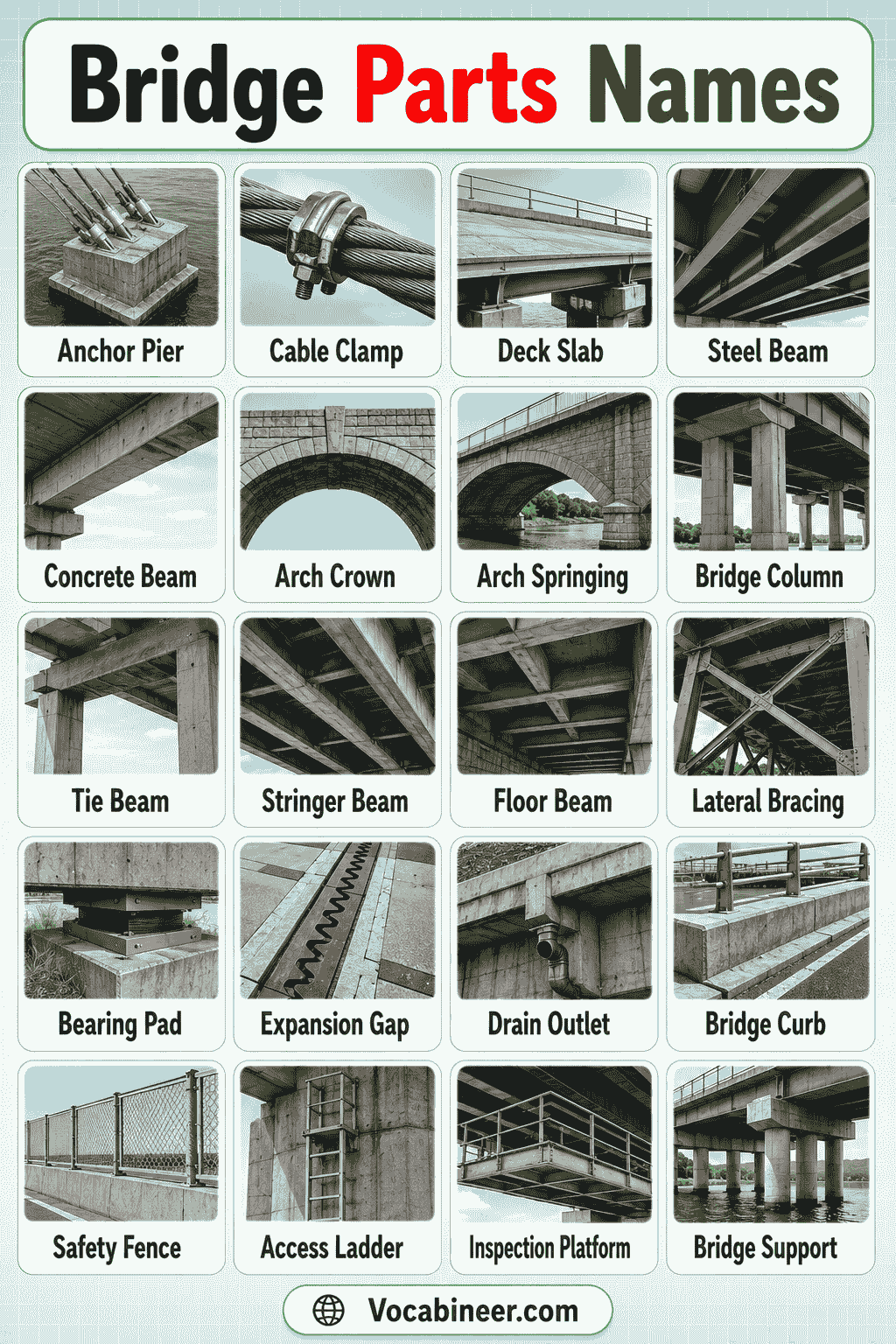
- Beam — a horizontal support member under the deck.
- Girder — a large main beam that carries heavy loads.
- Stringer — a smaller lengthwise beam that supports the deck.
- Floor beam — a crosswise beam that supports stringers or deck sections.
- Pier — a vertical support under the bridge.
- Pier cap — the top part of a pier that spreads loads.
- Abutment — the support at the end of the bridge.
- Bridge seat — the support area where a bridge span rests.
- Bearing — a part that transfers load and allows small movement.
- Foundation — the base that carries bridge loads into the ground.
- Railing — a safety edge along the side of the bridge.
- Expansion joint — a gap or flexible joint that allows movement.
- Drainage scupper — an opening that removes water from the bridge deck.
- Approach road — the road leading to the bridge.
Main Parts of a Bridge
The main parts of a bridge include the top travel surface, the supporting structure, the end supports, and the foundation system below.
- Deck — the top platform where people, vehicles, or trains move.
- Span — the distance between two bridge supports.
- Superstructure — the upper part of the bridge that carries traffic loads.
- Substructure — the lower support system under the superstructure.
- Foundation — the base that transfers bridge loads into the ground.
- Abutments — the supports at the ends of the bridge.
- Piers — vertical supports placed between bridge ends.
- Bearings — parts between the bridge structure and supports that transfer loads.
- Beams — horizontal members that help support the deck.
- Girders — large beams that carry heavier bridge loads.
- Railings — safety rails along the bridge edges.
- Expansion joints — flexible gaps that allow the bridge to expand and contract.
- Approach road — the road or path leading onto the bridge.
Main Bridge Structure
The main bridge structure can be divided into the upper part, the lower support part, and the foundation below.
- Deck — the platform at the top of the bridge. It provides the surface for vehicles, trains, cyclists, or pedestrians.
- Superstructure — the upper bridge section above the supports. It includes the deck and the main load-carrying parts.
- Substructure — the lower support section below the superstructure. It includes parts such as piers, abutments, columns, bearings, pier caps, and pile caps.
- Foundation — the base under the supports. It carries the bridge load into strong soil or rock.
Bridge Support Parts
Bridge support parts hold the bridge up and transfer loads from the upper bridge structure to the ground.
- Abutments — supports at the ends of a bridge. They hold the bridge ends and connect the bridge to the land or approach road.
- Piers — vertical supports between the bridge ends. They support longer bridges with more than one span.
- Columns — vertical support members. A pier may include one column or several columns.
- Bearings — parts that transfer loads from the superstructure to the supports and allow small movement.
- Bridge seat — the flat support area where a bridge span, beam, girder, or bearing rests.
- Pier cap — the top part of a pier that spreads loads from the bridge span to columns or supports.
- Piles — long foundation members driven or drilled deep into the ground.
- Pile caps — thick caps that connect several piles together and spread loads from piers or columns.
Bridge Load-Carrying Parts
Bridge load-carrying parts support the deck and spread weight across the bridge. The exact parts depend on the bridge type.
- Beams — horizontal support members that help carry the bridge deck.
- Girders — large main beams that carry heavier loads.
- Stringers — smaller lengthwise beams that support the deck or floor system.
- Floor beams — crosswise beams that support stringers or deck sections.
- Trusses — triangle-shaped frameworks that spread forces through connected members.
- Arches — curved structures that transfer loads outward and downward.
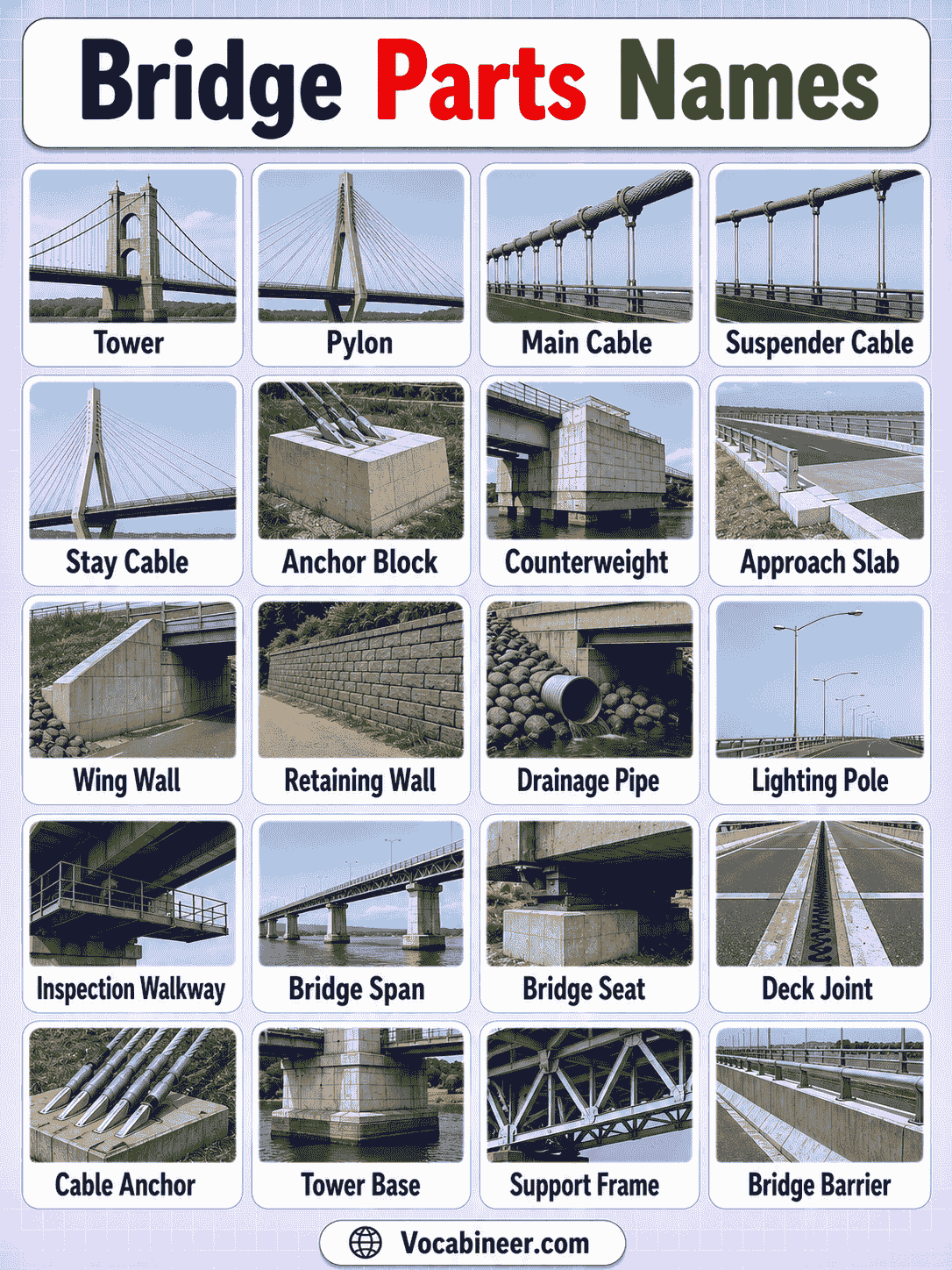
- Cables — strong tension members used in suspension and cable-stayed bridges.
- Suspenders — vertical cables that hang the deck from main suspension cables.
- Towers — tall structures that hold bridge cables.
- Anchorages — heavy end supports that hold main cables in place.
Bridge Deck and Travel Surface Parts
Bridge deck and travel surface parts are found on or near the top of the bridge. These parts help people and vehicles cross safely.
- Roadway — the vehicle travel area on the bridge.
- Sidewalk — a walking path for pedestrians.
- Curbs — raised edges near the roadway or sidewalk.
- Wearing surface — the top protective layer of the deck.
- Expansion joints — gaps or flexible joints that allow movement from heat, cold, and load changes.
- Bridge drainage system — drains, pipes, scuppers, or channels that remove rainwater.
- Drainage scuppers — openings that let water drain off the bridge deck.
Bridge Safety and Edge Parts
Bridge safety and edge parts protect pedestrians, drivers, cyclists, and the sides of the bridge.
- Railings — protective rails along bridge edges. They are common on pedestrian bridges, road bridges, and sidewalks.
- Parapets — solid or raised edge walls. They provide stronger side protection than simple railings.
- Barriers — strong protective structures used to stop or redirect vehicles.
- Guardrails — rail systems used near road edges or bridge approaches.
- Lighting — lights installed on or near the bridge for visibility and safety.
Bridge End and Approach Parts
Bridge end and approach parts connect the bridge to the road, land, or embankment around it. These parts help traffic move smoothly onto and off the bridge.
- Approach road — the road leading to the bridge.
- Approach slab — a concrete slab near the bridge end that creates a smoother transition from road to bridge.
- Approach span — a span near the bridge end that connects the main bridge span to the approach area.
- Wing walls — side walls connected to abutments that help hold back soil.
- Backwalls — walls at the back of abutments that retain soil and support the approach area.
- Retaining walls — walls that hold back soil near bridge approaches.
- Embankment — a raised earth area that lifts the roadway to bridge level.
How Bridge Parts Work Together
Bridge parts work together by transferring weight from the top of the bridge down to the ground. When a vehicle moves across the bridge, its weight first goes to the deck. Then, the deck passes that load to beams, girders, stringers, or floor beams, depending on the bridge design. After that, the load moves through bearings into the main supports, such as piers and abutments.
Finally, the foundation carries the load into strong soil or rock below, which keeps the bridge stable. At the same time, other parts support safe movement: expansion joints let the bridge expand and contract, drainage systems remove rainwater, railings and barriers protect users, and the approach road helps traffic enter and leave the bridge smoothly.
Confusing Bridge Parts Explained
Some bridge part names sound similar, but they do not always mean the same thing.
| Term | Simple Difference |
|---|---|
| Deck vs Roadway | The deck is the main platform of the bridge. The roadway is the part where vehicles actually travel. |
| Pier vs Abutment | A pier supports the bridge in the middle. An abutment supports the bridge at the ends and connects it to land. |
| Beam vs Girder | A beam is a general support member. A girder is a larger beam that carries heavier loads. |
| Superstructure vs Substructure | The superstructure is the upper part that carries traffic. The substructure is the lower support system. |
| Pile vs Pier | A pile is a deep underground foundation element. A pier is a visible vertical support above ground or water. |
| Pier Cap vs Pile Cap | A pier cap sits on top of a pier and spreads load. A pile cap connects multiple piles and spreads load to them. |
| Span vs Deck | A span is the distance between two supports. The deck is the surface where traffic moves. |
| Railing vs Parapet | A railing is an open protective edge. A parapet is a solid protective wall at bridge edges. |
| Bearing vs Foundation | A bearing allows movement and transfers load from deck to supports. A foundation transfers all load into the ground. |
Parts of a Bridge Chart with Pictures
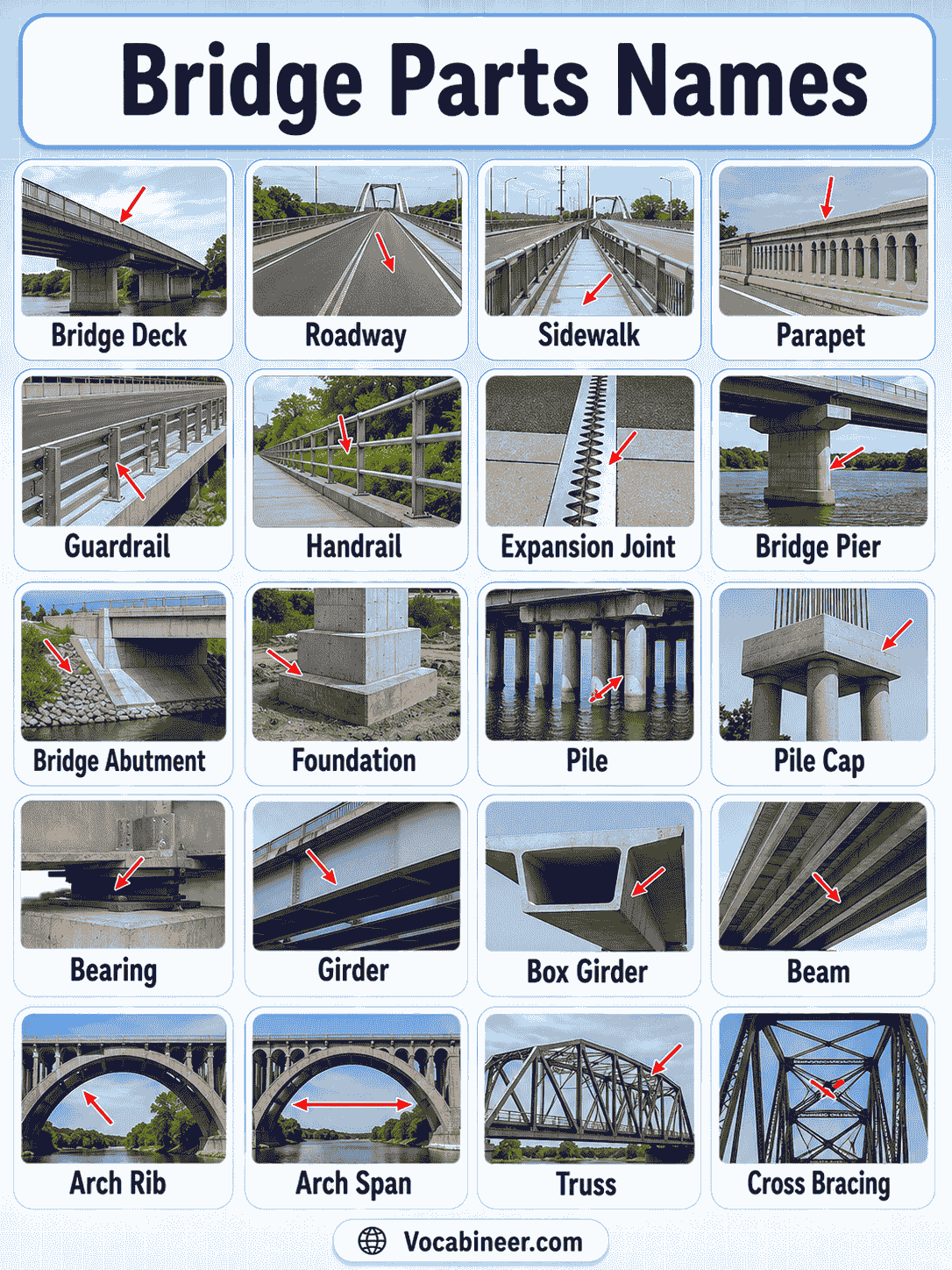
A bridge parts chart helps compare the main groups of bridge components, their roles, and common examples.
| Bridge Part Group | Details |
|---|---|
| Main Bridge Structure | Best for: understanding the basic bridge system Examples: deck, superstructure, substructure, foundation |
| Support Parts | Best for: holding the bridge up Examples: abutments, piers, columns, bearings, bridge seat, pier cap, piles, pile caps |
| Load-Carrying Parts | Best for: carrying and spreading weight Examples: beams, girders, stringers, floor beams, trusses, arches, cables, suspenders, towers, anchorages |
| Deck and Travel Surface Parts | Best for: traffic, walking, and deck protection Examples: roadway, sidewalk, curbs, wearing surface, expansion joints, drainage scuppers |
| Movement and Drainage Parts | Best for: allowing movement and removing water Examples: expansion joints, bridge drainage system, drainage scuppers |
| Safety and Edge Parts | Best for: protecting people and vehicles Examples: railings, parapets, barriers, guardrails, lighting |
| End and Approach Parts | Best for: connecting the bridge to road or land Examples: approach road, approach slab, approach span, wing walls, backwalls, retaining walls, embankment |
| Foundation Parts | Best for: transferring loads into the ground Examples: foundation, piles, pile caps |
FAQs
The main parts of a bridge include the deck, span, superstructure, substructure, foundation, abutments, piers, bearings, beams, girders, railings, expansion joints, and approach road.
The deck is the main platform of a bridge. It supports the roadway, sidewalk, railway track, or walking surface where people and vehicles travel.
A pier supports the bridge between its ends, while an abutment supports the bridge at the end and connects it to land or the approach road.
The deck, beams, girders, stringers, floor beams, trusses, arches, cables, piers, abutments, bearings, and foundations all help support and transfer loads. The exact parts depend on the bridge type.
The foundation is the base of the bridge. It transfers bridge loads from piers or abutments into strong soil or rock below.
Read More